×

Burkina Faso🇧🇫 | regionsNamentengaMossi chiefdom, Fulani cattle camps, Boulsa market, baobab plateau | things to do and best time to go

Explore GourmaExplore Dori

Backpacking in Namentenga
👌 Worth visitingregion ranked #2
By Johan Kruseman 🇳🇱 | Updated October 22, 2026

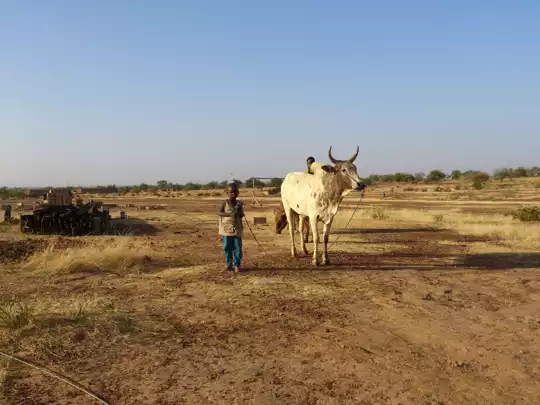
A herder steers his zebu through dust the color of paprika while a moto rattles past the Boulsa market, and nobody looks up. That is Namentenga, a province in the Centre-Nord of Burkina Faso, northeast of Ouagadougou, with Boulsa as its main town. Come for Mossi chiefdoms, Fulani cattle country and Sahelian bush that opens up beyond the roads. There are no monuments or ticket booths here, and the lodging is basic. Skip it if you need a checklist. Go if you want a place that hasn’t been packaged. A direct bush taxi saves time over a hitched ride, though the hitch costs less and gets you talking. Kaya, nearby, is bigger and easier, with more beds and more going on, while Namentenga is quieter and gives you less to do but more room to wander.

Discover everything you want to know in the 📖 Burkina Faso Travel Guide.
Safety warning

The current risk level for Burkina Faso is high. Check the advice before going.


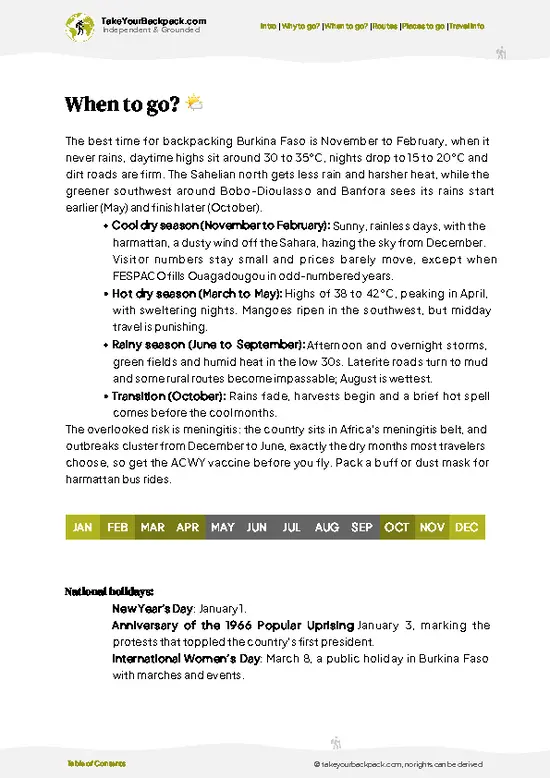
example page 0 from our offline Travel Guide for Burkina Faso
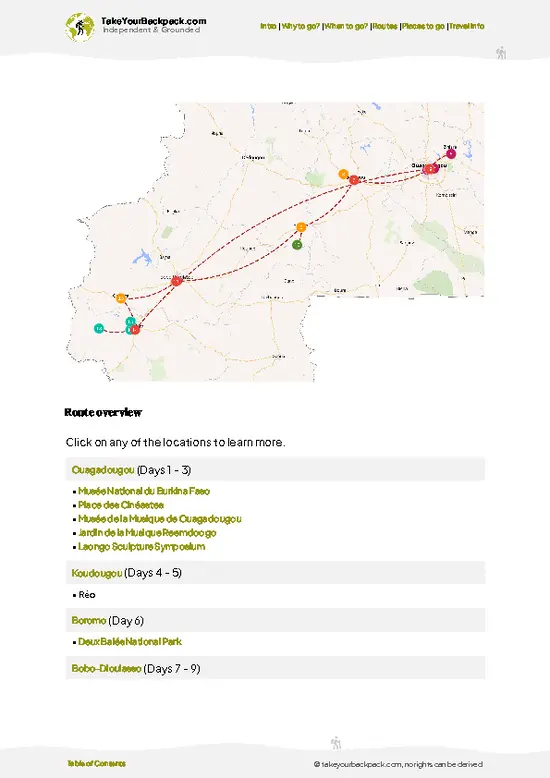
example page 1 from our offline Travel Guide for Burkina Faso
example page 2 from our offline Travel Guide for Burkina Faso
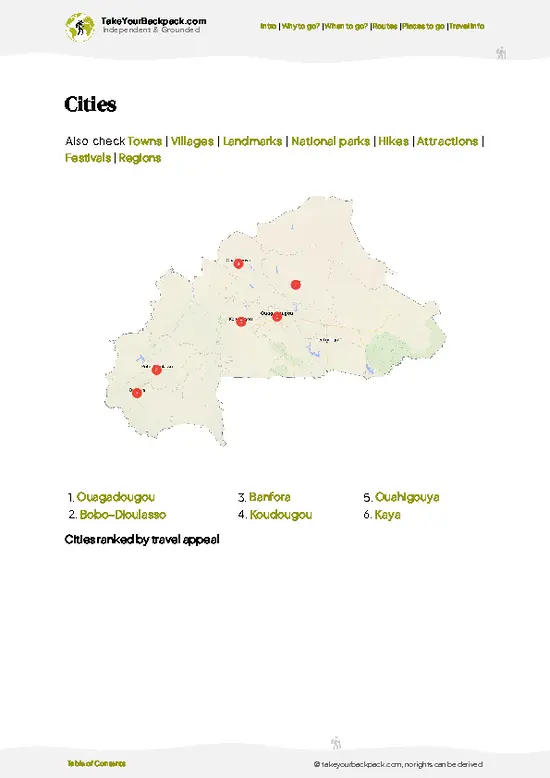
example page 3 from our offline Travel Guide for Burkina Faso
example page 4 from our offline Travel Guide for Burkina Faso
example page 5 from our offline Travel Guide for Burkina Faso
example page 6 from our offline Travel Guide for Burkina Faso
example page 7 from our offline Travel Guide for Burkina Faso
Loading the map 🌍
CLICK TO FILTER
cities
towns
villages
landmarks
national parks
hikes
attractions
festivals
regions
SHOW COUNTRY’S BESTSHOW ALL

✨ Why go?
Ranked #2 region in Burkina Faso
Why visitors keep coming back

Namentenga suits travelers who want to see how the Mossi plateau shades into the Sahel without hopping between far-flung stops. Boulsa gives you a single base with a working market, a chief’s court and bush tracks that start at the edge of town, so you can pack in several experiences without moving your bag. The main reason to come is the Boulsa Naba’s court, where chiefly authority still shapes village life and a polite greeting matters. The second is the cattle country around Boulsa, where Fulani herders move animals along the same paths their families have used for generations. A third is the simple pace: markets run on their own weekly cycles, and slow travel here means sitting under a tree when the sun peaks and walking out again in the cooler hours. It is a place to hear stories, not tick boxes.

💡 HighlightsKey sights and experiences for travelers

  1. Court of the Boulsa Naba: the seat of the local Mossi chief, the best-known cultural address in the province. Ask politely for an audience through a local guide and bring a small kola nut or token gift.
  2. Boulsa market: the commercial heart of the province, with millet, shea butter, dried fish, cotton cloth and livestock traders. Go early, before the heat flattens everything.
  3. Tougouri market and town: a farming and herding center with a lively weekly trade, rarely seen by outsiders and good for striking up conversations.
  4. Fulani cattle camps near Boulsa: seasonal herders water and graze zebu along dirt tracks. A local guide can arrange a respectful visit and a shared glass of sweet tea.
  5. Bush walks around Boulsa: baobabs, shea trees and granite outcrops mark the plateau edge. Walk in the early morning
… read more 👉
  1. Court of the Boulsa Naba: the seat of the local Mossi chief, the best-known cultural address in the province. Ask politely for an audience through a local guide and bring a small kola nut or token gift.
  2. Boulsa market: the commercial heart of the province, with millet, shea butter, dried fish, cotton cloth and livestock traders. Go early, before the heat flattens everything.
  3. Tougouri market and town: a farming and herding center with a lively weekly trade, rarely seen by outsiders and good for striking up conversations.
  4. Fulani cattle camps near Boulsa: seasonal herders water and graze zebu along dirt tracks. A local guide can arrange a respectful visit and a shared glass of sweet tea.
  5. Bush walks around Boulsa: baobabs, shea trees and granite outcrops mark the plateau edge. Walk in the early morning or late afternoon, when farmers are in the fields and the light is soft.
  6. Yalgo and its village markets: small-town stalls and rural life in the northern part of the province, a place locals appreciate and tourists nearly always skip.
  7. Boulsa village weaving and craft work: you can find cotton strip weaving and leatherwork in family compounds. Buy directly and expect to bargain gently.
Namentenga rewards a first visit best through the Boulsa market followed by the chief’s court, since together they show you how trade and tradition fit together.
Spotted a mistake or missing something? Contact us.

⌛️ 5 daysSeeing the highlights in 5 days

Day 1: Boulsa: Walk the town in the first cool hours and break at midday in the shade, because shared taxis and bush taxis run when they fill, not on a timetable. Boulsa is your hub, so arrive, find a bed and spend the afternoon at the market watching the trade. Evening is for greeting people and arranging a visit to the chief’s court.
Day 2: Boulsa Naba and surroundings: Spend the morning on an audience at the Boulsa Naba’s court, which only works early in the day and with a local guide to make introductions. Then hire a moto taxi for a loop to nearby farmland and herders’ camps. Doing this by moto saves hours over walking and costs little.
Day 3: Tougouri (detour): Take a shared taxi out to Tougouri, which adds a second market and a different town feel without breaking your base in Boulsa. … read more 👉
Day 1: Boulsa: Walk the town in the first cool hours and break at midday in the shade, because shared taxis and bush taxis run when they fill, not on a timetable. Boulsa is your hub, so arrive, find a bed and spend the afternoon at the market watching the trade. Evening is for greeting people and arranging a visit to the chief’s court.
Day 2: Boulsa Naba and surroundings: Spend the morning on an audience at the Boulsa Naba’s court, which only works early in the day and with a local guide to make introductions. Then hire a moto taxi for a loop to nearby farmland and herders’ camps. Doing this by moto saves hours over walking and costs little.
Day 3: Tougouri (detour): Take a shared taxi out to Tougouri, which adds a second market and a different town feel without breaking your base in Boulsa. Go early, stay for lunch and return before late afternoon, because vehicles thin out toward dusk.
Day 4: Yalgo and the north: Head north by bush taxi or moto, stopping at village markets. This is the slowest day, so leave margin and carry water.
Day 5: Back to Boulsa and onward: Use the morning for crafts and last purchases, then catch transport onward. If one day justifies the trip, it is Day 2, when the chief’s court and the herders’ tracks show you what Namentenga is about.

🌤️ When to go?When to go for the best experience

November to February is the most comfortable window for Namentenga, with dry air, cool nights and daytime highs of roughly 30 to 35°C (86 to 95°F). Nights can drop to about 16 to 20°C (61 to 68°F), and the harmattan wind brings dusty haze that softens the horizon.
  • Cool Dry Season (Nov to Feb): Walking, market days and village visits are easiest now. Mornings are crisp, and daylight runs about 11 to 12 hours. Prices stay steady because few tourists reach this part of the Sahel.
  • Hot Season (Mar to May): Afternoons climb to 40 to 44°C (104 to 111°F), so plan movement for dawn and after 4 pm. Water is scarce, and shade becomes the main thing you shop for.
  • Rainy Season (Jun to Sep): Storms arrive in short, heavy bursts, with highs of 31 to 36°C (88 to 97°F). Fields turn green, but dirt tracks soften
… read more 👉
November to February is the most comfortable window for Namentenga, with dry air, cool nights and daytime highs of roughly 30 to 35°C (86 to 95°F). Nights can drop to about 16 to 20°C (61 to 68°F), and the harmattan wind brings dusty haze that softens the horizon.
  • Cool Dry Season (Nov to Feb): Walking, market days and village visits are easiest now. Mornings are crisp, and daylight runs about 11 to 12 hours. Prices stay steady because few tourists reach this part of the Sahel.
  • Hot Season (Mar to May): Afternoons climb to 40 to 44°C (104 to 111°F), so plan movement for dawn and after 4 pm. Water is scarce, and shade becomes the main thing you shop for.
  • Rainy Season (Jun to Sep): Storms arrive in short, heavy bursts, with highs of 31 to 36°C (88 to 97°F). Fields turn green, but dirt tracks soften and some villages become hard to reach. Bus fares can rise slightly when roads are bad.
  • Early Rains (Oct): Roads dry out and the landscape stays green, with milder heat and quiet transport.
Check the date of the weekly market in the town you are heading to before you set your itinerary.


source: climatestotravel.comJANJanuary: excellent for travelingFEBFebruary: excellent for travelingMARMarch: highly recommended for travelingAPRApril: good for travelingMAYMay: fair for travelingJUNJune: fair for travelingJULJuly: below average for travelingAUGAugust: below average for travelingSEPSeptember: fair for travelingOCTOctober: good for travelingNOVNovember: highly recommended for travelingDECDecember: excellent for traveling
when-to-go

✈️ The backpacker research shortcutBurkina Faso Travel Guide

An offline-friendly backpacking guide with optimized travel routes, ranked highlights, transport advice, and the best areas to stay.
example page 0 from our offline Travel Guide for Burkina Faso
example page 1 from our offline Travel Guide for Burkina Faso
example page 2 from our offline Travel Guide for Burkina Faso
example page 3 from our offline Travel Guide for Burkina Faso
example page 4 from our offline Travel Guide for Burkina Faso
example page 5 from our offline Travel Guide for Burkina Faso
example page 6 from our offline Travel Guide for Burkina Faso
example page 7 from our offline Travel Guide for Burkina Faso
The digital guide (273 pages) contains:
✅ 63 highlights, ranked by travel appeal
✅ Optimized 5, 10 & 15-day travel routes
✅ Cities, national parks, landmarks, beaches
✅ How to get around
✅ Offline-friendly for travel without Wi-Fi
👉 Click to see all 30+ guide features

📅 Plan smarter in minutes, not weeks
✅ Month by month travel advice
✅ Festivals & national holidays
✅ Budget expectations

🗺️ Go to the right places, skip the overrated ones
✅ Honest pros & cons of destinations
✅ Top hikes, parks & viewpoints
✅ Lesser-known places most travelers miss
✅ Clear “worth it vs skip it” guidance

🛏️ Travel smoothly without rookie mistakes
✅ Best areas to stay
✅ Transport systems explained simply
✅ Common scams & safety advice
✅ SIM cards, money & practical tips

🌍 Understand the country, not just visit it
✅ Culture & traditions
✅ 52 Essential phrases & customs
✅ Festivals worth planning around
✅ Traveler-friendly historical context
✅ Insights that make places more meaningful

📱 Built for real travel conditions
✅ Fully downloadable PDF
✅ Works completely offline
✅ Optimized for phone use
✅ Useful in remote areas & buses
✅ Everything in one place
Stop searching, start planning
Get instant access to your full guide. 30‑day money-back guarantee.
+ Add another guide for just

By proceeding you agree to our terms.
Sent to your inbox immediately after payment • 100% Secure Checkout
Best Backpacking Travel Advisor 2025 tourism awardBest Backpacking
Travel Advisor
2025
What others say about Take Your Backpack Guides:
⭐⭐⭐⭐⭐
Fantastic, amazing amount of information!
⭐⭐⭐⭐⭐
My goodness this is amazing, it's what I've been looking for hats off too you!
⭐⭐⭐⭐⭐
I think this is absolutely BRILLIANT
⭐⭐⭐⭐
Very complete and informative. It's still missing places, but I gotta to commend you
⭐⭐⭐⭐⭐
This is truly amazing, thank you, can't wait to explore it with my kids!
⭐⭐⭐⭐⭐
Awesome resource, thank you!
⭐⭐⭐⭐⭐
This is amazing! Can't wait to explore the ones I haven't seen
⭐⭐⭐⭐
I love this! Well done, great idea.
⭐⭐⭐⭐⭐
Thanks for taking the time to make this gem!
⭐⭐⭐⭐⭐
This might be the best website I've ever seen.
⭐⭐⭐⭐⭐
Congratulations, and thank you so much for your work; it's incredibly valuable.
⭐⭐⭐⭐
In all seriousness I think you did a great job pointing out the important spots
⭐⭐⭐⭐⭐
10/10 very good
⭐⭐⭐⭐⭐
As someone who's only just starting to visit regularly this is awesome, thank you.
⭐⭐⭐⭐
Thank you very much! I'm going to visit my dad, it's going to be very useful!
⭐⭐⭐⭐⭐
This is really cool! We'll be travelling for the first time and this definitely come in handy.
⭐⭐⭐⭐⭐
You are now our minister of culture, congratulations 👨‍💼
⭐⭐⭐⭐⭐
Just wanted to tell you that this is a pearl! Going to follow your recommendations.
⭐⭐⭐⭐⭐
This is so cool. I'll definitely be using the resource for my travels soon.
⭐⭐⭐⭐⭐
This is very impressive! Good work.
⭐⭐⭐⭐⭐
This is an amazing and informative site. Very well done!

🛏️ Where to stay?Choosing the right base

Boulsa is the best base in Namentenga, because it holds the province’s main market, the most reliable power and phone coverage, and the largest choice of simple guesthouses at roughly €10 to 25 a night. It is a working Sahelian town rather than a backpacker scene, so socializing happens in the evening at open-air maquis, tea stands and around the market, where people are curious and friendly toward solo travelers. Safety is generally calm in town, but check current advice before leaving the main road, since security in the wider Sahel region can change.
Staying in Boulsa lets you make day trips … read more 👉
Boulsa is the best base in Namentenga, because it holds the province’s main market, the most reliable power and phone coverage, and the largest choice of simple guesthouses at roughly €10 to 25 a night. It is a working Sahelian town rather than a backpacker scene, so socializing happens in the evening at open-air maquis, tea stands and around the market, where people are curious and friendly toward solo travelers. Safety is generally calm in town, but check current advice before leaving the main road, since security in the wider Sahel region can change.
Staying in Boulsa lets you make day trips by moto-taxi to nearby villages and farmland without hauling your bag. Expect basic rooms, a fan or air-conditioning at the higher end, and bucket showers. Book nothing in advance, just arrive before dark.
Smaller towns such as Tougouri and Yalgo can work for a night if you are exploring further, but they have only a handful of beds, and you should ask a local to point you to a trusted place. Many travelers also arrange a stay with a host family through a local contact, which costs less and offers the best conversation. Bring cash, since cards and ATMs are rare outside the main town.

🚌 Getting aroundTransportation options and practical tips

From the Boulsa bus yard, the main hub of Namentenga, a moto-taxi to the town center costs about €0.30 to 0.60 and takes under 10 minutes, while walking works if you travel light and start early. Most backpackers reach the province by bus from Ouagadougou, then use motorbikes and bush taxis for the final stretches. The main road is reliable. Everything off it is slow and depends on the weather and on how full the vehicle is.
  • Intercity buses from Ouagadougou: The ride to Boulsa takes roughly 3 to 4 hours and costs about €4 to 7. Seats are basic but the vehicles are fixed-departure and safer than shared cars. This gives a backpacker the best value for the long leg, so take it and don’t pay extra for a private car.
  • Bush taxis and minibuses: These link Boulsa with smaller towns and cost roughly
… read more 👉
From the Boulsa bus yard, the main hub of Namentenga, a moto-taxi to the town center costs about €0.30 to 0.60 and takes under 10 minutes, while walking works if you travel light and start early. Most backpackers reach the province by bus from Ouagadougou, then use motorbikes and bush taxis for the final stretches. The main road is reliable. Everything off it is slow and depends on the weather and on how full the vehicle is.
  • Intercity buses from Ouagadougou: The ride to Boulsa takes roughly 3 to 4 hours and costs about €4 to 7. Seats are basic but the vehicles are fixed-departure and safer than shared cars. This gives a backpacker the best value for the long leg, so take it and don’t pay extra for a private car.
  • Bush taxis and minibuses: These link Boulsa with smaller towns and cost roughly €1 to 4 per hop. They leave only when full, so you can wait 1 to 2 hours, and the cramped seating gets hot in the afternoon. Use them for destinations with no other option, and start in the morning.
  • Moto-taxis: A short ride costs €0.30 to 1, and a negotiated half day to outlying villages runs about €10 to 20. They are fast on dirt tracks and the cheapest way to reach places buses skip. Dust and heat are the price, so bring a scarf and water.
  • Rented motorbike: Informal rentals sometimes cost about €12 to 20 a day, plus fuel. They give freedom, but the sandy tracks, patchy signage and little roadside help make this worth it only for experienced riders.
Carry small change and start every trip before 8 am, because vehicles fill faster and the heat stays bearable.

🍲 FoodLocal Cuisine & Drinks

Eat in Namentenga the way people in the Sahel do, starting with tô, a thick millet or sorghum porridge dipped in a sticky green sauce feuille or a tangy okra sauce. It is plain, filling and usually under €1.50. Rice with peanut sauce, riz gras and grilled chicken or guinea fowl appear at roadside stands, and skewered brochettes of beef smoke over charcoal each evening, spiced with chili and onion.
The local drink is dolo, a sour, cloudy millet beer served in calabashes at small cabarets for about €0.30 to 0.60 a serving. Also try bissap, a tart hibiscus juice, and fresh zoom-koom, a ginger and millet drink, both sold chilled in plastic bags. Sweet, strong tea is brewed in little groups at street corners.
For meals, head to the market stalls and women’s food counters, where lunch is ladled out … read more 👉
Eat in Namentenga the way people in the Sahel do, starting with tô, a thick millet or sorghum porridge dipped in a sticky green sauce feuille or a tangy okra sauce. It is plain, filling and usually under €1.50. Rice with peanut sauce, riz gras and grilled chicken or guinea fowl appear at roadside stands, and skewered brochettes of beef smoke over charcoal each evening, spiced with chili and onion.
The local drink is dolo, a sour, cloudy millet beer served in calabashes at small cabarets for about €0.30 to 0.60 a serving. Also try bissap, a tart hibiscus juice, and fresh zoom-koom, a ginger and millet drink, both sold chilled in plastic bags. Sweet, strong tea is brewed in little groups at street corners.
For meals, head to the market stalls and women’s food counters, where lunch is ladled out by noon and may be gone by 2 pm. Roadside maquis offer grilled meat and cold drinks after dark.
Eat with your right hand, and wash first from the water jug on offer. Sharing one bowl is common, so take the portion in front of you. Alcohol is available but not everywhere, and dishes are rarely labeled for vegetarians, so ask for beans or haricots and rice.

FAQFrequently asked questions about Namentenga

Two days is enough for Namentenga if you base yourself in Boulsa, and three to four days lets you add village trips. The town’s market and surrounding farmland fill one full day, with a second spent on moto-taxi runs to nearby villages for about €10 to 20. Ouagadougou is roughly 3 to 4 hours away by bus, so add travel time on either end.
Without a car, rely on buses from Ouagadougou to Boulsa (around €4 to 7, 3 to 4 hours), then use moto-taxis for local trips in Namentenga. Short rides cost about €0.30 to 1, and a half-day hire to villages is about €10 to 20. Bush taxis connect small towns for €1 to 4 but leave only when full, so start in the morning.
Namentenga is known for its Sahelian farming landscapes and its weekly markets, centered on Boulsa, where millet, livestock and crafts are traded. The province is home mainly to Mossi communities and keeps strong traditional chieftaincy customs. Visitors come for village life, local dolo beer and the quiet pace rather than major sights, with the cooler months from November to February being the most comfortable.
⚠️ Things can change over time, so always validate details locally before you go.

Other Burkinabé regions near Namentenga

Explore more nearby:

  • Bam—Lake Bam, reed pirogues, onion gardens, Kongoussi market| 123 km away
  • Gourma—Elephant savanna, Fada N’Gourma, Gulmance court, guinea fowl grills| 158 km away

💡 Not sure where to go next?
Create a personalized itinerary for Burkina Faso including Namentenga and the places that fit your trip.

Generate my itinerary

👉 Discover all regions

Or checkout all Burkina Faso has to offer (think cities, towns, villages, national parks, hikes, beaches, festivals)
Country photo of Burkina Faso

We 💚 feedbackIs it worth it?

Namentenga is for travelers who like unscripted days, markets without souvenirs and conversations in the shade. If that sounds good, you will love it. If you need amenities, skip it. Bring small bills, a head scarf or hat and patience, and accept every glass of tea you’re offered.

✍️ Help improve this page!
The information on this page is based on in-depth research, insights shared by experienced travelers, and feedback from the local travel community in Burkina Faso. While every effort is made to keep the information accurate and current, conditions can change — so if you spot anything incorrect or outdated, please get in touch.


🙋‍♂️ Give feedback

👋 Meet the founderWho’s Behind Take Your Backpack?

Johan, backpacker and founder of TakeYourBackpackHi, I’m Johan (Netherlands 🇳🇱), the creator of TakeYourBackpack. Over the past 3 decades, I’ve backpacked through 90+ countries across six continents, gaining extensive experience with independent travel, long-term trips, and overland routes.

This site is built on a combination of firsthand travel experience and carefully curated insights from other backpackers. Many guides are based on places I’ve personally visited, while others bring together tips, observations, and practical advice shared by trusted travelers I’ve met along the way.

The goal is to provide realistic, experience-driven guidance — not generic itineraries — so you can explore destinations with better context, clearer expectations, and more confidence.