×

Burkina Faso🇧🇫 | best regionsDiscover the 3 Best regions Across Burkina Faso

Burkina Faso splits into regions that feel like different countries: a dry Sahel north, a central plateau around Ouagadougou, and a greener, wetter southwest. For independent travel, this matters more than any map. The southwest is the easiest to enjoy, with cooler air, waterfalls, rock formations and short hops between villages. The center offers the best culture, food and transport links at moderate prices. The north and east are remote, with thin transport and few places to stay, so they are not worth your time unless you have local contacts and current security information. Expect CFA franc costs well below West African coastal capitals, few other travelers, and long bus days.

By Johan Kruseman 🇳🇱 | Updated October 23, 2026
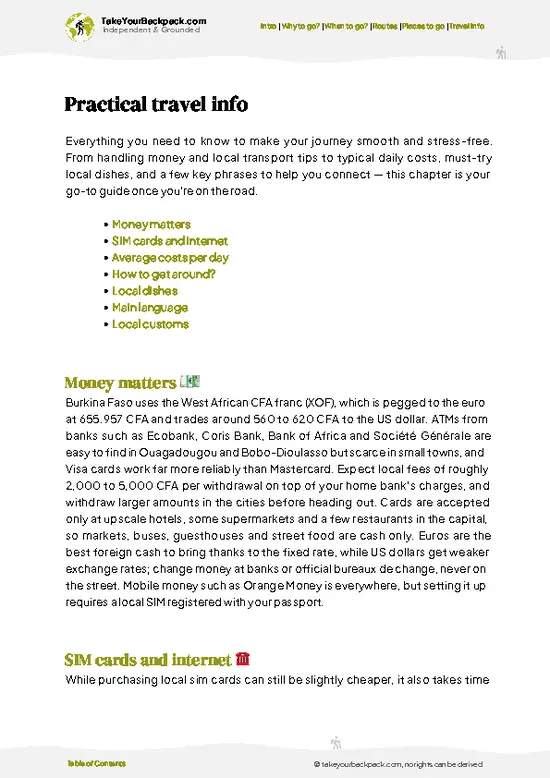
Explore the best cities in Burkina Faso

Why go?Why Travelers Love These Spots

Burkina Faso suits regional travel because it is landlocked, mostly flat, and cut by a few paved main corridors that link major cities. Distances are modest by West African standards, and the cost of buses, rooms and meals stays low. The country is also a crossroads of more than 60 ethnic groups, so language, architecture, masks and music change noticeably from one area to the next. That diversity is the real draw, not famous landmarks.

The limits are just as clear. Tourism infrastructure is thin, public transport is slow and often leaves only in the morning or when full, and ATMs outside the larger towns are unreliable, so carry West African CFA francs in cash. Roads outside the main corridors can turn rough, and in the rainy season some dirt tracks become impassable. Large parts of the … read more 👉
Burkina Faso suits regional travel because it is landlocked, mostly flat, and cut by a few paved main corridors that link major cities. Distances are modest by West African standards, and the cost of buses, rooms and meals stays low. The country is also a crossroads of more than 60 ethnic groups, so language, architecture, masks and music change noticeably from one area to the next. That diversity is the real draw, not famous landmarks.

The limits are just as clear. Tourism infrastructure is thin, public transport is slow and often leaves only in the morning or when full, and ATMs outside the larger towns are unreliable, so carry West African CFA francs in cash. Roads outside the main corridors can turn rough, and in the rainy season some dirt tracks become impassable. Large parts of the north, east and border zones have suffered serious security problems for years, and government travel advisories often warn against travel there. Check current advice from your own government and from local contacts before choosing any region, and do not count on areas that were open last year being open now. French is the working language for travel, and a few phrases in Mooré or Dioula help in markets and villages.
Why These Made the Cut
The list of best regions in Burkina Faso is created based on landscapes, local culture, attractions, vibes, and overall appeal. If you feel a region is missing in this list, please let us know.

When to go?Seasonal Guide to Visiting

Best months and why: The best months are November to February, when days are dry and the heat is bearable, with highs around 30 to 35°C and cooler nights, especially in the southwest. December and January can bring the harmattan, a dusty wind off the Sahara that cuts visibility and dries the throat, so photos look hazy and a scarf helps.
Shoulder and hot seasons: March to May is not worth your time for most trips. Daytime temperatures often reach 40 to 45°C, particularly in the north and around Ouagadougou, and long bus rides without air conditioning become miserable. October and early November are a good shoulder period, with the rains ending and the land still green.
Rainy season: The rains run roughly June to September, peaking in July and August. The south and southwest get the most, about … read more 👉
Best months and why: The best months are November to February, when days are dry and the heat is bearable, with highs around 30 to 35°C and cooler nights, especially in the southwest. December and January can bring the harmattan, a dusty wind off the Sahara that cuts visibility and dries the throat, so photos look hazy and a scarf helps.
Shoulder and hot seasons: March to May is not worth your time for most trips. Daytime temperatures often reach 40 to 45°C, particularly in the north and around Ouagadougou, and long bus rides without air conditioning become miserable. October and early November are a good shoulder period, with the rains ending and the land still green.
Rainy season: The rains run roughly June to September, peaking in July and August. The south and southwest get the most, about 900 to 1,200 mm a year, while the Sahel north gets under 500 mm. Dirt roads turn to mud, rivers rise, and some tracks close, so skip this period if you want to move around easily. On the plus side, it is farming season, the landscape is green, and rooms are always easy to find. Prices barely move with the seasons because tourism is small.

region hoppingSuggested Travel Strategies

How many days to plan: A trip combining several regions in Burkina Faso needs 10 to 14 days, because roads are slow and buses leave on their own schedule. Anything under a week means one base and day trips only.
Grouping and direction: Use Ouagadougou as your arrival hub and then head southwest toward Bobo-Dioulasso, the second city and the main transport node for the west. Going west first and returning along the same paved corridor is easier than trying a loop through the unsettled north or east. Give the capital 2 to 3 days, the western hub 2 to 3 days, and 3 to 4 days for the villages and countryside around it. Ouagadougou to Bobo-Dioulasso takes about 5 to 6 hours by bus on the main paved road. Local hops from Bobo-Dioulasso to nearby towns usually take 1 to 4 hours, but can stretch if … read more 👉
How many days to plan: A trip combining several regions in Burkina Faso needs 10 to 14 days, because roads are slow and buses leave on their own schedule. Anything under a week means one base and day trips only.
Grouping and direction: Use Ouagadougou as your arrival hub and then head southwest toward Bobo-Dioulasso, the second city and the main transport node for the west. Going west first and returning along the same paved corridor is easier than trying a loop through the unsettled north or east. Give the capital 2 to 3 days, the western hub 2 to 3 days, and 3 to 4 days for the villages and countryside around it. Ouagadougou to Bobo-Dioulasso takes about 5 to 6 hours by bus on the main paved road. Local hops from Bobo-Dioulasso to nearby towns usually take 1 to 4 hours, but can stretch if you rely on shared vehicles that wait until full.
Planning mistakes: The commonest error is cramming too many stops, which turns the trip into a series of bus stations. Pick two or three bases and use day trips instead. Another mistake is planning long travel days that start after noon, since buses may run late and arrive in the dark. Leave early in the morning. Do not schedule dirt-road excursions in the rains, and do not build in routes through areas under government warnings, however attractive they look on a map.

The ListThe Best regions of Burkina Faso

1 Bam

Lake Bam, reed pirogues, onion gardens, Kongoussi market

Walk the shoreline past hand-watered vegetable plots, paddle through reed beds where fishermen set nets, and watch waterbirds work the shallows.

2 Gourma

Elephant savanna, Fada N’Gourma, Gulmance court, guinea fowl grills

Track elephants and roan antelope across remote bush reserves, then return to a Gulmance and Fulani market town for early trading and evening grills.

3 Namentenga

Mossi chiefdom, Fulani cattle camps, Boulsa market, baobab plateau

Wander dusty Sahelian tracks between zebu herds, granite outcrops and weekly markets, and seek an audience at the Boulsa Naba’s court.

Loading the map 🌍

Expert viewExpert Commentary on regions

How many regions to visit: I would advise two to three regions per trip. Travel days are long, roads are slow, and each region repays several days of unhurried exploring. Trying four or more means spending most of your time in vehicles, and the extra cost in lost days outweighs what you see.
Choosing between kinds of regions: For first-time visitors and anyone on a tight budget, the green southwest is the safest choice, with hiking, villages and easy local transport. If your interest is music, crafts, markets and food, choose the central plateau and its capital, where galleries, workshops and festivals are concentrated. Travelers drawn by Sahelian culture should treat the north and east as a no-go unless local contacts and up-to-date official advice say otherwise. Those areas are not worth … read more 👉
How many regions to visit: I would advise two to three regions per trip. Travel days are long, roads are slow, and each region repays several days of unhurried exploring. Trying four or more means spending most of your time in vehicles, and the extra cost in lost days outweighs what you see.
Choosing between kinds of regions: For first-time visitors and anyone on a tight budget, the green southwest is the safest choice, with hiking, villages and easy local transport. If your interest is music, crafts, markets and food, choose the central plateau and its capital, where galleries, workshops and festivals are concentrated. Travelers drawn by Sahelian culture should treat the north and east as a no-go unless local contacts and up-to-date official advice say otherwise. Those areas are not worth the risk for a standard trip, and few services exist if something goes wrong.
Budget: A realistic backpacker budget is US$25 to 40 a day (roughly 15,000 to 25,000 CFA francs). Guesthouses cost about US$8 to 20 a night, street meals US$2 to 4, and long-distance buses US$6 to 12 per leg. Site entry fees are small, typically US$1 to 5, but local guides run US$10 to 25 for a half day, and a motorbike or car with driver costs more. A visit to a single region, including transport, a guide and a couple of nights, usually lands at US$80 to 150. Agree guide prices before you start, because quoted rates often rise at the end. Bring plenty of cash in small notes, as cards rarely work and change is scarce.
Safety and cultural points: Security is the main issue. Government advisories warn against travel to large parts of the country, and conditions change quickly, so check your embassy’s guidance and ask local hosts before every leg. Avoid border zones and travel after dark. Carry a copy of your passport and your yellow fever certificate, since police checkpoints are frequent and are usually routine and polite. Photography needs care: do not photograph soldiers, police, government buildings or bridges, and always ask before photographing people, especially at markets or ceremonies. Dress modestly, particularly in Muslim communities, and greet people properly before asking for anything, because greetings matter. Expect to pay small fees to village chiefs or custodians at some cultural sites, and ask for a receipt. Malaria is a real risk, so take prophylaxis and a net, and drink only bottled or treated water.

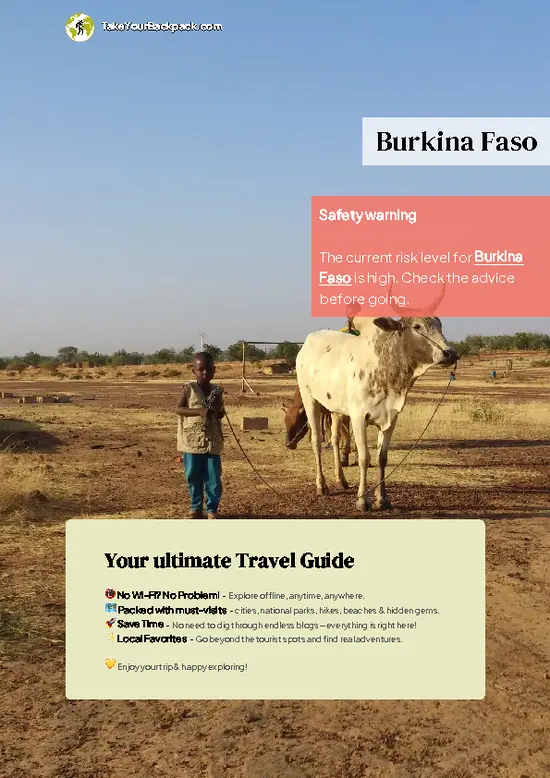
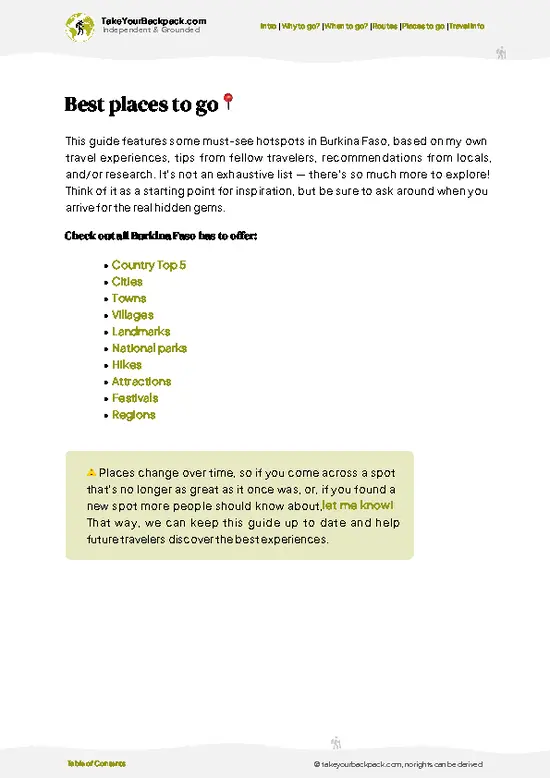
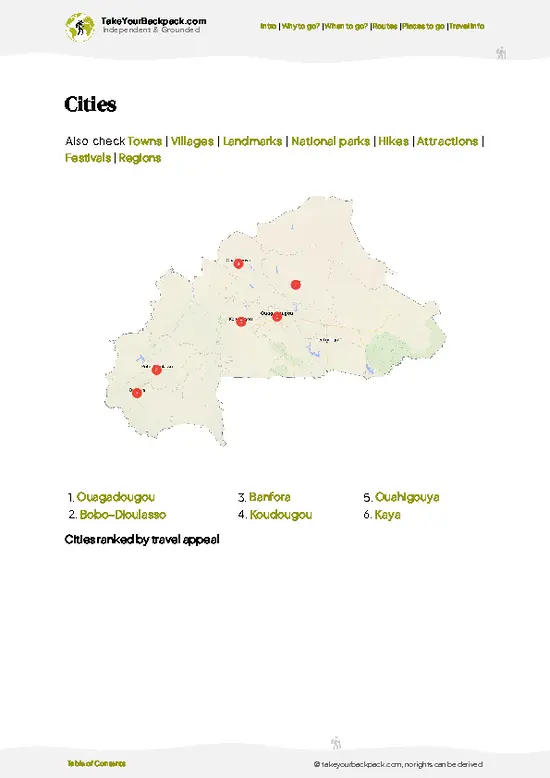
✈️ The backpacker research shortcutBurkina Faso Travel Guide

An offline-friendly backpacking guide with optimized travel routes, ranked highlights, transport advice, and the best areas to stay.
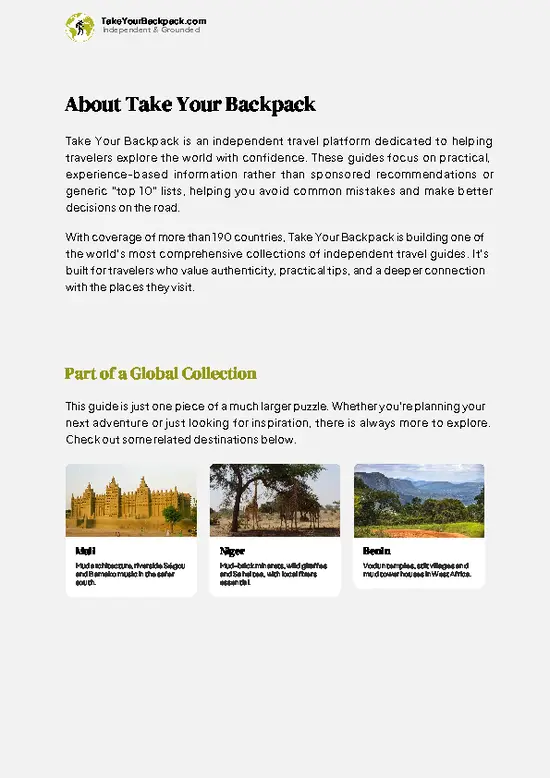
example page 0 from our offline Travel Guide for Burkina Faso
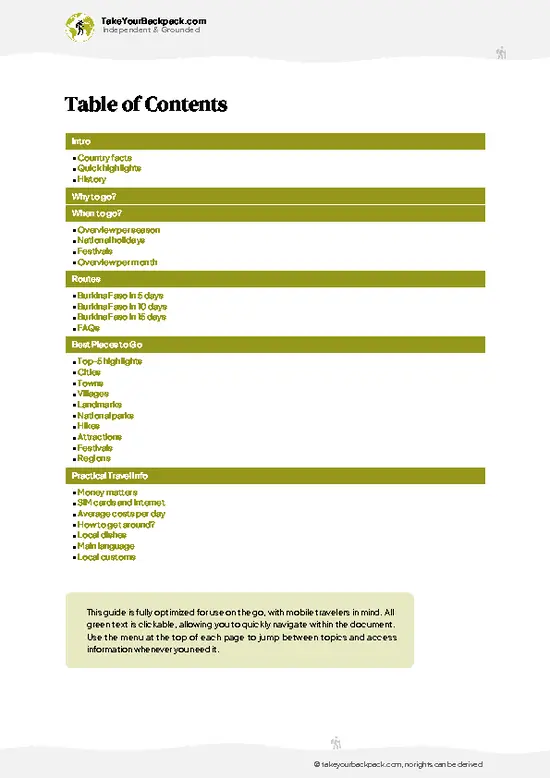
example page 1 from our offline Travel Guide for Burkina Faso
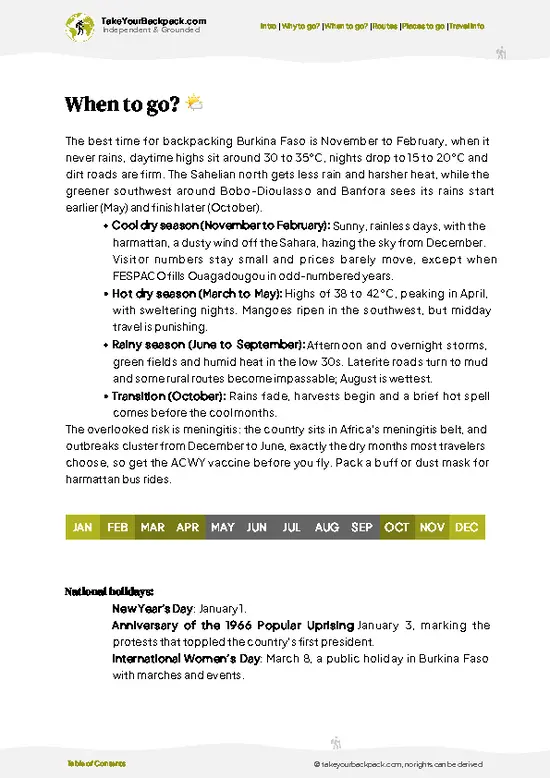
example page 2 from our offline Travel Guide for Burkina Faso
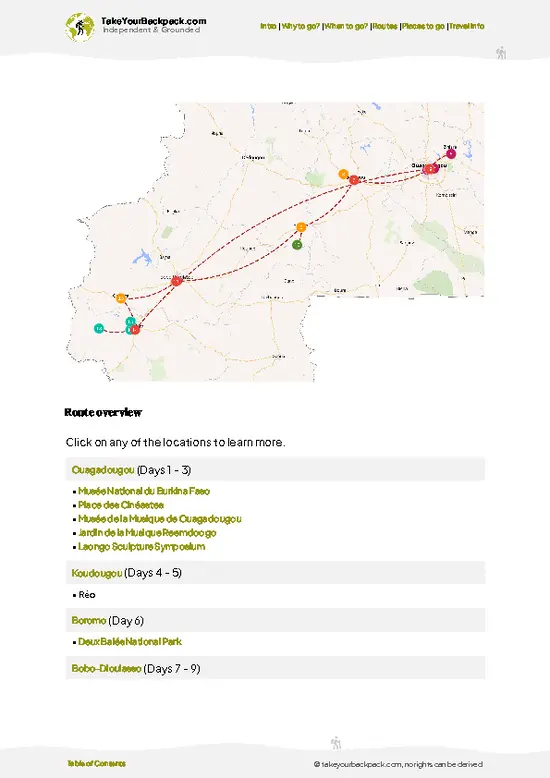
example page 3 from our offline Travel Guide for Burkina Faso
example page 4 from our offline Travel Guide for Burkina Faso
example page 5 from our offline Travel Guide for Burkina Faso
example page 6 from our offline Travel Guide for Burkina Faso
example page 7 from our offline Travel Guide for Burkina Faso
The digital guide (273 pages) contains:
✅ 63 highlights, ranked by travel appeal
✅ Optimized 5, 10 & 15-day travel routes
✅ Cities, national parks, landmarks, beaches
✅ How to get around
✅ Offline-friendly for travel without Wi-Fi
👉 Click to see all 30+ guide features

📅 Plan smarter in minutes, not weeks
✅ Month by month travel advice
✅ Festivals & national holidays
✅ Budget expectations

🗺️ Go to the right places, skip the overrated ones
✅ Honest pros & cons of destinations
✅ Top hikes, parks & viewpoints
✅ Lesser-known places most travelers miss
✅ Clear “worth it vs skip it” guidance

🛏️ Travel smoothly without rookie mistakes
✅ Best areas to stay
✅ Transport systems explained simply
✅ Common scams & safety advice
✅ SIM cards, money & practical tips

🌍 Understand the country, not just visit it
✅ Culture & traditions
✅ 52 Essential phrases & customs
✅ Festivals worth planning around
✅ Traveler-friendly historical context
✅ Insights that make places more meaningful

📱 Built for real travel conditions
✅ Fully downloadable PDF
✅ Works completely offline
✅ Optimized for phone use
✅ Useful in remote areas & buses
✅ Everything in one place
Stop searching, start planning
Get instant access to your full guide. 30‑day money-back guarantee.
+ Add another guide for just

By proceeding you agree to our terms.
Sent to your inbox immediately after payment • 100% Secure Checkout
Best Backpacking Travel Advisor 2025 tourism awardBest Backpacking
Travel Advisor
2025
What others say about Take Your Backpack Guides:
⭐⭐⭐⭐⭐
Fantastic, amazing amount of information!
⭐⭐⭐⭐⭐
My goodness this is amazing, it's what I've been looking for hats off too you!
⭐⭐⭐⭐⭐
I think this is absolutely BRILLIANT
⭐⭐⭐⭐
Very complete and informative. It's still missing places, but I gotta to commend you
⭐⭐⭐⭐⭐
This is truly amazing, thank you, can't wait to explore it with my kids!
⭐⭐⭐⭐⭐
Awesome resource, thank you!
⭐⭐⭐⭐⭐
This is amazing! Can't wait to explore the ones I haven't seen
⭐⭐⭐⭐
I love this! Well done, great idea.
⭐⭐⭐⭐⭐
Thanks for taking the time to make this gem!
⭐⭐⭐⭐⭐
This might be the best website I've ever seen.
⭐⭐⭐⭐⭐
Congratulations, and thank you so much for your work; it's incredibly valuable.
⭐⭐⭐⭐
In all seriousness I think you did a great job pointing out the important spots
⭐⭐⭐⭐⭐
10/10 very good
⭐⭐⭐⭐⭐
As someone who's only just starting to visit regularly this is awesome, thank you.
⭐⭐⭐⭐
Thank you very much! I'm going to visit my dad, it's going to be very useful!
⭐⭐⭐⭐⭐
This is really cool! We'll be travelling for the first time and this definitely come in handy.
⭐⭐⭐⭐⭐
You are now our minister of culture, congratulations 👨‍💼
⭐⭐⭐⭐⭐
Just wanted to tell you that this is a pearl! Going to follow your recommendations.
⭐⭐⭐⭐⭐
This is so cool. I'll definitely be using the resource for my travels soon.
⭐⭐⭐⭐⭐
This is very impressive! Good work.
⭐⭐⭐⭐⭐
This is an amazing and informative site. Very well done!

🛏️ Where to stay?Accommodation Highlights

Backpacker hostels with dorms barely exist in Burkina Faso, so budget travel here means simple auberges, church-run mission guesthouses and basic hotels at roughly 8,000 to 20,000 CFA (US$13 to 33) a night, almost all of them in the two cities still realistic for visitors. In Ouagadougou, the city center around the cathedral and the big avenues puts you near markets, maquis bars and live music but is noisy and dusty. Zone du Bois and Ouaga 2000 are quieter, greener and better guarded, at the cost of higher prices and a taxi ride for everything, while in Bobo-Dioulasso the cheap rooms cluster near the Grand Marché and the train station, walkable to the old Kibidwé quarter and the evening music … read more 👉
Backpacker hostels with dorms barely exist in Burkina Faso, so budget travel here means simple auberges, church-run mission guesthouses and basic hotels at roughly 8,000 to 20,000 CFA (US$13 to 33) a night, almost all of them in the two cities still realistic for visitors. In Ouagadougou, the city center around the cathedral and the big avenues puts you near markets, maquis bars and live music but is noisy and dusty. Zone du Bois and Ouaga 2000 are quieter, greener and better guarded, at the cost of higher prices and a taxi ride for everything, while in Bobo-Dioulasso the cheap rooms cluster near the Grand Marché and the train station, walkable to the old Kibidwé quarter and the evening music scene.

If you enjoy meeting fellow travelers, consider choosing hostels with high ratings for atmosphere. On the other hand, if you prefer having your own space, a hotel might be a better option.

Burkina FasoSee More of Burkina Faso

👋 Meet the founderWho’s Behind Take Your Backpack?

Johan, backpacker and founder of TakeYourBackpackHi, I’m Johan (Netherlands 🇳🇱), the creator of TakeYourBackpack. Over the past 3 decades, I’ve backpacked through 90+ countries across six continents, gaining extensive experience with independent travel, long-term trips, and overland routes.

This site is built on a combination of firsthand travel experience and carefully curated insights from other backpackers. Many guides are based on places I’ve personally visited, while others bring together tips, observations, and practical advice shared by trusted travelers I’ve met along the way.

The goal is to provide realistic, experience-driven guidance — not generic itineraries — so you can explore destinations with better context, clearer expectations, and more confidence.