×

Cabo Verde🇨🇻 | national parksFogo National Parkactive volcano, black lava fields, crater villages, high-altitude vineyards | things to do and best time to go

Explore Cabo Verde National ParkExplore Monte Gordo Natural Park

Backpacking in Fogo
🏆 Top picknational park ranked #1
By Johan Kruseman 🇳🇱 | Updated September 3, 2026

Most guides gloss over this, but here’s the truth: Fogo National Park’s main trail up Pico do Fogo isn’t a wilderness escape—it’s a living, working landscape, with farmers tending black volcanic fields right beside your boots. The park sits on Fogo Island, smack in the heart of Cabo Verde’s southern cluster, and it’s the country’s most dramatic, but also most inhabited, national park. Backpackers come for the raw, lunar scenery and the bragging rights of summiting an active volcano, but you’ll trade solitude for the buzz of local life—donkeys, kids, and the odd rooster are part of the soundtrack. Hiking is spectacular but relentless; the slopes are steep, the sun is merciless, and shade is a rumor. Wildlife is limited—think lizards and birds, not big mammals. Access is straightforward from São Filipe, but public transport is patchy and taxis add up. Entrance fees are low, but camping is unofficial and basic guesthouses fill fast after eruptions. Compared to the quieter, greener Santo Antão parks, Fogo is harsher, hotter, and more social—less postcard, more real life.

Discover everything you want to know in the 📖 Cabo Verde Travel Guide.
Loading the map 🌍
CLICK TO FILTER
cities
towns
villages
landmarks
national parks
hikes
beaches
attractions
festivals
regions
SHOW COUNTRY’S BESTSHOW ALL

✨ Why go?
Ranked #1 national park in Cabo Verde
What sets this place apart

Fogo National Park in Cabo Verde draws backpackers for several compelling reasons. Independent exploration is a major draw; the park’s trails are well-marked, allowing you to wander at your own pace. This freedom means you can soak in the stunning volcanic landscapes without the constraints of a guided tour.

Budget-conscious travelers will appreciate the camping and hostel options nearby. Affordable accommodations make it easy to stretch your funds while still enjoying the park’s beauty. You can pitch a tent under the stars or find a cozy hostel to recharge after a day of hiking.

The trail variety is another highlight. From challenging ascents to leisurely walks, there’s something for everyone. You can tackle the summit of Pico do Fogo, the island’s highest peak, or explore the lush valleys … read more 👉
Fogo National Park in Cabo Verde draws backpackers for several compelling reasons. Independent exploration is a major draw; the park’s trails are well-marked, allowing you to wander at your own pace. This freedom means you can soak in the stunning volcanic landscapes without the constraints of a guided tour.

Budget-conscious travelers will appreciate the camping and hostel options nearby. Affordable accommodations make it easy to stretch your funds while still enjoying the park’s beauty. You can pitch a tent under the stars or find a cozy hostel to recharge after a day of hiking.

The trail variety is another highlight. From challenging ascents to leisurely walks, there’s something for everyone. You can tackle the summit of Pico do Fogo, the island’s highest peak, or explore the lush valleys below.

This park is particularly suited for self-guided travelers. While tours are available, they often come with hidden costs and rigid schedules. By going solo, you maintain control over your itinerary, allowing you to focus your energy and budget on the experiences that truly matter.
Want to include Fogo National Park in your Cabo Verde route?
Create a personalized Cabo Verde itinerary that includes Fogo National Park and the places that fit your trip — based on your travel style, budget, and available time. Get your route in seconds.

Generate my trip

💡 HighlightsMust-see experiences and standout moments

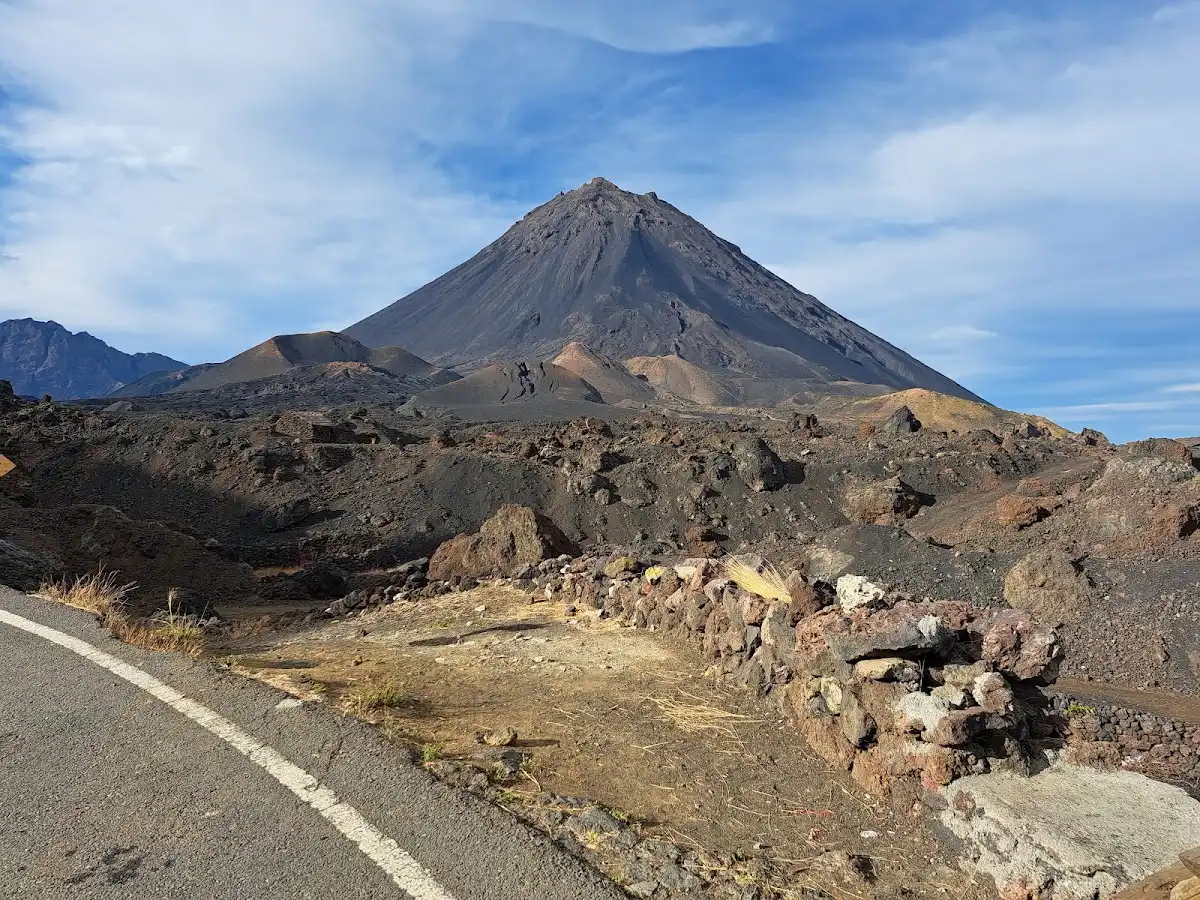
  • Pico do Fogo (the summit) — The island’s soaring volcano (about 2,829 m) and the obvious reason you came: a stark volcanic cone, dramatic panoramas across the archipelago, and a summit hike that feels properly adventurous. Expect steep, rocky slopes and lunar vistas from the top.
  • Chã das Caldeiras (the caldera village) — A tiny, resilient community living inside the caldera amid vineyards and coffee plots. It’s surreal: houses, farms and people tucked into the crater floor with close-up views of the volcano and real local character (and wine).
  • Bordeira (the caldera rim) — Massive cliff-like walls encircling the caldera that give you vertigo-inducing viewpoints down into Chã and out to the sea. Rim walks here deliver epic light for photos and a clear sense of the island’s volcanic scale.
read more 👉
  • Pico do Fogo (the summit) — The island’s soaring volcano (about 2,829 m) and the obvious reason you came: a stark volcanic cone, dramatic panoramas across the archipelago, and a summit hike that feels properly adventurous. Expect steep, rocky slopes and lunar vistas from the top.
  • Chã das Caldeiras (the caldera village) — A tiny, resilient community living inside the caldera amid vineyards and coffee plots. It’s surreal: houses, farms and people tucked into the crater floor with close-up views of the volcano and real local character (and wine).
  • Bordeira (the caldera rim) — Massive cliff-like walls encircling the caldera that give you vertigo-inducing viewpoints down into Chã and out to the sea. Rim walks here deliver epic light for photos and a clear sense of the island’s volcanic scale.
  • Lava fields and eruption scars — Black lava flows, pumice fields and the plainly readable scars from recent eruptions create raw, otherworldly landscapes. It’s great for geology fans, solitude seekers and dramatic sunset shots.
  • Monte Velha forest and microclimate pockets — Small patches of cooler, misty vegetation and endemic plants that survive in sheltered spots on the slopes. You’ll find rare flora (including species unique to Fogo), cooler air and a welcome break from the barren lava expanses.
  • Vineyards, terraces and Fogo wine — Tiny, terraced vineyards carved into volcanic soils produce the island’s distinctive wines and coffee. Sampling local production—often family-run—is one of the most memorable ways to experience how people make a living on a volcano.
  • Classic hiking routes and crater rim trails — A network of trails for day-hikes and overnight treks (often finishing or starting in Chã das Caldeiras) that range from tough summit pushes to gentler rim walks. Trails offer changing scenery, close geological features and real opportunities to camp or stay with locals.
Spotted a mistake or missing something? Contact us.

Things to do near Fogo National Park

Ratings based on Tripadvisor reviews. When you book through this link, you support our work at no extra cost to you.

🌤️ When to go?Seasonal considerations and timing


  • Topic: Weather – The dry season from November to June is your best bet. Expect minimal rain, which means trails stay accessible and the volcanic landscape reveals itself without mud or slippery rocks. July to October brings sporadic showers and higher humidity, which can sap your energy.

  • Topic: Temperature – Daytime highs hover around 25-30°C (77-86°F) during the dry months, perfect for hiking without overheating. Nights can dip to 18°C (64°F), so pack a light jacket. The wetter months feel warmer but stickier, making physical exertion tougher.

  • Topic: Daylight Hours – Daylight remains fairly consistent year-round, roughly 11 to 12 hours. This steady rhythm means you can plan full-day hikes without worrying about early sunsets cutting your trek short.

  • Topic: Crowds – Fogo National
read more 👉

  • Topic: Weather – The dry season from November to June is your best bet. Expect minimal rain, which means trails stay accessible and the volcanic landscape reveals itself without mud or slippery rocks. July to October brings sporadic showers and higher humidity, which can sap your energy.

  • Topic: Temperature – Daytime highs hover around 25-30°C (77-86°F) during the dry months, perfect for hiking without overheating. Nights can dip to 18°C (64°F), so pack a light jacket. The wetter months feel warmer but stickier, making physical exertion tougher.

  • Topic: Daylight Hours – Daylight remains fairly consistent year-round, roughly 11 to 12 hours. This steady rhythm means you can plan full-day hikes without worrying about early sunsets cutting your trek short.

  • Topic: Crowds – Fogo National Park is off the beaten path, so crowds are rare. However, the dry season, especially December through February, sees a slight uptick in visitors. If you want solitude, aim for shoulder months like November or March.

  • Topic: Seasonal Activities – The dry season is prime for climbing Pico do Fogo, the active volcano. Avoid the rainy months if you want clear views and safe trails. Local festivals often happen in the dry season too, adding cultural flavor to your visit.

  • Topic: Price Fluctuations – Accommodation and transport costs rise modestly during the dry season’s peak months due to increased demand. Booking ahead can save you from last-minute price hikes. The rainy season offers better deals but at the cost of less predictable conditions.


Pro-tip: Visit during the shoulder months of November or March to balance good weather, fewer people, and better prices—keeping your energy and budget intact for the real adventure.


source: climatestotravel.comJANJanuary: highly recommended for travelingFEBFebruary: highly recommended for travelingMARMarch: excellent for travelingAPRApril: excellent for travelingMAYMay: excellent for travelingJUNJune: excellent for travelingJULJuly: fair for travelingAUGAugust: fair for travelingSEPSeptember: fair for travelingOCTOctober: fair for travelingNOVNovember: excellent for travelingDECDecember: highly recommended for traveling
cabo-verde-national-park-fogo-national-park
© Google |

✈️ The backpacker research shortcutCabo Verde Travel Guide

An offline-friendly backpacking guide with optimized travel routes, ranked highlights, transport advice, and the best areas to stay.
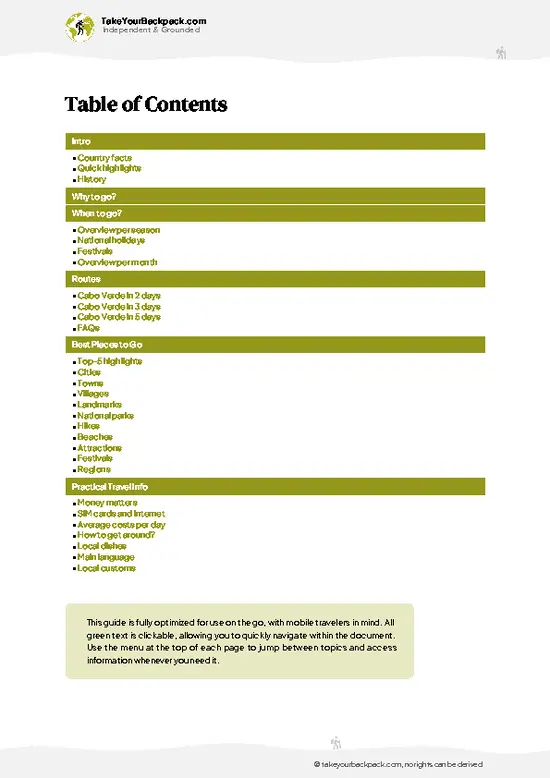
example page 0 from our offline Travel Guide for Cabo Verde
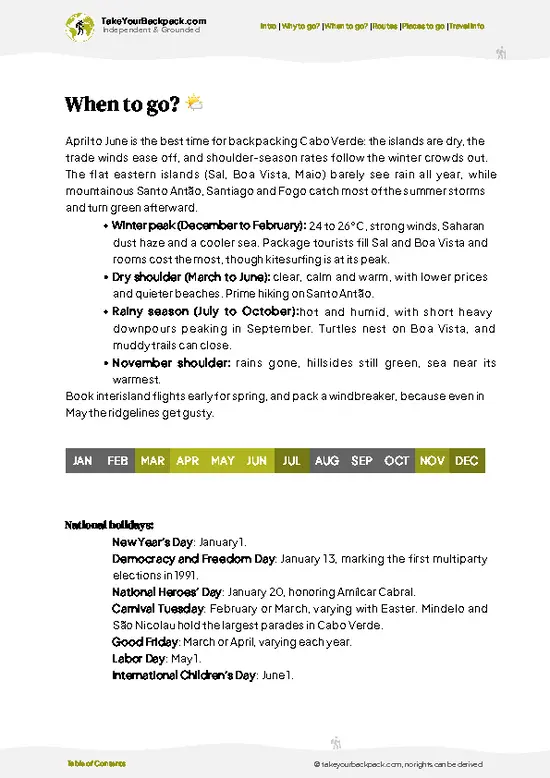
example page 1 from our offline Travel Guide for Cabo Verde
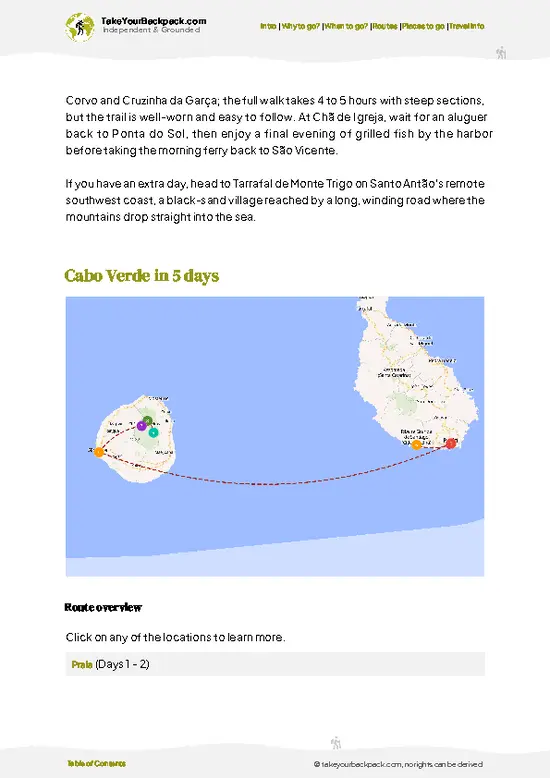
example page 2 from our offline Travel Guide for Cabo Verde
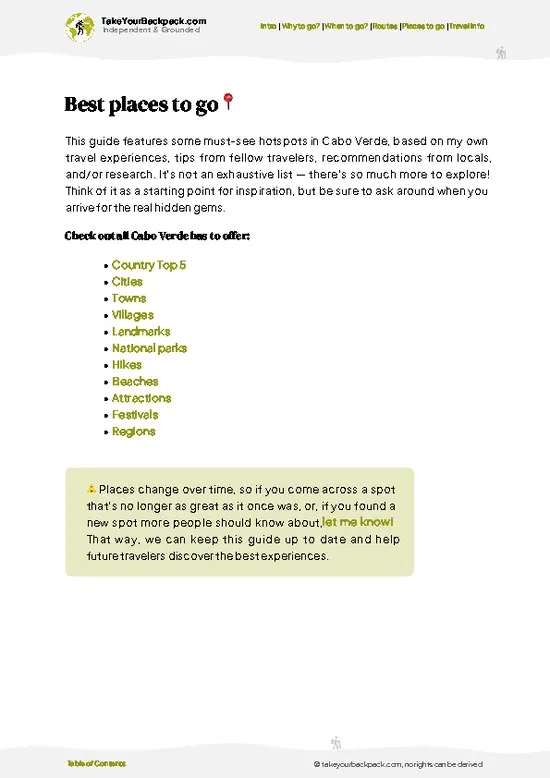
example page 3 from our offline Travel Guide for Cabo Verde
example page 4 from our offline Travel Guide for Cabo Verde
example page 5 from our offline Travel Guide for Cabo Verde
example page 6 from our offline Travel Guide for Cabo Verde
example page 7 from our offline Travel Guide for Cabo Verde
The digital guide (252 pages) contains:
61 highlights, ranked by travel appeal
Optimized 2, 3 & 5-day travel routes
Cities, national parks, landmarks, beaches
How to get around
Offline-friendly for travel without Wi-Fi
👉 Click to see all 30+ guide features

📅 Plan smarter in minutes, not weeks
Month by month travel advice
Festivals & national holidays
Budget expectations

🗺️ Go to the right places, skip the overrated ones
Honest pros & cons of destinations
Top hikes, parks & viewpoints
Lesser-known places most travelers miss
Clear “worth it vs skip it” guidance

🛏️ Travel smoothly without rookie mistakes
Best areas to stay
Transport systems explained simply
Common scams & safety advice
SIM cards, money & practical tips

🌍 Understand the country, not just visit it
Culture & traditions
52 Essential phrases & customs
Festivals worth planning around
Traveler-friendly historical context
Insights that make places more meaningful

📱 Built for real travel conditions
Fully downloadable PDF
Works completely offline
Optimized for phone use
Useful in remote areas & buses
Everything in one place
Save weeks of stressful planning
Get instant access to your full guide. 30‑day money-back guarantee.
+ Add another guide for just US$7.80

By proceeding you agree to our terms.
Sent to your inbox immediately after payment • 100% Secure Checkout
Best Backpacking Travel Advisor 2025 tourism awardBest Backpacking
Travel Advisor
2025
What others say about Take Your Backpack Guides:
⭐⭐⭐⭐⭐
Fantastic, amazing amount of information!
⭐⭐⭐⭐⭐
My goodness this is amazing, it's what I've been looking for hats off too you!
⭐⭐⭐⭐⭐
I think this is absolutely BRILLIANT
⭐⭐⭐⭐
Very complete and informative. It's still missing places, but I gotta to commend you
⭐⭐⭐⭐⭐
This is truly amazing, thank you, can't wait to explore it with my kids!
⭐⭐⭐⭐⭐
Awesome resource, thank you!
⭐⭐⭐⭐⭐
This is amazing! Can't wait to explore the ones I haven't seen
⭐⭐⭐⭐
I love this! Well done, great idea.
⭐⭐⭐⭐⭐
Thanks for taking the time to make this gem!
⭐⭐⭐⭐⭐
This might be the best website I've ever seen.
⭐⭐⭐⭐⭐
Congratulations, and thank you so much for your work; it's incredibly valuable.
⭐⭐⭐⭐
In all seriousness I think you did a great job pointing out the important spots
⭐⭐⭐⭐⭐
10/10 very good
⭐⭐⭐⭐⭐
As someone who's only just starting to visit regularly this is awesome, thank you.
⭐⭐⭐⭐
Thank you very much! I'm going to visit my dad, it's going to be very useful!
⭐⭐⭐⭐⭐
This is really cool! We'll be travelling for the first time and this definitely come in handy.
⭐⭐⭐⭐⭐
You are now our minister of culture, congratulations 👨‍💼
⭐⭐⭐⭐⭐
Just wanted to tell you that this is a pearl! Going to follow your recommendations.
⭐⭐⭐⭐⭐
This is so cool. I'll definitely be using the resource for my travels soon.
⭐⭐⭐⭐⭐
This is very impressive! Good work.
⭐⭐⭐⭐⭐
This is an amazing and informative site. Very well done!

🛏️ Where to stay?Best areas and accommodation options

Fogo National Park in Cabo Verde is a treasure for backpackers, but finding the right place to stay can make or break your experience. Inside the park, options are limited. There’s the cozy Casa de Liza, a simple guesthouse that offers basic amenities and a warm atmosphere. It’s a good base for exploring the volcanic landscapes, but don’t expect luxury.

For more variety, head to São Filipe, the nearest town. It’s about a 30-minute drive from the park entrance. Here, you’ll find several budget-friendly accommodations like Hotel Xaguate and Pensão Mãe D’Água. Both offer decent rooms and local charm, … read more 👉
Fogo National Park in Cabo Verde is a treasure for backpackers, but finding the right place to stay can make or break your experience. Inside the park, options are limited. There’s the cozy Casa de Liza, a simple guesthouse that offers basic amenities and a warm atmosphere. It’s a good base for exploring the volcanic landscapes, but don’t expect luxury.

For more variety, head to São Filipe, the nearest town. It’s about a 30-minute drive from the park entrance. Here, you’ll find several budget-friendly accommodations like Hotel Xaguate and Pensão Mãe D’Água. Both offer decent rooms and local charm, plus easy access to restaurants and shops. Staying in São Filipe gives you the chance to experience local life, which is a bonus.

Be mindful of transportation. If you’re relying on public transport, check schedules in advance; they can be sporadic. Renting a car is a solid option if you want flexibility, but factor in the cost.

Lastly, remember to pack snacks and water for your hikes. The park’s remote areas don’t have facilities, and you’ll want to preserve your energy for the stunning views and trails. Prioritize comfort and practicality over frills, and you’ll enjoy every moment.

👛 Costs (as of 3 September 2026)How expensive it really is

Fogo National Park in Cabo Verde offers a range of costs that can catch you off guard if you’re not prepared.

Entry fees to the park typically range from €5 to €10. This fee grants you access to the park’s stunning landscapes and hiking trails. It’s a small price for the experience, but keep in mind that it’s cash-only, so have some euros on hand.

Guided tours are another consideration. Prices can vary widely, from €30 to €100, depending on the length and inclusivity of the tour. Some tours include transportation, meals, and equipment, while others may not. Always clarify what’s included before committing.

If you plan to stay overnight, accommodations near the park can range from €20 for basic hostels to €100 for more comfortable lodgings. Booking in advance can save you some hassle and … read more 👉
Fogo National Park in Cabo Verde offers a range of costs that can catch you off guard if you’re not prepared.

Entry fees to the park typically range from €5 to €10. This fee grants you access to the park’s stunning landscapes and hiking trails. It’s a small price for the experience, but keep in mind that it’s cash-only, so have some euros on hand.

Guided tours are another consideration. Prices can vary widely, from €30 to €100, depending on the length and inclusivity of the tour. Some tours include transportation, meals, and equipment, while others may not. Always clarify what’s included before committing.

If you plan to stay overnight, accommodations near the park can range from €20 for basic hostels to €100 for more comfortable lodgings. Booking in advance can save you some hassle and potentially some cash.

Food costs are generally reasonable. Expect to pay around €10 to €20 for a meal at a local restaurant. However, if you’re venturing into more remote areas, prices may increase due to limited options.

Transportation is another factor. If you’re renting a car, budget around €30 to €50 per day. Public transport is cheaper but can be less reliable, so factor in extra time for travel.

Be aware of these costs to avoid surprises. Planning ahead preserves your energy and budget for the moments that truly matter in this remarkable park.
⚠️ Prices can change and everyone travels differently, so take this as a rough guide. Hope it helps you plan your adventure!

🥾 TrailsWhere to hike in Fogo: trails for every level

Fogo National Park is a hiker’s dream, nestled on the volcanic island of Fogo in Cabo Verde. The park features stunning landscapes dominated by the imposing Pico do Fogo, an active volcano that gives the area its dramatic scenery. You’ll find everything from rugged lava fields to lush green valleys, all while taking in breathtaking views of the surrounding islands. Wildlife is a bit sparse due to the harsh volcanic terrain, but keep an eye out for endemic birds and the occasional goat roaming the slopes.

One of the standout hikes is the Pico do Fogo Trail. Here are the details:
  • Length: 8 km (5
read more 👉
Fogo National Park is a hiker’s dream, nestled on the volcanic island of Fogo in Cabo Verde. The park features stunning landscapes dominated by the imposing Pico do Fogo, an active volcano that gives the area its dramatic scenery. You’ll find everything from rugged lava fields to lush green valleys, all while taking in breathtaking views of the surrounding islands. Wildlife is a bit sparse due to the harsh volcanic terrain, but keep an eye out for endemic birds and the occasional goat roaming the slopes.

One of the standout hikes is the Pico do Fogo Trail. Here are the details:
  • Length: 8 km (5 miles)
  • Estimated Duration: 5-7 hours
  • Difficulty Level: Challenging
  • Key Features: Summit views, volcanic landscapes, unique flora
  • Terrain: Rocky, steep ascents, and loose gravel

Getting to Fogo National Park isn’t too tricky. Most travelers take a ferry from Santiago to Fogo, then hop on a local bus or taxi to reach the park entrance. It can get a bit crowded, especially during the peak season, so starting early is a smart move. As for entrance fees, there’s usually a small charge, but it’s worth every cent for the jaw-dropping views you’ll encounter. Just pack plenty of water and snacks, and you’re all set for an unforgettable adventure!
⚠️ Hiking info can sometimes be outdated or inaccurate. Before you hit the trail, check the latest conditions with locals. If you do spot anything that's off, I'd love to hear from you, so I can update it for fellow travelers.

🛡️ SafetySafety Tips and Common Scams in Fogo

Fogo National Park offers a rewarding experience, but it’s wise to stay grounded about what to expect. The weather can shift quickly, especially at higher altitudes. Mornings might start cool, but by midday, temperatures can soar. Layering is key; a lightweight, breathable base layer with a windproof jacket will keep you comfortable.

The terrain is varied. Expect steep ascents and rocky paths that require careful footing. Navigation can be tricky, so download offline maps or carry a physical one. Pay attention to trail markers; they’re your best friend.

Wildlife encounters are rare but possible. If you spot a goat or a bird, enjoy the moment but keep your distance. Feeding wildlife is a no-go; it disrupts their natural behavior.

First-timers often underestimate hydration needs. Bring enough … read more 👉
Fogo National Park offers a rewarding experience, but it’s wise to stay grounded about what to expect. The weather can shift quickly, especially at higher altitudes. Mornings might start cool, but by midday, temperatures can soar. Layering is key; a lightweight, breathable base layer with a windproof jacket will keep you comfortable.

The terrain is varied. Expect steep ascents and rocky paths that require careful footing. Navigation can be tricky, so download offline maps or carry a physical one. Pay attention to trail markers; they’re your best friend.

Wildlife encounters are rare but possible. If you spot a goat or a bird, enjoy the moment but keep your distance. Feeding wildlife is a no-go; it disrupts their natural behavior.

First-timers often underestimate hydration needs. Bring enough water, especially on longer hikes. Start early to avoid the heat and give yourself ample time to enjoy the views without rushing. With these preparations, you’ll be set to savor the park’s beauty.

FAQCommon questions from travelers

2 to 3 days are sufficient to explore Fogo National Park thoroughly, including hiking to the volcano summit and visiting local villages. The main attraction is the Pico do Fogo volcano, which requires a full day for the hike. Additional time allows for acclimatization and exploring the crater and surrounding landscapes.
Yes, you can visit Fogo National Park without a car by using local taxis or arranging guided tours from São Filipe or other nearby towns. Public transportation is limited, so pre-arranged transport or tours are recommended for easier access to trailheads and remote areas.
No entrance fee or permit is required to enter Fogo National Park. However, hiring a local guide for the volcano hike is strongly advised for safety and navigation, which typically costs around 20 to 30 euros.
⚠️ Things can change over time, so always validate details locally before you go.

Other Cape Verdean national parks near Fogo

Explore more nearby:


💡 Not sure where to go next?
Create a personalized itinerary for Cabo Verde including Fogo and the places that fit your trip.

Generate my itinerary

👉 Discover all national parks

Or checkout all Cabo Verde has to offer (think cities, towns, villages, national parks, hikes, beaches, festivals)
Country photo of Cabo Verde

We 💚 feedbackKey takeaways before you go

Fogo National Park is a place where the earth feels alive. The volcanic landscapes are mesmerizing, but don’t underestimate the altitude; it can zap your energy. Bring layers—weather shifts quickly. The best surprise? The local coffee. It’s rich and smooth, a perfect pick-me-up after a hike. Just be mindful of the trails; some are less marked than you’d expect. Embrace the challenge, and you’ll find moments that stick with you long after you leave.

✍️ Help improve this page!
The information on this page is based on in-depth research, insights shared by experienced travelers, and feedback from the local travel community in Cabo Verde. While every effort is made to keep the information accurate and current, conditions can change — so if you spot anything incorrect or outdated, please get in touch.


🙋‍♂️ Give feedback

👋 Meet the founderWho’s Behind Take Your Backpack?

Johan, backpacker and founder of TakeYourBackpackHi, I’m Johan (Netherlands 🇳🇱), the creator of TakeYourBackpack. Over the past decade, I’ve backpacked through 80+ countries across six continents, gaining extensive experience with independent travel, long-term trips, and overland routes.

This site is built on a combination of firsthand travel experience and carefully curated insights from other backpackers. Many guides are based on places I’ve personally visited, while others bring together tips, observations, and practical advice shared by trusted travelers I’ve met along the way.

The goal is to provide realistic, experience-driven guidance — not generic itineraries — so you can explore destinations with better context, clearer expectations, and more confidence.

Get full Cabo Verde guide •
Instant download • 61 highlights • Full Offline guide