×

Canada🇨🇦 | villagesTadoussacFjord mouth, free ferry, Zodiac tours, 1747 chapel | things to do and best time to go

Explore St. Andrews by-the-SeaExplore Tofino

Backpacking in Tadoussac
👍 Recommendedvillage ranked #4
By Johan Kruseman 🇳🇱 | Updated October 22, 2026

Tadoussac sits where the Saguenay Fjord meets the St. Lawrence, in Quebec, Canada, and it is a village of roughly 800 people, not a resort town, with no train and no airport. The smarter way in is the free ferry across the Saguenay mouth on Route 138, which runs constantly, so skip the line-up anxiety and just drive or bike on. Whale boats are priced by season and fill early, which is why veterans book the morning departure and bring a windbreaker for the spray. The village is quiet after dark, with few places open late, so eat early. I paid about US$9 for a smoked fish sandwich and a coffee on the Rue des Pionniers, and the smoke smell followed me down to the water. Tide-slick rocks at the Pointe-de-l’Islet shoreline click underfoot as belugas surface offshore.

Discover everything you want to know in the 📖 Canada Travel Guide.


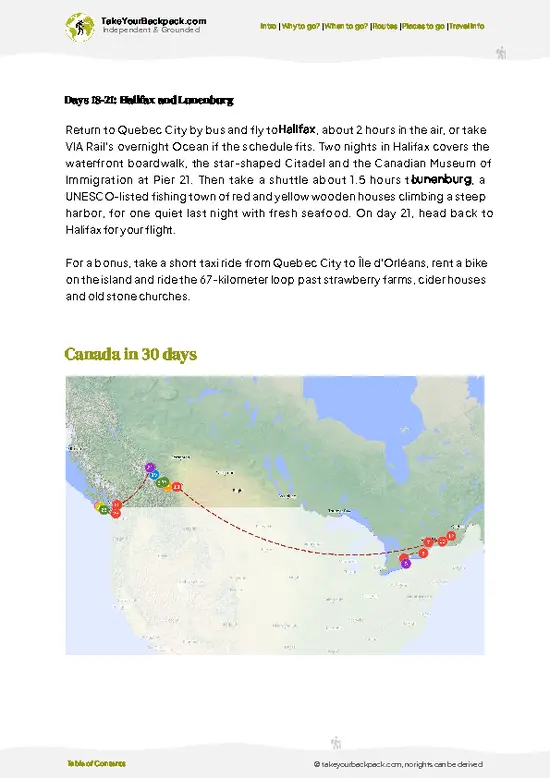
example page 0 from our offline Travel Guide for Canada
example page 1 from our offline Travel Guide for Canada
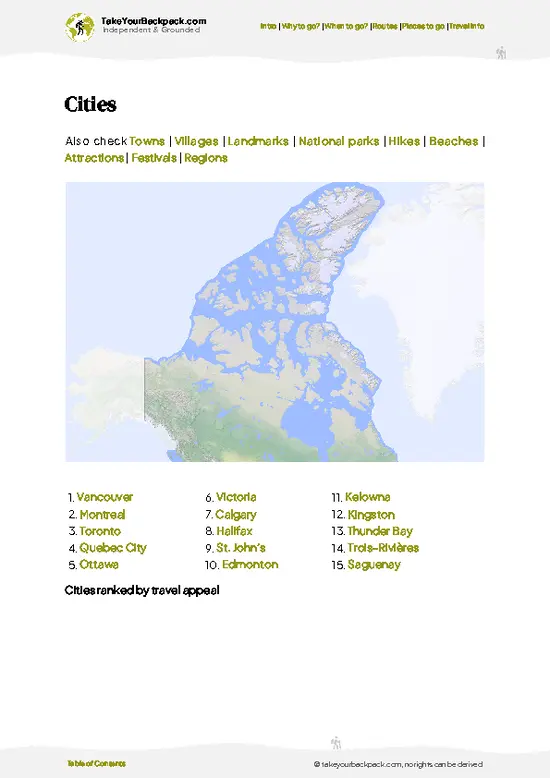
example page 2 from our offline Travel Guide for Canada
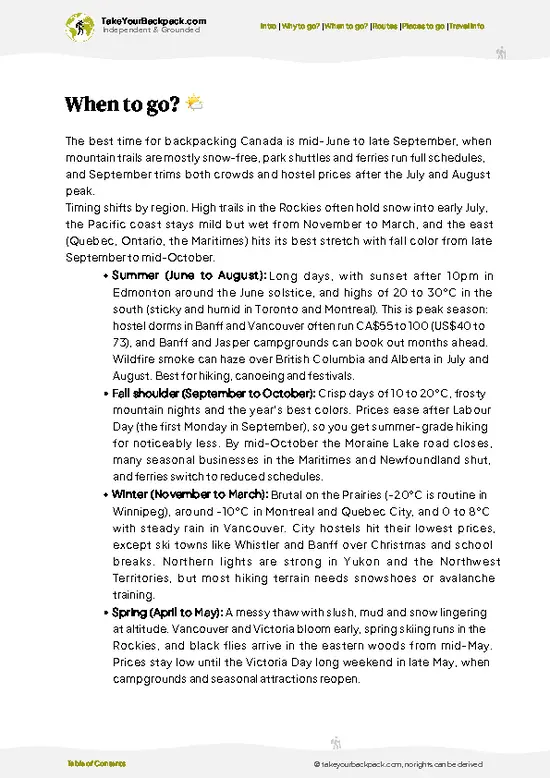
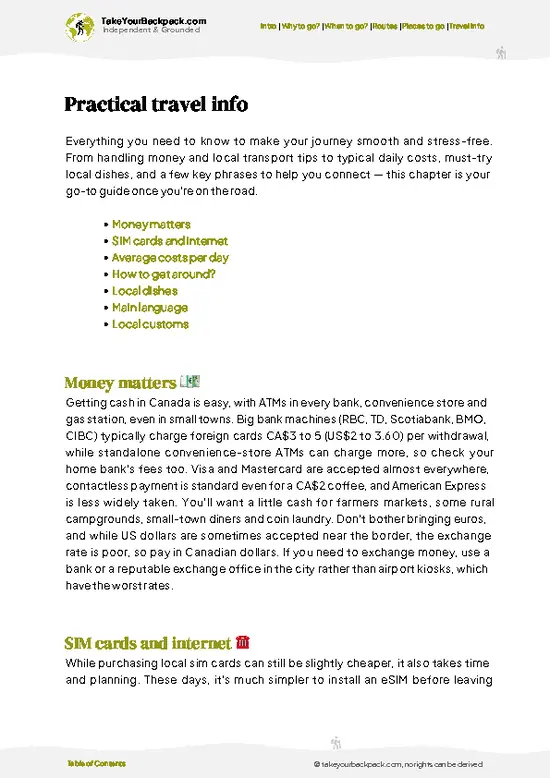
example page 3 from our offline Travel Guide for Canada
example page 4 from our offline Travel Guide for Canada
example page 5 from our offline Travel Guide for Canada
example page 6 from our offline Travel Guide for Canada
example page 7 from our offline Travel Guide for Canada
Loading the map 🌍
CLICK TO FILTER
cities
towns
villages
landmarks
national parks
hikes
beaches
attractions
festivals
regions
SHOW COUNTRY’S BESTSHOW ALL

✨ Why go?
Ranked #4 village in Canada
What sets this place apart

Tadoussac earns its place because whales feed right at the fjord mouth, where cold, deep Saguenay water meets the St. Lawrence. That means belugas, minke whales and sometimes fin whales close to shore, and you can spot them from land at Pointe-de-l’Islet without paying for a boat. Most backpackers stay one or two nights, but hikers and slow travelers linger for the Saguenay Fjord National Park trails, which climb to lookouts over the water. It works well as a pause on a loop along the north shore of the St. Lawrence, a calm break between the busier stretches of Quebec. The village is small and walkable, and the social side is easy: hostel kitchens and the few dining rooms are where solo travelers swap sightings and plans. Couples and nature lovers fit best. If you need nightlife or a big list … read more 👉
Tadoussac earns its place because whales feed right at the fjord mouth, where cold, deep Saguenay water meets the St. Lawrence. That means belugas, minke whales and sometimes fin whales close to shore, and you can spot them from land at Pointe-de-l’Islet without paying for a boat. Most backpackers stay one or two nights, but hikers and slow travelers linger for the Saguenay Fjord National Park trails, which climb to lookouts over the water. It works well as a pause on a loop along the north shore of the St. Lawrence, a calm break between the busier stretches of Quebec. The village is small and walkable, and the social side is easy: hostel kitchens and the few dining rooms are where solo travelers swap sightings and plans. Couples and nature lovers fit best. If you need nightlife or a big list of attractions, this is a short stop, not a destination.

💡 HighlightsThe experiences that define the visit

  1. Whale watching on the fjord mouth: The reason most people come. Zodiac and larger boat tours run from the marina, usually 2 to 3 hours, at roughly US$70 to 100. Morning departures are calmer, and June to October gives the best odds for belugas and minkes.
  2. Pointe-de-l’Islet: A rocky headland just by the village where you can watch for belugas from shore. It is free, open at all times, and you can spend 1 to 2 hours. Go at rising tide in early morning or evening when it is quiet.
  3. Chapelle des Indiens: A small wooden chapel dating to 1747, said to be among the oldest surviving wooden churches in North America, tied to early trade between the Innu and the French. Entry is about US$3 to 4, a visit takes 20 to 30 minutes, and it is open in summer, so go midday.
Tadoussac makes a good base for day trips … read more 👉
  1. Whale watching on the fjord mouth: The reason most people come. Zodiac and larger boat tours run from the marina, usually 2 to 3 hours, at roughly US$70 to 100. Morning departures are calmer, and June to October gives the best odds for belugas and minkes.
  2. Pointe-de-l’Islet: A rocky headland just by the village where you can watch for belugas from shore. It is free, open at all times, and you can spend 1 to 2 hours. Go at rising tide in early morning or evening when it is quiet.
  3. Chapelle des Indiens: A small wooden chapel dating to 1747, said to be among the oldest surviving wooden churches in North America, tied to early trade between the Innu and the French. Entry is about US$3 to 4, a visit takes 20 to 30 minutes, and it is open in summer, so go midday.
Tadoussac makes a good base for day trips to Saguenay Fjord National Park near Baie-Sainte-Catherine, the Cap de Bon-Désir interpretation center near Les Bergeronnes for land-based whale watching, and the Pointe-Noire lookout. For a first visit, Pointe-de-l’Islet is the best item: it costs nothing, takes little planning, and often delivers a first beluga sighting.
Spotted a mistake or missing something? Contact us.

Things to do around Tadoussac

Ratings based on Tripadvisor reviews. When you book through this link, you support our work at no extra cost to you.

🌤️ When to go?Weather, crowds, and seasonal trade-offs

Late June through September is when Tadoussac works best, with whale-watching cruises running daily and the full range of services open.
  • Summer (June to August): Highs run 20 to 25°C (68 to 77°F), nights drop to 10 to 13°C (50 to 55°F). Days are long, whales are reliably feeding in the fjord mouth, and beds and cruises cost the most. Book ahead on weekends.
  • Early Fall (September to mid-October): Highs of 10 to 17°C (50 to 63°F), fewer crowds, and the maples on the hills turn red. Many seasonal businesses close by mid-October, and belugas and some rorquals are still around.
  • Winter (November to March): Temperatures sit around -15 to -5°C (5 to 23°F) with deep snow. Cruises stop, but snowshoeing, ice fishing and a quiet village with cheap rooms suit hardy travelers.
  • Spring (April to May): Thaw and
… read more 👉
Late June through September is when Tadoussac works best, with whale-watching cruises running daily and the full range of services open.
  • Summer (June to August): Highs run 20 to 25°C (68 to 77°F), nights drop to 10 to 13°C (50 to 55°F). Days are long, whales are reliably feeding in the fjord mouth, and beds and cruises cost the most. Book ahead on weekends.
  • Early Fall (September to mid-October): Highs of 10 to 17°C (50 to 63°F), fewer crowds, and the maples on the hills turn red. Many seasonal businesses close by mid-October, and belugas and some rorquals are still around.
  • Winter (November to March): Temperatures sit around -15 to -5°C (5 to 23°F) with deep snow. Cruises stop, but snowshoeing, ice fishing and a quiet village with cheap rooms suit hardy travelers.
  • Spring (April to May): Thaw and mud, highs of 3 to 12°C (37 to 54°F), and most tours not yet running.
Book summer cruises and rooms several weeks ahead, and aim for a weekday departure.


source: climatestotravel.comJANJanuary: below average for travelingFEBFebruary: below average for travelingMARMarch: fair for travelingAPRApril: fair for travelingMAYMay: good for travelingJUNJune: highly recommended for travelingJULJuly: highly recommended for travelingAUGAugust: highly recommended for travelingSEPSeptember: highly recommended for travelingOCTOctober: good for travelingNOVNovember: fair for travelingDECDecember: below average for traveling
canada-city-tadoussac
© Google | Photographysf

✈️ The backpacker research shortcutCanada Travel Guide

An offline-friendly backpacking guide with optimized travel routes, ranked highlights, transport advice, and the best areas to stay.
example page 0 from our offline Travel Guide for Canada
example page 1 from our offline Travel Guide for Canada
example page 2 from our offline Travel Guide for Canada
example page 3 from our offline Travel Guide for Canada
example page 4 from our offline Travel Guide for Canada
example page 5 from our offline Travel Guide for Canada
example page 6 from our offline Travel Guide for Canada
example page 7 from our offline Travel Guide for Canada
The digital guide (385 pages) contains:
✅ 125 highlights, ranked by travel appeal
✅ Optimized 14, 21 & 30-day travel routes
✅ Cities, national parks, landmarks, beaches
✅ How to get around
✅ Offline-friendly for travel without Wi-Fi
👉 Click to see all 30+ guide features

📅 Plan smarter in minutes, not weeks
✅ Month by month travel advice
✅ Festivals & national holidays
✅ Budget expectations

🗺️ Go to the right places, skip the overrated ones
✅ Honest pros & cons of destinations
✅ Top hikes, parks & viewpoints
✅ Lesser-known places most travelers miss
✅ Clear “worth it vs skip it” guidance

🛏️ Travel smoothly without rookie mistakes
✅ Best areas to stay
✅ Transport systems explained simply
✅ Common scams & safety advice
✅ SIM cards, money & practical tips

🌍 Understand the country, not just visit it
✅ Culture & traditions
✅ Local customs
✅ Festivals worth planning around
✅ Traveler-friendly historical context
✅ Insights that make places more meaningful

📱 Built for real travel conditions
✅ Fully downloadable PDF
✅ Works completely offline
✅ Optimized for phone use
✅ Useful in remote areas & buses
✅ Everything in one place
Stop searching, start planning
Get instant access to your full guide. 30‑day money-back guarantee.
+ Add another guide for just

By proceeding you agree to our terms.
Sent to your inbox immediately after payment • 100% Secure Checkout
Best Backpacking Travel Advisor 2025 tourism awardBest Backpacking
Travel Advisor
2025
What others say about Take Your Backpack Guides:
⭐⭐⭐⭐⭐
Fantastic, amazing amount of information!
⭐⭐⭐⭐⭐
My goodness this is amazing, it's what I've been looking for hats off too you!
⭐⭐⭐⭐⭐
I think this is absolutely BRILLIANT
⭐⭐⭐⭐
Very complete and informative. It's still missing places, but I gotta to commend you
⭐⭐⭐⭐⭐
This is truly amazing, thank you, can't wait to explore it with my kids!
⭐⭐⭐⭐⭐
Awesome resource, thank you!
⭐⭐⭐⭐⭐
This is amazing! Can't wait to explore the ones I haven't seen
⭐⭐⭐⭐
I love this! Well done, great idea.
⭐⭐⭐⭐⭐
Thanks for taking the time to make this gem!
⭐⭐⭐⭐⭐
This might be the best website I've ever seen.
⭐⭐⭐⭐⭐
Congratulations, and thank you so much for your work; it's incredibly valuable.
⭐⭐⭐⭐
In all seriousness I think you did a great job pointing out the important spots
⭐⭐⭐⭐⭐
10/10 very good
⭐⭐⭐⭐⭐
As someone who's only just starting to visit regularly this is awesome, thank you.
⭐⭐⭐⭐
Thank you very much! I'm going to visit my dad, it's going to be very useful!
⭐⭐⭐⭐⭐
This is really cool! We'll be travelling for the first time and this definitely come in handy.
⭐⭐⭐⭐⭐
You are now our minister of culture, congratulations 👨‍💼
⭐⭐⭐⭐⭐
Just wanted to tell you that this is a pearl! Going to follow your recommendations.
⭐⭐⭐⭐⭐
This is so cool. I'll definitely be using the resource for my travels soon.
⭐⭐⭐⭐⭐
This is very impressive! Good work.
⭐⭐⭐⭐⭐
This is an amazing and informative site. Very well done!

🛏️ Where to stay?Choosing the right base

Tadoussac has one hostel, La Maison Majorique, open all year with dorm beds, and otherwise budget travelers choose between camping, a few guesthouses and the simpler rooms in the village center.
The most backpacker-friendly option is Camping Tadoussac, a large wooded site on the edge of the village near the dunes, with tent pitches around US$30 to 45 a night in summer. It has showers and a short walk to the waterfront. Arrive early on July and August weekends because it fills.
In the village itself, small family-run auberges and B&Bs are the next step up, with rooms typically US$85 to 150 in high … read more 👉
Tadoussac has one hostel, La Maison Majorique, open all year with dorm beds, and otherwise budget travelers choose between camping, a few guesthouses and the simpler rooms in the village center.
The most backpacker-friendly option is Camping Tadoussac, a large wooded site on the edge of the village near the dunes, with tent pitches around US$30 to 45 a night in summer. It has showers and a short walk to the waterfront. Arrive early on July and August weekends because it fills.
In the village itself, small family-run auberges and B&Bs are the next step up, with rooms typically US$85 to 150 in high season. Staying near the main street and the Maison Chauvin area keeps you within a walk of the marina, where the cruises depart, and the restaurants.
The grand Hôtel Tadoussac, the red-roofed white landmark overlooking the bay, is a splurge at US$200 and up. It is worth it only for a special night, and the view from its porch is free if you buy a drink.
Prices fall sharply after Labor Day, and many places close from late October to May. Book summer stays at least a month ahead.

🚌 Day tripsWhere to go beyond the main area

Tadoussac is an easy base for day trips if you have a car or a tour, but public transit beyond the village is thin, so plan around the free ferry and the few seasonal shuttles.Whale-Watching in the Saguenay Fjord and St. Lawrence: Cruises leave from the Tadoussac marina and last 2 to 3 hours, so this is the easiest outing. Zodiac boats get you close to the water for about US$85 to 100, and larger covered boats run around US$70 to 90. Minke, fin and sometimes blue whales feed here from June to September, with belugas often seen. Bring a windproof layer, since the water stays cold even in July.
Pointe-Noire Interpretation Center: A short drive from Tadoussac along the shore, this is the spot to watch whales from land. The center sits on a rocky point at the fjord mouth, and belugas and minke … read more 👉
Tadoussac is an easy base for day trips if you have a car or a tour, but public transit beyond the village is thin, so plan around the free ferry and the few seasonal shuttles.Whale-Watching in the Saguenay Fjord and St. Lawrence: Cruises leave from the Tadoussac marina and last 2 to 3 hours, so this is the easiest outing. Zodiac boats get you close to the water for about US$85 to 100, and larger covered boats run around US$70 to 90. Minke, fin and sometimes blue whales feed here from June to September, with belugas often seen. Bring a windproof layer, since the water stays cold even in July.
Pointe-Noire Interpretation Center: A short drive from Tadoussac along the shore, this is the spot to watch whales from land. The center sits on a rocky point at the fjord mouth, and belugas and minke can pass within meters in the rising tide. Allow half a day. Entry is a few dollars, and you can cross by free ferry. The common mistake is arriving at low tide in poor light, so check tide times.
Baie-Sainte-Catherine and the Charlevoix Ferry Road: Cross the Saguenay on the free 10-minute ferry (Route 138) to Baie-Sainte-Catherine and continue toward Charlevoix. It costs little if you have a car, while hitching is possible but slow. Best from June to October.
Les Bergeronnes and Cap-de-Bon-Désir: About 25 minutes north by car, Cap-de-Bon-Désir has a lighthouse, granite shore walks and some of the closest land-based whale sightings on the coast. Without a car it is hard to reach, so share a ride. Budget US$10 to 15 for entry and a snack. Go on a rising tide for the best sightings.

FAQCommon questions from travelers

Tadoussac is reached by road along Route 138 on Quebec’s North Shore, about 3 to 3.5 hours (215 km) from Quebec City, and you cross the Saguenay on the free ferry from Baie-Sainte-Catherine. There is no regular rail service, and Intercar buses run to the area from Quebec City on limited schedules, with fares around US$60 to 90. Driving or sharing a ride is far more flexible.
Tadoussac is worth the trip for whale-watching alone, as minke, fin, and belugas feed at the meeting of the fjord and the St. Lawrence from June to September. Two nights lets you fit in a cruise, the Pointe-Noire lookout and the dunes. Budget about US$85 to 100 for a Zodiac cruise, and expect higher prices in July and August.
Tadoussac can be done as a long day trip from Quebec City, but the 3 to 3.5 hour drive each way leaves little time for a cruise. It works better with a car if you leave early, take a 2 to 3 hour cruise, and drive back in the evening. Staying one or two nights is more relaxed and costs about US$30 to 45 for camping.
⚠️ Things can change over time, so always validate details locally before you go.

Other Canadian villages near Tadoussac

Explore more nearby:

  • St. Andrews by-the-Sea—Tide table, sandbar crossing, Kingsbrae alpacas, wharf kayaks| 397 km away
  • Lunenburg—Painted waterfront, dory shop, Bluenose II, harbor chowder| 589 km away
  • Tofino—Surf breaks, tidal flats, rainforest gardens, taproom crowd| 4033 km away

💡 Not sure where to go next?
Create a personalized itinerary for Canada including Tadoussac and the places that fit your trip.

Generate my itinerary

👉 Discover all villages

Or checkout all Canada has to offer (think cities, towns, villages, national parks, hikes, beaches, festivals)
Country photo of Canada

We 💚 feedbackKey takeaways before you go

Tadoussac is best from late June through September, and best of all in the early morning, when the fjord is flat and the belugas surface without a crowd. I would book the first boat of the day and walk the headland again at dusk. Bring a warm layer, because the water makes the air cool even in summer.

✈️ When did I visit Canada?
As part of my 1.5 year travel around the world trip, I visited Canada in 2016.

✍️ Help improve this page!
The information on this page is based on my own backpacking experience in Canada, supplemented with up-to-date research and feedback from other travelers. Travel details can change, so if you notice anything outdated or incomplete, feel free to let me know.


🙋‍♂️ Give feedback

👋 Meet the founderWho’s Behind Take Your Backpack?

Johan, backpacker and founder of TakeYourBackpackHi, I’m Johan (Netherlands 🇳🇱), the creator of TakeYourBackpack. Over the past 3 decades, I’ve backpacked through 90+ countries across six continents, gaining extensive experience with independent travel, long-term trips, and overland routes.

This site is built on a combination of firsthand travel experience and carefully curated insights from other backpackers. Many guides are based on places I’ve personally visited, while others bring together tips, observations, and practical advice shared by trusted travelers I’ve met along the way.

The goal is to provide realistic, experience-driven guidance — not generic itineraries — so you can explore destinations with better context, clearer expectations, and more confidence.