×

Central African Republic🇨🇫 | hikesDzanga Bai TrailForest elephants, wooden platform, Ba’Aka trackers, muddy clearing | things to do and best time to go

Explore Bossangoa Heritage FestivalExplore Lobaye River Trail

Backpacking in Dzanga Bai Trail
🏆 Top pickhike ranked #1
By Johan Kruseman 🇳🇱 | Updated October 22, 2026

You stop talking at the edge of the clearing, because the trackers hold up a hand and the noise ahead is a low rumble you feel in your sternum. Dzanga Bai Trail is a short forest walk in the southwest of the Central African Republic, inside Dzanga-Sangha Special Reserve near Bayanga, ending at a wooden platform above a mineral-rich clearing where forest elephants gather. The scenery is dense rainforest, then an open, muddy bai the size of several football fields. The walk is flat, short and easy, so fitness is no barrier. Do not come for a long trek, because there isn’t one, and do not expect the trail itself to be the highlight. The elephants are. Getting here is the hard part: Bayanga is remote, public transport is thin and unreliable, and the last stretch to the trailhead needs a reserve vehicle. Book your guide and permit through the reserve office in Bayanga before you set out.

Discover everything you want to know in the 📖 Central African Republic Travel Guide.
Best time to go: June - August, December - February
Duration: 4 hours
Distance: 4 kilometers
Total ascent: 30 meters
Safety warning

The current risk level for Central African Republic is high. Check the advice before going.


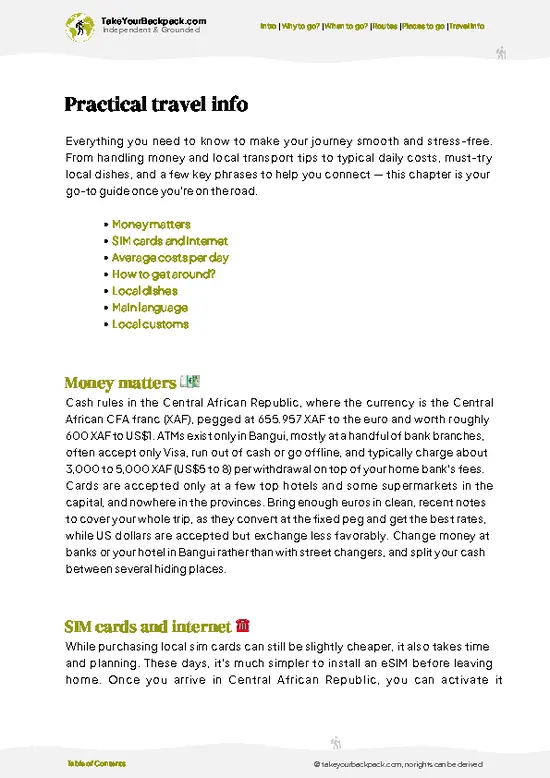
example page 0 from our offline Travel Guide for Central African Republic
example page 1 from our offline Travel Guide for Central African Republic
example page 2 from our offline Travel Guide for Central African Republic
example page 3 from our offline Travel Guide for Central African Republic
example page 4 from our offline Travel Guide for Central African Republic
example page 5 from our offline Travel Guide for Central African Republic
example page 6 from our offline Travel Guide for Central African Republic
example page 7 from our offline Travel Guide for Central African Republic
Loading the map 🌍
CLICK TO FILTER
cities
towns
landmarks
national parks
hikes
attractions
regions
SHOW COUNTRY’S BESTSHOW ALL

✨ Why go?
Ranked #1 hike in Central African Republic
Why visitors keep coming back

Dzanga Bai Trail leads to one of the few places on Earth where you can watch forest elephants in the open, and that is the whole case for it. These animals normally vanish into thick canopy, yet here dozens can stand in the clearing at once, digging for minerals with their trunks and tusks. Counts of 100 or more on a good day are not unusual, and calves, matriarchs and lone bulls all show up. The effort is tiny. You walk a short, flat path with Ba’Aka trackers who read the forest in a way no guidebook can, and you spend hours on the platform rather than on the trail. It also fits a longer Central African route. Combine it with the Sangha River landscape and the wider Sangha Trinational forest area, which spans three countries, and the reserve gives you gorilla tracking and river time within … read more 👉
Dzanga Bai Trail leads to one of the few places on Earth where you can watch forest elephants in the open, and that is the whole case for it. These animals normally vanish into thick canopy, yet here dozens can stand in the clearing at once, digging for minerals with their trunks and tusks. Counts of 100 or more on a good day are not unusual, and calves, matriarchs and lone bulls all show up. The effort is tiny. You walk a short, flat path with Ba’Aka trackers who read the forest in a way no guidebook can, and you spend hours on the platform rather than on the trail. It also fits a longer Central African route. Combine it with the Sangha River landscape and the wider Sangha Trinational forest area, which spans three countries, and the reserve gives you gorilla tracking and river time within the same stay. For wildlife value per step walked, nothing nearby comes close.

💡 HighlightsEssential experiences to have while hiking the Dzanga Bai Trail

  1. Dzanga Bai Clearing: This is the reason the trail exists. The bai is a wide, sandy and muddy opening in the forest where forest elephants come to dig for mineral salts. Dozens can be present at once, and the sound of trumpeting, splashing and deep rumbling carries across the whole space.
  2. The Viewing Platform: A raised wooden platform overlooks the clearing from the forest edge. You sit above the animals, at a respectful distance, and can stay for hours. The elevation gives a clear view of herd dynamics, including mothers shepherding calves through the mud.
  3. Forest Elephant Herds: Forest elephants are smaller than savanna ones, with straighter, downward-pointing tusks and a rounder ear. Watching them here lets you compare family groups, spot individual matriarchs and see younger males sparring.
… read more 👉
  1. Dzanga Bai Clearing: This is the reason the trail exists. The bai is a wide, sandy and muddy opening in the forest where forest elephants come to dig for mineral salts. Dozens can be present at once, and the sound of trumpeting, splashing and deep rumbling carries across the whole space.
  2. The Viewing Platform: A raised wooden platform overlooks the clearing from the forest edge. You sit above the animals, at a respectful distance, and can stay for hours. The elevation gives a clear view of herd dynamics, including mothers shepherding calves through the mud.
  3. Forest Elephant Herds: Forest elephants are smaller than savanna ones, with straighter, downward-pointing tusks and a rounder ear. Watching them here lets you compare family groups, spot individual matriarchs and see younger males sparring. Visits often involve naming the herds that regulars recognize.
  4. Ba’Aka Trackers: Local Ba’Aka guides lead the walk. They move almost silently, spot signs such as fresh dung, broken stems and fruit fall, and can often tell you which animals have passed. Their knowledge of plant uses and forest sounds makes the short approach feel like a lesson in reading rainforest.
  5. Other Bai Visitors: Elephants dominate, but the clearing also draws forest buffalo, bongo, sitatunga, giant forest hogs and red river hogs. Flocks of African grey parrots wheel overhead, and colorful birds work the edges of the mud. Bring binoculars, since the smaller visitors are easy to miss without them.
For a first visit, the platform at Dzanga Bai Trail’s end is the single best experience, because settling in there for a long, quiet watch shows you every other highlight at once.
Spotted a mistake or missing something? Contact us.

🌤️ When to go?When to go for the best experience

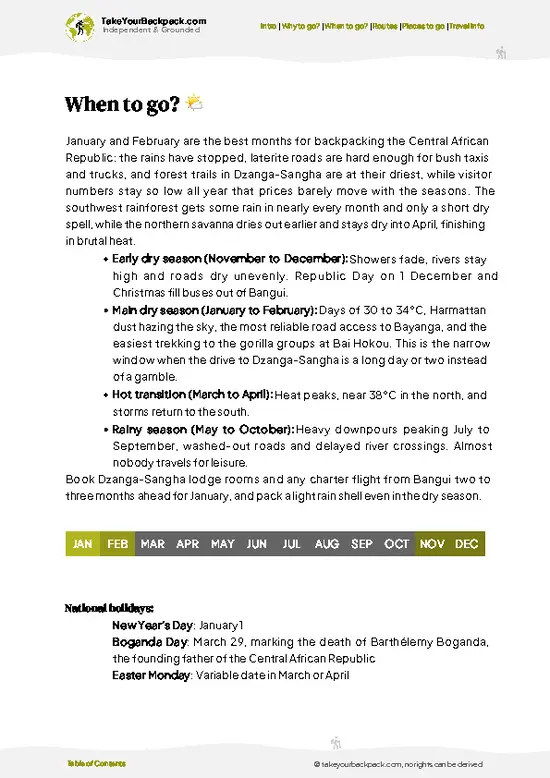
  • Main Dry Season (December to February): The most reliable window for the walk through Dzanga-Sangha forest to the clearing, with forest paths firm and fewer downpours. Days reach 29 to 32°C (84 to 90°F), nights drop to 20 to 22°C (68 to 72°F). Elephant numbers at the bai are often high, and this is when lodge beds fill and prices sit at their peak.
  • Short Dry Spell (July to August): Cloudier and a little cooler at 26 to 29°C (79 to 84°F), with lighter rain. Fewer visitors, and lodge rates tend to ease.
  • Wet Seasons (March to June, September to November): Expect near-daily storms, 24 to 30°C (75 to 86°F) and humidity that never lifts. The track in from Bayanga turns to mud and the last stretch gets slick. Rates are lowest, though some days the walk gets cancelled or delayed.
  • Daylight: Close to 12
… read more 👉
  • Main Dry Season (December to February): The most reliable window for the walk through Dzanga-Sangha forest to the clearing, with forest paths firm and fewer downpours. Days reach 29 to 32°C (84 to 90°F), nights drop to 20 to 22°C (68 to 72°F). Elephant numbers at the bai are often high, and this is when lodge beds fill and prices sit at their peak.
  • Short Dry Spell (July to August): Cloudier and a little cooler at 26 to 29°C (79 to 84°F), with lighter rain. Fewer visitors, and lodge rates tend to ease.
  • Wet Seasons (March to June, September to November): Expect near-daily storms, 24 to 30°C (75 to 86°F) and humidity that never lifts. The track in from Bayanga turns to mud and the last stretch gets slick. Rates are lowest, though some days the walk gets cancelled or delayed.
  • Daylight: Close to 12 hours all year, so plan to reach the platform in the morning when the forest is cooler and animals arrive early.
Book the platform and lodge beds weeks ahead for January and February, and keep a spare day in the schedule for rain.


source: climatestotravel.comJANJanuary: excellent for travelingFEBFebruary: excellent for travelingMARMarch: fair for travelingAPRApril: below average for travelingMAYMay: fair for travelingJUNJune: excellent for travelingJULJuly: excellent for travelingAUGAugust: excellent for travelingSEPSeptember: fair for travelingOCTOctober: below average for travelingNOVNovember: fair for travelingDECDecember: excellent for traveling
central-african-republic-hike-dzanga-bai-trail
© Google |

✈️ The backpacker research shortcutCentral African Republic Travel Guide

An offline-friendly backpacking guide with optimized travel routes, ranked highlights, transport advice, and the best areas to stay.
example page 0 from our offline Travel Guide for Central African Republic
example page 1 from our offline Travel Guide for Central African Republic
example page 2 from our offline Travel Guide for Central African Republic
example page 3 from our offline Travel Guide for Central African Republic
example page 4 from our offline Travel Guide for Central African Republic
example page 5 from our offline Travel Guide for Central African Republic
example page 6 from our offline Travel Guide for Central African Republic
example page 7 from our offline Travel Guide for Central African Republic
The digital guide (210 pages) contains:
✅ 42 highlights, ranked by travel appeal
✅ Optimized 5, 10 & 15-day travel routes
✅ Cities, national parks, landmarks, beaches
✅ How to get around
✅ Offline-friendly for travel without Wi-Fi
👉 Click to see all 30+ guide features

📅 Plan smarter in minutes, not weeks
✅ Month by month travel advice
✅ Festivals & national holidays
✅ Budget expectations

🗺️ Go to the right places, skip the overrated ones
✅ Honest pros & cons of destinations
✅ Top hikes, parks & viewpoints
✅ Lesser-known places most travelers miss
✅ Clear “worth it vs skip it” guidance

🛏️ Travel smoothly without rookie mistakes
✅ Best areas to stay
✅ Transport systems explained simply
✅ Common scams & safety advice
✅ SIM cards, money & practical tips

🌍 Understand the country, not just visit it
✅ Culture & traditions
✅ 52 Essential phrases & customs
✅ Festivals worth planning around
✅ Traveler-friendly historical context
✅ Insights that make places more meaningful

📱 Built for real travel conditions
✅ Fully downloadable PDF
✅ Works completely offline
✅ Optimized for phone use
✅ Useful in remote areas & buses
✅ Everything in one place
Stop searching, start planning
Get instant access to your full guide. 30‑day money-back guarantee.
+ Add another guide for just

By proceeding you agree to our terms.
Sent to your inbox immediately after payment • 100% Secure Checkout
Best Backpacking Travel Advisor 2025 tourism awardBest Backpacking
Travel Advisor
2025
What others say about Take Your Backpack Guides:
⭐⭐⭐⭐⭐
Fantastic, amazing amount of information!
⭐⭐⭐⭐⭐
My goodness this is amazing, it's what I've been looking for hats off too you!
⭐⭐⭐⭐⭐
I think this is absolutely BRILLIANT
⭐⭐⭐⭐
Very complete and informative. It's still missing places, but I gotta to commend you
⭐⭐⭐⭐⭐
This is truly amazing, thank you, can't wait to explore it with my kids!
⭐⭐⭐⭐⭐
Awesome resource, thank you!
⭐⭐⭐⭐⭐
This is amazing! Can't wait to explore the ones I haven't seen
⭐⭐⭐⭐
I love this! Well done, great idea.
⭐⭐⭐⭐⭐
Thanks for taking the time to make this gem!
⭐⭐⭐⭐⭐
This might be the best website I've ever seen.
⭐⭐⭐⭐⭐
Congratulations, and thank you so much for your work; it's incredibly valuable.
⭐⭐⭐⭐
In all seriousness I think you did a great job pointing out the important spots
⭐⭐⭐⭐⭐
10/10 very good
⭐⭐⭐⭐⭐
As someone who's only just starting to visit regularly this is awesome, thank you.
⭐⭐⭐⭐
Thank you very much! I'm going to visit my dad, it's going to be very useful!
⭐⭐⭐⭐⭐
This is really cool! We'll be travelling for the first time and this definitely come in handy.
⭐⭐⭐⭐⭐
You are now our minister of culture, congratulations 👨‍💼
⭐⭐⭐⭐⭐
Just wanted to tell you that this is a pearl! Going to follow your recommendations.
⭐⭐⭐⭐⭐
This is so cool. I'll definitely be using the resource for my travels soon.
⭐⭐⭐⭐⭐
This is very impressive! Good work.
⭐⭐⭐⭐⭐
This is an amazing and informative site. Very well done!

🛏️ Where to stay?How to pick the right area

If you enjoy meeting fellow travelers, consider choosing hostels with high ratings for atmosphere. On the other hand, if you prefer having your own space, a hotel might be a better option.

🥾 Hike detailsA practical overview of the hike

Total Distance: Dzanga Bai Trail is a short forest walk of roughly 1 to 2 kilometers one way from the Dzanga Sangha Special Reserve forest camp area to the clearing, usually covered as an out-and-back.
Estimated Duration: Allow 30 to 60 minutes each way at a quiet pace, plus as many hours as you want on the viewing platform. Most visitors stay 2 to 4 hours.
Difficulty: Easy. The ground is flat to gently rolling, but mud, roots and humidity make it feel slower than the distance suggests.
Starting Point: The trail begins at the Dzanga Sangha reserve park base near Bayanga, in the far southwest of the
… read more 👉
Total Distance: Dzanga Bai Trail is a short forest walk of roughly 1 to 2 kilometers one way from the Dzanga Sangha Special Reserve forest camp area to the clearing, usually covered as an out-and-back.
Estimated Duration: Allow 30 to 60 minutes each way at a quiet pace, plus as many hours as you want on the viewing platform. Most visitors stay 2 to 4 hours.
Difficulty: Easy. The ground is flat to gently rolling, but mud, roots and humidity make it feel slower than the distance suggests.
Starting Point: The trail begins at the Dzanga Sangha reserve park base near Bayanga, in the far southwest of the country. Public transport is thin. Reaching Bayanga itself means a long overland journey or a charter flight, and the final stretch to the trailhead is arranged through the reserve office, which supplies a vehicle or guide on site. Independent walking without a guide and permit is not allowed.
Major Landmarks:
  • Forest Entry Checkpoint: Rangers check your permit and brief you on silence, pace and distance rules.
  • Swamp Crossings: Short boardwalk or log sections cross damp ground where trackers often pause to read fresh signs.
  • Viewing Platform: A raised wooden deck overlooks the bai, a mineral-rich clearing of about 13 hectares where animals gather to dig for salts.
Terrain and Scenery: You walk beneath a closed canopy on a narrow, damp path, with filtered green light and constant insect noise. The trees open suddenly into a wide, sandy-floored clearing crossed by shallow streams. The contrast is the whole show.
Vegetation: Dense lowland rainforest of tall hardwoods, vines, giant-leaved herbs and buttressed trunks. Raphia palms and marshy grasses surround the clearing itself.
Wildlife: The clearing is known for forest elephants, often in groups of dozens, along with lowland gorilla sightings in some seasons. Along the path, listen for monkeys, hornbills and grey parrots overhead, and watch for duiker tracks and elephant dung in the mud.
Practical Notes:
  • Footwear: Waterproof boots or sturdy shoes with grip, since the path stays slick.
  • Clothing: Wear muted colors and long sleeves against insects, and carry a light rain layer.
  • Gear: Bring water, binoculars and a camera without a loud shutter. Talking on the platform is kept to whispers.
  • Guides: Trackers lead the way, set the pace and decide when it is safe to approach the platform.
⚠️ Hiking info can sometimes be outdated or inaccurate. Before you hit the trail, check the latest conditions with locals. If you do spot anything that's off, I'd love to hear from you, so I can update it for fellow travelers.

🛡️ SafetyScams, Hazards, and Annoyances

The walk to Dzanga Bai is short and flat, but it runs through dense rainforest where forest elephants, buffalo and gorillas share the paths, so you walk only with the park’s trackers and guides. Their instructions matter more than any gear: stay in single file, keep your voice low, and hold still when they stop. Never step toward an animal for a photo. Elephants at the clearing are habituated to the platform, not to people on foot. Footing is the usual problem. Roots and wet clay make boots with real tread worth bringing, and in rainy months the path can be ankle-deep mud. Humidity is heavy, so carry at least 2 liters of water and a light rain jacket. Sweat bees and mosquitoes are constant, so pack long sleeves and repellent, and take malaria prevention advised by a travel clinic. Many first-timers … read more 👉
The walk to Dzanga Bai is short and flat, but it runs through dense rainforest where forest elephants, buffalo and gorillas share the paths, so you walk only with the park’s trackers and guides. Their instructions matter more than any gear: stay in single file, keep your voice low, and hold still when they stop. Never step toward an animal for a photo. Elephants at the clearing are habituated to the platform, not to people on foot. Footing is the usual problem. Roots and wet clay make boots with real tread worth bringing, and in rainy months the path can be ankle-deep mud. Humidity is heavy, so carry at least 2 liters of water and a light rain jacket. Sweat bees and mosquitoes are constant, so pack long sleeves and repellent, and take malaria prevention advised by a travel clinic. Many first-timers underestimate how quiet they must be and how long they sit on the platform. Bring a cushion and patience. Check the current security situation locally before you travel to the region.

FAQFrequently asked questions about Dzanga Bai Trail

Plan on roughly 30 to 60 minutes each way on foot from the Dzanga Bai trailhead to the forest clearing, but most visitors spend 2 to 4 hours there, so count on a half day. Trackers often leave the lodge around dawn from Bayanga, about 30 minutes by vehicle from the start. Overnight visits are possible, with a stay on the platform for a longer watch.
Dzanga Bai Trail is easy to moderate: the route is flat and under 2 kilometers, with only mud, roots and humidity to deal with. Temperatures of 26 to 32°C (79 to 90°F) make it sweaty rather than steep. The harder part is reaching Bayanga, where roads are rough and travel takes days from the capital Bangui or via Cameroon.
Yes, Dzanga Bai Trail requires a guide, and entry is only through Dzanga-Sangha Protected Areas, whose trackers lead you in. Expect a park entry fee of roughly €15 to 30 plus a guide and tracker fee around €10 to 25 per group, with lodge transfers extra. Book through the park office in Bayanga or a local lodge, ideally weeks ahead in the busy months of December to February.
⚠️ Things can change over time, so always validate details locally before you go.

Other Central African hikes near Dzanga Bai Trail

Explore more nearby:

  • Lobaye River Trail—riverbank villages, canoe access, tropical vegetation, local markets| 199 km away
  • Boali Waterfalls Trail—50-meter waterfall, Mbali River, rainbow spray, short steps| 284 km away
  • Mount Ngaoui Trail—1,410 m summit, Yadé Massif, granite ridge, Cameroon border| 450 km away

💡 Not sure where to go next?
Create a personalized itinerary for Central African Republic including Dzanga Bai Trail and the places that fit your trip.

Generate my itinerary

👉 Discover all hikes

Or checkout all Central African Republic has to offer (think cities, towns, villages, national parks, hikes, beaches, festivals)
Country photo of Central African Republic

We 💚 feedbackSumming up the experience

Dzanga Bai Trail deserves a full day at minimum, and two if you can manage it. Elephant activity at the bai changes hour by hour, and the second visit is when you start recognizing family groups instead of just counting animals. I would bring a rain layer, a seat cushion for the platform and patience, because the best moments tend to arrive after a long, quiet stretch.

✍️ Help improve this page!
The information on this page is based on in-depth research, insights shared by experienced travelers, and feedback from the local travel community in Central African Republic. While every effort is made to keep the information accurate and current, conditions can change — so if you spot anything incorrect or outdated, please get in touch.


🙋‍♂️ Give feedback

👋 Meet the founderWho’s Behind Take Your Backpack?

Johan, backpacker and founder of TakeYourBackpackHi, I’m Johan (Netherlands 🇳🇱), the creator of TakeYourBackpack. Over the past 3 decades, I’ve backpacked through 90+ countries across six continents, gaining extensive experience with independent travel, long-term trips, and overland routes.

This site is built on a combination of firsthand travel experience and carefully curated insights from other backpackers. Many guides are based on places I’ve personally visited, while others bring together tips, observations, and practical advice shared by trusted travelers I’ve met along the way.

The goal is to provide realistic, experience-driven guidance — not generic itineraries — so you can explore destinations with better context, clearer expectations, and more confidence.