×

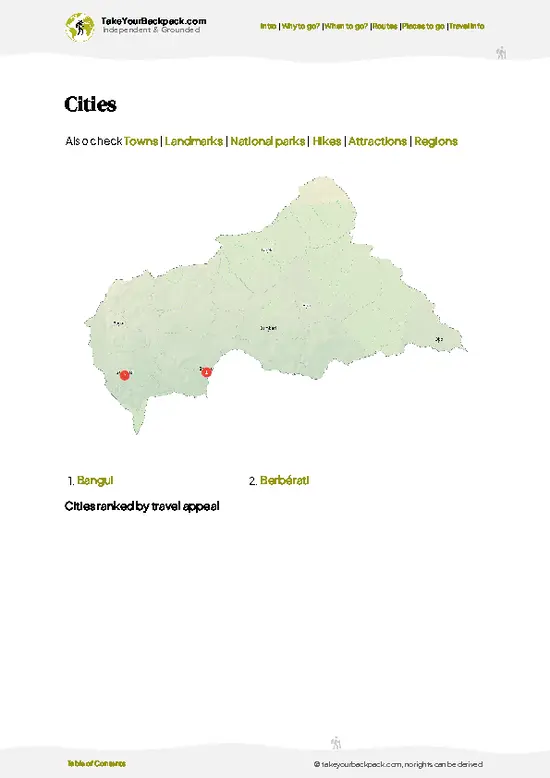
Central African Republic🇨🇫 | citiesBanguiUbangi riverfront, brick-red cathedral, Boganda Museum, Grand Marché | things to do and best time to go

Explore Barthélemy Boganda StadiumExplore Berbérati

Backpacking in Bangui
🏆 Top pickcity ranked #1
By Johan Kruseman 🇳🇱 | Updated October 24, 2026

Bangui suits seasoned overland travelers, reporters, aid workers and deliberate adventurers who want a look at Central Africa that few people get, and who value that over comfort. Anyone after a checklist of sights, easy nightlife or free wandering will find it thin going. Bangui sits on the north bank of the Ubangi River in the south of the Central African Republic, with the Democratic Republic of the Congo directly across the water. The cathedral, the national museum and the riverfront are worth your hours. Hunting for more sights is not, because time spent lining up a local contact saves more than it costs. A fixer adds to the bill, but it buys you safer movement and quicker introductions than a cheaper solo attempt. A mid-range guesthouse with a guarded compound is better value than a bargain room. Before you go, read your government’s current travel advice and arrange your visa and a trusted local contact in advance.

Discover everything you want to know in the 📖 Central African Republic Travel Guide.
Safety warning

The current risk level for Central African Republic is high. Check the advice before going.


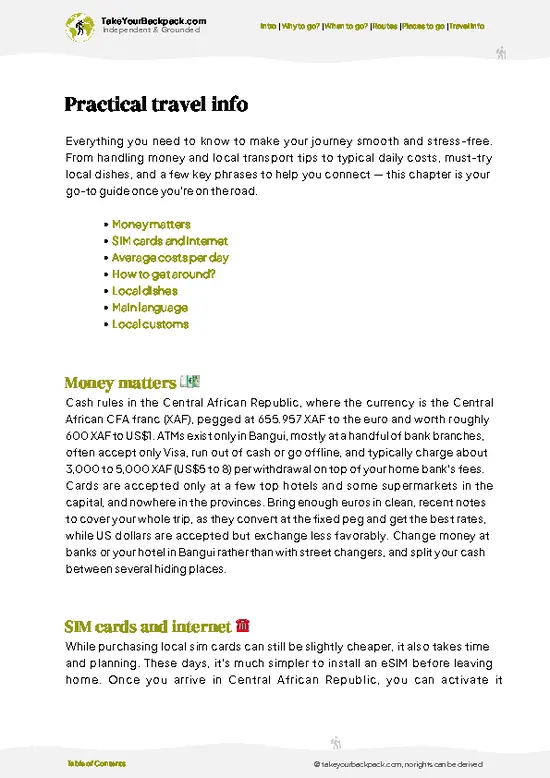
example page 0 from our offline Travel Guide for Central African Republic
example page 1 from our offline Travel Guide for Central African Republic
example page 2 from our offline Travel Guide for Central African Republic
example page 3 from our offline Travel Guide for Central African Republic
example page 4 from our offline Travel Guide for Central African Republic
example page 5 from our offline Travel Guide for Central African Republic
example page 6 from our offline Travel Guide for Central African Republic
example page 7 from our offline Travel Guide for Central African Republic
Loading the map 🌍
CLICK TO FILTER
cities
towns
landmarks
national parks
hikes
attractions
regions
SHOW COUNTRY’S BESTSHOW ALL

✨ Why go?
Ranked #1 city in Central African Republic
What makes this city worth visiting

Bangui is the one place in the country where the roads, the flights and the people all meet, so almost every route through the Central African Republic starts or ends here. That makes it your only realistic basecamp. Embassies, a handful of banks and the main international airport are all in the city, and that is where visas, permits and onward plans get sorted out. If you are heading toward the southwestern rainforest, the Lobaye region and the falls beyond town are the easiest excursions you can reach on a single day’s planning. The Ubangi here is wide and brown, and the city’s relaxed riverside pace gives you a rare view of everyday Central African life, with Sango spoken in every market and taxi. Do not come for hostels, backpacker bars or a social scene. They do not exist in the usual … read more 👉
Bangui is the one place in the country where the roads, the flights and the people all meet, so almost every route through the Central African Republic starts or ends here. That makes it your only realistic basecamp. Embassies, a handful of banks and the main international airport are all in the city, and that is where visas, permits and onward plans get sorted out. If you are heading toward the southwestern rainforest, the Lobaye region and the falls beyond town are the easiest excursions you can reach on a single day’s planning. The Ubangi here is wide and brown, and the city’s relaxed riverside pace gives you a rare view of everyday Central African life, with Sango spoken in every market and taxi. Do not come for hostels, backpacker bars or a social scene. They do not exist in the usual sense. Come for context: a few days to understand how the country works before pushing on, and to meet people who can advise you on where it is sensible to go next. Treat it as a short, purposeful stop, not a place to drift. It rewards preparation and punishes improvisation, so go with a plan.

💡 HighlightsDon't-miss highlights and experiences

  1. Notre-Dame de l’Immaculée Conception Cathedral: The city’s best-known landmark, a large brick-red church dating to the colonial era, where Pope Francis opened a Holy Door in 2015. Come for the Sunday morning Mass, when choirs fill the nave with drums and call-and-response singing. Entry is free, a donation is welcome, and 45 minutes to an hour covers it.
  2. Boganda Museum (Musée Barthélemy Boganda): The national museum, named after the independence leader, with traditional musical instruments, masks, hunting tools and exhibits on Ubangi and forest peoples, including Aka communities. Go in the morning when it is cool. Expect to pay roughly €2 to 5 and spend 1 to 1.5 hours. Ask before photographing.
  3. Ubangi riverfront: Dugout canoes, fishermen and the Congolese shore across the water make this the
… read more 👉
  1. Notre-Dame de l’Immaculée Conception Cathedral: The city’s best-known landmark, a large brick-red church dating to the colonial era, where Pope Francis opened a Holy Door in 2015. Come for the Sunday morning Mass, when choirs fill the nave with drums and call-and-response singing. Entry is free, a donation is welcome, and 45 minutes to an hour covers it.
  2. Boganda Museum (Musée Barthélemy Boganda): The national museum, named after the independence leader, with traditional musical instruments, masks, hunting tools and exhibits on Ubangi and forest peoples, including Aka communities. Go in the morning when it is cool. Expect to pay roughly €2 to 5 and spend 1 to 1.5 hours. Ask before photographing.
  3. Ubangi riverfront: Dugout canoes, fishermen and the Congolese shore across the water make this the most relaxed corner of town. Walk it in the late afternoon with a local companion. It is free and 45 minutes is plenty. The rapids upstream are lively in the rainy months.
  4. Boganda Monument and Mausoleum: A memorial to Barthélemy Boganda, the country’s founding political figure and first prime minister of the autonomous territory. It is a compact stop that explains a great deal about national pride. Free to view, 15 to 20 minutes, best in daylight.
  5. Grand Marché (Central Market): Dense stalls of cassava, smoked fish, caterpillars, bushmeat alternatives, cloth and plastics. It shows you what people eat and trade, and it is loud, crowded and hot. Go in the morning with a local guide, carry small notes, and keep your bag in front. Free, about one hour.
  6. Artisan stalls and craft sellers: Carved wood, malachite pieces and woven baskets are sold from small stands around the center. Prices are negotiable, so start at about half the first ask. Budget €5 to 25 for a good piece, 30 to 45 minutes of browsing.
Beyond Bangui, the best day trips are Boali Falls northwest of the city, the forested Lobaye River area to the southwest and the riverside villages near Bimbo. Seeing everything in the list takes about one full day with travel between sites, or a relaxed day and a half.
Spotted a mistake or missing something? Contact us.

🏘️ NeighborhoodsUnderstanding the local layout

Bangui is spread along the north bank of the Ubangi River, and the areas worth your time sit within a few kilometers of each other, so pick two or three and skip the rest.
  • Centre-ville and the riverfront: The administrative core around Avenue des Martyrs has the main banks, shops, bakeries and the Ubangi quays. It is flat and walkable in daylight, and it gives you the most for the least effort: you can change money, buy a SIM and eat within a few blocks. Worth a morning, not more.
  • Les Cinq Cents and Km5 (PK5): The commercial heart of the city, with the big Central Market, tailors, spice sellers and minibus chaos. It is the most energetic area to see, but access depends on the security situation and a local escort, so go only with a trusted guide and only if conditions are calm. Otherwise skip
… read more 👉
Bangui is spread along the north bank of the Ubangi River, and the areas worth your time sit within a few kilometers of each other, so pick two or three and skip the rest.
  • Centre-ville and the riverfront: The administrative core around Avenue des Martyrs has the main banks, shops, bakeries and the Ubangi quays. It is flat and walkable in daylight, and it gives you the most for the least effort: you can change money, buy a SIM and eat within a few blocks. Worth a morning, not more.
  • Les Cinq Cents and Km5 (PK5): The commercial heart of the city, with the big Central Market, tailors, spice sellers and minibus chaos. It is the most energetic area to see, but access depends on the security situation and a local escort, so go only with a trusted guide and only if conditions are calm. Otherwise skip it.
  • Bimbo and Sica: Quieter residential neighborhoods with shaded streets, small maquis (open-air grill bars) and a calmer pace. Walking is fine in the day, but distances are long, so take a moto-taxi for the last stretch. Good for a relaxed meal.
  • Gobongo and Boy-Rabe: Sprawling outer districts with few sights. Boy-Rabe in particular is not worth the detour for visitors, and the time and risk outweigh anything you would see.
  • Ubangi riverbank: Fishing pirogues, women washing laundry and views across to the Congo shore. A short, rewarding stop at the end of a day, best before dusk.

⌛️ 1 day1-day itinerary for Bangui

7:30 AM, Notre-Dame Cathedral: Start here because the morning is cool, the light on the brick is soft and the neighborhood is calmer before traffic builds. Walk the grounds, step in quietly and ask permission before taking photos. Your driver or guide can take you to the next stop in a few minutes.
9:00 AM, Boganda Monument and Mausoleum: A short, quiet stop that gives you the political backstory you need for everything else you will see. Read the inscriptions, then continue by car to the museum.
10:00 AM, Boganda Museum: Spend about an hour with the masks, instruments and tools. The collection ties together the forest and river cultures you will hear about in town. Ask the curator to explain the instruments, since a few can still be played.
12:00 PM, Lunch near the center: Choose a simple restaurant … read more 👉
7:30 AM, Notre-Dame Cathedral: Start here because the morning is cool, the light on the brick is soft and the neighborhood is calmer before traffic builds. Walk the grounds, step in quietly and ask permission before taking photos. Your driver or guide can take you to the next stop in a few minutes.
9:00 AM, Boganda Monument and Mausoleum: A short, quiet stop that gives you the political backstory you need for everything else you will see. Read the inscriptions, then continue by car to the museum.
10:00 AM, Boganda Museum: Spend about an hour with the masks, instruments and tools. The collection ties together the forest and river cultures you will hear about in town. Ask the curator to explain the instruments, since a few can still be played.
12:00 PM, Lunch near the center: Choose a simple restaurant with grilled capitaine fish, cassava and plantain. Eat early and keep it modest, because the afternoon is warm and you will be walking.
1:30 PM, Grand Marché: Go with a local companion and move steadily through the stalls. Look at the smoked fish, spices, tailors’ rows and fabric sellers. Keep valuables hidden, buy water and finish within an hour.
3:30 PM, Craft sellers: Visit a few of the carving and basket stands. This is a less usual stop, where you can talk with makers and hear which woods and patterns come from which region.
4:45 PM, Ubangi riverbank: End by the water, away from the main port area, where fishermen pull in nets and canoes shuttle goods. Stay with your companion, watch the Congolese shore turn gold, and head back to your guesthouse well before dark.

🌤️ When to go?Seasonal considerations and timing

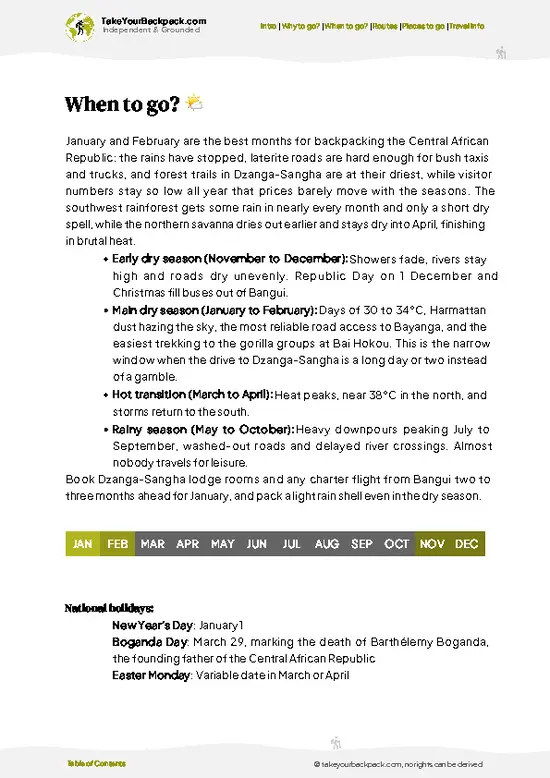
November to February is the easiest window for Bangui, with drier roads and clearer skies.
  • Dry Season (November to February): Days reach about 32 to 34°C (90 to 93°F), nights around 20 to 22°C (68 to 72°F). Harmattan haze can dull the views, but dirt roads are firmest and moto rides are comfortable. Flights and guides are busiest, so prices edge up.
  • Hot Transition (March to April): Highs push toward 35°C (95°F) and afternoons feel heavy before the first storms. Daylight is steady near 12 hours, and crowds are thin.
  • Rainy Season (May to October): Expect 28 to 31°C (82 to 88°F) with downpours most afternoons, peaking August to October. Roads turn to mud, the river rises and travel outside the city slows sharply. Rooms and tours can be cheaper to negotiate.
Book flights and a local fixer a few weeks ahead if you travel in December or January.

source: climatestotravel.comJANJanuary: highly recommended for travelingFEBFebruary: highly recommended for travelingMARMarch: good for travelingAPRApril: highly recommended for travelingMAYMay: fair for travelingJUNJune: fair for travelingJULJuly: fair for travelingAUGAugust: fair for travelingSEPSeptember: fair for travelingOCTOctober: fair for travelingNOVNovember: highly recommended for travelingDECDecember: highly recommended for traveling
when-to-go

✈️ The backpacker research shortcutCentral African Republic Travel Guide

An offline-friendly backpacking guide with optimized travel routes, ranked highlights, transport advice, and the best areas to stay.
example page 0 from our offline Travel Guide for Central African Republic
example page 1 from our offline Travel Guide for Central African Republic
example page 2 from our offline Travel Guide for Central African Republic
example page 3 from our offline Travel Guide for Central African Republic
example page 4 from our offline Travel Guide for Central African Republic
example page 5 from our offline Travel Guide for Central African Republic
example page 6 from our offline Travel Guide for Central African Republic
example page 7 from our offline Travel Guide for Central African Republic
The digital guide (210 pages) contains:
✅ 42 highlights, ranked by travel appeal
✅ Optimized 5, 10 & 15-day travel routes
✅ Cities, national parks, landmarks, beaches
✅ How to get around
✅ Offline-friendly for travel without Wi-Fi
👉 Click to see all 30+ guide features

📅 Plan smarter in minutes, not weeks
✅ Month by month travel advice
✅ Festivals & national holidays
✅ Budget expectations

🗺️ Go to the right places, skip the overrated ones
✅ Honest pros & cons of destinations
✅ Top hikes, parks & viewpoints
✅ Lesser-known places most travelers miss
✅ Clear “worth it vs skip it” guidance

🛏️ Travel smoothly without rookie mistakes
✅ Best areas to stay
✅ Transport systems explained simply
✅ Common scams & safety advice
✅ SIM cards, money & practical tips

🌍 Understand the country, not just visit it
✅ Culture & traditions
✅ 52 Essential phrases & customs
✅ Festivals worth planning around
✅ Traveler-friendly historical context
✅ Insights that make places more meaningful

📱 Built for real travel conditions
✅ Fully downloadable PDF
✅ Works completely offline
✅ Optimized for phone use
✅ Useful in remote areas & buses
✅ Everything in one place
Stop searching, start planning
Get instant access to your full guide. 30‑day money-back guarantee.
+ Add another guide for just

By proceeding you agree to our terms.
Sent to your inbox immediately after payment • 100% Secure Checkout
Best Backpacking Travel Advisor 2025 tourism awardBest Backpacking
Travel Advisor
2025
What others say about Take Your Backpack Guides:
⭐⭐⭐⭐⭐
Fantastic, amazing amount of information!
⭐⭐⭐⭐⭐
My goodness this is amazing, it's what I've been looking for hats off too you!
⭐⭐⭐⭐⭐
I think this is absolutely BRILLIANT
⭐⭐⭐⭐
Very complete and informative. It's still missing places, but I gotta to commend you
⭐⭐⭐⭐⭐
This is truly amazing, thank you, can't wait to explore it with my kids!
⭐⭐⭐⭐⭐
Awesome resource, thank you!
⭐⭐⭐⭐⭐
This is amazing! Can't wait to explore the ones I haven't seen
⭐⭐⭐⭐
I love this! Well done, great idea.
⭐⭐⭐⭐⭐
Thanks for taking the time to make this gem!
⭐⭐⭐⭐⭐
This might be the best website I've ever seen.
⭐⭐⭐⭐⭐
Congratulations, and thank you so much for your work; it's incredibly valuable.
⭐⭐⭐⭐
In all seriousness I think you did a great job pointing out the important spots
⭐⭐⭐⭐⭐
10/10 very good
⭐⭐⭐⭐⭐
As someone who's only just starting to visit regularly this is awesome, thank you.
⭐⭐⭐⭐
Thank you very much! I'm going to visit my dad, it's going to be very useful!
⭐⭐⭐⭐⭐
This is really cool! We'll be travelling for the first time and this definitely come in handy.
⭐⭐⭐⭐⭐
You are now our minister of culture, congratulations 👨‍💼
⭐⭐⭐⭐⭐
Just wanted to tell you that this is a pearl! Going to follow your recommendations.
⭐⭐⭐⭐⭐
This is so cool. I'll definitely be using the resource for my travels soon.
⭐⭐⭐⭐⭐
This is very impressive! Good work.
⭐⭐⭐⭐⭐
This is an amazing and informative site. Very well done!

🛏️ Where to stay?Best areas and accommodation options

Centre-ville and the nearby Bimbo and Sica districts are the best bases for a budget stay in Bangui. True hostels barely exist, so expect small guesthouses, church-run lodgings and basic hotels, typically €15 to 40 a night for a simple room with a fan or air conditioning. Book ahead by phone or message, because supply is limited and rooms fill during NGO and conference periods.
Centre-ville gives you the shortest hops to banks, shops, the riverfront and moto stands, and the streets near the main avenues are the easiest to move around in at dusk. Generators are common, so confirm that power and … read more 👉
Centre-ville and the nearby Bimbo and Sica districts are the best bases for a budget stay in Bangui. True hostels barely exist, so expect small guesthouses, church-run lodgings and basic hotels, typically €15 to 40 a night for a simple room with a fan or air conditioning. Book ahead by phone or message, because supply is limited and rooms fill during NGO and conference periods.
Centre-ville gives you the shortest hops to banks, shops, the riverfront and moto stands, and the streets near the main avenues are the easiest to move around in at dusk. Generators are common, so confirm that power and water run overnight. Noise comes from traffic and street music, so ask for a room at the back.
Bimbo and Sica are calmer, greener and more residential, with walled compounds, gated entrances and night guards. Rooms here are often better value and quieter, but you will depend on a moto or taxi to reach the center, and fares rise after dark.
Choose a place with a secured compound, a guard and reliable backup power over a slightly cheaper room on a main road. Avoid sleeping in outer districts such as Boy-Rabe, where transport links are weak and there is little reason to be.

🚌 Getting aroundTransportation options and practical tips

Bangui punishes anyone who agrees on a moto or taxi fare after the ride instead of before it, and the same goes for arriving at the airport without a pre-arranged pickup. Distances between areas are long, the heat is heavy and public transport is informal, so most backpackers combine short walks with moto-taxis. Roads are patchy, traffic clogs around the market districts and everything slows in rain.
  • Walking: Free, and the best choice inside the center during the morning when streets are quiet and shops open. Avoid long walks after dark or in the midday sun, as pavements are broken and unlit, and you will arrive tired for little gain.
  • Moto-taxis: The practical answer for most trips, at roughly €0.50 to 1.50 for a typical ride across town. They are fast through jams and the cheapest door-to-door
… read more 👉
Bangui punishes anyone who agrees on a moto or taxi fare after the ride instead of before it, and the same goes for arriving at the airport without a pre-arranged pickup. Distances between areas are long, the heat is heavy and public transport is informal, so most backpackers combine short walks with moto-taxis. Roads are patchy, traffic clogs around the market districts and everything slows in rain.
  • Walking: Free, and the best choice inside the center during the morning when streets are quiet and shops open. Avoid long walks after dark or in the midday sun, as pavements are broken and unlit, and you will arrive tired for little gain.
  • Moto-taxis: The practical answer for most trips, at roughly €0.50 to 1.50 for a typical ride across town. They are fast through jams and the cheapest door-to-door option, but helmets are rare and rain makes them miserable. Agree the fare first and carry small bills, as drivers often lack change. Use a hotel-recommended driver at night.
  • Shared taxis: Battered sedans run set routes along main roads for about €0.30 to 0.60 a seat. They are cheap but crammed, slow to fill and hard to decode without local help. Worth it only on busy corridors where you know the destination.
  • Private taxi or hired driver: Charter a car for about €5 to 10 for a short hop or around €40 to 70 for a full day with a driver. It costs far more than a moto, yet it is the sensible choice from the airport, on rainy days or when you carry a pack. Hiring through your accommodation also gives you a driver who knows which areas to avoid.
Skip public buses, which are rare, and do not rely on ride apps, which do not operate here. Fuel shortages sometimes push fares up without warning, so ask your host what the current rate is.

👛 Costs (as of 24 October 2026)Typical daily expenses

Bangui costs around €52 a day for a backpacker, which is high for Central Africa because supply is thin and goods are imported.
CategoryBudget RangeLocal Reality
Dorm accommodation (high season)€15 to 25Few true dorms exist, so expect a basic guesthouse room in November to February.
Dorm accommodation (off-season)€12 to 20Slightly softer prices in the rainy months, with limited choice.
Meals€6 to 12Maquis fish and gozo, street snacks, bakery breakfast.
Local transport€4 to 8Moto-taxis and shared cars, paid in cash.
City transport passNot availableNo pass exists, so pay each ride separately.
Basic activities and entry fees€3 to 10Riverfront boat rides, museum or craft visits.
Miscellaneous€3 to 6SIM and data, water, small tips.
Total Daily Budget€52High-season estimate, with a hired driver extra.
Pay … read more 👉
Bangui costs around €52 a day for a backpacker, which is high for Central Africa because supply is thin and goods are imported.
CategoryBudget RangeLocal Reality
Dorm accommodation (high season)€15 to 25Few true dorms exist, so expect a basic guesthouse room in November to February.
Dorm accommodation (off-season)€12 to 20Slightly softer prices in the rainy months, with limited choice.
Meals€6 to 12Maquis fish and gozo, street snacks, bakery breakfast.
Local transport€4 to 8Moto-taxis and shared cars, paid in cash.
City transport passNot availableNo pass exists, so pay each ride separately.
Basic activities and entry fees€3 to 10Riverfront boat rides, museum or craft visits.
Miscellaneous€3 to 6SIM and data, water, small tips.
Total Daily Budget€52High-season estimate, with a hired driver extra.
Pay your guesthouse and meals in cash and bring small euro or CFA-franc notes, since cards are rarely accepted and you save by negotiating rates for stays over several nights.


source: worldbank.org
⚠️ Prices can change and everyone travels differently, so take this as a rough guide. Hope it helps you plan your adventure!

🚌 Day tripsExploring the surroundings

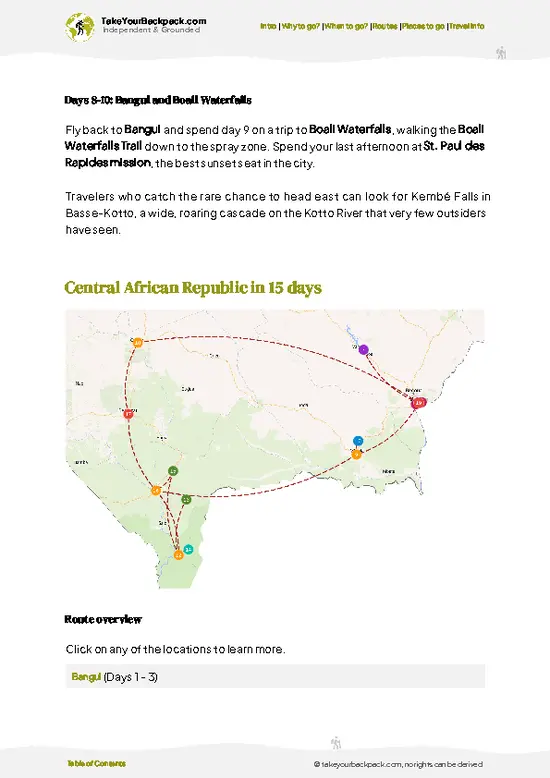
Bangui works as a base for short, early-start trips, but roads outside the city are poor and security shifts, so only go with a local driver who checks current conditions.Boali Falls: Water drops about 50 meters on the Mbali River, and it is the classic escape from the capital. Count 1.5 to 2.5 hours each way by hired car, with a full round trip costing roughly €50 to 90 split among passengers. Go from November to January when roads are firm, though flow is strongest after the rains. First-timers often leave too late and hit the afternoon storms or checkpoints at dusk.
Lobaye Forest and Mbaiki: The forest edge southwest of the capital brings you under tall canopy, with palm wine stops and small villages along the way. Mbaiki is roughly 100 kilometers away, so expect about 3 hours each way on … read more 👉
Bangui works as a base for short, early-start trips, but roads outside the city are poor and security shifts, so only go with a local driver who checks current conditions.Boali Falls: Water drops about 50 meters on the Mbali River, and it is the classic escape from the capital. Count 1.5 to 2.5 hours each way by hired car, with a full round trip costing roughly €50 to 90 split among passengers. Go from November to January when roads are firm, though flow is strongest after the rains. First-timers often leave too late and hit the afternoon storms or checkpoints at dusk.
Lobaye Forest and Mbaiki: The forest edge southwest of the capital brings you under tall canopy, with palm wine stops and small villages along the way. Mbaiki is roughly 100 kilometers away, so expect about 3 hours each way on rough road, and a driver costs around €60 to 100 for the day. It is best in the dry months. Check road status before leaving, since rain closes sections quickly.
Ubangi River by pirogue: A local boatman can take you along the riverbank for an hour or two to watch fishing crews, sandbanks and the Congo shore. It starts from the city itself, so costs only about €5 to 15 for a negotiated boat. Go in the morning, and agree on the route and duration beforehand to avoid inflated prices.
Bimbo and Lake Mbi area: A short ride to the southwest gives a quieter day of village life, small markets and shaded paths. Allow 30 to 60 minutes each way by moto for about €3 to 8. It is easiest in the dry season.

🍲 FoodLocal Flavors for Backpackers

Bangui's cooking leans on the river and the forest. Look for capitaine, Nile perch from the Ubangi, grilled whole over charcoal and served with fried plantains or manioc (cassava) and a sharp pili-pili sauce. Gozo, a thick cassava paste, is the staple on most plates, often with sauce gombo (okra) or peanut sauce. Bushmeat and caterpillar dishes appear in forest villages and some markets, and the leafy ngunza (cassava leaves) cooked with fish or smoked meat is a local comfort.
Cheap meals come from maquis, the open-air grill spots that fill at dusk with smoke and music, usually costing €2 to 5 for fish and sides. Market stalls sell skewers, fried dough and bagged sweet fritters for under €1. Small bakeries around the center sell fresh baguettes that make a good breakfast with coffee for about … read more 👉
Bangui's cooking leans on the river and the forest. Look for capitaine, Nile perch from the Ubangi, grilled whole over charcoal and served with fried plantains or manioc (cassava) and a sharp pili-pili sauce. Gozo, a thick cassava paste, is the staple on most plates, often with sauce gombo (okra) or peanut sauce. Bushmeat and caterpillar dishes appear in forest villages and some markets, and the leafy ngunza (cassava leaves) cooked with fish or smoked meat is a local comfort.
Cheap meals come from maquis, the open-air grill spots that fill at dusk with smoke and music, usually costing €2 to 5 for fish and sides. Market stalls sell skewers, fried dough and bagged sweet fritters for under €1. Small bakeries around the center sell fresh baguettes that make a good breakfast with coffee for about €1 to 2.
Drink Mocaf or Export beer, the local lagers, at around €1 to 2 a bottle, and look for palm wine and sweet ginger juice from roadside vendors. Stick to bottled or filtered water, and eat food that was cooked hot in front of you.

🛡️ SafetyTraveler Safety Guide

Bangui needs more preparation than most capitals, and security changes quickly, so check current government advice and ask your accommodation about the situation before heading out. Most trouble comes from opportunistic theft, checkpoints and certain districts rather than tourist scams. Km5 (PK5) and Boy-Rabe can be tense, so visit only with a trusted local guide if conditions allow. Keep movements to daytime, return to your compound before dark and use a moto or taxi arranged through your host after sunset. Solo travelers should share plans with the guesthouse and avoid walking alone in the evening. Carry only the cash you need, keep your phone out of sight on the street and carry copies of your passport and visa, as police and soldiers do check documents. Photographing government buildings, … read more 👉
Bangui needs more preparation than most capitals, and security changes quickly, so check current government advice and ask your accommodation about the situation before heading out. Most trouble comes from opportunistic theft, checkpoints and certain districts rather than tourist scams. Km5 (PK5) and Boy-Rabe can be tense, so visit only with a trusted local guide if conditions allow. Keep movements to daytime, return to your compound before dark and use a moto or taxi arranged through your host after sunset. Solo travelers should share plans with the guesthouse and avoid walking alone in the evening. Carry only the cash you need, keep your phone out of sight on the street and carry copies of your passport and visa, as police and soldiers do check documents. Photographing government buildings, soldiers or the airport can cause serious trouble, so ask permission first. Small bribe requests at checkpoints are best met with calm, polite patience and your papers in order.

FAQTraveler FAQ

Two to three days is enough for Bangui itself, as long as you spend one on the riverfront and center and another on a trip such as Boali Falls, about 2 hours each way by car. Add a day if you need paperwork or a security briefing. Budget roughly €50 to 60 a day for a basic stay.
Bangui is riskier than most capitals, so solo backpackers should travel with local guidance, stay in a secured guesthouse and be back before dark. Avoid Km5 and Boy-Rabe unless a trusted guide says conditions are calm, and use moto-taxis arranged through your host after dusk. Check government travel advice before each trip, as the situation can change quickly.
Bangui is known for the wide Ubangi River on the border with the Democratic Republic of the Congo, the busy Central Market in Km5, and its role as the capital of the Central African Republic. Nearby Boali Falls, about 100 kilometers away, is the main natural draw. The city is also known for river fish such as capitaine grilled at open-air maquis for roughly €2 to 5.
⚠️ Things can change over time, so always validate details locally before you go.

Expanding your trip beyond this stop

Bangui isn’t the only highlight in Central African Republic. Explore all what Central African Republic has to offer.
Country photo of Central African Republic

We 💚 feedbackIs it worth it?

Bangui is best in the early morning, when the air is cool, markets are filling and church choirs are warming up. Aim for the dry months, roughly December to February, when roads are more reliable and the river is calmer. I would skip any plan that has you out after dusk, and I would bring cash in small notes and a printed copy of every document you own.

✍️ Help improve this page!
The information on this page is based on in-depth research, insights shared by experienced travelers, and feedback from the local travel community in Central African Republic. While every effort is made to keep the information accurate and current, conditions can change — so if you spot anything incorrect or outdated, please get in touch.


🙋‍♂️ Give feedback

👋 Meet the founderWho’s Behind Take Your Backpack?

Johan, backpacker and founder of TakeYourBackpackHi, I’m Johan (Netherlands 🇳🇱), the creator of TakeYourBackpack. Over the past 3 decades, I’ve backpacked through 90+ countries across six continents, gaining extensive experience with independent travel, long-term trips, and overland routes.

This site is built on a combination of firsthand travel experience and carefully curated insights from other backpackers. Many guides are based on places I’ve personally visited, while others bring together tips, observations, and practical advice shared by trusted travelers I’ve met along the way.

The goal is to provide realistic, experience-driven guidance — not generic itineraries — so you can explore destinations with better context, clearer expectations, and more confidence.