×

Central African Republic🇨🇫 | best citiesBest 2 cities in Central African Republic

Central African Republic has almost no city life in the sense most backpackers expect. Bangui, on the Ubangi River, is the one real urban center, and everything else is a provincial town linked by laterite roads that wash out in the rains. Cafés, guesthouses and cash machines are scarce, and outside the capital they are nearly absent. Costs run high because food and fuel are imported. Independent travel is possible only with current security briefings, local contacts and flexible plans. Western towns near the Cameroon corridor are easiest to reach. Skip the east and northeast, where access is poor and conflict persists.

By Johan Kruseman 🇳🇱 | Updated October 23, 2026
Explore the best towns in Central African Republic

Why go?Why These city Stand Out

Central African Republic suits cities poorly, and that is the first thing to understand. The country is landlocked, with a population of roughly five million spread thinly across savanna and rainforest. Few urban centers grew large, and decades of coups, rebellion and neglect left the infrastructure thin. Paved roads are rare, so distances that look short on a map take a full day or more.

The Ubangi and Sangha rivers shaped what towns exist. The colonial era fixed settlement along rivers and trade routes, and the legacy shows in French-language administration, Catholic missions, and markets that mix Sango, French and Lingala. Sango is the everyday language, and a few phrases earn real goodwill.

Before choosing this country for its towns, know that security is the deciding factor. Armed groups … read more 👉
Central African Republic suits cities poorly, and that is the first thing to understand. The country is landlocked, with a population of roughly five million spread thinly across savanna and rainforest. Few urban centers grew large, and decades of coups, rebellion and neglect left the infrastructure thin. Paved roads are rare, so distances that look short on a map take a full day or more.

The Ubangi and Sangha rivers shaped what towns exist. The colonial era fixed settlement along rivers and trade routes, and the legacy shows in French-language administration, Catholic missions, and markets that mix Sango, French and Lingala. Sango is the everyday language, and a few phrases earn real goodwill.

Before choosing this country for its towns, know that security is the deciding factor. Armed groups still control parts of the country, and conditions shift quickly, so government travel advisories carry more weight than any guidebook. Expect checkpoints, permit requirements and few formal tourist services. The upside is real. Visitors meet people unaccustomed to tourists, and nothing is staged. The downside is cost, logistics and risk. If you want easy, comfortable city-hopping, go to Cameroon or Rwanda instead.
Why These Made the Cut
The list of best cities in Central African Republic is created based on culture, vibe, attractions, transport ease, and local charm. If you feel a city is missing in this list, please let us know.

When to go?Timing Your Visit for the Best Experience

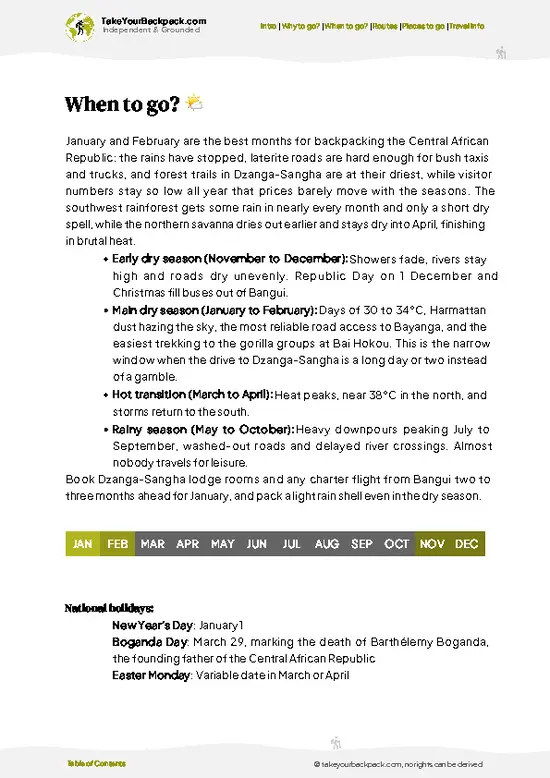
Best months: The best months are December to February, when the dry season keeps laterite roads passable and rivers are low enough for ferries to run reliably. Daytime temperatures sit around 30 to 35°C, with cooler nights near 20 to 22°C, and the harmattan haze from the north can cloud the skies.

Shoulder and wet seasons: March to May and October to November are shoulder periods. Rains start to build, and road quality drops fast. June to September is the wettest stretch in the south and southwest, with monthly rainfall often above 150 to 200 mm around Bangui and the Sangha forest zone. Dirt roads turn to mud, bridges fail and a journey of 6 hours can take 2 days. Skip this period unless you are flying between stops.

Regional differences: The north and northeast have a longer dry season … read more 👉
Best months: The best months are December to February, when the dry season keeps laterite roads passable and rivers are low enough for ferries to run reliably. Daytime temperatures sit around 30 to 35°C, with cooler nights near 20 to 22°C, and the harmattan haze from the north can cloud the skies.

Shoulder and wet seasons: March to May and October to November are shoulder periods. Rains start to build, and road quality drops fast. June to September is the wettest stretch in the south and southwest, with monthly rainfall often above 150 to 200 mm around Bangui and the Sangha forest zone. Dirt roads turn to mud, bridges fail and a journey of 6 hours can take 2 days. Skip this period unless you are flying between stops.

Regional differences: The north and northeast have a longer dry season and a harsher one, with hotter days that can exceed 38°C in March and April. The south stays humid year-round, and rain can fall in any month. Forest areas near the Congo border are the wettest.

Crowds and prices: There is no tourist peak, so crowds are not a factor. Prices are steadier than seasonal, but fuel and food costs rise when roads close, and transport fares can jump 20 to 50 percent in the rains.

city hoppingTips for Visiting Multiple Destinations

How long to allow: A trip linking several towns in Central African Republic needs 10 to 14 days, and that includes buffer days for delays. Fewer than 10 means you spend most of it in vehicles.

Grouping and direction: The country works best as a single cluster around Bangui and the southwest, where roads link toward the Cameroon border and the Sangha region. Treat the capital as the hub. Fly or arrive there, then branch out in one direction and return, rather than looping across the country. Heading west toward the Cameroon corridor is the most workable option, since that axis carries the most traffic. The east and northeast are not realistic for independent travel, so leave them out.

Time per stop and between regions: Allow 2 to 3 nights per stop. Overland legs of 150 to 300 km commonly … read more 👉
How long to allow: A trip linking several towns in Central African Republic needs 10 to 14 days, and that includes buffer days for delays. Fewer than 10 means you spend most of it in vehicles.

Grouping and direction: The country works best as a single cluster around Bangui and the southwest, where roads link toward the Cameroon border and the Sangha region. Treat the capital as the hub. Fly or arrive there, then branch out in one direction and return, rather than looping across the country. Heading west toward the Cameroon corridor is the most workable option, since that axis carries the most traffic. The east and northeast are not realistic for independent travel, so leave them out.

Time per stop and between regions: Allow 2 to 3 nights per stop. Overland legs of 150 to 300 km commonly take 6 to 12 hours on unpaved roads, and longer in the rains. Shared taxis and trucks run on no fixed timetable and leave when full. Hiring a 4x4 with a driver is the dependable choice, though it is far pricier.

Common planning mistakes: The biggest error is packing in too many towns on the map's evidence. Distances mislead here. Plan one long leg per two days at most. Another is skipping permits and checkpoint paperwork, which stalls journeys for hours. Travel only in daylight, since driving after dark is both unsafe and slow. Keep a spare day before any international flight out.

The ListTop cities of Central African Republic

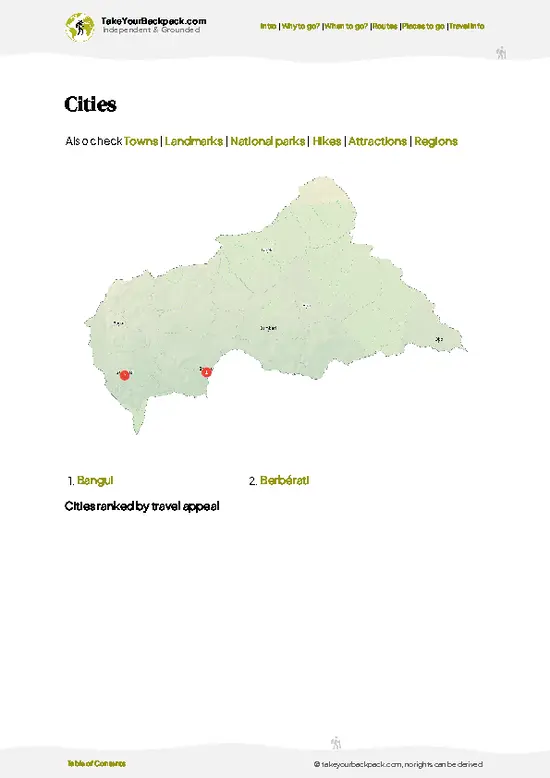
1 Bangui

Ubangi riverfront, brick-red cathedral, Boganda Museum, Grand Marché

Walk the Ubangi bank with a local companion, then visit the national museum, the Boganda memorial and the Sunday choirs at the cathedral.

2 Berbérati

Coffee drying yards, Mambéré River, red-earth streets, cathedral quarter

Watch growers turn coffee beans on tarps at the town edge, then follow the market trade and pirogue crossings along the Mambéré.

Loading the map 🌍

Expert viewWhat You Should Know

How many towns to visit: Plan on two to three places, no more. Roads are slow, security can change within days, and each move uses a full day plus a margin for delays. Three stops over two weeks is realistic. Five is a recipe for missed flights and wasted money.

Choosing by travel style: Anyone with limited time, or with limited tolerance for risk, should anchor on the capital, where embassies, hospitals, banks and flights concentrate. Travelers wanting river life and a quieter pace should add one provincial town in the southwest, which is the calmer part of the country. Those drawn to history and markets can focus on the capital’s central districts. Do not chase remote northern or eastern towns for the sake of the list. Access is unreliable, help is far away, and the experience is rarely … read more 👉
How many towns to visit: Plan on two to three places, no more. Roads are slow, security can change within days, and each move uses a full day plus a margin for delays. Three stops over two weeks is realistic. Five is a recipe for missed flights and wasted money.

Choosing by travel style: Anyone with limited time, or with limited tolerance for risk, should anchor on the capital, where embassies, hospitals, banks and flights concentrate. Travelers wanting river life and a quieter pace should add one provincial town in the southwest, which is the calmer part of the country. Those drawn to history and markets can focus on the capital’s central districts. Do not chase remote northern or eastern towns for the sake of the list. Access is unreliable, help is far away, and the experience is rarely better than in the south.

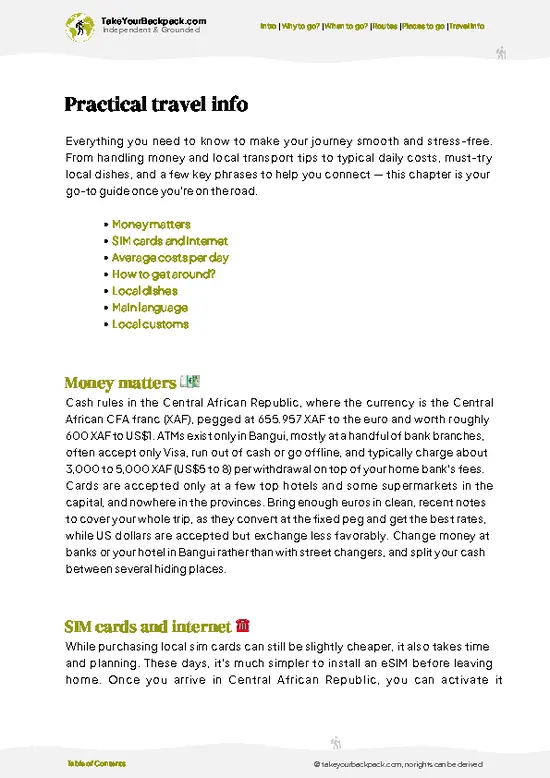
What it costs: Expect US$60 to 120 a day for a careful independent traveler, far above neighboring countries. A basic guesthouse room runs about US$30 to 70 a night, with better rooms in the capital at US$80 to 150. A meal at a local eatery costs US$3 to 8, and more at expatriate restaurants. A driver with a 4x4 typically costs US$100 to 200 a day plus fuel, and a shared vehicle between towns about US$10 to 30 per leg. Budget for a visa, which commonly runs US$100 or more, and yellow fever vaccination proof is required. Mobile money and cards are barely usable, so carry clean US dollars or euros in small bills and change into CFA francs in town. Bad exchange rates for torn or old notes are a common loss of 5 to 10 percent.

Safety and local conduct: Check government advisories right before departure and again on arrival, and register with your embassy. Use a local fixer or trusted guesthouse for current conditions. Avoid travel after dark, and do not move without a driver who knows the roads. Carry copies of your passport, visa and vaccination card at every checkpoint, and keep manner calm and polite. Small official fees do come up, so keep small notes accessible.

Ask before photographing people, officials, bridges or anything military, since it can lead to detention. Dress modestly, greet everyone first in French or Sango, and bargain gently in markets. Malaria is a constant risk, so take prophylaxis and nets. Medical care outside the capital is minimal, so carry a full kit and evacuation insurance. Skip any plan that depends on cash machines, card payment or fixed bus timetables, because none of them can be relied on.

✈️ The backpacker research shortcutCentral African Republic Travel Guide

An offline-friendly backpacking guide with optimized travel routes, ranked highlights, transport advice, and the best areas to stay.
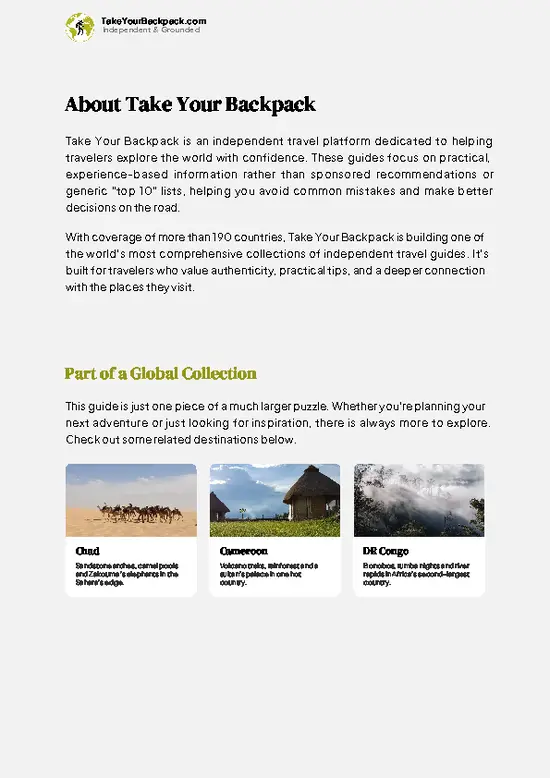
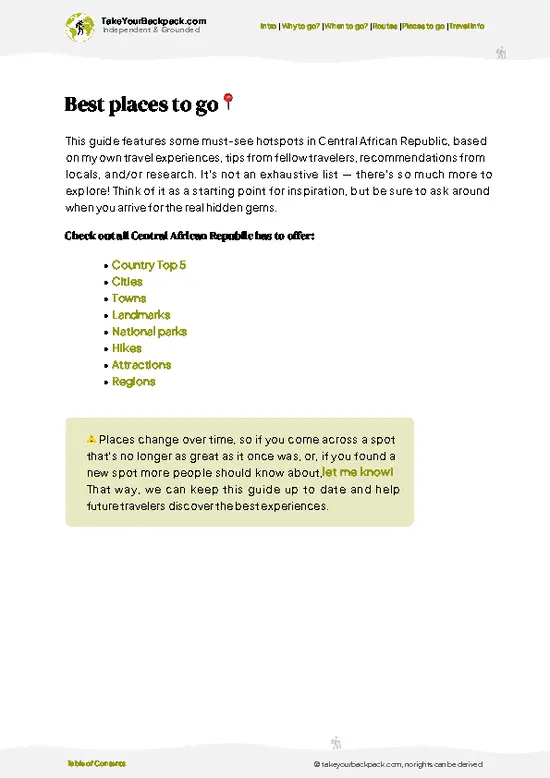
example page 0 from our offline Travel Guide for Central African Republic
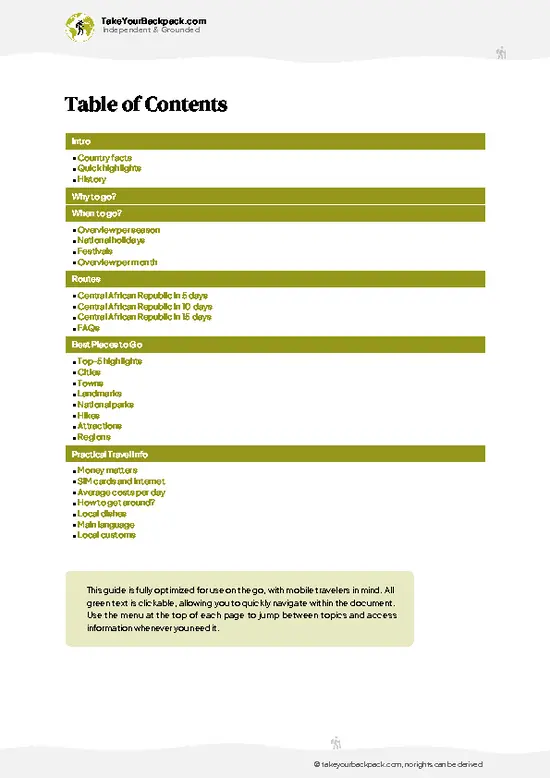
example page 1 from our offline Travel Guide for Central African Republic
example page 2 from our offline Travel Guide for Central African Republic
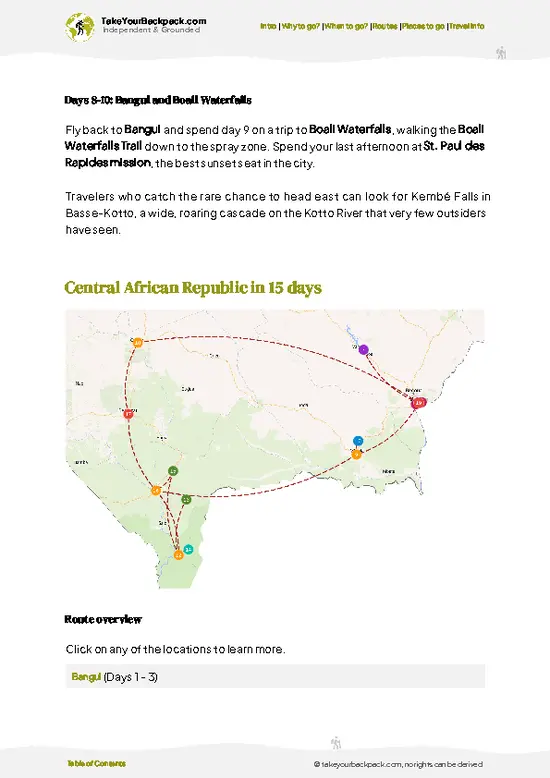
example page 3 from our offline Travel Guide for Central African Republic
example page 4 from our offline Travel Guide for Central African Republic
example page 5 from our offline Travel Guide for Central African Republic
example page 6 from our offline Travel Guide for Central African Republic
example page 7 from our offline Travel Guide for Central African Republic
The digital guide (210 pages) contains:
✅ 42 highlights, ranked by travel appeal
✅ Optimized 5, 10 & 15-day travel routes
✅ Cities, national parks, landmarks, beaches
✅ How to get around
✅ Offline-friendly for travel without Wi-Fi
👉 Click to see all 30+ guide features

📅 Plan smarter in minutes, not weeks
✅ Month by month travel advice
✅ Festivals & national holidays
✅ Budget expectations

🗺️ Go to the right places, skip the overrated ones
✅ Honest pros & cons of destinations
✅ Top hikes, parks & viewpoints
✅ Lesser-known places most travelers miss
✅ Clear “worth it vs skip it” guidance

🛏️ Travel smoothly without rookie mistakes
✅ Best areas to stay
✅ Transport systems explained simply
✅ Common scams & safety advice
✅ SIM cards, money & practical tips

🌍 Understand the country, not just visit it
✅ Culture & traditions
✅ 52 Essential phrases & customs
✅ Festivals worth planning around
✅ Traveler-friendly historical context
✅ Insights that make places more meaningful

📱 Built for real travel conditions
✅ Fully downloadable PDF
✅ Works completely offline
✅ Optimized for phone use
✅ Useful in remote areas & buses
✅ Everything in one place
Stop searching, start planning
Get instant access to your full guide. 30‑day money-back guarantee.
+ Add another guide for just

By proceeding you agree to our terms.
Sent to your inbox immediately after payment • 100% Secure Checkout
Best Backpacking Travel Advisor 2025 tourism awardBest Backpacking
Travel Advisor
2025
What others say about Take Your Backpack Guides:
⭐⭐⭐⭐⭐
Fantastic, amazing amount of information!
⭐⭐⭐⭐⭐
My goodness this is amazing, it's what I've been looking for hats off too you!
⭐⭐⭐⭐⭐
I think this is absolutely BRILLIANT
⭐⭐⭐⭐
Very complete and informative. It's still missing places, but I gotta to commend you
⭐⭐⭐⭐⭐
This is truly amazing, thank you, can't wait to explore it with my kids!
⭐⭐⭐⭐⭐
Awesome resource, thank you!
⭐⭐⭐⭐⭐
This is amazing! Can't wait to explore the ones I haven't seen
⭐⭐⭐⭐
I love this! Well done, great idea.
⭐⭐⭐⭐⭐
Thanks for taking the time to make this gem!
⭐⭐⭐⭐⭐
This might be the best website I've ever seen.
⭐⭐⭐⭐⭐
Congratulations, and thank you so much for your work; it's incredibly valuable.
⭐⭐⭐⭐
In all seriousness I think you did a great job pointing out the important spots
⭐⭐⭐⭐⭐
10/10 very good
⭐⭐⭐⭐⭐
As someone who's only just starting to visit regularly this is awesome, thank you.
⭐⭐⭐⭐
Thank you very much! I'm going to visit my dad, it's going to be very useful!
⭐⭐⭐⭐⭐
This is really cool! We'll be travelling for the first time and this definitely come in handy.
⭐⭐⭐⭐⭐
You are now our minister of culture, congratulations 👨‍💼
⭐⭐⭐⭐⭐
Just wanted to tell you that this is a pearl! Going to follow your recommendations.
⭐⭐⭐⭐⭐
This is so cool. I'll definitely be using the resource for my travels soon.
⭐⭐⭐⭐⭐
This is very impressive! Good work.
⭐⭐⭐⭐⭐
This is an amazing and informative site. Very well done!

🛏️ Where to stay?Where to Stay in Central African Republic

There are no true backpacker hostels in the Central African Republic, so budget travel here means simple guesthouses and mission lodgings in Bangui, typically 15,000 to 30,000 XAF (US$25 to 50) a night for a fan room, with anything reliably secure and air-conditioned costing more. Centre-Ville, the downtown grid near the Oubangui River, has the widest choice, the best security, and walking access to restaurants, banks and the few bars, though prices run highest there. Cheaper rooms around PK0 and Lakouanga put you closer to markets and daily street life, but the streets get dark early and need more caution at night, while the quieter area near M’Poko airport suits early flights but leaves you … read more 👉
There are no true backpacker hostels in the Central African Republic, so budget travel here means simple guesthouses and mission lodgings in Bangui, typically 15,000 to 30,000 XAF (US$25 to 50) a night for a fan room, with anything reliably secure and air-conditioned costing more. Centre-Ville, the downtown grid near the Oubangui River, has the widest choice, the best security, and walking access to restaurants, banks and the few bars, though prices run highest there. Cheaper rooms around PK0 and Lakouanga put you closer to markets and daily street life, but the streets get dark early and need more caution at night, while the quieter area near M’Poko airport suits early flights but leaves you a taxi ride from everything.

If you enjoy meeting fellow travelers, consider choosing hostels with high ratings for atmosphere. On the other hand, if you prefer having your own space, a hotel might be a better option.

Central African RepublicMore of Central African Republic

👋 Meet the founderWho’s Behind Take Your Backpack?

Johan, backpacker and founder of TakeYourBackpackHi, I’m Johan (Netherlands 🇳🇱), the creator of TakeYourBackpack. Over the past 3 decades, I’ve backpacked through 90+ countries across six continents, gaining extensive experience with independent travel, long-term trips, and overland routes.

This site is built on a combination of firsthand travel experience and carefully curated insights from other backpackers. Many guides are based on places I’ve personally visited, while others bring together tips, observations, and practical advice shared by trusted travelers I’ve met along the way.

The goal is to provide realistic, experience-driven guidance — not generic itineraries — so you can explore destinations with better context, clearer expectations, and more confidence.