×

Central African Republic🇨🇫 | regionsBasse-KottoUbangi River, Mobaye pirogues, Alindao market, Kotto riverbanks | things to do and best time to go

Explore Mbaéré-Bodingué National ParkExplore Lobaye

Backpacking in Basse-Kotto
👍 Recommendedregion ranked #2
By Johan Kruseman 🇳🇱 | Updated October 22, 2026

The Ubangi River at Mobaye is the reason anyone makes this trip: wide brown water, pirogues, and the Congolese bank in plain view. What gets overlooked is that Basse-Kotto asks more planning than almost anywhere else in the country. Conditions can change fast, so local contacts and current advice on the road matter more than any itinerary. The prefecture lies in the southeast of the Central African Republic, with Alindao and Mobaye as its main towns. Don’t bother with long loops through small villages. They cost days on rough laterite and add little you can’t see in the two main towns. Pairing Alindao and Mobaye gives a backpacker the most for the time and the effort. Compared with Bangassou, farther east in Mbomou, Basse-Kotto has fewer facilities and a quieter, more riverside feel.

Discover everything you want to know in the 📖 Central African Republic Travel Guide.
Safety warning

The current risk level for Central African Republic is high. Check the advice before going.


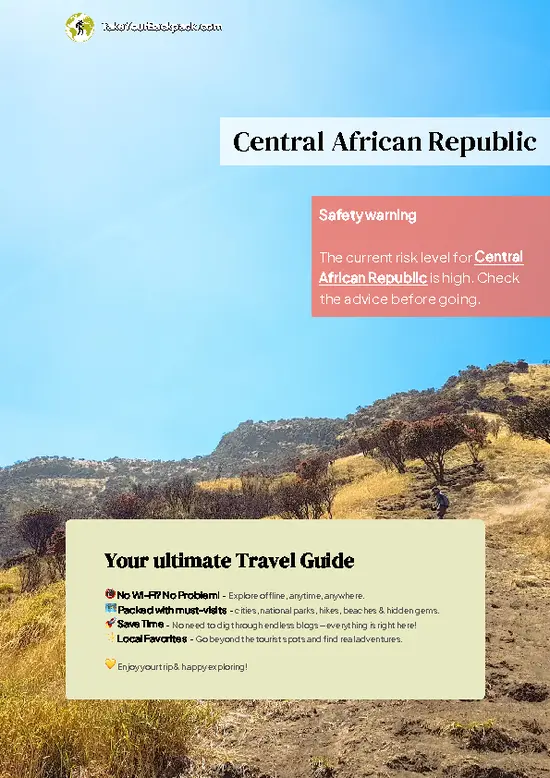
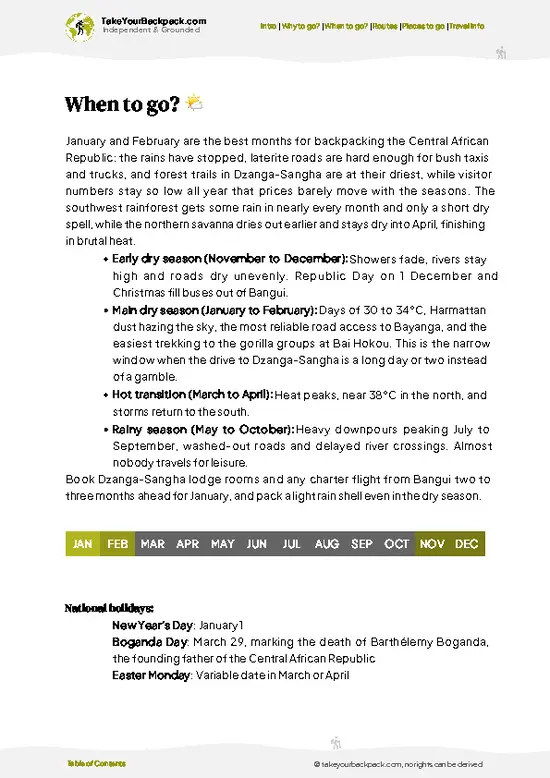
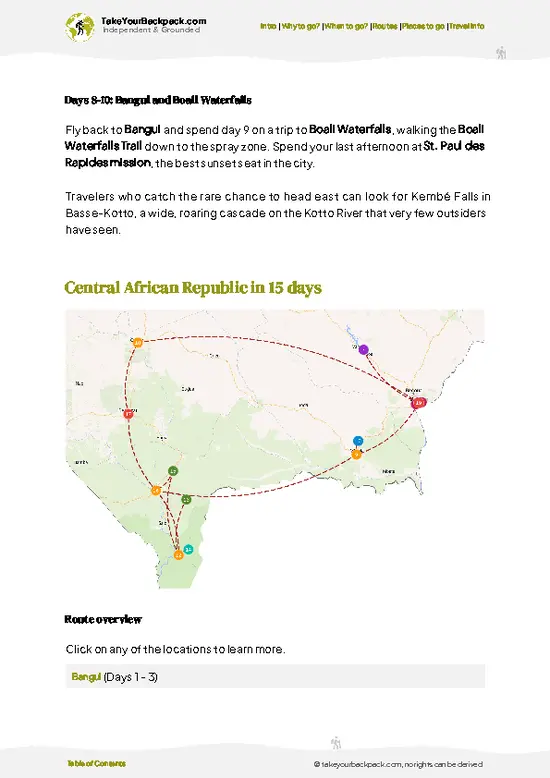
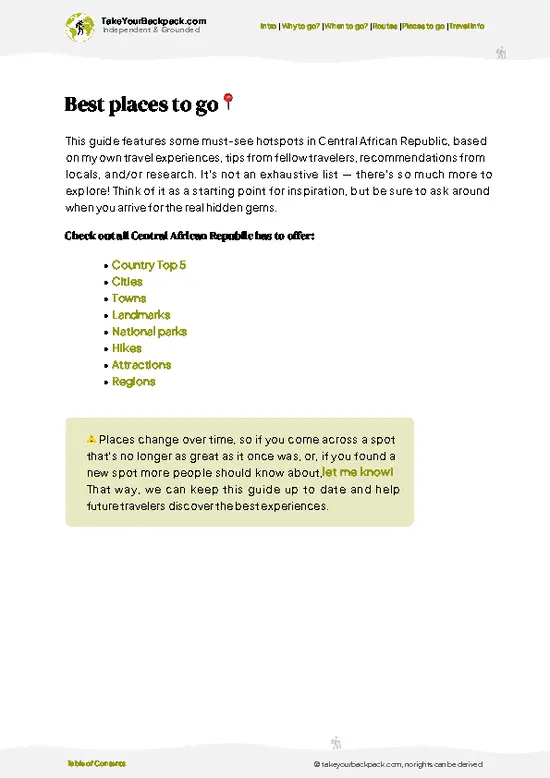
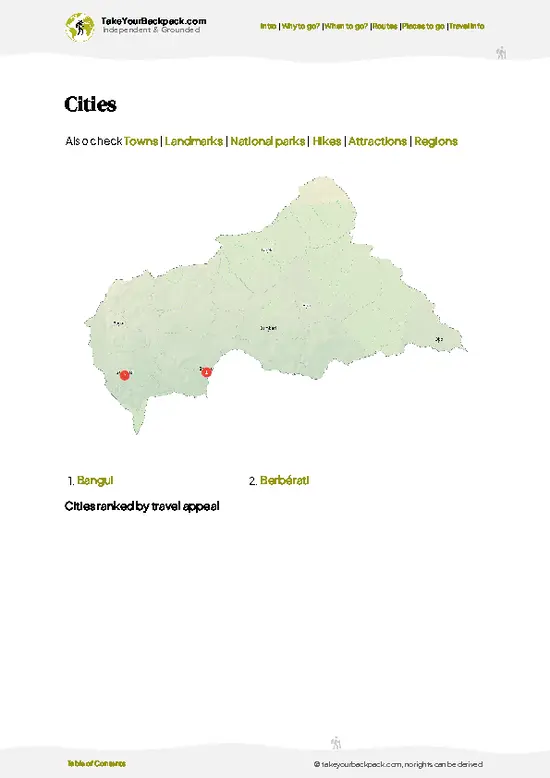
example page 0 from our offline Travel Guide for Central African Republic
example page 1 from our offline Travel Guide for Central African Republic
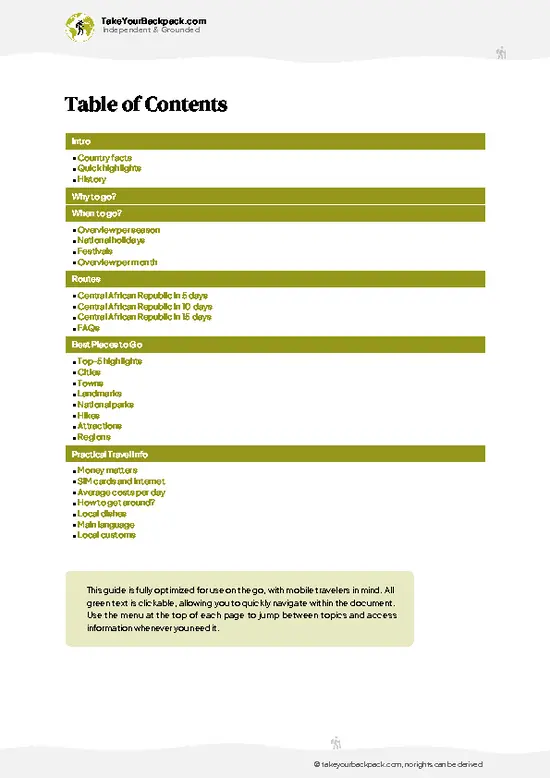
example page 2 from our offline Travel Guide for Central African Republic
example page 3 from our offline Travel Guide for Central African Republic
example page 4 from our offline Travel Guide for Central African Republic
example page 5 from our offline Travel Guide for Central African Republic
example page 6 from our offline Travel Guide for Central African Republic
example page 7 from our offline Travel Guide for Central African Republic
Loading the map 🌍
CLICK TO FILTER
cities
towns
landmarks
national parks
hikes
attractions
regions
SHOW COUNTRY’S BESTSHOW ALL

✨ Why go?
Ranked #2 region in Central African Republic
What makes it a must-see region

Basse-Kotto rewards travelers who want a working river region rather than a sightseeing circuit. The first draw is the Ubangi River at Mobaye, where fishing canoes, trading boats and the border with the Democratic Republic of the Congo make a full day of watching without any ticket or guide. The second is the way the prefecture packs two different settings into a short line of travel: Alindao’s market and mission quarter inland, and the river towns on the Ubangi. You don’t need constant relocation to see both, and slow movement suits the region, because roads are unpaved and plans shift with rain and local conditions. The third is the chance to meet people who rarely host outsiders. Conversations at the market, the riverbank and the church grounds are the real content here, and the Kotto River … read more 👉
Basse-Kotto rewards travelers who want a working river region rather than a sightseeing circuit. The first draw is the Ubangi River at Mobaye, where fishing canoes, trading boats and the border with the Democratic Republic of the Congo make a full day of watching without any ticket or guide. The second is the way the prefecture packs two different settings into a short line of travel: Alindao’s market and mission quarter inland, and the river towns on the Ubangi. You don’t need constant relocation to see both, and slow movement suits the region, because roads are unpaved and plans shift with rain and local conditions. The third is the chance to meet people who rarely host outsiders. Conversations at the market, the riverbank and the church grounds are the real content here, and the Kotto River adds a quieter stretch of water for walking its banks. Come with patience, local introductions and flexible days.

💡 HighlightsWhat this place is best known for

  1. Ubangi River at Mobaye: The region’s signature view. The river is broad here, and the opposite bank belongs to the Democratic Republic of the Congo. Watch fishing canoes and cargo boats work from the landing.
  2. Mobaye riverfront: The town’s waterfront is where trade, fishing and daily chores overlap. Early morning is the busiest, with catches landed and goods carried up the bank.
  3. Alindao central market: The prefecture’s main inland trading point, stacked with cassava, dried fish, produce and household goods. It shows how supply from the surrounding villages reaches town.
  4. Alindao Catholic mission quarter: A long-established church compound at the heart of the town, important to local community life. Visit respectfully and ask permission before taking photos.
  5. Kotto River banks near Alindao: A lesser-known
… read more 👉
  1. Ubangi River at Mobaye: The region’s signature view. The river is broad here, and the opposite bank belongs to the Democratic Republic of the Congo. Watch fishing canoes and cargo boats work from the landing.
  2. Mobaye riverfront: The town’s waterfront is where trade, fishing and daily chores overlap. Early morning is the busiest, with catches landed and goods carried up the bank.
  3. Alindao central market: The prefecture’s main inland trading point, stacked with cassava, dried fish, produce and household goods. It shows how supply from the surrounding villages reaches town.
  4. Alindao Catholic mission quarter: A long-established church compound at the heart of the town, important to local community life. Visit respectfully and ask permission before taking photos.
  5. Kotto River banks near Alindao: A lesser-known stretch where locals fish, wash and cross by canoe. It is a calm place for a walk away from the market noise.
  6. Mobaye pirogue crossings: Local paddlers ferry people and goods along the Ubangi. Watching the technique, and the loads they manage, is a small lesson in river life that most outsiders never see.
  7. Mobaye market: Smaller than Alindao’s but with more river produce, especially smoked and fresh fish. Locals use it as a meeting point, which makes it good for conversation.
  8. Village paths around Alindao: Footpaths between farm plots and savanna patches show how families grow cassava and other crops. Go with a local who knows the routes and the people.
Mobaye’s riverfront and its market combine well in one day, with the landing at first light and the market stalls as the morning warms up, which leaves Basse-Kotto’s inland sights for another day.
Spotted a mistake or missing something? Contact us.

⌛️ 5 daysHow to make the most of Basse-Kotto

Heat and rough laterite set the pace here: you move in the cool early hours, rest through the midday sun, and go out again once the afternoon eases. Motorbike taxis and shared vehicles cover short hops, but schedules bend to road and local conditions, so keep every day loose.Day 1: Alindao: Start in the inland hub and spend the day on foot. The market gives you the lay of the land, and the mission quarter is calm once the stalls thin out. Arranging a local contact on the first day makes every later move simpler and safer.Day 2: Kotto River near Alindao: This is the detour, and it costs almost nothing in logistics. Walk the riverbank with a local guide in the morning, watch the canoe crossings, then rest through the hot hours and return to town by late afternoon. It adds a quieter side to the … read more 👉
Heat and rough laterite set the pace here: you move in the cool early hours, rest through the midday sun, and go out again once the afternoon eases. Motorbike taxis and shared vehicles cover short hops, but schedules bend to road and local conditions, so keep every day loose.Day 1: Alindao: Start in the inland hub and spend the day on foot. The market gives you the lay of the land, and the mission quarter is calm once the stalls thin out. Arranging a local contact on the first day makes every later move simpler and safer.Day 2: Kotto River near Alindao: This is the detour, and it costs almost nothing in logistics. Walk the riverbank with a local guide in the morning, watch the canoe crossings, then rest through the hot hours and return to town by late afternoon. It adds a quieter side to the stay without leaving the Alindao base.Day 3: Travel to Mobaye: Use the day for the move east toward the Ubangi, and treat it as the main event, since road conditions decide when you arrive. Reach the riverfront in the late afternoon and watch the landing slow down for the evening.Day 4: Mobaye: Spend the morning at the market and the pirogue crossings, when the fish arrive and trade is at its loudest. Take the midday break out of the sun, then walk the waterfront again for the changing light on the Congolese bank.Day 5: Ubangi River at Mobaye: This is the day that justifies the trip. Go down at dawn, stay with the river as it wakes, and let the fishermen, traders and boat crews fill the hours. Nothing else in Basse-Kotto matches that wide water and the activity along it.

🌤️ When to go?Weather, crowds, and seasonal trade-offs

Dry months from December to February give the easiest travel in Basse-Kotto, with laterite roads firm and river levels lower.
  • Dry Season (December to February): Days reach 30 to 33°C (86 to 91°F) and nights drop to 20 to 22°C (68 to 72°F). Dust hangs over the roads, but trucks run on schedule and crossings are simpler.
  • Hot Transition (March to April): Heat peaks near 35°C (95°F) and the first storms start. Roads begin to soften.
  • Rainy Season (May to October): Highs sit around 27 to 30°C (81 to 86°F) with heavy afternoon downpours. Tracks turn to mud, bridges fail and fares for trucks and motorbikes climb. Caterpillars and mushrooms appear in the markets.
  • Late Rains (November): Showers thin out and roads recover. Daylight stays steady at about 11.5 to 12.5 hours across the year, so planning around
… read more 👉
Dry months from December to February give the easiest travel in Basse-Kotto, with laterite roads firm and river levels lower.
  • Dry Season (December to February): Days reach 30 to 33°C (86 to 91°F) and nights drop to 20 to 22°C (68 to 72°F). Dust hangs over the roads, but trucks run on schedule and crossings are simpler.
  • Hot Transition (March to April): Heat peaks near 35°C (95°F) and the first storms start. Roads begin to soften.
  • Rainy Season (May to October): Highs sit around 27 to 30°C (81 to 86°F) with heavy afternoon downpours. Tracks turn to mud, bridges fail and fares for trucks and motorbikes climb. Caterpillars and mushrooms appear in the markets.
  • Late Rains (November): Showers thin out and roads recover. Daylight stays steady at about 11.5 to 12.5 hours across the year, so planning around the sun matters little.
Aim to arrive in early December, when roads have dried but food prices have not yet peaked.


source: climatestotravel.comJANJanuary: excellent for travelingFEBFebruary: excellent for travelingMARMarch: excellent for travelingAPRApril: excellent for travelingMAYMay: fair for travelingJUNJune: fair for travelingJULJuly: below average for travelingAUGAugust: below average for travelingSEPSeptember: fair for travelingOCTOctober: fair for travelingNOVNovember: highly recommended for travelingDECDecember: excellent for traveling
when-to-go

✈️ The backpacker research shortcutCentral African Republic Travel Guide

An offline-friendly backpacking guide with optimized travel routes, ranked highlights, transport advice, and the best areas to stay.
example page 0 from our offline Travel Guide for Central African Republic
example page 1 from our offline Travel Guide for Central African Republic
example page 2 from our offline Travel Guide for Central African Republic
example page 3 from our offline Travel Guide for Central African Republic
example page 4 from our offline Travel Guide for Central African Republic
example page 5 from our offline Travel Guide for Central African Republic
example page 6 from our offline Travel Guide for Central African Republic
example page 7 from our offline Travel Guide for Central African Republic
The digital guide (210 pages) contains:
✅ 42 highlights, ranked by travel appeal
✅ Optimized 5, 10 & 15-day travel routes
✅ Cities, national parks, landmarks, beaches
✅ How to get around
✅ Offline-friendly for travel without Wi-Fi
👉 Click to see all 30+ guide features

📅 Plan smarter in minutes, not weeks
✅ Month by month travel advice
✅ Festivals & national holidays
✅ Budget expectations

🗺️ Go to the right places, skip the overrated ones
✅ Honest pros & cons of destinations
✅ Top hikes, parks & viewpoints
✅ Lesser-known places most travelers miss
✅ Clear “worth it vs skip it” guidance

🛏️ Travel smoothly without rookie mistakes
✅ Best areas to stay
✅ Transport systems explained simply
✅ Common scams & safety advice
✅ SIM cards, money & practical tips

🌍 Understand the country, not just visit it
✅ Culture & traditions
✅ 52 Essential phrases & customs
✅ Festivals worth planning around
✅ Traveler-friendly historical context
✅ Insights that make places more meaningful

📱 Built for real travel conditions
✅ Fully downloadable PDF
✅ Works completely offline
✅ Optimized for phone use
✅ Useful in remote areas & buses
✅ Everything in one place
Stop searching, start planning
Get instant access to your full guide. 30‑day money-back guarantee.
+ Add another guide for just

By proceeding you agree to our terms.
Sent to your inbox immediately after payment • 100% Secure Checkout
Best Backpacking Travel Advisor 2025 tourism awardBest Backpacking
Travel Advisor
2025
What others say about Take Your Backpack Guides:
⭐⭐⭐⭐⭐
Fantastic, amazing amount of information!
⭐⭐⭐⭐⭐
My goodness this is amazing, it's what I've been looking for hats off too you!
⭐⭐⭐⭐⭐
I think this is absolutely BRILLIANT
⭐⭐⭐⭐
Very complete and informative. It's still missing places, but I gotta to commend you
⭐⭐⭐⭐⭐
This is truly amazing, thank you, can't wait to explore it with my kids!
⭐⭐⭐⭐⭐
Awesome resource, thank you!
⭐⭐⭐⭐⭐
This is amazing! Can't wait to explore the ones I haven't seen
⭐⭐⭐⭐
I love this! Well done, great idea.
⭐⭐⭐⭐⭐
Thanks for taking the time to make this gem!
⭐⭐⭐⭐⭐
This might be the best website I've ever seen.
⭐⭐⭐⭐⭐
Congratulations, and thank you so much for your work; it's incredibly valuable.
⭐⭐⭐⭐
In all seriousness I think you did a great job pointing out the important spots
⭐⭐⭐⭐⭐
10/10 very good
⭐⭐⭐⭐⭐
As someone who's only just starting to visit regularly this is awesome, thank you.
⭐⭐⭐⭐
Thank you very much! I'm going to visit my dad, it's going to be very useful!
⭐⭐⭐⭐⭐
This is really cool! We'll be travelling for the first time and this definitely come in handy.
⭐⭐⭐⭐⭐
You are now our minister of culture, congratulations 👨‍💼
⭐⭐⭐⭐⭐
Just wanted to tell you that this is a pearl! Going to follow your recommendations.
⭐⭐⭐⭐⭐
This is so cool. I'll definitely be using the resource for my travels soon.
⭐⭐⭐⭐⭐
This is very impressive! Good work.
⭐⭐⭐⭐⭐
This is an amazing and informative site. Very well done!

🛏️ Where to stay?Best areas and accommodation options

Mobaye and Alindao are the two bases that make sense in Basse-Kotto, and Mobaye is the better pick for a first night.
Mobaye is the prefecture capital, sitting on the Ubangi with Congo on the far bank. It has a river market, a long waterfront for evening walks, and the densest cluster of NGO and church staff, which means useful local contacts and the likeliest chance of meeting other outsiders. Rooms are simple, usually a bed, a net and a bucket wash, and cost roughly €5 to 15 a night.
Alindao is a crossroads market town on the route from Bambari, handy when you are coming overland and need a night … read more 👉
Mobaye and Alindao are the two bases that make sense in Basse-Kotto, and Mobaye is the better pick for a first night.
Mobaye is the prefecture capital, sitting on the Ubangi with Congo on the far bank. It has a river market, a long waterfront for evening walks, and the densest cluster of NGO and church staff, which means useful local contacts and the likeliest chance of meeting other outsiders. Rooms are simple, usually a bed, a net and a bucket wash, and cost roughly €5 to 15 a night.
Alindao is a crossroads market town on the route from Bambari, handy when you are coming overland and need a night before pushing on. It has a busy central market and a large mission presence, and rooms cost about the same as in Mobaye. Power is patchy in both towns, so bring a torch and a power bank.
Smaller villages along the road have no formal lodging. Stays there depend on the village chief and a local introduction, and a small gift of food or a few euros is normal. Check conditions with local contacts in Bangui before going, because the situation in each town changes from month to month.

🚌 Getting aroundGetting around like a local

A moto-taxi ride in Basse-Kotto costs about €0.30 to 1 within a town, paid in cash in Central African CFA francs, and you settle the fare before you climb on. Motorbikes handle the local tracks, while longer legs depend on trucks and the Ubangi river. Reliability is low. Departures follow loads rather than timetables, and the security situation on any given road decides whether anyone drives it, so ask local drivers, church missions or aid agencies before you commit.
  • Moto-taxi: This is the one that earns its place. It costs little, goes down tracks no vehicle can use, and the driver knows which bridges are out. Comfort is poor on mud, and a day hire of €10 to 15 buys more than any other option here.
  • Shared trucks and minibuses: The Bangui to Alindao and Mobaye corridor runs by truck, roughly
… read more 👉
A moto-taxi ride in Basse-Kotto costs about €0.30 to 1 within a town, paid in cash in Central African CFA francs, and you settle the fare before you climb on. Motorbikes handle the local tracks, while longer legs depend on trucks and the Ubangi river. Reliability is low. Departures follow loads rather than timetables, and the security situation on any given road decides whether anyone drives it, so ask local drivers, church missions or aid agencies before you commit.
  • Moto-taxi: This is the one that earns its place. It costs little, goes down tracks no vehicle can use, and the driver knows which bridges are out. Comfort is poor on mud, and a day hire of €10 to 15 buys more than any other option here.
  • Shared trucks and minibuses: The Bangui to Alindao and Mobaye corridor runs by truck, roughly €20 to 40 per seat, and takes one to three days depending on rain and checkpoints. Sitting on top of cargo is cheap and dusty. A cab seat costs more and is worth it for anything over eight hours.
  • Pirogue on the Ubangi: Dugouts link Mobaye with villages along the river for around €2 to 8 a hop. They are slow and sit low in the water, so they suit short crossings and are not worth taking for long distances.
  • Humanitarian flights: Air services reach the region for aid workers, and a seat for a backpacker is rarely available. Do not plan around it.
  • Bicycle or on foot: Between neighboring villages, walking a few kilometers is often faster than waiting for a truck. Carry water and leave early, before the afternoon storms.
Fuel and spare parts run short in the rains, so arrange the return ride when you arrive, and carry small CFA notes, because drivers rarely have change.

🍲 FoodWhat to Eat & Drink

Food in Basse-Kotto centers on gozo, a stiff cassava paste you tear off, roll into a ball and use to scoop ngunza, cassava leaves pounded and simmered with palm oil, peanuts and often smoked fish. The sauce is earthy, a little bitter and rich with oil. Grilled Ubangi fish is the best thing near the river, charred over wood and served with chili paste. During the rains, caterpillars are sold dried or fried, with a nutty, salty crunch that tastes like cheap snack food once you get past the idea.
Eating happens at market stalls and in women’s cooking shacks beside the road, where one pot and one bench serve the whole morning. A plate costs about €0.70 to 2. Bread, fried dough, omelets and sweet tea appear at dawn near the taxi stands. Bottled drinks are sold warm or lightly chilled where a generator … read more 👉
Food in Basse-Kotto centers on gozo, a stiff cassava paste you tear off, roll into a ball and use to scoop ngunza, cassava leaves pounded and simmered with palm oil, peanuts and often smoked fish. The sauce is earthy, a little bitter and rich with oil. Grilled Ubangi fish is the best thing near the river, charred over wood and served with chili paste. During the rains, caterpillars are sold dried or fried, with a nutty, salty crunch that tastes like cheap snack food once you get past the idea.
Eating happens at market stalls and in women’s cooking shacks beside the road, where one pot and one bench serve the whole morning. A plate costs about €0.70 to 2. Bread, fried dough, omelets and sweet tea appear at dawn near the taxi stands. Bottled drinks are sold warm or lightly chilled where a generator runs. Locals drink palm wine, tangy and slightly fizzy, from plastic jugs at village gatherings.
Eat with your right hand and wash before and after, since a bowl of water usually comes around. If someone offers you food, take at least a taste. Arrive after the main meal and you may still be handed a plate. Bring small bills, because change is scarce.

FAQTraveler FAQ

Three to five days covers Basse-Kotto if roads are open, though the journey itself can take as long. Overland from Bangui to Alindao or Mobaye is one to three days by truck, so budget extra time in the rains. Allow a day in Alindao for the market and a day in Mobaye for the Ubangi waterfront and river crossings.
Moto-taxis and shared trucks are the usual way around Basse-Kotto without a car. A moto-taxi ride in town costs about €0.30 to 1, and a day hire runs roughly €10 to 15. Trucks on the Bangui to Alindao and Mobaye corridor cost about €20 to 40 a seat and leave when full, while pirogues cover short hops on the Ubangi for €2 to 8.
Basse-Kotto is known for the Ubangi river frontier with Congo, the prefecture capital Mobaye, and the market town of Alindao. The region is a farming area of cassava, coffee and palm oil, and its river fish is smoked and grilled in Mobaye. Travel here is rough and dependent on road and security conditions, so it draws mostly aid workers and a few adventurous overlanders.
⚠️ Things can change over time, so always validate details locally before you go.

Where to go next

Basse-Kotto isn’t the only highlight in Central African Republic. Explore all what Central African Republic has to offer.
Country photo of Central African Republic

We 💚 feedbackWhat to keep in mind

Basse-Kotto suits patient travelers who like river towns, market talk and slow days, and who are comfortable relying on local contacts. If you want sights on a checklist, skip it. I would bring small gifts for hosts, a good hat and plenty of flexibility, then spend most of the trip on the Ubangi riverbank at Mobaye.

✍️ Help improve this page!
The information on this page is based on in-depth research, insights shared by experienced travelers, and feedback from the local travel community in Central African Republic. While every effort is made to keep the information accurate and current, conditions can change — so if you spot anything incorrect or outdated, please get in touch.


🙋‍♂️ Give feedback

👋 Meet the founderWho’s Behind Take Your Backpack?

Johan, backpacker and founder of TakeYourBackpackHi, I’m Johan (Netherlands 🇳🇱), the creator of TakeYourBackpack. Over the past 3 decades, I’ve backpacked through 90+ countries across six continents, gaining extensive experience with independent travel, long-term trips, and overland routes.

This site is built on a combination of firsthand travel experience and carefully curated insights from other backpackers. Many guides are based on places I’ve personally visited, while others bring together tips, observations, and practical advice shared by trusted travelers I’ve met along the way.

The goal is to provide realistic, experience-driven guidance — not generic itineraries — so you can explore destinations with better context, clearer expectations, and more confidence.