×

Central African Republic🇨🇫 | regionsLobayeNgotto rainforest, Ba’Aka villages, coffee yards, Mbaïki market | things to do and best time to go

Explore Basse-KottoExplore Bambari

Backpacking in Lobaye
🏆 Top pickregion ranked #1
By Johan Kruseman 🇳🇱 | Updated October 22, 2026

Lobaye is known for its rainforest and the Ba’Aka forest people, whose net-hunting, honey-gathering and polyphonic singing still shape life in the villages around Ngotto. What gets overlooked is that this is also the country’s coffee and rubber belt, so farm tracks, drying yards and mission towns are as much the story as the trees. It lies in the southwest of the Central African Republic, southwest of Bangui, around the town of Mbaïki. There are no tourist facilities and no fixed schedules here. Move with a local contact or a registered guide from Bangui, because that is how permission, lodging and forest access get arranged. Skip anything that promises a “pygmy show”, and spend your time on working plantations and walks with forest families instead. Plan a first day in Mbaïki: walk the central market in the morning, then spend the afternoon on a coffee farm talking to the people who pick and dry the beans.

Discover everything you want to know in the 📖 Central African Republic Travel Guide.
Safety warning

The current risk level for Central African Republic is high. Check the advice before going.


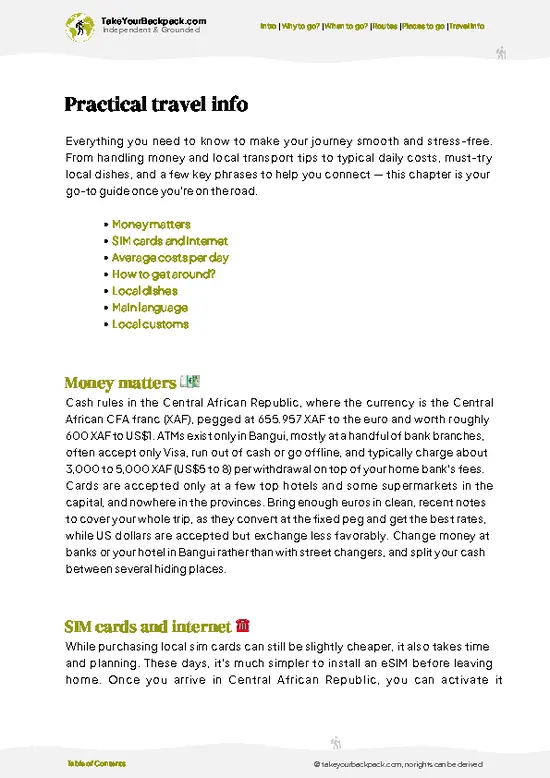
example page 0 from our offline Travel Guide for Central African Republic
example page 1 from our offline Travel Guide for Central African Republic
example page 2 from our offline Travel Guide for Central African Republic
example page 3 from our offline Travel Guide for Central African Republic
example page 4 from our offline Travel Guide for Central African Republic
example page 5 from our offline Travel Guide for Central African Republic
example page 6 from our offline Travel Guide for Central African Republic
example page 7 from our offline Travel Guide for Central African Republic
Loading the map 🌍
CLICK TO FILTER
cities
towns
landmarks
national parks
hikes
attractions
regions
SHOW COUNTRY’S BESTSHOW ALL

✨ Why go?
Ranked #1 region in Central African Republic
The unique appeal for travelers

Lobaye gives you forest, river and farmland in one compact area, so you rarely repack for long. Mbaïki works as an anchor, and from there the Ngotto forest and the Ba’Aka camps around it can be reached on short local runs rather than endless relocation. That matters in a country where roads are slow and plans change.
The second reason is the coffee and rubber economy. Robusta grown under forest cover is the thing this prefecture is known for, and following it from plantation to market shows you everyday rural life that Bangui hides. You meet growers, buyers and truck drivers, and the conversations go further than any museum label.
The third is the Oubangui River frontier at Mongoumba. After days under canopy, the wide brown river, pirogues and fishing camps give a completely different landscape … read more 👉
Lobaye gives you forest, river and farmland in one compact area, so you rarely repack for long. Mbaïki works as an anchor, and from there the Ngotto forest and the Ba’Aka camps around it can be reached on short local runs rather than endless relocation. That matters in a country where roads are slow and plans change.
The second reason is the coffee and rubber economy. Robusta grown under forest cover is the thing this prefecture is known for, and following it from plantation to market shows you everyday rural life that Bangui hides. You meet growers, buyers and truck drivers, and the conversations go further than any museum label.
The third is the Oubangui River frontier at Mongoumba. After days under canopy, the wide brown river, pirogues and fishing camps give a completely different landscape without leaving the prefecture. Slow travel suits all of this. Stay a few nights, accept that one village visit fills a morning, and let the local people set the pace.

💡 HighlightsDon't-miss highlights and experiences

  1. Ngotto Forest: The best-known tract of dense lowland rainforest in the prefecture, with giant hardwoods, forest elephants in the wider area and Ba’Aka communities living at its edges. Go with a guide who has standing with the villages.
  2. Ba’Aka forest camps near Bagandou: Seasonal camps where families still gather honey, hunt with nets and sing in layered voices. Visit by invitation, bring gifts of salt or soap for the community, and never photograph without asking.
  3. Mbaïki central market: The prefecture’s main trading floor, stacked with cassava, caterpillars in season, smoked fish, palm oil and coffee sacks. Go early, when the buyers are still haggling.
  4. Coffee plantations around Mbaïki: Robusta grown in forest shade, with beans drying on raised mats and tarps in the yard. Growers will show you
… read more 👉
  1. Ngotto Forest: The best-known tract of dense lowland rainforest in the prefecture, with giant hardwoods, forest elephants in the wider area and Ba’Aka communities living at its edges. Go with a guide who has standing with the villages.
  2. Ba’Aka forest camps near Bagandou: Seasonal camps where families still gather honey, hunt with nets and sing in layered voices. Visit by invitation, bring gifts of salt or soap for the community, and never photograph without asking.
  3. Mbaïki central market: The prefecture’s main trading floor, stacked with cassava, caterpillars in season, smoked fish, palm oil and coffee sacks. Go early, when the buyers are still haggling.
  4. Coffee plantations around Mbaïki: Robusta grown in forest shade, with beans drying on raised mats and tarps in the yard. Growers will show you the whole process if you arrive in harvest season.
  5. Boukoko: A former agricultural research and mission center with old plantation buildings and tree collections, rarely seen by outsiders and good for a quiet half day.
  6. Bobangui: The village where Barthélemy Boganda, the country’s independence-era leader, was born. There is little to see beyond the setting, but locals will tell you the story.
  7. Lobaye River crossings: The tea-colored river that gives the prefecture its name, crossed by ferries and log bridges. Watch fishermen set traps at the rapids.
  8. Mongoumba: A river town on the Oubangui where pirogues run to the Congolese bank, with fish smoking on racks along the shore.
  9. Boda: A trading town on the edge of the Lobaye zone with a lively market, a mix of farming and mining people, and a feel quite different from Mbaïki.
  10. Pissa area villages: Quiet forest-edge settlements where palm wine, drumming and farm life carry on without any visitor routine. Arrive with a local host.
For a first visit, the Ba’Aka forest camps near Bagandou give Lobaye its clearest sense of place, as long as you go with a trusted guide.
Spotted a mistake or missing something? Contact us.

⌛️ 5 days5-day itinerary for Lobaye

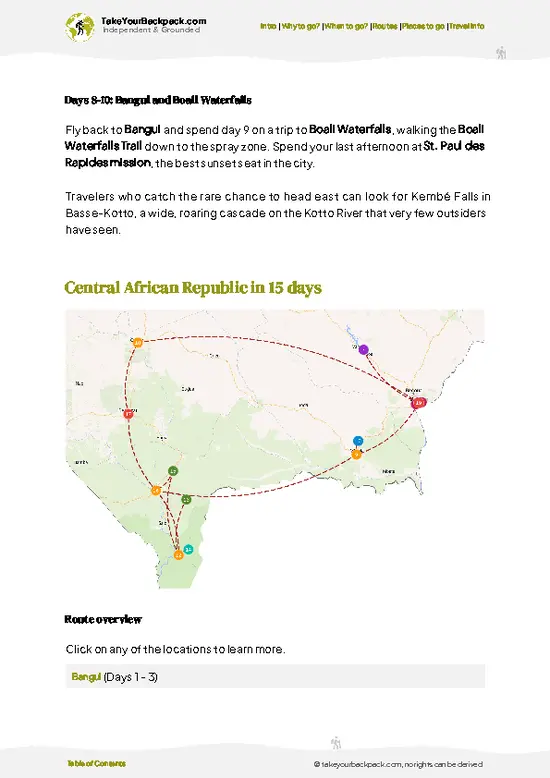
Distances are short on paper but roads are rutted, rivers need ferries, and rain can close a track overnight, so the days run on foot and by shared vehicle, with a long midday rest when the heat peaks and everything slows down.
Day 1: Mbaïki: Arrive early and settle in. Mbaïki has the market, the buyers and the people who can arrange guides, so use the first afternoon to walk the stalls and meet a coffee grower. Everything else in the prefecture depends on those introductions.
Day 2: Boukoko: Head out to Boukoko for the old plantation grounds and the farmland around them. It is an easy outing that lets you see how the coffee economy actually works before you go into the forest, and it gives you a day of low effort after arrival.
Day 3: Ngotto Forest: Spend a full day in the forest with a guide … read more 👉
Distances are short on paper but roads are rutted, rivers need ferries, and rain can close a track overnight, so the days run on foot and by shared vehicle, with a long midday rest when the heat peaks and everything slows down.
Day 1: Mbaïki: Arrive early and settle in. Mbaïki has the market, the buyers and the people who can arrange guides, so use the first afternoon to walk the stalls and meet a coffee grower. Everything else in the prefecture depends on those introductions.
Day 2: Boukoko: Head out to Boukoko for the old plantation grounds and the farmland around them. It is an easy outing that lets you see how the coffee economy actually works before you go into the forest, and it gives you a day of low effort after arrival.
Day 3: Ngotto Forest: Spend a full day in the forest with a guide and, if arranged, a Ba’Aka family from the nearest camp. Start before the heat builds, walk under the canopy, then return to the village for the midday lull. Staying overnight in a nearby village saves you a rough return.
Day 4: Mongoumba: Move west to the Oubangui. The river changes the mood completely. Watch pirogues cross, eat smoked fish at the landing and let the evening air do the work. Transport here is irregular, so keep the day free of other plans.
Day 5: Lobaye River and back: Turn back toward Mbaïki along the river, stopping at crossings and small markets.
For a detour, add Bobangui, the birthplace of Barthélemy Boganda, which sits close to the main route and takes only a morning.
If you only get one day, make it Day 3: the forest, the Ba’Aka camp and the village evening are what no other place in the country repeats.

🌤️ When to go?Best time to visit Lobaye

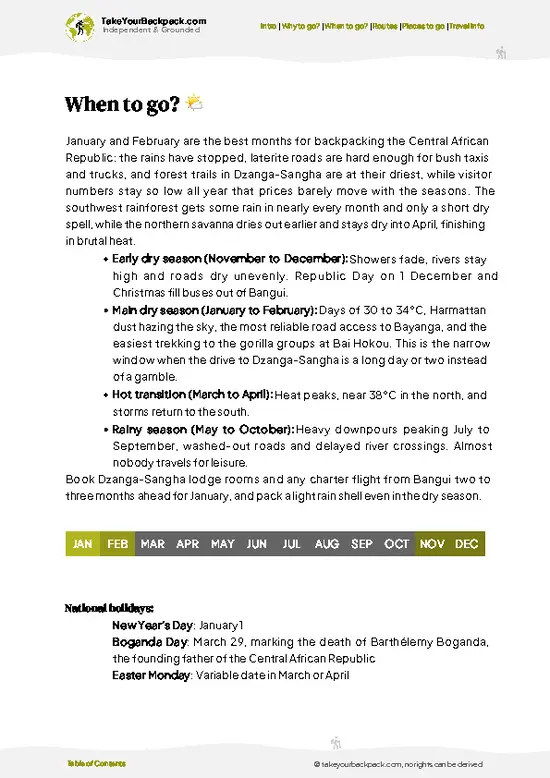
December to February gives the most reliable travel window in Lobaye, with dry roads and cooler mornings.
  • Dry Season (December to February): Days reach 30 to 33°C (86 to 91°F) and nights drop to 20 to 22°C (68 to 72°F). Harmattan haze softens the light, and laterite roads stay firm. Coffee is harvested and dried along the roadside in these months.
  • Hot Transition (March to April): Highs of 32 to 35°C (90 to 95°F) with heavy humidity and the first afternoon storms. Forest walks are sticky but quiet.
  • Rainy Season (May to October): Highs of 27 to 30°C (81 to 86°F) with downpours most afternoons. Tracks to forest villages turn to mud, and vehicle hire costs more because trips take longer. Caterpillars appear in the markets.
  • Late Rains (November): Showers fade and the forest is at its greenest, with
… read more 👉
December to February gives the most reliable travel window in Lobaye, with dry roads and cooler mornings.
  • Dry Season (December to February): Days reach 30 to 33°C (86 to 91°F) and nights drop to 20 to 22°C (68 to 72°F). Harmattan haze softens the light, and laterite roads stay firm. Coffee is harvested and dried along the roadside in these months.
  • Hot Transition (March to April): Highs of 32 to 35°C (90 to 95°F) with heavy humidity and the first afternoon storms. Forest walks are sticky but quiet.
  • Rainy Season (May to October): Highs of 27 to 30°C (81 to 86°F) with downpours most afternoons. Tracks to forest villages turn to mud, and vehicle hire costs more because trips take longer. Caterpillars appear in the markets.
  • Late Rains (November): Showers fade and the forest is at its greenest, with roads drying out.
Daylight stays close to 12 hours all year, so plan to be at your destination before late afternoon.


source: climatestotravel.comJANJanuary: highly recommended for travelingFEBFebruary: highly recommended for travelingMARMarch: highly recommended for travelingAPRApril: good for travelingMAYMay: fair for travelingJUNJune: fair for travelingJULJuly: fair for travelingAUGAugust: fair for travelingSEPSeptember: fair for travelingOCTOctober: fair for travelingNOVNovember: highly recommended for travelingDECDecember: highly recommended for traveling
central-african-republic-region-lobaye
© Google |

✈️ The backpacker research shortcutCentral African Republic Travel Guide

An offline-friendly backpacking guide with optimized travel routes, ranked highlights, transport advice, and the best areas to stay.
example page 0 from our offline Travel Guide for Central African Republic
example page 1 from our offline Travel Guide for Central African Republic
example page 2 from our offline Travel Guide for Central African Republic
example page 3 from our offline Travel Guide for Central African Republic
example page 4 from our offline Travel Guide for Central African Republic
example page 5 from our offline Travel Guide for Central African Republic
example page 6 from our offline Travel Guide for Central African Republic
example page 7 from our offline Travel Guide for Central African Republic
The digital guide (210 pages) contains:
✅ 42 highlights, ranked by travel appeal
✅ Optimized 5, 10 & 15-day travel routes
✅ Cities, national parks, landmarks, beaches
✅ How to get around
✅ Offline-friendly for travel without Wi-Fi
👉 Click to see all 30+ guide features

📅 Plan smarter in minutes, not weeks
✅ Month by month travel advice
✅ Festivals & national holidays
✅ Budget expectations

🗺️ Go to the right places, skip the overrated ones
✅ Honest pros & cons of destinations
✅ Top hikes, parks & viewpoints
✅ Lesser-known places most travelers miss
✅ Clear “worth it vs skip it” guidance

🛏️ Travel smoothly without rookie mistakes
✅ Best areas to stay
✅ Transport systems explained simply
✅ Common scams & safety advice
✅ SIM cards, money & practical tips

🌍 Understand the country, not just visit it
✅ Culture & traditions
✅ 52 Essential phrases & customs
✅ Festivals worth planning around
✅ Traveler-friendly historical context
✅ Insights that make places more meaningful

📱 Built for real travel conditions
✅ Fully downloadable PDF
✅ Works completely offline
✅ Optimized for phone use
✅ Useful in remote areas & buses
✅ Everything in one place
Stop searching, start planning
Get instant access to your full guide. 30‑day money-back guarantee.
+ Add another guide for just

By proceeding you agree to our terms.
Sent to your inbox immediately after payment • 100% Secure Checkout
Best Backpacking Travel Advisor 2025 tourism awardBest Backpacking
Travel Advisor
2025
What others say about Take Your Backpack Guides:
⭐⭐⭐⭐⭐
Fantastic, amazing amount of information!
⭐⭐⭐⭐⭐
My goodness this is amazing, it's what I've been looking for hats off too you!
⭐⭐⭐⭐⭐
I think this is absolutely BRILLIANT
⭐⭐⭐⭐
Very complete and informative. It's still missing places, but I gotta to commend you
⭐⭐⭐⭐⭐
This is truly amazing, thank you, can't wait to explore it with my kids!
⭐⭐⭐⭐⭐
Awesome resource, thank you!
⭐⭐⭐⭐⭐
This is amazing! Can't wait to explore the ones I haven't seen
⭐⭐⭐⭐
I love this! Well done, great idea.
⭐⭐⭐⭐⭐
Thanks for taking the time to make this gem!
⭐⭐⭐⭐⭐
This might be the best website I've ever seen.
⭐⭐⭐⭐⭐
Congratulations, and thank you so much for your work; it's incredibly valuable.
⭐⭐⭐⭐
In all seriousness I think you did a great job pointing out the important spots
⭐⭐⭐⭐⭐
10/10 very good
⭐⭐⭐⭐⭐
As someone who's only just starting to visit regularly this is awesome, thank you.
⭐⭐⭐⭐
Thank you very much! I'm going to visit my dad, it's going to be very useful!
⭐⭐⭐⭐⭐
This is really cool! We'll be travelling for the first time and this definitely come in handy.
⭐⭐⭐⭐⭐
You are now our minister of culture, congratulations 👨‍💼
⭐⭐⭐⭐⭐
Just wanted to tell you that this is a pearl! Going to follow your recommendations.
⭐⭐⭐⭐⭐
This is so cool. I'll definitely be using the resource for my travels soon.
⭐⭐⭐⭐⭐
This is very impressive! Good work.
⭐⭐⭐⭐⭐
This is an amazing and informative site. Very well done!

🛏️ Where to stay?Where staying makes the most sense

Mbaïki is the best base in Lobaye, because it has the only real concentration of guesthouses, a daily market, mobile network coverage and moto-taxis waiting at every junction. Rooms here run about €10 to 25 a night, with basic fan rooms at the low end and a private bathroom pushing you toward the top. It is also the safest place to arrange guides, since the town is small and people quickly know who is visiting. Evenings are social in a low-key way: sit at a roadside bar near the market, order a cold drink and expect conversations with teachers, coffee traders and NGO staff.
Boukoko, a short ride … read more 👉
Mbaïki is the best base in Lobaye, because it has the only real concentration of guesthouses, a daily market, mobile network coverage and moto-taxis waiting at every junction. Rooms here run about €10 to 25 a night, with basic fan rooms at the low end and a private bathroom pushing you toward the top. It is also the safest place to arrange guides, since the town is small and people quickly know who is visiting. Evenings are social in a low-key way: sit at a roadside bar near the market, order a cold drink and expect conversations with teachers, coffee traders and NGO staff.
Boukoko, a short ride from Mbaïki, is the choice for quiet. It sits in forest country where Aka communities live nearby, and it suits travelers who want early walks and long evenings without much noise. Accommodation there is simpler and sometimes means a mission-style room or a homestay arranged through local contacts, usually for €5 to 12.
Mongoumba, on the Oubangui river in the south, works for a night or two if you want river life: fishing boats at dawn, grilled fish at the landing and water views. It is far from the main road, so only go if you have time to spare.
Stay in Mbaïki for most trips and make forest and river excursions from there.

🚌 Getting aroundHow to get from A to B

Lobaye has no walkable center in the city sense: the core of Mbaïki, the prefecture capital, can be crossed on foot in about 20 minutes, and that is where walking stops making sense. Forest villages, coffee plantations and river landings sit 10 to 60 km apart on dirt tracks, so you need wheels beyond the market.
Most backpackers reach Lobaye from Bangui, about 107 km away, and then switch to motorbikes or a hired vehicle. The main road is the one dependable link. Everything off it depends on weather and fuel.
  • Shared minibus or taxi-brousse: Run from Bangui to Mbaïki for about €3 to 6 and take 2 to 4 hours. They leave when full, not on a timetable, so arrive early in the morning. Afternoon departures often fill late or not at all.
  • Moto-taxi: The only practical way around Mbaïki and the nearby
… read more 👉
Lobaye has no walkable center in the city sense: the core of Mbaïki, the prefecture capital, can be crossed on foot in about 20 minutes, and that is where walking stops making sense. Forest villages, coffee plantations and river landings sit 10 to 60 km apart on dirt tracks, so you need wheels beyond the market.
Most backpackers reach Lobaye from Bangui, about 107 km away, and then switch to motorbikes or a hired vehicle. The main road is the one dependable link. Everything off it depends on weather and fuel.
  • Shared minibus or taxi-brousse: Run from Bangui to Mbaïki for about €3 to 6 and take 2 to 4 hours. They leave when full, not on a timetable, so arrive early in the morning. Afternoon departures often fill late or not at all.
  • Moto-taxi: The only practical way around Mbaïki and the nearby villages. Short rides cost €0.50 to 2, and a full day with a rider runs €10 to 20. Bikes beat cars on rutted tracks because they can bypass the mud and fallen trees. Agree the price and fuel before leaving.
  • Hired 4x4 with driver: About €100 to 160 a day including fuel, and worth it only if you are heading to remote forest communities or covering several stops in a day. Splitting it among four people brings the cost down to a level that matches a few days of moto rides.
  • Pirogue: Dugout canoes work the Lobaye and Oubangui rivers around Mongoumba. Hire them locally for €5 to 20 per short crossing or river stretch, depending on distance and engine. They are slow, but in the rains they can be quicker than the roads.
  • On foot: Fine for Mbaïki’s market and for short forest paths with a local guide, who usually charges €5 to 10 for a half day. Do not try to walk between villages, because distances are longer than they look and there is little shade or water on the tracks.
Leave Bangui at first light so you arrive in Mbaïki with the whole day left, and fill your fuel and water there, since supplies thin out quickly beyond the town.

🍲 FoodWhat to Eat & Drink

Eat gozo first. This stiff manioc paste is rolled into a ball by hand, pressed into a dip and used to scoop up sauces. The best partner is fumbwa or koko, shredded wild leaves cooked down with groundnut paste until earthy and slightly bitter. Rivers around Mongoumba supply smoked and grilled fish, charred at the edges, sold at the landing with chili paste that stings at the first bite. In the rainy months, caterpillars (makongo) turn up in markets and sauces, nutty and rich, a seasonal specialty worth tasting once.
Lobaye is coffee country, and robusta grows here. Ask for a small cup of strong, sweet local coffee at a market stall, usually well under €0.50. After dark, locals gather over palm wine, milky, slightly fizzy and sour, poured from plastic jugs at roadside bars. Beer is available … read more 👉
Eat gozo first. This stiff manioc paste is rolled into a ball by hand, pressed into a dip and used to scoop up sauces. The best partner is fumbwa or koko, shredded wild leaves cooked down with groundnut paste until earthy and slightly bitter. Rivers around Mongoumba supply smoked and grilled fish, charred at the edges, sold at the landing with chili paste that stings at the first bite. In the rainy months, caterpillars (makongo) turn up in markets and sauces, nutty and rich, a seasonal specialty worth tasting once.
Lobaye is coffee country, and robusta grows here. Ask for a small cup of strong, sweet local coffee at a market stall, usually well under €0.50. After dark, locals gather over palm wine, milky, slightly fizzy and sour, poured from plastic jugs at roadside bars. Beer is available in Mbaïki, though it is warm unless the bar has power.
Eat at the Mbaïki market, where women run charcoal stands with fried dough, beans, cassava and grilled meat for roughly €0.50 to 2 a plate. Small canteens serve a single pot of the day, so look at what is cooking and point.
Eat with your right hand, and expect a basin and soap to be brought for washing before and after. Guests are served first, and refusing a shared plate can seem cold, so take a few bites. Bring small bills, as change is scarce.

FAQTraveler FAQ

Two to three days is enough for Lobaye if you base yourself in Mbaïki, about 107 km from Bangui. Day one covers the journey and the town market, day two can go to coffee plantations and forest villages around Boukoko, and a third day allows a river trip toward Mongoumba. Add extra days only for remote forest visits, since the tracks are slow in rain.
In Lobaye you rely on shared minibuses from Bangui to Mbaïki (about €3 to 6, 2 to 4 hours) and then on moto-taxis, which cost €0.50 to 2 for short rides and €10 to 20 for a full day. For river stretches around Mongoumba, local pirogues are the only option, at roughly €5 to 20 per hire. A 4x4 with driver at €100 to 160 a day is the alternative for remote villages.
Lobaye is known for its robusta coffee, dense southwestern rainforest and the Aka forest communities who live in it. The Oubangui and Lobaye rivers shape daily life around Mongoumba, with fishing and canoe transport. Mbaïki is the prefecture capital and market hub, and Boukoko is the usual stop for forest culture.
⚠️ Things can change over time, so always validate details locally before you go.

More places to explore across Central African Republic

Lobaye isn’t the only highlight in Central African Republic. Explore all what Central African Republic has to offer.
Country photo of Central African Republic

We 💚 feedbackKey takeaways before you go

Lobaye rewards people who treat the coffee drying yards as seriously as the forest. Stop at one in Mbaïki during harvest and ask what grade the beans are; farmers love explaining, and the conversation usually ends with an invitation somewhere better than any sight. I would bring salt, soap and small gifts for forest hosts, and I would skip rushing between villages.

✍️ Help improve this page!
The information on this page is based on in-depth research, insights shared by experienced travelers, and feedback from the local travel community in Central African Republic. While every effort is made to keep the information accurate and current, conditions can change — so if you spot anything incorrect or outdated, please get in touch.


🙋‍♂️ Give feedback

👋 Meet the founderWho’s Behind Take Your Backpack?

Johan, backpacker and founder of TakeYourBackpackHi, I’m Johan (Netherlands 🇳🇱), the creator of TakeYourBackpack. Over the past 3 decades, I’ve backpacked through 90+ countries across six continents, gaining extensive experience with independent travel, long-term trips, and overland routes.

This site is built on a combination of firsthand travel experience and carefully curated insights from other backpackers. Many guides are based on places I’ve personally visited, while others bring together tips, observations, and practical advice shared by trusted travelers I’ve met along the way.

The goal is to provide realistic, experience-driven guidance — not generic itineraries — so you can explore destinations with better context, clearer expectations, and more confidence.