×

Chile🇨🇱 | hikesCerro CastilloLenga forest traverse, turquoise lagoon, serrated volcanic ridge, Paso Peñón | things to do and best time to go

Explore Festival Internacional de Cine de Viña del MarExplore Lake District trails

Backpacking in Cerro Castillo
👍 Recommendedhike ranked #4
By Johan Kruseman 🇳🇱 | Updated October 19, 2026

The trek ends at the village itself, so you can buy supplies and sleep in a bed there before a bus takes you to the start at Las Horquetas. Cerro Castillo sits in Chile’s Aysén region, along the Carretera Austral, south of Coyhaique. The route is a traverse of roughly four days that climbs through lenga forest to a turquoise lake under jagged spires, then crosses a high pass with wind that never quits. Buses on the highway stop in the village, which keeps logistics easy, though schedules are thin and fill in summer. I paid about US$3 for a fat cheese empanada and a mug of coffee at a café on the main street before setting off, and it held me through the first long climb. Trails are steep and rocky in places, with several river crossings and fast-changing weather. Fit hikers who like real mountain days will love it. Anyone wanting a gentle stroll should choose a shorter day walk.

Discover everything you want to know in the 📖 Chile Travel Guide.
Best time to go: October - March
Duration: 4 days
Distance: 53 kilometers
Total ascent: 2400 meters


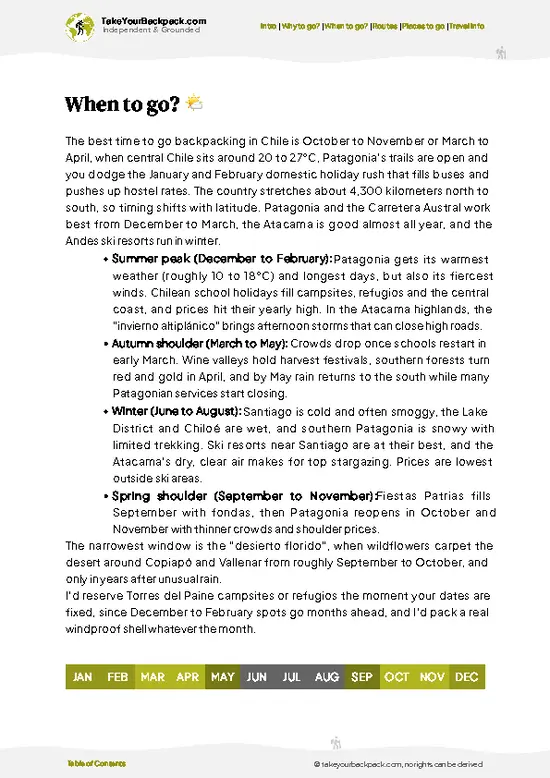
example page 0 from our offline Travel Guide for Chile
example page 1 from our offline Travel Guide for Chile
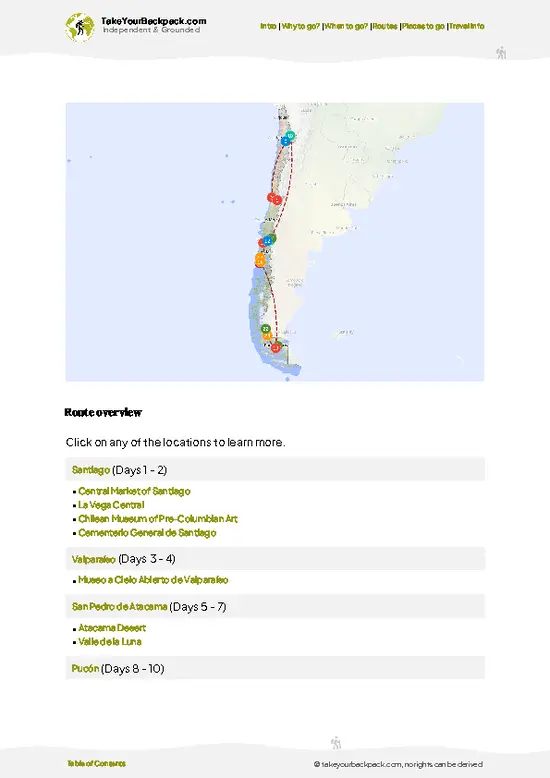
example page 2 from our offline Travel Guide for Chile
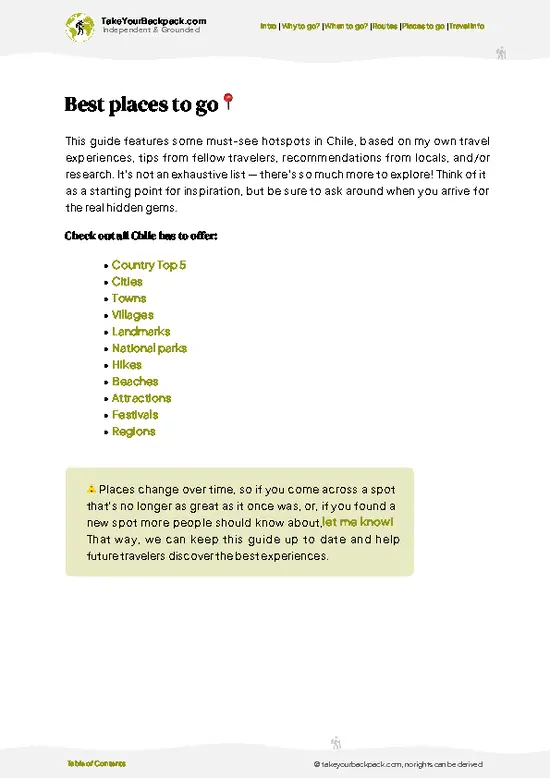
example page 3 from our offline Travel Guide for Chile
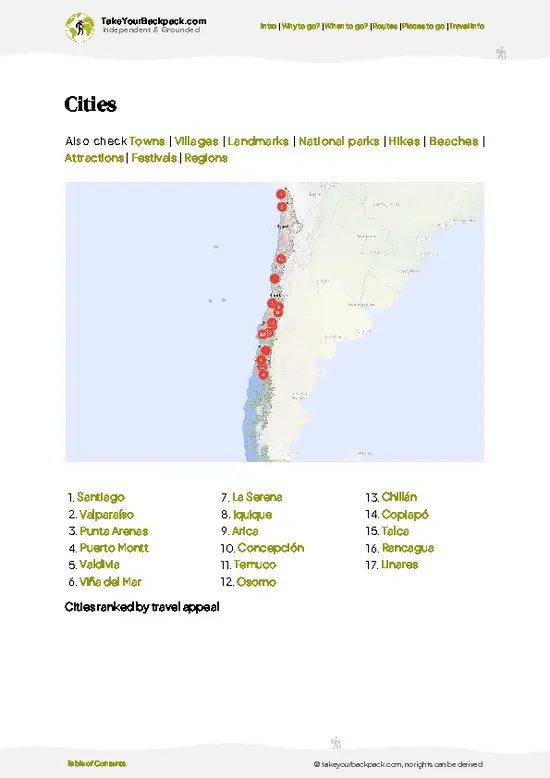
example page 4 from our offline Travel Guide for Chile
example page 5 from our offline Travel Guide for Chile
example page 6 from our offline Travel Guide for Chile
example page 7 from our offline Travel Guide for Chile
Loading the map 🌍
CLICK TO FILTER
cities
towns
villages
landmarks
national parks
hikes
beaches
attractions
festivals
regions
SHOW COUNTRY’S BESTSHOW ALL

✨ Why go?
Ranked #4 hike in Chile
Why visitors keep coming back

Cerro Castillo gives you a full alpine circuit without needing a vehicle or a guide. The big draw is the view of the Cerro Castillo massif, a ridge of dark, broken spires that rises behind a glacier-fed lake in a color you rarely see outside a paint chart. Few Patagonian treks put this much drama into four days. The route is also sociable and well marked, with simple campsites roughly a day apart, so you can go without booking every night. The second reason is the Carretera Austral. The trailhead sits on the highway, so the hike slots into a longer southbound trip along the road, and you can resupply in the village before you go and again afterward. The third is the Paso Peñón crossing, a high pass where the whole valley opens beneath you. Expect wind, scree and some sketchy footing, but also … read more 👉
Cerro Castillo gives you a full alpine circuit without needing a vehicle or a guide. The big draw is the view of the Cerro Castillo massif, a ridge of dark, broken spires that rises behind a glacier-fed lake in a color you rarely see outside a paint chart. Few Patagonian treks put this much drama into four days. The route is also sociable and well marked, with simple campsites roughly a day apart, so you can go without booking every night. The second reason is the Carretera Austral. The trailhead sits on the highway, so the hike slots into a longer southbound trip along the road, and you can resupply in the village before you go and again afterward. The third is the Paso Peñón crossing, a high pass where the whole valley opens beneath you. Expect wind, scree and some sketchy footing, but also the feeling of having earned a view that most road-trippers only see in photos.

💡 HighlightsMust-see experiences and standout moments

  1. Laguna Cerro Castillo: The headline sight. A milky turquoise lake sits directly below the castle-like peaks, with hanging glaciers dropping into it. Most day walkers aim for this and nothing else, and the scale of the wall behind the water justifies the climb.
  2. Cerro Castillo Spires: The serrated ridge that gave the mountain its name. Its dark volcanic towers look like battlements, and you see them from multiple angles on the loop, each one different. On clear mornings the rock turns sharp and detailed.
  3. Paso Peñón: The high point of the circuit, crossed over loose rock and open ground. The pass gives long views over the valleys on either side. It is exposed and often windy, so it demands an early start and a solid weather window.
  4. Campamento Neozelandés: A forest camp beside a stream, a natural
… read more 👉
  1. Laguna Cerro Castillo: The headline sight. A milky turquoise lake sits directly below the castle-like peaks, with hanging glaciers dropping into it. Most day walkers aim for this and nothing else, and the scale of the wall behind the water justifies the climb.
  2. Cerro Castillo Spires: The serrated ridge that gave the mountain its name. Its dark volcanic towers look like battlements, and you see them from multiple angles on the loop, each one different. On clear mornings the rock turns sharp and detailed.
  3. Paso Peñón: The high point of the circuit, crossed over loose rock and open ground. The pass gives long views over the valleys on either side. It is exposed and often windy, so it demands an early start and a solid weather window.
  4. Campamento Neozelandés: A forest camp beside a stream, a natural overnight stop. The trees block much of the wind, and it comes after the lake and the Morro Negro ridge. It is among the more pleasant places to cook dinner on the trek.
  5. Valle de la Lima: The river valley at the start of the trek near Las Horquetas, with forest, a wide gravel floodplain and rushing meltwater. It is quieter than the high sections and gives you a different side of the landscape, with a decent chance of spotting condors circling overhead.
If time is short, skip the full traverse and make a day trip to the lake from the village instead.
Spotted a mistake or missing something? Contact us.

Things to do near Cerro Castillo

Ratings based on Tripadvisor reviews. When you book through this link, you support our work at no extra cost to you.

🌤️ When to go?Weather, crowds, and seasonal trade-offs

  • Summer (December to February): Cerro Castillo is at its most dependable for the multi-day circuit, with daytime highs of 15 to 22°C (59 to 72°F) and nights near 2 to 5°C (36 to 41°F). Daylight runs roughly 15 to 16 hours. Wind is constant and sometimes violent on the passes. This is peak season, so campsites fill and lodging in Villa Cerro Castillo costs the most.
  • Autumn (March to April): Lenga forests turn red and orange, crowds thin, and highs sit at 8 to 15°C (46 to 59°F). Rain and early snow on the high pass become more likely by April.
  • Winter (May to September): Snow covers the passes, daylight drops to about 8 hours, and temperatures range from -8 to 5°C (18 to 41°F). Most services close and the circuit is not practical without mountaineering skills.
  • Spring (October to November): Trails
… read more 👉
  • Summer (December to February): Cerro Castillo is at its most dependable for the multi-day circuit, with daytime highs of 15 to 22°C (59 to 72°F) and nights near 2 to 5°C (36 to 41°F). Daylight runs roughly 15 to 16 hours. Wind is constant and sometimes violent on the passes. This is peak season, so campsites fill and lodging in Villa Cerro Castillo costs the most.
  • Autumn (March to April): Lenga forests turn red and orange, crowds thin, and highs sit at 8 to 15°C (46 to 59°F). Rain and early snow on the high pass become more likely by April.
  • Winter (May to September): Snow covers the passes, daylight drops to about 8 hours, and temperatures range from -8 to 5°C (18 to 41°F). Most services close and the circuit is not practical without mountaineering skills.
  • Spring (October to November): Trails are wet and muddy with lingering snow up high. Highs are 8 to 15°C (46 to 59°F), and prices are lower.
Aim for late January or February if you want the quietest weather window before March.


source: climatestotravel.comJANJanuary: excellent for travelingFEBFebruary: excellent for travelingMARMarch: highly recommended for travelingAPRApril: fair for travelingMAYMay: below average for travelingJUNJune: below average for travelingJULJuly: below average for travelingAUGAugust: below average for travelingSEPSeptember: fair for travelingOCTOctober: good for travelingNOVNovember: highly recommended for travelingDECDecember: excellent for traveling
chile-hike-cerro-castillo
© Google | Leo Fotografie

✈️ The backpacker research shortcutChile Travel Guide

An offline-friendly backpacking guide with optimized travel routes, ranked highlights, transport advice, and the best areas to stay.
example page 0 from our offline Travel Guide for Chile
example page 1 from our offline Travel Guide for Chile
example page 2 from our offline Travel Guide for Chile
example page 3 from our offline Travel Guide for Chile
example page 4 from our offline Travel Guide for Chile
example page 5 from our offline Travel Guide for Chile
example page 6 from our offline Travel Guide for Chile
example page 7 from our offline Travel Guide for Chile
The digital guide (333 pages) contains:
✅ 107 highlights, ranked by travel appeal
✅ Optimized 7, 14 & 21-day travel routes
✅ Cities, national parks, landmarks, beaches
✅ How to get around
✅ Offline-friendly for travel without Wi-Fi
👉 Click to see all 30+ guide features

📅 Plan smarter in minutes, not weeks
✅ Month by month travel advice
✅ Festivals & national holidays
✅ Budget expectations

🗺️ Go to the right places, skip the overrated ones
✅ Honest pros & cons of destinations
✅ Top hikes, parks & viewpoints
✅ Lesser-known places most travelers miss
✅ Clear “worth it vs skip it” guidance

🛏️ Travel smoothly without rookie mistakes
✅ Best areas to stay
✅ Transport systems explained simply
✅ Common scams & safety advice
✅ SIM cards, money & practical tips

🌍 Understand the country, not just visit it
✅ Culture & traditions
✅ 52 Essential phrases & customs
✅ Festivals worth planning around
✅ Traveler-friendly historical context
✅ Insights that make places more meaningful

📱 Built for real travel conditions
✅ Fully downloadable PDF
✅ Works completely offline
✅ Optimized for phone use
✅ Useful in remote areas & buses
✅ Everything in one place
Stop searching, start planning
Get instant access to your full guide. 30‑day money-back guarantee.
+ Add another guide for just

By proceeding you agree to our terms.
Sent to your inbox immediately after payment • 100% Secure Checkout
Best Backpacking Travel Advisor 2025 tourism awardBest Backpacking
Travel Advisor
2025
What others say about Take Your Backpack Guides:
⭐⭐⭐⭐⭐
Fantastic, amazing amount of information!
⭐⭐⭐⭐⭐
My goodness this is amazing, it's what I've been looking for hats off too you!
⭐⭐⭐⭐⭐
I think this is absolutely BRILLIANT
⭐⭐⭐⭐
Very complete and informative. It's still missing places, but I gotta to commend you
⭐⭐⭐⭐⭐
This is truly amazing, thank you, can't wait to explore it with my kids!
⭐⭐⭐⭐⭐
Awesome resource, thank you!
⭐⭐⭐⭐⭐
This is amazing! Can't wait to explore the ones I haven't seen
⭐⭐⭐⭐
I love this! Well done, great idea.
⭐⭐⭐⭐⭐
Thanks for taking the time to make this gem!
⭐⭐⭐⭐⭐
This might be the best website I've ever seen.
⭐⭐⭐⭐⭐
Congratulations, and thank you so much for your work; it's incredibly valuable.
⭐⭐⭐⭐
In all seriousness I think you did a great job pointing out the important spots
⭐⭐⭐⭐⭐
10/10 very good
⭐⭐⭐⭐⭐
As someone who's only just starting to visit regularly this is awesome, thank you.
⭐⭐⭐⭐
Thank you very much! I'm going to visit my dad, it's going to be very useful!
⭐⭐⭐⭐⭐
This is really cool! We'll be travelling for the first time and this definitely come in handy.
⭐⭐⭐⭐⭐
You are now our minister of culture, congratulations 👨‍💼
⭐⭐⭐⭐⭐
Just wanted to tell you that this is a pearl! Going to follow your recommendations.
⭐⭐⭐⭐⭐
This is so cool. I'll definitely be using the resource for my travels soon.
⭐⭐⭐⭐⭐
This is very impressive! Good work.
⭐⭐⭐⭐⭐
This is an amazing and informative site. Very well done!

🛏️ Where to stay?Where staying makes the most sense

If you enjoy meeting fellow travelers, consider choosing hostels with high ratings for atmosphere. On the other hand, if you prefer having your own space, a hotel might be a better option.

🥾 Hike detailsRoute, distance, and difficulty explained

Cerro Castillo Circuit: Cerro Castillo is usually hiked as a one-way traverse of about 50 to 55 kilometers, with the option of a shorter out-and-back to the lake.
Total Distance: Roughly 50 to 55 kilometers for the full traverse.
Estimated Duration: Four days is standard; fit hikers with early starts sometimes manage it in three.
Difficulty: Moderate to demanding. Steep climbs, loose scree and exposed sections near the pass make it harder than the distance suggests. Several stream crossings can run high after rain or heavy melt.
Starting Point: The trail begins at the Las Horquetas entrance on the
… read more 👉
Cerro Castillo Circuit: Cerro Castillo is usually hiked as a one-way traverse of about 50 to 55 kilometers, with the option of a shorter out-and-back to the lake.
Total Distance: Roughly 50 to 55 kilometers for the full traverse.
Estimated Duration: Four days is standard; fit hikers with early starts sometimes manage it in three.
Difficulty: Moderate to demanding. Steep climbs, loose scree and exposed sections near the pass make it harder than the distance suggests. Several stream crossings can run high after rain or heavy melt.
Starting Point: The trail begins at the Las Horquetas entrance on the Carretera Austral north of the village, where buses can drop you. It finishes at the Estero Parada entrance next to Villa Cerro Castillo.
Major Landmarks:
  • Río Turbio Valley: An approach along an old logging road with gentle early gradients and the first camp.
  • Campamento El Bosque: A forest camp below the lake, the base for the climb to the viewpoint.
  • Laguna Cerro Castillo: The turquoise lake beneath the spires, the scenic highlight.
  • Paso Peñón: The exposed high pass at the heart of the route.
Terrain and Scenery: Forest paths give way to moraines, scree slopes, rocky ridges and glacial valleys, with the castle-like ridge dominating the horizon throughout.
Vegetation: Lenga and ñire forest in the lower valleys, thinning to shrubs, grass and bare rock above the tree line.
Wildlife: Andean condors are common overhead. Foxes and guanacos sometimes appear, and the rare huemul, an endangered Andean deer, lives in the area, though sightings are unusual.
⚠️ Hiking info can sometimes be outdated or inaccurate. Before you hit the trail, check the latest conditions with locals. If you do spot anything that's off, I'd love to hear from you, so I can update it for fellow travelers.

🛡️ SafetySafety Tips and Common Scams in Cerro Castillo

The Cerro Castillo circuit is well marked and straightforward for fit hikers, but the weather is what catches people out. Wind on the high pass at Paso Peñón can knock you off balance, and storms arrive fast, so start early and carry a proper shell, warm layers, gloves and a hat even in January. The climb to the viewpoint over the turquoise lagoon is steep and loose underfoot, so poles help on the descent. Several streams need crossing after rain, and waterproof boots or camp shoes make that easier. Camp only in designated sites, since fires are banned and wildfire risk is taken seriously. Pumas and huemul deer live here but encounters are rare. Store food securely and give any wildlife distance. Register at the ranger post, as the park charges an entry fee, and carry offline maps because phone signal disappears quickly.

FAQTraveler FAQ

The classic Cerro Castillo circuit takes 4 days and 3 nights, covering roughly 50 to 55 km (31 to 34 miles). Most people start at Las Horquetas near Villa Cerro Castillo and finish at Estero Parada or the reverse. Day hikers can reach the viewpoint above the turquoise lagoon in about 6 to 8 hours round trip from Villa Cerro Castillo.
Cerro Castillo is a moderate to challenging trek, mainly because of wind, weather and steep ascents rather than technical terrain. Days run 5 to 9 hours with long climbs, including the high pass at about 1,450 m (4,750 ft) and a rocky, exposed descent. Good fitness and a decent pack weight under 15 kg (33 lb) make it far more enjoyable.
Cerro Castillo does not require a guide, as the trail is well marked and many hikers go independently. A park entry ticket is required, for foreigners about US$25 for a day hike and about US$35 for the multi-day trek, paid at the entrance or in advance online. Guided trips from Coyhaique or Villa Cerro Castillo run roughly US$400 to 800 for four days, including gear and food.
⚠️ Things can change over time, so always validate details locally before you go.

Other Chilean hikes near Cerro Castillo

Explore more nearby:


💡 Not sure where to go next?
Create a personalized itinerary for Chile including Cerro Castillo and the places that fit your trip.

Generate my itinerary

👉 Discover all hikes

Or checkout all Chile has to offer (think cities, towns, villages, national parks, hikes, beaches, festivals)
Country photo of Chile

We 💚 feedbackSumming up the experience

Cerro Castillo suits hikers who want a proper mountain loop, with big views and some effort, rather than a casual stroll. If you have only a day, walk to the lake and stop there. If you have four, do the circuit and start early on the pass day. I would bring trekking poles for the scree and the stream crossings.

✈️ When did I visit Chile?
I have visited Chile, together with Argentina, in September 2012.

✍️ Help improve this page!
The information on this page is based on my own backpacking experience in Chile, supplemented with up-to-date research and feedback from other travelers. Travel details can change, so if you notice anything outdated or incomplete, feel free to let me know.


🙋‍♂️ Give feedback

👋 Meet the founderWho’s Behind Take Your Backpack?

Johan, backpacker and founder of TakeYourBackpackHi, I’m Johan (Netherlands 🇳🇱), the creator of TakeYourBackpack. Over the past 3 decades, I’ve backpacked through 90+ countries across six continents, gaining extensive experience with independent travel, long-term trips, and overland routes.

This site is built on a combination of firsthand travel experience and carefully curated insights from other backpackers. Many guides are based on places I’ve personally visited, while others bring together tips, observations, and practical advice shared by trusted travelers I’ve met along the way.

The goal is to provide realistic, experience-driven guidance — not generic itineraries — so you can explore destinations with better context, clearer expectations, and more confidence.