×

Comoros🇰🇲 | citiesMoroniHarbor medina, Karthala trailhead, Volo Volo market, corniche | things to do and best time to go

Explore Bouni BeachExplore Mutsamudu

Backpacking in Moroni
🏆 Top pickcity ranked #1
By Johan Kruseman 🇳🇱 | Updated October 24, 2026

Most people come to Moroni for the Old Friday Mosque and the medina around the harbor, where dhows rock beside a fishing quay and the air smells of cloves, diesel and grilled fish. What gets overlooked is that Moroni is the practical gateway to Mount Karthala, the active volcano on Grande Comore, and the place where you sort out almost everything else. Moroni sits on the west coast of Grande Comore, in Comoros’s capital region. Cash matters here because cards rarely work, so bring euros and change them at a bank or with a trusted money changer, the way locals do. Power cuts are routine, so charge things whenever you can and carry a headlamp. Dress modestly, since the island is devoutly Muslim, and you will blend in and get warmer greetings. It suits flexible travelers and not those wanting polish. A first day could start at the harbor at dawn, then wander the medina lanes and finish with grilled fish on the seafront.

Discover everything you want to know in the 📖 Comoros Travel Guide.


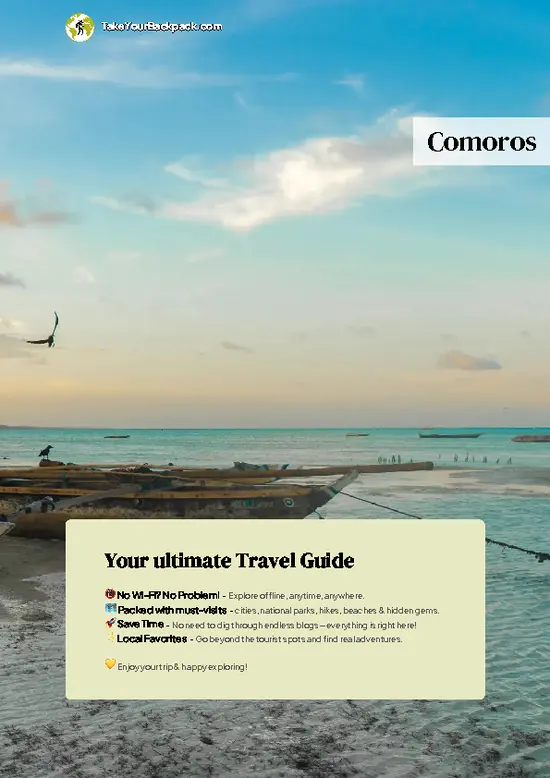
example page 0 from our offline Travel Guide for Comoros
example page 1 from our offline Travel Guide for Comoros
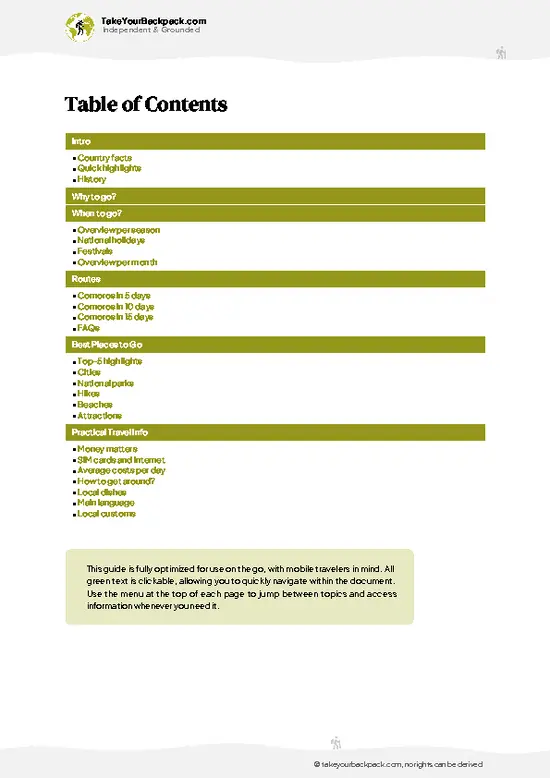
example page 2 from our offline Travel Guide for Comoros
example page 3 from our offline Travel Guide for Comoros
example page 4 from our offline Travel Guide for Comoros
example page 5 from our offline Travel Guide for Comoros
example page 6 from our offline Travel Guide for Comoros
example page 7 from our offline Travel Guide for Comoros
Loading the map 🌍
CLICK TO FILTER
cities
national parks
hikes
beaches
attractions
SHOW COUNTRY’S BESTSHOW ALL

✨ Why go?
Ranked #1 city in Comoros
Why visitors keep coming back

Moroni is where you land, and for most people it is also where Comoros starts to make sense. The medina is compact enough to cover on foot, and the old mosques, carved doors and Volcan Karthala looming behind the city give you a real sense of place within a morning. The island has few hostels, so you will mostly use small guesthouses and family-run hotels, which brings you into contact with locals more than a dorm would. The pace is slow, the French and Comorian conversations are friendly, and the food leans on fish, cassava, coconut and spice. Moroni works as a basecamp for Grande Comore, since you can reach beaches, crater walks and villages without changing beds. It also works for onward travel, because the main airport at Hahaya and the ferries and flights to Anjouan and Mohéli all start … read more 👉
Moroni is where you land, and for most people it is also where Comoros starts to make sense. The medina is compact enough to cover on foot, and the old mosques, carved doors and Volcan Karthala looming behind the city give you a real sense of place within a morning. The island has few hostels, so you will mostly use small guesthouses and family-run hotels, which brings you into contact with locals more than a dorm would. The pace is slow, the French and Comorian conversations are friendly, and the food leans on fish, cassava, coconut and spice. Moroni works as a basecamp for Grande Comore, since you can reach beaches, crater walks and villages without changing beds. It also works for onward travel, because the main airport at Hahaya and the ferries and flights to Anjouan and Mohéli all start here. Come for three or four days if you want a volcano hike and some beach time. It is not a nightlife city, and a quiet evening of tea and seafood is the norm. If you want infrastructure and ease, this is a short stop. If you like rough edges and warm welcomes, it is a pleasure.

💡 HighlightsMust-see experiences and standout moments

  1. Old Friday Mosque (Ancienne Mosquée du Vendredi): The white-washed 15th-century mosque with a tall minaret sits on the harbor and is the city’s best-known landmark. Visit in the early morning, dress modestly and ask before entering. Exterior views are free, and 30 minutes is enough.
  2. Medina and old harbor: Narrow lanes, carved wooden doors and fishermen mending nets around the dhow quay. Go at dawn or late afternoon when the light is soft and boats are active. Free, 1 to 2 hours.
  3. Volcan Karthala viewpoints and hikes: The volcano dominates the skyline, and a guided hike to the crater is the island’s signature outing. Go in the dry season, from roughly May to October. A local guide costs about €30 to 60, and the trek takes one to two days depending on route.
  4. Prince Said Ibrahim Mosque: A striking
… read more 👉
  1. Old Friday Mosque (Ancienne Mosquée du Vendredi): The white-washed 15th-century mosque with a tall minaret sits on the harbor and is the city’s best-known landmark. Visit in the early morning, dress modestly and ask before entering. Exterior views are free, and 30 minutes is enough.
  2. Medina and old harbor: Narrow lanes, carved wooden doors and fishermen mending nets around the dhow quay. Go at dawn or late afternoon when the light is soft and boats are active. Free, 1 to 2 hours.
  3. Volcan Karthala viewpoints and hikes: The volcano dominates the skyline, and a guided hike to the crater is the island’s signature outing. Go in the dry season, from roughly May to October. A local guide costs about €30 to 60, and the trek takes one to two days depending on route.
  4. Prince Said Ibrahim Mosque: A striking mosque on the waterfront with a distinct Arab-influenced design, best seen from outside at golden hour. Free, 15 to 20 minutes.
  5. Marché Volo Volo: The main market, loud with fruit, vanilla, cloves, spices and fabric. Go in the morning when stock is freshest. Entry is free and you will spend about an hour. Bring small euro notes.
  6. Seafront Corniche: A walk along the waterfront past fishing boats and old buildings. Best in the evening when the breeze comes in. Free, 30 to 60 minutes.
  7. Musée National des Comores: A small museum on local history, crafts and culture. Plan around 45 minutes. Entry is typically cheap, around €2 to 5.
Beyond the city, day trips can take you to Itsandra beach, Mitsamiouli and the white-sand coast of the north, Lac Salé crater lake, and Chomoni on the east side. Start with the mosque and medina at dawn, since the light is gentle, the harbor is busiest with fishermen and the heat has not yet built.
Spotted a mistake or missing something? Contact us.

🏘️ NeighborhoodsHow different areas shape the experience

Moroni is small enough to cover on foot in a morning, but the heat and the traffic decide how you do it, so start early and finish before the midday sun flattens everything.
  • Medina and old port: This is the core. Narrow lanes run between coral-stone houses with carved wooden doors, and the air smells of salt, diesel, cloves and fish from the harbor. Tour it before 10 a.m., when fishermen unload and the light is soft. Dress modestly, since this is a devout Muslim quarter.
  • Volo Volo market: Stalls pile up vanilla, ylang-ylang, cloves, bananas and cassava, with vendors calling over the sound of radios. Go in the morning, when produce is freshest and the crush is manageable. Carry small notes, because nobody can break large ones.
  • Place de France and the center: Banks, offices, small cafés and the
… read more 👉
Moroni is small enough to cover on foot in a morning, but the heat and the traffic decide how you do it, so start early and finish before the midday sun flattens everything.
  • Medina and old port: This is the core. Narrow lanes run between coral-stone houses with carved wooden doors, and the air smells of salt, diesel, cloves and fish from the harbor. Tour it before 10 a.m., when fishermen unload and the light is soft. Dress modestly, since this is a devout Muslim quarter.
  • Volo Volo market: Stalls pile up vanilla, ylang-ylang, cloves, bananas and cassava, with vendors calling over the sound of radios. Go in the morning, when produce is freshest and the crush is manageable. Carry small notes, because nobody can break large ones.
  • Place de France and the center: Banks, offices, small cafés and the main taxi hub sit here. It is noisy with horns and dust, and not pretty, but it is where you sort out money and transport. Walkable, though sidewalks are patchy.
  • Itsandra and the northern coast: A few kilometers north, black volcanic rock meets calm water and the pace drops. Rides take 10 to 15 minutes by shared taxi. Better for a quiet evening meal and a swim than for sights.
  • Corniche and south edge: Walking the sea road at dusk, you get grilled fish smoke, kids playing football on the sand and views of Karthala’s bulk inland. Lighting is poor after dark, so a shared taxi home is smarter than a late stroll.

⌛️ 1 dayHow to make the most of one day

7:00 AM: Old harbor. Start at the dhow quay while fishermen unload and the light is soft. Watch the boats, then walk uphill into the medina, which is a few minutes away.
8:00 AM: Old Friday Mosque. Admire the white minaret from outside and ask politely before entering. Then wander the nearby lanes and look at carved doors.
9:30 AM: Breakfast in the medina. Stop at a small local spot for mahamri-style bread or fried snacks and sweet tea. Prices are small and you meet locals.
10:30 AM: Marché Volo Volo. Walk to the market and browse cloves, vanilla and fabric. Go before the midday heat, and bring small notes.
12:30 PM: Lunch by the sea. Order grilled fish with rice or cassava at a simple waterfront restaurant and rest through the hottest hours.
2:30 PM: Musée National des Comores. Spend under an … read more 👉
7:00 AM: Old harbor. Start at the dhow quay while fishermen unload and the light is soft. Watch the boats, then walk uphill into the medina, which is a few minutes away.
8:00 AM: Old Friday Mosque. Admire the white minaret from outside and ask politely before entering. Then wander the nearby lanes and look at carved doors.
9:30 AM: Breakfast in the medina. Stop at a small local spot for mahamri-style bread or fried snacks and sweet tea. Prices are small and you meet locals.
10:30 AM: Marché Volo Volo. Walk to the market and browse cloves, vanilla and fabric. Go before the midday heat, and bring small notes.
12:30 PM: Lunch by the sea. Order grilled fish with rice or cassava at a simple waterfront restaurant and rest through the hottest hours.
2:30 PM: Musée National des Comores. Spend under an hour on local history and crafts. It is quiet and a good escape from the heat.
4:00 PM: Backstreets of the residential quarters. Leave the usual route and wander the quieter neighborhoods away from the harbor, where kids play, women chat on doorsteps and small shops sell everyday goods. Greet people, ask before photographing and keep a relaxed pace.
5:30 PM: Corniche at sunset. Walk the seafront as the breeze rises and fishing boats head out. Finish with tea or a cold drink and a plate of grilled seafood.

🌤️ When to go?Best time to visit Moroni

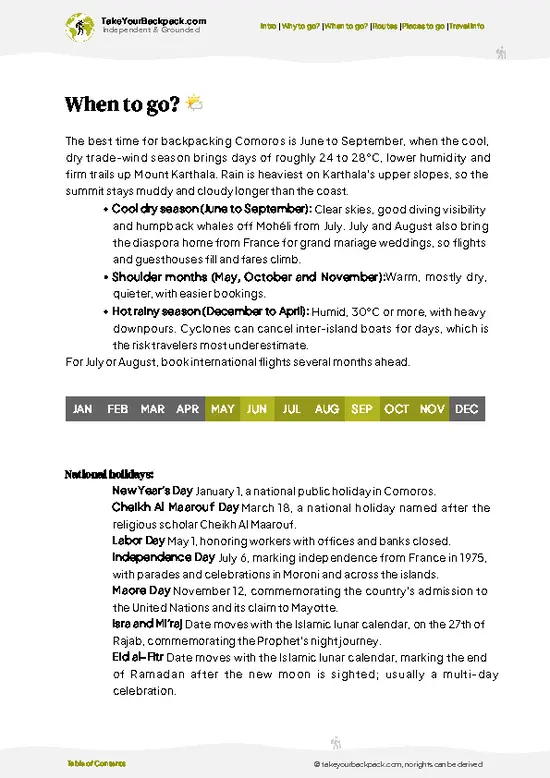
The best time for Moroni is the dry season from May to October, when days sit around 25 to 28°C (77 to 82°F) and rain is light.
  • Dry season (May to October): Humidity eases, nights fall to about 19 to 22°C (66 to 72°F), and seas are good for swimming and boat trips. Days are shorter, with roughly 11 to 12 hours of daylight. Flights and rooms are tightest in July and August, when diaspora families visit, so prices rise.
  • Hot wet season (November to April): Expect 28 to 32°C (82 to 90°F), heavy humidity, and downpours that flood streets. Cyclone risk peaks from January to March, and some ferries and flights get disrupted. Prices dip and crowds are almost nil.
  • Ramadan: Many cafés and food stalls close in daylight, and energy is lower. Evenings are lively after the fast breaks. Dates shift each year.
… read more 👉
The best time for Moroni is the dry season from May to October, when days sit around 25 to 28°C (77 to 82°F) and rain is light.
  • Dry season (May to October): Humidity eases, nights fall to about 19 to 22°C (66 to 72°F), and seas are good for swimming and boat trips. Days are shorter, with roughly 11 to 12 hours of daylight. Flights and rooms are tightest in July and August, when diaspora families visit, so prices rise.
  • Hot wet season (November to April): Expect 28 to 32°C (82 to 90°F), heavy humidity, and downpours that flood streets. Cyclone risk peaks from January to March, and some ferries and flights get disrupted. Prices dip and crowds are almost nil.
  • Ramadan: Many cafés and food stalls close in daylight, and energy is lower. Evenings are lively after the fast breaks. Dates shift each year.
  • Grand Mariage season: Big wedding celebrations cluster in the dry months and can fill the city with visitors.
Book flights for June or September if you want dry weather without the summer price spike.


source: climatestotravel.comJANJanuary: below average for travelingFEBFebruary: below average for travelingMARMarch: fair for travelingAPRApril: fair for travelingMAYMay: excellent for travelingJUNJune: excellent for travelingJULJuly: highly recommended for travelingAUGAugust: highly recommended for travelingSEPSeptember: excellent for travelingOCTOctober: excellent for travelingNOVNovember: fair for travelingDECDecember: fair for traveling
when-to-go

✈️ The backpacker research shortcutComoros Travel Guide

An offline-friendly backpacking guide with optimized travel routes, ranked highlights, transport advice, and the best areas to stay.
example page 0 from our offline Travel Guide for Comoros
example page 1 from our offline Travel Guide for Comoros
example page 2 from our offline Travel Guide for Comoros
example page 3 from our offline Travel Guide for Comoros
example page 4 from our offline Travel Guide for Comoros
example page 5 from our offline Travel Guide for Comoros
example page 6 from our offline Travel Guide for Comoros
example page 7 from our offline Travel Guide for Comoros
The digital guide (84 pages) contains:
✅ 15 highlights, ranked by travel appeal
✅ Optimized 5, 10 & 15-day travel routes
✅ Cities, national parks, landmarks, beaches
✅ How to get around
✅ Offline-friendly for travel without Wi-Fi
👉 Click to see all 30+ guide features

📅 Plan smarter in minutes, not weeks
✅ Month by month travel advice
✅ Festivals & national holidays
✅ Budget expectations

🗺️ Go to the right places, skip the overrated ones
✅ Honest pros & cons of destinations
✅ Top hikes, parks & viewpoints
✅ Lesser-known places most travelers miss
✅ Clear “worth it vs skip it” guidance

🛏️ Travel smoothly without rookie mistakes
✅ Best areas to stay
✅ Transport systems explained simply
✅ Common scams & safety advice
✅ SIM cards, money & practical tips

🌍 Understand the country, not just visit it
✅ Culture & traditions
✅ 52 Essential phrases & customs
✅ Festivals worth planning around
✅ Traveler-friendly historical context
✅ Insights that make places more meaningful

📱 Built for real travel conditions
✅ Fully downloadable PDF
✅ Works completely offline
✅ Optimized for phone use
✅ Useful in remote areas & buses
✅ Everything in one place
Stop searching, start planning
Get instant access to your full guide. 30‑day money-back guarantee.
+ Add another guide for just

By proceeding you agree to our terms.
Sent to your inbox immediately after payment • 100% Secure Checkout
Best Backpacking Travel Advisor 2025 tourism awardBest Backpacking
Travel Advisor
2025
What others say about Take Your Backpack Guides:
⭐⭐⭐⭐⭐
Fantastic, amazing amount of information!
⭐⭐⭐⭐⭐
My goodness this is amazing, it's what I've been looking for hats off too you!
⭐⭐⭐⭐⭐
I think this is absolutely BRILLIANT
⭐⭐⭐⭐
Very complete and informative. It's still missing places, but I gotta to commend you
⭐⭐⭐⭐⭐
This is truly amazing, thank you, can't wait to explore it with my kids!
⭐⭐⭐⭐⭐
Awesome resource, thank you!
⭐⭐⭐⭐⭐
This is amazing! Can't wait to explore the ones I haven't seen
⭐⭐⭐⭐
I love this! Well done, great idea.
⭐⭐⭐⭐⭐
Thanks for taking the time to make this gem!
⭐⭐⭐⭐⭐
This might be the best website I've ever seen.
⭐⭐⭐⭐⭐
Congratulations, and thank you so much for your work; it's incredibly valuable.
⭐⭐⭐⭐
In all seriousness I think you did a great job pointing out the important spots
⭐⭐⭐⭐⭐
10/10 very good
⭐⭐⭐⭐⭐
As someone who's only just starting to visit regularly this is awesome, thank you.
⭐⭐⭐⭐
Thank you very much! I'm going to visit my dad, it's going to be very useful!
⭐⭐⭐⭐⭐
This is really cool! We'll be travelling for the first time and this definitely come in handy.
⭐⭐⭐⭐⭐
You are now our minister of culture, congratulations 👨‍💼
⭐⭐⭐⭐⭐
Just wanted to tell you that this is a pearl! Going to follow your recommendations.
⭐⭐⭐⭐⭐
This is so cool. I'll definitely be using the resource for my travels soon.
⭐⭐⭐⭐⭐
This is very impressive! Good work.
⭐⭐⭐⭐⭐
This is an amazing and informative site. Very well done!

🛏️ Where to stay?How to pick the right area

The best bet for a budget bed in Moroni is the central area around the medina and Place de France, with the Itsandra coast to the north as a quieter alternative.
Budget choices are limited. There are no true hostel dorms in the usual sense, so most backpackers use small guesthouses and basic hotels, roughly €15 to 35 a night for a private room. Book ahead in July and August, when families return from abroad and rooms fill.
The center puts you within walking distance of the market, banks, ATMs and the shared taxi hub, and you can reach most places on foot. Expect noise: horns, early calls to prayer … read more 👉
The best bet for a budget bed in Moroni is the central area around the medina and Place de France, with the Itsandra coast to the north as a quieter alternative.
Budget choices are limited. There are no true hostel dorms in the usual sense, so most backpackers use small guesthouses and basic hotels, roughly €15 to 35 a night for a private room. Book ahead in July and August, when families return from abroad and rooms fill.
The center puts you within walking distance of the market, banks, ATMs and the shared taxi hub, and you can reach most places on foot. Expect noise: horns, early calls to prayer and generators from first light. Earplugs are worth packing. Streets are reasonably safe in the evening, but unlit stretches make short taxi rides sensible after dark.
Itsandra and the northern coast trade convenience for calm. Rooms there tend to cost a bit more, but you get sea breezes, less traffic and easier swimming. Shared taxis reach town in 10 to 15 minutes by day, though service dries up in the evening, so you may pay for a private ride back.
Back-street rooms in the medina can be cheaper, though some lack reliable water or power. Ask whether there is a generator and fan, because outages are common.

🚌 Getting aroundHow to get around Moroni

Climbing into a private taxi without agreeing the fare first costs visitors the most, because the driver quotes tourist prices and the argument starts once you arrive. Shared taxis are the answer. Moroni is compact, traffic is loud but slow, and there is no real public transit system, so everything runs on informal vehicles, your feet and the occasional scooter.
  • Walking: The medina, port, Volo Volo and center are all within about 20 minutes of each other. Go early, before the heat builds, and watch for potholes and uneven curbs, because sidewalks vanish without warning. Free.
  • Shared taxis: White-and-colored cars and minivans run fixed routes along the coast and into town, honking for passengers. Fares are about €0.30 to 0.70 per short hop, and drivers squeeze in extra people, so expect close
… read more 👉
Climbing into a private taxi without agreeing the fare first costs visitors the most, because the driver quotes tourist prices and the argument starts once you arrive. Shared taxis are the answer. Moroni is compact, traffic is loud but slow, and there is no real public transit system, so everything runs on informal vehicles, your feet and the occasional scooter.
  • Walking: The medina, port, Volo Volo and center are all within about 20 minutes of each other. Go early, before the heat builds, and watch for potholes and uneven curbs, because sidewalks vanish without warning. Free.
  • Shared taxis: White-and-colored cars and minivans run fixed routes along the coast and into town, honking for passengers. Fares are about €0.30 to 0.70 per short hop, and drivers squeeze in extra people, so expect close quarters and open windows. Watch what locals pay and hand over the same, in small coins or notes. Service thins out after dark, around 8 or 9 p.m., and early mornings start around 6 a.m.
  • Private taxi (course): Cars for one passenger cost roughly €2 to 4 within town and €8 to 15 for longer runs such as the airport at Hahaya, about 20 to 30 minutes away. Fix the price before you open the door. Hotels can call a driver they trust, which beats flagging one at the airport.
  • Hired car with driver: For a day around Grande Comore, drivers charge about €40 to 70 depending on distance and bargaining. Splitting between three or four people makes this sensible, and it is the easiest way to reach Karthala foothills, Mitsamiouli and the crater lakes.
  • Scooter or motorbike taxi: Some riders carry passengers for €1 to 2, though helmets are rare and roads are rough. I would skip this on wet days, when the dust turns to slick mud.

👛 Costs (as of 24 October 2026)How expensive it really is

Backpacking in Moroni costs about €45 a day in high season, with most of the money going to a private room.
CategoryBudget RangeLocal Reality
Dorm/budget bed (high season)€15 to 25No real dorms. A basic guesthouse room runs about €20, and it fills in July and August.
Budget bed (off-season)€12 to 20Rooms are easier to bargain down from November to April.
Meals€8 to 12Street snacks under €1, plate of fish and rice €3 to 6.
Local transport€2 to 4Shared taxi hops cost €0.30 to 0.70 each, private rides €2 to 4.
City transport passNot availableNo pass exists. Pay per ride in cash.
Basic activities/entry fees€3 to 8Most sights are free, but guides and beach access can add small fees.
Miscellaneous€3 to 5Bottled water, SIM data and snacks.
Total Daily Budget€41 to 74About €45 on a lean day with a high-season
… read more 👉
Backpacking in Moroni costs about €45 a day in high season, with most of the money going to a private room.
CategoryBudget RangeLocal Reality
Dorm/budget bed (high season)€15 to 25No real dorms. A basic guesthouse room runs about €20, and it fills in July and August.
Budget bed (off-season)€12 to 20Rooms are easier to bargain down from November to April.
Meals€8 to 12Street snacks under €1, plate of fish and rice €3 to 6.
Local transport€2 to 4Shared taxi hops cost €0.30 to 0.70 each, private rides €2 to 4.
City transport passNot availableNo pass exists. Pay per ride in cash.
Basic activities/entry fees€3 to 8Most sights are free, but guides and beach access can add small fees.
Miscellaneous€3 to 5Bottled water, SIM data and snacks.
Total Daily Budget€41 to 74About €45 on a lean day with a high-season bed, shared rides and local meals.
Eat where locals do, and share a hired car for day trips so the cost per person drops by half or more.
⚠️ Prices can change and everyone travels differently, so take this as a rough guide. Hope it helps you plan your adventure!

🚌 Day tripsExploring the surroundings

Moroni works well as a base for day trips because Grande Comore is small and every major sight is under two hours away by road, though you will need a hired car or patient shared taxis.
Mitsamiouli and Trou du Prophète:
The beaches north of the capital have white sand and clear water, and the Trou du Prophète is a sea-edge cave pool. The drive takes about 45 to 60 minutes. Budget €5 to 10 by shared taxi chains, or €15 to 20 per person in a split private car. Go in the dry months, and bring cash for any local guide.
👉 Explore Mitsamiouli
Lac Salé:
A salty crater lake near Mitsamiouli, ringed by dark volcanic rock, reached about 1 hour from Moroni. It is a short, easy visit, best combined with the northern beaches in one day. A common mistake is trying to go on public transport alone and running … read more 👉
Moroni works well as a base for day trips because Grande Comore is small and every major sight is under two hours away by road, though you will need a hired car or patient shared taxis.
Mitsamiouli and Trou du Prophète:
The beaches north of the capital have white sand and clear water, and the Trou du Prophète is a sea-edge cave pool. The drive takes about 45 to 60 minutes. Budget €5 to 10 by shared taxi chains, or €15 to 20 per person in a split private car. Go in the dry months, and bring cash for any local guide.
👉 Explore Mitsamiouli
Lac Salé:
A salty crater lake near Mitsamiouli, ringed by dark volcanic rock, reached about 1 hour from Moroni. It is a short, easy visit, best combined with the northern beaches in one day. A common mistake is trying to go on public transport alone and running out of return rides by late afternoon.
👉 Explore Lac Salé
Mount Karthala foothills:
Karthala is an active volcano with one of the world’s largest calderas. The full summit hike takes two days, but the lower slopes and villages like Boboni can be visited in a day from Moroni, roughly 1 to 1.5 hours by road. Expect €20 to 40 for a driver and local guide. Mornings are clearer, before clouds close in.
👉 Explore Mount Karthala
Iconi:
This coastal village about 15 minutes south has black cliffs, old stone walls and a memorial to a historic mass suicide against slave raiders. Shared taxis cost under €1. Visit with respect, and ask before photographing people.
👉 Explore Iconi

🍲 FoodLocal Flavors for Backpackers

Eating in Moroni means coconut milk, cassava and fresh fish, with spices that reflect the island’s clove and vanilla trade. Try langouste à la vanille, lobster in a light vanilla sauce, which is a signature of the islands, though it is a splurge at around €15 to 25. For a budget version, poulet au coco and grilled capitaine or tuna with rice cost roughly €3 to 6 at small local eateries. Another to seek out is mataba, cassava leaves simmered with coconut milk, rich, green and slightly bitter.
Street snacks are the cheapest fuel. Look for mkatra foutra, a sweet coconut-scented bread, and sambos or samosas, fried at stalls near Volo Volo market in the morning, often under €1. Fresh green coconut water is sold from carts. Boiled cassava and green bananas show up beside most meals.
Drink ginger tea … read more 👉
Eating in Moroni means coconut milk, cassava and fresh fish, with spices that reflect the island’s clove and vanilla trade. Try langouste à la vanille, lobster in a light vanilla sauce, which is a signature of the islands, though it is a splurge at around €15 to 25. For a budget version, poulet au coco and grilled capitaine or tuna with rice cost roughly €3 to 6 at small local eateries. Another to seek out is mataba, cassava leaves simmered with coconut milk, rich, green and slightly bitter.
Street snacks are the cheapest fuel. Look for mkatra foutra, a sweet coconut-scented bread, and sambos or samosas, fried at stalls near Volo Volo market in the morning, often under €1. Fresh green coconut water is sold from carts. Boiled cassava and green bananas show up beside most meals.
Drink ginger tea and vanilla-spiced coffee at small cafés in the center. Alcohol is scarce in this largely Muslim city and is mainly found in a few hotels and expat-oriented bars, at higher prices. During Ramadan, expect most daytime kitchens to close and street stalls to burst into life after sunset.

🛡️ SafetyScams, Hazards, and Annoyances

Moroni is broadly safe for travelers, and violent crime against visitors is uncommon. The usual troubles are petty: opportunistic phone or bag grabs in the crowded Volo Volo market and around the port, so carry only what you need and keep it in front of you. Streets are poorly lit after dark, and potholes and open drains cause more injuries than people do, so take a taxi for any trip after about 8 p.m. Solo travelers, women especially, will meet more stares than hassle. Dress modestly in shoulders and knees covered, which also earns warmth from locals, and avoid walking beach edges alone at night. Scams are mild, mostly inflated taxi fares when you do not agree a price first, or guides who suggest extra fees at the end of a trip. Political demonstrations occasionally flare in the center, so … read more 👉
Moroni is broadly safe for travelers, and violent crime against visitors is uncommon. The usual troubles are petty: opportunistic phone or bag grabs in the crowded Volo Volo market and around the port, so carry only what you need and keep it in front of you. Streets are poorly lit after dark, and potholes and open drains cause more injuries than people do, so take a taxi for any trip after about 8 p.m. Solo travelers, women especially, will meet more stares than hassle. Dress modestly in shoulders and knees covered, which also earns warmth from locals, and avoid walking beach edges alone at night. Scams are mild, mostly inflated taxi fares when you do not agree a price first, or guides who suggest extra fees at the end of a trip. Political demonstrations occasionally flare in the center, so steer clear if you hear crowds. Tap water is not reliably safe, so drink bottled or filtered water, and bring mosquito repellent, as dengue and malaria are present.

FAQFrequently asked questions about Moroni

Two to three days is enough for Moroni itself, covering the medina, old port, Volo Volo market and the Itsandra coast. Add one or two more days if you want day trips to Mitsamiouli, Lac Salé or the lower slopes of Karthala, each 45 minutes to 1.5 hours away. A summit hike on Karthala needs two extra days.
Moroni is generally safe for solo backpackers, with violent crime against visitors rare. Petty theft in Volo Volo market and around the port is the main risk, and unlit streets make taxis wise after about 8 p.m., costing roughly €2 to 4. Dress modestly, especially women, and agree taxi prices before getting in.
Moroni is known for its old medina and port, its coral-stone mosques including the Old Friday Mosque, and the spice trade in vanilla, cloves and ylang-ylang. It sits at the foot of Mount Karthala, an active volcano with one of the largest calderas in the world. Visitors also come for the black-sand coast and langouste à la vanille, a lobster dish costing about €15 to 25.
⚠️ Things can change over time, so always validate details locally before you go.

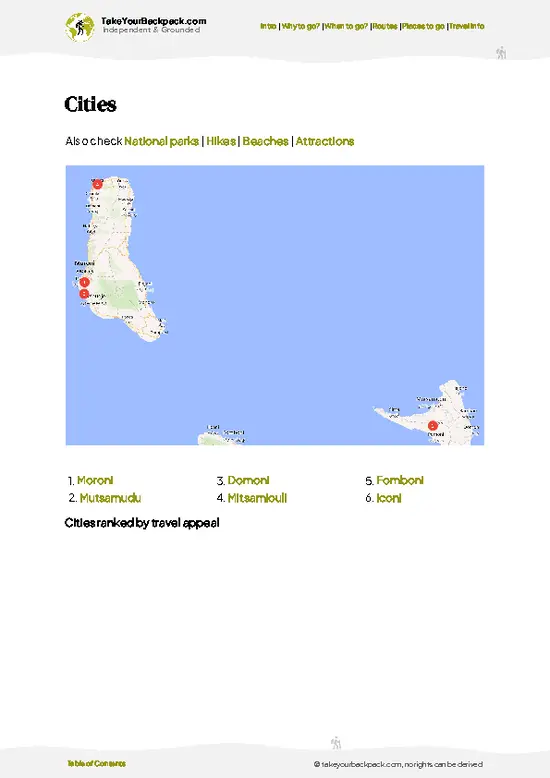
Other Comoran cities near Moroni

Explore more nearby:

  • Iconi—1819 cliff site, lava-stone citadel, black rock coves| 4 km away
  • Mitsamiouli—Pale-sand beaches, sacred cove, northern tip, fishing landing| 35 km away
  • Fomboni—Mohéli Marine Park gateway, turtle nights, ylang-ylang stills, ferry-paced port| 83 km away

💡 Not sure where to go next?
Create a personalized itinerary for Comoros including Moroni and the places that fit your trip.

Generate my itinerary

👉 Discover all cities

Or checkout all Comoros has to offer (think cities, towns, villages, national parks, hikes, beaches, festivals)
Country photo of Comoros

We 💚 feedbackWhat to keep in mind

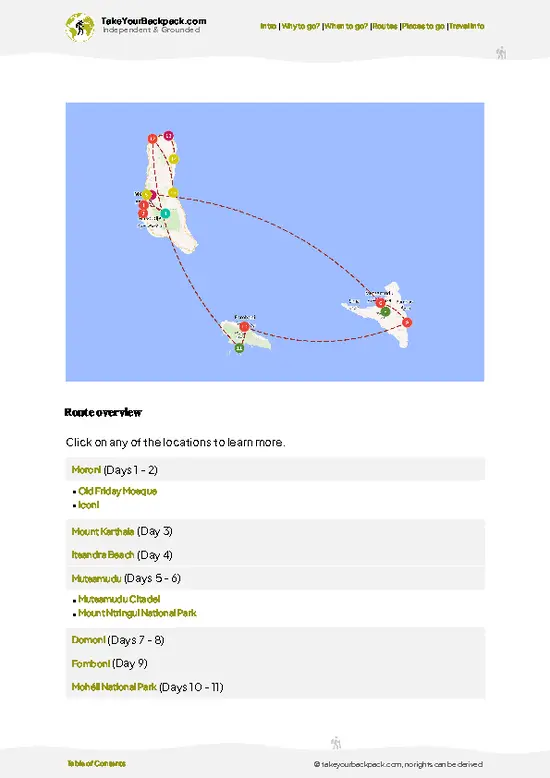
Moroni pairs best with a beach stay in the north of Grande Comore, and then a flight or ferry to Mohéli or Anjouan for quieter coves and marine life. Use the capital for logistics, the mosque and the market, then move on. I would carry plenty of small euro notes and a headlamp, and I would book a Karthala guide through your guesthouse rather than at the last minute.

✍️ Help improve this page!
The information on this page is based on in-depth research, insights shared by experienced travelers, and feedback from the local travel community in Comoros. While every effort is made to keep the information accurate and current, conditions can change — so if you spot anything incorrect or outdated, please get in touch.


🙋‍♂️ Give feedback

👋 Meet the founderWho’s Behind Take Your Backpack?

Johan, backpacker and founder of TakeYourBackpackHi, I’m Johan (Netherlands 🇳🇱), the creator of TakeYourBackpack. Over the past 3 decades, I’ve backpacked through 90+ countries across six continents, gaining extensive experience with independent travel, long-term trips, and overland routes.

This site is built on a combination of firsthand travel experience and carefully curated insights from other backpackers. Many guides are based on places I’ve personally visited, while others bring together tips, observations, and practical advice shared by trusted travelers I’ve met along the way.

The goal is to provide realistic, experience-driven guidance — not generic itineraries — so you can explore destinations with better context, clearer expectations, and more confidence.