×

Comoros🇰🇲 | citiesMutsamuduHillside medina, sultanate fort, steep port, green Anjouan | things to do and best time to go

Explore MoroniExplore Fomboni

Backpacking in Mutsamudu
🏆 Top pickcity ranked #2
By Johan Kruseman 🇳🇱 | Updated October 22, 2026

Mutsamudu was once a fortified sultanate capital where cannons faced the sea; today it is a steep, salt-streaked port town of tin roofs and carved doors, with no resort polish at all. It sits on the north coast of Anjouan (Ndzuwani) in the Comoros, climbing a hillside above a small harbor. Expect the smell of diesel, grilled fish and cloves, the call to prayer bouncing off whitewashed walls, and lanes so narrow that motorbikes squeeze past with a toot. Roads are potholed and power flickers, so carry a headlamp and cash, since cards rarely work here. Walk the medina in the cool early morning, when the light is soft and the heat has not yet built, and ask a local to point out the doors. It suits curious, flexible travelers and bores anyone wanting beaches and nightlife. Compared with Moroni on Grande Comore, Mutsamudu is greener, hillier, more compact and far quieter.

Discover everything you want to know in the 📖 Comoros Travel Guide.


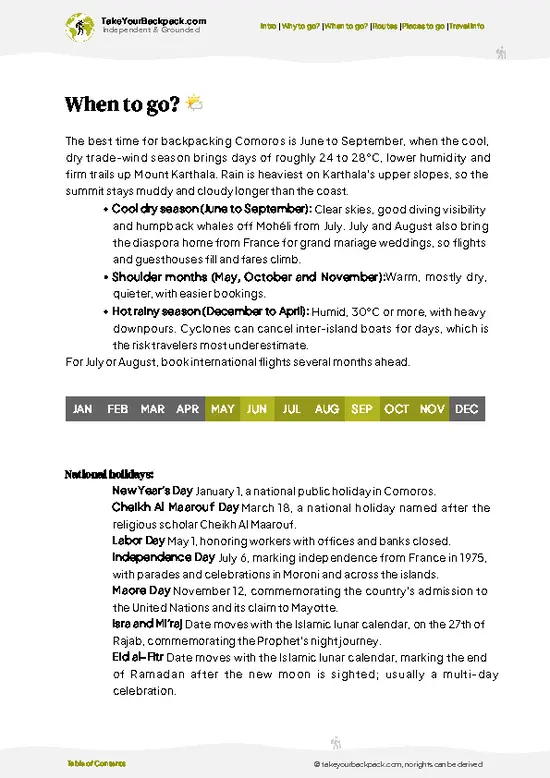
example page 0 from our offline Travel Guide for Comoros
example page 1 from our offline Travel Guide for Comoros
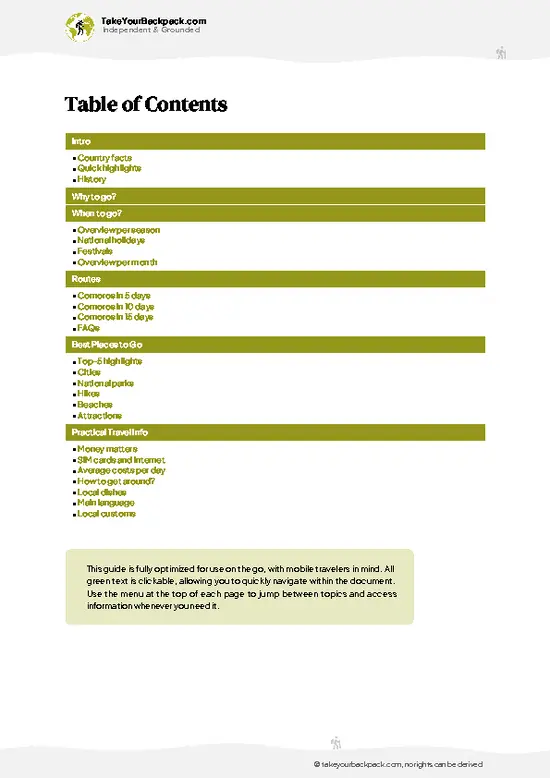
example page 2 from our offline Travel Guide for Comoros
example page 3 from our offline Travel Guide for Comoros
example page 4 from our offline Travel Guide for Comoros
example page 5 from our offline Travel Guide for Comoros
example page 6 from our offline Travel Guide for Comoros
example page 7 from our offline Travel Guide for Comoros
Loading the map 🌍
CLICK TO FILTER
cities
national parks
hikes
beaches
attractions
SHOW COUNTRY’S BESTSHOW ALL

✨ Why go?
Ranked #2 city in Comoros
What makes this city worth visiting

Mutsamudu earns a place on a Comoros route because it is the most atmospheric old town in the archipelago, and you can cover the whole thing on foot in a day. The medina of narrow stepped lanes rises straight from the harbor, so you go from fishing boats to mosque courtyards in minutes. There is no hostel scene. You stay in small guesthouses and local hotels, which means you end up talking with owners, drivers and fishermen rather than other backpackers, and that is much of the appeal. Food is simple and good: grilled fish, cassava, coconut-heavy stews and sweet spiced tea. Because Anjouan is green, mountainous and full of waterfalls, the town also works as a base for exploring the island by shared taxi. Two nights is plenty if you only want the town, but add more if you plan to hike. Boats … read more 👉
Mutsamudu earns a place on a Comoros route because it is the most atmospheric old town in the archipelago, and you can cover the whole thing on foot in a day. The medina of narrow stepped lanes rises straight from the harbor, so you go from fishing boats to mosque courtyards in minutes. There is no hostel scene. You stay in small guesthouses and local hotels, which means you end up talking with owners, drivers and fishermen rather than other backpackers, and that is much of the appeal. Food is simple and good: grilled fish, cassava, coconut-heavy stews and sweet spiced tea. Because Anjouan is green, mountainous and full of waterfalls, the town also works as a base for exploring the island by shared taxi. Two nights is plenty if you only want the town, but add more if you plan to hike. Boats and flights link the island to the other islands, though schedules shift, so keep your onward plans loose.

💡 HighlightsWhat this place is best known for

  1. Medina of Mutsamudu: A maze of stone alleys, carved wooden doors and small mosques climbing from the harbor. Go early morning or late afternoon for cooler air and good light. Free, 1.5 to 2 hours.
  2. Citadel (old fort): Old defensive walls and cannons on the hill above the harbor, with sweeping views over the roofs and bay. Climb in the morning before the heat. Usually free or a small tip of about €1 to 2, 45 minutes.
  3. Friday Mosque (Mosquée du Vendredi): A historic mosque in the old quarter, valued for its architecture and role in the town’s Islamic heritage. Visit outside prayer times and dress modestly. Free, 20 to 30 minutes.
  4. Harbor and fish landing: Wooden boats unload the catch, and men repair nets and chat in the shade. Best at dawn or late afternoon. Free, 30 to 60 minutes.
  5. Central market:
… read more 👉
  1. Medina of Mutsamudu: A maze of stone alleys, carved wooden doors and small mosques climbing from the harbor. Go early morning or late afternoon for cooler air and good light. Free, 1.5 to 2 hours.
  2. Citadel (old fort): Old defensive walls and cannons on the hill above the harbor, with sweeping views over the roofs and bay. Climb in the morning before the heat. Usually free or a small tip of about €1 to 2, 45 minutes.
  3. Friday Mosque (Mosquée du Vendredi): A historic mosque in the old quarter, valued for its architecture and role in the town’s Islamic heritage. Visit outside prayer times and dress modestly. Free, 20 to 30 minutes.
  4. Harbor and fish landing: Wooden boats unload the catch, and men repair nets and chat in the shade. Best at dawn or late afternoon. Free, 30 to 60 minutes.
  5. Central market: Piles of bananas, cassava, spices, vanilla, cloves and ylang-ylang products. Mornings are liveliest. Budget €2 to 5 for snacks and small purchases, 45 minutes.
  6. Old town doors and sultans’ quarter: Look for intricately carved doorways, a signature of Swahili-influenced craft. A local guide can explain the symbols for about €5 to 10, 1 hour.
Beyond town, the Moya beach area, Sima village, the Dziani Boundouni and Lac Dzialandzé areas, and the waterfalls of the interior make good day trips by shared taxi or hired driver. All of Mutsamudu’s sights fit comfortably into half a day, or a full day at an unhurried pace.
Spotted a mistake or missing something? Contact us.

🏘️ NeighborhoodsKey areas and districts to know

Mutsamudu, on Anjouan (Ndzuwani), is small enough to cover on foot in a morning, but it climbs steeply, so plan around the slope and the heat.
  • The Medina: The old quarter drops toward the harbor in a maze of stone lanes barely wider than your shoulders. Carved wooden doors, whitewashed walls and the smell of woodsmoke, cloves and frying dough fill the air. Satellite-free navigation fails here, so walk downhill from the main road and let the lanes spit you out at the port. Go early, when the light is soft and the shutters are still closing out the night.
  • The Port and Waterfront: Fishing boats, cargo dhows and the call of men unloading crates make this the loudest corner. The old Portuguese-style fort above the harbor gives a view over the roofs. Visit in the morning when fish is landed; by midday
… read more 👉
Mutsamudu, on Anjouan (Ndzuwani), is small enough to cover on foot in a morning, but it climbs steeply, so plan around the slope and the heat.
  • The Medina: The old quarter drops toward the harbor in a maze of stone lanes barely wider than your shoulders. Carved wooden doors, whitewashed walls and the smell of woodsmoke, cloves and frying dough fill the air. Satellite-free navigation fails here, so walk downhill from the main road and let the lanes spit you out at the port. Go early, when the light is soft and the shutters are still closing out the night.
  • The Port and Waterfront: Fishing boats, cargo dhows and the call of men unloading crates make this the loudest corner. The old Portuguese-style fort above the harbor gives a view over the roofs. Visit in the morning when fish is landed; by midday the concrete quay is too hot for bare feet.
  • Main Market Streets: Stalls pile up with bananas, breadfruit, cassava, ylang-ylang oil and spices. Cash is how it works, small notes only, because vendors rarely have change for large ones. Experienced travelers carry a stack of small bills and buy from the same stall twice to get a friendlier price.
  • Upper Town and Hillsides: Newer concrete houses climb the green slopes behind the center. It is quiet, cooler and breezy, with roosters instead of traffic. The climb is steep, so take a shared taxi up and walk back down.
  • Evenings: Nightlife is minimal. Cafés close early, so people gather at the waterfront after sunset to talk, and you should do the same.

⌛️ 1 day1-day itinerary for Mutsamudu

7:00 AM: Harbor and fish landing. Start at the water, when boats are coming in and the air is still cool. You see the town as it works, and it is the best place to pick up a coffee or sweet tea from a stall. Walk uphill into the old town afterward.
8:30 AM: Medina and carved doors. Wander the stepped lanes at an easy pace, looking for old doors and small mosques. Greet people, ask permission before photographing, and let yourself get lost; the town is small enough that downhill always returns you to the sea.
10:30 AM: Citadel. Climb to the old fortifications for views over the roofs and bay and a look at the cannons. Go before noon, since there is little shade. Then drift back down toward the center.
12:30 PM: Lunch near the market. Eat grilled fish with rice or cassava at a local spot, and browse … read more 👉
7:00 AM: Harbor and fish landing. Start at the water, when boats are coming in and the air is still cool. You see the town as it works, and it is the best place to pick up a coffee or sweet tea from a stall. Walk uphill into the old town afterward.
8:30 AM: Medina and carved doors. Wander the stepped lanes at an easy pace, looking for old doors and small mosques. Greet people, ask permission before photographing, and let yourself get lost; the town is small enough that downhill always returns you to the sea.
10:30 AM: Citadel. Climb to the old fortifications for views over the roofs and bay and a look at the cannons. Go before noon, since there is little shade. Then drift back down toward the center.
12:30 PM: Lunch near the market. Eat grilled fish with rice or cassava at a local spot, and browse the market for spices, bananas and vanilla while it is still active.
2:30 PM: Friday Mosque quarter. Visit the historic mosque area outside prayer times, dressing modestly, and take time in the quieter back lanes where residents sit in doorways.
4:00 PM: Residential hillside lanes above the center. Few visitors go here. Walk up through ordinary neighborhoods with gardens, goats and laundry, and you get wide views and a feel for everyday life.
5:30 PM: Waterfront at dusk. Return to the harbor as fishermen prepare for the night, and finish with tea or a simple dinner while the town’s lights come on.

🌤️ When to go?Seasonal considerations and timing

The best time for Mutsamudu is the dry season from May to October, when rain is lightest and the hills stay green but passable.
  • Dry Season (May to October): Days run 24 to 28°C (75 to 82°F), nights are cooler and the air is less sticky. Roads are easier, hikes into the interior are safer and boats cross more reliably. Daylight lasts roughly 11.5 to 12 hours. This is the busiest period, though crowds are still tiny.
  • Hot Wet Season (November to April): Expect 27 to 32°C (81 to 90°F), heavy humidity and downpours that turn mountain trails to mud. Cyclones are possible, mostly January to March, and can disrupt flights and ferries. Rooms are easiest to find, but landslides can cut roads.
  • Holidays and Events: Ramadan shifts opening hours, with many food stalls closed in daytime. Eid and the July independence
… read more 👉
The best time for Mutsamudu is the dry season from May to October, when rain is lightest and the hills stay green but passable.
  • Dry Season (May to October): Days run 24 to 28°C (75 to 82°F), nights are cooler and the air is less sticky. Roads are easier, hikes into the interior are safer and boats cross more reliably. Daylight lasts roughly 11.5 to 12 hours. This is the busiest period, though crowds are still tiny.
  • Hot Wet Season (November to April): Expect 27 to 32°C (81 to 90°F), heavy humidity and downpours that turn mountain trails to mud. Cyclones are possible, mostly January to March, and can disrupt flights and ferries. Rooms are easiest to find, but landslides can cut roads.
  • Holidays and Events: Ramadan shifts opening hours, with many food stalls closed in daytime. Eid and the July independence period bring family travel, so flights and boats fill up and prices rise.
Book flights and any inter-island boat early if you travel in July or August, and keep a spare day in case weather delays you.


source: climatestotravel.comJANJanuary: below average for travelingFEBFebruary: below average for travelingMARMarch: fair for travelingAPRApril: fair for travelingMAYMay: excellent for travelingJUNJune: excellent for travelingJULJuly: highly recommended for travelingAUGAugust: highly recommended for travelingSEPSeptember: excellent for travelingOCTOctober: excellent for travelingNOVNovember: fair for travelingDECDecember: fair for traveling
when-to-go

✈️ The backpacker research shortcutComoros Travel Guide

An offline-friendly backpacking guide with optimized travel routes, ranked highlights, transport advice, and the best areas to stay.
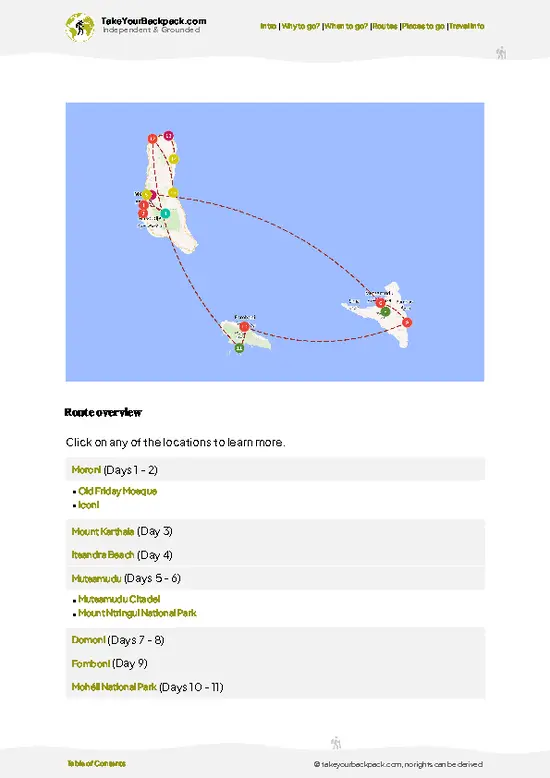
example page 0 from our offline Travel Guide for Comoros
example page 1 from our offline Travel Guide for Comoros
example page 2 from our offline Travel Guide for Comoros
example page 3 from our offline Travel Guide for Comoros
example page 4 from our offline Travel Guide for Comoros
example page 5 from our offline Travel Guide for Comoros
example page 6 from our offline Travel Guide for Comoros
example page 7 from our offline Travel Guide for Comoros
The digital guide (84 pages) contains:
✅ 15 highlights, ranked by travel appeal
✅ Optimized 5, 10 & 15-day travel routes
✅ Cities, national parks, landmarks, beaches
✅ How to get around
✅ Offline-friendly for travel without Wi-Fi
👉 Click to see all 30+ guide features

📅 Plan smarter in minutes, not weeks
✅ Month by month travel advice
✅ Festivals & national holidays
✅ Budget expectations

🗺️ Go to the right places, skip the overrated ones
✅ Honest pros & cons of destinations
✅ Top hikes, parks & viewpoints
✅ Lesser-known places most travelers miss
✅ Clear “worth it vs skip it” guidance

🛏️ Travel smoothly without rookie mistakes
✅ Best areas to stay
✅ Transport systems explained simply
✅ Common scams & safety advice
✅ SIM cards, money & practical tips

🌍 Understand the country, not just visit it
✅ Culture & traditions
✅ 52 Essential phrases & customs
✅ Festivals worth planning around
✅ Traveler-friendly historical context
✅ Insights that make places more meaningful

📱 Built for real travel conditions
✅ Fully downloadable PDF
✅ Works completely offline
✅ Optimized for phone use
✅ Useful in remote areas & buses
✅ Everything in one place
Stop searching, start planning
Get instant access to your full guide. 30‑day money-back guarantee.
+ Add another guide for just

By proceeding you agree to our terms.
Sent to your inbox immediately after payment • 100% Secure Checkout
Best Backpacking Travel Advisor 2025 tourism awardBest Backpacking
Travel Advisor
2025
What others say about Take Your Backpack Guides:
⭐⭐⭐⭐⭐
Fantastic, amazing amount of information!
⭐⭐⭐⭐⭐
My goodness this is amazing, it's what I've been looking for hats off too you!
⭐⭐⭐⭐⭐
I think this is absolutely BRILLIANT
⭐⭐⭐⭐
Very complete and informative. It's still missing places, but I gotta to commend you
⭐⭐⭐⭐⭐
This is truly amazing, thank you, can't wait to explore it with my kids!
⭐⭐⭐⭐⭐
Awesome resource, thank you!
⭐⭐⭐⭐⭐
This is amazing! Can't wait to explore the ones I haven't seen
⭐⭐⭐⭐
I love this! Well done, great idea.
⭐⭐⭐⭐⭐
Thanks for taking the time to make this gem!
⭐⭐⭐⭐⭐
This might be the best website I've ever seen.
⭐⭐⭐⭐⭐
Congratulations, and thank you so much for your work; it's incredibly valuable.
⭐⭐⭐⭐
In all seriousness I think you did a great job pointing out the important spots
⭐⭐⭐⭐⭐
10/10 very good
⭐⭐⭐⭐⭐
As someone who's only just starting to visit regularly this is awesome, thank you.
⭐⭐⭐⭐
Thank you very much! I'm going to visit my dad, it's going to be very useful!
⭐⭐⭐⭐⭐
This is really cool! We'll be travelling for the first time and this definitely come in handy.
⭐⭐⭐⭐⭐
You are now our minister of culture, congratulations 👨‍💼
⭐⭐⭐⭐⭐
Just wanted to tell you that this is a pearl! Going to follow your recommendations.
⭐⭐⭐⭐⭐
This is so cool. I'll definitely be using the resource for my travels soon.
⭐⭐⭐⭐⭐
This is very impressive! Good work.
⭐⭐⭐⭐⭐
This is an amazing and informative site. Very well done!

🛏️ Where to stay?Choosing the right base

The best area for a budget stay is the center near the port and market, where guesthouses and simple small hotels sit within walking distance of food, money changers and shared taxis.
Bed supply in Mutsamudu is limited. There are no big hostel dorms, so budget travelers usually take a basic private room or guesthouse room at roughly €15 to 35 a night. It helps to book ahead by phone or message, especially in July and August and around Eid, because the few good cheap rooms fill quickly. Check that the room has a working fan and water, as supply can be intermittent.
The waterfront side is lively from … read more 👉
The best area for a budget stay is the center near the port and market, where guesthouses and simple small hotels sit within walking distance of food, money changers and shared taxis.
Bed supply in Mutsamudu is limited. There are no big hostel dorms, so budget travelers usually take a basic private room or guesthouse room at roughly €15 to 35 a night. It helps to book ahead by phone or message, especially in July and August and around Eid, because the few good cheap rooms fill quickly. Check that the room has a working fan and water, as supply can be intermittent.
The waterfront side is lively from dawn, with boat engines, roosters and the call to prayer, so light sleepers should ask for a room facing inland or on an upper floor. After dark the streets are quiet and mostly empty, though the central area is easy to walk back through if you stay on lit roads.
The second option is the upper hillside neighborhoods. They are calmer, cooler and greener, and sleep is better, but you will rely on taxis after dark and hauling a pack uphill in the heat is tiring. Choose these if you have a longer stay planned or want fewer crowds, and pick the center if you rely on public transport and want shorter walks to everything.

🚌 Getting aroundMoving around without the hassle

The costliest mistake is accepting a private taxi price at the airport or port without asking what the shared rate is, because foreigners often start at several times the local fare. Mutsamudu is compact and hilly, and most of it is done on foot, with taxis for the steep or long stretches.
  • Walking: The medina, port and market are all within about 15 minutes of each other, but lanes are uneven stone and slick after rain. Wear closed shoes with grip, go early before the heat builds, and expect to climb when heading inland.
  • Shared Taxis (taxi-brousse): These battered minibuses and cars run along the coast road to other towns and cost about €0.50 to 3 depending on distance. They leave when full, usually from the market area, so you may wait 15 to 30 minutes. Ask the fare from another passenger before
… read more 👉
The costliest mistake is accepting a private taxi price at the airport or port without asking what the shared rate is, because foreigners often start at several times the local fare. Mutsamudu is compact and hilly, and most of it is done on foot, with taxis for the steep or long stretches.
  • Walking: The medina, port and market are all within about 15 minutes of each other, but lanes are uneven stone and slick after rain. Wear closed shoes with grip, go early before the heat builds, and expect to climb when heading inland.
  • Shared Taxis (taxi-brousse): These battered minibuses and cars run along the coast road to other towns and cost about €0.50 to 3 depending on distance. They leave when full, usually from the market area, so you may wait 15 to 30 minutes. Ask the fare from another passenger before boarding, pay at the end, and sit by a window for air since the cabin smells of diesel and sun-warmed vinyl.
  • Private Taxis: A short ride in town is around €1.50 to 3, and a charter to Domoni or the airport area runs about €15 to 30. Agree the price before you sit down and carry small notes, because drivers seldom have change. Hiring one for half a day, around €25 to 40, is cheaper than separate trips if you want waterfalls or viewpoints.
  • Motorbike Taxis: Some riders take passengers up the steep side streets for about €1 to 2. They are quick in traffic but usually have no helmet for you, so use them only for short hops, not on the main highway.
  • Boats: Small boats serve fishing villages and neighboring coast spots on informal schedules, so ask at the port in the morning. Agree the fare, often €3 to 10, before boarding and avoid overloaded vessels or rough weather.
Public transport runs from early morning until roughly late afternoon, and after dark you will depend on taxis, which are scarce and cost more. Plan your last ride before sunset.

👛 Costs (as of 22 October 2026)What things cost and how to budget

A backpacker in Mutsamudu spends about €32 to 63 a day, and with high-season accommodation this comes to roughly €48.
CategoryBudget RangeLocal Reality
Dorm accommodation (high season)€15 to 25True dorms are rare, so this means a basic private room or simple guesthouse bed in July and August.
Dorm accommodation (off-season)€12 to 20Rooms are easier to find and prices are negotiable from November to April.
Meals€8 to 14Stall plates of fish, rice and cassava cost €2 to 5, and a sit-down meal is €6 to 10.
Local transport€3 to 8Shared taxis cost €0.50 to 3, and short private taxi rides €1.50 to 3.
City transport pass€0No pass exists, so you pay each ride in cash.
Basic activities and entry fees€3 to 10Most sights are free, and guides for hikes run around €10 to 25.
Miscellaneous€3 to 6Water, SIM data,
… read more 👉
A backpacker in Mutsamudu spends about €32 to 63 a day, and with high-season accommodation this comes to roughly €48.
CategoryBudget RangeLocal Reality
Dorm accommodation (high season)€15 to 25True dorms are rare, so this means a basic private room or simple guesthouse bed in July and August.
Dorm accommodation (off-season)€12 to 20Rooms are easier to find and prices are negotiable from November to April.
Meals€8 to 14Stall plates of fish, rice and cassava cost €2 to 5, and a sit-down meal is €6 to 10.
Local transport€3 to 8Shared taxis cost €0.50 to 3, and short private taxi rides €1.50 to 3.
City transport pass€0No pass exists, so you pay each ride in cash.
Basic activities and entry fees€3 to 10Most sights are free, and guides for hikes run around €10 to 25.
Miscellaneous€3 to 6Water, SIM data, snacks and small tips.
Total Daily Budget€32 to 63About €48 at a typical mid-range of these rows with high-season lodging.
Carry small euro or local notes and eat where locals do, since market stalls and shared taxis cost a fraction of what tourist-oriented options charge.
⚠️ Prices can change and everyone travels differently, so take this as a rough guide. Hope it helps you plan your adventure!

🚌 Day tripsBest day trips from Mutsamudu

Mutsamudu works well as a base for day trips, since Anjouan is small and most sights lie within two hours by road, though shared taxis run on their own schedule so leave early.
Domoni:
This old Swahili-style coastal town has narrow lanes, carved doors and a quiet harbor, and it is one of the oldest settlements on the island. The ride takes around 1.5 to 2 hours by shared taxi at about €2 to 4 each way. Go in the morning, since fewer vehicles return in the afternoon, and many first-timers get stranded waiting for a full car.
👉 Explore Domoni
Sima:
A fishing village on the western coast, it is worth visiting for its harbor, boat building and slow rhythm. Allow about 45 minutes to an hour by shared taxi or €10 to 20 by private car round trip. The dry season gives clearer roads and calmer sea, and … read more 👉
Mutsamudu works well as a base for day trips, since Anjouan is small and most sights lie within two hours by road, though shared taxis run on their own schedule so leave early.
Domoni:
This old Swahili-style coastal town has narrow lanes, carved doors and a quiet harbor, and it is one of the oldest settlements on the island. The ride takes around 1.5 to 2 hours by shared taxi at about €2 to 4 each way. Go in the morning, since fewer vehicles return in the afternoon, and many first-timers get stranded waiting for a full car.
👉 Explore Domoni
Sima:
A fishing village on the western coast, it is worth visiting for its harbor, boat building and slow rhythm. Allow about 45 minutes to an hour by shared taxi or €10 to 20 by private car round trip. The dry season gives clearer roads and calmer sea, and a half day is plenty.

Moya:
This southern beach village is known for its sand and clear water, and it is the easiest swim on the island. Travel takes around 1.5 hours each way and a shared taxi costs roughly €2 to 4, or €30 to 45 by chartered taxi with waiting time. Bring your own water and food, and avoid swimming in rough seas or after heavy rain, when currents pick up.

Lac Dzialandzé:
This crater lake sits in the green interior and requires a hike through forest, with cool air and bird calls as you climb. Plan a full day with a local guide, around €10 to 25 plus transport to the trailhead. Go in the dry season, start early and wear shoes with grip, since paths turn to slick mud and clouds can close in by afternoon.

🍲 FoodWhat to Eat & Drink

Food in Mutsamudu leans on the island's soil and sea: coconut milk, cassava, breadfruit, plantain and fresh grilled fish such as tuna, often seasoned with ginger, garlic and local cloves and vanilla. Try langouste (spiny lobster) when in season, and mataba, cassava leaves simmered with coconut milk, which is richer and greener here than on the plate you may expect elsewhere. Snacks include mkatra foutra, a sweet coconut flatbread, and deep-fried samosas or banana fritters, sold around the market in the morning. Drinks are mostly sweet spiced tea with ginger, fresh coconut water and juices from tropical fruit. Alcohol is rare and mostly absent in public.
Backpackers eat cheaply at small stalls and canteens around the market and port, where a plate of fish or rice with sauce costs about €2 to … read more 👉
Food in Mutsamudu leans on the island's soil and sea: coconut milk, cassava, breadfruit, plantain and fresh grilled fish such as tuna, often seasoned with ginger, garlic and local cloves and vanilla. Try langouste (spiny lobster) when in season, and mataba, cassava leaves simmered with coconut milk, which is richer and greener here than on the plate you may expect elsewhere. Snacks include mkatra foutra, a sweet coconut flatbread, and deep-fried samosas or banana fritters, sold around the market in the morning. Drinks are mostly sweet spiced tea with ginger, fresh coconut water and juices from tropical fruit. Alcohol is rare and mostly absent in public.
Backpackers eat cheaply at small stalls and canteens around the market and port, where a plate of fish or rice with sauce costs about €2 to 5. Fish is best at midday, straight from the morning catch, and it smells of smoke and lime when the grills fire up. Food is often eaten with the right hand during family meals, and during Ramadan most places only open after sunset, so buy daytime snacks early.

🛡️ SafetyTraveler Safety Guide

Mutsamudu is broadly safe, and most problems are small ones such as pickpocketing in the market crowds or being quoted inflated prices as a foreigner. Keep your phone and cash in a front pocket in the market and at the port, where people press together around unloading boats. Solo travelers, including women, generally report being treated with curiosity and politeness, but local norms are conservative, so cover shoulders and knees and avoid drinking in public. After dark the streets empty quickly and are poorly lit, so walk only on the main lanes or take a taxi, and avoid the medina's dead-end alleys and the hillside paths alone. Agree taxi and boat fares before you get in. Swim only where locals do, since currents near the harbor and in rough weather can be strong. Political tension has flared … read more 👉
Mutsamudu is broadly safe, and most problems are small ones such as pickpocketing in the market crowds or being quoted inflated prices as a foreigner. Keep your phone and cash in a front pocket in the market and at the port, where people press together around unloading boats. Solo travelers, including women, generally report being treated with curiosity and politeness, but local norms are conservative, so cover shoulders and knees and avoid drinking in public. After dark the streets empty quickly and are poorly lit, so walk only on the main lanes or take a taxi, and avoid the medina's dead-end alleys and the hillside paths alone. Agree taxi and boat fares before you get in. Swim only where locals do, since currents near the harbor and in rough weather can be strong. Political tension has flared on Anjouan in the past, so check local news before travel and steer clear of demonstrations.

FAQFrequently asked questions about Mutsamudu

Two days is enough for Mutsamudu itself, which covers the medina, port, fort and market on foot in a day. Add a third or fourth day for day trips to Domoni (1.5 to 2 hours by shared taxi) or the beach at Moya. Hikers heading to Lac Dzialandzé should allow a full extra day.
Mutsamudu is generally safe for solo backpackers, with petty theft and inflated prices the main issues. Keep valuables in front pockets in the market, dress modestly and avoid unlit lanes after dark, using taxis (about €1.50 to 3) for night rides. Check local news for political tension before you go.
Mutsamudu is known for its old medina of stone lanes and carved doors, its working harbor and its hillside setting on Anjouan. It also has a fort overlooking the port and a market selling spices, ylang-ylang and cloves. Most visitors spend one to two days here and use it as a base for Domoni, Sima and the island's beaches.
⚠️ Things can change over time, so always validate details locally before you go.

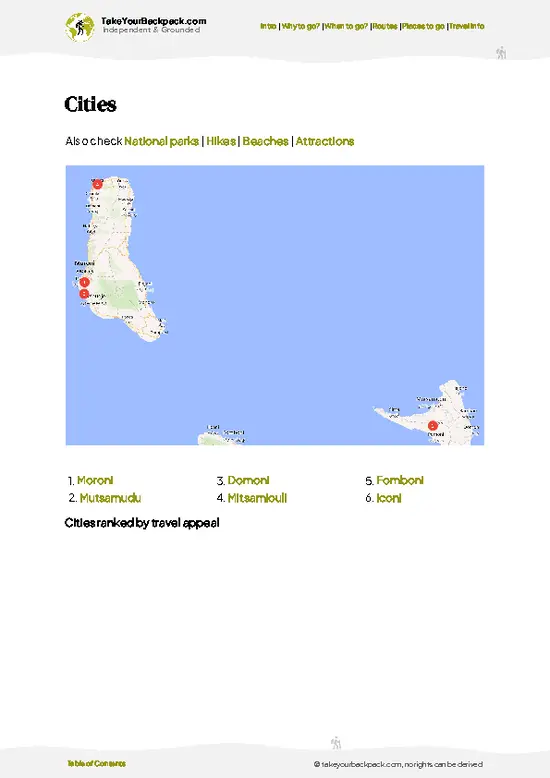
Other Comoran cities near Mutsamudu

Explore more nearby:

  • Domoni—Carved doors, dhow quay, coral-stone lanes, former sultans’ seat| 17 km away
  • Fomboni—Mohéli Marine Park gateway, turtle nights, ylang-ylang stills, ferry-paced port| 73 km away
  • Iconi—1819 cliff site, lava-stone citadel, black rock coves| 134 km away

💡 Not sure where to go next?
Create a personalized itinerary for Comoros including Mutsamudu and the places that fit your trip.

Generate my itinerary

👉 Discover all cities

Or checkout all Comoros has to offer (think cities, towns, villages, national parks, hikes, beaches, festivals)
Country photo of Comoros

We 💚 feedbackKey takeaways before you go

Mutsamudu’s best detail is the carved wooden doors, which most first-timers walk straight past on their way to the citadel. Slow down in the medina, look at the patterns, and ask someone about the house behind them. I would bring small bills for tea, snacks and taxis, because change is scarce and cash is everything.

✍️ Help improve this page!
The information on this page is based on in-depth research, insights shared by experienced travelers, and feedback from the local travel community in Comoros. While every effort is made to keep the information accurate and current, conditions can change — so if you spot anything incorrect or outdated, please get in touch.


🙋‍♂️ Give feedback

👋 Meet the founderWho’s Behind Take Your Backpack?

Johan, backpacker and founder of TakeYourBackpackHi, I’m Johan (Netherlands 🇳🇱), the creator of TakeYourBackpack. Over the past 3 decades, I’ve backpacked through 90+ countries across six continents, gaining extensive experience with independent travel, long-term trips, and overland routes.

This site is built on a combination of firsthand travel experience and carefully curated insights from other backpackers. Many guides are based on places I’ve personally visited, while others bring together tips, observations, and practical advice shared by trusted travelers I’ve met along the way.

The goal is to provide realistic, experience-driven guidance — not generic itineraries — so you can explore destinations with better context, clearer expectations, and more confidence.