
×

Cook Islands🇨🇰 | national parksTakitumu Conservation AreaKakerori birds, guided forest walk, tree ferns, bush medicine | things to do and best time to go

Explore Rarotonga National ParkExplore Aitutaki Lagoon

Backpacking in Takitumu Conservation Area
🏆 Top picknational park ranked #1
By Johan Kruseman 🇳🇱 | Updated October 22, 2026

Spending a morning here instead of on the sand comes down to whether you care about birds and forest medicine enough to book ahead, because the walk is guided and only runs on arrangement. That is how the community keeps rat traps and nesting zones undisturbed, so the smarter move is to message the operators a day or two early and ask for the first slot. Mornings are cooler and the birds are calling. It sits on the southeast side of Rarotonga in the Cook Islands, in the Takitumu district, up a valley behind the coast road. Expect steep, slippery red-brown mud after rain and mosquitoes in the shade, so wear closed shoes and put repellent on before you arrive. The scenery is dense green forest, not a summit view, and the headline bird is small and shy. If you like patient, close-up nature with a local explaining it, you will love it. If you want a big sweat or a sure photo, skip it.

Discover everything you want to know in the 📖 Cook Islands Travel Guide.


example page 0 from our offline Travel Guide for Cook Islands
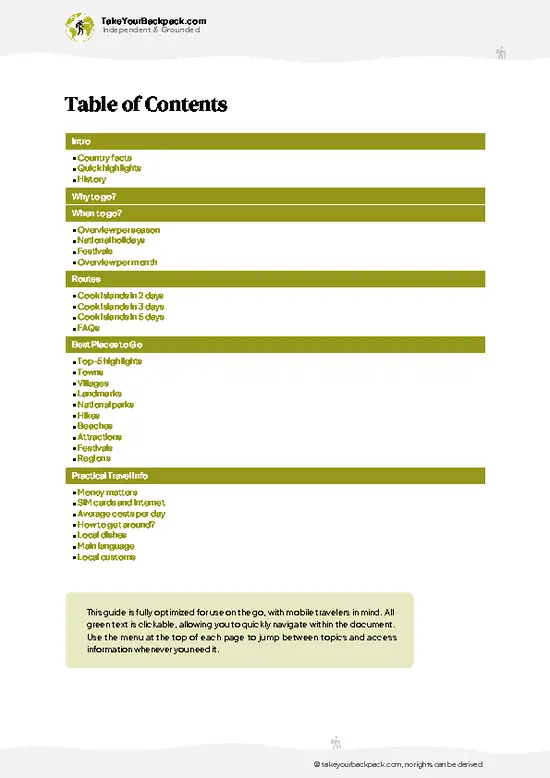
example page 1 from our offline Travel Guide for Cook Islands
example page 2 from our offline Travel Guide for Cook Islands
example page 3 from our offline Travel Guide for Cook Islands
example page 4 from our offline Travel Guide for Cook Islands
example page 5 from our offline Travel Guide for Cook Islands
example page 6 from our offline Travel Guide for Cook Islands
example page 7 from our offline Travel Guide for Cook Islands
Loading the map 🌍
CLICK TO FILTER
towns
villages
landmarks
national parks
hikes
beaches
attractions
festivals
regions
SHOW COUNTRY’S BESTSHOW ALL

✨ Why go?
Ranked #1 national park in Cook Islands
Reasons people choose to explore here

Backpackers come for the one thing no beach on the island can offer: a community-run effort that pulled the kakerori (Rarotonga flycatcher) back from a population of about 30 birds in the late 1980s. Seeing the result is the point, and a landowner family guiding you through their own valley makes it feel like a visit, not a product.

It also suits independent travelers who are tired of resort-style activities. You can reach the district on your own by scooter or bus along the coast road, spend a morning in the forest, then wander down to the lagoon and Muri’s cheap eateries without any package attached. The guided forest walk is slow and talkative, so you learn the names of native trees, which leaves were used for healing, and why rats and mynas are the enemy. Nothing about it needs gear beyond … read more 👉
Backpackers come for the one thing no beach on the island can offer: a community-run effort that pulled the kakerori (Rarotonga flycatcher) back from a population of about 30 birds in the late 1980s. Seeing the result is the point, and a landowner family guiding you through their own valley makes it feel like a visit, not a product.

It also suits independent travelers who are tired of resort-style activities. You can reach the district on your own by scooter or bus along the coast road, spend a morning in the forest, then wander down to the lagoon and Muri’s cheap eateries without any package attached. The guided forest walk is slow and talkative, so you learn the names of native trees, which leaves were used for healing, and why rats and mynas are the enemy. Nothing about it needs gear beyond decent shoes. It works best as a half-day anchor between swims, and it gives you something concrete to talk about when everyone else only mentions snorkeling.

💡 HighlightsThe experiences that define the visit

  1. Kakerori Forest Walk: the guided walk through the valley forest that the park is known for, usually a morning outing of a couple of hours, with a modest fee paid to the community operators. The guide stops often to point out birds and plants.
  2. The kakerori itself: a small, orange-brown flycatcher found only on Rarotonga and, since a 2001 transfer, Atiu, restored from a tiny remnant to several hundred birds. You hear its sharp call before you spot it flitting low through the canopy.
  3. Cook Islands fruit dove: a rare and softly colored pigeon-like bird that lives in the same forest. Look for it in fruiting trees where it sits very still.
  4. Native forest and mamaku tree ferns: the walk passes towering tree ferns and old hardwoods that give a very different feel from the coconut-lined coast, shaded and
… read more 👉
  1. Kakerori Forest Walk: the guided walk through the valley forest that the park is known for, usually a morning outing of a couple of hours, with a modest fee paid to the community operators. The guide stops often to point out birds and plants.
  2. The kakerori itself: a small, orange-brown flycatcher found only on Rarotonga and, since a 2001 transfer, Atiu, restored from a tiny remnant to several hundred birds. You hear its sharp call before you spot it flitting low through the canopy.
  3. Cook Islands fruit dove: a rare and softly colored pigeon-like bird that lives in the same forest. Look for it in fruiting trees where it sits very still.
  4. Native forest and mamaku tree ferns: the walk passes towering tree ferns and old hardwoods that give a very different feel from the coconut-lined coast, shaded and damp, with the sound of dripping leaves.
  5. Bush medicine plants: guides identify leaves and roots traditionally used in Cook Islands remedies, and often let you crush and smell them. This is the part first-timers tend to remember.
  6. Avana Harbour: a short ride down the road, this narrow harbor on the Takitumu coast is the traditional departure point of the canoes that sailed to Aotearoa, marked by a memorial and quiet water.
  7. Ara Metua: the old inland road that runs through the district, lined with taro patches, small farms and churchyards. It is flat and perfect for a bicycle ride before or after the walk.
Most visitors miss the rat bait stations and trap lines that the guide explains along the path, which are the real reason the kakerori survived.
Spotted a mistake or missing something? Contact us.

Things to do near Takitumu Conservation Area

Ratings based on Tripadvisor reviews. When you book through this link, you support our work at no extra cost to you.

🌤️ When to go?Choosing the right time of year

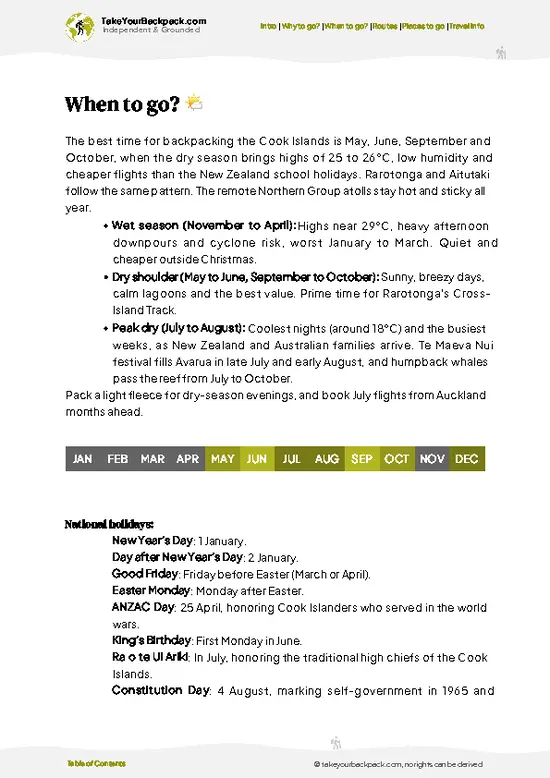
May to October is the best window for Takitumu, with drier trails and cooler air.
  • Dry Season (May to October): Days run 20 to 26°C (68 to 79°F), humidity drops, and the inland muddy sections firm up. Daylight lasts about 11 hours in June and July. July and August bring the most visitors and the highest bed prices.
  • Wet Season (November to April): Expect 23 to 29°C (73 to 84°F), heavy humid downpours, and slick root-covered paths. Daylight stretches to roughly 13.5 hours around December. Cyclone season runs through this period, though direct hits are rare. Rooms are often discounted outside Christmas and school holidays.
  • Bird Breeding Season (about October to March): The endangered kakerori (Rarotonga flycatcher) is nesting, and guides know where pairs hold territory. Early mornings give the best
… read more 👉
May to October is the best window for Takitumu, with drier trails and cooler air.
  • Dry Season (May to October): Days run 20 to 26°C (68 to 79°F), humidity drops, and the inland muddy sections firm up. Daylight lasts about 11 hours in June and July. July and August bring the most visitors and the highest bed prices.
  • Wet Season (November to April): Expect 23 to 29°C (73 to 84°F), heavy humid downpours, and slick root-covered paths. Daylight stretches to roughly 13.5 hours around December. Cyclone season runs through this period, though direct hits are rare. Rooms are often discounted outside Christmas and school holidays.
  • Bird Breeding Season (about October to March): The endangered kakerori (Rarotonga flycatcher) is nesting, and guides know where pairs hold territory. Early mornings give the best chance of a sighting.
  • Christmas and New Year: Flights and rooms are at their priciest, and the south coast fills with visitors.
Book a guided walk for a morning, when the forest is cooler and birds are most active.


source: climatestotravel.comJANJanuary: fair for travelingFEBFebruary: fair for travelingMARMarch: fair for travelingAPRApril: fair for travelingMAYMay: highly recommended for travelingJUNJune: highly recommended for travelingJULJuly: good for travelingAUGAugust: good for travelingSEPSeptember: highly recommended for travelingOCTOctober: highly recommended for travelingNOVNovember: fair for travelingDECDecember: fair for traveling
cook-islands-national-park-takitumu-conservation-area
© Google | Andreas Bodenstein

✈️ The backpacker research shortcutCook Islands Travel Guide

An offline-friendly backpacking guide with optimized travel routes, ranked highlights, transport advice, and the best areas to stay.
example page 0 from our offline Travel Guide for Cook Islands
example page 1 from our offline Travel Guide for Cook Islands
example page 2 from our offline Travel Guide for Cook Islands
example page 3 from our offline Travel Guide for Cook Islands
example page 4 from our offline Travel Guide for Cook Islands
example page 5 from our offline Travel Guide for Cook Islands
example page 6 from our offline Travel Guide for Cook Islands
example page 7 from our offline Travel Guide for Cook Islands
The digital guide (99 pages) contains:
✅ 24 highlights, ranked by travel appeal
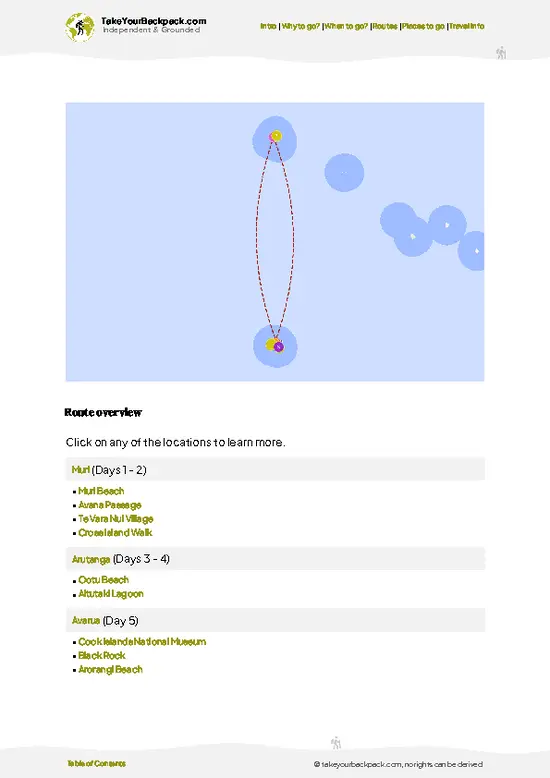
✅ Optimized 2, 3 & 5-day travel routes
✅ Cities, national parks, landmarks, beaches
✅ How to get around
✅ Offline-friendly for travel without Wi-Fi
👉 Click to see all 30+ guide features

📅 Plan smarter in minutes, not weeks
✅ Month by month travel advice
✅ Festivals & national holidays
✅ Budget expectations

🗺️ Go to the right places, skip the overrated ones
✅ Honest pros & cons of destinations
✅ Top hikes, parks & viewpoints
✅ Lesser-known places most travelers miss
✅ Clear “worth it vs skip it” guidance

🛏️ Travel smoothly without rookie mistakes
✅ Best areas to stay
✅ Transport systems explained simply
✅ Common scams & safety advice
✅ SIM cards, money & practical tips

🌍 Understand the country, not just visit it
✅ Culture & traditions
✅ 52 Essential phrases & customs
✅ Festivals worth planning around
✅ Traveler-friendly historical context
✅ Insights that make places more meaningful

📱 Built for real travel conditions
✅ Fully downloadable PDF
✅ Works completely offline
✅ Optimized for phone use
✅ Useful in remote areas & buses
✅ Everything in one place
Stop searching, start planning
Get instant access to your full guide. 30‑day money-back guarantee.
+ Add another guide for just

By proceeding you agree to our terms.
Sent to your inbox immediately after payment • 100% Secure Checkout
Best Backpacking Travel Advisor 2025 tourism awardBest Backpacking
Travel Advisor
2025
What others say about Take Your Backpack Guides:
⭐⭐⭐⭐⭐
Fantastic, amazing amount of information!
⭐⭐⭐⭐⭐
My goodness this is amazing, it's what I've been looking for hats off too you!
⭐⭐⭐⭐⭐
I think this is absolutely BRILLIANT
⭐⭐⭐⭐
Very complete and informative. It's still missing places, but I gotta to commend you
⭐⭐⭐⭐⭐
This is truly amazing, thank you, can't wait to explore it with my kids!
⭐⭐⭐⭐⭐
Awesome resource, thank you!
⭐⭐⭐⭐⭐
This is amazing! Can't wait to explore the ones I haven't seen
⭐⭐⭐⭐
I love this! Well done, great idea.
⭐⭐⭐⭐⭐
Thanks for taking the time to make this gem!
⭐⭐⭐⭐⭐
This might be the best website I've ever seen.
⭐⭐⭐⭐⭐
Congratulations, and thank you so much for your work; it's incredibly valuable.
⭐⭐⭐⭐
In all seriousness I think you did a great job pointing out the important spots
⭐⭐⭐⭐⭐
10/10 very good
⭐⭐⭐⭐⭐
As someone who's only just starting to visit regularly this is awesome, thank you.
⭐⭐⭐⭐
Thank you very much! I'm going to visit my dad, it's going to be very useful!
⭐⭐⭐⭐⭐
This is really cool! We'll be travelling for the first time and this definitely come in handy.
⭐⭐⭐⭐⭐
You are now our minister of culture, congratulations 👨‍💼
⭐⭐⭐⭐⭐
Just wanted to tell you that this is a pearl! Going to follow your recommendations.
⭐⭐⭐⭐⭐
This is so cool. I'll definitely be using the resource for my travels soon.
⭐⭐⭐⭐⭐
This is very impressive! Good work.
⭐⭐⭐⭐⭐
This is an amazing and informative site. Very well done!

🛏️ Where to stay?Best areas to stay in Cook Islands

No accommodation exists inside the Takitumu Conservation Area, so you sleep in the coastal villages around Rarotonga and drive or ride in for walks. Muri, on the southeast coast, is the closest base and sits roughly 10 to 15 minutes from the Takitumu side by scooter. It has the island’s best lagoon, small self-catering units, and a cluster of cafes and the Muri night market. Budget rooms and studios here run about NZ$90 to 200 (US$55 to 120) a night in high season, and units with kitchens help you save on food.
Titikaveka, just west of Muri, is quieter and has fewer restaurants, but its beach is … read more 👉
No accommodation exists inside the Takitumu Conservation Area, so you sleep in the coastal villages around Rarotonga and drive or ride in for walks. Muri, on the southeast coast, is the closest base and sits roughly 10 to 15 minutes from the Takitumu side by scooter. It has the island’s best lagoon, small self-catering units, and a cluster of cafes and the Muri night market. Budget rooms and studios here run about NZ$90 to 200 (US$55 to 120) a night in high season, and units with kitchens help you save on food.
Titikaveka, just west of Muri, is quieter and has fewer restaurants, but its beach is excellent for snorkeling and a few simple guesthouses sit right by the sand.
For dorm beds, look to Arorangi on the west coast, where Rarotonga Backpackers offers shared rooms from around NZ$35 to 50 (US$21 to 30) and sunset views. Avarua, the capital, is the transport hub, with the airport nearby, and has cheap guesthouses and the main supermarkets. The island’s ring road is only about 32 km (20 miles) around, so anywhere you stay is within 30 minutes of Takitumu. Rent a scooter or use the circle-island bus, and book ahead for July, August, and December.

👛 Costs (as of 22 October 2026)Typical daily expenses

A backpacker covering Takitumu Conservation Area on a typical day spends about US$95 to 120, and the total below uses the high-season hostel bed. The reserve sits in the Avarua and Matavera hinterland on the southeast side of Rarotonga, and the main outlay is the guided walk, since the forest and its kakerori (Rarotonga flycatcher) are best seen with a local guide.
CategoryBudget RangeLocal Reality
Guided reserve visitUS$35 to 50A guided bird and forest walk of roughly 2 to 3 hours is the normal way in. Prices vary by tour length and group size, and bookings are made ahead through the local conservation team.
Accommodation (high season)US$25 to 40A hostel dorm or basic room on the island's south and east sides. Private units and studios run about US$70 to 130.
Accommodation (low season)US$20 to
… read more 👉
A backpacker covering Takitumu Conservation Area on a typical day spends about US$95 to 120, and the total below uses the high-season hostel bed. The reserve sits in the Avarua and Matavera hinterland on the southeast side of Rarotonga, and the main outlay is the guided walk, since the forest and its kakerori (Rarotonga flycatcher) are best seen with a local guide.
CategoryBudget RangeLocal Reality
Guided reserve visitUS$35 to 50A guided bird and forest walk of roughly 2 to 3 hours is the normal way in. Prices vary by tour length and group size, and bookings are made ahead through the local conservation team.
Accommodation (high season)US$25 to 40A hostel dorm or basic room on the island's south and east sides. Private units and studios run about US$70 to 130.
Accommodation (low season)US$20 to 32Dorm prices ease a little, and walk-in rooms are easier to find from roughly November to March shoulder weeks.
Local transportUS$4 to 20The island bus circles the coast road in both directions, with single rides costing a few dollars. A rented scooter costs about US$15 to 20 a day and gets you to trailheads and tour pickup points.
Food and suppliesUS$18 to 30Groceries from island supermarkets keep costs down, while a cafe lunch is around US$10 to 16 and a dinner out US$18 to 30. Imported goods are pricey. Pay in New Zealand dollars, which the islands use.
Water, snacks, repellentUS$3 to 8Carry a refillable bottle. Insect repellent and sunscreen cost more than at home, so bring them with you.
Total Daily BudgetUS$95 to 120Based on the guided visit, a high-season hostel bed, bus or scooter use, food and supplies.
⚠️ Prices can change and everyone travels differently, so take this as a rough guide. Hope it helps you plan your adventure!

🥾 TrailsExploring Takitumu Conservation Area: trails, terrain, and views

Takitumu Conservation Area sits in the southeast of Rarotonga, in the inland valleys of the Takitumu district, and it protects the kakerori (Rarotonga flycatcher), a small bird that fell to about 29 individuals in the 1980s and has since recovered into the hundreds. Walking here is guided, and the terrain is steep volcanic ridge, wet forest and stream valley.
  • Takitumu Kakerori Forest Walk: A guided walk of roughly 2 to 3 hours through the conservation valley. Difficulty is easy to moderate, with muddy, root-tangled paths, stream crossings and gentle climbs. The aim is to spot kakerori, a cream-and-orange
… read more 👉
Takitumu Conservation Area sits in the southeast of Rarotonga, in the inland valleys of the Takitumu district, and it protects the kakerori (Rarotonga flycatcher), a small bird that fell to about 29 individuals in the 1980s and has since recovered into the hundreds. Walking here is guided, and the terrain is steep volcanic ridge, wet forest and stream valley.
  • Takitumu Kakerori Forest Walk: A guided walk of roughly 2 to 3 hours through the conservation valley. Difficulty is easy to moderate, with muddy, root-tangled paths, stream crossings and gentle climbs. The aim is to spot kakerori, a cream-and-orange flycatcher, along with fruit doves, mynas and the odd bulbul calling overhead. Guides also point out native trees and plants used in traditional medicine.
The forest is humid and shaded, so expect mosquitoes, leaf litter and sticky mud after rain. Wear shoes with real grip, carry at least 1.5 liters of water, and bring repellent. Starting early keeps you ahead of the afternoon showers and the heat.
Getting here is simple. The island’s circle-island bus runs past the southeast coast, and the stop nearest the valley is a short walk from the starting point. Scooters and bicycles are common for the last stretch, and a guide will usually collect you if you book ahead. The area is quiet. You may share the forest with only a handful of other walkers, and the island’s main tracks see more people than the kakerori valley does.
Entry to the conservation area is arranged through a guided tour, with a fee paid to the operators.
⚠️ Hiking info can sometimes be outdated or inaccurate. Before you hit the trail, check the latest conditions with locals. If you do spot anything that's off, I'd love to hear from you, so I can update it for fellow travelers.

🛡️ SafetyScams, Hazards, and Annoyances

Takitumu is a low-risk place to hike, and the main hazards are mud, heat, and getting lost. Paths climb through steep, root-tangled forest on the island’s interior slopes, and after rain the clay turns slick enough to cause falls. Wear shoes with real grip rather than flip-flops, and use a guide, since many routes are poorly marked and the community-run walks are the proper way in. Humidity makes a short walk feel harder than it is, so carry at least 1 liter of water per person and pace yourself on the uphills. Mosquitoes are common, particularly in the wet season, so bring repellent. Dengue has appeared on the island, so cover up at dusk. There are no dangerous land animals. The kakerori is a protected species, so stay on the path, keep voices low, and do not play recorded calls. Tell your … read more 👉
Takitumu is a low-risk place to hike, and the main hazards are mud, heat, and getting lost. Paths climb through steep, root-tangled forest on the island’s interior slopes, and after rain the clay turns slick enough to cause falls. Wear shoes with real grip rather than flip-flops, and use a guide, since many routes are poorly marked and the community-run walks are the proper way in. Humidity makes a short walk feel harder than it is, so carry at least 1 liter of water per person and pace yourself on the uphills. Mosquitoes are common, particularly in the wet season, so bring repellent. Dengue has appeared on the island, so cover up at dusk. There are no dangerous land animals. The kakerori is a protected species, so stay on the path, keep voices low, and do not play recorded calls. Tell your accommodation where you are going, carry a phone in a dry bag, and avoid streams after heavy rain, which can rise quickly.

FAQTraveler FAQ

One day is enough for Takitumu itself, since the guided forest walk takes roughly half a day and fits around a morning start. Most backpackers add 3 to 5 days on Rarotonga to cover the lagoon at Muri, the Cross-Island Track (about 3 to 4 hours), and the Punanga Nui market in Avarua. The island ring road is only about 32 km, so everything stays within 30 minutes of your base.
Yes, the circle-island bus makes this easy, with clockwise and anti-clockwise services running along the coast road, around NZ$5 per ride. Takitumu sits on the island’s interior slopes behind the southeast coast, so you take the bus to the nearest village and join a guided walk, often with a pickup arranged. A scooter for NZ$15 to 30 a day gives more flexibility, though you need a valid license or a local permit from the police station in Avarua.
There is no entrance fee for the area, but access is by guided walk, which costs roughly NZ$60 to 100 (US$36 to 60) per person depending on the tour and group size. Book ahead through your accommodation or the local conservation team, since trails are on community land and unguided entry is discouraged. No separate national permit is required, and the walk usually lasts 2 to 4 hours.
⚠️ Things can change over time, so always validate details locally before you go.

Other Cook Islands national parks near Takitumu Conservation Area

Explore more nearby:


💡 Not sure where to go next?
Create a personalized itinerary for Cook Islands including Takitumu Conservation Area and the places that fit your trip.

Generate my itinerary

👉 Discover all national parks

Or checkout all Cook Islands has to offer (think cities, towns, villages, national parks, hikes, beaches, festivals)
Country photo of Cook Islands

We 💚 feedbackParting advice and final tips

Listen as much as you look. The guide can mimic the kakerori’s call, and the bird often answers from the branches right above you, which is the moment that makes the early start worth it. Book the first morning slot, wear shoes you do not mind staining with red mud, and put repellent on before you leave your room. Then ride down to Muri for a late breakfast.

✍️ Help improve this page!
The information on this page is based on in-depth research, insights shared by experienced travelers, and feedback from the local travel community in Cook Islands. While every effort is made to keep the information accurate and current, conditions can change — so if you spot anything incorrect or outdated, please get in touch.


🙋‍♂️ Give feedback

👋 Meet the founderWho’s Behind Take Your Backpack?

Johan, backpacker and founder of TakeYourBackpackHi, I’m Johan (Netherlands 🇳🇱), the creator of TakeYourBackpack. Over the past 3 decades, I’ve backpacked through 90+ countries across six continents, gaining extensive experience with independent travel, long-term trips, and overland routes.

This site is built on a combination of firsthand travel experience and carefully curated insights from other backpackers. Many guides are based on places I’ve personally visited, while others bring together tips, observations, and practical advice shared by trusted travelers I’ve met along the way.

The goal is to provide realistic, experience-driven guidance — not generic itineraries — so you can explore destinations with better context, clearer expectations, and more confidence.