×

Cook Islands🇨🇰 | best national parksWhere to Find the Best national parks in Cook Islands

Cook Islands has no sprawling park system. Protection runs through Marae Moana, the marine park covering the entire ocean zone, plus community-run conservation areas and traditional rahui harvest bans. Rarotonga gives you rainforest interior and easy access, while the Northern Group is remote and pricey. Independent travelers can cover the main island on NZ$5 buses (about US$3). Plan outer islands around flights, and walk midweek for empty trails.

By Johan Kruseman 🇳🇱 | Updated October 23, 2026
Explore the best hikes in Cook Islands

Why go?Why Travelers Love These Spots

Cook Islands protects nature differently from most countries because land is owned by families, not the state, so access depends on landowner goodwill and community-run schemes rather than ranger gates. That is why you pay local guides instead of ticket booths, and why trails can close after heavy rain. The ocean is the real star: Marae Moana, created in 2017, covers about 1.9 million square kilometers, and the rahui tradition of temporarily banning harvests still shapes lagoons and reefs. The islands are small, volcanic or coral, so expect compact areas rather than multi-day wilderness treks. Before choosing, know that signage is thin, facilities are basic, and the farther islands depend on infrequent flights. Bring a refillable water bottle, reef-safe sunscreen and shoes with real grip, and ask your host which trails are open this week.
Behind the Scenes of Selection
The list of best national parks in Cook Islands is created based on landscapes, wildlife, adventure opportunities, facilities, and overall experience. If you feel a national park is missing in this list, please let us know.

When to go?Optimal Periods for Travel

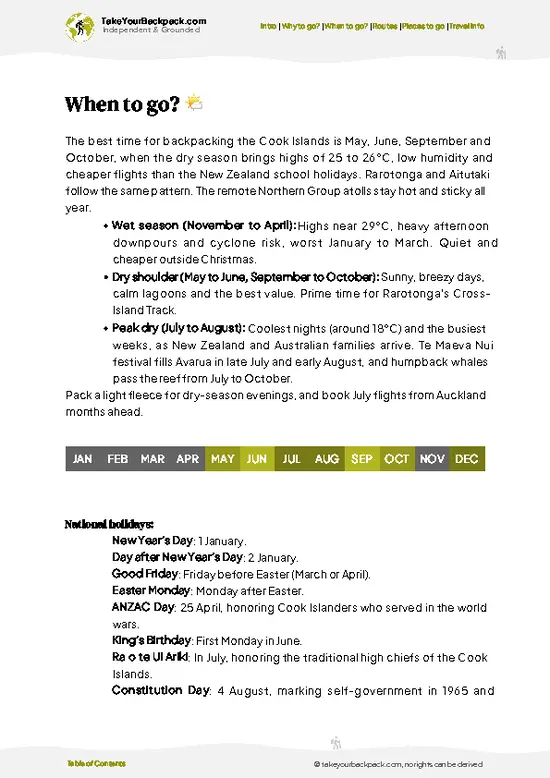
Best months for trails and lagoons: May to October is the best window, because the dry season brings daytime highs of about 24 to 28°C, lower humidity and firmer, less slippery ground. Shoulder and wet seasons: May, June, September and October are the sweet spot, with good weather and thinner crowds, and room prices often NZ$20 to 60 (US$12 to 36) a night below July and August. Those two months, plus the New Zealand school holidays, are busiest, so book flights and beds early. November to April is hotter (28 to 31°C), muggier and wetter, with rainfall peaking from January to March and cyclone season officially running November to April. Streams swell and clay paths turn greasy then. The Northern Group is warmer and wetter than Rarotonga and the Southern Group, so favor the dry months there too.

national park hoppingOptimizing Your Multi-Stop Itinerary

How many days to allow: A trip linking several protected areas in Cook Islands needs 7 to 10 days, and 5 days is the realistic minimum if you add one outer island. Start on Rarotonga, where most international flights land (often late at night), and give it 3 to 4 days for interior walks and lagoon time. Then fly to Aitutaki, about 45 minutes, and allow 2 to 3 days. End back on Rarotonga with a one-night buffer before your international flight. The Northern Group is reached by infrequent flights or private yacht, so treat it as a separate trip. The usual mistakes are cramming a different island into every two days, booking a tight same-day connection, and forgetting that Sundays are quiet. Instead, leave slack for weather delays, confirm flight days early, and keep one flexible day.

The ListMust-Visit national parks in Cook Islands

1 Takitumu Conservation Area

Kakerori birds, guided forest walk, tree ferns, bush medicine

Book an early guided walk up a Takitumu valley to hear the rare kakerori, pass towering tree ferns, and crush medicinal leaves.

cook-islands-national-park-takitumu-conservation-area
© Google | Andreas Bodenstein
Loading the map 🌍

Expert viewPro Tips for Exploring the Best

How many to visit: Two or three protected areas is the right number for most backpackers, because the islands are small, the good ones take a half day each, and more than that turns into box-ticking while you miss the lagoon time that defines the place. One forest walk, one marine area and, if budget allows, one outer-island stop gives the most variety for the least cost.Which kind suits you: Forest and trail areas on the main island cost the least. Many walks are free, while a guided hike runs roughly NZ$80 to 150 (US$48 to 90). A guide costs more but saves you from wrong turns and teaches you plants and history, so I would pay for one guide on your most demanding walk and do the rest solo. Marine areas are cheaper still, since snorkeling off the beach costs nothing beyond gear rental at … read more 👉
How many to visit: Two or three protected areas is the right number for most backpackers, because the islands are small, the good ones take a half day each, and more than that turns into box-ticking while you miss the lagoon time that defines the place. One forest walk, one marine area and, if budget allows, one outer-island stop gives the most variety for the least cost.Which kind suits you: Forest and trail areas on the main island cost the least. Many walks are free, while a guided hike runs roughly NZ$80 to 150 (US$48 to 90). A guide costs more but saves you from wrong turns and teaches you plants and history, so I would pay for one guide on your most demanding walk and do the rest solo. Marine areas are cheaper still, since snorkeling off the beach costs nothing beyond gear rental at NZ$10 to 20 (US$6 to 12). Outer-island stops cost the most in money and time, with return flights around NZ$250 to 450 (US$150 to 270), so go only if you have five or more days.Budget and safety: Expect US$70 to 120 a day for a dorm bed, bus or scooter, food from markets and takeaways, and one activity. Scooter rental is about NZ$15 to 20 (US$9 to 12) a day, but you need a local license from the police station and a helmet, and scooter crashes are the most common injury visitors face. Trails are slick after rain, so wear shoes with grip and carry at least 1.5 liters of water. Sun is strong year-round, and reef shoes protect against coral cuts. Land belongs to families, so ask before crossing private ground and never take shells, coral or plants. Respect rahui signs, cover your shoulders in villages, and keep Sunday morning quiet around churches.

✈️ The backpacker research shortcutCook Islands Travel Guide

An offline-friendly backpacking guide with optimized travel routes, ranked highlights, transport advice, and the best areas to stay.
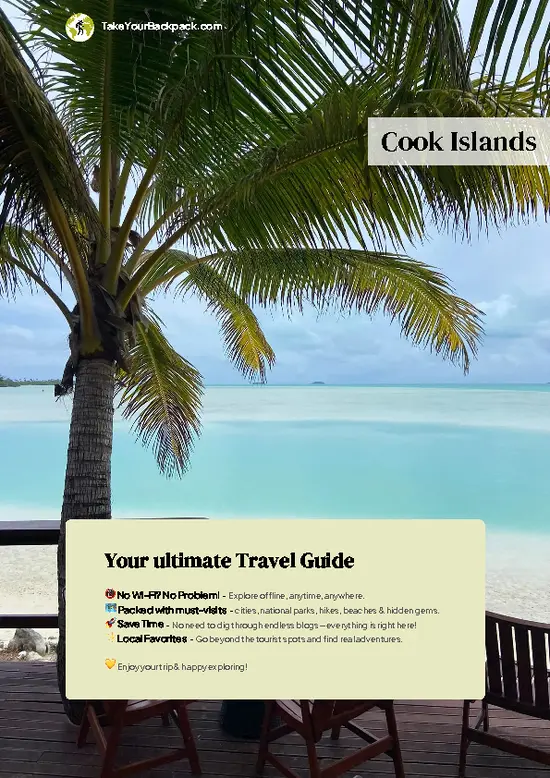
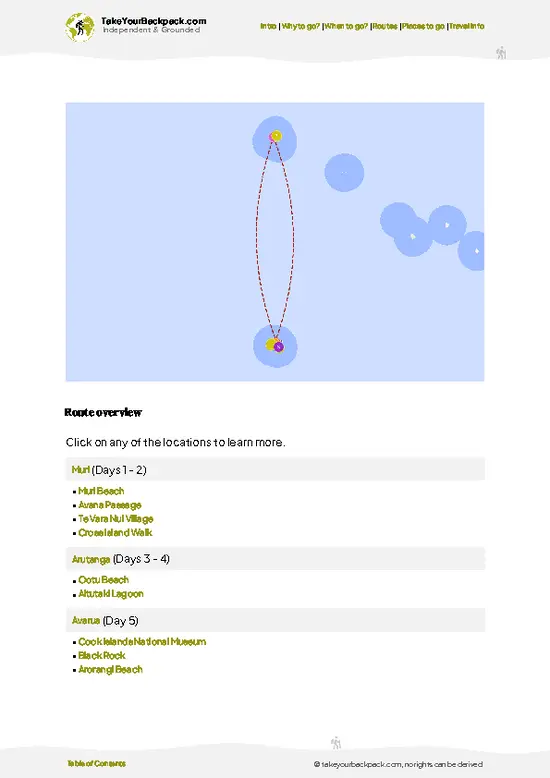
example page 0 from our offline Travel Guide for Cook Islands
example page 1 from our offline Travel Guide for Cook Islands
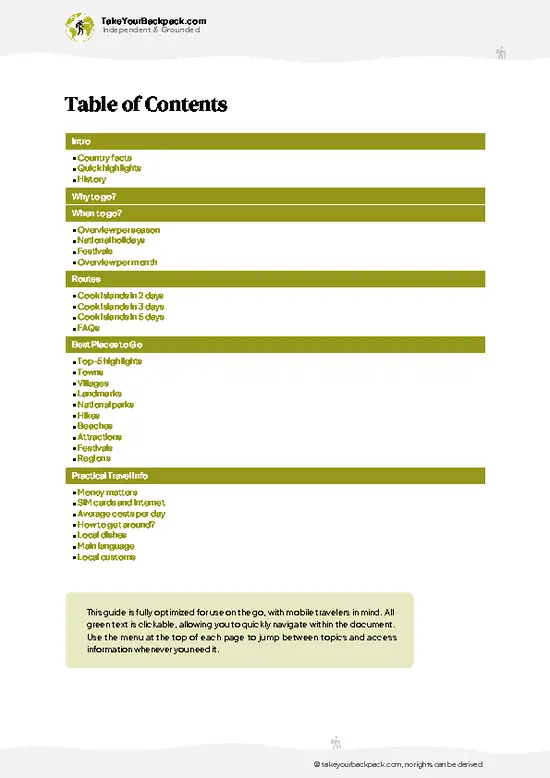
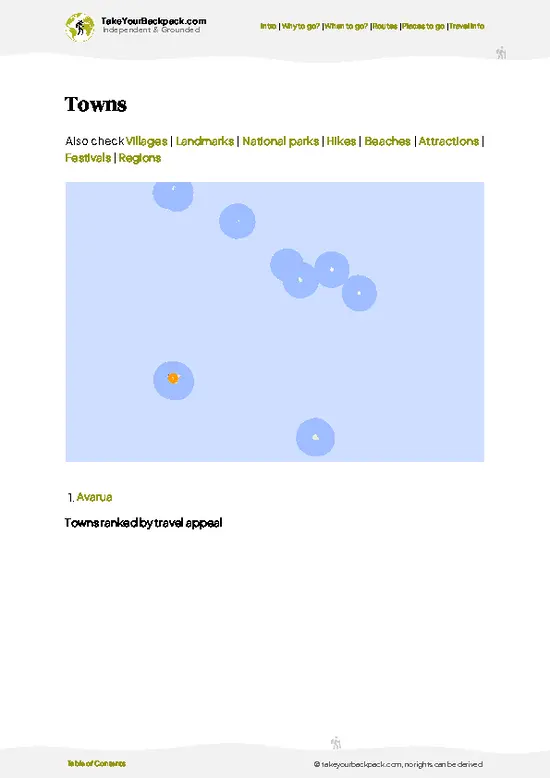
example page 2 from our offline Travel Guide for Cook Islands
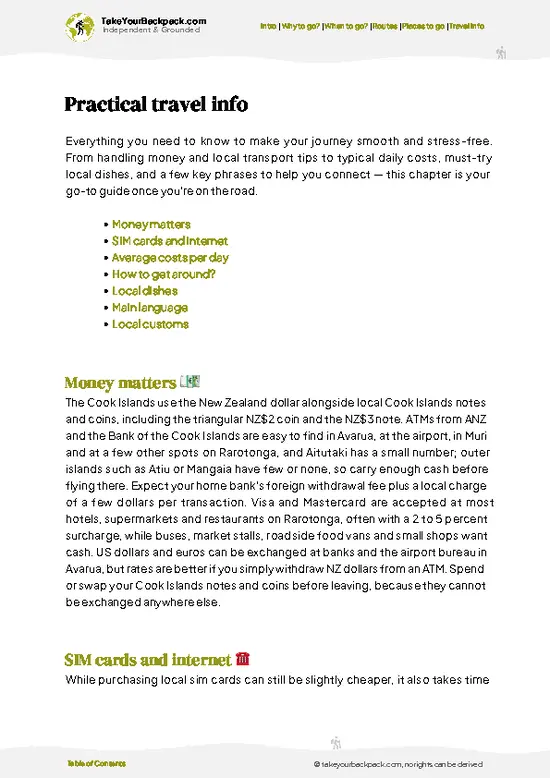
example page 3 from our offline Travel Guide for Cook Islands
example page 4 from our offline Travel Guide for Cook Islands
example page 5 from our offline Travel Guide for Cook Islands
example page 6 from our offline Travel Guide for Cook Islands
example page 7 from our offline Travel Guide for Cook Islands
The digital guide (99 pages) contains:
✅ 24 highlights, ranked by travel appeal
✅ Optimized 2, 3 & 5-day travel routes
✅ Cities, national parks, landmarks, beaches
✅ How to get around
✅ Offline-friendly for travel without Wi-Fi
👉 Click to see all 30+ guide features

📅 Plan smarter in minutes, not weeks
✅ Month by month travel advice
✅ Festivals & national holidays
✅ Budget expectations

🗺️ Go to the right places, skip the overrated ones
✅ Honest pros & cons of destinations
✅ Top hikes, parks & viewpoints
✅ Lesser-known places most travelers miss
✅ Clear “worth it vs skip it” guidance

🛏️ Travel smoothly without rookie mistakes
✅ Best areas to stay
✅ Transport systems explained simply
✅ Common scams & safety advice
✅ SIM cards, money & practical tips

🌍 Understand the country, not just visit it
✅ Culture & traditions
✅ 52 Essential phrases & customs
✅ Festivals worth planning around
✅ Traveler-friendly historical context
✅ Insights that make places more meaningful

📱 Built for real travel conditions
✅ Fully downloadable PDF
✅ Works completely offline
✅ Optimized for phone use
✅ Useful in remote areas & buses
✅ Everything in one place
Stop searching, start planning
Get instant access to your full guide. 30‑day money-back guarantee.
+ Add another guide for just

By proceeding you agree to our terms.
Sent to your inbox immediately after payment • 100% Secure Checkout
Best Backpacking Travel Advisor 2025 tourism awardBest Backpacking
Travel Advisor
2025
What others say about Take Your Backpack Guides:
⭐⭐⭐⭐⭐
Fantastic, amazing amount of information!
⭐⭐⭐⭐⭐
My goodness this is amazing, it's what I've been looking for hats off too you!
⭐⭐⭐⭐⭐
I think this is absolutely BRILLIANT
⭐⭐⭐⭐
Very complete and informative. It's still missing places, but I gotta to commend you
⭐⭐⭐⭐⭐
This is truly amazing, thank you, can't wait to explore it with my kids!
⭐⭐⭐⭐⭐
Awesome resource, thank you!
⭐⭐⭐⭐⭐
This is amazing! Can't wait to explore the ones I haven't seen
⭐⭐⭐⭐
I love this! Well done, great idea.
⭐⭐⭐⭐⭐
Thanks for taking the time to make this gem!
⭐⭐⭐⭐⭐
This might be the best website I've ever seen.
⭐⭐⭐⭐⭐
Congratulations, and thank you so much for your work; it's incredibly valuable.
⭐⭐⭐⭐
In all seriousness I think you did a great job pointing out the important spots
⭐⭐⭐⭐⭐
10/10 very good
⭐⭐⭐⭐⭐
As someone who's only just starting to visit regularly this is awesome, thank you.
⭐⭐⭐⭐
Thank you very much! I'm going to visit my dad, it's going to be very useful!
⭐⭐⭐⭐⭐
This is really cool! We'll be travelling for the first time and this definitely come in handy.
⭐⭐⭐⭐⭐
You are now our minister of culture, congratulations 👨‍💼
⭐⭐⭐⭐⭐
Just wanted to tell you that this is a pearl! Going to follow your recommendations.
⭐⭐⭐⭐⭐
This is so cool. I'll definitely be using the resource for my travels soon.
⭐⭐⭐⭐⭐
This is very impressive! Good work.
⭐⭐⭐⭐⭐
This is an amazing and informative site. Very well done!

🛏️ Where to stay?Top Areas to Stay

The Cook Islands have a small but solid spread of backpacker lodges, hostels and simple guesthouses, almost all on Rarotonga, with dorm beds around NZ$35 to 50 (US$21 to 30) and private rooms from roughly NZ$70 to 120 (US$42 to 72). Avarua puts you near the airport, supermarkets, the Saturday market and the island’s few late bars, though its lagoon is poor for swimming, while Muri on the southeast coast has the best swimming lagoon, kayak rentals and night food stalls, but sleeps early and costs a little more. Arorangi on the west coast is the quietest and cheapest of the three, with sunset views and easy reef snorkeling, but you’ll lean on the round-island bus or a rented scooter for everything … read more 👉
The Cook Islands have a small but solid spread of backpacker lodges, hostels and simple guesthouses, almost all on Rarotonga, with dorm beds around NZ$35 to 50 (US$21 to 30) and private rooms from roughly NZ$70 to 120 (US$42 to 72). Avarua puts you near the airport, supermarkets, the Saturday market and the island’s few late bars, though its lagoon is poor for swimming, while Muri on the southeast coast has the best swimming lagoon, kayak rentals and night food stalls, but sleeps early and costs a little more. Arorangi on the west coast is the quietest and cheapest of the three, with sunset views and easy reef snorkeling, but you’ll lean on the round-island bus or a rented scooter for everything else, and on Aitutaki budget beds are scarce, so book well ahead.

If you enjoy meeting fellow travelers, consider choosing hostels with high ratings for atmosphere. On the other hand, if you prefer having your own space, a hotel might be a better option.

Cook IslandsDiscover the Country

👋 Meet the founderWho’s Behind Take Your Backpack?

Johan, backpacker and founder of TakeYourBackpackHi, I’m Johan (Netherlands 🇳🇱), the creator of TakeYourBackpack. Over the past 3 decades, I’ve backpacked through 90+ countries across six continents, gaining extensive experience with independent travel, long-term trips, and overland routes.

This site is built on a combination of firsthand travel experience and carefully curated insights from other backpackers. Many guides are based on places I’ve personally visited, while others bring together tips, observations, and practical advice shared by trusted travelers I’ve met along the way.

The goal is to provide realistic, experience-driven guidance — not generic itineraries — so you can explore destinations with better context, clearer expectations, and more confidence.