×

Côte d’Ivoire🇨🇮 | citiesDuékouéWestern crossroads, plantation tastings, mission shade, charcoal stalls | things to do and best time to go

Explore GagnoaExplore Adzopé

Backpacking in Duékoué
👍 Recommendedcity ranked #13
By Johan Kruseman 🇳🇱 | Updated October 22, 2026

Motorbike taxis whine past a roadside grill where smoke from charcoal drifts over red dust, and the humid air tastes faintly of cocoa and exhaust. Duékoué sits in the west of Côte d’Ivoire, on the road between Man and the cocoa belt around Daloa and Guiglo. It is a working crossroads, not a sightseeing town. The market and the nearby forest villages deserve your time; the main strip of fuel stops and noisy junctions does not. You will like it most if you want real western Ivorian life and a practical overnight. If you need monuments, polished cafés or quiet, skip it.

Discover everything you want to know in the 📖 Côte d’Ivoire Travel Guide.


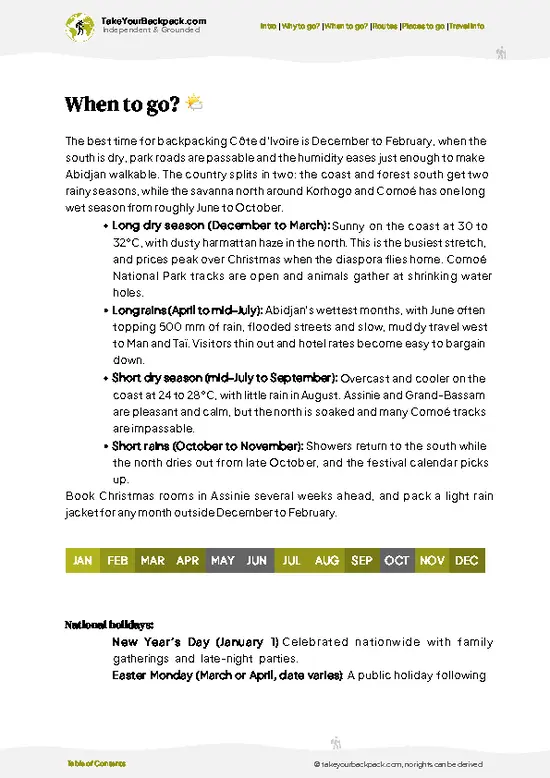
example page 0 from our offline Travel Guide for Côte d’Ivoire
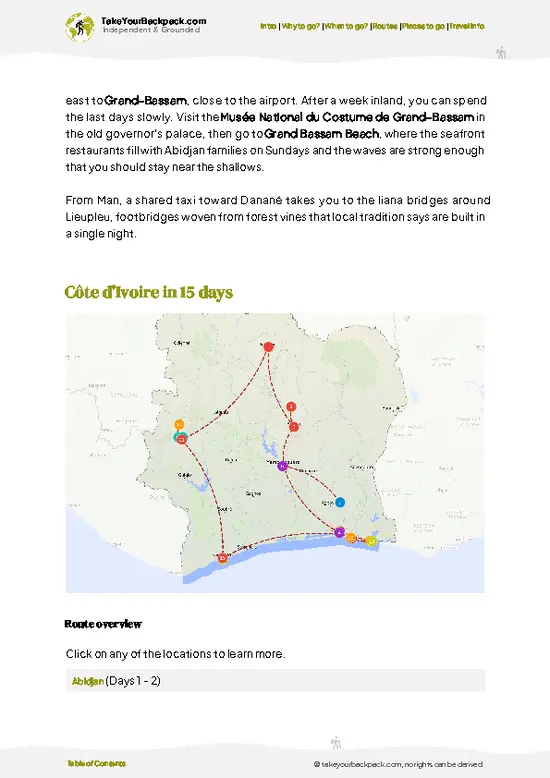
example page 1 from our offline Travel Guide for Côte d’Ivoire
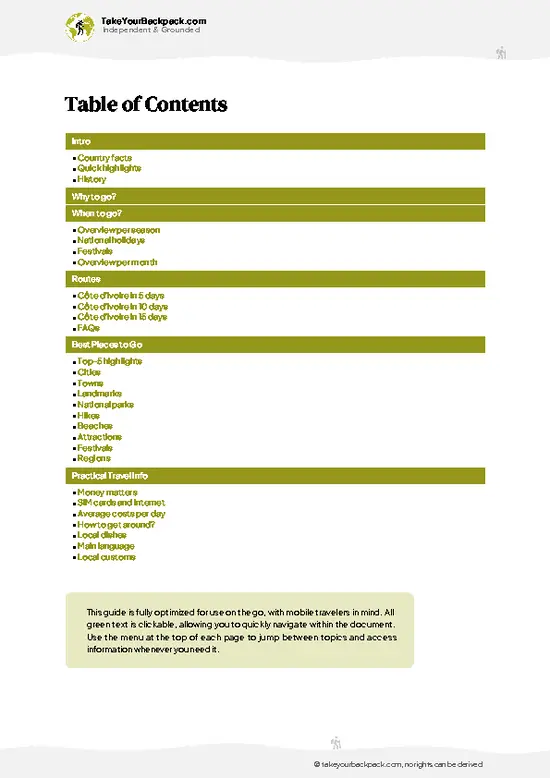
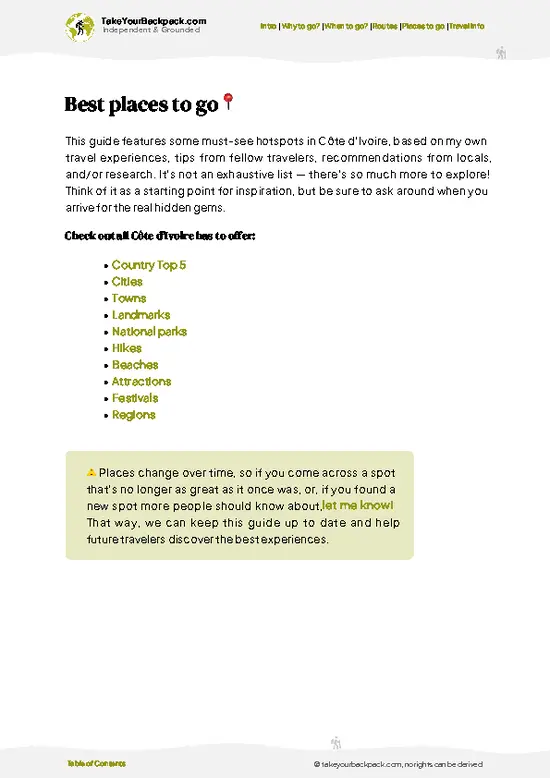
example page 2 from our offline Travel Guide for Côte d’Ivoire
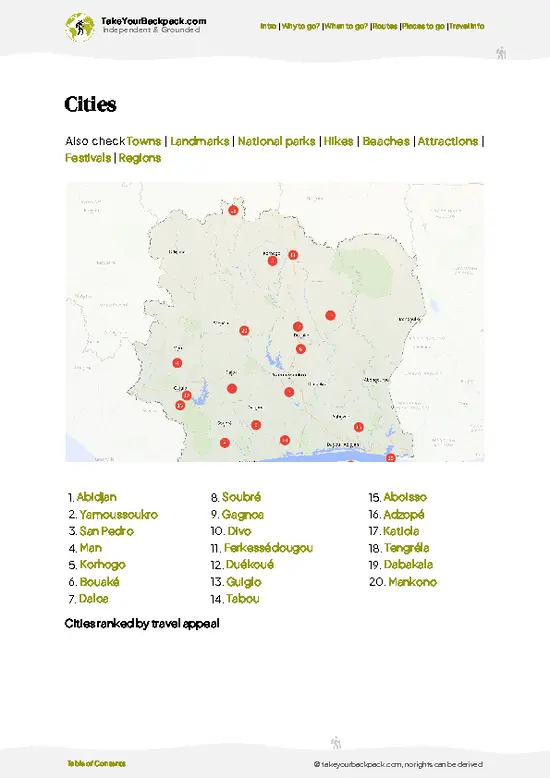
example page 3 from our offline Travel Guide for Côte d’Ivoire
example page 4 from our offline Travel Guide for Côte d’Ivoire
example page 5 from our offline Travel Guide for Côte d’Ivoire
example page 6 from our offline Travel Guide for Côte d’Ivoire
example page 7 from our offline Travel Guide for Côte d’Ivoire
Loading the map 🌍
CLICK TO FILTER
cities
towns
landmarks
national parks
hikes
beaches
attractions
festivals
regions
SHOW COUNTRY’S BESTSHOW ALL

✨ Why go?
Ranked #13 city in Côte d’Ivoire
What makes this city worth visiting

Duékoué earns its place on a route as a junction, not a destination. Roads fan out toward the mountains of Man, the forest of the Guiglo area and the cocoa towns to the east, so you can switch directions here without backtracking. The town is compact enough to cover on foot or by motorbike taxi, and the daily market gives you a clear look at how cocoa, rubber and cassava country actually lives and eats. Food is simple and filling, usually grilled fish or chicken with attiéké at roadside maquis. Nightlife is a few open-air bars with loud music, nothing more. Treat Duékoué as a one-night stop with a market morning, then move on toward bigger sights.

💡 HighlightsDon't-miss highlights and experiences

  1. Duékoué Central Market: The town’s best sight is its main market, with piles of cassava, peppers, smoked fish and cloth. Go early, from about 7 to 10 AM, before the heat. Entry is free and an hour or two is plenty.
  2. Cocoa plantation visit near town: Local farmers will show you pods being split, beans fermenting and drying on mats. Arrange it through your guesthouse or a local guide. Expect €5 to 15 as a tip or fee, and 2 to 3 hours. Morning is best.
  3. Catholic Mission area: The town’s church grounds are a quiet, shaded pause, and the mission history ties into the region’s past. Go in the late afternoon. Free, about 30 minutes.
  4. Evening grill street: Charcoal stalls and maquis along the main road serve fish and chicken as dusk cools the air. Plan €3 to 6 for a meal and an hour of sitting and watching
… read more 👉
  1. Duékoué Central Market: The town’s best sight is its main market, with piles of cassava, peppers, smoked fish and cloth. Go early, from about 7 to 10 AM, before the heat. Entry is free and an hour or two is plenty.
  2. Cocoa plantation visit near town: Local farmers will show you pods being split, beans fermenting and drying on mats. Arrange it through your guesthouse or a local guide. Expect €5 to 15 as a tip or fee, and 2 to 3 hours. Morning is best.
  3. Catholic Mission area: The town’s church grounds are a quiet, shaded pause, and the mission history ties into the region’s past. Go in the late afternoon. Free, about 30 minutes.
  4. Evening grill street: Charcoal stalls and maquis along the main road serve fish and chicken as dusk cools the air. Plan €3 to 6 for a meal and an hour of sitting and watching traffic roll through.
  5. Sunday morning in town: Church singing drifts from several neighborhoods, and the streets are calmer than on market days. Free, 1 hour, best for photographs of everyday life if you ask first.
For day trips, Man with its waterfalls and Dent de Man peaks, the forests around Guiglo and the cocoa towns toward Daloa are all reachable from Duékoué. Nothing in town needs a ticket or advance booking, though plantation visits go more smoothly if you arrange them the day before.
Spotted a mistake or missing something? Contact us.

🏘️ NeighborhoodsWhere things are and how it's laid out

Duékoué is a sprawling, low-rise market town where you sort the areas by what they sell and who lives there.
  • Central market and main road: This is where you spend your time. The market hums from early morning, with the smell of smoked fish, palm oil and wet cocoa beans, and motorbike horns never stop. Walk it in an hour.
  • Carrefour (the main junction): Dusty, loud and lined with bus offices, grill stands and phone-credit kiosks. Worth passing through, not lingering. It is the best place to watch the town’s trade move.
  • Quartier Kokoma and the residential edges: Red-earth lanes, mango trees, kids playing football and generator hum at night. Pleasant for a late-afternoon wander, but there are no sights, so skip it if time is short.
  • Cocoa-belt outskirts: Cocoa and rubber plantations start where the
… read more 👉
Duékoué is a sprawling, low-rise market town where you sort the areas by what they sell and who lives there.
  • Central market and main road: This is where you spend your time. The market hums from early morning, with the smell of smoked fish, palm oil and wet cocoa beans, and motorbike horns never stop. Walk it in an hour.
  • Carrefour (the main junction): Dusty, loud and lined with bus offices, grill stands and phone-credit kiosks. Worth passing through, not lingering. It is the best place to watch the town’s trade move.
  • Quartier Kokoma and the residential edges: Red-earth lanes, mango trees, kids playing football and generator hum at night. Pleasant for a late-afternoon wander, but there are no sights, so skip it if time is short.
  • Cocoa-belt outskirts: Cocoa and rubber plantations start where the pavement ends. Hire a moto-taxi to see beans drying on tarps. The heat is heavy by midday, so go early.

⌛️ 1 day1-day itinerary for Duékoué

The day works best on foot for the central pieces and by shared taxi or moto-taxi for anything farther, with a long lunch break from midday to mid-afternoon when the heat flattens the town.
7:00 AM: Main market
Start early while the stalls are being set up. Duékoué sits in cocoa and coffee country, so look for sacks of beans, piles of cassava, smoked fish and red palm oil. Grab a coffee with bread and an omelet from a street vendor, then wander the lanes slowly.
9:00 AM: Grand Mosque and the town center
Walk through the central streets and see the mosque, a visible sign of the town’s large northern and Sahelian communities living alongside southern groups. Greet people first; it opens doors here.
10:30 AM: Catholic mission of Duékoué
Take a short moto-taxi ride to the mission area. The grounds are … read more 👉
The day works best on foot for the central pieces and by shared taxi or moto-taxi for anything farther, with a long lunch break from midday to mid-afternoon when the heat flattens the town.
7:00 AM: Main market
Start early while the stalls are being set up. Duékoué sits in cocoa and coffee country, so look for sacks of beans, piles of cassava, smoked fish and red palm oil. Grab a coffee with bread and an omelet from a street vendor, then wander the lanes slowly.
9:00 AM: Grand Mosque and the town center
Walk through the central streets and see the mosque, a visible sign of the town’s large northern and Sahelian communities living alongside southern groups. Greet people first; it opens doors here.
10:30 AM: Catholic mission of Duékoué
Take a short moto-taxi ride to the mission area. The grounds are quiet and shaded, and they help you grasp the town’s recent history and its resilience. Be respectful, and ask before taking photos.
12:30 PM: Maquis lunch
Sit in a shaded open-air maquis for grilled chicken or fish with attiéké and spicy onion sauce. Stay put through the hottest hours and let the ceiling fan do its work.
3:30 PM: Cocoa plantation edge
This is not on the usual route. Hire a moto-taxi to the farmland just outside town and ask a farmer to show you cocoa pods on the tree. Seeing how beans are split and dried gives the whole region context.
6:00 PM: Evening street food
Return to town as the air cools. Eat grilled brochettes at a roadside stand and finish with a cold local beer.

🌤️ When to go?Seasonal considerations and timing

The dry months from roughly November to March are easiest for Duékoué, with sunny days of 30 to 34°C (86 to 93°F) and cooler nights near 20°C (68°F).
  • Dry season (Nov to Mar): Dusty roads, hazy skies from Harmattan wind, and the cocoa main-crop harvest from about October. Daylight lasts about 12 hours all year.
  • Short dry spell (Aug): A brief break in the rains with fewer downpours, though mud lingers.
  • Rainy seasons (Apr to Jul, Sep to Oct): Humid, 24 to 31°C (75 to 88°F), with afternoon storms that turn laterite tracks slick. Transport slows but prices stay steady.
Travel in the morning, since storms usually build after lunch.

source: climatestotravel.comJANJanuary: excellent for travelingFEBFebruary: excellent for travelingMARMarch: excellent for travelingAPRApril: excellent for travelingMAYMay: fair for travelingJUNJune: fair for travelingJULJuly: fair for travelingAUGAugust: fair for travelingSEPSeptember: fair for travelingOCTOctober: fair for travelingNOVNovember: excellent for travelingDECDecember: excellent for traveling
when-to-go

✈️ The backpacker research shortcutCôte d’Ivoire Travel Guide

An offline-friendly backpacking guide with optimized travel routes, ranked highlights, transport advice, and the best areas to stay.
example page 0 from our offline Travel Guide for Côte d’Ivoire
example page 1 from our offline Travel Guide for Côte d’Ivoire
example page 2 from our offline Travel Guide for Côte d’Ivoire
example page 3 from our offline Travel Guide for Côte d’Ivoire
example page 4 from our offline Travel Guide for Côte d’Ivoire
example page 5 from our offline Travel Guide for Côte d’Ivoire
example page 6 from our offline Travel Guide for Côte d’Ivoire
example page 7 from our offline Travel Guide for Côte d’Ivoire
The digital guide (279 pages) contains:
✅ 64 highlights, ranked by travel appeal
✅ Optimized 5, 10 & 15-day travel routes
✅ Cities, national parks, landmarks, beaches
✅ How to get around
✅ Offline-friendly for travel without Wi-Fi
👉 Click to see all 30+ guide features

📅 Plan smarter in minutes, not weeks
✅ Month by month travel advice
✅ Festivals & national holidays
✅ Budget expectations

🗺️ Go to the right places, skip the overrated ones
✅ Honest pros & cons of destinations
✅ Top hikes, parks & viewpoints
✅ Lesser-known places most travelers miss
✅ Clear “worth it vs skip it” guidance

🛏️ Travel smoothly without rookie mistakes
✅ Best areas to stay
✅ Transport systems explained simply
✅ Common scams & safety advice
✅ SIM cards, money & practical tips

🌍 Understand the country, not just visit it
✅ Culture & traditions
✅ 52 Essential phrases & customs
✅ Festivals worth planning around
✅ Traveler-friendly historical context
✅ Insights that make places more meaningful

📱 Built for real travel conditions
✅ Fully downloadable PDF
✅ Works completely offline
✅ Optimized for phone use
✅ Useful in remote areas & buses
✅ Everything in one place
Stop searching, start planning
Get instant access to your full guide. 30‑day money-back guarantee.
+ Add another guide for just

By proceeding you agree to our terms.
Sent to your inbox immediately after payment • 100% Secure Checkout
Best Backpacking Travel Advisor 2025 tourism awardBest Backpacking
Travel Advisor
2025
What others say about Take Your Backpack Guides:
⭐⭐⭐⭐⭐
Fantastic, amazing amount of information!
⭐⭐⭐⭐⭐
My goodness this is amazing, it's what I've been looking for hats off too you!
⭐⭐⭐⭐⭐
I think this is absolutely BRILLIANT
⭐⭐⭐⭐
Very complete and informative. It's still missing places, but I gotta to commend you
⭐⭐⭐⭐⭐
This is truly amazing, thank you, can't wait to explore it with my kids!
⭐⭐⭐⭐⭐
Awesome resource, thank you!
⭐⭐⭐⭐⭐
This is amazing! Can't wait to explore the ones I haven't seen
⭐⭐⭐⭐
I love this! Well done, great idea.
⭐⭐⭐⭐⭐
Thanks for taking the time to make this gem!
⭐⭐⭐⭐⭐
This might be the best website I've ever seen.
⭐⭐⭐⭐⭐
Congratulations, and thank you so much for your work; it's incredibly valuable.
⭐⭐⭐⭐
In all seriousness I think you did a great job pointing out the important spots
⭐⭐⭐⭐⭐
10/10 very good
⭐⭐⭐⭐⭐
As someone who's only just starting to visit regularly this is awesome, thank you.
⭐⭐⭐⭐
Thank you very much! I'm going to visit my dad, it's going to be very useful!
⭐⭐⭐⭐⭐
This is really cool! We'll be travelling for the first time and this definitely come in handy.
⭐⭐⭐⭐⭐
You are now our minister of culture, congratulations 👨‍💼
⭐⭐⭐⭐⭐
Just wanted to tell you that this is a pearl! Going to follow your recommendations.
⭐⭐⭐⭐⭐
This is so cool. I'll definitely be using the resource for my travels soon.
⭐⭐⭐⭐⭐
This is very impressive! Good work.
⭐⭐⭐⭐⭐
This is an amazing and informative site. Very well done!

🛏️ Where to stay?Choosing the right base

The streets around the main junction and market are the best bet for a budget bed in Duékoué, with simple guesthouses from about €10 to 20 a night and no real hostel scene. Being central means you can walk to food, money changers and the bus offices, and you will catch early coaches without a taxi. Expect noise from motorbikes and loudspeakers from dawn, so bring earplugs. The quieter residential edge near Kokoma suits light sleepers. Rooms there are similarly priced, but you will depend on moto-taxis after dark and the walk home is less lit. Either way, ask for a fan or air-conditioned room with … read more 👉
The streets around the main junction and market are the best bet for a budget bed in Duékoué, with simple guesthouses from about €10 to 20 a night and no real hostel scene. Being central means you can walk to food, money changers and the bus offices, and you will catch early coaches without a taxi. Expect noise from motorbikes and loudspeakers from dawn, so bring earplugs. The quieter residential edge near Kokoma suits light sleepers. Rooms there are similarly priced, but you will depend on moto-taxis after dark and the walk home is less lit. Either way, ask for a fan or air-conditioned room with a net, check that the generator runs overnight, and carry cash since cards are rarely accepted.

🚌 Getting aroundHow to get from A to B

Duékoué’s center is walkable in an hour, but walking stops making sense once you head for the outskirts, where heat, dust and long red-earth roads wear you down fast. Traffic is mostly motorbikes, so the air smells of exhaust and frying oil, and public transport is informal rather than scheduled.
  • Walking: Free and best for the market, the main junction and the streets around them. Go before 10 a.m. while the light is soft and the sun is not yet punishing.
  • Moto-taxi: The default way to cover the town. Rides cost about €0.30 to 1, and longer runs to the outskirts about €1.50 to 3. Agree the fare first and ask for a helmet.
  • Shared taxi (woro-woro): Battered cars with fixed routes on main roads, about €0.30 to 0.60 a seat. They squeeze in four passengers across the back and leave when full. Hours
… read more 👉
Duékoué’s center is walkable in an hour, but walking stops making sense once you head for the outskirts, where heat, dust and long red-earth roads wear you down fast. Traffic is mostly motorbikes, so the air smells of exhaust and frying oil, and public transport is informal rather than scheduled.
  • Walking: Free and best for the market, the main junction and the streets around them. Go before 10 a.m. while the light is soft and the sun is not yet punishing.
  • Moto-taxi: The default way to cover the town. Rides cost about €0.30 to 1, and longer runs to the outskirts about €1.50 to 3. Agree the fare first and ask for a helmet.
  • Shared taxi (woro-woro): Battered cars with fixed routes on main roads, about €0.30 to 0.60 a seat. They squeeze in four passengers across the back and leave when full. Hours run from early morning to dusk.
  • Intercity minibus or coach: The way in and out. Offices cluster by the main junction. Man is about 1.5 to 2 hours away for €3 to 5, and Abidjan about 6 to 8 hours for €10 to 15. Leave early, as departures thin out after midday.

👛 Costs (as of 22 October 2026)Travel costs and budget guide for Duékoué

Duékoué costs backpackers about €20 to 36 a day, with a bed, street meals and moto-taxis all cheap.
CategoryBudget RangeLocal Reality
Dorm accommodation (high season)€10 to 15No true dorms, so a basic guesthouse room with a fan
Dorm accommodation (off-season)€8 to 12Rooms drop slightly in the rains
Meals€5 to 9Market and grill plates, plus a cold drink
Local transport€1 to 3Moto-taxis and shared cars
City transport passNot availablePay per ride in cash
Basic activities/entry fees€2 to 5Mostly free, with tips for plantation visits
Miscellaneous€2 to 4Phone credit, water, small tips
Total Daily Budget€20 to 36About €28 at a realistic midpoint
Save money by eating where the drivers eat and carrying small notes for exact fares.

source: cotedivoiretourisme.ci
⚠️ Prices can change and everyone travels differently, so take this as a rough guide. Hope it helps you plan your adventure!

🚌 Day tripsShort trips worth adding

Duékoué works well as a base for rural day trips, since the roads fan out to forest, mountains and river towns.Man and the Dix-Huit Montagnes: Man sits about 1.5 to 2 hours away by minibus (€3 to 5 each way). Climb the Dent de Man for forest views, and allow €15 to 25 in total with a guide. Go in the dry season, because wet trails are treacherous. First-timers often start too late and run out of daylight.
👉 Explore ManCocoa plantations around Duékoué: A moto-taxi gets you to farms within 30 minutes for about €3 to 6 round trip. Farmers show you pods being split, beans fermenting and drying. October to March is harvest time. Bring cash to tip and ask permission before photographing people.
Guiglo and the Cavally River: Guiglo is about 1 to 1.5 hours west by shared taxi or minibus, for €2 to 4 … read more 👉
Duékoué works well as a base for rural day trips, since the roads fan out to forest, mountains and river towns.Man and the Dix-Huit Montagnes: Man sits about 1.5 to 2 hours away by minibus (€3 to 5 each way). Climb the Dent de Man for forest views, and allow €15 to 25 in total with a guide. Go in the dry season, because wet trails are treacherous. First-timers often start too late and run out of daylight.
👉 Explore ManCocoa plantations around Duékoué: A moto-taxi gets you to farms within 30 minutes for about €3 to 6 round trip. Farmers show you pods being split, beans fermenting and drying. October to March is harvest time. Bring cash to tip and ask permission before photographing people.
Guiglo and the Cavally River: Guiglo is about 1 to 1.5 hours west by shared taxi or minibus, for €2 to 4 each way. Markets and river views make it worthwhile, and the road is rougher after rain. Check the last return, which is usually late afternoon.
👉 Explore GuigloBangolo: A quiet town about an hour north by shared taxi for €1.50 to 3. Go for a market day and village life. Return before dusk, since onward vehicles are scarce.
👉 Explore Bangolo

🍲 FoodWhat to Eat & Drink

Duékoué sits in cocoa and rubber country in the west, so food leans on forest ingredients and river fish. Look for attiéké with grilled fish at roadside stands, plus kedjenou, a slow-cooked chicken stew in a sealed pot, often made here with guinea fowl. Sauce graine (palm nut) and sauce gouagouassou turn up at family-run maquis. Bush meat is sold but best skipped.
Eat at the central market and the junction grills, where smoke, chili and charcoal fill the air by early evening. A plate costs about €1.50 to 4. Drink bissap (hibiscus juice) or local beer at open-air maquis, where plastic chairs and loud music make the social scene.

🛡️ SafetySafety Tips and Common Scams in Duékoué

Duékoué is calm by day and easy to move around, but extra awareness helps in a region that still carries memories of past conflict, so keep conversations about politics light. Petty theft is the usual problem, so keep your phone in a front pocket in the crowded market and at the junction. Solo travelers, women included, do fine in daylight, but moto-taxis after dark and unlit side streets are best avoided. Police checkpoints on the roads are common. Stay polite, keep a passport copy handy and carry small notes for any informal “fees.” Check current local conditions before long road trips.

FAQFrequently asked questions about Duékoué

Two days is enough for Duékoué itself, since the market and surroundings take a day. Add a third day for a trip to Man, about 1.5 to 2 hours away for €3 to 5 by minibus, or to the Dent de Man hike. Plantation visits take half a day.
Duékoué is manageable for solo backpackers in daylight, and most problems are petty theft in the crowded market and junction. Avoid moto-taxis after dark and keep valuables in a front pocket. Police checkpoints are routine, so carry a passport copy and small cash.
Duékoué is known for cocoa and rubber farming, and for being a major crossroads town in western Côte d’Ivoire. Its busy market sells produce from the surrounding plantations, and the town lies about 1.5 to 2 hours from Man. Travelers use it as a base for forest and mountain trips.
⚠️ Things can change over time, so always validate details locally before you go.

Other Ivorian cities near Duékoué

Explore more nearby:

  • Guiglo—River crossing, logging trucks, market square| 27 km away
  • Man—Mountain views, waterfalls, forest trails| 76 km away
  • Daloa—Cocoa warehouses, roadside eateries, transport hubs| 103 km away

💡 Not sure where to go next?
Create a personalized itinerary for Côte d’Ivoire including Duékoué and the places that fit your trip.

Generate my itinerary

👉 Discover all cities

Or checkout all Côte d’Ivoire has to offer (think cities, towns, villages, national parks, hikes, beaches, festivals)
Country photo of Côte d’Ivoire

We 💚 feedbackKey takeaways before you go

Duékoué deserves one night and one morning, two at most if you arrange a plantation visit. I would arrive by midday, eat at the grills, and leave next morning for Man. Bring small bills for motorbike taxis and keep your expectations practical.

✍️ Help improve this page!
The information on this page is based on in-depth research, insights shared by experienced travelers, and feedback from the local travel community in Côte d’Ivoire. While every effort is made to keep the information accurate and current, conditions can change — so if you spot anything incorrect or outdated, please get in touch.


🙋‍♂️ Give feedback

👋 Meet the founderWho’s Behind Take Your Backpack?

Johan, backpacker and founder of TakeYourBackpackHi, I’m Johan (Netherlands 🇳🇱), the creator of TakeYourBackpack. Over the past 3 decades, I’ve backpacked through 90+ countries across six continents, gaining extensive experience with independent travel, long-term trips, and overland routes.

This site is built on a combination of firsthand travel experience and carefully curated insights from other backpackers. Many guides are based on places I’ve personally visited, while others bring together tips, observations, and practical advice shared by trusted travelers I’ve met along the way.

The goal is to provide realistic, experience-driven guidance — not generic itineraries — so you can explore destinations with better context, clearer expectations, and more confidence.