×

DR Congo🇨🇩 | attractionsJardin Zoologique de Lubumbashibotanical paths, animal habitats, educational signage | things to do and best time to go

Explore Musée de la GécaminesExplore Cathédrale Saints Pierre et Paul de Lubumbashi

Backpacking in Jardin Zoologique de Lubumbashi
🌟 Highlightattraction ranked #7
By Johan Kruseman 🇳🇱 | Updated September 3, 2026

Here’s what nobody tells you: Jardin Zoologique de Lubumbashi isn’t just a zoo—it’s a living, breathing crash course in DR Congo’s complicated relationship with wildlife, conservation, and colonial legacy. Smack in the heart of Lubumbashi, the country’s second city, this place is a world away from the polished, Instagram-ready animal parks you’ll find in South Africa or Kenya. Yes, you’ll see lions and monkeys, but you’ll also see the real cost of running a zoo in a country where infrastructure is a daily struggle. Entry is cheap—almost shockingly so if you’re used to Western prices—but don’t expect manicured lawns or curated animal encounters. Crowds are mostly local families, not tour groups, so you get a raw, unfiltered vibe. The wow-factor isn’t in the facilities; it’s in the chance to witness how Congolese communities interact with their own wildlife heritage, up close and unscripted. If you want glossy, look elsewhere. If you want real, start here.

Discover everything you want to know in the 📖 DR Congo Travel Guide.
Safety warning

The current risk level for DR Congo is high. Check the advice before going.


Get your DR Congo guide
95 ranked highlights, routes & tips, works offline (372 pages)
Loading the map 🌍
CLICK TO FILTER
cities
towns
landmarks
national parks
hikes
beaches
attractions
festivals
regions
SHOW COUNTRY’S BESTSHOW ALL

✨ Why go?
Ranked #7 attraction in DR Congo
What makes it a must-see attraction

The Jardin Zoologique de Lubumbashi isn’t your typical zoo, and that’s exactly why backpackers carve out time for it. Yes, it’s crowded and the facilities might not match the polished zoos you’ve seen on glossy travel feeds. But here’s the real deal: this place is a living archive of DR Congo’s wild heart and colonial history, wrapped into one gritty, raw experience. It’s iconic because it’s one of the few spots where you can see native Congolese wildlife up close without the polished tourist bubble. The animals here aren’t just exhibits; they’re survivors of a complex history that mirrors the country’s own struggles and resilience.

For backpackers pushing through DR Congo, the zoo is a milestone—proof that you’ve stepped off the beaten path and into something authentic. It’s a place where … read more 👉
The Jardin Zoologique de Lubumbashi isn’t your typical zoo, and that’s exactly why backpackers carve out time for it. Yes, it’s crowded and the facilities might not match the polished zoos you’ve seen on glossy travel feeds. But here’s the real deal: this place is a living archive of DR Congo’s wild heart and colonial history, wrapped into one gritty, raw experience. It’s iconic because it’s one of the few spots where you can see native Congolese wildlife up close without the polished tourist bubble. The animals here aren’t just exhibits; they’re survivors of a complex history that mirrors the country’s own struggles and resilience.

For backpackers pushing through DR Congo, the zoo is a milestone—proof that you’ve stepped off the beaten path and into something authentic. It’s a place where the effort to navigate Lubumbashi’s chaotic streets pays off with a dose of adrenaline and cultural insight. You get a front-row seat to local life, from the vendors hawking snacks to families spending their day here, all while soaking in the deep-rooted significance of conservation in a country where wildlife faces constant threats. The Jardin Zoologique isn’t just a stop; it’s a gritty, meaningful checkpoint on the DR Congo route that rewards those willing to look beyond the surface.
Want to include Jardin Zoologique de Lubumbashi in your DR Congo route?
Create a personalized DR Congo itinerary that includes Jardin Zoologique de Lubumbashi and the places that fit your trip — based on your travel style, budget, and available time. Get your route in seconds.

Generate my trip

💡 HighlightsPlaces and moments you shouldn't skip

The Big Cats—Up Close, No Filter
Forget the airbrushed safari brochures. The lions and leopards here aren’t lounging on golden savannahs—they’re pacing, yawning, and sometimes staring right back at you from just a few meters away. It’s raw, sometimes unsettling, and absolutely real. The enclosures are old-school, which means you’re closer than you’d ever get in a Western zoo. That proximity is electrifying, but it’s also a gut-check: you see the power, the boredom, and the wildness that no Instagram filter can fake. If you want to feel the pulse of Africa’s apex predators without a thousand-dollar safari, this is it.


Chimpanzee Encounters—Personality Over Perfection
The chimps at Lubumbashi’s zoo are the main event for a reason. They’re not props for tourist selfies; they’re characters with … read more 👉
The Big Cats—Up Close, No Filter
Forget the airbrushed safari brochures. The lions and leopards here aren’t lounging on golden savannahs—they’re pacing, yawning, and sometimes staring right back at you from just a few meters away. It’s raw, sometimes unsettling, and absolutely real. The enclosures are old-school, which means you’re closer than you’d ever get in a Western zoo. That proximity is electrifying, but it’s also a gut-check: you see the power, the boredom, and the wildness that no Instagram filter can fake. If you want to feel the pulse of Africa’s apex predators without a thousand-dollar safari, this is it.


Chimpanzee Encounters—Personality Over Perfection
The chimps at Lubumbashi’s zoo are the main event for a reason. They’re not props for tourist selfies; they’re characters with moods, grudges, and a sense of humor that’s sharper than most people you’ll meet on the road. Watch them interact—sometimes with each other, sometimes with you. They’ll mug for attention, throw the occasional tantrum, and remind you that the line between human and animal is thinner than you think. It’s not always pretty, but it’s never boring.


Old-School Zoo Vibes—A Walk Through Time
This isn’t a polished, Disney-fied animal park. The Jardin Zoologique de Lubumbashi is a relic from another era, and that’s part of its strange charm. The faded signage, the weathered cages, the mix of local families and curious travelers—it all adds up to an experience that’s as much about people-watching as animal-spotting. You’ll see Congolese kids wide-eyed at their first lion, and elders reminiscing about visits decades ago. It’s a living slice of DR Congo’s urban history, not just a collection of animals.


Local Wildlife—A Crash Course in DR Congo’s Biodiversity
You’re not just here for the headline acts. The zoo is one of the few places in southern DR Congo where you can see native species up close: think crocodiles, monkeys, and antelope you’ve never heard of unless you’ve spent time in the bush. The collection isn’t curated for international tourists; it’s a grab-bag of what’s local and what’s survived. That means surprises—sometimes delightful, sometimes sobering.


Street Food and People-Watching—The Real Show Outside the Cages
Don’t skip the vendors outside the gates. This is where Lubumbashi’s energy really crackles: grilled corn, roasted meat, and cold drinks served up with a side of local gossip. Grab a snack, find a patch of shade, and watch the city swirl by. The zoo is a crossroads for families, students, and hustlers. If you want to feel the heartbeat of Lubumbashi, this is where you do it—messy, noisy, and absolutely alive.
Spotted a mistake or missing something? Contact us.

🌤️ When to go?Seasonal considerations and timing


  • Weather: The DR Congo’s tropical climate means Jardin Zoologique de Lubumbashi is hot and humid most of the year. The dry season, from June to September, offers more comfortable conditions with less rain, making it easier to explore without getting drenched.

  • Temperature: Expect daytime highs around 25-28°C (77-82°F) during the dry months, which is far more bearable than the 30-33°C (86-91°F) heat and sticky humidity of the wet season from October to May.

  • Daylight Hours: Daylight is fairly consistent year-round, roughly 11 to 12 hours daily. This means you won’t lose much exploring time no matter when you visit, but starting early is key to avoid the midday heat.

  • Crowds: The zoo isn’t a major tourist magnet, so crowds are generally light. However, local school holidays in July and
read more 👉

  • Weather: The DR Congo’s tropical climate means Jardin Zoologique de Lubumbashi is hot and humid most of the year. The dry season, from June to September, offers more comfortable conditions with less rain, making it easier to explore without getting drenched.

  • Temperature: Expect daytime highs around 25-28°C (77-82°F) during the dry months, which is far more bearable than the 30-33°C (86-91°F) heat and sticky humidity of the wet season from October to May.

  • Daylight Hours: Daylight is fairly consistent year-round, roughly 11 to 12 hours daily. This means you won’t lose much exploring time no matter when you visit, but starting early is key to avoid the midday heat.

  • Crowds: The zoo isn’t a major tourist magnet, so crowds are generally light. However, local school holidays in July and August can bring more families, which adds a lively atmosphere but also means a bit more noise and bustle.

  • Seasonal Activities: Wildlife is more visible during the dry season when animals gather around water sources, giving you better chances for memorable sightings. The wet season’s lush greenery is beautiful but can obscure views and make trails muddy.

  • Price Fluctuations: Entry fees remain stable year-round, but travel costs to Lubumbashi can spike during peak dry season due to higher demand, so booking transport and accommodation early pays off.


Pro-tip: Aim for July or August to catch cooler weather, active wildlife, and manageable crowds—just brace for a few more local families sharing the experience.


source: climatestotravel.comJANJanuary: fair for travelingFEBFebruary: fair for travelingMARMarch: fair for travelingAPRApril: fair for travelingMAYMay: fair for travelingJUNJune: highly recommended for travelingJULJuly: excellent for travelingAUGAugust: excellent for travelingSEPSeptember: highly recommended for travelingOCTOctober: fair for travelingNOVNovember: fair for travelingDECDecember: fair for traveling
democratic-republic-of-the-congo-attraction-jardin-zoologique-de-lubumbashi v1
© Google |

✈️ The backpacker research shortcutDR Congo Travel Guide

An offline-friendly backpacking guide with optimized travel routes, ranked highlights, transport advice, and the best areas to stay.
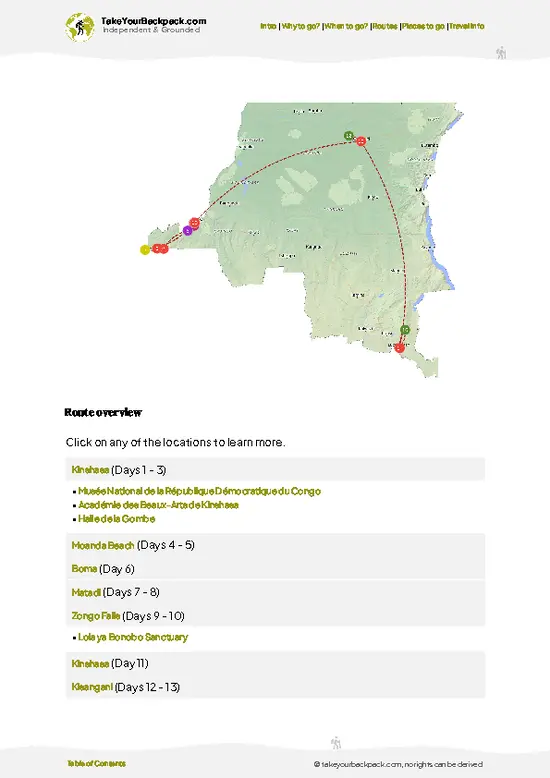
example page 0 from our offline Travel Guide for Democratic Republic of the Congo
example page 1 from our offline Travel Guide for Democratic Republic of the Congo
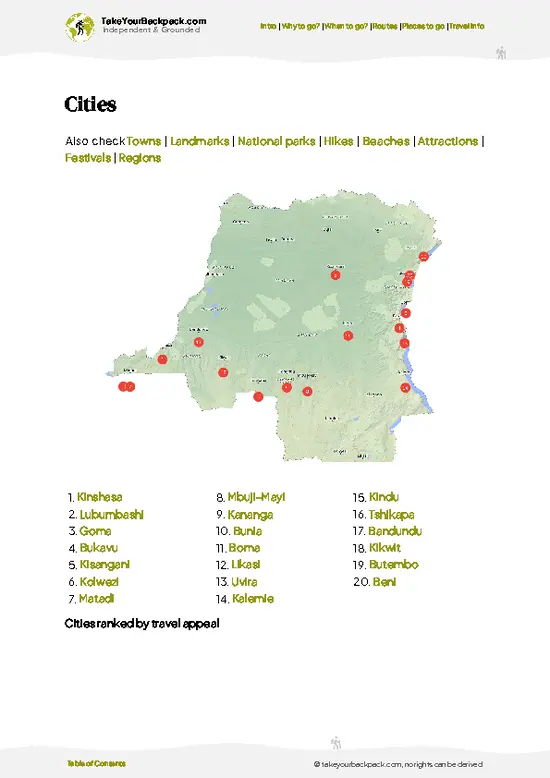
example page 2 from our offline Travel Guide for Democratic Republic of the Congo
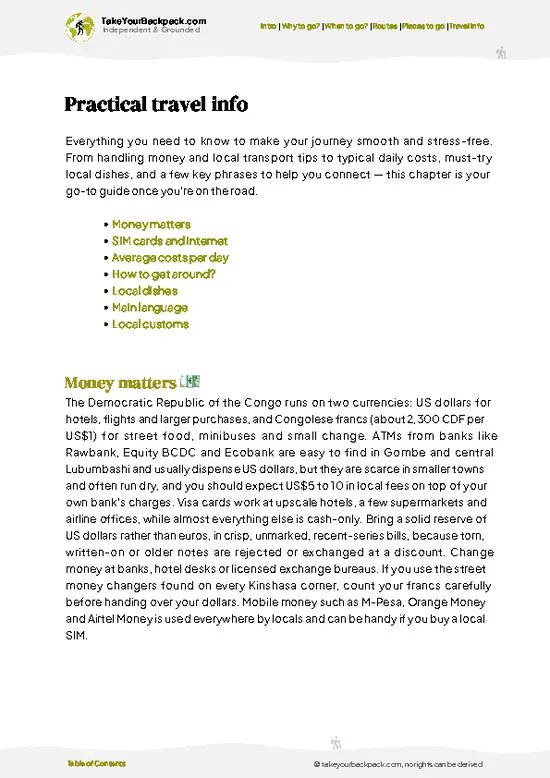
example page 3 from our offline Travel Guide for Democratic Republic of the Congo
example page 4 from our offline Travel Guide for Democratic Republic of the Congo
example page 5 from our offline Travel Guide for Democratic Republic of the Congo
example page 6 from our offline Travel Guide for Democratic Republic of the Congo
example page 7 from our offline Travel Guide for Democratic Republic of the Congo
The digital guide (372 pages) contains:
95 highlights, ranked by travel appeal
Optimized 7, 14 & 21-day travel routes
Cities, national parks, landmarks, beaches
How to get around
Offline-friendly for travel without Wi-Fi
👉 Click to see all 30+ guide features

📅 Plan smarter in minutes, not weeks
Month by month travel advice
Festivals & national holidays
Budget expectations

🗺️ Go to the right places, skip the overrated ones
Honest pros & cons of destinations
Top hikes, parks & viewpoints
Lesser-known places most travelers miss
Clear “worth it vs skip it” guidance

🛏️ Travel smoothly without rookie mistakes
Best areas to stay
Transport systems explained simply
Common scams & safety advice
SIM cards, money & practical tips

🌍 Understand the country, not just visit it
Culture & traditions
52 Essential phrases & customs
Festivals worth planning around
Traveler-friendly historical context
Insights that make places more meaningful

📱 Built for real travel conditions
Fully downloadable PDF
Works completely offline
Optimized for phone use
Useful in remote areas & buses
Everything in one place
Save weeks of stressful planning
Get instant access to your full guide. 30‑day money-back guarantee.
+ Add another guide for just US$7.80

By proceeding you agree to our terms.
Sent to your inbox immediately after payment • 100% Secure Checkout
Best Backpacking Travel Advisor 2025 tourism awardBest Backpacking
Travel Advisor
2025
What others say about Take Your Backpack Guides:
⭐⭐⭐⭐⭐
Fantastic, amazing amount of information!
⭐⭐⭐⭐⭐
My goodness this is amazing, it's what I've been looking for hats off too you!
⭐⭐⭐⭐⭐
I think this is absolutely BRILLIANT
⭐⭐⭐⭐
Very complete and informative. It's still missing places, but I gotta to commend you
⭐⭐⭐⭐⭐
This is truly amazing, thank you, can't wait to explore it with my kids!
⭐⭐⭐⭐⭐
Awesome resource, thank you!
⭐⭐⭐⭐⭐
This is amazing! Can't wait to explore the ones I haven't seen
⭐⭐⭐⭐
I love this! Well done, great idea.
⭐⭐⭐⭐⭐
Thanks for taking the time to make this gem!
⭐⭐⭐⭐⭐
This might be the best website I've ever seen.
⭐⭐⭐⭐⭐
Congratulations, and thank you so much for your work; it's incredibly valuable.
⭐⭐⭐⭐
In all seriousness I think you did a great job pointing out the important spots
⭐⭐⭐⭐⭐
10/10 very good
⭐⭐⭐⭐⭐
As someone who's only just starting to visit regularly this is awesome, thank you.
⭐⭐⭐⭐
Thank you very much! I'm going to visit my dad, it's going to be very useful!
⭐⭐⭐⭐⭐
This is really cool! We'll be travelling for the first time and this definitely come in handy.
⭐⭐⭐⭐⭐
You are now our minister of culture, congratulations 👨‍💼
⭐⭐⭐⭐⭐
Just wanted to tell you that this is a pearl! Going to follow your recommendations.
⭐⭐⭐⭐⭐
This is so cool. I'll definitely be using the resource for my travels soon.
⭐⭐⭐⭐⭐
This is very impressive! Good work.
⭐⭐⭐⭐⭐
This is an amazing and informative site. Very well done!

🛏️ Where to stay?Best areas and accommodation options

If you’re backpacking to see the Jardin Zoologique de Lubumbashi, brace yourself: this isn’t your polished safari park postcard. The crowds aren’t overwhelming, but the infrastructure around the zoo is rough around the edges, and safety can be a real concern if you wander off the beaten path. That said, the real magic isn’t in the zoo itself—it’s in the neighborhoods nearby where locals live, work, and share stories.

Focus your stay in the city’s central districts just north and west of the zoo. These areas are where budget travelers and solo backpackers tend to cluster because they offer a mix … read more 👉
If you’re backpacking to see the Jardin Zoologique de Lubumbashi, brace yourself: this isn’t your polished safari park postcard. The crowds aren’t overwhelming, but the infrastructure around the zoo is rough around the edges, and safety can be a real concern if you wander off the beaten path. That said, the real magic isn’t in the zoo itself—it’s in the neighborhoods nearby where locals live, work, and share stories.

Focus your stay in the city’s central districts just north and west of the zoo. These areas are where budget travelers and solo backpackers tend to cluster because they offer a mix of safety, social spots, and access to authentic local life. You’ll find street vendors selling fresh fruit, small cafés where you can practice your French or Swahili, and a chance to connect with Congolese youth who are eager to share their culture beyond the usual tourist script.

Avoid the outskirts or less populated zones after dark; the city’s uneven security means you want to stick where there’s a buzz and a watchful eye. These neighborhoods aren’t flashy or touristy—they’re gritty, real, and full of character. If you want to experience DR Congo beyond the surface, this is where you’ll find it. The zoo is just a day trip from these hubs, but the real story unfolds in the streets where locals live their daily hustle.

👛 Costs (as of 3 September 2026)Travel costs and budget guide for Jardin Zoologique de Lubumbashi

As of the most recent estimates, the entrance fees for Jardin Zoologique de Lubumbashi are as follows: for local visitors, children under 12 years old pay 1,000 FC (approximately €1.08), and adults pay 2,500 FC (approximately €2.70); for foreign visitors, children under 12 years old pay 3,500 FC (approximately €3.80), and adults pay 6,000 FC (approximately €6.50). Additional costs may include food and beverage purchases within the zoo.

source: toukimontreal.com
⚠️ Prices can change and everyone travels differently, so take this as a rough guide. Hope it helps you plan your adventure!

FAQTraveler FAQ

2 to 3 hours is sufficient to visit Jardin Zoologique de Lubumbashi, allowing time to see most animal exhibits and enjoy the park atmosphere.
Yes, Jardin Zoologique de Lubumbashi is worth the entrance fee, which is typically low-cost, offering a unique chance to see local and exotic wildlife in a well-maintained setting.
To get to Jardin Zoologique de Lubumbashi, take a taxi or local bus from the city center; it is located about 5 kilometers southeast of downtown Lubumbashi.
⚠️ Things can change over time, so always validate details locally before you go.

Other Congolese attractions near Jardin Zoologique de Lubumbashi

Explore more nearby:


💡 Not sure where to go next?
Create a personalized itinerary for DR Congo including Jardin Zoologique de Lubumbashi and the places that fit your trip.

Generate my itinerary

👉 Discover all attractions

Or checkout all DR Congo has to offer (think cities, towns, villages, national parks, hikes, beaches, festivals)
Country photo of DR Congo

We 💚 feedbackParting advice and final tips

The Jardin Zoologique de Lubumbashi isn’t your polished safari park—expect crowds, some wear and tear, and a vibe that’s more local hangout than tourist spectacle. But here’s the kicker: it’s one of the few places in DR Congo where you can see native wildlife up close without the usual tourist gloss. The real magic is in the rawness—the kids playing, the caretakers chatting, the animals just being themselves. If you’re after a curated experience, skip it. But if you want a genuine slice of Congolese life with animals in the mix, this is worth your time.

✍️ Help improve this page!
The information on this page is based on in-depth research, insights shared by experienced travelers, and feedback from the local travel community in DR Congo. While every effort is made to keep the information accurate and current, conditions can change — so if you spot anything incorrect or outdated, please get in touch.


🙋‍♂️ Give feedback

👋 Meet the founderWho’s Behind Take Your Backpack?

Johan, backpacker and founder of TakeYourBackpackHi, I’m Johan (Netherlands 🇳🇱), the creator of TakeYourBackpack. Over the past decade, I’ve backpacked through 80+ countries across six continents, gaining extensive experience with independent travel, long-term trips, and overland routes.

This site is built on a combination of firsthand travel experience and carefully curated insights from other backpackers. Many guides are based on places I’ve personally visited, while others bring together tips, observations, and practical advice shared by trusted travelers I’ve met along the way.

The goal is to provide realistic, experience-driven guidance — not generic itineraries — so you can explore destinations with better context, clearer expectations, and more confidence.

Get full DR Congo guide •
Instant download • 95 highlights • Full Offline guide