×

Democratic Republic of the Congo🇨🇩 | best attractionsThe 10 Top attractions in DR Congo

Attractions in DR Congo (the Democratic Republic of the Congo) are wild, remote and expensive to reach, and they are not a country of ticking off sights. The eastern highlands hold mountain gorillas, an active volcano and Lake Kivu, but permits run in the hundreds of US dollars and armed conflict repeatedly closes access. The far north and center offer rainforest and river life with almost no infrastructure. Kinshasa is the easy entry point, with music, markets and a bonobo sanctuary, though it is pricey for what you get. The south around Lubumbashi has quieter plateau parks and mining-town history. Independent travel is possible but slow and costly, so go for wildlife and raw river-and-forest scenery, and skip the idea of a comfortable circuit. Expect almost no other tourists anywhere.

By Johan Kruseman 🇳🇱 | Updated October 20, 2026
Explore the best festivals in DR Congo

Why go?Why These attraction Stand Out

DR Congo is the second-largest country in Africa, and that size explains nearly everything about its attractions. The Congo River basin holds the world’s second-largest rainforest, and the eastern rift edge carries volcanoes, mountain gorillas and deep lakes. No other country has that mix of habitats, and almost nobody visits, so what you see is not packaged or polished.

The same size is the problem. Roads outside the cities are mostly poor or absent, and rivers and small planes do the work that highways do elsewhere. Distances between regions are measured in flights, not drives, which pushes costs far above the regional norm. Expect Uganda or Rwanda to be cheaper for gorillas by a wide margin, and be clear on why you are choosing Congo over them: the lack of crowds, the rawness of the forest … read more 👉
DR Congo is the second-largest country in Africa, and that size explains nearly everything about its attractions. The Congo River basin holds the world’s second-largest rainforest, and the eastern rift edge carries volcanoes, mountain gorillas and deep lakes. No other country has that mix of habitats, and almost nobody visits, so what you see is not packaged or polished.

The same size is the problem. Roads outside the cities are mostly poor or absent, and rivers and small planes do the work that highways do elsewhere. Distances between regions are measured in flights, not drives, which pushes costs far above the regional norm. Expect Uganda or Rwanda to be cheaper for gorillas by a wide margin, and be clear on why you are choosing Congo over them: the lack of crowds, the rawness of the forest and the cultural weight of music, art and river towns.

Security shapes the whole picture. Parts of the east, especially North and South Kivu and Ituri, have seen armed groups and shifting front lines for decades, and national parks there have closed, reopened and closed again. The west and south are calmer, but corruption, checkpoints and paperwork are everyday friction. Official travel advisories for much of the country are at their highest warning levels, and travel insurance often excludes it.

Before choosing Congo, know that almost nothing is bookable independently online. Parks, permits and guides run through a handful of operators or park authorities, and plans change at short notice. Visas, a yellow fever certificate and malaria prophylaxis are required in practice. Rainforest and river trips here are slow by design. If you want ease, pick a neighbor. If you want somewhere that still feels unmapped, this is the place, with realistic expectations.
How the List Was Created
The list of best attractions in DR Congo is created based on cultural significance or entertainment value. If you feel a attraction is missing in this list, please let us know.

When to go?Best Time to Visit DR Congo for attractions

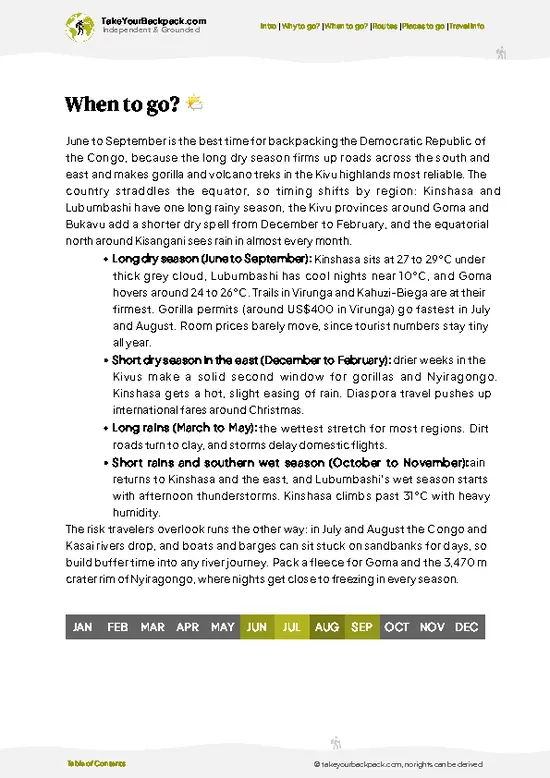
Best months by region: The best months are June to August, when the east and south are driest and trails, roads and flights work most reliably. The country straddles the equator, so there is no single season. South of the equator (Kinshasa, Katanga, Lubumbashi), the dry season runs roughly May to September, with almost no rain and cooler nights of 10 to 15°C in the Katanga highlands. Days reach 28 to 32°C.
The east and the Kivu highlands: Near the equator, the east gets two drier windows, June to August and December to February, and two rainy periods with 100 to 200 mm a month at the wettest. Forest trails turn to mud in the wet months, and volcano and gorilla treks are slower and harder. Temperatures at altitude run 15 to 25°C by day and drop at night, so pack a warm layer. Because this area … read more 👉
Best months by region: The best months are June to August, when the east and south are driest and trails, roads and flights work most reliably. The country straddles the equator, so there is no single season. South of the equator (Kinshasa, Katanga, Lubumbashi), the dry season runs roughly May to September, with almost no rain and cooler nights of 10 to 15°C in the Katanga highlands. Days reach 28 to 32°C.
The east and the Kivu highlands: Near the equator, the east gets two drier windows, June to August and December to February, and two rainy periods with 100 to 200 mm a month at the wettest. Forest trails turn to mud in the wet months, and volcano and gorilla treks are slower and harder. Temperatures at altitude run 15 to 25°C by day and drop at night, so pack a warm layer. Because this area is the most conflict-affected, timing matters less than current security conditions on the ground.
North, center and the river: The equatorial rainforest basin has rain in almost every month, with heavy downpours in many afternoons and 80 to 90 percent humidity. There is no truly dry time here, only less wet. Daytime temperatures hold at 28 to 32°C all year. River travel is possible in all months, but road links in the interior can vanish after heavy rain.
Crowds and prices: Crowds are not a factor anywhere. Peak demand is minimal, and prices for permits and park fees do not usually shift by season. Flights and hotels in Kinshasa and Goma are priced for business and aid-sector travelers, so plan early for dry months and expect to pay US$80 to 150 a night for a safe mid-range room year-round. Skip the heaviest rains, March to May in much of the north and east, unless forest conditions are what you came for.

attraction hoppingHow to Combine attractions Into One Trip

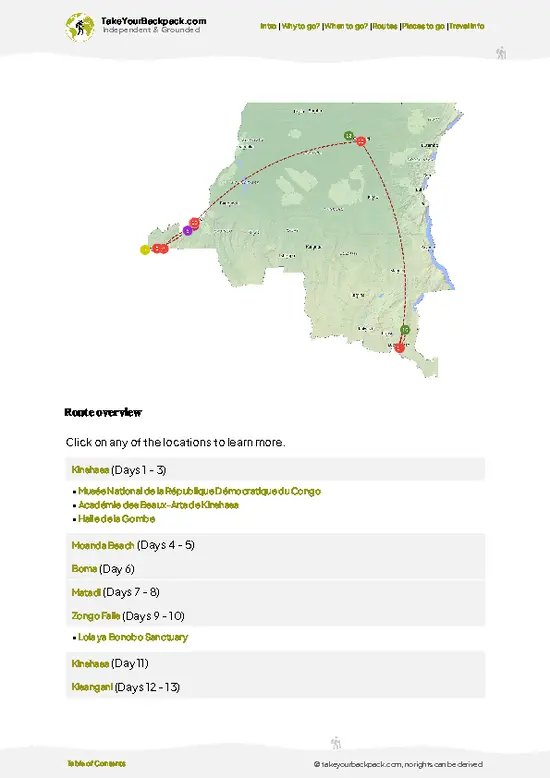
How long a combined trip takes: A trip combining several attractions in DR Congo needs 14 to 21 days, and even that covers only one or two regions. The country is too big and too poorly connected to cover in one go, so treat the east, the capital and the south as separate trips.
Which regions group together: Kinshasa works as the hub because most international flights arrive there and domestic flights fan out from it. Pairing Kinshasa with the east (Goma, Bukavu) is the most common combination for wildlife and volcano trips, but only when security allows. Kinshasa to the Lubumbashi area in the southeast is a flight of roughly 2 to 2.5 hours, and the south is quieter and more stable. The river city of Kisangani sits about 2 hours by air from Kinshasa. Travel in the direction that keeps you near … read more 👉
How long a combined trip takes: A trip combining several attractions in DR Congo needs 14 to 21 days, and even that covers only one or two regions. The country is too big and too poorly connected to cover in one go, so treat the east, the capital and the south as separate trips.
Which regions group together: Kinshasa works as the hub because most international flights arrive there and domestic flights fan out from it. Pairing Kinshasa with the east (Goma, Bukavu) is the most common combination for wildlife and volcano trips, but only when security allows. Kinshasa to the Lubumbashi area in the southeast is a flight of roughly 2 to 2.5 hours, and the south is quieter and more stable. The river city of Kisangani sits about 2 hours by air from Kinshasa. Travel in the direction that keeps you near airports: start in Kinshasa, fly to your main region, and return the same way. Moving between the east and the south overland is not realistic.
Time per stop: Allow 2 to 3 days in Kinshasa for permits, registration and orientation. Park and forest stops need 3 to 5 days each, including a buffer day for delays. Reaching a remote park from the nearest airport can take 4 to 10 hours by road, longer in the wet season.
Planning mistakes: The first is trusting overland timings. Distances that look short on a map can take a full day or two, so book flights for any leg over 300 km. The second is a tight return schedule. Domestic flights are cancelled or rescheduled often, so leave 2 days before an international departure. The third is stacking too many parks. Each needs separate permits and guides, which take time to arrange, so pick two regions at most. The fourth is arranging things on arrival. Book transport, permits and accommodation through a local operator before you land, and confirm again 48 hours before each leg.

The ListMust-Visit attractions in DR Congo

1 Lola ya Bonobo Sanctuary

bonobo rescue, forest trails, primate observation

Watch rescued bonobos thrive in semi-wild enclosures and learn about conservation efforts in a forested reserve near Kinshasa.

2 Musée National de la République Démocratique du Congo

ethnographic collections, ceremonial masks, national heritage

Survey Congo’s cultural diversity through curated displays of artifacts, textiles, and traditional objects from across the country.

democratic-republic-of-the-congo-attraction-musee-national-de-la-republique-democratique-du-congo
© Google |

3 Jardin Zoologique de Kinshasa

urban wildlife, shaded enclosures, family-friendly

Observe native and exotic animals in a compact zoo that offers a glimpse of Congo’s biodiversity within city limits.

democratic-republic-of-the-congo-attraction-jardin-zoologique-de-kinshasa
© Google |

4 Académie des Beaux-Arts de Kinshasa

contemporary art, student studios, sculpture garden

Browse evolving exhibitions and observe artists at work in a creative campus that reflects Kinshasa’s dynamic visual arts scene.

5 Musée National de Lubumbashi

archaeological finds, regional art, colonial relics

View artifacts spanning prehistory to modern times, with a focus on Katanga’s peoples and historical transitions.

democratic-republic-of-the-congo-attraction-musee-national-de-lubumbashi
© Google |

6 Jardin Zoologique de Lubumbashi

botanical paths, animal habitats, educational signage

Stroll tree-lined walkways and view regional fauna in a relaxed setting designed for learning and leisure.

democratic-republic-of-the-congo-attraction-jardin-zoologique-de-lubumbashi
© Google |

7 Cathédrale Notre-Dame du Congo

colonial-era architecture, soaring ceilings, city landmark

Step inside a monumental church where Kinshasa’s history and religious traditions are reflected in grand design and daily rituals.

8 Cathédrale Saints Pierre et Paul de Lubumbashi

red brick façade, bell tower, religious murals

Experience Lubumbashi’s Catholic heritage in a spacious cathedral known for its distinctive exterior and vibrant interior artwork.

democratic-republic-of-the-congo-attraction-cathedrale-saints-pierre-et-paul-de-lubumbashi
© Google |

9 Halle de la Gombe

film screenings, live music, cultural library

Join Kinshasa’s cultural crowd for international cinema, concerts, and literary events in a modern venue with a lively calendar.

democratic-republic-of-the-congo-attraction-halle-de-la-gombe
© Google |

10 Centre d’Art Picha

contemporary exhibitions, artist residencies, visual storytelling

Discover experimental art and photography projects that challenge perspectives and highlight Congolese voices in a collaborative setting.

11 Centre Culturel Boboto

performance hall, youth workshops, urban gathering space

Attend concerts, exhibitions, or community events in a venue that fosters cultural exchange and creative expression in Kinshasa.

12 Théâtre de Verdure de Kinshasa

open-air amphitheater, live performances, park setting

Experience music and theater under the sky in a leafy venue that draws audiences for seasonal shows and community gatherings.

13 Wenze ya Bikeko

railway setting, souvenir stands, woodwork

Explore a market set beside Kinshasa’s central station, where travelers find locally crafted goods and practical keepsakes.

14 Marché d’Art de Goma

volcanic stone carvings, local painters, open-air stalls

Browse handmade crafts and paintings reflecting Goma’s landscape and culture in a bustling outdoor market.

15 Musée de la Gécamines

mining heritage, industrial artifacts, Lubumbashi history

Trace the region’s mining legacy through exhibits of machinery, minerals, and archival photos in a museum rooted in local industry.

16 Centre Culturel de Bukavu

local crafts, art exhibitions, community hub

Engage with Bukavu’s creative community through rotating displays and hands-on activities in a welcoming, centrally located space.

17 Cathédrale Notre-Dame de la Paix de Bukavu

hilltop views, stained glass, tranquil nave

Admire architectural details and panoramic lake vistas from a peaceful sanctuary that anchors Bukavu’s spiritual and civic life.

18 Théâtre de la Halle de l’Étoile

modern stage, local productions, cultural events

Attend plays, concerts, and festivals in a contemporary theater that supports Lubumbashi’s performing arts scene.

Think you know DR Congo?

Prove you’re a true local — uncover 8 lesser-known attractions in DR Congo that locals tend to keep to themselves.
Loading the map 🌍

Expert viewWhat You Should Know

How many attractions to plan: Plan two to four attractions on a single trip, no more. Each one takes several days of access and transport, and delays eat the margin. Packing in more means paying for flights, permits and guides without actually seeing anything properly. Fewer stops also leave room for the unplanned: a canceled flight, a closed road or a permit that takes two extra days.
Prioritizing by travel style: Wildlife-focused travelers should put the gorilla and volcano areas first, but only when the security picture is clear, because these are the most expensive and the most exposed to closure. Culture and city travelers get far better value in Kinshasa, where music, art and markets cost little and need no permits. River and forest lovers should look at the interior, where trips are … read more 👉
How many attractions to plan: Plan two to four attractions on a single trip, no more. Each one takes several days of access and transport, and delays eat the margin. Packing in more means paying for flights, permits and guides without actually seeing anything properly. Fewer stops also leave room for the unplanned: a canceled flight, a closed road or a permit that takes two extra days.
Prioritizing by travel style: Wildlife-focused travelers should put the gorilla and volcano areas first, but only when the security picture is clear, because these are the most expensive and the most exposed to closure. Culture and city travelers get far better value in Kinshasa, where music, art and markets cost little and need no permits. River and forest lovers should look at the interior, where trips are slower and cheaper but logistics are heavier. If your budget is tight, skip anything that needs a charter flight. Skip the parks that have no working access or guiding system. A trip built around one or two well-organized stops is better than an ambitious one that stalls.
What it costs: Expect US$100 to 200 a day on a basic independent trip, and US$250 or more with a private vehicle and guide. Accommodation in Kinshasa runs US$60 to 150 a night for something safe and clean. Meals cost US$8 to 20 at local restaurants and more in hotels. Gorilla permits in the east are about US$400. A volcano hike permit is roughly US$300, and park entry, porters and guides add US$50 to 150 per visit. Domestic flights cost US$150 to 400 one way, and prices are not published reliably. Carry cash in clean, recent US dollar notes, because ATMs are unreliable and notes that are torn or older are often refused.
Costs and delays that catch travelers out: Permits are the biggest trap. Pay only through the official park authority or a verified operator, and get a written receipt. Unofficial fees at checkpoints and borders do occur, so carry small bills and keep copies of your documents. Domestic flights are often rescheduled or cancelled, so confirm 48 hours ahead and keep a spare day. Visa processing and the yellow fever certificate need to be sorted well before you leave, because you can be refused boarding or entry without them. Photography permits for cities and sites are sometimes required, and taking photos of government buildings, airports, bridges or soldiers can lead to detention or a fine. Ask your guide before you raise a camera.
Safety and cultural considerations: Conflict in the east is the main risk. Armed groups, shifting front lines and sudden road closures mean that a park open today can be shut tomorrow. Check your government’s travel advice and local operator updates right up to departure, and have an evacuation-capable insurance policy. In the cities, avoid walking at night, keep valuables out of sight and use hotel-arranged drivers. Always carry copies of your passport and visa, since police checks are frequent.
Respect and local etiquette: Greet people before asking for anything, since a short greeting in French or Lingala changes how an exchange goes. Dress modestly, especially outside Kinshasa. Ask before photographing people, and expect some to refuse or ask for payment. At wildlife sites, follow ranger instructions exactly, including keeping 7 meters from gorillas and staying home if you have a cold or other illness, because great apes catch human infections easily. Hire local guides and porters, as they are often the main benefit these attractions bring to nearby communities.

✈️ The backpacker research shortcutDR Congo Travel Guide

An offline-friendly backpacking guide with optimized travel routes, ranked highlights, transport advice, and the best areas to stay.
example page 0 from our offline Travel Guide for Democratic Republic of the Congo
example page 1 from our offline Travel Guide for Democratic Republic of the Congo
example page 2 from our offline Travel Guide for Democratic Republic of the Congo
example page 3 from our offline Travel Guide for Democratic Republic of the Congo
example page 4 from our offline Travel Guide for Democratic Republic of the Congo
example page 5 from our offline Travel Guide for Democratic Republic of the Congo
example page 6 from our offline Travel Guide for Democratic Republic of the Congo
example page 7 from our offline Travel Guide for Democratic Republic of the Congo
The digital guide (330 pages) contains:
✅ 76 highlights, ranked by travel appeal
✅ Optimized 7, 14 & 21-day travel routes
✅ Cities, national parks, landmarks, beaches
✅ How to get around
✅ Offline-friendly for travel without Wi-Fi
👉 Click to see all 30+ guide features

📅 Plan smarter in minutes, not weeks
✅ Month by month travel advice
✅ Festivals & national holidays
✅ Budget expectations

🗺️ Go to the right places, skip the overrated ones
✅ Honest pros & cons of destinations
✅ Top hikes, parks & viewpoints
✅ Lesser-known places most travelers miss
✅ Clear “worth it vs skip it” guidance

🛏️ Travel smoothly without rookie mistakes
✅ Best areas to stay
✅ Transport systems explained simply
✅ Common scams & safety advice
✅ SIM cards, money & practical tips

🌍 Understand the country, not just visit it
✅ Culture & traditions
✅ 52 Essential phrases & customs
✅ Festivals worth planning around
✅ Traveler-friendly historical context
✅ Insights that make places more meaningful

📱 Built for real travel conditions
✅ Fully downloadable PDF
✅ Works completely offline
✅ Optimized for phone use
✅ Useful in remote areas & buses
✅ Everything in one place
Stop searching, start planning
Get instant access to your full guide. 30‑day money-back guarantee.
+ Add another guide for just

By proceeding you agree to our terms.
Sent to your inbox immediately after payment • 100% Secure Checkout
Best Backpacking Travel Advisor 2025 tourism awardBest Backpacking
Travel Advisor
2025
What others say about Take Your Backpack Guides:
⭐⭐⭐⭐⭐
Fantastic, amazing amount of information!
⭐⭐⭐⭐⭐
My goodness this is amazing, it's what I've been looking for hats off too you!
⭐⭐⭐⭐⭐
I think this is absolutely BRILLIANT
⭐⭐⭐⭐
Very complete and informative. It's still missing places, but I gotta to commend you
⭐⭐⭐⭐⭐
This is truly amazing, thank you, can't wait to explore it with my kids!
⭐⭐⭐⭐⭐
Awesome resource, thank you!
⭐⭐⭐⭐⭐
This is amazing! Can't wait to explore the ones I haven't seen
⭐⭐⭐⭐
I love this! Well done, great idea.
⭐⭐⭐⭐⭐
Thanks for taking the time to make this gem!
⭐⭐⭐⭐⭐
This might be the best website I've ever seen.
⭐⭐⭐⭐⭐
Congratulations, and thank you so much for your work; it's incredibly valuable.
⭐⭐⭐⭐
In all seriousness I think you did a great job pointing out the important spots
⭐⭐⭐⭐⭐
10/10 very good
⭐⭐⭐⭐⭐
As someone who's only just starting to visit regularly this is awesome, thank you.
⭐⭐⭐⭐
Thank you very much! I'm going to visit my dad, it's going to be very useful!
⭐⭐⭐⭐⭐
This is really cool! We'll be travelling for the first time and this definitely come in handy.
⭐⭐⭐⭐⭐
You are now our minister of culture, congratulations 👨‍💼
⭐⭐⭐⭐⭐
Just wanted to tell you that this is a pearl! Going to follow your recommendations.
⭐⭐⭐⭐⭐
This is so cool. I'll definitely be using the resource for my travels soon.
⭐⭐⭐⭐⭐
This is very impressive! Good work.
⭐⭐⭐⭐⭐
This is an amazing and informative site. Very well done!

🛏️ Where to stay?Top Places to Consider Staying

Proper backpacker hostels barely exist in the Democratic Republic of the Congo, so budget travelers rely on simple guesthouses and church-run mission lodgings, which typically cost US$30 to 60 a night for a basic private room. In Kinshasa, Gombe has the widest choice and the calmest, best-policed streets close to the river, embassies and cafés, though prices run higher, while Kalamu around Matonge is cheaper and has the city’s liveliest bars and music clubs but is noisy and less comfortable to walk after dark. In Lubumbashi, the grid of streets around the city center keeps you within walking distance of restaurants and banks, with quieter guesthouses spread toward the residential areas.

If you … read more 👉
Proper backpacker hostels barely exist in the Democratic Republic of the Congo, so budget travelers rely on simple guesthouses and church-run mission lodgings, which typically cost US$30 to 60 a night for a basic private room. In Kinshasa, Gombe has the widest choice and the calmest, best-policed streets close to the river, embassies and cafés, though prices run higher, while Kalamu around Matonge is cheaper and has the city’s liveliest bars and music clubs but is noisy and less comfortable to walk after dark. In Lubumbashi, the grid of streets around the city center keeps you within walking distance of restaurants and banks, with quieter guesthouses spread toward the residential areas.

If you enjoy meeting fellow travelers, consider choosing hostels with high ratings for atmosphere. On the other hand, if you prefer having your own space, a hotel might be a better option.

DR CongoMore Places Across DR Congo

👋 Meet the founderWho’s Behind Take Your Backpack?

Johan, backpacker and founder of TakeYourBackpackHi, I’m Johan (Netherlands 🇳🇱), the creator of TakeYourBackpack. Over the past 3 decades, I’ve backpacked through 90+ countries across six continents, gaining extensive experience with independent travel, long-term trips, and overland routes.

This site is built on a combination of firsthand travel experience and carefully curated insights from other backpackers. Many guides are based on places I’ve personally visited, while others bring together tips, observations, and practical advice shared by trusted travelers I’ve met along the way.

The goal is to provide realistic, experience-driven guidance — not generic itineraries — so you can explore destinations with better context, clearer expectations, and more confidence.