×

Dominica🇩🇲 | best festivalsDiscover the 4 Best festivals Across Dominica

Festivals in Dominica are small, loud and local: drums echoing off steep valley walls, creole food smoke drifting from roadside stalls, sweat and rum in the heat. Crowds stay modest, and most events are free or cheap. The Roseau side has the biggest stages and easiest buses, while villages in the east and north feel rawer and slower to reach. Independent travelers get closest to the action here.

By Johan Kruseman 🇳🇱 | Updated October 23, 2026
Explore the best regions in Dominica

Why go?Understanding Their Importance

Dominica has no mass-tourism machinery, so festivals here stay community-owned. Their roots run through French-influenced Kwéyòl language, African drumming and the Kalinago people’s living traditions on the east coast. The island is mountainous, with rainforest, volcanic soil and winding roads, which keeps events scattered across villages rather than concentrated in one resort zone. Expect warm, humid air, sudden downpours, and the smell of grilled fish, bakes and fresh nutmeg-spiced drinks.

Before choosing Dominica for its festivals, know the limits. Accommodation is limited and fills fast around major events, buses run mostly on weekdays and thin out in the evening, and late-night returns from rural venues can be difficult. Cash is the norm at stalls, and ATMs exist mainly in Roseau and … read more 👉
Dominica has no mass-tourism machinery, so festivals here stay community-owned. Their roots run through French-influenced Kwéyòl language, African drumming and the Kalinago people’s living traditions on the east coast. The island is mountainous, with rainforest, volcanic soil and winding roads, which keeps events scattered across villages rather than concentrated in one resort zone. Expect warm, humid air, sudden downpours, and the smell of grilled fish, bakes and fresh nutmeg-spiced drinks.

Before choosing Dominica for its festivals, know the limits. Accommodation is limited and fills fast around major events, buses run mostly on weekdays and thin out in the evening, and late-night returns from rural venues can be difficult. Cash is the norm at stalls, and ATMs exist mainly in Roseau and larger towns. The payoff is access that feels personal, not packaged.
Behind the Scenes of Selection
The list of best festivals in Dominica is created based on energy, traditions, crowd experience, activities, and overall excitement. If you feel a festival is missing in this list, please let us know.

When to go?Optimal Periods for Travel

Best months and weather: The best months are October to early November and February to March, when events cluster around Independence season and Carnival while the dry season brings the most settled weather. Daytime temperatures sit around 27 to 31°C (81 to 88°F) on the coast, cooler and wetter in the highlands, where rain can pass through any day.
Shoulder and wet seasons: June to November is the wetter season, with heavier rain, muddy village roads and a hurricane risk that peaks from August to October. Rates can drop, but road washouts may slow travel. December to April is the driest, brightest stretch, and Roseau guesthouses and rental cars become pricier and tighter around Carnival, so book early. The east coast catches more wind and spray, while the leeward west near Roseau is calmer.

festival hoppingHow to Combine festivals Into One Trip

How many days to allow: A trip combining several festivals in Dominica needs 7 to 10 days, because roads are slow and distances feel longer than they look. Start in Roseau, where buses, ATMs and most lodging are concentrated, then move north toward Portsmouth and east toward the Kalinago Territory, finishing back near the capital for flights or ferries.
Pacing and transport: Allow 2 to 3 nights per stop. Roseau to Portsmouth takes roughly 1.5 to 2 hours by road, and Roseau to the Kalinago Territory about 1.5 to 2 hours on winding, rainforest-lined routes. A common mistake is packing in events on consecutive nights across opposite coasts, then relying on evening buses that may not exist. Instead, base yourself in one area, use hired drivers or shared minibuses for late returns, and leave a buffer day for rain.

The ListHighly Recommended festivals of Dominica

1 Dominica Carnival

Mas Domnik parades, calypso finals, j’ouvert paint, jing ping bands

Watch feathered mas bands roll through Roseau on Monday and Tuesday before Lent, then catch calypso in Kwéyòl and English and early-morning j’ouvert.

2 World Creole Music Festival

Windsor Park nights, zouk and kompa, late October, Wob Dwiyet

Spend three late-October nights in Roseau’s stadium, moving from bouyon’s pounding bass to slow zouk, kompa and older jing ping accordion sets.

3 Dominica Jazz ’n Creole

Jazz and bouyon, May in Portsmouth, fish-stall suppers, Prince Rupert Bay

Hear international jazz and soul share a stage with Dominican bouyon and cadence-lypso, then swim the bay or walk Fort Shirley the morning after.

4 Independence Day Celebrations

November 3 parade, Creole Week, Kwéyòl storytelling, bélé and quadrille

Line up along Roseau’s parade route for school bands and cadets, then follow the Creole dance, madras dress and callaloo stalls through the holiday.

Loading the map 🌍

Expert viewPro Tips for Exploring the Best

How many to attend: I advise two or three festivals in one trip. Dominica’s roads curve through mountains and each journey eats half a day, so more than that turns your visit into transit. Fewer lets you linger, learn a few Kwéyòl greetings and actually talk to people over a plate of fish and provisions.
Choosing by travel style: If you want music and crowds, pick a large national event near Roseau, where energy is high and transport is simplest. If you prefer culture and quiet, choose a village or Kalinago-focused gathering, where drumming, crafts and food feel intimate and unhurried. Nature lovers can pair a smaller event with hiking, since both fit the island’s rhythm.
What it costs: Budget US$60 to 110 a day including a guesthouse room, local meals, and public minibuses. Many community events … read more 👉
How many to attend: I advise two or three festivals in one trip. Dominica’s roads curve through mountains and each journey eats half a day, so more than that turns your visit into transit. Fewer lets you linger, learn a few Kwéyòl greetings and actually talk to people over a plate of fish and provisions.
Choosing by travel style: If you want music and crowds, pick a large national event near Roseau, where energy is high and transport is simplest. If you prefer culture and quiet, choose a village or Kalinago-focused gathering, where drumming, crafts and food feel intimate and unhurried. Nature lovers can pair a smaller event with hiking, since both fit the island’s rhythm.
What it costs: Budget US$60 to 110 a day including a guesthouse room, local meals, and public minibuses. Many community events are free, while larger concerts or shows may charge roughly US$10 to 40. A hired driver for late returns can add US$30 to 80 depending on distance. Carry small East Caribbean dollar notes, since stalls rarely take cards.
Safety and etiquette: Dominica is generally relaxed, but stay aware in crowds, keep phones and cash tucked away, and arrange your ride home before dark. Rural roads are narrow, unlit and often wet, so avoid walking back alone. Dress neatly for church-linked or traditional events, ask before photographing performers or elders, and accept offers of food graciously. Rum is plentiful, but pace yourself in the heat. Staying respectful earns you invitations to join the dance, the best moment of any night here.

✈️ The backpacker research shortcutDominica Travel Guide

An offline-friendly backpacking guide with optimized travel routes, ranked highlights, transport advice, and the best areas to stay.
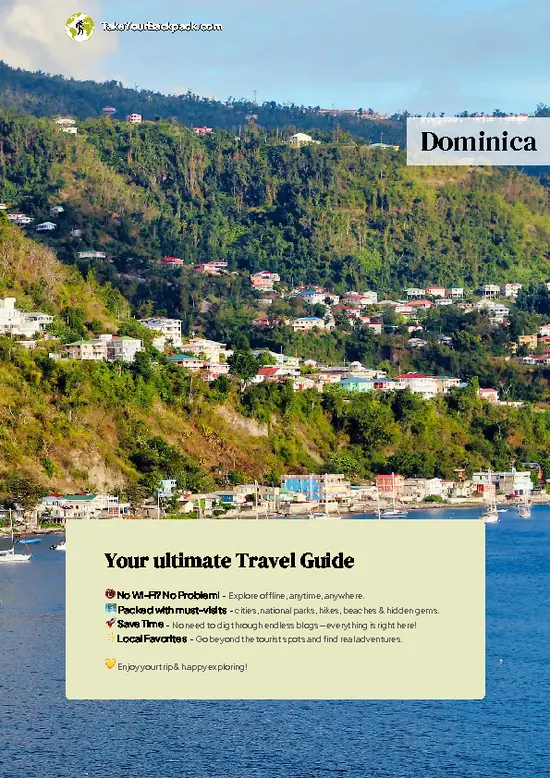
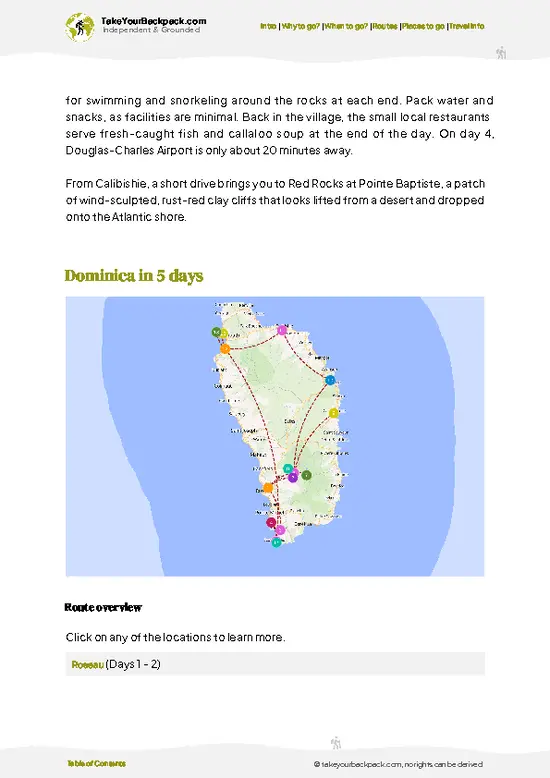
example page 0 from our offline Travel Guide for Dominica
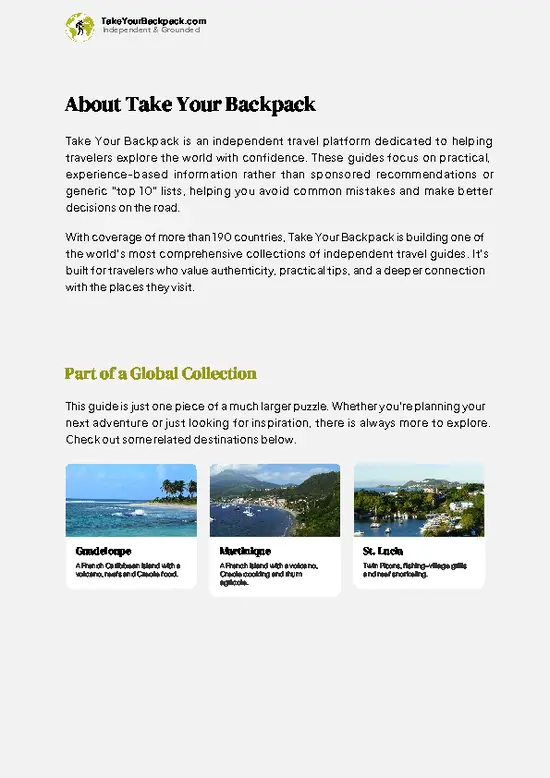
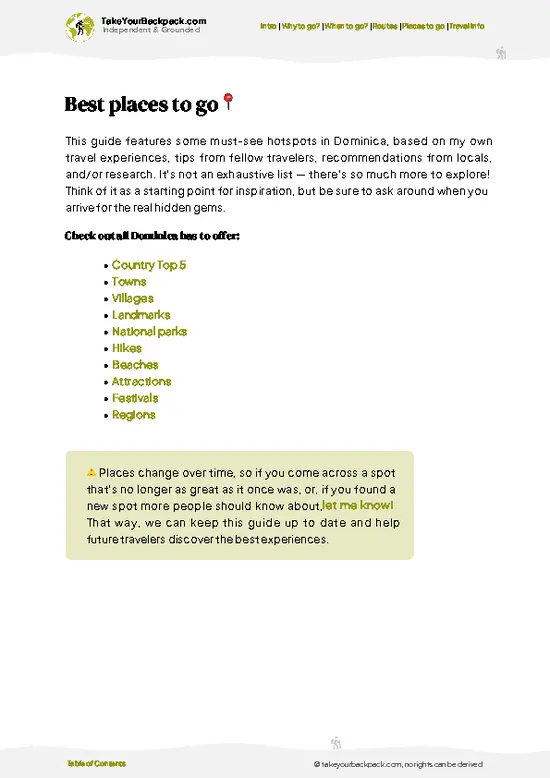
example page 1 from our offline Travel Guide for Dominica
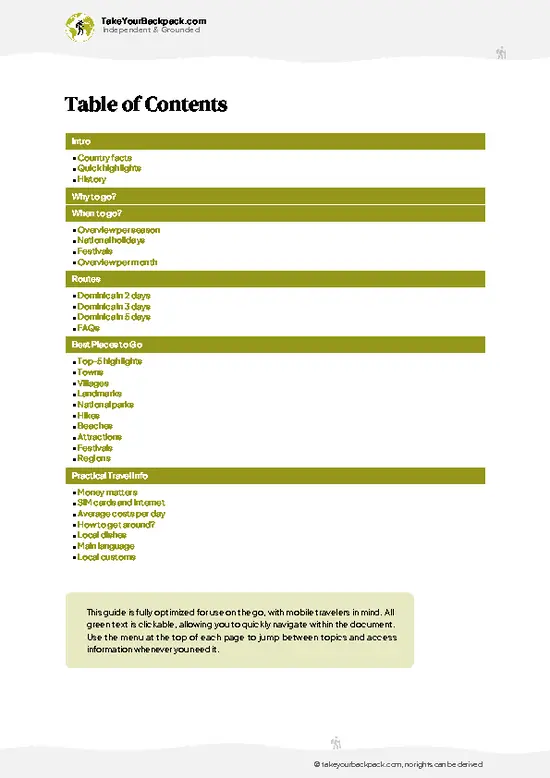
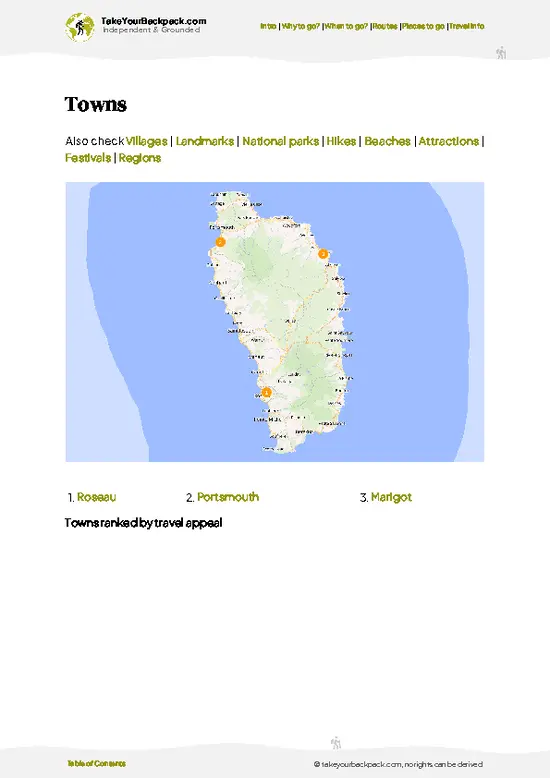
example page 2 from our offline Travel Guide for Dominica
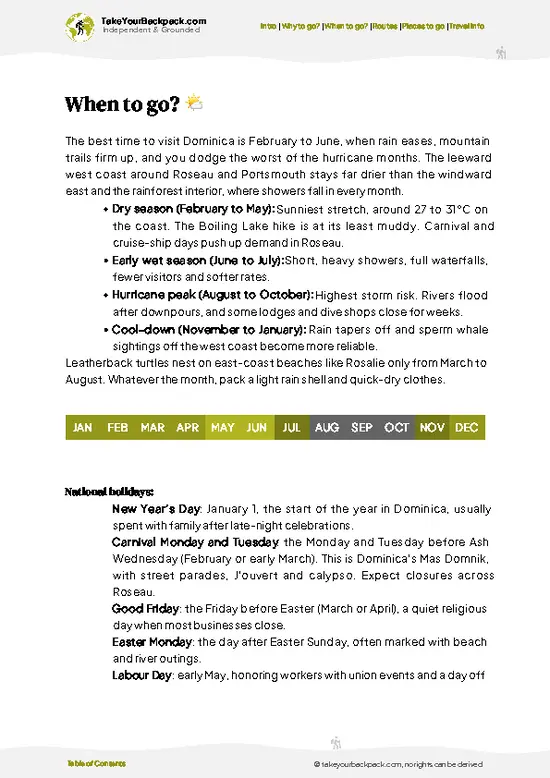
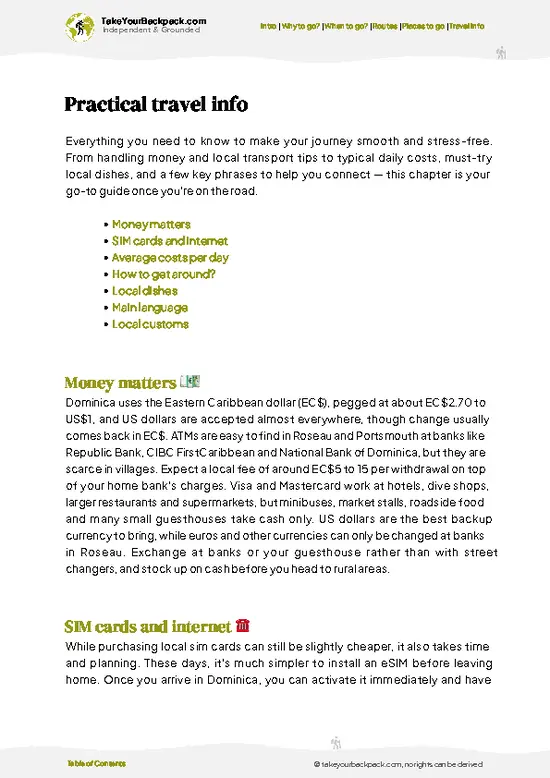
example page 3 from our offline Travel Guide for Dominica
example page 4 from our offline Travel Guide for Dominica
example page 5 from our offline Travel Guide for Dominica
example page 6 from our offline Travel Guide for Dominica
example page 7 from our offline Travel Guide for Dominica
The digital guide (132 pages) contains:
✅ 33 highlights, ranked by travel appeal
✅ Optimized 2, 3 & 5-day travel routes
✅ Cities, national parks, landmarks, beaches
✅ How to get around
✅ Offline-friendly for travel without Wi-Fi
👉 Click to see all 30+ guide features

📅 Plan smarter in minutes, not weeks
✅ Month by month travel advice
✅ Festivals & national holidays
✅ Budget expectations

🗺️ Go to the right places, skip the overrated ones
✅ Honest pros & cons of destinations
✅ Top hikes, parks & viewpoints
✅ Lesser-known places most travelers miss
✅ Clear “worth it vs skip it” guidance

🛏️ Travel smoothly without rookie mistakes
✅ Best areas to stay
✅ Transport systems explained simply
✅ Common scams & safety advice
✅ SIM cards, money & practical tips

🌍 Understand the country, not just visit it
✅ Culture & traditions
✅ Local customs
✅ Festivals worth planning around
✅ Traveler-friendly historical context
✅ Insights that make places more meaningful

📱 Built for real travel conditions
✅ Fully downloadable PDF
✅ Works completely offline
✅ Optimized for phone use
✅ Useful in remote areas & buses
✅ Everything in one place
Stop searching, start planning
Get instant access to your full guide. 30‑day money-back guarantee.
+ Add another guide for just

By proceeding you agree to our terms.
Sent to your inbox immediately after payment • 100% Secure Checkout
Best Backpacking Travel Advisor 2025 tourism awardBest Backpacking
Travel Advisor
2025
What others say about Take Your Backpack Guides:
⭐⭐⭐⭐⭐
Fantastic, amazing amount of information!
⭐⭐⭐⭐⭐
My goodness this is amazing, it's what I've been looking for hats off too you!
⭐⭐⭐⭐⭐
I think this is absolutely BRILLIANT
⭐⭐⭐⭐
Very complete and informative. It's still missing places, but I gotta to commend you
⭐⭐⭐⭐⭐
This is truly amazing, thank you, can't wait to explore it with my kids!
⭐⭐⭐⭐⭐
Awesome resource, thank you!
⭐⭐⭐⭐⭐
This is amazing! Can't wait to explore the ones I haven't seen
⭐⭐⭐⭐
I love this! Well done, great idea.
⭐⭐⭐⭐⭐
Thanks for taking the time to make this gem!
⭐⭐⭐⭐⭐
This might be the best website I've ever seen.
⭐⭐⭐⭐⭐
Congratulations, and thank you so much for your work; it's incredibly valuable.
⭐⭐⭐⭐
In all seriousness I think you did a great job pointing out the important spots
⭐⭐⭐⭐⭐
10/10 very good
⭐⭐⭐⭐⭐
As someone who's only just starting to visit regularly this is awesome, thank you.
⭐⭐⭐⭐
Thank you very much! I'm going to visit my dad, it's going to be very useful!
⭐⭐⭐⭐⭐
This is really cool! We'll be travelling for the first time and this definitely come in handy.
⭐⭐⭐⭐⭐
You are now our minister of culture, congratulations 👨‍💼
⭐⭐⭐⭐⭐
Just wanted to tell you that this is a pearl! Going to follow your recommendations.
⭐⭐⭐⭐⭐
This is so cool. I'll definitely be using the resource for my travels soon.
⭐⭐⭐⭐⭐
This is very impressive! Good work.
⭐⭐⭐⭐⭐
This is an amazing and informative site. Very well done!

🛏️ Where to stay?Where to Base Yourself

Dominica has very few dorm-style hostels, so budget travelers here mostly sleep in family-run guesthouses, rooms for rent and simple eco-lodge cabins, typically EC$110 to 190 (US$40 to 70) a night for a double. Roseau has the widest choice and is the minibus hub for the whole island, with the most bars and street food, though it gets loud on weekends and goes quiet after dark. The Roseau Valley villages of Trafalgar and Wotten Waven put you near the waterfalls and sulfur hot springs in cool, quiet hills, while Portsmouth in the north is cheaper and calmer for Indian River and Cabrits, and Calibishie on the northeast coast offers beaches and the shortest airport transfer but little nightlife … read more 👉
Dominica has very few dorm-style hostels, so budget travelers here mostly sleep in family-run guesthouses, rooms for rent and simple eco-lodge cabins, typically EC$110 to 190 (US$40 to 70) a night for a double. Roseau has the widest choice and is the minibus hub for the whole island, with the most bars and street food, though it gets loud on weekends and goes quiet after dark. The Roseau Valley villages of Trafalgar and Wotten Waven put you near the waterfalls and sulfur hot springs in cool, quiet hills, while Portsmouth in the north is cheaper and calmer for Indian River and Cabrits, and Calibishie on the northeast coast offers beaches and the shortest airport transfer but little nightlife and sparse buses.

If you enjoy meeting fellow travelers, consider choosing hostels with high ratings for atmosphere. On the other hand, if you prefer having your own space, a hotel might be a better option.

DominicaExpand Your Journey

👋 Meet the founderWho’s Behind Take Your Backpack?

Johan, backpacker and founder of TakeYourBackpackHi, I’m Johan (Netherlands 🇳🇱), the creator of TakeYourBackpack. Over the past 3 decades, I’ve backpacked through 90+ countries across six continents, gaining extensive experience with independent travel, long-term trips, and overland routes.

This site is built on a combination of firsthand travel experience and carefully curated insights from other backpackers. Many guides are based on places I’ve personally visited, while others bring together tips, observations, and practical advice shared by trusted travelers I’ve met along the way.

The goal is to provide realistic, experience-driven guidance — not generic itineraries — so you can explore destinations with better context, clearer expectations, and more confidence.