×

Egypt🇪🇬 | attractionsCoptic MuseumChristian manuscripts, carved woodwork, religious icons | things to do and best time to go

Explore Dahshur PyramidsExplore Islamic Art Museum in Cairo

Backpacking in Coptic Museum
👌 Worth visitingattraction ranked #15
By Johan Kruseman 🇳🇱 | Updated June 5, 2026

Here’s what nobody tells you until it’s too late: the Coptic Museum is air-conditioned, blissfully so, and after a week of Cairo’s furnace heat and relentless street noise, that alone feels like a minor miracle. You’ll find it tucked inside Old Cairo, wedged between ancient churches and the city’s oldest synagogue—a crossroads of faiths that’s more than just a backdrop. Now, let’s be real: the Coptic Museum isn’t going to blow up your Instagram feed with pyramids or pharaohs. But if you want to see Egypt’s soul beyond the tourist conveyor belt, this is where the story gets weird, layered, and deeply human. The crowds are manageable, even in peak season, and the ticket price is a fraction of what you’ll pay at the Egyptian Museum or Giza. The vibe is contemplative, not chaotic. You’re here for intricate woodwork, faded manuscripts, and the quiet thrill of seeing a side of Egypt that most travelers skip—often because they don’t know what they’re missing.

Discover everything you want to know in the 📖 Egypt Travel Guide.


Get your Egypt guide
116 ranked highlights, routes & tips, works offline (438 pages)
Loading the map 🌍
CLICK TO FILTER
cities
towns
landmarks
national parks
hikes
beaches
attractions
festivals
regions
SHOW COUNTRY’S BESTSHOW ALL

✨ Why go?
Ranked #15 attraction in Egypt
Why Coptic Museum should be on your travel list

The Coptic Museum in Cairo isn’t some flashy, Instagram-perfect spot where you snap a quick selfie and move on. It’s a deep dive into Egypt’s layered identity, a place where the country’s Christian heritage stands shoulder to shoulder with its ancient pharaonic past. Yes, it gets busy—especially during peak tourist season—and the entry fee isn’t dirt cheap by local standards. But here’s the kicker: this museum is a milestone for any backpacker serious about understanding Egypt beyond the pyramids and desert clichés.

Inside, you’re not just looking at dusty relics. You’re walking through centuries of religious art, manuscripts, textiles, and everyday objects that tell the story of a community that survived empire after empire. The craftsmanship is raw and real, not polished for mass appeal. … read more 👉
The Coptic Museum in Cairo isn’t some flashy, Instagram-perfect spot where you snap a quick selfie and move on. It’s a deep dive into Egypt’s layered identity, a place where the country’s Christian heritage stands shoulder to shoulder with its ancient pharaonic past. Yes, it gets busy—especially during peak tourist season—and the entry fee isn’t dirt cheap by local standards. But here’s the kicker: this museum is a milestone for any backpacker serious about understanding Egypt beyond the pyramids and desert clichés.

Inside, you’re not just looking at dusty relics. You’re walking through centuries of religious art, manuscripts, textiles, and everyday objects that tell the story of a community that survived empire after empire. The craftsmanship is raw and real, not polished for mass appeal. It’s a cultural heartbeat that’s often overshadowed by the more famous sites, but it’s exactly this authenticity that makes it worth the effort.

If you’re pacing yourself on a route through Egypt, the Coptic Museum is a checkpoint where history, faith, and art collide in a way that challenges your assumptions and rewards your curiosity. It’s not just a museum; it’s a reality check on what Egypt really is beneath the tourist gloss.
Want to include Coptic Museum in your Egypt route?
Create a personalized Egypt itinerary that includes Coptic Museum and the places that fit your trip — based on your travel style, budget, and available time. Get your route in seconds.

Generate my trip

💡 HighlightsMust-see experiences and standout moments

The Old Cairo Setting
Let’s get real: most people come to the Coptic Museum expecting a quick detour before the pyramids or the Khan el-Khalili bazaar. But the museum’s location, tucked inside the walls of Old Cairo, is a showstopper in its own right. You’re not just walking into a building—you’re stepping into a living, breathing crossroads of Christian, Islamic, and Jewish history. The air smells faintly of incense and dust, and the call to prayer echoes through the ancient alleyways. If you want to feel the pulse of Egypt’s layered identity, this is ground zero.


The Woodwork Hall
Forget the glass cases for a second. The museum’s carved wooden screens and doors are the real scene-stealers. Some of these pieces date back to the 5th century and are so intricate you’ll wonder how anyone had … read more 👉
The Old Cairo Setting
Let’s get real: most people come to the Coptic Museum expecting a quick detour before the pyramids or the Khan el-Khalili bazaar. But the museum’s location, tucked inside the walls of Old Cairo, is a showstopper in its own right. You’re not just walking into a building—you’re stepping into a living, breathing crossroads of Christian, Islamic, and Jewish history. The air smells faintly of incense and dust, and the call to prayer echoes through the ancient alleyways. If you want to feel the pulse of Egypt’s layered identity, this is ground zero.


The Woodwork Hall
Forget the glass cases for a second. The museum’s carved wooden screens and doors are the real scene-stealers. Some of these pieces date back to the 5th century and are so intricate you’ll wonder how anyone had the patience (or eyesight) to finish them. The geometric patterns and Coptic crosses aren’t just decorative—they’re coded messages from a time when Christians had to keep their faith under wraps. It’s a masterclass in subtle rebellion, and it’s more gripping than any Instagram filter.


The Nag Hammadi Codices
This is the museum’s mic-drop moment. The Nag Hammadi manuscripts—discovered in a clay jar by a farmer in 1945—are the closest you’ll get to Indiana Jones territory in Cairo. These are original Gnostic texts, some of which were banned and hunted by the early church. You’re looking at the raw, unedited drafts of Christian thought, complete with heresies and wild ideas that never made it into the Bible. If you want to see the real, messy birth of a religion, this is it.


The Frescoes and Wall Paintings
Most museums keep their best art behind velvet ropes. Here, you’re face-to-face with 1,500-year-old frescoes that still pop with color. The saints and angels have big, soulful eyes and a style that’s unmistakably Egyptian—think Pharaonic art meets Sunday school. These aren’t just pretty pictures; they’re a visual survival guide for a community that lived under constant threat. The stories are raw, sometimes violent, always human.


The Coptic Textiles
If you think ancient Egypt is all about stone and sand, the museum’s textile collection will change your mind. These are not your grandma’s doilies. We’re talking tunics, tapestries, and fragments that survived centuries of heat, humidity, and conquest. The colors are still shockingly vivid, and the patterns blend Greco-Roman, Pharaonic, and Christian motifs in a way that’s uniquely Egyptian. It’s wearable history, and it’s a reminder that faith here was lived, not just preached.


The Courtyard and Architecture
Here’s the part nobody tells you: the museum itself is a work of art. The mashrabiya windows throw dappled light across the marble floors, and the inner courtyard is a rare oasis of calm in a city that never shuts up. Sit for five minutes and you’ll hear a dozen languages, see monks in black robes, and maybe catch a wedding procession passing by. The building is a love letter to Cairo’s past, and it’s the one place in the city where you can actually hear yourself think.
Spotted a mistake or missing something? Contact us.

Things to do around Coptic Museum

Ratings based on Tripadvisor reviews. When you book through this link, you support our work at no extra cost to you.

🌤️ When to go?Seasonal considerations and timing


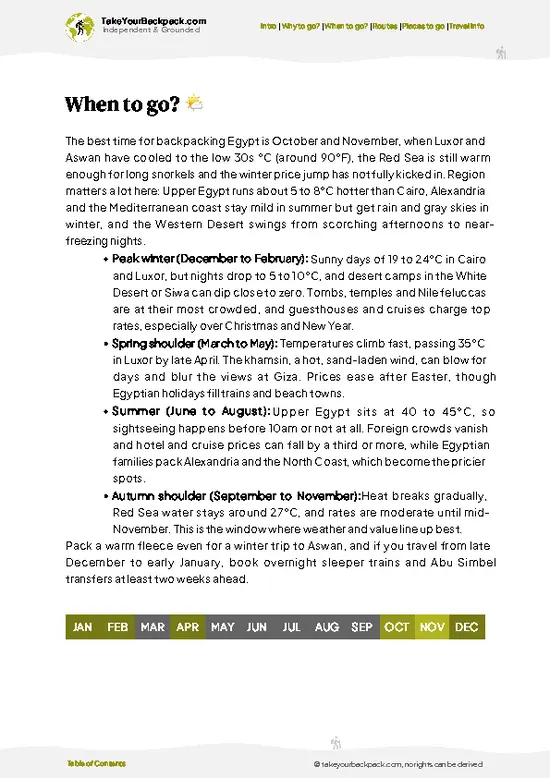
  • Weather & Temperature: The best time to visit the Coptic Museum is between October and April when Cairo’s weather is mild and bearable. Expect daytime highs around 20-25°C (68-77°F), perfect for wandering without melting in the desert heat. Summers (May to September) can scorch you with highs pushing 35-40°C (95-104°F), making indoor museums a sweaty slog.

  • Daylight Hours: From October to April, daylight lasts roughly 10-11 hours, giving you ample time to explore without rushing. In summer, longer days mean more light but also more heat, which can drain your energy fast.

  • Crowds: Peak tourist season hits from December to February, so expect the museum to be busier, especially around holidays. Shoulder months like October-November and March-April offer a quieter experience without sacrificing
read more 👉

  • Weather & Temperature: The best time to visit the Coptic Museum is between October and April when Cairo’s weather is mild and bearable. Expect daytime highs around 20-25°C (68-77°F), perfect for wandering without melting in the desert heat. Summers (May to September) can scorch you with highs pushing 35-40°C (95-104°F), making indoor museums a sweaty slog.

  • Daylight Hours: From October to April, daylight lasts roughly 10-11 hours, giving you ample time to explore without rushing. In summer, longer days mean more light but also more heat, which can drain your energy fast.

  • Crowds: Peak tourist season hits from December to February, so expect the museum to be busier, especially around holidays. Shoulder months like October-November and March-April offer a quieter experience without sacrificing comfort.

  • Seasonal Activities: The museum itself doesn’t host many seasonal events, but nearby Coptic Cairo sees religious festivals in April and December, which can add a raw, authentic vibe if you time it right.

  • Price Fluctuations: Entrance fees stay stable year-round, but flights and accommodation spike in peak season. Visiting in shoulder months can save you cash without losing the essence of the experience.


Pro-tip: Aim for late October or early April—cool temps, manageable crowds, and a chance to catch local religious ceremonies that bring the Coptic heritage to life beyond the museum walls.


source: climatestotravel.comJANJanuary: highly recommended for travelingFEBFebruary: highly recommended for travelingMARMarch: highly recommended for travelingAPRApril: highly recommended for travelingMAYMay: fair for travelingJUNJune: below average for travelingJULJuly: below average for travelingAUGAugust: below average for travelingSEPSeptember: fair for travelingOCTOctober: highly recommended for travelingNOVNovember: highly recommended for travelingDECDecember: highly recommended for traveling
when-to-go

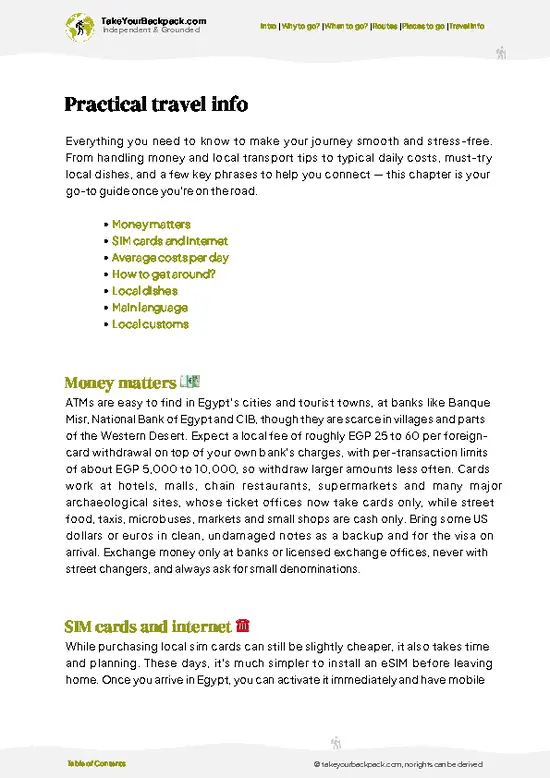
✈️ The backpacker research shortcutEgypt Travel Guide

An offline-friendly backpacking guide with optimized travel routes, ranked highlights, transport advice, and the best areas to stay.
example page 0 from our offline Travel Guide for Egypt
example page 1 from our offline Travel Guide for Egypt
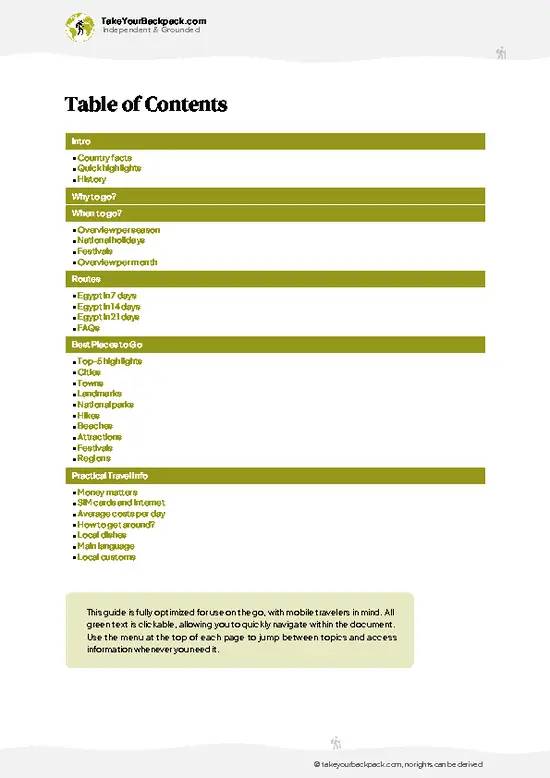
example page 2 from our offline Travel Guide for Egypt
example page 3 from our offline Travel Guide for Egypt
example page 4 from our offline Travel Guide for Egypt
example page 5 from our offline Travel Guide for Egypt
example page 6 from our offline Travel Guide for Egypt
example page 7 from our offline Travel Guide for Egypt
The digital guide (438 pages) contains:
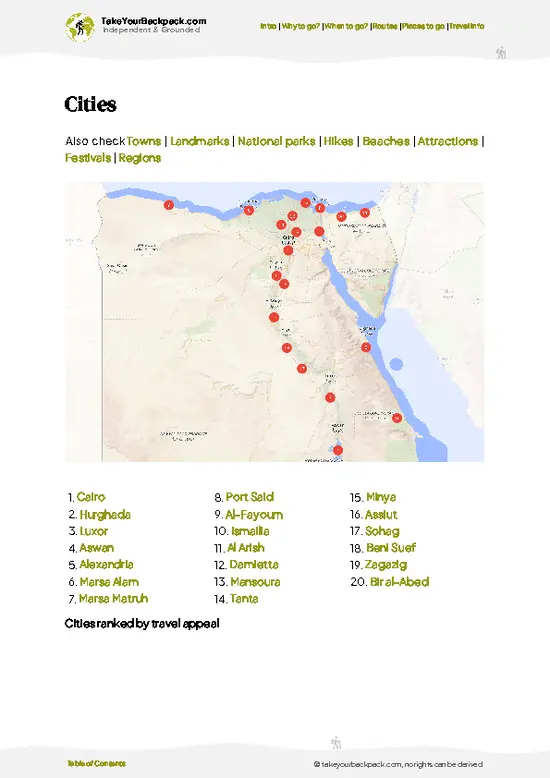
116 highlights, ranked by travel appeal
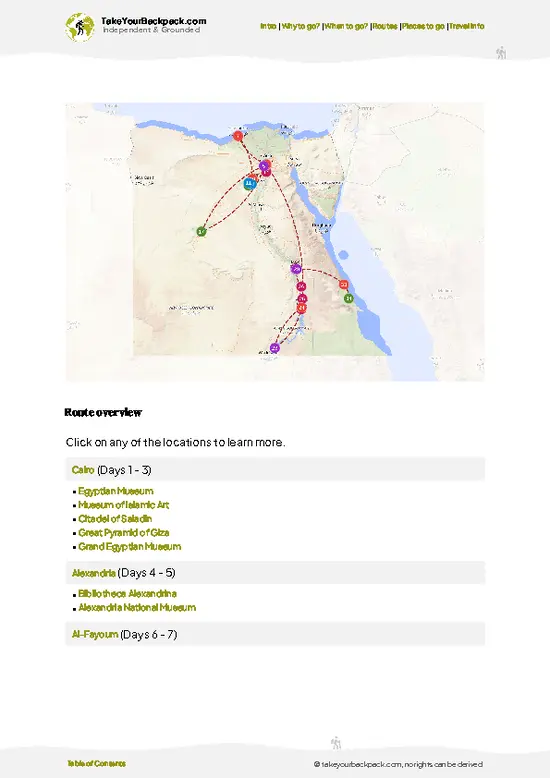
Optimized 7, 14 & 21-day travel routes
Cities, national parks, landmarks, beaches
How to get around
Offline-friendly for travel without Wi-Fi
👉 Click to see all 30+ guide features

📅 Plan smarter in minutes, not weeks
Month by month travel advice
Festivals & national holidays
Budget expectations

🗺️ Go to the right places, skip the overrated ones
Honest pros & cons of destinations
Top hikes, parks & viewpoints
Lesser-known places most travelers miss
Clear “worth it vs skip it” guidance

🛏️ Travel smoothly without rookie mistakes
Best areas to stay
Transport systems explained simply
Common scams & safety advice
SIM cards, money & practical tips

🌍 Understand the country, not just visit it
Culture & traditions
52 Essential phrases & customs
Festivals worth planning around
Traveler-friendly historical context
Insights that make places more meaningful

📱 Built for real travel conditions
Fully downloadable PDF
Works completely offline
Optimized for phone use
Useful in remote areas & buses
Everything in one place
Save weeks of stressful planning
Get instant access to your full guide. 30‑day money-back guarantee.


By proceeding you agree to our terms.
Sent to your inbox immediately after payment • 100% Secure Checkout
Best Backpacking Travel Advisor 2025 tourism awardBest Backpacking
Travel Advisor
2025
What others say about Take Your Backpack Guides:
⭐⭐⭐⭐⭐
Fantastic, amazing amount of information!
⭐⭐⭐⭐⭐
My goodness this is amazing, it's what I've been looking for hats off too you!
⭐⭐⭐⭐⭐
I think this is absolutely BRILLIANT
⭐⭐⭐⭐
Very complete and informative. It's still missing places, but I gotta to commend you
⭐⭐⭐⭐⭐
This is truly amazing, thank you, can't wait to explore it with my kids!
⭐⭐⭐⭐⭐
Awesome resource, thank you!
⭐⭐⭐⭐⭐
This is amazing! Can't wait to explore the ones I haven't seen
⭐⭐⭐⭐
I love this! Well done, great idea.
⭐⭐⭐⭐⭐
Thanks for taking the time to make this gem!
⭐⭐⭐⭐⭐
This might be the best website I've ever seen.
⭐⭐⭐⭐⭐
Congratulations, and thank you so much for your work; it's incredibly valuable.
⭐⭐⭐⭐
In all seriousness I think you did a great job pointing out the important spots
⭐⭐⭐⭐⭐
10/10 very good
⭐⭐⭐⭐⭐
As someone who's only just starting to visit regularly this is awesome, thank you.
⭐⭐⭐⭐
Thank you very much! I'm going to visit my dad, it's going to be very useful!
⭐⭐⭐⭐⭐
This is really cool! We'll be travelling for the first time and this definitely come in handy.
⭐⭐⭐⭐⭐
You are now our minister of culture, congratulations 👨‍💼
⭐⭐⭐⭐⭐
Just wanted to tell you that this is a pearl! Going to follow your recommendations.
⭐⭐⭐⭐⭐
This is so cool. I'll definitely be using the resource for my travels soon.
⭐⭐⭐⭐⭐
This is very impressive! Good work.
⭐⭐⭐⭐⭐
This is an amazing and informative site. Very well done!

🛏️ Where to stay?Best areas and accommodation options

If you’re backpacking to see the Coptic Museum in Cairo, let’s cut through the tourist brochure fluff. The area around Old Cairo, especially the neighborhoods of Coptic Cairo and nearby Attaba, is where you want to plant your flag. This isn’t the glitzy, polished part of the city; it’s gritty, alive, and packed with history that hits you in the gut.

Old Cairo is safe enough if you keep your wits about you—think street-smart, not reckless. It’s a magnet for solo travelers and budget backpackers because it’s close to the museum and other ancient sites like the Hanging Church and Ben Ezra Synagogue. … read more 👉
If you’re backpacking to see the Coptic Museum in Cairo, let’s cut through the tourist brochure fluff. The area around Old Cairo, especially the neighborhoods of Coptic Cairo and nearby Attaba, is where you want to plant your flag. This isn’t the glitzy, polished part of the city; it’s gritty, alive, and packed with history that hits you in the gut.

Old Cairo is safe enough if you keep your wits about you—think street-smart, not reckless. It’s a magnet for solo travelers and budget backpackers because it’s close to the museum and other ancient sites like the Hanging Church and Ben Ezra Synagogue. You’ll find plenty of guesthouses and budget digs where the vibe is social without being overrun by tourists. The locals are friendly, and the streets buzz with street vendors selling everything from falafel to papyrus art, giving you a real taste of Cairo’s pulse.

Attaba, just a short walk or cheap tuk-tuk ride away, is a bit more chaotic but offers even cheaper stays and a chance to rub elbows with locals rather than tourists. It’s a no-frills zone where you’ll get the authentic Cairo experience, minus the polished tourist traps.

Bottom line: Stay in Old Cairo or Attaba if you want to be close to the Coptic Museum and soak in the real city—safe, social, and packed with character. Skip the shiny hotels miles away; this is where the story lives.

👛 Costs (as of 28 January 2026)Typical daily expenses

As of the most recent estimates, the Coptic Museum in Cairo charges an entrance fee of EGP 280 (approximately €9) for adult foreign visitors and EGP 140 (approximately €4.50) for student foreign visitors. Egyptian and Arab visitors pay EGP 20 (approximately €0.65) for adults and EGP 10 (approximately €0.30) for students. Children under 6 years old, Egyptian seniors aged 60 and over, Egyptian citizens with special needs, orphaned children, and public primary and preparatory school trips receive free admission. Photography with mobile phones is permitted free of charge. The museum operates daily from 9:00 AM to 5:00 PM, with the last ticket sold at 4:00 PM. During Ramadan, visiting hours are from 9:00 AM to 3:00 PM, with the last ticket sold at 2:00 PM.
⚠️ Prices can change and everyone travels differently, so take this as a rough guide. Hope it helps you plan your adventure!

Other Egyptian attractions near Coptic Museum

Explore more nearby:


💡 Not sure where to go next?
Create a personalized itinerary for Egypt including Coptic Museum and the places that fit your trip.

Generate my itinerary

👉 Discover all attractions

Or checkout all Egypt has to offer (think cities, towns, villages, national parks, hikes, beaches, festivals)
Country photo of Egypt

We 💚 feedbackKey takeaways before you go

The Coptic Museum isn’t a flashy stop on the usual Egypt tour, and yes, it can feel a bit quiet compared to the pyramids’ chaos. But that’s exactly why it’s worth your time. The real magic is in the details—the intricate textiles, the ancient manuscripts, and the way the light hits those carved wooden doors. It’s a slow burn, not a quick thrill. If you’re after something that connects you to Egypt’s layered history beyond the usual, this place quietly delivers. Just don’t expect crowds or flashy exhibits—come ready to soak it in.

✍️ Help improve this page!
The information on this page is based on in-depth research, insights shared by experienced travelers, and feedback from the local travel community in Egypt. While every effort is made to keep the information accurate and current, conditions can change — so if you spot anything incorrect or outdated, please get in touch.


🙋‍♂️ Give feedback

👋 Meet the founderWho’s Behind Take Your Backpack?

Johan, backpacker and founder of TakeYourBackpackHi, I’m Johan (Netherlands 🇳🇱), the creator of TakeYourBackpack. Over the past decade, I’ve backpacked through 80+ countries across six continents, gaining extensive experience with independent travel, long-term trips, and overland routes.

This site is built on a combination of firsthand travel experience and carefully curated insights from other backpackers. Many guides are based on places I’ve personally visited, while others bring together tips, observations, and practical advice shared by trusted travelers I’ve met along the way.

The goal is to provide realistic, experience-driven guidance — not generic itineraries — so you can explore destinations with better context, clearer expectations, and more confidence.

Get full Egypt guide •
Instant download • 116 highlights • Full Offline guide