×

Equatorial Guinea🇬🇶 | beachesSipopo BeachGroomed palm strip, summit complex, calm shallows, weekend fish stands | things to do and best time to go

Explore Playa de MbiniExplore Bata

Backpacking in Sipopo Beach
🌟 Highlightbeach ranked #3
By Johan Kruseman 🇳🇱 | Updated October 22, 2026

Sipopo Beach is a short taxi ride from central Malabo, so you can swim and be back in town for dinner without planning a whole day around it. It lies on the northwest coast of Bioko Island, in Equatorial Guinea’s capital area, next to the summit complex built for large international gatherings. The surroundings are tidy and quiet, with landscaped grounds and little litter, which is not a given on this coast. The drawback is atmosphere: there is no hostel scene, no dive shop, and the nearby resort hotel is pricey. Swimming is fine on calm days, but the Gulf of Guinea surf can pull hard, so stay in the shallows. Snorkeling is not worth the effort. Weekends bring local families, while weekdays are close to empty. Skip it if you want nightlife. Go for a calm stretch of sand. A first day could be a late-morning taxi, a walk along the shore, grilled fish for lunch and a swim before the afternoon clouds build.

Discover everything you want to know in the 📖 Equatorial Guinea Travel Guide.


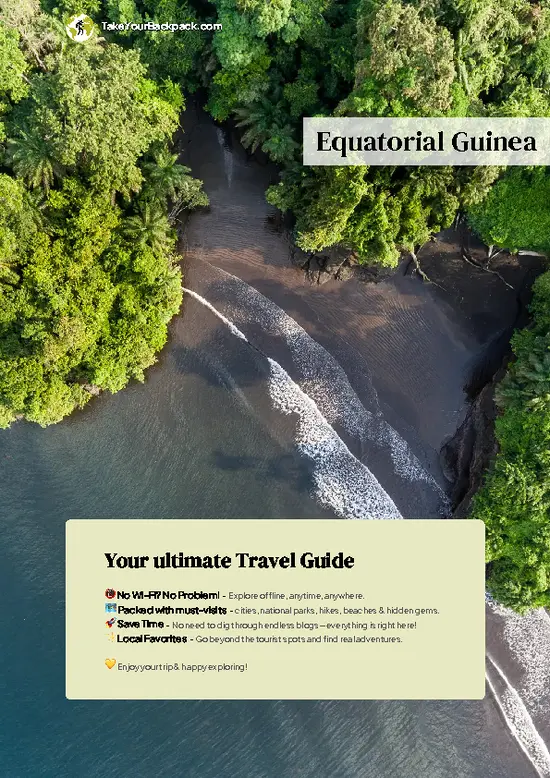
example page 0 from our offline Travel Guide for Equatorial Guinea
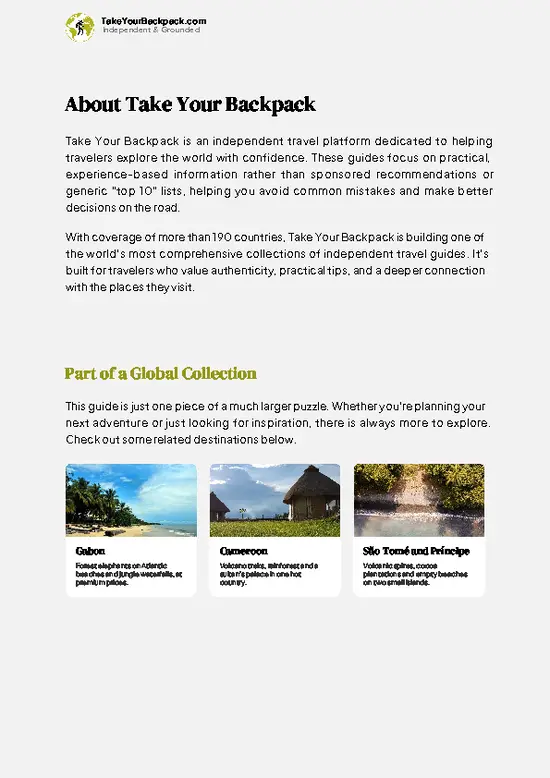
example page 1 from our offline Travel Guide for Equatorial Guinea
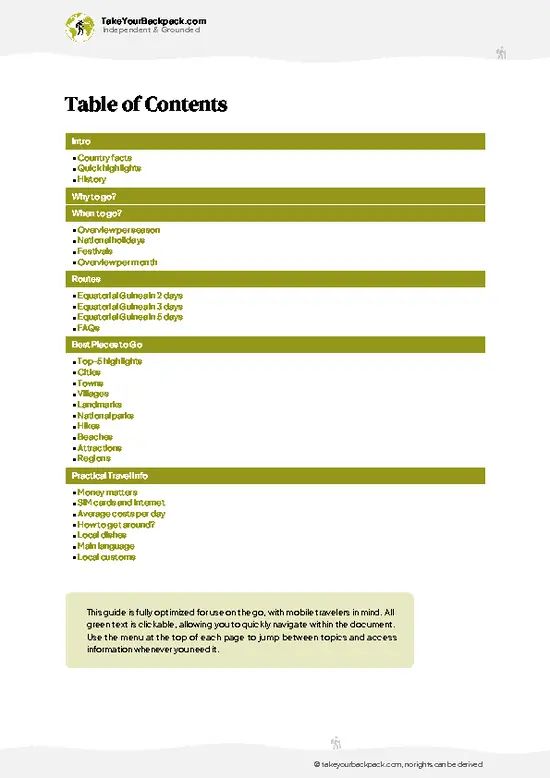
example page 2 from our offline Travel Guide for Equatorial Guinea
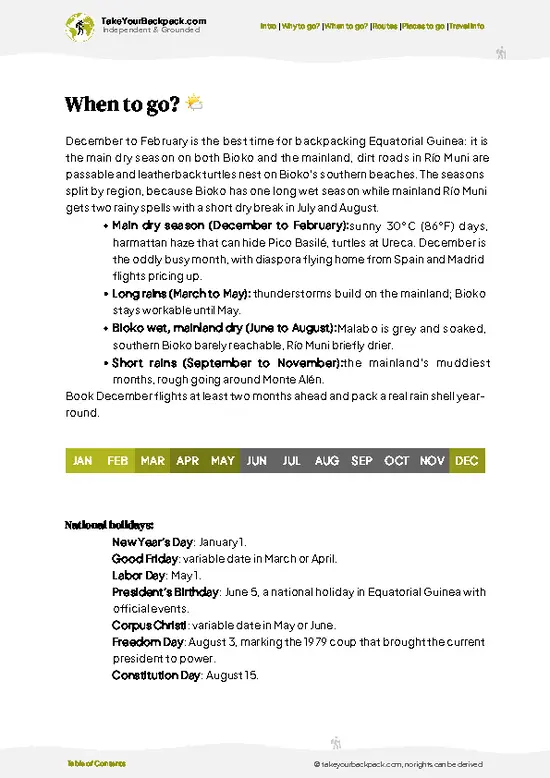
example page 3 from our offline Travel Guide for Equatorial Guinea
example page 4 from our offline Travel Guide for Equatorial Guinea
example page 5 from our offline Travel Guide for Equatorial Guinea
example page 6 from our offline Travel Guide for Equatorial Guinea
example page 7 from our offline Travel Guide for Equatorial Guinea
Loading the map 🌍
CLICK TO FILTER
cities
towns
villages
landmarks
national parks
hikes
beaches
attractions
regions
SHOW COUNTRY’S BESTSHOW ALL

✨ Why go?
Ranked #3 beach in Equatorial Guinea
The unique appeal for travelers

Sipopo Beach earns its stop because it is the easiest place near Malabo to get your feet in the Atlantic without leaving the capital’s orbit. Most backpackers arrive on Bioko Island for business logistics, visas or onward flights, and a day in the city can be hot and loud. This stretch of coast offers a break from that, with space to walk and sit without anyone selling you anything.

The second reason is the setting. The Sipopo conference complex next door is an odd, oversized backdrop of villas, lawns and a lagoon, and it gives the beach a spaciousness you rarely find around African capitals. Walking its quiet roads is a strange and interesting contrast to the old Spanish-era streets in Malabo.

The third is the social angle, which is small but real. On weekends, Equatoguinean families and … read more 👉
Sipopo Beach earns its stop because it is the easiest place near Malabo to get your feet in the Atlantic without leaving the capital’s orbit. Most backpackers arrive on Bioko Island for business logistics, visas or onward flights, and a day in the city can be hot and loud. This stretch of coast offers a break from that, with space to walk and sit without anyone selling you anything.

The second reason is the setting. The Sipopo conference complex next door is an odd, oversized backdrop of villas, lawns and a lagoon, and it gives the beach a spaciousness you rarely find around African capitals. Walking its quiet roads is a strange and interesting contrast to the old Spanish-era streets in Malabo.

The third is the social angle, which is small but real. On weekends, Equatoguinean families and expats from the oil and gas sector gather here, and the weekend food stands are a simple way to start a conversation over grilled fish. Treat it as a pause between Bioko’s volcanic highlands and the city, not as a base.

💡 HighlightsKey sights and experiences for travelers

  1. The beach itself: A long strip of sand facing the Gulf of Guinea, backed by palms and groomed grounds. It is cleaner than most city beaches in the region. Walk it in the morning when the sand is firm and the air is cooler, and use the shallows rather than the open surf.
  2. Sipopo conference complex: A gated-style district of purpose-built villas, wide avenues and a ceremonial hall, created for a major African summit. You can drive or walk the outer roads and take in the scale of it. It reads like a small planned city, and it is quiet enough that you will hear your own footsteps.
  3. The lagoon and marina area: Water channels and landscaped banks run through the complex, giving you a calm place to sit in shade when the beach is too bright. Birdlife drifts through in the early morning, and the still
… read more 👉
  1. The beach itself: A long strip of sand facing the Gulf of Guinea, backed by palms and groomed grounds. It is cleaner than most city beaches in the region. Walk it in the morning when the sand is firm and the air is cooler, and use the shallows rather than the open surf.
  2. Sipopo conference complex: A gated-style district of purpose-built villas, wide avenues and a ceremonial hall, created for a major African summit. You can drive or walk the outer roads and take in the scale of it. It reads like a small planned city, and it is quiet enough that you will hear your own footsteps.
  3. The lagoon and marina area: Water channels and landscaped banks run through the complex, giving you a calm place to sit in shade when the beach is too bright. Birdlife drifts through in the early morning, and the still water makes better photos than the surf does.
  4. Weekend grilled fish stands: When families come on Saturdays and Sundays, informal vendors set up near the sand with fresh fish, plantain and cold drinks. It is the most local thing to do here, and the simplest way to eat on a budget without leaving the shore.
  5. Sunset over the Gulf of Guinea: The beach faces west, so the evening light settles low across the water with the volcanic outline of Bioko behind you. Stay until the sky changes color, then arrange a taxi back to Malabo before full dark, since little transport waits here at night.
Sipopo Beach takes a relaxed half day all told, or a full day if you add a long lunch and a slow stroll through the complex.
Spotted a mistake or missing something? Contact us.

🌤️ When to go?Weather, crowds, and seasonal trade-offs

  • Dry Season (December to February): This is the window for beach days at Sipopo Beach, with the least rain and more sun. Expect 24 to 31°C (75 to 88°F), though harmattan haze can dull the sky and the sea.
  • Wet Season (March to November): Rain is frequent on Bioko Island, and it peaks roughly from June to October with heavy downpours and gray skies. Temperatures stay steady at 22 to 29°C (72 to 84°F), the sea turns rougher and visibility drops.
  • Shoulder Months (March to May, November): Showers tend to arrive in the afternoon, so mornings often stay clear enough for a swim.
  • Daylight: Days run close to 12 hours all year, so plan to finish beach time well before dusk.
  • Crowds and Prices: Weekends bring local families and Malabo residents. Weekdays are quiet. Hotel rates in Malabo stay high all year and
… read more 👉
  • Dry Season (December to February): This is the window for beach days at Sipopo Beach, with the least rain and more sun. Expect 24 to 31°C (75 to 88°F), though harmattan haze can dull the sky and the sea.
  • Wet Season (March to November): Rain is frequent on Bioko Island, and it peaks roughly from June to October with heavy downpours and gray skies. Temperatures stay steady at 22 to 29°C (72 to 84°F), the sea turns rougher and visibility drops.
  • Shoulder Months (March to May, November): Showers tend to arrive in the afternoon, so mornings often stay clear enough for a swim.
  • Daylight: Days run close to 12 hours all year, so plan to finish beach time well before dusk.
  • Crowds and Prices: Weekends bring local families and Malabo residents. Weekdays are quiet. Hotel rates in Malabo stay high all year and rise around conferences and government events at the Sipopo complex.
Go on a weekday morning in the dry season for the calmest water and the emptiest sand.


source: climatestotravel.comJANJanuary: fair for travelingFEBFebruary: fair for travelingMARMarch: fair for travelingAPRApril: fair for travelingMAYMay: good for travelingJUNJune: excellent for travelingJULJuly: excellent for travelingAUGAugust: excellent for travelingSEPSeptember: excellent for travelingOCTOctober: good for travelingNOVNovember: fair for travelingDECDecember: fair for traveling
when-to-go

✈️ The backpacker research shortcutEquatorial Guinea Travel Guide

An offline-friendly backpacking guide with optimized travel routes, ranked highlights, transport advice, and the best areas to stay.
example page 0 from our offline Travel Guide for Equatorial Guinea
example page 1 from our offline Travel Guide for Equatorial Guinea
example page 2 from our offline Travel Guide for Equatorial Guinea
example page 3 from our offline Travel Guide for Equatorial Guinea
example page 4 from our offline Travel Guide for Equatorial Guinea
example page 5 from our offline Travel Guide for Equatorial Guinea
example page 6 from our offline Travel Guide for Equatorial Guinea
example page 7 from our offline Travel Guide for Equatorial Guinea
The digital guide (174 pages) contains:
✅ 36 highlights, ranked by travel appeal
✅ Optimized 2, 3 & 5-day travel routes
✅ Cities, national parks, landmarks, beaches
✅ How to get around
✅ Offline-friendly for travel without Wi-Fi
👉 Click to see all 30+ guide features

📅 Plan smarter in minutes, not weeks
✅ Month by month travel advice
✅ Festivals & national holidays
✅ Budget expectations

🗺️ Go to the right places, skip the overrated ones
✅ Honest pros & cons of destinations
✅ Top hikes, parks & viewpoints
✅ Lesser-known places most travelers miss
✅ Clear “worth it vs skip it” guidance

🛏️ Travel smoothly without rookie mistakes
✅ Best areas to stay
✅ Transport systems explained simply
✅ Common scams & safety advice
✅ SIM cards, money & practical tips

🌍 Understand the country, not just visit it
✅ Culture & traditions
✅ 52 Essential phrases & customs
✅ Festivals worth planning around
✅ Traveler-friendly historical context
✅ Insights that make places more meaningful

📱 Built for real travel conditions
✅ Fully downloadable PDF
✅ Works completely offline
✅ Optimized for phone use
✅ Useful in remote areas & buses
✅ Everything in one place
Stop searching, start planning
Get instant access to your full guide. 30‑day money-back guarantee.
+ Add another guide for just

By proceeding you agree to our terms.
Sent to your inbox immediately after payment • 100% Secure Checkout
Best Backpacking Travel Advisor 2025 tourism awardBest Backpacking
Travel Advisor
2025
What others say about Take Your Backpack Guides:
⭐⭐⭐⭐⭐
Fantastic, amazing amount of information!
⭐⭐⭐⭐⭐
My goodness this is amazing, it's what I've been looking for hats off too you!
⭐⭐⭐⭐⭐
I think this is absolutely BRILLIANT
⭐⭐⭐⭐
Very complete and informative. It's still missing places, but I gotta to commend you
⭐⭐⭐⭐⭐
This is truly amazing, thank you, can't wait to explore it with my kids!
⭐⭐⭐⭐⭐
Awesome resource, thank you!
⭐⭐⭐⭐⭐
This is amazing! Can't wait to explore the ones I haven't seen
⭐⭐⭐⭐
I love this! Well done, great idea.
⭐⭐⭐⭐⭐
Thanks for taking the time to make this gem!
⭐⭐⭐⭐⭐
This might be the best website I've ever seen.
⭐⭐⭐⭐⭐
Congratulations, and thank you so much for your work; it's incredibly valuable.
⭐⭐⭐⭐
In all seriousness I think you did a great job pointing out the important spots
⭐⭐⭐⭐⭐
10/10 very good
⭐⭐⭐⭐⭐
As someone who's only just starting to visit regularly this is awesome, thank you.
⭐⭐⭐⭐
Thank you very much! I'm going to visit my dad, it's going to be very useful!
⭐⭐⭐⭐⭐
This is really cool! We'll be travelling for the first time and this definitely come in handy.
⭐⭐⭐⭐⭐
You are now our minister of culture, congratulations 👨‍💼
⭐⭐⭐⭐⭐
Just wanted to tell you that this is a pearl! Going to follow your recommendations.
⭐⭐⭐⭐⭐
This is so cool. I'll definitely be using the resource for my travels soon.
⭐⭐⭐⭐⭐
This is very impressive! Good work.
⭐⭐⭐⭐⭐
This is an amazing and informative site. Very well done!

🛏️ Where to stay?Choosing the right base

Central Malabo is the best base for backpackers, because the beds, cheap eateries and shared taxis are all there and Sipopo Beach is a short ride west along the coast. Expect to pay roughly €40 to 90 a night for a basic guesthouse or small hotel, since Malabo is one of Africa’s pricier cities and true dorm hostels are scarce.
Stay around the old colonial core near the Spanish Cathedral and Plaza de la Independencia. You can walk to markets, bakeries and bars, and the guesthouses here are where other independent travelers, aid workers and visiting traders tend to cross paths. Evenings are easy to … read more 👉
Central Malabo is the best base for backpackers, because the beds, cheap eateries and shared taxis are all there and Sipopo Beach is a short ride west along the coast. Expect to pay roughly €40 to 90 a night for a basic guesthouse or small hotel, since Malabo is one of Africa’s pricier cities and true dorm hostels are scarce.
Stay around the old colonial core near the Spanish Cathedral and Plaza de la Independencia. You can walk to markets, bakeries and bars, and the guesthouses here are where other independent travelers, aid workers and visiting traders tend to cross paths. Evenings are easy to fill without a car, and taxis are plentiful until late.
The neighborhoods around Malabo II and the waterfront also have mid-range options with better power and water, which matters in the wet season. A shared taxi hop within town costs about €0.75 to 1.50.
Staying at Sipopo itself means resort-style hotels in the conference complex, with higher prices, quiet nights and little social life. Use it only if you want the sea outside your door and can afford it. Most budget travelers sleep in town and visit Sipopo for the day.

🛡️ SafetyTraveler Safety Guide

Sipopo Beach is generally calm for visitors, and the main practical issues are the surf, the sun and local rules around the government complex. The Gulf of Guinea sends in swell, so waves can be moderate and rip currents form on rougher days, especially in the wet season. Stay where locals are swimming, keep to waist-deep water when the surf is up, and skip swimming alone. Lifeguards and flag systems are not something to rely on.
The equatorial sun is strong even under cloud, so wear sunscreen and a hat, and carry water. Afternoon storms roll in fast between March and November. Mornings are the best time for swimming and for avoiding the midday heat.
Keep valuables minimal and bring only what you need to the sand. Carry a copy of your passport, as police checkpoints are common on the road from … read more 👉
Sipopo Beach is generally calm for visitors, and the main practical issues are the surf, the sun and local rules around the government complex. The Gulf of Guinea sends in swell, so waves can be moderate and rip currents form on rougher days, especially in the wet season. Stay where locals are swimming, keep to waist-deep water when the surf is up, and skip swimming alone. Lifeguards and flag systems are not something to rely on.
The equatorial sun is strong even under cloud, so wear sunscreen and a hat, and carry water. Afternoon storms roll in fast between March and November. Mornings are the best time for swimming and for avoiding the midday heat.
Keep valuables minimal and bring only what you need to the sand. Carry a copy of your passport, as police checkpoints are common on the road from Malabo. Ask before photographing official buildings or uniformed personnel around the Sipopo complex.

FAQFrequently asked questions about Sipopo Beach

Sipopo Beach lies about 10 km west of central Malabo on Bioko Island, and the coast road takes 15 to 30 minutes depending on traffic. Take a private taxi for roughly €5 to 10 each way, or a shared taxi toward the Sipopo road for about €1 to 2 and walk the last stretch. Most travelers fly into Malabo’s airport from Madrid, Addis Ababa, Casablanca or Douala before heading out, and a visa is needed before arrival.
Sipopo Beach works best for a swim or a paddle on calm mornings, mostly from December to February. Surf is not a draw, since the waves are inconsistent and there is no board rental scene. Snorkeling is poor, with limited visibility along this stretch and no organized gear hire. Bring your own mask if you want to try, and swim where locals do, because currents pick up in the wet season.
Sipopo Beach itself is free to enter, and there is no ticket to walk onto the sand. Some resort and club sections of the Sipopo complex are private or charge for sunbeds and food, typically a few euros up to €15 or more at hotel venues. Budget about €1 to 2 for a shared taxi from Malabo, or €5 to 10 for a private one, and carry cash because card use is limited.
⚠️ Things can change over time, so always validate details locally before you go.

Other Equatoguinean beaches near Sipopo Beach

Explore more nearby:

  • Arena Blanca Beach—seasonal butterfly migrations, white sand, forest backdrop, local weekend crowds| 42 km away
  • Playa de Arena Blanca—coastal cliffs, tidal pools, quiet mornings, birdlife| 44 km away
  • Playa de Mbini—river mouth, fishing boats, wide open sand, village proximity| 255 km away

💡 Not sure where to go next?
Create a personalized itinerary for Equatorial Guinea including Sipopo Beach and the places that fit your trip.

Generate my itinerary

👉 Discover all beaches

Or checkout all Equatorial Guinea has to offer (think cities, towns, villages, national parks, hikes, beaches, festivals)
Country photo of Equatorial Guinea

We 💚 feedbackFinal thoughts on visiting Sipopo Beach

Sipopo Beach is best judged by the road behind it, not the sand. The empty avenues of the summit complex are what most first-timers rush past, yet they make the most memorable walk, especially in the cooler hours. I would bring water and a hat, agree on a return taxi before you arrive, and skip swimming when the waves look heavy.

✍️ Help improve this page!
The information on this page is based on in-depth research, insights shared by experienced travelers, and feedback from the local travel community in Equatorial Guinea. While every effort is made to keep the information accurate and current, conditions can change — so if you spot anything incorrect or outdated, please get in touch.


🙋‍♂️ Give feedback

👋 Meet the founderWho’s Behind Take Your Backpack?

Johan, backpacker and founder of TakeYourBackpackHi, I’m Johan (Netherlands 🇳🇱), the creator of TakeYourBackpack. Over the past 3 decades, I’ve backpacked through 90+ countries across six continents, gaining extensive experience with independent travel, long-term trips, and overland routes.

This site is built on a combination of firsthand travel experience and carefully curated insights from other backpackers. Many guides are based on places I’ve personally visited, while others bring together tips, observations, and practical advice shared by trusted travelers I’ve met along the way.

The goal is to provide realistic, experience-driven guidance — not generic itineraries — so you can explore destinations with better context, clearer expectations, and more confidence.