×

Eritrea🇪🇷 | national parksDahlak Marine National ParkRed Sea reefs, Dahlak Kebir, mangrove channels, beach camps | things to do and best time to go

Explore Senafe to Metera TrailExplore Hawashaiti National Park

Backpacking in Dahlak Marine
🏆 Top picknational park ranked #1
By Johan Kruseman 🇳🇱 | Updated October 22, 2026

Dahlak Marine National Park has some of the clearest, least-visited reef water in the Red Sea, because so few boats ever reach it. The park covers the Dahlak Archipelago in the Red Sea, off the coast of Eritrea, east of the port city of Massawa. Only a handful of the 200-plus islands are inhabited, and the rest are bare coral limestone with mangroves, sand spits and nesting seabirds. Diving and snorkeling are excellent, and dolphins, turtles and rays are regular sightings. There are no marked hiking circuits, so walking means beach and island strolls. Access is the main hurdle. Visitors need a travel permit and normally a pre-arranged boat, since there is no public ferry schedule you can rely on, so book through a Massawa operator and let them handle the paperwork. Heat is heavy and shade scarce, so carry water and cover up. A first day usually starts with a morning boat run from Massawa, a snorkel stop over shallow reef, then a beach camp on an island with simple food cooked by the crew.

Discover everything you want to know in the 📖 Eritrea Travel Guide.


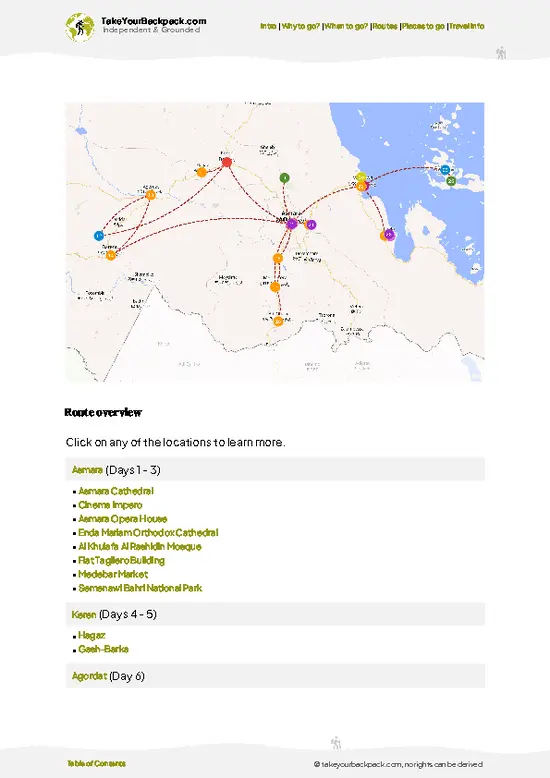
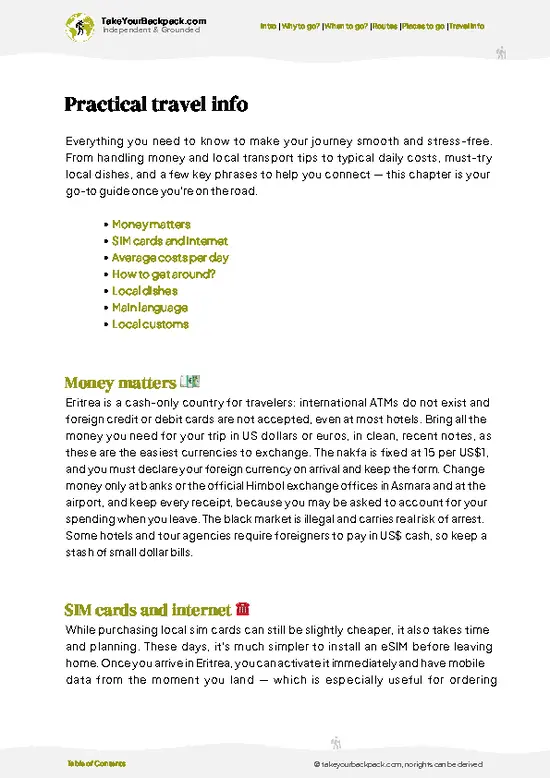
example page 0 from our offline Travel Guide for Eritrea
example page 1 from our offline Travel Guide for Eritrea
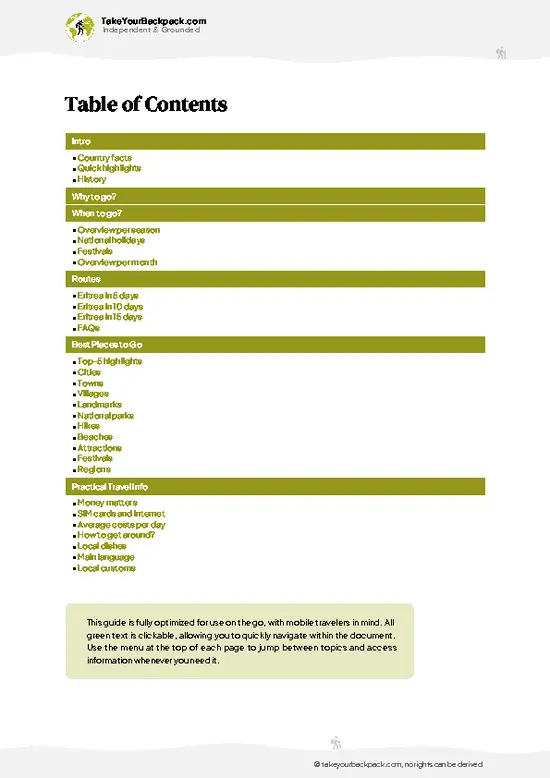
example page 2 from our offline Travel Guide for Eritrea
example page 3 from our offline Travel Guide for Eritrea
example page 4 from our offline Travel Guide for Eritrea
example page 5 from our offline Travel Guide for Eritrea
example page 6 from our offline Travel Guide for Eritrea
example page 7 from our offline Travel Guide for Eritrea
Loading the map 🌍
CLICK TO FILTER
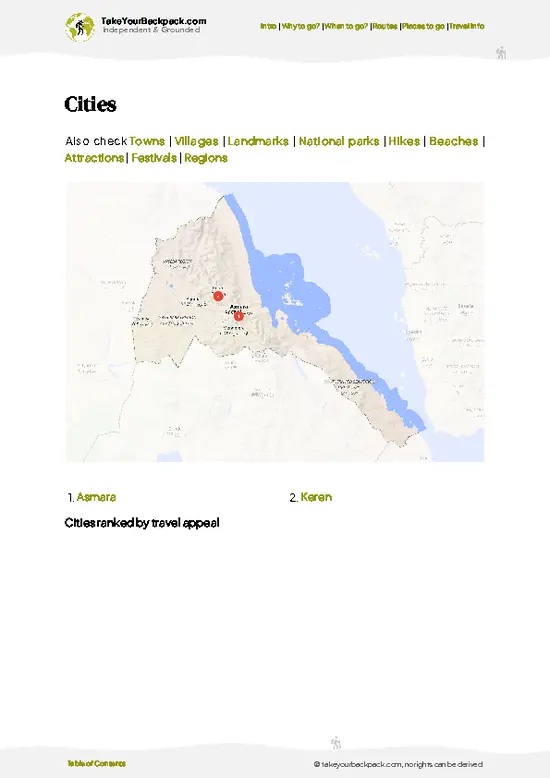
cities
towns
villages
landmarks
national parks
hikes
beaches
attractions
festivals
regions
SHOW COUNTRY’S BESTSHOW ALL

✨ Why go?
Ranked #1 national park in Eritrea
Why Dahlak Marine should be on your travel list

Dahlak Marine National Park draws backpackers who would rather arrange their own boat and camp on sand than join a resort package, because there are no resorts here at all. The archipelago holds more than 200 islands in the Red Sea off Massawa, and only a handful have people living on them. That leaves Dissei Island and the shallow sandbars around it for you and a boat crew, with reefs a few meters offshore. Snorkeling over coral gardens is the main event, with sea turtles, reef fish and, on some sites, dolphins turning up on the water between islands.

The second reason is independence of a particular kind. Trips are set up in Massawa, so you choose the islands, the number of nights and how basic you want it. Sleeping on deck or on a beach under a night sky with almost no artificial light … read more 👉
Dahlak Marine National Park draws backpackers who would rather arrange their own boat and camp on sand than join a resort package, because there are no resorts here at all. The archipelago holds more than 200 islands in the Red Sea off Massawa, and only a handful have people living on them. That leaves Dissei Island and the shallow sandbars around it for you and a boat crew, with reefs a few meters offshore. Snorkeling over coral gardens is the main event, with sea turtles, reef fish and, on some sites, dolphins turning up on the water between islands.

The second reason is independence of a particular kind. Trips are set up in Massawa, so you choose the islands, the number of nights and how basic you want it. Sleeping on deck or on a beach under a night sky with almost no artificial light costs far less than any organized tour of comparable length. Expect to bring your own food, water and shade, since the islands offer very little.

The third is the history. Dahlak Kebir, the largest island, holds old cisterns and Islamic-era tombs that point to a trading past stretching back centuries. Few places let you combine that with empty reefs, which is why seasoned travelers who have already seen the busier Red Sea dive towns still make the crossing.

💡 HighlightsMust-see experiences and standout moments

  1. Dahlak Kebir: The largest island and the only one with a real settlement, with fishing families, a scattering of old stone cisterns and a quiet, sun-baked feel.
  2. Reefs for snorkeling: Shallow coral gardens around the smaller islands hold parrotfish, angelfish, turtles and the occasional ray, with visibility often well beyond 20 meters.
  3. Diving sites: Drop-offs and walls attract reef sharks, barracuda and big schools of jacks, and the lack of crowds is the main difference from busier Red Sea spots.
  4. Necropolis of Dahlak Kebir: Ruined tombs and carved Arabic funerary inscriptions on the island recall the medieval Islamic trading era when pearls and slaves moved through the archipelago.
  5. Mangrove channels: Thin waterways wind between low islands, good for slow boat rides and for spotting herons, egrets
… read more 👉
  1. Dahlak Kebir: The largest island and the only one with a real settlement, with fishing families, a scattering of old stone cisterns and a quiet, sun-baked feel.
  2. Reefs for snorkeling: Shallow coral gardens around the smaller islands hold parrotfish, angelfish, turtles and the occasional ray, with visibility often well beyond 20 meters.
  3. Diving sites: Drop-offs and walls attract reef sharks, barracuda and big schools of jacks, and the lack of crowds is the main difference from busier Red Sea spots.
  4. Necropolis of Dahlak Kebir: Ruined tombs and carved Arabic funerary inscriptions on the island recall the medieval Islamic trading era when pearls and slaves moved through the archipelago.
  5. Mangrove channels: Thin waterways wind between low islands, good for slow boat rides and for spotting herons, egrets and other wading birds.
  6. Seabird colonies: Several islets hold nesting terns, boobies and gulls, best viewed from a boat to avoid disturbing breeding birds.
  7. Dolphin encounters: Pods are regularly seen from boats between islands, sometimes riding the bow wave on open crossings.
  8. Beach camps: Uninhabited sand spits with no light pollution give some of the best night skies in the country.
Dahlak Marine National Park has no ticketed sights as such, so a beach walk or a snorkel from the sand costs nothing beyond the boat you already hired.
Spotted a mistake or missing something? Contact us.

Things to do near Dahlak Marine National Park

Ratings based on Tripadvisor reviews. When you book through this link, you support our work at no extra cost to you.

🌤️ When to go?When to go for the best experience

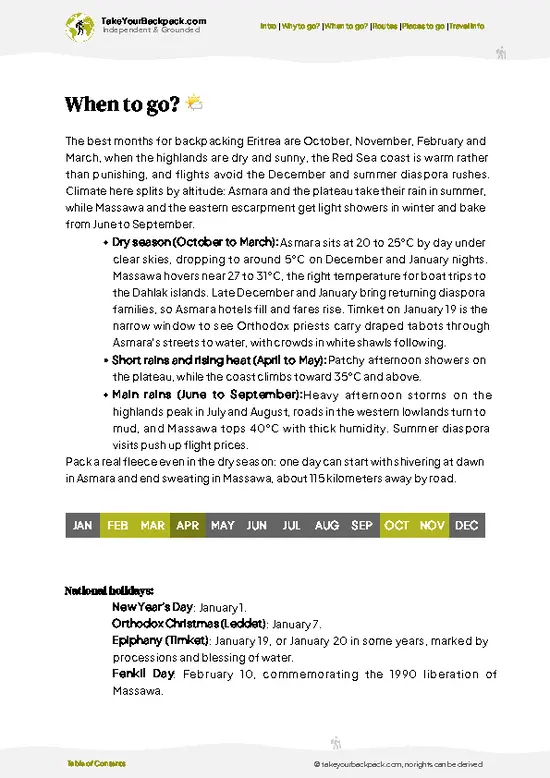
  • Cool Season (November to March): Sea temperatures sit around 26 to 28°C (79 to 82°F), air runs 26 to 32°C (79 to 90°F), and the Red Sea is calm enough for dhow trips between islands. Visibility for diving and snorkeling is at its best, and this is when the few liveaboard and charter groups arrive.
  • Shoulder Months (April and October): Air climbs to 32 to 36°C (90 to 97°F) with fewer boats going out. Charter prices can soften, and you can often negotiate harder.
  • Hot Season (May to September): Highs reach 38 to 43°C (100 to 109°F) with heavy humidity and strong afternoon winds. Shade on the islands is scarce, so daytime exploring is punishing. Rain is rare, falling mostly in winter and in small amounts.
  • Daylight: Days are close to 11 to 13 hours across the year, so plan boat legs for the morning.
… read more 👉
  • Cool Season (November to March): Sea temperatures sit around 26 to 28°C (79 to 82°F), air runs 26 to 32°C (79 to 90°F), and the Red Sea is calm enough for dhow trips between islands. Visibility for diving and snorkeling is at its best, and this is when the few liveaboard and charter groups arrive.
  • Shoulder Months (April and October): Air climbs to 32 to 36°C (90 to 97°F) with fewer boats going out. Charter prices can soften, and you can often negotiate harder.
  • Hot Season (May to September): Highs reach 38 to 43°C (100 to 109°F) with heavy humidity and strong afternoon winds. Shade on the islands is scarce, so daytime exploring is punishing. Rain is rare, falling mostly in winter and in small amounts.
  • Daylight: Days are close to 11 to 13 hours across the year, so plan boat legs for the morning.
Book your boat and permits in Massawa at least a week before your target dates in the cool season, since the islands have very few vessels available.


source: climatestotravel.comJANJanuary: excellent for travelingFEBFebruary: excellent for travelingMARMarch: excellent for travelingAPRApril: highly recommended for travelingMAYMay: fair for travelingJUNJune: below average for travelingJULJuly: below average for travelingAUGAugust: below average for travelingSEPSeptember: fair for travelingOCTOctober: highly recommended for travelingNOVNovember: excellent for travelingDECDecember: excellent for traveling
when-to-go

✈️ The backpacker research shortcutEritrea Travel Guide

An offline-friendly backpacking guide with optimized travel routes, ranked highlights, transport advice, and the best areas to stay.
example page 0 from our offline Travel Guide for Eritrea
example page 1 from our offline Travel Guide for Eritrea
example page 2 from our offline Travel Guide for Eritrea
example page 3 from our offline Travel Guide for Eritrea
example page 4 from our offline Travel Guide for Eritrea
example page 5 from our offline Travel Guide for Eritrea
example page 6 from our offline Travel Guide for Eritrea
example page 7 from our offline Travel Guide for Eritrea
The digital guide (245 pages) contains:
✅ 56 highlights, ranked by travel appeal
✅ Optimized 5, 10 & 15-day travel routes
✅ Cities, national parks, landmarks, beaches
✅ How to get around
✅ Offline-friendly for travel without Wi-Fi
👉 Click to see all 30+ guide features

📅 Plan smarter in minutes, not weeks
✅ Month by month travel advice
✅ Festivals & national holidays
✅ Budget expectations

🗺️ Go to the right places, skip the overrated ones
✅ Honest pros & cons of destinations
✅ Top hikes, parks & viewpoints
✅ Lesser-known places most travelers miss
✅ Clear “worth it vs skip it” guidance

🛏️ Travel smoothly without rookie mistakes
✅ Best areas to stay
✅ Transport systems explained simply
✅ Common scams & safety advice
✅ SIM cards, money & practical tips

🌍 Understand the country, not just visit it
✅ Culture & traditions
✅ 52 Essential phrases & customs
✅ Festivals worth planning around
✅ Traveler-friendly historical context
✅ Insights that make places more meaningful

📱 Built for real travel conditions
✅ Fully downloadable PDF
✅ Works completely offline
✅ Optimized for phone use
✅ Useful in remote areas & buses
✅ Everything in one place
Stop searching, start planning
Get instant access to your full guide. 30‑day money-back guarantee.
+ Add another guide for just

By proceeding you agree to our terms.
Sent to your inbox immediately after payment • 100% Secure Checkout
Best Backpacking Travel Advisor 2025 tourism awardBest Backpacking
Travel Advisor
2025
What others say about Take Your Backpack Guides:
⭐⭐⭐⭐⭐
Fantastic, amazing amount of information!
⭐⭐⭐⭐⭐
My goodness this is amazing, it's what I've been looking for hats off too you!
⭐⭐⭐⭐⭐
I think this is absolutely BRILLIANT
⭐⭐⭐⭐
Very complete and informative. It's still missing places, but I gotta to commend you
⭐⭐⭐⭐⭐
This is truly amazing, thank you, can't wait to explore it with my kids!
⭐⭐⭐⭐⭐
Awesome resource, thank you!
⭐⭐⭐⭐⭐
This is amazing! Can't wait to explore the ones I haven't seen
⭐⭐⭐⭐
I love this! Well done, great idea.
⭐⭐⭐⭐⭐
Thanks for taking the time to make this gem!
⭐⭐⭐⭐⭐
This might be the best website I've ever seen.
⭐⭐⭐⭐⭐
Congratulations, and thank you so much for your work; it's incredibly valuable.
⭐⭐⭐⭐
In all seriousness I think you did a great job pointing out the important spots
⭐⭐⭐⭐⭐
10/10 very good
⭐⭐⭐⭐⭐
As someone who's only just starting to visit regularly this is awesome, thank you.
⭐⭐⭐⭐
Thank you very much! I'm going to visit my dad, it's going to be very useful!
⭐⭐⭐⭐⭐
This is really cool! We'll be travelling for the first time and this definitely come in handy.
⭐⭐⭐⭐⭐
You are now our minister of culture, congratulations 👨‍💼
⭐⭐⭐⭐⭐
Just wanted to tell you that this is a pearl! Going to follow your recommendations.
⭐⭐⭐⭐⭐
This is so cool. I'll definitely be using the resource for my travels soon.
⭐⭐⭐⭐⭐
This is very impressive! Good work.
⭐⭐⭐⭐⭐
This is an amazing and informative site. Very well done!

🛏️ Where to stay?Best areas to stay in Eritrea

The only practical base for Dahlak Marine National Park is Massawa on the mainland coast, with a handful of basic camps on the islands themselves. Massawa’s old Italian-era island quarter, Batsi, has the most atmospheric guesthouses, and the mainland district of Taulud has mid-range hotels with air conditioning, which you will want in the heat. Expect US$15 to 40 a night for simple rooms. Book ahead in the cool season, as the town is small. Foreign visitors need a permit before heading to the islands, and the process usually runs through Massawa tour agencies and the tourism office.
On Dahlak Kebir, … read more 👉
The only practical base for Dahlak Marine National Park is Massawa on the mainland coast, with a handful of basic camps on the islands themselves. Massawa’s old Italian-era island quarter, Batsi, has the most atmospheric guesthouses, and the mainland district of Taulud has mid-range hotels with air conditioning, which you will want in the heat. Expect US$15 to 40 a night for simple rooms. Book ahead in the cool season, as the town is small. Foreign visitors need a permit before heading to the islands, and the process usually runs through Massawa tour agencies and the tourism office.
On Dahlak Kebir, the largest island, there is a small government-run guesthouse in the main village of Dahlak Hagar, with spartan rooms and fixed meals. Several other islands, including Dissei and Nora, are used for overnight camping. Most trips involve sleeping on a boat deck or on the beach under a mosquito net, with your operator supplying food, water and tents. Nothing on the islands is luxurious, and you should bring cash, a sleeping mat and plenty of drinking water.
Asmara is the other common base, about 3 to 4 hours downhill by road from Massawa. Many travelers stay there first, then descend to the coast and arrange the islands from Massawa.

👛 Costs (as of 22 October 2026)Money, prices, and spending tips

Dahlak Marine National Park costs roughly US$123 to 335 a day for a backpacker, mostly because boats and permits are the main expense. The table shows typical figures for one day of an organized island trip based out of Massawa.
CategoryBudget RangeLocal Reality
Park and travel permitsUS$10 to 30Arranged through Massawa agencies or the tourism office, and paid in cash or through the operator.
Accommodation (high season)US$15 to 40Basic Massawa guesthouses, with simple island camps or boat decks when on the islands.
Boat charter (shared per person)US$80 to 180Dhows and small boats are priced per vessel, so a group of four to six brings the cost down sharply.
Local transportUS$3 to 15Shared minibuses and taxis within Massawa, plus the mainland road from Asmara.
Food and waterUS$10 to 30Fresh fish,
… read more 👉
Dahlak Marine National Park costs roughly US$123 to 335 a day for a backpacker, mostly because boats and permits are the main expense. The table shows typical figures for one day of an organized island trip based out of Massawa.
CategoryBudget RangeLocal Reality
Park and travel permitsUS$10 to 30Arranged through Massawa agencies or the tourism office, and paid in cash or through the operator.
Accommodation (high season)US$15 to 40Basic Massawa guesthouses, with simple island camps or boat decks when on the islands.
Boat charter (shared per person)US$80 to 180Dhows and small boats are priced per vessel, so a group of four to six brings the cost down sharply.
Local transportUS$3 to 15Shared minibuses and taxis within Massawa, plus the mainland road from Asmara.
Food and waterUS$10 to 30Fresh fish, rice and bread are provided on most boat trips, with extra water bought in Massawa.
Snorkel or dive gearUS$5 to 40Bring your own mask and snorkel if possible, since rental choices are limited.
Total Daily BudgetUS$123 to 335Group size and trip length are the biggest levers on this figure.
⚠️ Prices can change and everyone travels differently, so take this as a rough guide. Hope it helps you plan your adventure!

🥾 TrailsDiscover Dahlak Marine's top trails and natural wonders

Dahlak Marine National Park offers walking and water exploration rather than formal hiking, and the terrain is flat, sandy and exposed. The walks people actually do start from a beach camp and follow the shoreline around a small island, a circuit that usually takes 30 to 90 minutes. Footing alternates between hard sand, broken coral and crusty salt flats, so sturdy sandals or reef shoes help. Daytime heat is severe and shade rare, so walks work best early or late.
  • Shoreline circuits: Easy loops around uninhabited islets, 1 to 3 km, mostly on sand, with views of reef shallows and nesting birds.
  • Dahlak
… read more 👉
Dahlak Marine National Park offers walking and water exploration rather than formal hiking, and the terrain is flat, sandy and exposed. The walks people actually do start from a beach camp and follow the shoreline around a small island, a circuit that usually takes 30 to 90 minutes. Footing alternates between hard sand, broken coral and crusty salt flats, so sturdy sandals or reef shoes help. Daytime heat is severe and shade rare, so walks work best early or late.
  • Shoreline circuits: Easy loops around uninhabited islets, 1 to 3 km, mostly on sand, with views of reef shallows and nesting birds.
  • Dahlak Kebir village walk: An easy, flat stroll of an hour or two past houses, water cisterns and the old tombs, with local people around to ask permission and directions.
  • Mangrove edges: Short wades or boat-assisted walks along muddy flats, best at low tide, for birds and crabs.
  • Snorkel drift: Not a trail, but the most rewarding activity, with one to two hours over reef at an easy pace, suitable for any competent swimmer.
Wildlife includes turtles, rays, dolphins, reef fish and many seabirds, plus gazelles on a few islands. Reaching the park requires a boat from Massawa, and there is no regular public service, so most visitors go with an operator who arranges the permit, food and water. Expect small groups and very few other travelers, even in peak season. Entry is charged as part of a tour or permit package, so confirm what is included before you commit. Bring sun protection, plenty of drinking water, cash in dollars and a dry bag.
⚠️ Hiking info can sometimes be outdated or inaccurate. Before you hit the trail, check the latest conditions with locals. If you do spot anything that's off, I'd love to hear from you, so I can update it for fellow travelers.

🛡️ SafetyScams, Hazards, and Annoyances

Dahlak Marine National Park is straightforward on foot but demanding on the body, because heat and sun are the real hazards. Summer highs pass 40°C (104°F) with high humidity, and island shade is almost nonexistent. Wear a long-sleeved shirt, a wide hat and reef-safe sunscreen, and carry far more water than seems sensible, roughly 4 to 5 liters per person per day. Plan walks for early morning.
Boat travel is the main risk. Crossings can be rough when northerly winds rise, so use an operator with a sound hull, life jackets and a working radio, and accept delays if the captain calls them. Sharks and rays are present but encounters are rare and calm. Do not touch coral, and shuffle your feet in shallows to avoid stonefish and sea urchins. Wear reef shoes.
Bring your own medical kit, rehydration … read more 👉
Dahlak Marine National Park is straightforward on foot but demanding on the body, because heat and sun are the real hazards. Summer highs pass 40°C (104°F) with high humidity, and island shade is almost nonexistent. Wear a long-sleeved shirt, a wide hat and reef-safe sunscreen, and carry far more water than seems sensible, roughly 4 to 5 liters per person per day. Plan walks for early morning.
Boat travel is the main risk. Crossings can be rough when northerly winds rise, so use an operator with a sound hull, life jackets and a working radio, and accept delays if the captain calls them. Sharks and rays are present but encounters are rare and calm. Do not touch coral, and shuffle your feet in shallows to avoid stonefish and sea urchins. Wear reef shoes.
Bring your own medical kit, rehydration salts and a charged power bank, since mobile signal is limited. Photography near military sites is restricted, so ask your guide before pointing a camera at anything official. Keep your permit and passport handy.

FAQCommon questions from travelers

Plan on 3 to 4 days for Dahlak Marine National Park, including a day to arrange permits and boats in Massawa. A single full day gets you to nearby islands like Dahlak Kebir or Dissei, while a night or two on the water lets you reach quieter reefs. Add a day at either end if you are traveling from Asmara, which is 3 to 4 hours by road.
Visiting Dahlak Marine National Park without your own car is the normal way to go, because the islands can only be reached by boat. Take a shared minibus or bus from Asmara to Massawa in 3 to 4 hours, then arrange a dhow or small boat there. Crossings to the main island of Dahlak Kebir typically take several hours, depending on the vessel.
Yes, Dahlak Marine National Park requires permits, and visitors should arrange them before boarding a boat. Your Massawa tour operator or the tourism office handles the paperwork, and total permit and park costs usually run US$10 to 30 per person. Foreigners also need the standard Eritrean travel permit for movement outside Asmara, so allow at least one extra day.
⚠️ Things can change over time, so always validate details locally before you go.

Other Eritrean national parks near Dahlak Marine

Explore more nearby:


💡 Not sure where to go next?
Create a personalized itinerary for Eritrea including Dahlak Marine and the places that fit your trip.

Generate my itinerary

👉 Discover all national parks

Or checkout all Eritrea has to offer (think cities, towns, villages, national parks, hikes, beaches, festivals)
Country photo of Eritrea

We 💚 feedbackParting advice and final tips

Dahlak Marine National Park rewards the people who look beyond the reef. The old cisterns and inscribed tombs on Dahlak Kebir are easy to skip when everyone is rushing back to the boat, and they show how long this archipelago has been a trading stop. I would give the island at least a couple of unhurried hours, then snorkel afterward, when the afternoon water is warm and calm.

✍️ Help improve this page!
The information on this page is based on in-depth research, insights shared by experienced travelers, and feedback from the local travel community in Eritrea. While every effort is made to keep the information accurate and current, conditions can change — so if you spot anything incorrect or outdated, please get in touch.


🙋‍♂️ Give feedback

👋 Meet the founderWho’s Behind Take Your Backpack?

Johan, backpacker and founder of TakeYourBackpackHi, I’m Johan (Netherlands 🇳🇱), the creator of TakeYourBackpack. Over the past 3 decades, I’ve backpacked through 90+ countries across six continents, gaining extensive experience with independent travel, long-term trips, and overland routes.

This site is built on a combination of firsthand travel experience and carefully curated insights from other backpackers. Many guides are based on places I’ve personally visited, while others bring together tips, observations, and practical advice shared by trusted travelers I’ve met along the way.

The goal is to provide realistic, experience-driven guidance — not generic itineraries — so you can explore destinations with better context, clearer expectations, and more confidence.