×

Eswatini🇸🇿 | national parksMbuluzi Game ReservePrivate reserve, river hippos, mopane thornveld, 300 bird species | things to do and best time to go

Explore Shewula Mountain CampExplore Ezulwini Valley

Backpacking in Mbuluzi Game Reserve
👍 Recommendednational park ranked #5
By Johan Kruseman 🇳🇱 | Updated October 22, 2026

Mbuluzi Game Reserve is privately owned and run separately from the nearby state-managed parks, so it has its own gate, its own camps and its own rhythm. It sits in the northeast of Eswatini, in the lowveld below the Lubombo range, where the Mbuluzi River cuts through acacia and mopane bush. Gravel tracks wind past zebra, giraffe, blue wildebeest, kudu and impala, and you can leave the car and walk, which gets you the sound of hooves in dry grass. Hippos and crocodiles hold the river pools. The bird list is long. There are no lions or elephants, and the roads can be rough in the rains. It is quiet, with few other people around. It suits self-drivers, birders and walkers who like silence. It will disappoint anyone who wants big-cat sightings or guided pageantry.

Discover everything you want to know in the 📖 Eswatini Travel Guide.


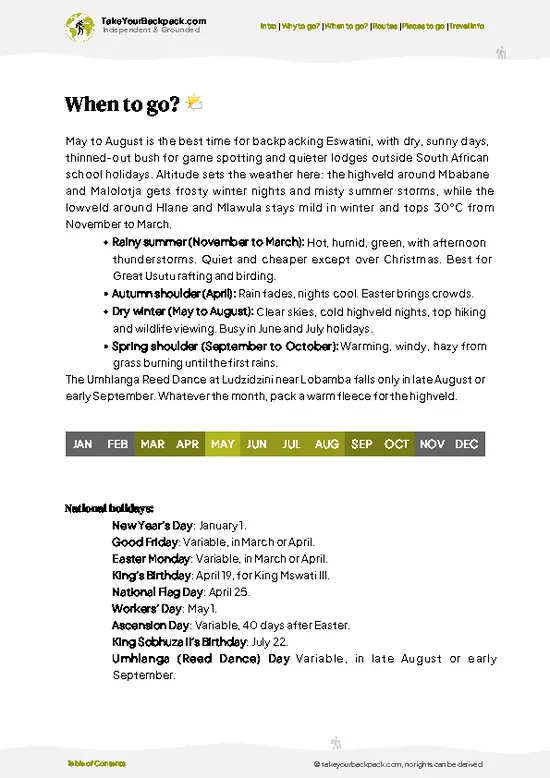
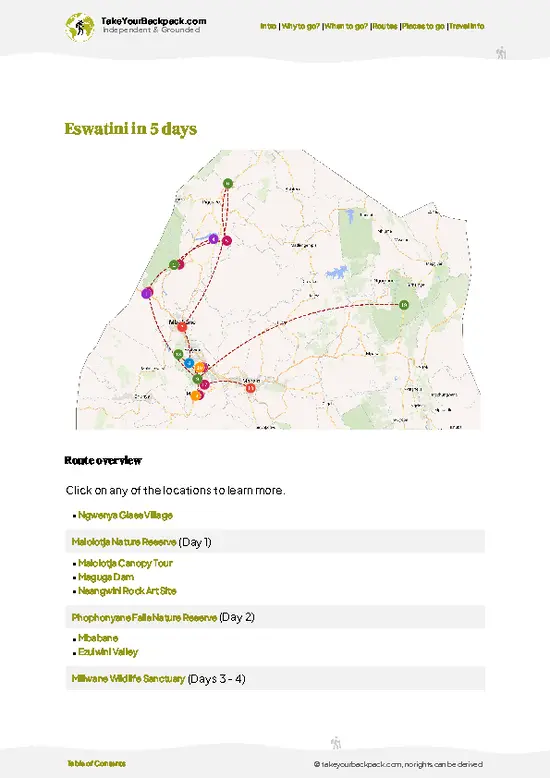
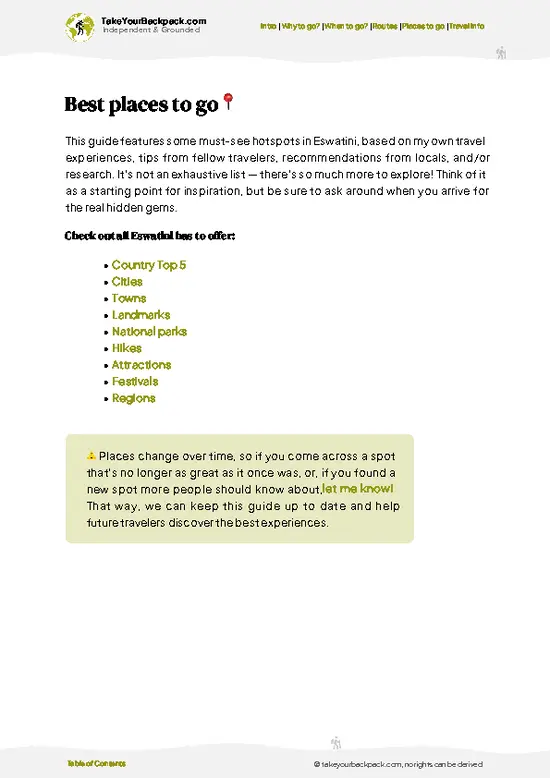
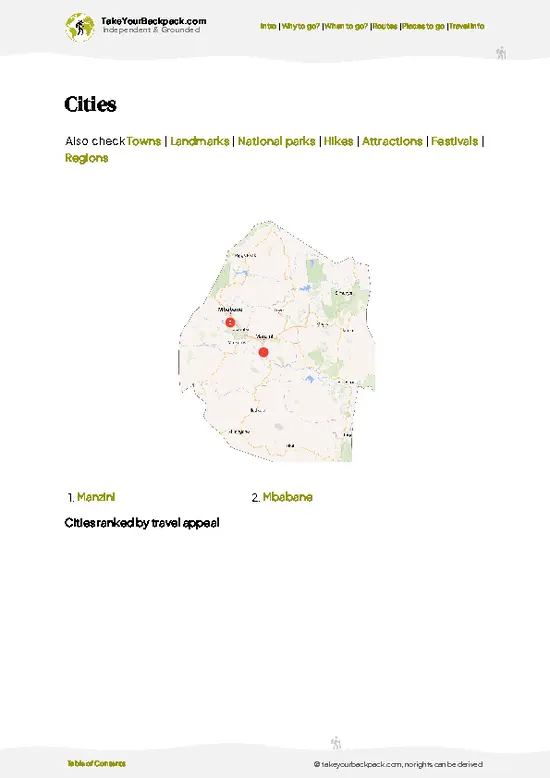
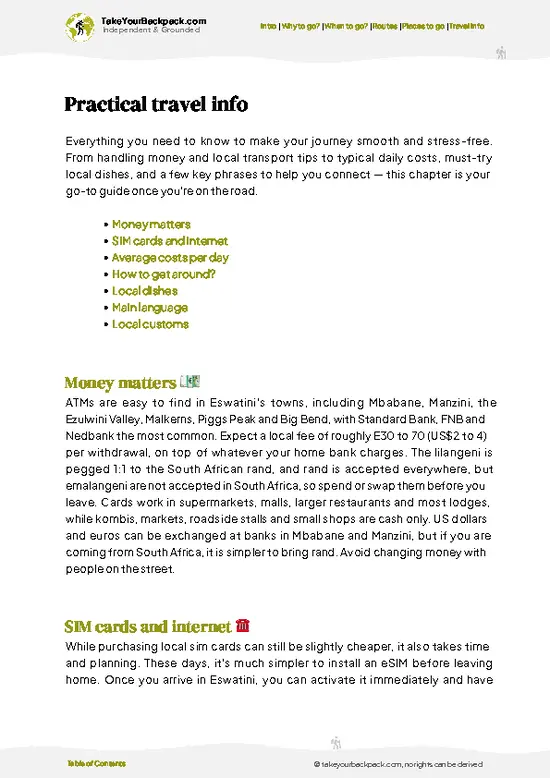
example page 0 from our offline Travel Guide for Eswatini
example page 1 from our offline Travel Guide for Eswatini
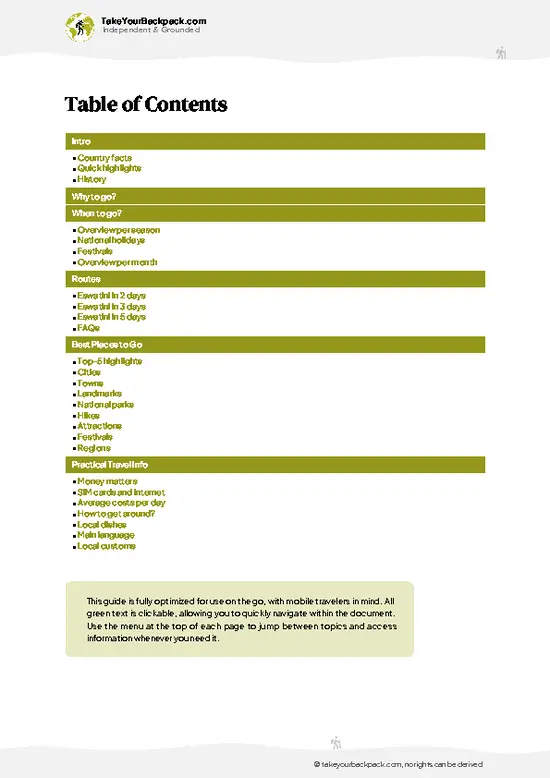
example page 2 from our offline Travel Guide for Eswatini
example page 3 from our offline Travel Guide for Eswatini
example page 4 from our offline Travel Guide for Eswatini
example page 5 from our offline Travel Guide for Eswatini
example page 6 from our offline Travel Guide for Eswatini
example page 7 from our offline Travel Guide for Eswatini
Loading the map 🌍
CLICK TO FILTER
cities
towns
landmarks
national parks
hikes
attractions
festivals
regions
SHOW COUNTRY’S BESTSHOW ALL

✨ Why go?
Ranked #5 national park in Eswatini
What sets this place apart

Mbuluzi Game Reserve suits backpackers who would rather plan their own day than follow a guide’s script. The reserve is compact, and its network of gravel tracks lets you drive slowly, stop where an animal stands and stay as long as you like. Walking is allowed in much of the bush, which is rare in African reserves and gives you the smell of crushed sage and a close look at tracks in the sand. The riverside section along the Mbuluzi River concentrates hippos, crocodiles and a long list of waterbirds into a short stretch. Because the reserve is small and quiet, even a first-timer can find their bearings in an hour. It also sits beside the Lubombo Conservancy parks, so you can combine several reserves on one trip without paying for a tour.

💡 HighlightsPlaces and moments you shouldn't skip

  1. Mbuluzi River pools: The river is the reserve’s center of activity, with hippos wallowing in the deeper pools and crocodiles on the sandbanks. Kingfishers and herons work the edges.
  2. Plains game on the main tracks: Zebra, wildebeest, impala and giraffe graze the open bushveld along the gravel roads. Early morning gives the best light and the most movement.
  3. Bush walks: Walking among nyala, kudu and warthog puts you at eye level with the animals. Tracks, dung and birdsong fill in the details a car window hides.
  4. Birdwatching: Over 300 species are recorded across the reserve, from African fish eagles to bee-eaters and hornbills. The riverside thickets are the most productive.
  5. Lowveld acacia and mopane bush: The thornveld has a distinct look, with flat-topped trees, red soil and termite mounds. It is
… read more 👉
  1. Mbuluzi River pools: The river is the reserve’s center of activity, with hippos wallowing in the deeper pools and crocodiles on the sandbanks. Kingfishers and herons work the edges.
  2. Plains game on the main tracks: Zebra, wildebeest, impala and giraffe graze the open bushveld along the gravel roads. Early morning gives the best light and the most movement.
  3. Bush walks: Walking among nyala, kudu and warthog puts you at eye level with the animals. Tracks, dung and birdsong fill in the details a car window hides.
  4. Birdwatching: Over 300 species are recorded across the reserve, from African fish eagles to bee-eaters and hornbills. The riverside thickets are the most productive.
  5. Lowveld acacia and mopane bush: The thornveld has a distinct look, with flat-topped trees, red soil and termite mounds. It is a reminder that this is dry, working country.
  6. Night sounds at the camps: After dark the bush fills with hippo grunts, nightjars and the occasional hyena call. You hear far more than you see.
  7. Lubombo range backdrop: The ridge on the eastern skyline frames the reserve and shifts from grey-green to dark blue as the day ends.
Mbuluzi Game Reserve pairs best when you do a dawn drive along the plains tracks and spend the heat of midday birding at the river pools.
Spotted a mistake or missing something? Contact us.

🌤️ When to go?Seasonal considerations and timing

  • Winter (May to August): Dry, sunny days of 20 to 25°C (68 to 77°F) and cold nights that can fall to 3 to 8°C (37 to 46°F). The bush thins out, so animals show up at waterholes, and walking and mountain biking are comfortable. Daylight runs about 11 hours.
  • Spring (September to November): Warming to 25 to 32°C (77 to 90°F), with the first storms late in the season. Birds are active and fresh growth draws grazers into the open.
  • Summer (December to February): Hot and humid at 28 to 35°C (82 to 95°F), with afternoon thunderstorms and about 14 hours of daylight. Ticks and mosquitoes are worst, but bird life peaks and rooms are the cheapest.
  • Autumn (March to April): Mild at 22 to 28°C (72 to 82°F), the rain easing and the grass still tall.
Crowds stay light all year, with school holidays and long weekends … read more 👉
  • Winter (May to August): Dry, sunny days of 20 to 25°C (68 to 77°F) and cold nights that can fall to 3 to 8°C (37 to 46°F). The bush thins out, so animals show up at waterholes, and walking and mountain biking are comfortable. Daylight runs about 11 hours.
  • Spring (September to November): Warming to 25 to 32°C (77 to 90°F), with the first storms late in the season. Birds are active and fresh growth draws grazers into the open.
  • Summer (December to February): Hot and humid at 28 to 35°C (82 to 95°F), with afternoon thunderstorms and about 14 hours of daylight. Ticks and mosquitoes are worst, but bird life peaks and rooms are the cheapest.
  • Autumn (March to April): Mild at 22 to 28°C (72 to 82°F), the rain easing and the grass still tall.
Crowds stay light all year, with school holidays and long weekends the only busy spells. Book winter weekends ahead and go midweek for the quietest trails.


source: climatestotravel.comJANJanuary: fair for travelingFEBFebruary: fair for travelingMARMarch: fair for travelingAPRApril: fair for travelingMAYMay: highly recommended for travelingJUNJune: excellent for travelingJULJuly: excellent for travelingAUGAugust: excellent for travelingSEPSeptember: highly recommended for travelingOCTOctober: fair for travelingNOVNovember: fair for travelingDECDecember: fair for traveling
when-to-go

✈️ The backpacker research shortcutEswatini Travel Guide

An offline-friendly backpacking guide with optimized travel routes, ranked highlights, transport advice, and the best areas to stay.
example page 0 from our offline Travel Guide for Eswatini
example page 1 from our offline Travel Guide for Eswatini
example page 2 from our offline Travel Guide for Eswatini
example page 3 from our offline Travel Guide for Eswatini
example page 4 from our offline Travel Guide for Eswatini
example page 5 from our offline Travel Guide for Eswatini
example page 6 from our offline Travel Guide for Eswatini
example page 7 from our offline Travel Guide for Eswatini
The digital guide (151 pages) contains:
✅ 33 highlights, ranked by travel appeal
✅ Optimized 2, 3 & 5-day travel routes
✅ Cities, national parks, landmarks, beaches
✅ How to get around
✅ Offline-friendly for travel without Wi-Fi
👉 Click to see all 30+ guide features

📅 Plan smarter in minutes, not weeks
✅ Month by month travel advice
✅ Festivals & national holidays
✅ Budget expectations

🗺️ Go to the right places, skip the overrated ones
✅ Honest pros & cons of destinations
✅ Top hikes, parks & viewpoints
✅ Lesser-known places most travelers miss
✅ Clear “worth it vs skip it” guidance

🛏️ Travel smoothly without rookie mistakes
✅ Best areas to stay
✅ Transport systems explained simply
✅ Common scams & safety advice
✅ SIM cards, money & practical tips

🌍 Understand the country, not just visit it
✅ Culture & traditions
✅ 52 Essential phrases & customs
✅ Festivals worth planning around
✅ Traveler-friendly historical context
✅ Insights that make places more meaningful

📱 Built for real travel conditions
✅ Fully downloadable PDF
✅ Works completely offline
✅ Optimized for phone use
✅ Useful in remote areas & buses
✅ Everything in one place
Stop searching, start planning
Get instant access to your full guide. 30‑day money-back guarantee.
+ Add another guide for just

By proceeding you agree to our terms.
Sent to your inbox immediately after payment • 100% Secure Checkout
Best Backpacking Travel Advisor 2025 tourism awardBest Backpacking
Travel Advisor
2025
What others say about Take Your Backpack Guides:
⭐⭐⭐⭐⭐
Fantastic, amazing amount of information!
⭐⭐⭐⭐⭐
My goodness this is amazing, it's what I've been looking for hats off too you!
⭐⭐⭐⭐⭐
I think this is absolutely BRILLIANT
⭐⭐⭐⭐
Very complete and informative. It's still missing places, but I gotta to commend you
⭐⭐⭐⭐⭐
This is truly amazing, thank you, can't wait to explore it with my kids!
⭐⭐⭐⭐⭐
Awesome resource, thank you!
⭐⭐⭐⭐⭐
This is amazing! Can't wait to explore the ones I haven't seen
⭐⭐⭐⭐
I love this! Well done, great idea.
⭐⭐⭐⭐⭐
Thanks for taking the time to make this gem!
⭐⭐⭐⭐⭐
This might be the best website I've ever seen.
⭐⭐⭐⭐⭐
Congratulations, and thank you so much for your work; it's incredibly valuable.
⭐⭐⭐⭐
In all seriousness I think you did a great job pointing out the important spots
⭐⭐⭐⭐⭐
10/10 very good
⭐⭐⭐⭐⭐
As someone who's only just starting to visit regularly this is awesome, thank you.
⭐⭐⭐⭐
Thank you very much! I'm going to visit my dad, it's going to be very useful!
⭐⭐⭐⭐⭐
This is really cool! We'll be travelling for the first time and this definitely come in handy.
⭐⭐⭐⭐⭐
You are now our minister of culture, congratulations 👨‍💼
⭐⭐⭐⭐⭐
Just wanted to tell you that this is a pearl! Going to follow your recommendations.
⭐⭐⭐⭐⭐
This is so cool. I'll definitely be using the resource for my travels soon.
⭐⭐⭐⭐⭐
This is very impressive! Good work.
⭐⭐⭐⭐⭐
This is an amazing and informative site. Very well done!

🛏️ Where to stay?Choosing the right base

Mbuluzi Game Reserve has its own places to sleep, so you can wake up among zebra and impala. Inside the reserve, the Mbuluzi Bush Lodge and a few self-catering bush camps and rustic cottages sit along the Mbuluzi River. A small campsite is also available for those with tents, though facilities are basic. Bring your own food for the self-catering options, and stock up beforehand because there is no shop on site. Rates run roughly US$30 to 90 per person depending on style.
Outside the gate, the nearest base is Simunye, a small sugar-estate town about 15 minutes away with limited guesthouses and a … read more 👉
Mbuluzi Game Reserve has its own places to sleep, so you can wake up among zebra and impala. Inside the reserve, the Mbuluzi Bush Lodge and a few self-catering bush camps and rustic cottages sit along the Mbuluzi River. A small campsite is also available for those with tents, though facilities are basic. Bring your own food for the self-catering options, and stock up beforehand because there is no shop on site. Rates run roughly US$30 to 90 per person depending on style.
Outside the gate, the nearest base is Simunye, a small sugar-estate town about 15 minutes away with limited guesthouses and a few restaurants. Siteki, roughly 30 to 40 minutes by road, has simple guesthouses from about US$25 to 45 and local eateries. For more choice, Manzini is about an hour away and has hostels, budget hotels and shops from US$20 to 50. Mbabane and the Ezulwini Valley are farther, with backpacker hostels, craft markets and a wider range of food. Because public transport to the gate is thin, most backpackers pick one of the inside lodgings and arrange a lift from a nearby town.

👛 Costs (as of 22 October 2026)Money, prices, and spending tips

A day at Mbuluzi Game Reserve costs about US$65 to 140 for a backpacker who camps or uses a simple lodge and self-caters.
CategoryBudget RangeLocal Reality
Entrance feeUS$5 to 10A small per-person day fee at the gate, with extra for each vehicle.
Accommodation (high season)US$30 to 60Camping is the cheapest option, with self-catering cottages and bush lodge rooms costing more.
Accommodation (low season)US$25 to 50Summer rates drop slightly, and midweek stays are often cheaper.
Local transportUS$10 to 25Minibuses run to Simunye or Siteki, but you will need a private lift or hired car for the last stretch.
Food and suppliesUS$10 to 20Buy groceries in Manzini or Siteki before arrival because the reserve has no shop.
ActivitiesUS$10 to 25Guided drives, bush walks and mountain biking are priced separately,
… read more 👉
A day at Mbuluzi Game Reserve costs about US$65 to 140 for a backpacker who camps or uses a simple lodge and self-caters.
CategoryBudget RangeLocal Reality
Entrance feeUS$5 to 10A small per-person day fee at the gate, with extra for each vehicle.
Accommodation (high season)US$30 to 60Camping is the cheapest option, with self-catering cottages and bush lodge rooms costing more.
Accommodation (low season)US$25 to 50Summer rates drop slightly, and midweek stays are often cheaper.
Local transportUS$10 to 25Minibuses run to Simunye or Siteki, but you will need a private lift or hired car for the last stretch.
Food and suppliesUS$10 to 20Buy groceries in Manzini or Siteki before arrival because the reserve has no shop.
ActivitiesUS$10 to 25Guided drives, bush walks and mountain biking are priced separately, while many walks are free.
Total Daily BudgetUS$65 to 140Roughly US$100 for a typical day with camping, supplies and one activity.
⚠️ Prices can change and everyone travels differently, so take this as a rough guide. Hope it helps you plan your adventure!

🥾 TrailsTrail guide for Mbuluzi Game Reserve national park

Mbuluzi Game Reserve has no famous long-distance trail, and that suits its character. The walks people do start at the camps or at pull-outs along the gravel tracks, and you choose your own length. Terrain is mostly flat to gently rolling, so fitness is rarely an issue.
  • River walk: Follow the Mbuluzi River bank from the camp area for a short, easy stroll of about 1 to 2 hours. You pass hippo pools, reed beds and good birding, and the footing is sandy in places.
  • Bushveld loops: Link the gravel tracks into loops of roughly 3 to 6 kilometers (2 to 4 miles). Allow 1.5 to 3 hours. The terrain is open
… read more 👉
Mbuluzi Game Reserve has no famous long-distance trail, and that suits its character. The walks people do start at the camps or at pull-outs along the gravel tracks, and you choose your own length. Terrain is mostly flat to gently rolling, so fitness is rarely an issue.
  • River walk: Follow the Mbuluzi River bank from the camp area for a short, easy stroll of about 1 to 2 hours. You pass hippo pools, reed beds and good birding, and the footing is sandy in places.
  • Bushveld loops: Link the gravel tracks into loops of roughly 3 to 6 kilometers (2 to 4 miles). Allow 1.5 to 3 hours. The terrain is open acacia and mopane with grassy flats, and you will likely see zebra, impala and wildebeest.
  • Drive and stop: Self-driving the tracks and getting out at viewpoints is the most popular way to cover the reserve. It is easy to do in half a day.
  • Wildlife: Giraffe, nyala, kudu, warthog, hippo and crocodile are the regulars. Keep your distance from hippos and stay away from the river edge at dusk.
  • Difficulty: Easy overall. The main hazards are heat, ticks and sun, so carry plenty of water and a hat.
Getting to Mbuluzi Game Reserve by public transport is difficult. Buses and minibuses run along the main road nearby, but the final stretch to the gate usually needs a lift or a pre-arranged pickup, so having your own vehicle makes everything simpler. The reserve is rarely crowded, and you may have long stretches of track to yourself. There is a modest entrance fee payable at the gate, and walking is best done in the cooler hours of early morning.
⚠️ Hiking info can sometimes be outdated or inaccurate. Before you hit the trail, check the latest conditions with locals. If you do spot anything that's off, I'd love to hear from you, so I can update it for fellow travelers.

🛡️ SafetyTraveler Safety Guide

Mbuluzi Game Reserve is a small, well-managed private reserve, and most visits are straightforward. The animals are mostly zebra, giraffe, wildebeest, impala and warthog, with hippos and crocodiles in the river, so keep your distance from the water and never swim. Hippos can leave the river at night, so carry a torch and stay near your accommodation after dark. Walking is allowed on marked routes, and the terrain is gentle, with sandy tracks and thornveld that can be rough on shoes. Summer afternoons are hot and humid and storms can flood low crossings, so start early and carry more water than you think you need, at least 2 to 3 liters per person. Ticks are common in long grass, so wear long socks and check yourself in the evening. Malaria is present in the lowveld in summer, so ask a travel … read more 👉
Mbuluzi Game Reserve is a small, well-managed private reserve, and most visits are straightforward. The animals are mostly zebra, giraffe, wildebeest, impala and warthog, with hippos and crocodiles in the river, so keep your distance from the water and never swim. Hippos can leave the river at night, so carry a torch and stay near your accommodation after dark. Walking is allowed on marked routes, and the terrain is gentle, with sandy tracks and thornveld that can be rough on shoes. Summer afternoons are hot and humid and storms can flood low crossings, so start early and carry more water than you think you need, at least 2 to 3 liters per person. Ticks are common in long grass, so wear long socks and check yourself in the evening. Malaria is present in the lowveld in summer, so ask a travel clinic about prophylaxis. Tell reception your route and keep to the paths.

FAQTraveler FAQ

Two days with one night inside is enough for Mbuluzi Game Reserve. That gives you an afternoon game drive or bush walk and a full morning when the animals are most active. Add a third day if you want to mountain bike or combine it with nearby Hlane Royal National Park, about 30 to 40 minutes away.
Mbuluzi Game Reserve is hard to reach without a car, but not impossible. Minibuses run from Manzini to Simunye or Siteki in roughly one to one and a half hours, and you then need a pre-arranged transfer or taxi for the last few kilometers. Staying inside means you can explore on foot or by bike, and the lodge can organize guided drives.
Mbuluzi Game Reserve charges a small daily entrance fee, roughly US$5 to 10 per person, plus a vehicle fee if you drive in. No separate permit is needed for walking on the marked routes, and overnight guests usually pay entry as part of their booking. You pay in emalangeni at the gate, so bring cash because card machines can be unreliable.
⚠️ Things can change over time, so always validate details locally before you go.

Other Swazi national parks near Mbuluzi Game Reserve

Explore more nearby:


💡 Not sure where to go next?
Create a personalized itinerary for Eswatini including Mbuluzi Game Reserve and the places that fit your trip.

Generate my itinerary

👉 Discover all national parks

Or checkout all Eswatini has to offer (think cities, towns, villages, national parks, hikes, beaches, festivals)
Country photo of Eswatini

We 💚 feedbackIs it worth it?

Mbuluzi Game Reserve is easy to treat as an add-on to its bigger neighbors, but the river stretch rewards the most attention. I would bring binoculars and sit by the water for an hour instead of ticking off animals. The bird life there is the real surprise, and the cooler early hours make it better.

✍️ Help improve this page!
The information on this page is based on in-depth research, insights shared by experienced travelers, and feedback from the local travel community in Eswatini. While every effort is made to keep the information accurate and current, conditions can change — so if you spot anything incorrect or outdated, please get in touch.


🙋‍♂️ Give feedback

👋 Meet the founderWho’s Behind Take Your Backpack?

Johan, backpacker and founder of TakeYourBackpackHi, I’m Johan (Netherlands 🇳🇱), the creator of TakeYourBackpack. Over the past 3 decades, I’ve backpacked through 90+ countries across six continents, gaining extensive experience with independent travel, long-term trips, and overland routes.

This site is built on a combination of firsthand travel experience and carefully curated insights from other backpackers. Many guides are based on places I’ve personally visited, while others bring together tips, observations, and practical advice shared by trusted travelers I’ve met along the way.

The goal is to provide realistic, experience-driven guidance — not generic itineraries — so you can explore destinations with better context, clearer expectations, and more confidence.