×

Eswatini🇸🇿 | national parksMkhaya Game ReserveBlack rhino, sable and roan, Stone Camp, guided only | things to do and best time to go

Explore Mantenga Nature ReserveExplore Mlawula Nature Reserve

Backpacking in Mkhaya Game Reserve
🌟 Highlightnational park ranked #3
By Johan Kruseman 🇳🇱 | Updated October 22, 2026

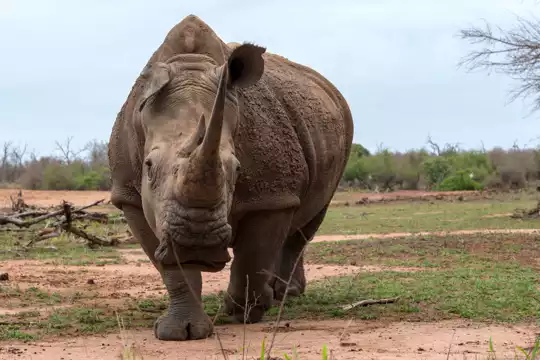
Mkhaya Game Reserve lets you see white and black rhino on foot or from an open vehicle with a guide, which is rare in southern Africa at this price level of access. It lies in the southeast of Eswatini, in the lowveld near Phuzumoya, on sandy bushveld and acacia thornveld along the Mkhaya river system. Game drives run along sandy tracks where rhino, buffalo, giraffe, sable and roan antelope step out of the scrub, and you finish with a clear sense of how close a two-ton animal can stand. Guided walks add the smell of crushed leaves and the sound of hornbills. The reserve is small and fenced, so the wild feel is managed, and the camp is rustic, quiet and without phone signal in places. Crowds are thin because numbers are limited. The one practical thing to know before going: visits are by pre-booked guided activity only, and you are collected from the entrance at Phuzumoya station, not driven in yourself.

Discover everything you want to know in the 📖 Eswatini Travel Guide.


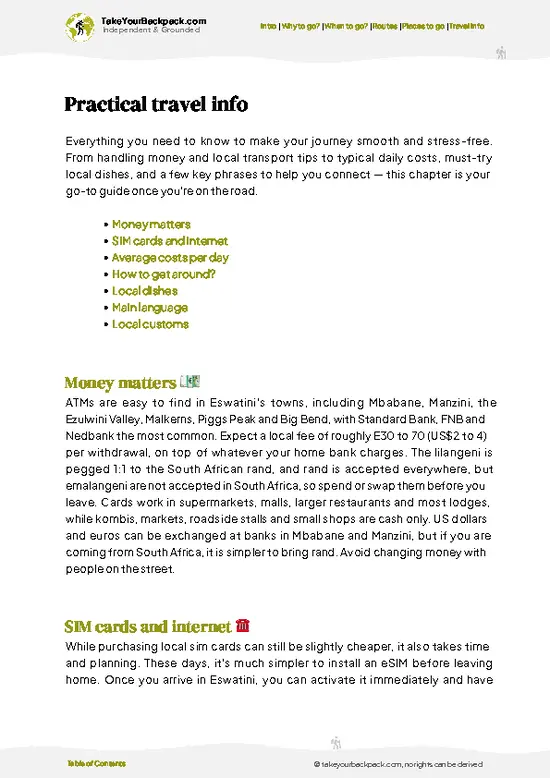
example page 0 from our offline Travel Guide for Eswatini
example page 1 from our offline Travel Guide for Eswatini
example page 2 from our offline Travel Guide for Eswatini
example page 3 from our offline Travel Guide for Eswatini
example page 4 from our offline Travel Guide for Eswatini
example page 5 from our offline Travel Guide for Eswatini
example page 6 from our offline Travel Guide for Eswatini
example page 7 from our offline Travel Guide for Eswatini
Loading the map 🌍
CLICK TO FILTER
cities
towns
landmarks
national parks
hikes
attractions
festivals
regions
SHOW COUNTRY’S BESTSHOW ALL

✨ Why go?
Ranked #3 national park in Eswatini
What makes it a must-see national park

Mkhaya Game Reserve suits backpackers who want serious wildlife without a safari-company price tag or a tour bus schedule. Most of what you do is led by a ranger, but you arrange it yourself, turn up with a small pack and join other independent travelers at the camp. The reserve is known for its black rhino population, one of the best places in southern Africa to see them, along with white rhino, and Stone Camp gives you a bush stay with open-air dining and no fences between you and the night sounds. That setting is the main draw: shared tables, a low-key group, and guides who talk about tracking, tree species and anti-poaching work for hours. Self-drive is not allowed inside, so independence here means choosing your own dates, your own route to the entrance and how much you add on, such as … read more 👉
Mkhaya Game Reserve suits backpackers who want serious wildlife without a safari-company price tag or a tour bus schedule. Most of what you do is led by a ranger, but you arrange it yourself, turn up with a small pack and join other independent travelers at the camp. The reserve is known for its black rhino population, one of the best places in southern Africa to see them, along with white rhino, and Stone Camp gives you a bush stay with open-air dining and no fences between you and the night sounds. That setting is the main draw: shared tables, a low-key group, and guides who talk about tracking, tree species and anti-poaching work for hours. Self-drive is not allowed inside, so independence here means choosing your own dates, your own route to the entrance and how much you add on, such as walks or a river-edge sundowner. If you want a trail you can wander alone, look at other parks. If you want close encounters and good conversation, this is a strong pick.

💡 HighlightsDon't-miss highlights and experiences

  1. Black rhino viewing: Mkhaya is best known for its black rhino, a shy, hooked-lipped browser that is hard to find elsewhere. Guides track them on foot or by open vehicle, often within a short distance of the animal.
  2. White rhino on foot: Walking with a ranger toward a grazing white rhino, wind in your face, is a slow and tense experience that no vehicle can match.
  3. Open-vehicle game drives: Sandy tracks pass giraffe, zebra, wildebeest, buffalo and warthog. Morning and late afternoon drives are the most active.
  4. Sable and roan antelope: Mkhaya holds rare antelope, including sable and roan, and the long curved horns of a sable bull in the thornveld are worth the early start.
  5. Stone Camp: The bush camp itself is a sight. Stone-and-thatch cottages sit in the trees, with open-sided dining and animals passing
… read more 👉
  1. Black rhino viewing: Mkhaya is best known for its black rhino, a shy, hooked-lipped browser that is hard to find elsewhere. Guides track them on foot or by open vehicle, often within a short distance of the animal.
  2. White rhino on foot: Walking with a ranger toward a grazing white rhino, wind in your face, is a slow and tense experience that no vehicle can match.
  3. Open-vehicle game drives: Sandy tracks pass giraffe, zebra, wildebeest, buffalo and warthog. Morning and late afternoon drives are the most active.
  4. Sable and roan antelope: Mkhaya holds rare antelope, including sable and roan, and the long curved horns of a sable bull in the thornveld are worth the early start.
  5. Stone Camp: The bush camp itself is a sight. Stone-and-thatch cottages sit in the trees, with open-sided dining and animals passing nearby after dark.
  6. Birdwatching along the Mkhaya river: Riverine woodland draws hornbills, bee-eaters, fish eagles and many smaller species, so a pair of binoculars pays off.
  7. Nguni cattle at the reserve: The reserve keeps Nguni cattle, the traditional breed with mottled coats, a reminder of the farming heritage around the park.
For a first visit, join a rhino tracking drive and walk, since it is the reason Mkhaya Game Reserve exists and it delivers the closest encounter.
Spotted a mistake or missing something? Contact us.

🌤️ When to go?Weather, crowds, and seasonal trade-offs

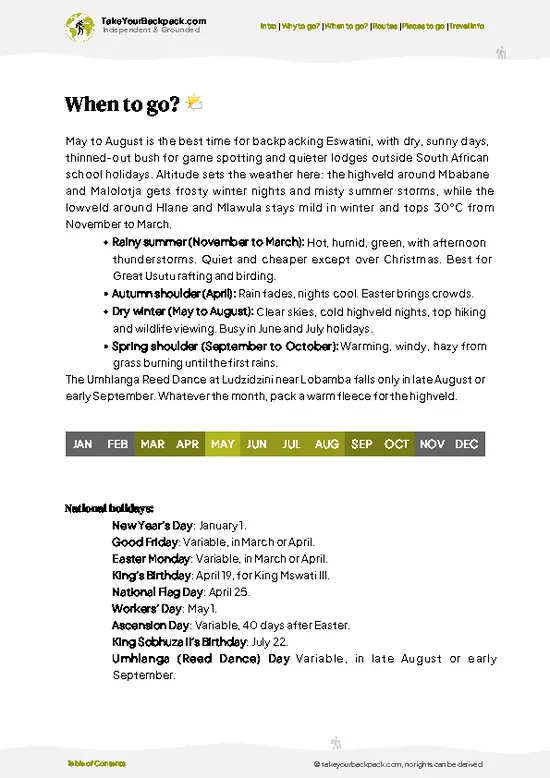
  • Dry Winter (May to August): Mkhaya’s best game viewing runs here, because thin bush and shrinking waterholes put rhino, buffalo and sable in the open. Days reach 22 to 26°C (72 to 79°F), nights drop to 6 to 10°C (43 to 50°F), and daylight is roughly 11 hours.
  • Spring (September to October): Warming days of 26 to 32°C (79 to 90°F) and fewer visitors than July. First rains can green the bush by late October.
  • Wet Summer (November to March): Hot and humid, 30 to 36°C (86 to 97°F), with afternoon thunderstorms and about 14 hours of light. Birding peaks with migrants, and lodge rates are usually lowest.
  • Autumn (April): Warm days around 25 to 29°C (77 to 84°F), settled weather and thinning crowds.
  • Holidays: South African school breaks (July, late December) fill the few lodges and lift prices.
Book the … read more 👉
  • Dry Winter (May to August): Mkhaya’s best game viewing runs here, because thin bush and shrinking waterholes put rhino, buffalo and sable in the open. Days reach 22 to 26°C (72 to 79°F), nights drop to 6 to 10°C (43 to 50°F), and daylight is roughly 11 hours.
  • Spring (September to October): Warming days of 26 to 32°C (79 to 90°F) and fewer visitors than July. First rains can green the bush by late October.
  • Wet Summer (November to March): Hot and humid, 30 to 36°C (86 to 97°F), with afternoon thunderstorms and about 14 hours of light. Birding peaks with migrants, and lodge rates are usually lowest.
  • Autumn (April): Warm days around 25 to 29°C (77 to 84°F), settled weather and thinning crowds.
  • Holidays: South African school breaks (July, late December) fill the few lodges and lift prices.
Book the limited camps well ahead for June to August, and ask for the early game drive when the animals are most active.


source: climatestotravel.comJANJanuary: fair for travelingFEBFebruary: fair for travelingMARMarch: fair for travelingAPRApril: fair for travelingMAYMay: highly recommended for travelingJUNJune: excellent for travelingJULJuly: excellent for travelingAUGAugust: excellent for travelingSEPSeptember: highly recommended for travelingOCTOctober: fair for travelingNOVNovember: fair for travelingDECDecember: fair for traveling
when-to-go

✈️ The backpacker research shortcutEswatini Travel Guide

An offline-friendly backpacking guide with optimized travel routes, ranked highlights, transport advice, and the best areas to stay.
example page 0 from our offline Travel Guide for Eswatini
example page 1 from our offline Travel Guide for Eswatini
example page 2 from our offline Travel Guide for Eswatini
example page 3 from our offline Travel Guide for Eswatini
example page 4 from our offline Travel Guide for Eswatini
example page 5 from our offline Travel Guide for Eswatini
example page 6 from our offline Travel Guide for Eswatini
example page 7 from our offline Travel Guide for Eswatini
The digital guide (151 pages) contains:
✅ 33 highlights, ranked by travel appeal
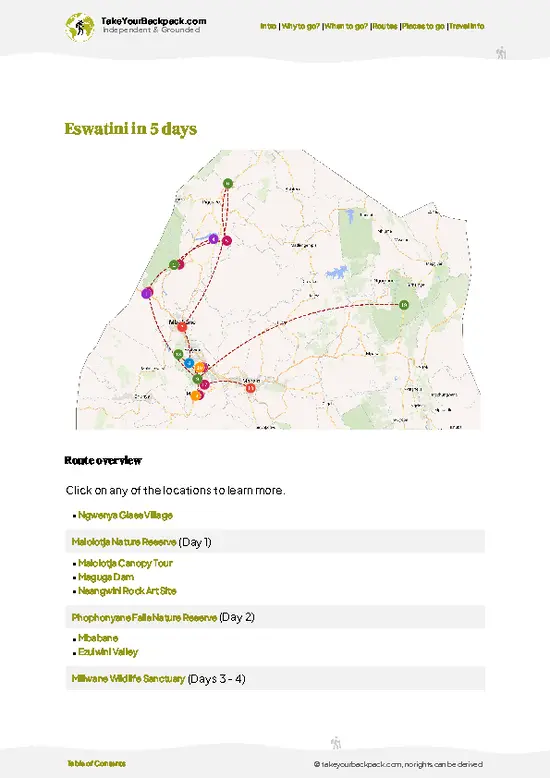
✅ Optimized 2, 3 & 5-day travel routes
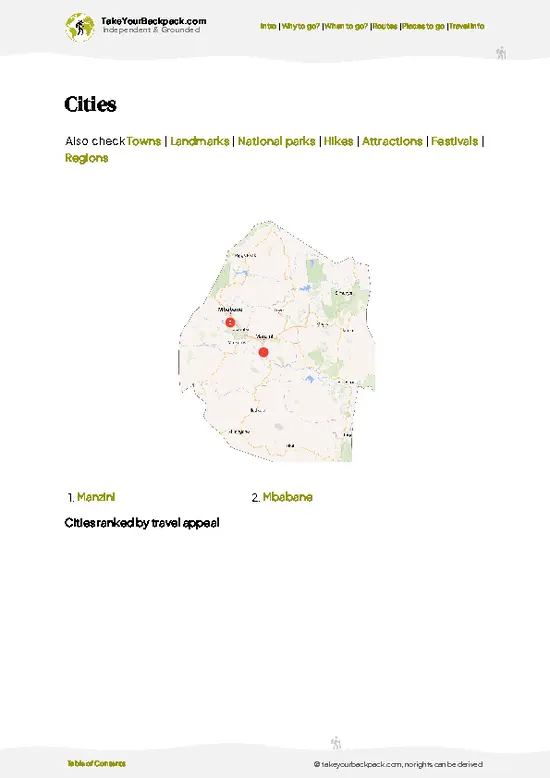
✅ Cities, national parks, landmarks, beaches
✅ How to get around
✅ Offline-friendly for travel without Wi-Fi
👉 Click to see all 30+ guide features

📅 Plan smarter in minutes, not weeks
✅ Month by month travel advice
✅ Festivals & national holidays
✅ Budget expectations

🗺️ Go to the right places, skip the overrated ones
✅ Honest pros & cons of destinations
✅ Top hikes, parks & viewpoints
✅ Lesser-known places most travelers miss
✅ Clear “worth it vs skip it” guidance

🛏️ Travel smoothly without rookie mistakes
✅ Best areas to stay
✅ Transport systems explained simply
✅ Common scams & safety advice
✅ SIM cards, money & practical tips

🌍 Understand the country, not just visit it
✅ Culture & traditions
✅ 52 Essential phrases & customs
✅ Festivals worth planning around
✅ Traveler-friendly historical context
✅ Insights that make places more meaningful

📱 Built for real travel conditions
✅ Fully downloadable PDF
✅ Works completely offline
✅ Optimized for phone use
✅ Useful in remote areas & buses
✅ Everything in one place
Stop searching, start planning
Get instant access to your full guide. 30‑day money-back guarantee.
+ Add another guide for just

By proceeding you agree to our terms.
Sent to your inbox immediately after payment • 100% Secure Checkout
Best Backpacking Travel Advisor 2025 tourism awardBest Backpacking
Travel Advisor
2025
What others say about Take Your Backpack Guides:
⭐⭐⭐⭐⭐
Fantastic, amazing amount of information!
⭐⭐⭐⭐⭐
My goodness this is amazing, it's what I've been looking for hats off too you!
⭐⭐⭐⭐⭐
I think this is absolutely BRILLIANT
⭐⭐⭐⭐
Very complete and informative. It's still missing places, but I gotta to commend you
⭐⭐⭐⭐⭐
This is truly amazing, thank you, can't wait to explore it with my kids!
⭐⭐⭐⭐⭐
Awesome resource, thank you!
⭐⭐⭐⭐⭐
This is amazing! Can't wait to explore the ones I haven't seen
⭐⭐⭐⭐
I love this! Well done, great idea.
⭐⭐⭐⭐⭐
Thanks for taking the time to make this gem!
⭐⭐⭐⭐⭐
This might be the best website I've ever seen.
⭐⭐⭐⭐⭐
Congratulations, and thank you so much for your work; it's incredibly valuable.
⭐⭐⭐⭐
In all seriousness I think you did a great job pointing out the important spots
⭐⭐⭐⭐⭐
10/10 very good
⭐⭐⭐⭐⭐
As someone who's only just starting to visit regularly this is awesome, thank you.
⭐⭐⭐⭐
Thank you very much! I'm going to visit my dad, it's going to be very useful!
⭐⭐⭐⭐⭐
This is really cool! We'll be travelling for the first time and this definitely come in handy.
⭐⭐⭐⭐⭐
You are now our minister of culture, congratulations 👨‍💼
⭐⭐⭐⭐⭐
Just wanted to tell you that this is a pearl! Going to follow your recommendations.
⭐⭐⭐⭐⭐
This is so cool. I'll definitely be using the resource for my travels soon.
⭐⭐⭐⭐⭐
This is very impressive! Good work.
⭐⭐⭐⭐⭐
This is an amazing and informative site. Very well done!

🛏️ Where to stay?Best areas and accommodation options

The only places to sleep at Mkhaya Game Reserve are the two camps run by Big Game Parks, so booking ahead is the real plan.
Stone Camp is the signature stay: a small, rustic camp of thatched stone cottages and open-sided bathrooms, lit by paraffin lamps with no electricity. Rates are fully inclusive of meals and game drives, and sit in the luxury bracket, around US$300 to 400 per person. Mkhaya also has a basic Reed Valley style bush camp for small groups, but check availability first, since it is not always open to individual travelers.
Truly budget backpackers do better outside the gate. Phuzumoya, … read more 👉
The only places to sleep at Mkhaya Game Reserve are the two camps run by Big Game Parks, so booking ahead is the real plan.
Stone Camp is the signature stay: a small, rustic camp of thatched stone cottages and open-sided bathrooms, lit by paraffin lamps with no electricity. Rates are fully inclusive of meals and game drives, and sit in the luxury bracket, around US$300 to 400 per person. Mkhaya also has a basic Reed Valley style bush camp for small groups, but check availability first, since it is not always open to individual travelers.
Truly budget backpackers do better outside the gate. Phuzumoya, Mlilwane Wildlife Sanctuary near Mbabane, is the usual hub: rest camp huts, a backpacker-friendly campsite and dorm-style beds from about US$15 to 40. The towns of Manzini and Matsapha have guesthouses at US$40 to 70 and the best transport links. Siteki and Big Bend, closer to Mkhaya, offer simple lodgings at US$30 to 60.
Most backpackers take a day visit from Manzini or Mlilwane. Arrange pickup in advance, because public transport does not reach the reserve entrance directly.

👛 Costs (as of 22 October 2026)Typical daily expenses

A visit to Mkhaya Game Reserve costs roughly US$105 to 205 per day for a backpacker who joins one guided activity and sleeps outside the reserve, and far more if you stay inside.
CategoryBudget RangeLocal Reality
Entrance and game driveUS$50 to 90Day visits are arranged with Big Game Parks and normally bundle the guided drive or walk.
Accommodation (high season)US$25 to 45Dorm beds or campsites at Mlilwane, or guesthouses in Manzini. Stone Camp inside Mkhaya costs US$300 and up.
Local transportUS$15 to 40Minibuses run between towns for a few dollars, but you need a pre-arranged pickup or a shared transfer for the final leg.
Food and suppliesUS$10 to 20Lunch is often included with day visits. Stock up on snacks and water in Manzini.
Tips and extrasUS$5 to 10Rangers and trackers appreciate small tips.
… read more 👉
A visit to Mkhaya Game Reserve costs roughly US$105 to 205 per day for a backpacker who joins one guided activity and sleeps outside the reserve, and far more if you stay inside.
CategoryBudget RangeLocal Reality
Entrance and game driveUS$50 to 90Day visits are arranged with Big Game Parks and normally bundle the guided drive or walk.
Accommodation (high season)US$25 to 45Dorm beds or campsites at Mlilwane, or guesthouses in Manzini. Stone Camp inside Mkhaya costs US$300 and up.
Local transportUS$15 to 40Minibuses run between towns for a few dollars, but you need a pre-arranged pickup or a shared transfer for the final leg.
Food and suppliesUS$10 to 20Lunch is often included with day visits. Stock up on snacks and water in Manzini.
Tips and extrasUS$5 to 10Rangers and trackers appreciate small tips. Pay in emalangeni or US dollars if accepted, cash preferred.
Total Daily BudgetUS$105 to 205Roughly US$150 on a typical day visit.
⚠️ Prices can change and everyone travels differently, so take this as a rough guide. Hope it helps you plan your adventure!

🥾 TrailsPlan your hike in Mkhaya Game Reserve: routes, terrain, and sights

Mkhaya Game Reserve is organized around guided activities rather than self-guided trails, so hiking means ranger-led bush walks on sandy tracks and game paths through acacia thornveld and riverine woodland. The ground is flat to gently rolling, easy underfoot, and the main challenge is heat in summer.
  • Guided bush walk: Usually two to three hours, easy difficulty. You follow a ranger on foot through thornveld, stopping to read tracks and approach rhino or antelope downwind.
  • Rhino tracking walk: Roughly two to three hours, easy to moderate. Pace is slow, and you may need to stand still or crouch while
… read more 👉
Mkhaya Game Reserve is organized around guided activities rather than self-guided trails, so hiking means ranger-led bush walks on sandy tracks and game paths through acacia thornveld and riverine woodland. The ground is flat to gently rolling, easy underfoot, and the main challenge is heat in summer.
  • Guided bush walk: Usually two to three hours, easy difficulty. You follow a ranger on foot through thornveld, stopping to read tracks and approach rhino or antelope downwind.
  • Rhino tracking walk: Roughly two to three hours, easy to moderate. Pace is slow, and you may need to stand still or crouch while the guide checks the animals' mood.
  • Open vehicle drive: About two to three hours, no effort required. Sandy tracks cover more ground than walking and reach the far side of the reserve.
  • River and woodland walk: A shorter, easy stroll along the river where birdlife is thickest, best at first light.
  • Wildlife: Black and white rhino, buffalo, giraffe, zebra, sable, roan, hippo in the water, plus leopard that you are unlikely to see.
Public transport reaches the nearby road and station area, but the reserve itself is reached by arranged pick-up from the entrance, so confirm with the reserve before you set out. Crowds are very low because visitor numbers are limited and activities are run in small groups. There is an entrance and activity fee, usually handled when you book. Wear neutral clothing, closed shoes, a hat and carry water, as the lowveld is hot and dry for much of the year. Rangers decide the route each day depending on where the animals are, so treat the walks as flexible.
⚠️ Hiking info can sometimes be outdated or inaccurate. Before you hit the trail, check the latest conditions with locals. If you do spot anything that's off, I'd love to hear from you, so I can update it for fellow travelers.

🛡️ SafetyScams, Hazards, and Annoyances

Mkhaya is a well-managed reserve where you are always accompanied by a ranger, so safety is mostly a matter of following instructions.
Game viewing happens by open safari vehicle and on guided walks, which is the only way to see the black and white rhino, buffalo, hippo and crocodile at close range. Stay seated in the vehicle, keep voices low, and do not stand up when elephants or rhino are near. On foot, walk in single file behind the guide and never move toward an animal for a photo.
The lowveld is hot, so carry a liter of water per person, a hat and sunscreen, and wear closed shoes in neutral colors. Mornings can be cold in winter, so pack a fleece for the open vehicle. Ticks and mosquitoes occur in summer, so repellent is useful, and the area is a low malaria risk zone but check current … read more 👉
Mkhaya is a well-managed reserve where you are always accompanied by a ranger, so safety is mostly a matter of following instructions.
Game viewing happens by open safari vehicle and on guided walks, which is the only way to see the black and white rhino, buffalo, hippo and crocodile at close range. Stay seated in the vehicle, keep voices low, and do not stand up when elephants or rhino are near. On foot, walk in single file behind the guide and never move toward an animal for a photo.
The lowveld is hot, so carry a liter of water per person, a hat and sunscreen, and wear closed shoes in neutral colors. Mornings can be cold in winter, so pack a fleece for the open vehicle. Ticks and mosquitoes occur in summer, so repellent is useful, and the area is a low malaria risk zone but check current advice before travel. Do not swim in rivers or dams.

FAQFrequently asked questions about Mkhaya Game Reserve

One full day is enough to see Mkhaya Game Reserve, and two days suit you if you want both a morning drive and a guided walk. A morning game drive takes about three hours, and the best animal activity is early. Staying a night at Stone Camp lets you add sunset and dawn drives.
Mkhaya Game Reserve is hard to reach without a car, because no public buses go to the gate. You can take a minibus to Manzini (about 45 minutes from Mbabane) and then arrange a pickup or tour with Big Game Parks. Many backpackers join a transfer from Mlilwane, roughly an hour away, which costs around US$30 to 60.
Mkhaya Game Reserve has no walk-in entry, because you must book a guided activity or a stay through Big Game Parks. A day visit with a game drive typically costs US$50 to 90 per person, while overnight stays at Stone Camp run from about US$300 to 400. Reserve ahead, especially from June to August, and bring your passport.
⚠️ Things can change over time, so always validate details locally before you go.

Other Swazi national parks near Mkhaya Game Reserve

Explore more nearby:


💡 Not sure where to go next?
Create a personalized itinerary for Eswatini including Mkhaya Game Reserve and the places that fit your trip.

Generate my itinerary

👉 Discover all national parks

Or checkout all Eswatini has to offer (think cities, towns, villages, national parks, hikes, beaches, festivals)
Country photo of Eswatini

We 💚 feedbackParting advice and final tips

Mkhaya Game Reserve pairs well with a night or two in the Malolotja or Mlilwane area on a loop through Eswatini, then onward to Hlane for elephants and lions. Do Mkhaya first for the rhino walks, then trade bush camp quiet for hiking elsewhere. I would pack binoculars and book the early walk.

✍️ Help improve this page!
The information on this page is based on in-depth research, insights shared by experienced travelers, and feedback from the local travel community in Eswatini. While every effort is made to keep the information accurate and current, conditions can change — so if you spot anything incorrect or outdated, please get in touch.


🙋‍♂️ Give feedback

👋 Meet the founderWho’s Behind Take Your Backpack?

Johan, backpacker and founder of TakeYourBackpackHi, I’m Johan (Netherlands 🇳🇱), the creator of TakeYourBackpack. Over the past 3 decades, I’ve backpacked through 90+ countries across six continents, gaining extensive experience with independent travel, long-term trips, and overland routes.

This site is built on a combination of firsthand travel experience and carefully curated insights from other backpackers. Many guides are based on places I’ve personally visited, while others bring together tips, observations, and practical advice shared by trusted travelers I’ve met along the way.

The goal is to provide realistic, experience-driven guidance — not generic itineraries — so you can explore destinations with better context, clearer expectations, and more confidence.