v2.webp)
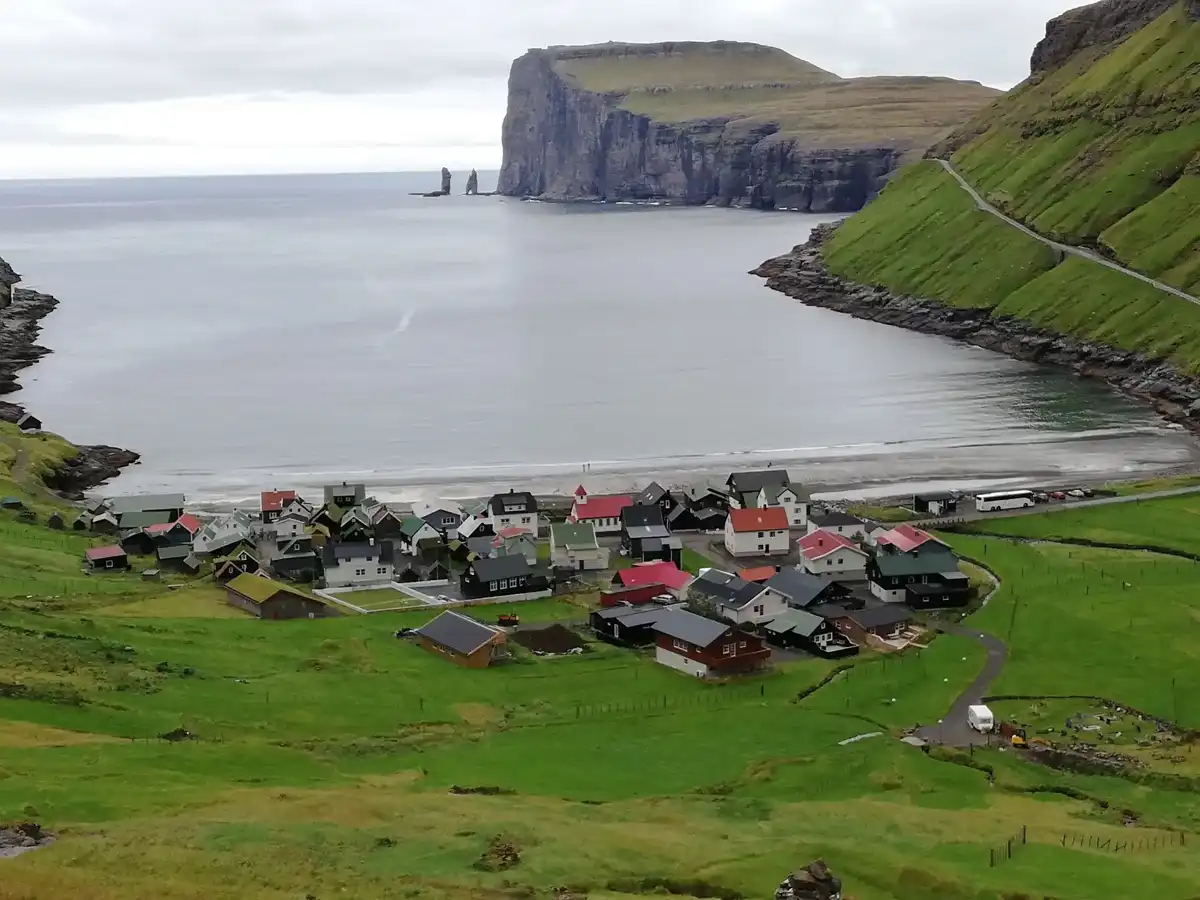
- Tjørnuvík beach (the black-sand bay) — A wide strip of coarse black sand framed by sheer cliffs; perfect for staring at the Atlantic, watching weather roll in, and getting photos that actually look like the Faroe Islands.
- The village cluster of turf-roof and wooden houses — Tiny, lived-in buildings with turf roofs and well-worn paths between them; an honest slice of Faroese rural life rather than a polished tourist set-piece.
- The jetty and small harbour — Where local boats tie up and fishermen pull nets; great for watching daily comings and goings and seeing how coastal life still works here.
- Basalt cliffs and rock formations at the bay — Craggy, layered rock faces and quirky formations you can walk up to and examine; they give the shoreline its stark, geological character.
- Short ridge
- Tjørnuvík beach (the black-sand bay) — A wide strip of coarse black sand framed by sheer cliffs; perfect for staring at the Atlantic, watching weather roll in, and getting photos that actually look like the Faroe Islands.
- The village cluster of turf-roof and wooden houses — Tiny, lived-in buildings with turf roofs and well-worn paths between them; an honest slice of Faroese rural life rather than a polished tourist set-piece.
- The jetty and small harbour — Where local boats tie up and fishermen pull nets; great for watching daily comings and goings and seeing how coastal life still works here.
- Basalt cliffs and rock formations at the bay — Craggy, layered rock faces and quirky formations you can walk up to and examine; they give the shoreline its stark, geological character.
- Short ridge hike / viewpoint above the village — A steep-ish scramble of 15-45 minutes (depending how fast you move) that rewards you with panoramic views down into the bay and across to neighboring islands — ideal for a quick workout and a proper vantage point.
- Sheep pastures and traditional sheepfolds — The village’s surrounding outfields are active grazing ground; the traffic here is often four-legged. Walking through the pastures gives you a real feel for Faroese farming rhythms.
- Hjallar and boathouse remains — The old wooden drying racks and simple boathouses scattered around the shoreline show traditional methods of preserving fish and gear — small details that tell big stories about local survival strategies.
- The little stream that runs into the bay — An easy, pleasant feature to explore on foot: follow the stream’s short valley into the village for different angles on the cliffs and a quieter, less photographed side of Tjørnuvík.
- Seabird and seal-watching spots — From the shore and low cliffs you can often spot common seabirds and seals hauled out on rocks; bring binoculars — wildlife encounters are unforced and always memorable.
- Everyday village life — local farms and seasonal routines — There’s real value in wandering the lanes, chatting if locals are around, and noticing things like turf-cutting, hay-stacking or lambing season; those daily rhythms are the cultural core of Tjørnuvík.
Spotted a mistake or missing something? Contact us.

 Best Backpacking
.jpg) Hi, I’m Johan (Netherlands 🇳🇱), the creator of TakeYourBackpack. Over the past 3 decades, I’ve backpacked through 90+ countries across six continents, gaining extensive experience with independent travel, long-term trips, and overland routes.
Hi, I’m Johan (Netherlands 🇳🇱), the creator of TakeYourBackpack. Over the past 3 decades, I’ve backpacked through 90+ countries across six continents, gaining extensive experience with independent travel, long-term trips, and overland routes.