

×

Fiji🇫🇯 | attractionsNavala Traditional Fijian Village Cultural SiteThatched bure, sevusevu, Ba River, highland village | things to do and best time to go

Explore Damodar Arts VillageExplore Caqalai Island

Backpacking in Navala Traditional Fijian Village Cultural Site
By Johan Kruseman 🇳🇱 | Updated October 15, 2026

Every home in Navala is a bure, built from timber, bamboo and thatched reed grass, and the doorways are cut low so you duck as you enter, a habit that keeps the cooking smoke inside and the visitor humble. Navala sits in the Ba Highlands on Viti Levu, in the interior of Fiji, inland from the western coast near Ba and Lautoka. It is the one place where roughly 200 thatched bure still stand in a single village, set against steep green ridges beside the Ba River. The wow-factor is real, and so is the walk-around: an hour or two covers it. Go in the morning, when cook-fire smoke curls through the thatch and the light is soft. Dress modestly and bring sevusevu, a bundle of kava root, for the chief. The road in is rough, so a day tour or a 4WD is smarter than a rental sedan. Skip any rush; the kava ceremony in the village hall is the part worth lingering over, with its coconut-shell bowl and slow clapping.

Discover everything you want to know in the 📖 Fiji Travel Guide.


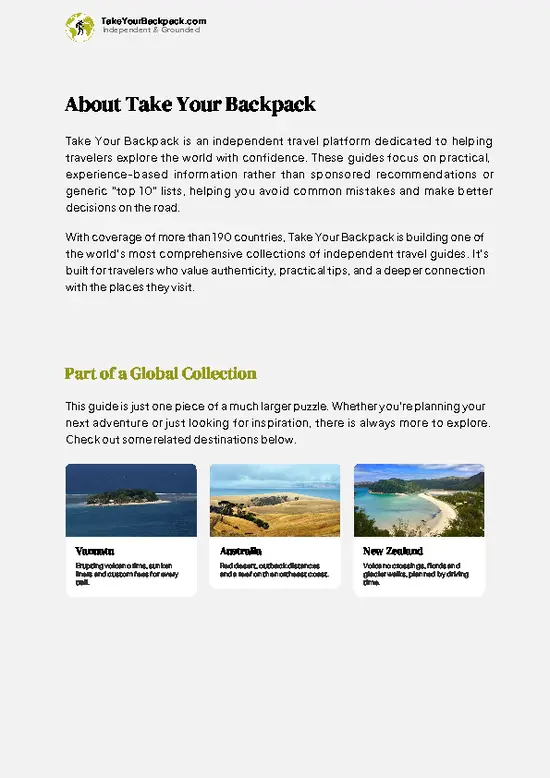
example page 0 from our offline Travel Guide for Fiji
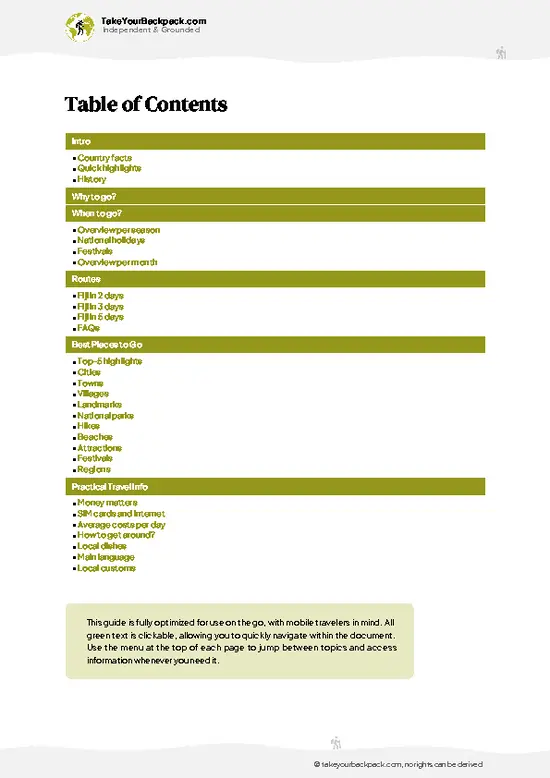
example page 1 from our offline Travel Guide for Fiji
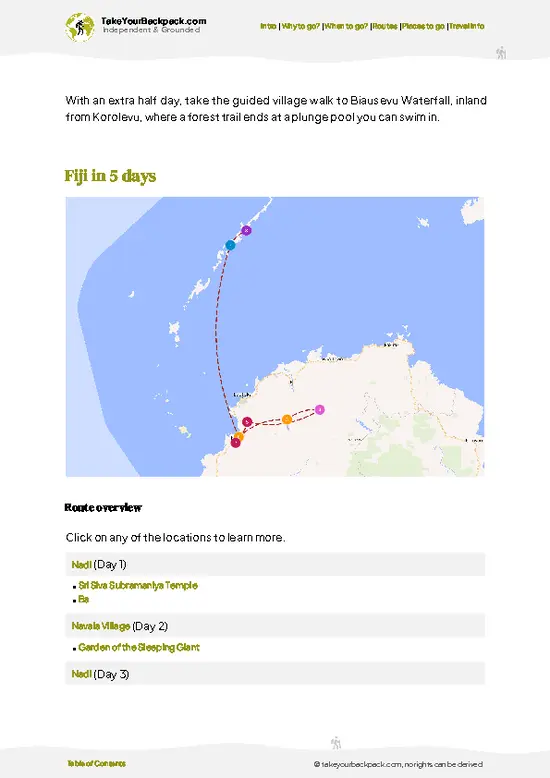
example page 2 from our offline Travel Guide for Fiji
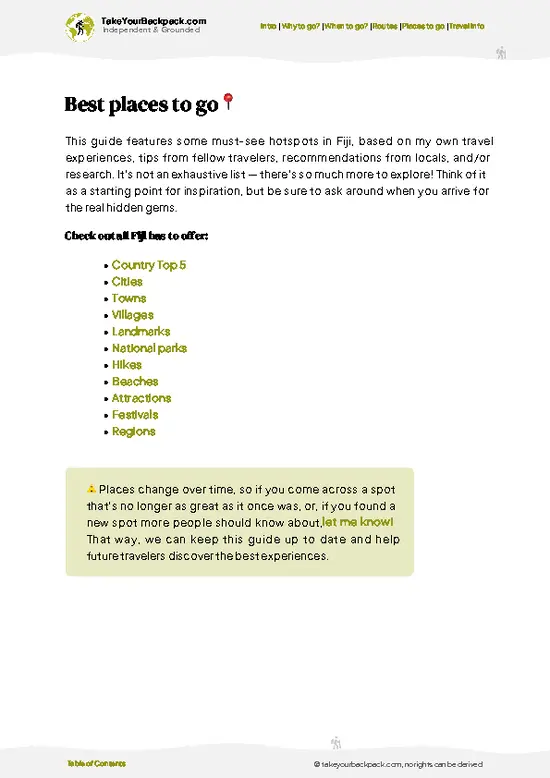
example page 3 from our offline Travel Guide for Fiji
example page 4 from our offline Travel Guide for Fiji
example page 5 from our offline Travel Guide for Fiji
example page 6 from our offline Travel Guide for Fiji
example page 7 from our offline Travel Guide for Fiji
Loading the map 🌍
CLICK TO FILTER
cities
towns
villages
landmarks
national parks
hikes
beaches
attractions
festivals
regions
SHOW COUNTRY’S BESTSHOW ALL

✨ Why go?
Ranked #99 attraction in Fiji
What makes it a must-see attraction

Navala is the clearest answer to the question of what a Fijian village looked like before tin roofs arrived. Here, around 200 thatched bure still stand in tidy lines, and the villagers rebuild them by hand when cyclones strike. After Cyclone Winston in 2016 the community rebuilt in traditional style rather than switch to modern materials, which says a lot about how seriously they take their heritage. That commitment is the first reason to come.

The second is the access. You are welcomed by a host family, taken through the village on foot, and invited to a sevusevu kava ceremony that follows proper protocol: you present the root, the chief accepts it, and the bowl is passed. It is a rare chance to see the ritual in a place where it is still part of daily life, not staged for a stage show.
… read more 👉
Navala is the clearest answer to the question of what a Fijian village looked like before tin roofs arrived. Here, around 200 thatched bure still stand in tidy lines, and the villagers rebuild them by hand when cyclones strike. After Cyclone Winston in 2016 the community rebuilt in traditional style rather than switch to modern materials, which says a lot about how seriously they take their heritage. That commitment is the first reason to come.

The second is the access. You are welcomed by a host family, taken through the village on foot, and invited to a sevusevu kava ceremony that follows proper protocol: you present the root, the chief accepts it, and the bowl is passed. It is a rare chance to see the ritual in a place where it is still part of daily life, not staged for a stage show.

The third is the setting. The road in climbs through the highlands and crosses the Ba River, where villagers wash, swim and fish. For a backpacker, it breaks up beach hopping with something rooted and quiet, and it gives a day of real conversation.

💡 HighlightsTop highlights of Navala Traditional Fijian Village Cultural Site

  1. The thatched bure rows: The village’s signature sight is the grid of reed-and-thatch houses with steeply pitched roofs, lashed together with sennit cord rather than nails. Walk the main grass lanes and look at the bound joints and the woven walls.
  2. Sevusevu and kava ceremony: Your visit opens by presenting kava root to the village chief or his representative, followed by clapping and a shared bowl. It is a short, formal moment that sets the tone for the whole day.
  3. Guided village walk: A local guide explains how houses are built, who lives where and how the village has rebuilt after cyclones. Questions are welcome, and the pace is relaxed.
  4. Inside a bure: Hosts often invite visitors into a home. Sit cross-legged on the woven pandanus mats, notice the dark, cool interior and the smoky smell from
… read more 👉
  1. The thatched bure rows: The village’s signature sight is the grid of reed-and-thatch houses with steeply pitched roofs, lashed together with sennit cord rather than nails. Walk the main grass lanes and look at the bound joints and the woven walls.
  2. Sevusevu and kava ceremony: Your visit opens by presenting kava root to the village chief or his representative, followed by clapping and a shared bowl. It is a short, formal moment that sets the tone for the whole day.
  3. Guided village walk: A local guide explains how houses are built, who lives where and how the village has rebuilt after cyclones. Questions are welcome, and the pace is relaxed.
  4. Inside a bure: Hosts often invite visitors into a home. Sit cross-legged on the woven pandanus mats, notice the dark, cool interior and the smoky smell from the cooking fire, and take in how the single room is used.
  5. Ba River: The river runs beside the village. People bathe, wash clothes and fish here, and visitors can sit on the bank or cool off in the shallows if invited to.
  6. Village lunch: Meals typically feature root crops like cassava and taro, with fish or chicken, often cooked in a lovo earth oven. Eating together on the mat floor is a highlight in its own right.
  7. Highland views: The ring of steep green ridges around the valley is best seen at the road’s final descent and from the village edge, where thatch roofs spread out below the hills.
  8. Village church: The community church is a quiet part of daily life here, and Sunday singing is a strong tradition in Fijian villages. Visit only if your host invites you, and dress modestly.
Do the sevusevu first, since it formally welcomes you and everything else in the village follows from that permission.
Spotted a mistake or missing something? Contact us.

Things to do near Navala Traditional Fijian Village Cultural Site

Ratings based on Tripadvisor reviews. When you book through this link, you support our work at no extra cost to you.

🌤️ When to go?Seasonal considerations and timing

May to October is the window to aim for, when Navala’s thatched bure and the rutted road from Ba stay dry enough to enjoy.
  • Dry Season (May to October): Days run 24 to 29°C (75 to 84°F), nights in the highlands dip to 15 to 19°C (59 to 66°F). Rain is light, the Ba River is crossable, and sunrise is around 6:30 am with sunset near 5:45 pm. This is also when visitor numbers and tour prices peak, especially July and August.
  • Wet Season (November to April): Expect 26 to 32°C (79 to 90°F), heavy afternoon downpours, and humidity that makes the village paths muddy. Daylight stretches to nearly 7:30 pm. Cyclones can hit between December and March, and the road may close after heavy rain. Prices drop and you will often have the village almost to yourself.
  • Sunday: Villagers attend church, and visits are
… read more 👉
May to October is the window to aim for, when Navala’s thatched bure and the rutted road from Ba stay dry enough to enjoy.
  • Dry Season (May to October): Days run 24 to 29°C (75 to 84°F), nights in the highlands dip to 15 to 19°C (59 to 66°F). Rain is light, the Ba River is crossable, and sunrise is around 6:30 am with sunset near 5:45 pm. This is also when visitor numbers and tour prices peak, especially July and August.
  • Wet Season (November to April): Expect 26 to 32°C (79 to 90°F), heavy afternoon downpours, and humidity that makes the village paths muddy. Daylight stretches to nearly 7:30 pm. Cyclones can hit between December and March, and the road may close after heavy rain. Prices drop and you will often have the village almost to yourself.
  • Sunday: Villagers attend church, and visits are limited or quiet, so plan around it.
Arrive before 10 am for cooler air and clearer views of the Nausori Highlands behind the village.


source: climatestotravel.comJANJanuary: fair for travelingFEBFebruary: fair for travelingMARMarch: fair for travelingAPRApril: fair for travelingMAYMay: excellent for travelingJUNJune: highly recommended for travelingJULJuly: highly recommended for travelingAUGAugust: highly recommended for travelingSEPSeptember: excellent for travelingOCTOctober: highly recommended for travelingNOVNovember: below average for travelingDECDecember: below average for traveling
when-to-go

✈️ The backpacker research shortcutFiji Travel Guide

An offline-friendly backpacking guide with optimized travel routes, ranked highlights, transport advice, and the best areas to stay.
example page 0 from our offline Travel Guide for Fiji
example page 1 from our offline Travel Guide for Fiji
example page 2 from our offline Travel Guide for Fiji
example page 3 from our offline Travel Guide for Fiji
example page 4 from our offline Travel Guide for Fiji
example page 5 from our offline Travel Guide for Fiji
example page 6 from our offline Travel Guide for Fiji
example page 7 from our offline Travel Guide for Fiji
The digital guide (159 pages) contains:
✅ 41 highlights, ranked by travel appeal
✅ Optimized 2, 3 & 5-day travel routes
✅ Cities, national parks, landmarks, beaches
✅ How to get around
✅ Offline-friendly for travel without Wi-Fi
👉 Click to see all 30+ guide features

📅 Plan smarter in minutes, not weeks
✅ Month by month travel advice
✅ Festivals & national holidays
✅ Budget expectations

🗺️ Go to the right places, skip the overrated ones
✅ Honest pros & cons of destinations
✅ Top hikes, parks & viewpoints
✅ Lesser-known places most travelers miss
✅ Clear “worth it vs skip it” guidance

🛏️ Travel smoothly without rookie mistakes
✅ Best areas to stay
✅ Transport systems explained simply
✅ Common scams & safety advice
✅ SIM cards, money & practical tips

🌍 Understand the country, not just visit it
✅ Culture & traditions
✅ 52 Essential phrases & customs
✅ Festivals worth planning around
✅ Traveler-friendly historical context
✅ Insights that make places more meaningful

📱 Built for real travel conditions
✅ Fully downloadable PDF
✅ Works completely offline
✅ Optimized for phone use
✅ Useful in remote areas & buses
✅ Everything in one place
Stop searching, start planning
Get instant access to your full guide. 30‑day money-back guarantee.
+ Add another guide for just

By proceeding you agree to our terms.
Sent to your inbox immediately after payment • 100% Secure Checkout
Best Backpacking Travel Advisor 2025 tourism awardBest Backpacking
Travel Advisor
2025
What others say about Take Your Backpack Guides:
⭐⭐⭐⭐⭐
Fantastic, amazing amount of information!
⭐⭐⭐⭐⭐
My goodness this is amazing, it's what I've been looking for hats off too you!
⭐⭐⭐⭐⭐
I think this is absolutely BRILLIANT
⭐⭐⭐⭐
Very complete and informative. It's still missing places, but I gotta to commend you
⭐⭐⭐⭐⭐
This is truly amazing, thank you, can't wait to explore it with my kids!
⭐⭐⭐⭐⭐
Awesome resource, thank you!
⭐⭐⭐⭐⭐
This is amazing! Can't wait to explore the ones I haven't seen
⭐⭐⭐⭐
I love this! Well done, great idea.
⭐⭐⭐⭐⭐
Thanks for taking the time to make this gem!
⭐⭐⭐⭐⭐
This might be the best website I've ever seen.
⭐⭐⭐⭐⭐
Congratulations, and thank you so much for your work; it's incredibly valuable.
⭐⭐⭐⭐
In all seriousness I think you did a great job pointing out the important spots
⭐⭐⭐⭐⭐
10/10 very good
⭐⭐⭐⭐⭐
As someone who's only just starting to visit regularly this is awesome, thank you.
⭐⭐⭐⭐
Thank you very much! I'm going to visit my dad, it's going to be very useful!
⭐⭐⭐⭐⭐
This is really cool! We'll be travelling for the first time and this definitely come in handy.
⭐⭐⭐⭐⭐
You are now our minister of culture, congratulations 👨‍💼
⭐⭐⭐⭐⭐
Just wanted to tell you that this is a pearl! Going to follow your recommendations.
⭐⭐⭐⭐⭐
This is so cool. I'll definitely be using the resource for my travels soon.
⭐⭐⭐⭐⭐
This is very impressive! Good work.
⭐⭐⭐⭐⭐
This is an amazing and informative site. Very well done!

🛏️ Where to stay?Best areas to stay in Fiji

Ba town and the Nadi area are the practical bases for most backpackers, with a village homestay in Navala itself as the standout choice if you want an overnight.
Navala has no hostels, but a handful of family-run homestays and a small guesthouse operate inside the village. Sleeping in a bure with a family, sharing a kava ceremony and a meal cooked in the earth oven, is the most social option available here. Beds are simple mats on the floor, and facilities are basic, so pack a torch and small gifts such as kava roots (sevusevu) for the chief.
Ba town sits roughly 1.5 to 2 hours away by road and … read more 👉
Ba town and the Nadi area are the practical bases for most backpackers, with a village homestay in Navala itself as the standout choice if you want an overnight.
Navala has no hostels, but a handful of family-run homestays and a small guesthouse operate inside the village. Sleeping in a bure with a family, sharing a kava ceremony and a meal cooked in the earth oven, is the most social option available here. Beds are simple mats on the floor, and facilities are basic, so pack a torch and small gifts such as kava roots (sevusevu) for the chief.
Ba town sits roughly 1.5 to 2 hours away by road and has budget guesthouses, markets, and cheap curry shops. It suits you if you prefer a bed with hot water and a town to wander in the evening, though it has little traveler scene.
Nadi and Nadi’s Martintar strip are the best choice for meeting other solo backpackers. Dorm-heavy hostels there run pub nights and organize day trips to Navala, with pickups. Lautoka is a quieter alternative with less nightlife and a calmer feel. If you only have one night, stay in the village and skip the long round trip.

👛 Costs (as of 15 October 2026)What things cost and how to budget

A day around Navala typically costs US$50 to 111 per person, with a homestay and a tour or private transfer driving most of the total.
CategoryBudget RangeLocal Reality
Village entry and sevusevuFJD 20 to 30 (US$9 to 14)Paid at the village gate or to the guide. A bundle of kava root for the chief is usually included.
Accommodation (high season)FJD 60 to 110 (US$27 to 50)A homestay bed usually includes dinner and breakfast. Ba and Nadi guesthouses cost similar or slightly more.
FoodFJD 10 to 25 (US$5 to 11)Lunch is often a simple cooked meal. Curry and roti in Ba cost less than FJD 10.
TransportFJD 15 to 60 (US$7 to 27)Local buses from Ba reach the turnoff, then a carrier or taxi covers the last stretch. Private transfers from Nadi cost more.
ExtrasFJD 5 to 20 (US$2 to 9)Handicrafts, a river swim,
… read more 👉
A day around Navala typically costs US$50 to 111 per person, with a homestay and a tour or private transfer driving most of the total.
CategoryBudget RangeLocal Reality
Village entry and sevusevuFJD 20 to 30 (US$9 to 14)Paid at the village gate or to the guide. A bundle of kava root for the chief is usually included.
Accommodation (high season)FJD 60 to 110 (US$27 to 50)A homestay bed usually includes dinner and breakfast. Ba and Nadi guesthouses cost similar or slightly more.
FoodFJD 10 to 25 (US$5 to 11)Lunch is often a simple cooked meal. Curry and roti in Ba cost less than FJD 10.
TransportFJD 15 to 60 (US$7 to 27)Local buses from Ba reach the turnoff, then a carrier or taxi covers the last stretch. Private transfers from Nadi cost more.
ExtrasFJD 5 to 20 (US$2 to 9)Handicrafts, a river swim, tips for guides. Bring cash, as there are no ATMs.
Total Daily BudgetFJD 110 to 245 (US$50 to 111)Day visitors using public transport and skipping the homestay stay at the low end.
⚠️ Prices can change and everyone travels differently, so take this as a rough guide. Hope it helps you plan your adventure!

FAQCommon questions from travelers

Plan on a half day for a quick visit, or an overnight stay if you want the full experience. A guided walk through the bure and along the Ba River takes 1.5 to 2 hours, plus 1.5 to 2 hours of driving each way from Nadi or Ba. Staying one night in a homestay adds a kava ceremony and evening meal.
Yes, for most visitors the village entry of roughly FJD 20 to 30 (US$9 to 14) is good value. It covers a guided look at one of the last Fijian villages built entirely of traditional thatched bure, and the money goes to the community. Add an overnight stay for around FJD 60 to 110 if you want more than a quick photo stop.
Drive or take transport from Ba, then follow the winding road about 40 km (25 miles) inland into the Nausori Highlands. Allow 1.5 to 2 hours from Ba and 2.5 to 3 hours from Nadi. Tours from Nadi hostels handle the logistics, while public buses from Ba stop at the turnoff and need a carrier or taxi for the final stretch.
⚠️ Things can change over time, so always validate details locally before you go.

Other Fijian attractions near Navala Traditional Fijian Village Cultural Site

Explore more nearby:


💡 Not sure where to go next?
Create a personalized itinerary for Fiji including Navala Traditional Fijian Village Cultural Site and the places that fit your trip.

Generate my itinerary

👉 Discover all attractions

Or checkout all Fiji has to offer (think cities, towns, villages, national parks, hikes, beaches, festivals)
Country photo of Fiji

We 💚 feedbackWhat to keep in mind

Navala suits curious travelers who want conversation more than spectacle, and anyone tired of resort Fiji. Go on a weekday morning, bring kava root as a gift if your host asks, and keep your camera lowered until you have been invited to raise it. Save the Sunday for rest, when the village keeps quiet.

✍️ Help improve this page!
The information on this page is based on in-depth research, insights shared by experienced travelers, and feedback from the local travel community in Fiji. While every effort is made to keep the information accurate and current, conditions can change — so if you spot anything incorrect or outdated, please get in touch.


🙋‍♂️ Give feedback

👋 Meet the founderWho’s Behind Take Your Backpack?

Johan, backpacker and founder of TakeYourBackpackHi, I’m Johan (Netherlands 🇳🇱), the creator of TakeYourBackpack. Over the past 3 decades, I’ve backpacked through 90+ countries across six continents, gaining extensive experience with independent travel, long-term trips, and overland routes.

This site is built on a combination of firsthand travel experience and carefully curated insights from other backpackers. Many guides are based on places I’ve personally visited, while others bring together tips, observations, and practical advice shared by trusted travelers I’ve met along the way.

The goal is to provide realistic, experience-driven guidance — not generic itineraries — so you can explore destinations with better context, clearer expectations, and more confidence.