×

French Guiana🇬🇫 | national parksAmana Nature ReserveLeatherback nesting, tidal sand flats, scarlet ibis, Kali’na village | things to do and best time to go

Explore Voltaire Falls TrailExplore Cawapé Natural Reserve

Backpacking in Amana Nature Reserve
👍 Recommendednational park ranked #4
By Johan Kruseman 🇳🇱 | Updated October 19, 2026

Amana Nature Reserve is reached by road through Awala-Yalimapo, and the nesting turtles are the whole reason the shoreline is protected. It sits in the northwest of French Guiana, on the Atlantic coast near Awala-Yalimapo, north of Saint-Laurent-du-Maroni. Trails are short and flat, wildlife is superb, and crowds are thin. The catch is that the walking is hot, exposed sand with little shade, and the mud flats shift with the tide. Experienced travelers time walks around low tide, when the sand is firm, and carry far more water than seems sensible, because the sun reflects off the beach. Mornings smell of salt and rotting seaweed, and the surf grinds constantly. Frigate birds hang overhead. At night, the beach is dark, with only the pale shape of a leatherback hauling itself up the sand.

Discover everything you want to know in the 📖 French Guiana Travel Guide.


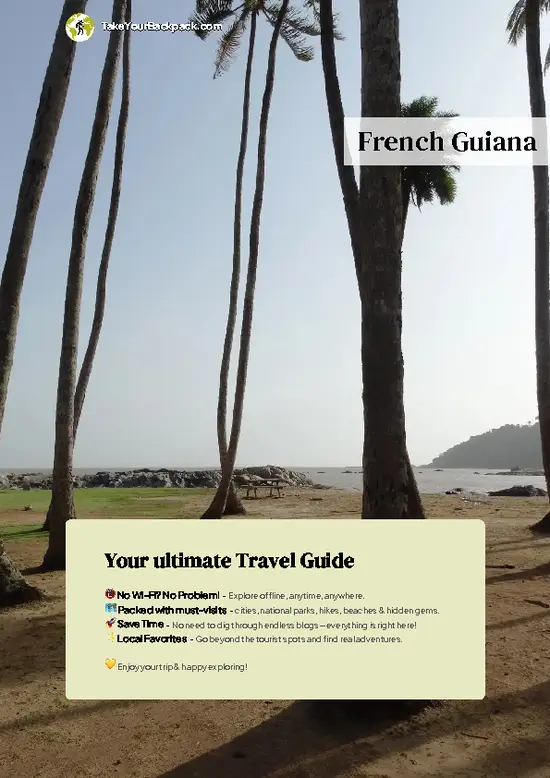
example page 0 from our offline Travel Guide for French Guiana
example page 1 from our offline Travel Guide for French Guiana
example page 2 from our offline Travel Guide for French Guiana
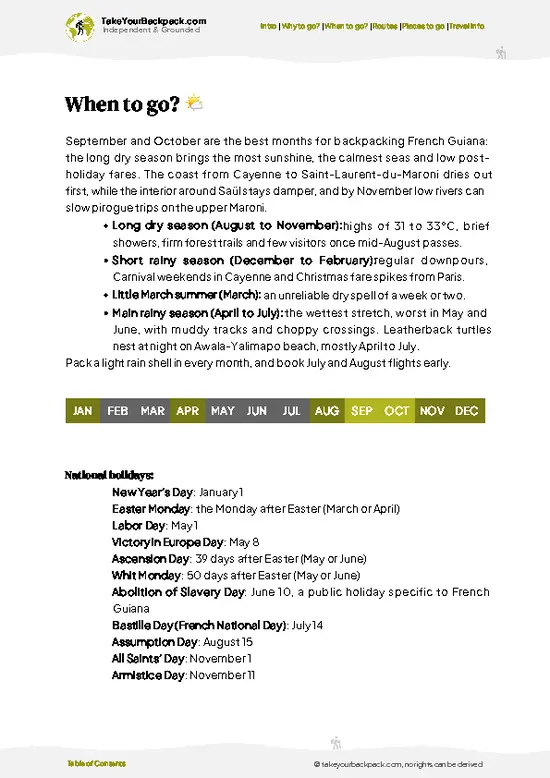
example page 3 from our offline Travel Guide for French Guiana
example page 4 from our offline Travel Guide for French Guiana
example page 5 from our offline Travel Guide for French Guiana
example page 6 from our offline Travel Guide for French Guiana
example page 7 from our offline Travel Guide for French Guiana
Loading the map 🌍
CLICK TO FILTER
towns
villages
landmarks
national parks
hikes
beaches
attractions
festivals
SHOW COUNTRY’S BESTSHOW ALL

✨ Why go?
Ranked #4 national park in French Guiana
Reasons people choose to explore here

Amana Nature Reserve suits backpackers who want wildlife without a tour-bus feel. The headline draw is the leatherback turtle, the world's largest sea turtle, which comes ashore on the beaches near Awala-Yalimapo to lay eggs, along with green turtles and olive ridleys. Local Kali'na guides and the village's small-scale lodging keep things modest, so you can spend several days walking the shore on your own schedule. The reserve also protects the mangroves and the Mana estuary, where scarlet ibis flocks and wading birds feed on the mudflats at dusk. Because the beaches stretch for kilometers with almost no one on them, self-guided wandering works well, while the night turtle watch is the one thing worth doing with a registered guide. That mix of solitude and one tightly organized experience … read more 👉
Amana Nature Reserve suits backpackers who want wildlife without a tour-bus feel. The headline draw is the leatherback turtle, the world's largest sea turtle, which comes ashore on the beaches near Awala-Yalimapo to lay eggs, along with green turtles and olive ridleys. Local Kali'na guides and the village's small-scale lodging keep things modest, so you can spend several days walking the shore on your own schedule. The reserve also protects the mangroves and the Mana estuary, where scarlet ibis flocks and wading birds feed on the mudflats at dusk. Because the beaches stretch for kilometers with almost no one on them, self-guided wandering works well, while the night turtle watch is the one thing worth doing with a registered guide. That mix of solitude and one tightly organized experience makes Amana a rare Guianese stop that rewards independent travelers.

💡 HighlightsDon't-miss highlights and experiences

  1. Leatherback nesting at Les Hattes: The beach at Awala-Yalimapo is among the best places in the world to watch leatherbacks lay eggs, usually from roughly April to July. Go with a registered local guide, use no flash, and keep your distance.
  2. Plage des Hattes at low tide: A broad, firm sweep of sand, ideal for long walks, with hermit crabs, sanderlings and the occasional turtle track.
  3. Green turtle nesting: Green turtles also come ashore here, often later in the year, making the beach worth visiting beyond leatherback season.
  4. Scarlet ibis at the Mana estuary: At dusk, flocks of bright red ibis settle in the mangroves, a color you will not forget against the gray mud.
  5. Mangrove edges: Tangled roots, mudskippers, fiddler crabs and herons line the shore, best viewed from the boardwalk or a boat.
  6. Kali'na
… read more 👉
  1. Leatherback nesting at Les Hattes: The beach at Awala-Yalimapo is among the best places in the world to watch leatherbacks lay eggs, usually from roughly April to July. Go with a registered local guide, use no flash, and keep your distance.
  2. Plage des Hattes at low tide: A broad, firm sweep of sand, ideal for long walks, with hermit crabs, sanderlings and the occasional turtle track.
  3. Green turtle nesting: Green turtles also come ashore here, often later in the year, making the beach worth visiting beyond leatherback season.
  4. Scarlet ibis at the Mana estuary: At dusk, flocks of bright red ibis settle in the mangroves, a color you will not forget against the gray mud.
  5. Mangrove edges: Tangled roots, mudskippers, fiddler crabs and herons line the shore, best viewed from the boardwalk or a boat.
  6. Kali'na village of Awala-Yalimapo: The nearby Indigenous village has a small museum and craft stalls that explain the community's long link to the turtles.
Plan on two to three days to cover all of it, with one night out for the turtles.
Spotted a mistake or missing something? Contact us.

🌤️ When to go?Choosing the right time of year

The best window for Amana Nature Reserve is the long dry spell from August to November, when the coastal nesting beaches and the mangrove channels are easiest to reach.
  • Long Dry Season (Aug to Nov): Little rain, 26 to 32°C (79 to 90°F), and calmer seas for boat transfers from Awala-Yalimapo. Leatherback turtles still come ashore in the early part of this period, and prices for guides and lodging are firmest.
  • Short Dry Spell (Feb to Mar): A brief lull in the rain with similar temperatures. Fewer visitors, and trails along the Mana estuary are passable.
  • Turtle Nesting (Apr to Jul): Leatherbacks lay at night on Les Hattes beach, peaking around May and June. Nights are warm, around 24°C (75°F), and night walks book up.
  • Heavy Rains (Dec to Jan, Apr to Jun): Downpours, 85 to 95% humidity and muddy tracks.
… read more 👉
The best window for Amana Nature Reserve is the long dry spell from August to November, when the coastal nesting beaches and the mangrove channels are easiest to reach.
  • Long Dry Season (Aug to Nov): Little rain, 26 to 32°C (79 to 90°F), and calmer seas for boat transfers from Awala-Yalimapo. Leatherback turtles still come ashore in the early part of this period, and prices for guides and lodging are firmest.
  • Short Dry Spell (Feb to Mar): A brief lull in the rain with similar temperatures. Fewer visitors, and trails along the Mana estuary are passable.
  • Turtle Nesting (Apr to Jul): Leatherbacks lay at night on Les Hattes beach, peaking around May and June. Nights are warm, around 24°C (75°F), and night walks book up.
  • Heavy Rains (Dec to Jan, Apr to Jun): Downpours, 85 to 95% humidity and muddy tracks. Quieter, with cheaper rooms.
Daylight stays close to twelve hours all year, so plan your days around the afternoon showers. Book turtle-watching outings a few weeks ahead for May and June.


source: climatestotravel.comJANJanuary: fair for travelingFEBFebruary: fair for travelingMARMarch: fair for travelingAPRApril: fair for travelingMAYMay: fair for travelingJUNJune: fair for travelingJULJuly: fair for travelingAUGAugust: highly recommended for travelingSEPSeptember: excellent for travelingOCTOctober: excellent for travelingNOVNovember: highly recommended for travelingDECDecember: highly recommended for traveling
when-to-go

✈️ The backpacker research shortcutFrench Guiana Travel Guide

An offline-friendly backpacking guide with optimized travel routes, ranked highlights, transport advice, and the best areas to stay.
example page 0 from our offline Travel Guide for French Guiana
example page 1 from our offline Travel Guide for French Guiana
example page 2 from our offline Travel Guide for French Guiana
example page 3 from our offline Travel Guide for French Guiana
example page 4 from our offline Travel Guide for French Guiana
example page 5 from our offline Travel Guide for French Guiana
example page 6 from our offline Travel Guide for French Guiana
example page 7 from our offline Travel Guide for French Guiana
The digital guide (130 pages) contains:
✅ 31 highlights, ranked by travel appeal
✅ Optimized 2, 3 & 5-day travel routes
✅ Cities, national parks, landmarks, beaches
✅ How to get around
✅ Offline-friendly for travel without Wi-Fi
👉 Click to see all 30+ guide features

📅 Plan smarter in minutes, not weeks
✅ Month by month travel advice
✅ Festivals & national holidays
✅ Budget expectations

🗺️ Go to the right places, skip the overrated ones
✅ Honest pros & cons of destinations
✅ Top hikes, parks & viewpoints
✅ Lesser-known places most travelers miss
✅ Clear “worth it vs skip it” guidance

🛏️ Travel smoothly without rookie mistakes
✅ Best areas to stay
✅ Transport systems explained simply
✅ Common scams & safety advice
✅ SIM cards, money & practical tips

🌍 Understand the country, not just visit it
✅ Culture & traditions
✅ 52 Essential phrases & customs
✅ Festivals worth planning around
✅ Traveler-friendly historical context
✅ Insights that make places more meaningful

📱 Built for real travel conditions
✅ Fully downloadable PDF
✅ Works completely offline
✅ Optimized for phone use
✅ Useful in remote areas & buses
✅ Everything in one place
Stop searching, start planning
Get instant access to your full guide. 30‑day money-back guarantee.
+ Add another guide for just

By proceeding you agree to our terms.
Sent to your inbox immediately after payment • 100% Secure Checkout
Best Backpacking Travel Advisor 2025 tourism awardBest Backpacking
Travel Advisor
2025
What others say about Take Your Backpack Guides:
⭐⭐⭐⭐⭐
Fantastic, amazing amount of information!
⭐⭐⭐⭐⭐
My goodness this is amazing, it's what I've been looking for hats off too you!
⭐⭐⭐⭐⭐
I think this is absolutely BRILLIANT
⭐⭐⭐⭐
Very complete and informative. It's still missing places, but I gotta to commend you
⭐⭐⭐⭐⭐
This is truly amazing, thank you, can't wait to explore it with my kids!
⭐⭐⭐⭐⭐
Awesome resource, thank you!
⭐⭐⭐⭐⭐
This is amazing! Can't wait to explore the ones I haven't seen
⭐⭐⭐⭐
I love this! Well done, great idea.
⭐⭐⭐⭐⭐
Thanks for taking the time to make this gem!
⭐⭐⭐⭐⭐
This might be the best website I've ever seen.
⭐⭐⭐⭐⭐
Congratulations, and thank you so much for your work; it's incredibly valuable.
⭐⭐⭐⭐
In all seriousness I think you did a great job pointing out the important spots
⭐⭐⭐⭐⭐
10/10 very good
⭐⭐⭐⭐⭐
As someone who's only just starting to visit regularly this is awesome, thank you.
⭐⭐⭐⭐
Thank you very much! I'm going to visit my dad, it's going to be very useful!
⭐⭐⭐⭐⭐
This is really cool! We'll be travelling for the first time and this definitely come in handy.
⭐⭐⭐⭐⭐
You are now our minister of culture, congratulations 👨‍💼
⭐⭐⭐⭐⭐
Just wanted to tell you that this is a pearl! Going to follow your recommendations.
⭐⭐⭐⭐⭐
This is so cool. I'll definitely be using the resource for my travels soon.
⭐⭐⭐⭐⭐
This is very impressive! Good work.
⭐⭐⭐⭐⭐
This is an amazing and informative site. Very well done!

🛏️ Where to stay?Choosing the right base

Most backpackers sleep in Awala-Yalimapo, the village on the reserve’s edge, because no lodging exists inside the protected area itself.
The village has a handful of small guesthouses, family-run carbets (open-sided cabins with hammock hooks) and a few simple campsites by the beach. Expect hammock spaces from about €10 to 15 a night, basic rooms from €45 to 80, and the carbets are the most atmospheric choice, with sea breezes and nesting season sounds. Bring your own hammock and mosquito net if you can, since rentals are limited. Book ahead from April to July, when turtle watchers fill everything. … read more 👉
Most backpackers sleep in Awala-Yalimapo, the village on the reserve’s edge, because no lodging exists inside the protected area itself.
The village has a handful of small guesthouses, family-run carbets (open-sided cabins with hammock hooks) and a few simple campsites by the beach. Expect hammock spaces from about €10 to 15 a night, basic rooms from €45 to 80, and the carbets are the most atmospheric choice, with sea breezes and nesting season sounds. Bring your own hammock and mosquito net if you can, since rentals are limited. Book ahead from April to July, when turtle watchers fill everything.
Mana, roughly 20 minutes inland by road, is the larger town. It has a few guesthouses, a supermarket and a bakery, so it works for restocking or when the beach is full. Saint-Laurent-du-Maroni, about 45 minutes to an hour away, has the widest choice of hotels, restaurants, ATMs and the bus connections to Cayenne. Many travelers sleep there the first night, then continue to the coast. Self-catering in Awala is possible but stock is thin, so carry food from Mana or Saint-Laurent.

👛 Costs (as of 19 October 2026)What things cost and how to budget

Expect to spend about €68 a day at Amana Nature Reserve on a backpacker budget in high season, with lodging as the biggest line.
CategoryBudget RangeLocal Reality
Entrance fee€0No general entry charge. Guided turtle evenings and boat trips are paid separately.
Accommodation (high season)€10 to 45Hammock spots or camping start near €10 to 15. Private rooms in Awala-Yalimapo run €45 to 80, so a hammock keeps the daily total low. Low season is a bit cheaper.
Food and supplies€15 to 25Small restaurants in Awala serve fish and creole plates for about €10 to 18. Self-catering from Mana supermarkets is cheaper. Prices are higher than in mainland France.
Local transport€5 to 15Public buses are scarce. Shared taxis or rides between Saint-Laurent, Mana and Awala cost roughly €5 to 15, and car rental is about
… read more 👉
Expect to spend about €68 a day at Amana Nature Reserve on a backpacker budget in high season, with lodging as the biggest line.
CategoryBudget RangeLocal Reality
Entrance fee€0No general entry charge. Guided turtle evenings and boat trips are paid separately.
Accommodation (high season)€10 to 45Hammock spots or camping start near €10 to 15. Private rooms in Awala-Yalimapo run €45 to 80, so a hammock keeps the daily total low. Low season is a bit cheaper.
Food and supplies€15 to 25Small restaurants in Awala serve fish and creole plates for about €10 to 18. Self-catering from Mana supermarkets is cheaper. Prices are higher than in mainland France.
Local transport€5 to 15Public buses are scarce. Shared taxis or rides between Saint-Laurent, Mana and Awala cost roughly €5 to 15, and car rental is about €40 to 60 a day.
Guided activities€10 to 20Turtle night walks cost about €10 to 15 in nesting season. Boat trips in the estuary and mangroves run higher, from €25 to 50.
Total Daily Budget€40 to 105About €68 for a midrange backpacker day, with a hammock, local meals and one guided outing.
Pay in euros, and carry cash because card machines are rare in the village.
⚠️ Prices can change and everyone travels differently, so take this as a rough guide. Hope it helps you plan your adventure!

🥾 TrailsScenic routes and wildlife spotting in Amana Nature Reserve

Amana Nature Reserve, in the northwest corner of French Guiana near the Surinamese border, is built around a coastline rather than a trail network, so the walking here means beaches, mangrove edges and a few sandy forest paths rather than signed summit routes. Terrain is flat, sandy and muddy in turns, and the heat comes off the sand as much as from above.
  • Plage Les Hattes beach walk: The main event. Walk the long sandy beach at Awala-Yalimapo for 3 to 8 km each way depending on how far you push, 1 to 3 hours. Easy, but soft sand and sun exposure make it tiring. Giant leatherback turtles nest here,
… read more 👉
Amana Nature Reserve, in the northwest corner of French Guiana near the Surinamese border, is built around a coastline rather than a trail network, so the walking here means beaches, mangrove edges and a few sandy forest paths rather than signed summit routes. Terrain is flat, sandy and muddy in turns, and the heat comes off the sand as much as from above.
  • Plage Les Hattes beach walk: The main event. Walk the long sandy beach at Awala-Yalimapo for 3 to 8 km each way depending on how far you push, 1 to 3 hours. Easy, but soft sand and sun exposure make it tiring. Giant leatherback turtles nest here, and you may see green turtles too.
  • Mangrove and Mana river estuary: Reached by boat with a local guide rather than on foot. The mangroves hold scarlet ibis at dusk, caimans and a crowd of herons. Plan on 2 to 3 hours.
  • Pointe Isère and the Organabo savanna edges: Flat, open walking over wet savanna and mudflats, best for birdwatchers. Expect mud, mosquitoes and very little shade.
  • Night turtle walks: Guided evening walks on the beach during nesting season, usually 2 to 3 hours. Easy ground, but you walk in near darkness with no lights, so the guide sets the pace.
Leatherback nesting runs roughly April to July, and that is when the beach is most alive. Outside it, you will mostly find birds, crabs and empty sand, which suits anyone wanting quiet.
Getting there is the hard part. There is no useful public transport to the reserve, so most travelers rent a car or share a taxi from Saint-Laurent-du-Maroni, then continue by road to Awala-Yalimapo, the village at the reserve’s edge. Crowds are small even in turtle season, though night walks do fill up, so book ahead through the village’s visitor office. Walking the beach itself is free. Guided turtle outings and boat trips carry a modest fee, generally around €10 to 25 per person for turtle walks, and boat prices vary by group size. Bring a head net or strong repellent, closed shoes for the mud, a red-filtered headlamp and more water than seems sensible.
⚠️ Hiking info can sometimes be outdated or inaccurate. Before you hit the trail, check the latest conditions with locals. If you do spot anything that's off, I'd love to hear from you, so I can update it for fellow travelers.

🛡️ SafetyTraveler Safety Guide

Amana Nature Reserve is a low-risk destination, and most problems come from heat, insects and tides rather than anything dramatic.
The coast is flat, but sand and mud slow you down, and sun exposure on the open beach is intense, so carry two liters of water per person, a hat and reef-safe sunscreen. Mosquitoes are constant at dusk, so cover up, use repellent and sleep under a net. Check your vaccinations (yellow fever is required for entry) and ask about dengue precautions.
Swimming is unwise because of strong currents and murky water. Turtle nights are tightly managed: use red light only, keep your distance, and never touch a nesting female. Walk on the beach with a guide after dark, since caimans and snakes live in the mangroves and rivers. Tides change channel depths, so confirm boat times … read more 👉
Amana Nature Reserve is a low-risk destination, and most problems come from heat, insects and tides rather than anything dramatic.
The coast is flat, but sand and mud slow you down, and sun exposure on the open beach is intense, so carry two liters of water per person, a hat and reef-safe sunscreen. Mosquitoes are constant at dusk, so cover up, use repellent and sleep under a net. Check your vaccinations (yellow fever is required for entry) and ask about dengue precautions.
Swimming is unwise because of strong currents and murky water. Turtle nights are tightly managed: use red light only, keep your distance, and never touch a nesting female. Walk on the beach with a guide after dark, since caimans and snakes live in the mangroves and rivers. Tides change channel depths, so confirm boat times locally. Mobile coverage is patchy, so tell your host where you are headed.

FAQTraveler FAQ

Two to three days is enough for Amana Nature Reserve if you want the beach, the mangroves and one night walk. Spend a full day around Awala-Yalimapo and the Les Hattes shoreline, and add another for a boat trip on the Mana estuary. During nesting season from April to July, stay at least two nights so you can attend an evening turtle outing.
Visiting Amana Nature Reserve without a car is possible but slow. Buses run from Cayenne to Saint-Laurent-du-Maroni (about 4 to 5 hours), then you need a shared taxi or a pre-arranged transfer to Mana and Awala-Yalimapo, roughly 45 to 60 minutes. Once in Awala, the beach and village are walkable, though trips farther afield require a guide or a lift from your host.
Amana Nature Reserve has no general entry fee, and day visitors do not need a permit to walk the beach near Awala-Yalimapo. Guided turtle-watching evenings are charged, usually about €10 to 15 per person, and must be booked with local operators. Boat excursions on the estuary typically cost €25 to 50, and some protected zones are off-limits without a guide.
⚠️ Things can change over time, so always validate details locally before you go.

Other French Guianese national parks near Amana Nature Reserve

Explore more nearby:


💡 Not sure where to go next?
Create a personalized itinerary for French Guiana including Amana Nature Reserve and the places that fit your trip.

Generate my itinerary

👉 Discover all national parks

Or checkout all French Guiana has to offer (think cities, towns, villages, national parks, hikes, beaches, festivals)
Country photo of French Guiana

We 💚 feedbackWhat to keep in mind

Amana Nature Reserve is best between April and July, when leatherbacks haul themselves up the sand after dark. Plan to walk the beach at low tide in the early morning, before the sun gets harsh, then rest at midday and go again after nightfall with a guide. I would bring a headlamp with a red light setting and sandals you can rinse.

✍️ Help improve this page!
The information on this page is based on in-depth research, insights shared by experienced travelers, and feedback from the local travel community in French Guiana. While every effort is made to keep the information accurate and current, conditions can change — so if you spot anything incorrect or outdated, please get in touch.


🙋‍♂️ Give feedback

👋 Meet the founderWho’s Behind Take Your Backpack?

Johan, backpacker and founder of TakeYourBackpackHi, I’m Johan (Netherlands 🇳🇱), the creator of TakeYourBackpack. Over the past 3 decades, I’ve backpacked through 90+ countries across six continents, gaining extensive experience with independent travel, long-term trips, and overland routes.

This site is built on a combination of firsthand travel experience and carefully curated insights from other backpackers. Many guides are based on places I’ve personally visited, while others bring together tips, observations, and practical advice shared by trusted travelers I’ve met along the way.

The goal is to provide realistic, experience-driven guidance — not generic itineraries — so you can explore destinations with better context, clearer expectations, and more confidence.