×

French Guiana🇬🇫 | national parksTrésor Nature ReserveCloud-dripping hills, orchids, night frogs, lodge stays | things to do and best time to go

Explore Parc Amazonien de GuyaneExplore Cacao

Backpacking in Trésor Nature Reserve
👌 Worth visitingnational park ranked #5
By Johan Kruseman 🇳🇱 | Updated October 19, 2026

Trésor Nature Reserve forces one decision: a quick daytime visit from Cayenne or a night in the reserve’s lodge, and the answer turns on whether you want to hear the forest after dark. Day visitors get the boardwalk but miss the frog chorus and the cool, dripping hours before dawn. It sits southeast of Cayenne in the Kaw-Roura hills of French Guiana, reached by a rough, winding road that the rain keeps muddy. Go in sturdy shoes, because laterite clay turns slick and stays that way. Trails run steeply up and down through dense, dripping forest, with orchids, bromeliads and the occasional glimpse of a toucan or a sloth. Mosquitoes are constant, so long sleeves beat spray. Unlike nearby Kaw-Roura marshes, which you explore by boat across open water, Trésor is all foot travel under closed canopy.

Discover everything you want to know in the 📖 French Guiana Travel Guide.


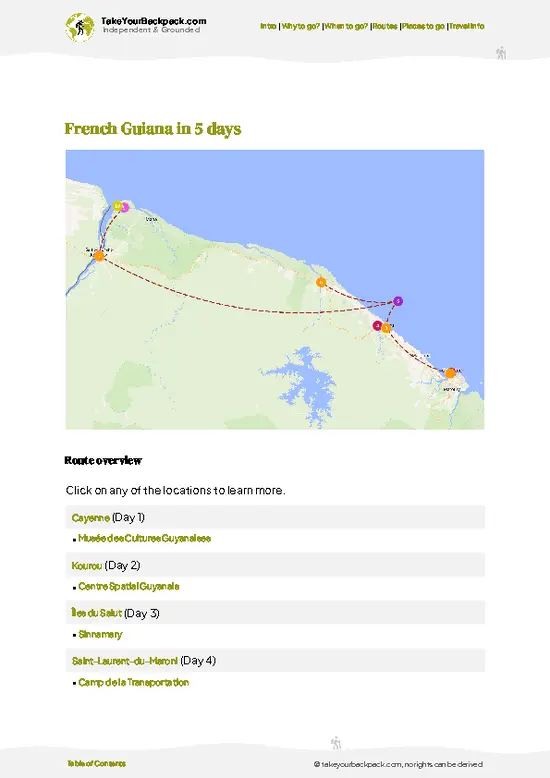
example page 0 from our offline Travel Guide for French Guiana
example page 1 from our offline Travel Guide for French Guiana
example page 2 from our offline Travel Guide for French Guiana
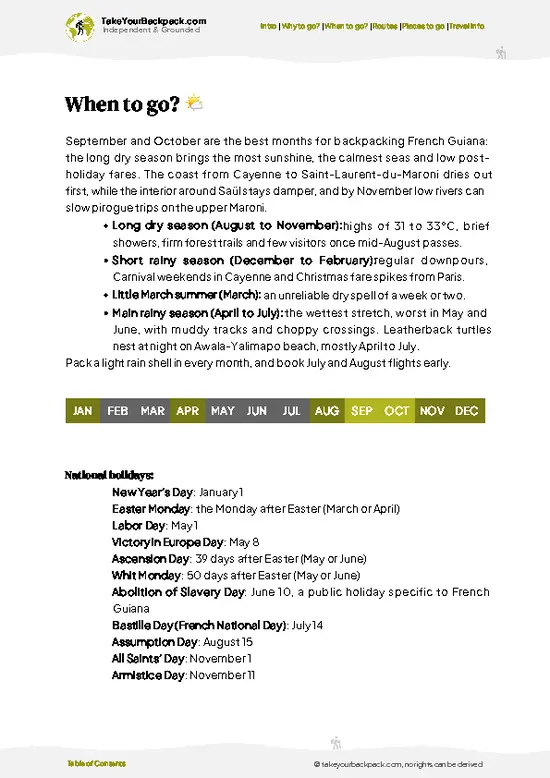
example page 3 from our offline Travel Guide for French Guiana
example page 4 from our offline Travel Guide for French Guiana
example page 5 from our offline Travel Guide for French Guiana
example page 6 from our offline Travel Guide for French Guiana
example page 7 from our offline Travel Guide for French Guiana
Loading the map 🌍
CLICK TO FILTER
towns
villages
landmarks
national parks
hikes
beaches
attractions
festivals
SHOW COUNTRY’S BESTSHOW ALL

✨ Why go?
Ranked #5 national park in French Guiana
The unique appeal for travelers

Trésor Nature Reserve suits backpackers who want primary rainforest without paying for a guided expedition. The reserve covers about 2,464 hectares of forested hills, and its hilltop setting gives it a cooler, wetter climate than the coast, with a different mix of plants. You can wander its marked paths on your own, which is rare in a territory where most jungle access means a boat, a guide and a firm schedule. The short, signed botanical trail of about 1.75 km means a first-timer can feel confident within minutes of leaving the car. Staying overnight turns the visit into something richer, since the forest changes completely after dusk, with frogs, insects and night birds taking over. If you like unhurried self-guided walking and hate crowds, this fits. If you want big mammals on demand, look elsewhere.

💡 HighlightsTop highlights of Trésor Nature Reserve

  1. Primary rainforest canopy: Tall, closed forest on the hills, with buttress roots, lianas and a constantly dripping, cool understory.
  2. Orchids and bromeliads: The wet plateau supports epiphytes clinging to trunks and branches, best seen close along the paths.
  3. Frog chorus at night: After dark the forest fills with calls, and a headlamp reveals tree frogs on leaves beside the trail.
  4. Birdlife: Toucans, manakins and trogons call from the canopy, with early morning the best time to spot them.
  5. Primates and sloths: Howler and capuchin monkeys, plus the occasional sloth, can turn up overhead if you move slowly and quietly.
  6. Streams and small cascades: Clear creeks cross the lower trails, giving cool stops and sounds that mask the insect hum.
  7. Hilltop viewpoints: Gaps in the forest on higher ground open onto
… read more 👉
  1. Primary rainforest canopy: Tall, closed forest on the hills, with buttress roots, lianas and a constantly dripping, cool understory.
  2. Orchids and bromeliads: The wet plateau supports epiphytes clinging to trunks and branches, best seen close along the paths.
  3. Frog chorus at night: After dark the forest fills with calls, and a headlamp reveals tree frogs on leaves beside the trail.
  4. Birdlife: Toucans, manakins and trogons call from the canopy, with early morning the best time to spot them.
  5. Primates and sloths: Howler and capuchin monkeys, plus the occasional sloth, can turn up overhead if you move slowly and quietly.
  6. Streams and small cascades: Clear creeks cross the lower trails, giving cool stops and sounds that mask the insect hum.
  7. Hilltop viewpoints: Gaps in the forest on higher ground open onto green waves of canopy rolling toward the Kaw-Roura hills.
Allow a full day to see the main walks, or an overnight stay to include the evening forest.
Spotted a mistake or missing something? Contact us.

🌤️ When to go?Choosing the right time of year

  • Long Dry Season (August to November): The most reliable window, with little rain, 24 to 33°C (75 to 91°F) and firmer trails. Rivers and creeks run low, and Kaw-area visitors fill the few lodges at weekends.
  • Short Rainy Season (December to January): Showers come in bursts, usually 23 to 31°C (73 to 88°F). Trails stay passable and quiet.
  • Short Dry Spell (February to March): A brief break in the rain, often called the “little March summer.” Good for a shorter trip, with fewer people than autumn.
  • Main Rainy Season (April to July): Heavy downpours, mud and swollen creeks. Temperatures stay 23 to 30°C (73 to 86°F). Lodging is easy to get and often cheaper, but boat access and hiking are harder.
Daylight is almost constant at about 12 hours all year, so plan for dark by early evening. Book a guide or lodging a few weeks ahead for August to November.

source: climatestotravel.comJANJanuary: fair for travelingFEBFebruary: fair for travelingMARMarch: fair for travelingAPRApril: fair for travelingMAYMay: fair for travelingJUNJune: fair for travelingJULJuly: fair for travelingAUGAugust: highly recommended for travelingSEPSeptember: excellent for travelingOCTOctober: excellent for travelingNOVNovember: excellent for travelingDECDecember: highly recommended for traveling
french-guiana-national-park-tresor-nature-reserve
© Google | Angelina Caussé

✈️ The backpacker research shortcutFrench Guiana Travel Guide

An offline-friendly backpacking guide with optimized travel routes, ranked highlights, transport advice, and the best areas to stay.
example page 0 from our offline Travel Guide for French Guiana
example page 1 from our offline Travel Guide for French Guiana
example page 2 from our offline Travel Guide for French Guiana
example page 3 from our offline Travel Guide for French Guiana
example page 4 from our offline Travel Guide for French Guiana
example page 5 from our offline Travel Guide for French Guiana
example page 6 from our offline Travel Guide for French Guiana
example page 7 from our offline Travel Guide for French Guiana
The digital guide (130 pages) contains:
✅ 31 highlights, ranked by travel appeal
✅ Optimized 2, 3 & 5-day travel routes
✅ Cities, national parks, landmarks, beaches
✅ How to get around
✅ Offline-friendly for travel without Wi-Fi
👉 Click to see all 30+ guide features

📅 Plan smarter in minutes, not weeks
✅ Month by month travel advice
✅ Festivals & national holidays
✅ Budget expectations

🗺️ Go to the right places, skip the overrated ones
✅ Honest pros & cons of destinations
✅ Top hikes, parks & viewpoints
✅ Lesser-known places most travelers miss
✅ Clear “worth it vs skip it” guidance

🛏️ Travel smoothly without rookie mistakes
✅ Best areas to stay
✅ Transport systems explained simply
✅ Common scams & safety advice
✅ SIM cards, money & practical tips

🌍 Understand the country, not just visit it
✅ Culture & traditions
✅ 52 Essential phrases & customs
✅ Festivals worth planning around
✅ Traveler-friendly historical context
✅ Insights that make places more meaningful

📱 Built for real travel conditions
✅ Fully downloadable PDF
✅ Works completely offline
✅ Optimized for phone use
✅ Useful in remote areas & buses
✅ Everything in one place
Stop searching, start planning
Get instant access to your full guide. 30‑day money-back guarantee.
+ Add another guide for just

By proceeding you agree to our terms.
Sent to your inbox immediately after payment • 100% Secure Checkout
Best Backpacking Travel Advisor 2025 tourism awardBest Backpacking
Travel Advisor
2025
What others say about Take Your Backpack Guides:
⭐⭐⭐⭐⭐
Fantastic, amazing amount of information!
⭐⭐⭐⭐⭐
My goodness this is amazing, it's what I've been looking for hats off too you!
⭐⭐⭐⭐⭐
I think this is absolutely BRILLIANT
⭐⭐⭐⭐
Very complete and informative. It's still missing places, but I gotta to commend you
⭐⭐⭐⭐⭐
This is truly amazing, thank you, can't wait to explore it with my kids!
⭐⭐⭐⭐⭐
Awesome resource, thank you!
⭐⭐⭐⭐⭐
This is amazing! Can't wait to explore the ones I haven't seen
⭐⭐⭐⭐
I love this! Well done, great idea.
⭐⭐⭐⭐⭐
Thanks for taking the time to make this gem!
⭐⭐⭐⭐⭐
This might be the best website I've ever seen.
⭐⭐⭐⭐⭐
Congratulations, and thank you so much for your work; it's incredibly valuable.
⭐⭐⭐⭐
In all seriousness I think you did a great job pointing out the important spots
⭐⭐⭐⭐⭐
10/10 very good
⭐⭐⭐⭐⭐
As someone who's only just starting to visit regularly this is awesome, thank you.
⭐⭐⭐⭐
Thank you very much! I'm going to visit my dad, it's going to be very useful!
⭐⭐⭐⭐⭐
This is really cool! We'll be travelling for the first time and this definitely come in handy.
⭐⭐⭐⭐⭐
You are now our minister of culture, congratulations 👨‍💼
⭐⭐⭐⭐⭐
Just wanted to tell you that this is a pearl! Going to follow your recommendations.
⭐⭐⭐⭐⭐
This is so cool. I'll definitely be using the resource for my travels soon.
⭐⭐⭐⭐⭐
This is very impressive! Good work.
⭐⭐⭐⭐⭐
This is an amazing and informative site. Very well done!

🛏️ Where to stay?Best areas to stay in French Guiana

There is no formal lodging inside Trésor Nature Reserve, so most backpackers sleep in Cayenne or in the Kaw and Roura area and visit by road. The reserve sits along the D6 Kaw road southeast of Cayenne, about 60 to 75 minutes by car, near the village of Roura.
Cayenne is the practical base. Budget guesthouses and small hotels run about €45 to 90 a night for a double, and hostel-style options are scarce. You can buy supplies at its markets and supermarkets before heading out.
Roura is closer, with a handful of guesthouses and family-run gîtes, usually €50 to 100 a night. It is quiet, and you need … read more 👉
There is no formal lodging inside Trésor Nature Reserve, so most backpackers sleep in Cayenne or in the Kaw and Roura area and visit by road. The reserve sits along the D6 Kaw road southeast of Cayenne, about 60 to 75 minutes by car, near the village of Roura.
Cayenne is the practical base. Budget guesthouses and small hotels run about €45 to 90 a night for a double, and hostel-style options are scarce. You can buy supplies at its markets and supermarkets before heading out.
Roura is closer, with a handful of guesthouses and family-run gîtes, usually €50 to 100 a night. It is quiet, and you need to arrange dinner in advance since restaurants are few.
For a night in the forest, look at ecolodges and carbets (open-sided shelters with hammock hooks) around Kaw and along the Approuague road. Hammock spots at carbets can cost about €8 to 20 a night, and you bring your own hammock and mosquito net. Book ahead, as many depend on a host or boat transfer. Sleeping in the reserve itself usually needs permission from the managing authority, so check before you go.

👛 Costs (as of 19 October 2026)How expensive it really is

A realistic budget for Trésor Nature Reserve is about €80 to 180 a day, with most of the cost coming from lodging and transport in this expensive part of France.
CategoryBudget RangeLocal Reality
Entrance fee€0Access to the reserve’s main trails is generally free, though a guided visit costs extra.
Accommodation (high season)€45 to 70Cayenne guesthouses or Roura gîtes; carbet hammock spots are cheaper at about €8 to 20.
Local transport€15 to 35Public transport is limited, so a rental car (about €40 to 70 a day, shared) or taxi is common for the road from Cayenne.
Food and supplies€20 to 35Supermarket food in Cayenne is pricey; a simple meal at a local snack bar or Creole cafe runs about €10 to 18.
Guide or activity€0 to 40Local guides charge about €30 to 80 a day, often split among a group.
Total
… read more 👉
A realistic budget for Trésor Nature Reserve is about €80 to 180 a day, with most of the cost coming from lodging and transport in this expensive part of France.
CategoryBudget RangeLocal Reality
Entrance fee€0Access to the reserve’s main trails is generally free, though a guided visit costs extra.
Accommodation (high season)€45 to 70Cayenne guesthouses or Roura gîtes; carbet hammock spots are cheaper at about €8 to 20.
Local transport€15 to 35Public transport is limited, so a rental car (about €40 to 70 a day, shared) or taxi is common for the road from Cayenne.
Food and supplies€20 to 35Supermarket food in Cayenne is pricey; a simple meal at a local snack bar or Creole cafe runs about €10 to 18.
Guide or activity€0 to 40Local guides charge about €30 to 80 a day, often split among a group.
Total Daily Budget€80 to 180About €100 a day at the midpoint for one traveler with some shared transport and a guide.
⚠️ Prices can change and everyone travels differently, so take this as a rough guide. Hope it helps you plan your adventure!

🥾 TrailsPlan your hike in Trésor Nature Reserve: routes, terrain, and sights

Trésor Nature Reserve offers short to moderate forest walks rather than long treks, so a fit visitor can cover the main routes in a day. Terrain is the real challenge: red clay that becomes slick after rain, steep stretches, roots and stream crossings. Humidity is heavy, so start early and carry more water than seems sensible.
  • Forest loops: Short marked walks from the entrance area, around 1 to 2 hours, easy to moderate, passing large trees, epiphytes and small streams.
  • Hill climbs: Steeper paths up to the ridge, around 2 to 3 hours return, moderate, with canopy views and the best chance of monkeys.
… read more 👉
Trésor Nature Reserve offers short to moderate forest walks rather than long treks, so a fit visitor can cover the main routes in a day. Terrain is the real challenge: red clay that becomes slick after rain, steep stretches, roots and stream crossings. Humidity is heavy, so start early and carry more water than seems sensible.
  • Forest loops: Short marked walks from the entrance area, around 1 to 2 hours, easy to moderate, passing large trees, epiphytes and small streams.
  • Hill climbs: Steeper paths up to the ridge, around 2 to 3 hours return, moderate, with canopy views and the best chance of monkeys.
  • Night walk: A slow evening stroll near the lodge, about an hour, easy, focused on frogs, insects and night sounds.
Wildlife is shy. Expect birds and frogs most reliably, with monkeys and sloths as a bonus. Public transport does not reach the reserve, so most visitors arrive by rental car or shared lift along the D6 road toward Kaw. Crowds are rarely a problem and you may have the paths to yourself on weekdays. An entrance fee is normally low or waived for walkers, but confirm locally. Wear long sleeves, bring insect repellent and keep your feet dry with quick-drying socks.
⚠️ Hiking info can sometimes be outdated or inaccurate. Before you hit the trail, check the latest conditions with locals. If you do spot anything that's off, I'd love to hear from you, so I can update it for fellow travelers.

🛡️ SafetyStaying Safe: What Travelers Should Know

Trésor is a manageable rainforest reserve, but the heat, humidity and mud make it harder than the distances suggest. Hike in the cool early morning, carry at least 2 to 3 liters of water per person and wear boots with grip, since roots and clay turn slick after rain. Trails are not always marked well, so go with a local guide or download an offline map and tell someone your route. Creeks can rise quickly in the wet months, so do not cross swollen water. Expect mosquitoes and ticks, and use repellent and long, light clothing. Snakes, caimans and jaguars exist but are rarely seen; watch your step, keep your distance and never feed animals. Dengue is present, so cover up at dusk. First-timers often underestimate how soaked they will get, so pack spare dry clothes in waterproof bags.

FAQTraveler FAQ

Plan on one full day for Trésor Nature Reserve, or two days if you want a guided hike and a night in a carbet nearby. The reserve lies roughly 60 to 75 minutes by road from Cayenne, so a day trip is realistic. Most walks take 2 to 5 hours, and adding a stop around Roura or Kaw fills a second day well.
Visiting Trésor Nature Reserve without a car is possible but slow. Buses and shared minibuses run from Cayenne toward Roura, a taxi from Cayenne costs roughly €60 to 100 each way, and you would still need a ride or a walk for the last stretch. Joining a guided tour or sharing a rental car, often around €40 to 70 a day, is far easier.
Trésor Nature Reserve generally has no fixed entrance fee for walking its main trails, so a basic visit costs €0. A guided visit usually costs about €30 to 80 a day per group, and overnight stays or group activities may need approval from the managing authority. Check with local tourism offices in Cayenne or Roura before you go, as rules and access can change.
⚠️ Things can change over time, so always validate details locally before you go.

Other French Guianese national parks near Trésor Nature Reserve

Explore more nearby:


💡 Not sure where to go next?
Create a personalized itinerary for French Guiana including Trésor Nature Reserve and the places that fit your trip.

Generate my itinerary

👉 Discover all national parks

Or checkout all French Guiana has to offer (think cities, towns, villages, national parks, hikes, beaches, festivals)
Country photo of French Guiana

We 💚 feedbackParting advice and final tips

Trésor Nature Reserve is best for patient walkers who like listening more than ticking off animals, and for anyone happy with mud on their boots. I would sleep over, pack a headlamp and leave the schedule loose. Skip it if you need a fast, dry, guaranteed wildlife encounter.

✍️ Help improve this page!
The information on this page is based on in-depth research, insights shared by experienced travelers, and feedback from the local travel community in French Guiana. While every effort is made to keep the information accurate and current, conditions can change — so if you spot anything incorrect or outdated, please get in touch.


🙋‍♂️ Give feedback

👋 Meet the founderWho’s Behind Take Your Backpack?

Johan, backpacker and founder of TakeYourBackpackHi, I’m Johan (Netherlands 🇳🇱), the creator of TakeYourBackpack. Over the past 3 decades, I’ve backpacked through 90+ countries across six continents, gaining extensive experience with independent travel, long-term trips, and overland routes.

This site is built on a combination of firsthand travel experience and carefully curated insights from other backpackers. Many guides are based on places I’ve personally visited, while others bring together tips, observations, and practical advice shared by trusted travelers I’ve met along the way.

The goal is to provide realistic, experience-driven guidance — not generic itineraries — so you can explore destinations with better context, clearer expectations, and more confidence.