
×

French Polynesia🇵🇫 | festivalsHeiva i TahitiJudged troupes, ‘ōte’a and ‘aparima, outrigger races, tifaifai quilts | things to do and best time to go

Explore Festival of the ArtsExplore Marquesas Islands Festival

Backpacking in Heiva i Tahiti
🏆 Top pickfestival ranked #1
By Johan Kruseman 🇳🇱 | Updated October 15, 2026

Heiva i Tahiti is a judged competition between island dance and music troupes, with months of rehearsal behind each entry, and it runs as a season rather than a single night. It takes place in Papeete, French Polynesia’s capital on the northwest coast of Tahiti, and the main stage sits on the waterfront at Place To’ata. Expect Polynesian drumming, chanting, hip-shaking ‘ōte’a dance, and a crowd made up mostly of Tahitian families who know every group by name. Sessions start in the evening, so arrive by late afternoon, claim a seat on the open stands, and bring a light layer because the breeze off the harbor cools things down. Traditional sports such as stone lifting and javelin throwing fill other days, and the festival usually spans late June through July. Buy tickets early for the big nights, then wander over to the roulottes on the quay for a plate of poisson cru before the last group comes on. Costumes of fresh leaves and flowers make the whole square smell green.

Discover everything you want to know in the 📖 French Polynesia Travel Guide.


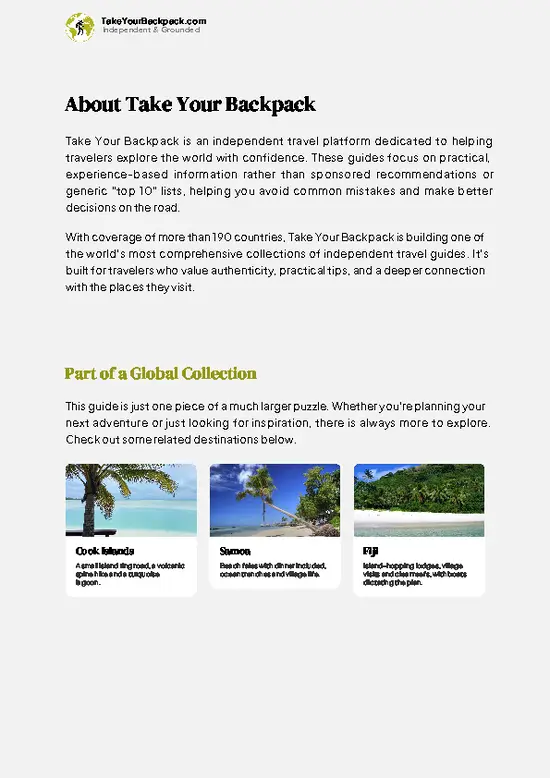
example page 0 from our offline Travel Guide for French Polynesia
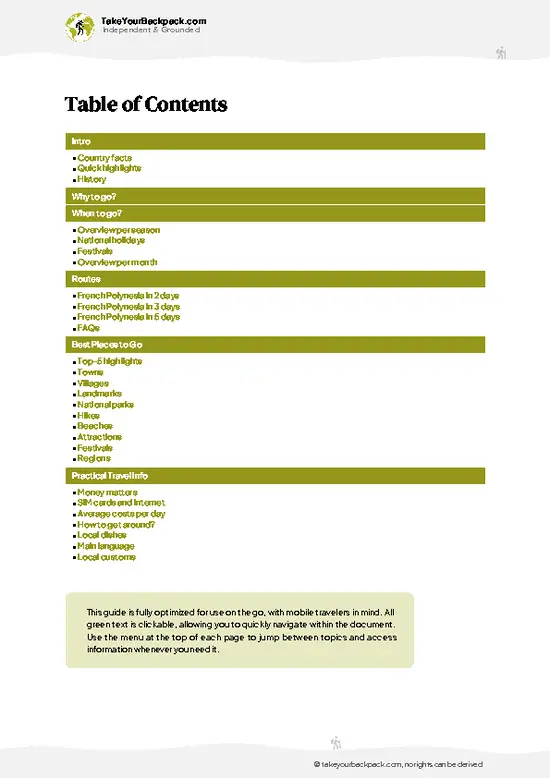
example page 1 from our offline Travel Guide for French Polynesia
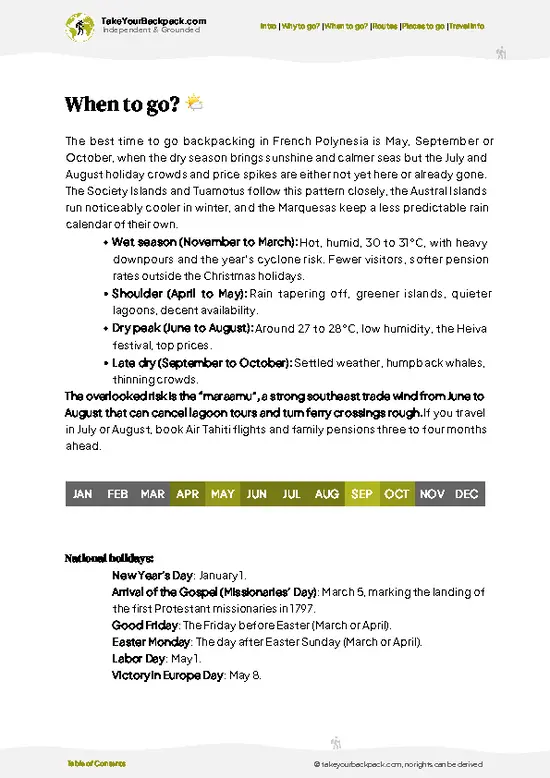
example page 2 from our offline Travel Guide for French Polynesia
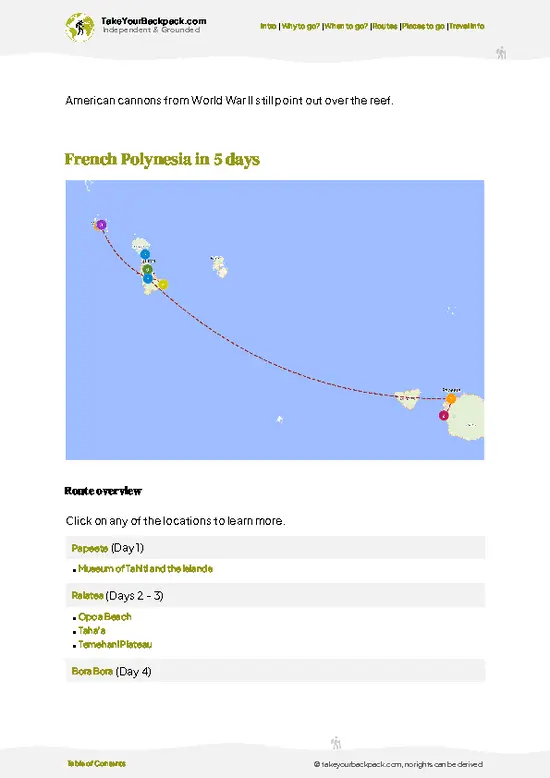
example page 3 from our offline Travel Guide for French Polynesia
example page 4 from our offline Travel Guide for French Polynesia
example page 5 from our offline Travel Guide for French Polynesia
example page 6 from our offline Travel Guide for French Polynesia
example page 7 from our offline Travel Guide for French Polynesia
Loading the map 🌍
CLICK TO FILTER
towns
villages
landmarks
national parks
hikes
beaches
attractions
festivals
regions
SHOW COUNTRY’S BESTSHOW ALL

✨ Why go?
Ranked #1 festival in French Polynesia
Why visitors keep coming back

Backpackers build a route around Heiva because it is the one time Tahiti feels like it belongs to Tahitians rather than honeymooners. Most of French Polynesia is priced for resort guests, yet here a ticket for a night of live performance costs far less than a resort show, and you watch the real thing: groups of 100 or more dancers and musicians telling island legends in Tahitian.

The social side is easy. You sit shoulder to shoulder with local families on the stands, trade guesses about who will win, and end up sharing food at the roulottes on the Papeete waterfront. Strangers explain the meaning of a chant if you ask. Because the festival covers about a month, it also fits neatly into a longer Pacific trip, a few nights in Papeete before or after Moorea or the outer islands.

The timing … read more 👉
Backpackers build a route around Heiva because it is the one time Tahiti feels like it belongs to Tahitians rather than honeymooners. Most of French Polynesia is priced for resort guests, yet here a ticket for a night of live performance costs far less than a resort show, and you watch the real thing: groups of 100 or more dancers and musicians telling island legends in Tahitian.

The social side is easy. You sit shoulder to shoulder with local families on the stands, trade guesses about who will win, and end up sharing food at the roulottes on the Papeete waterfront. Strangers explain the meaning of a chant if you ask. Because the festival covers about a month, it also fits neatly into a longer Pacific trip, a few nights in Papeete before or after Moorea or the outer islands.

The timing matters too. Heiva coincides with the July holiday season, when the whole island is in party mode, so the energy extends beyond the stage into the streets, the lagoon, and the craft stalls.

💡 HighlightsWhat this place is best known for

  1. Dance and song competitions at Place To’ata: The centerpiece of the festival. Troupes perform original pieces built around a legend or historic theme, judged on choreography, costume, music, and storytelling. The nights with the top categories are the most dramatic, with drummers hammering out rhythm in unison.
  2. ‘Ōte’a and ‘aparima performances: The fast, hip-swiveling ‘ōte’a is the one you picture, driven by wooden toere drums. ‘Aparima is slower and tells a story with the hands. Seeing the two side by side shows how much range Tahitian dance has.
  3. Traditional sports competitions: Stone lifting, javelin throwing at a coconut atop a tall pole, coconut husking, and copra splitting are contested with real pride. The stone lifts, with athletes hoisting boulders of well over 100 kilograms onto their
… read more 👉
  1. Dance and song competitions at Place To’ata: The centerpiece of the festival. Troupes perform original pieces built around a legend or historic theme, judged on choreography, costume, music, and storytelling. The nights with the top categories are the most dramatic, with drummers hammering out rhythm in unison.
  2. ‘Ōte’a and ‘aparima performances: The fast, hip-swiveling ‘ōte’a is the one you picture, driven by wooden toere drums. ‘Aparima is slower and tells a story with the hands. Seeing the two side by side shows how much range Tahitian dance has.
  3. Traditional sports competitions: Stone lifting, javelin throwing at a coconut atop a tall pole, coconut husking, and copra splitting are contested with real pride. The stone lifts, with athletes hoisting boulders of well over 100 kilograms onto their shoulders, are the most dramatic to watch.
  4. Va’a outrigger canoe racing: Paddlers race outriggers on the Papeete lagoon, a reminder that the canoe is central to Polynesian identity. Watching from the shoreline, with Moorea on the horizon, makes a good afternoon between evening shows.
  5. Heiva Rima’i craft exhibition: Artisans display tifaifai quilts, woven pandanus, wood and bone carving, and tapa cloth, and you can buy directly from the makers. It is a more affordable way to bring home something authentic than the tourist shops on the main drag.
Most visitors skip the craft exhibition, yet it is where you can speak with the people who make the fiber costumes and carvings you saw onstage the night before.
Spotted a mistake or missing something? Contact us.

Things to do around Heiva i Tahiti

Ratings based on Tripadvisor reviews. When you book through this link, you support our work at no extra cost to you.

🌤️ When to go?When is the celebration of Heiva i Tahiti?

Heiva i Tahiti runs from late June through July, about three to four weeks, with dance and song competitions at the To’ata Square amphitheater in Pape’ete and sports events (outrigger racing, stone lifting, javelin throwing) staged at other sites around the island.
  • Best nights: Competition nights in the first half of the run draw the big dance groups, and the final awards evenings are the most packed. Weeknight sessions are easier for finding a good seat.
  • Weather: Expect dry, breezy evenings of roughly 20 to 28°C (68 to 82°F), with sunset around 5:30 pm. Bring a light sweater for the open-air stands, a rain shell for the odd shower, and a cushion for the benches.
  • Booking: Buy tickets a few weeks ahead for the popular evenings. July is high season, so book guesthouses and flights from Europe and
… read more 👉
Heiva i Tahiti runs from late June through July, about three to four weeks, with dance and song competitions at the To’ata Square amphitheater in Pape’ete and sports events (outrigger racing, stone lifting, javelin throwing) staged at other sites around the island.
  • Best nights: Competition nights in the first half of the run draw the big dance groups, and the final awards evenings are the most packed. Weeknight sessions are easier for finding a good seat.
  • Weather: Expect dry, breezy evenings of roughly 20 to 28°C (68 to 82°F), with sunset around 5:30 pm. Bring a light sweater for the open-air stands, a rain shell for the odd shower, and a cushion for the benches.
  • Booking: Buy tickets a few weeks ahead for the popular evenings. July is high season, so book guesthouses and flights from Europe and the US two to four months out; rooms in Pape’ete can cost 20 to 40 percent more.
  • Crowds and roads: Traffic on the waterfront jams before each show, so arrive by 5 pm. Le Truck buses thin out late, so plan a taxi or a short walk back.
Book a room within walking distance of To’ata Square and you can skip the late-night transport scramble entirely.


source: climatestotravel.comJANJanuary: not recommended for travelingFEBFebruary: not recommended for travelingMARMarch: not recommended for travelingAPRApril: not recommended for travelingMAYMay: not recommended for travelingJUNJune: not recommended for travelingJULJuly: excellent for travelingAUGAugust: not recommended for travelingSEPSeptember: not recommended for travelingOCTOctober: not recommended for travelingNOVNovember: not recommended for travelingDECDecember: not recommended for traveling

✈️ The backpacker research shortcutFrench Polynesia Travel Guide

An offline-friendly backpacking guide with optimized travel routes, ranked highlights, transport advice, and the best areas to stay.
example page 0 from our offline Travel Guide for French Polynesia
example page 1 from our offline Travel Guide for French Polynesia
example page 2 from our offline Travel Guide for French Polynesia
example page 3 from our offline Travel Guide for French Polynesia
example page 4 from our offline Travel Guide for French Polynesia
example page 5 from our offline Travel Guide for French Polynesia
example page 6 from our offline Travel Guide for French Polynesia
example page 7 from our offline Travel Guide for French Polynesia
The digital guide (149 pages) contains:
✅ 41 highlights, ranked by travel appeal
✅ Optimized 2, 3 & 5-day travel routes
✅ Cities, national parks, landmarks, beaches
✅ How to get around
✅ Offline-friendly for travel without Wi-Fi
👉 Click to see all 30+ guide features

📅 Plan smarter in minutes, not weeks
✅ Month by month travel advice
✅ Festivals & national holidays
✅ Budget expectations

🗺️ Go to the right places, skip the overrated ones
✅ Honest pros & cons of destinations
✅ Top hikes, parks & viewpoints
✅ Lesser-known places most travelers miss
✅ Clear “worth it vs skip it” guidance

🛏️ Travel smoothly without rookie mistakes
✅ Best areas to stay
✅ Transport systems explained simply
✅ Common scams & safety advice
✅ SIM cards, money & practical tips

🌍 Understand the country, not just visit it
✅ Culture & traditions
✅ 52 Essential phrases & customs
✅ Festivals worth planning around
✅ Traveler-friendly historical context
✅ Insights that make places more meaningful

📱 Built for real travel conditions
✅ Fully downloadable PDF
✅ Works completely offline
✅ Optimized for phone use
✅ Useful in remote areas & buses
✅ Everything in one place
Stop searching, start planning
Get instant access to your full guide. 30‑day money-back guarantee.
+ Add another guide for just

By proceeding you agree to our terms.
Sent to your inbox immediately after payment • 100% Secure Checkout
Best Backpacking Travel Advisor 2025 tourism awardBest Backpacking
Travel Advisor
2025
What others say about Take Your Backpack Guides:
⭐⭐⭐⭐⭐
Fantastic, amazing amount of information!
⭐⭐⭐⭐⭐
My goodness this is amazing, it's what I've been looking for hats off too you!
⭐⭐⭐⭐⭐
I think this is absolutely BRILLIANT
⭐⭐⭐⭐
Very complete and informative. It's still missing places, but I gotta to commend you
⭐⭐⭐⭐⭐
This is truly amazing, thank you, can't wait to explore it with my kids!
⭐⭐⭐⭐⭐
Awesome resource, thank you!
⭐⭐⭐⭐⭐
This is amazing! Can't wait to explore the ones I haven't seen
⭐⭐⭐⭐
I love this! Well done, great idea.
⭐⭐⭐⭐⭐
Thanks for taking the time to make this gem!
⭐⭐⭐⭐⭐
This might be the best website I've ever seen.
⭐⭐⭐⭐⭐
Congratulations, and thank you so much for your work; it's incredibly valuable.
⭐⭐⭐⭐
In all seriousness I think you did a great job pointing out the important spots
⭐⭐⭐⭐⭐
10/10 very good
⭐⭐⭐⭐⭐
As someone who's only just starting to visit regularly this is awesome, thank you.
⭐⭐⭐⭐
Thank you very much! I'm going to visit my dad, it's going to be very useful!
⭐⭐⭐⭐⭐
This is really cool! We'll be travelling for the first time and this definitely come in handy.
⭐⭐⭐⭐⭐
You are now our minister of culture, congratulations 👨‍💼
⭐⭐⭐⭐⭐
Just wanted to tell you that this is a pearl! Going to follow your recommendations.
⭐⭐⭐⭐⭐
This is so cool. I'll definitely be using the resource for my travels soon.
⭐⭐⭐⭐⭐
This is very impressive! Good work.
⭐⭐⭐⭐⭐
This is an amazing and informative site. Very well done!

🛏️ Where to stay?Where staying makes the most sense

Pape’ete itself is the smartest base, because the main shows at To’ata Square sit on the waterfront and you can walk to them from most central streets. Staying in the town center puts you near the Le Truck stops, the municipal market, supermarkets and cheap food trucks, and you can get home after the late finish without a taxi hunt. It is also where solo travelers tend to cross paths, with guesthouses and dorm-style lodgings that have shared kitchens and common rooms, so you can find people to split rides and tickets with.
The streets around the market and the harbor are lively and generally fine … read more 👉
Pape’ete itself is the smartest base, because the main shows at To’ata Square sit on the waterfront and you can walk to them from most central streets. Staying in the town center puts you near the Le Truck stops, the municipal market, supermarkets and cheap food trucks, and you can get home after the late finish without a taxi hunt. It is also where solo travelers tend to cross paths, with guesthouses and dorm-style lodgings that have shared kitchens and common rooms, so you can find people to split rides and tickets with.
The streets around the market and the harbor are lively and generally fine at night in a group, but stay alert on quieter side streets after the shows and avoid wandering alone late along dark stretches of the waterfront.
For a calmer option, look at Fa’a’a on the west side near the airport, about 10 to 15 minutes from the center by car. It suits late arrivals and early departures, and it has a handful of pensions and a few places to eat.
Punaauia, 15 to 20 minutes west of town, offers guesthouses with kitchens and better beach access, at a slightly higher price and with less of a social scene. You will want to use taxis or rent a car for evening shows from there, as Le Truck service runs thin at night.
Book early for July, since the best-value central beds disappear first.

👛 Costs (as of 15 October 2026)How expensive it really is

A day at Heiva i Tahiti runs about €118 for an independent traveler in high season, with the performances themselves the smallest part of the bill.
CategoryBudget RangeLocal Reality
Festival tickets€8 to 25Evening shows at the To’ata Square amphitheater in Papeete are ticketed, with standing or bleacher seats at the low end and reserved seats higher. The best dance and song competition nights sell out first. Some daytime events, such as the traditional sports and stone lifting, are free or cost very little.
Accommodation€35 to 90A dorm bed or basic guesthouse room in Papeete or nearby Pirae costs €35 to 55 in July. Private rooms and pensions with kitchens run €65 to 90. Prices climb during the festival weeks, and you pay in Pacific francs or by card.
Local transport€3 to 12Le Truck buses around
… read more 👉
A day at Heiva i Tahiti runs about €118 for an independent traveler in high season, with the performances themselves the smallest part of the bill.
CategoryBudget RangeLocal Reality
Festival tickets€8 to 25Evening shows at the To’ata Square amphitheater in Papeete are ticketed, with standing or bleacher seats at the low end and reserved seats higher. The best dance and song competition nights sell out first. Some daytime events, such as the traditional sports and stone lifting, are free or cost very little.
Accommodation€35 to 90A dorm bed or basic guesthouse room in Papeete or nearby Pirae costs €35 to 55 in July. Private rooms and pensions with kitchens run €65 to 90. Prices climb during the festival weeks, and you pay in Pacific francs or by card.
Local transport€3 to 12Le Truck buses around Papeete cost about €1.50 to 2 a ride and run less often in the evening. Taxis are expensive, roughly €10 to 20 for a short evening hop, so many travelers walk from central lodging to the venue.
Food & drinks€20 to 40Roulottes (food trucks) on Place Vaiete serve steak frites, chow mein and poisson cru for about €10 to 15 a plate. Groceries cut costs. A beer at a bar is €5 to 7, and festival stalls charge a bit more than the roulottes.
Miscellaneous expenses€8 to 25Sunscreen, a rain jacket, a SIM card or water. Handicraft stalls add pareo and monoi oil purchases at €10 to 25 each. Cash is useful at small stalls.
Total Daily Budget€118Based on one day at mid-range of each row, with accommodation counted at its high-season rate.
⚠️ Prices can change and everyone travels differently, so take this as a rough guide. Hope it helps you plan your adventure!

🍲 FoodEating & Drinking in Heiva i Tahiti

Around the venues and along the Pape’ete waterfront, the roulottes (food trucks) are the cheapest and most atmospheric way to eat. Their plastic tables fill up after sunset, and the menus run from poisson cru (raw tuna marinated in lime juice and coconut milk) to grilled steak with fries, chow mein and Chinese-style dishes such as sweet and sour pork.
At festival stalls and in the market, try fafaru if you are brave (fermented fish with a strong smell), poe (a sweet fruit pudding served with coconut cream) and fresh coconut bread. Many of the heiva villages and sports events also serve a ma’a Tahiti spread, where pork, taro, breadfruit and fe’i bananas come out of an underground oven (ahima’a). That smoky, earthy flavor is the real taste of the islands.
For drinks, go for cold Hinano beer, fresh … read more 👉
Around the venues and along the Pape’ete waterfront, the roulottes (food trucks) are the cheapest and most atmospheric way to eat. Their plastic tables fill up after sunset, and the menus run from poisson cru (raw tuna marinated in lime juice and coconut milk) to grilled steak with fries, chow mein and Chinese-style dishes such as sweet and sour pork.
At festival stalls and in the market, try fafaru if you are brave (fermented fish with a strong smell), poe (a sweet fruit pudding served with coconut cream) and fresh coconut bread. Many of the heiva villages and sports events also serve a ma’a Tahiti spread, where pork, taro, breadfruit and fe’i bananas come out of an underground oven (ahima’a). That smoky, earthy flavor is the real taste of the islands.
For drinks, go for cold Hinano beer, fresh juices from pineapple, passion fruit and grapefruit, and straight coconut water sold from the shell. Rum cocktails appear at some stalls, but alcohol is pricey.
Bring cash in Pacific francs (XPF), because small stalls and trucks rarely take cards. Servings are generous, so sharing a plate is common and nobody minds. Lines get long right before the shows, so eat early or grab something between acts. Meals typically cost 1,200 to 2,500 XPF (US$11 to 23).

FAQCommon questions from travelers

Heiva i Tahiti takes place from late June through July, usually running about three to four weeks. The main dance and song competitions are held in the evenings at the To’ata Square amphitheater in Pape’ete, while sports events like outrigger races and stone lifting happen at other sites around the island. Exact dates change each year, so check the program published by Tahiti Tourisme before you book flights.
Attending costs roughly US$130 to 270 per day for a budget traveler, with accommodation taking the largest share at about US$70 to 130 a night in high season. Tickets for the To’ata Square shows run about 1,000 to 3,000 XPF (US$10 to 30), and roulotte meals cost about 1,200 to 2,500 XPF (US$11 to 23). Many sports events and village activities are free to watch.
Yes, buy tickets in advance for the popular competition nights at To’ata Square, especially the final evenings, because the best seats sell out. Tickets can usually be purchased online or at sales points in Pape’ete a few weeks before the event, and they cost about 1,000 to 3,000 XPF. Free events, such as many sports contests and village demonstrations, need no ticket.
⚠️ Things can change over time, so always validate details locally before you go.

Other French Polynesian festivals near Heiva i Tahiti

Explore more nearby:


💡 Not sure where to go next?
Create a personalized itinerary for French Polynesia including Heiva i Tahiti and the places that fit your trip.

Generate my itinerary

👉 Discover all festivals

Or checkout all French Polynesia has to offer (think cities, towns, villages, national parks, hikes, beaches, festivals)
Country photo of French Polynesia

We 💚 feedbackFinal thoughts on celebrating the Heiva i Tahiti

Heiva i Tahiti suits travelers who like watching craft up close: dancers, drummers and singers who rehearse for months, then perform as neighbors from the same district. If you want a beach party with a headliner, look elsewhere. If you enjoy hearing a to’ere log drum shake your ribs and seeing a pareu dyed with local plants, you’ll be happy here. I’d buy the cheaper tickets, arrive early for a seat with a clear view, and bring a light layer for the late evening breeze. Pack a seat cushion too, since the wooden benches get hard by the third group.

✍️ Help improve this page!
The information on this page is based on in-depth research, insights shared by experienced travelers, and feedback from the local travel community in French Polynesia. While every effort is made to keep the information accurate and current, conditions can change — so if you spot anything incorrect or outdated, please get in touch.


🙋‍♂️ Give feedback

👋 Meet the founderWho’s Behind Take Your Backpack?

Johan, backpacker and founder of TakeYourBackpackHi, I’m Johan (Netherlands 🇳🇱), the creator of TakeYourBackpack. Over the past 3 decades, I’ve backpacked through 90+ countries across six continents, gaining extensive experience with independent travel, long-term trips, and overland routes.

This site is built on a combination of firsthand travel experience and carefully curated insights from other backpackers. Many guides are based on places I’ve personally visited, while others bring together tips, observations, and practical advice shared by trusted travelers I’ve met along the way.

The goal is to provide realistic, experience-driven guidance — not generic itineraries — so you can explore destinations with better context, clearer expectations, and more confidence.