×

The Gambia🇬🇲 | national parksMakasutu Culture ForestKapok giants, creek canoe, palm wine, drumming nights | things to do and best time to go

Explore River Gambia Estuary TrailExplore Tanbi Wetland National Park

Backpacking in Makasutu Culture Forest
🏆 Top picknational park ranked #1
By Johan Kruseman 🇳🇱 | Updated October 22, 2026

Makasutu Culture Forest sits close enough to the coast that you can reach it in under an hour from the Kotu and Senegambia hotel strip, which makes it the easiest real patch of forest in the country. It lies in the west of the Gambia, on the south bank of the River Gambia near Brikama and the village of Kankurang. Expect a private reserve of roughly 500 hectares, not a wilderness park, with guided walks, a mangrove creek and a few built-in showpieces. Crowds arrive in late morning on organized excursions, so book the first slot or go after lunch. Entry costs more than the sticker suggests once extras stack up, so confirm what your package includes before paying twice. Taxis wait to overcharge on the way back, so agree a return fare at the gate. Midday heat is heavy, mosquitoes gather in the mangroves at dusk, and sandals are a poor choice on root-tangled paths. The reward is shade, birdsong and the smell of damp earth, with palm wine tasted beneath ancient kapok trees.

Discover everything you want to know in the 📖 The Gambia Travel Guide.
Best time to go: November - May
Daily cost: US$54 to 101
Duration: 3 to 4 hours
Distance: 10 kilometers
Total ascent: 0 meters


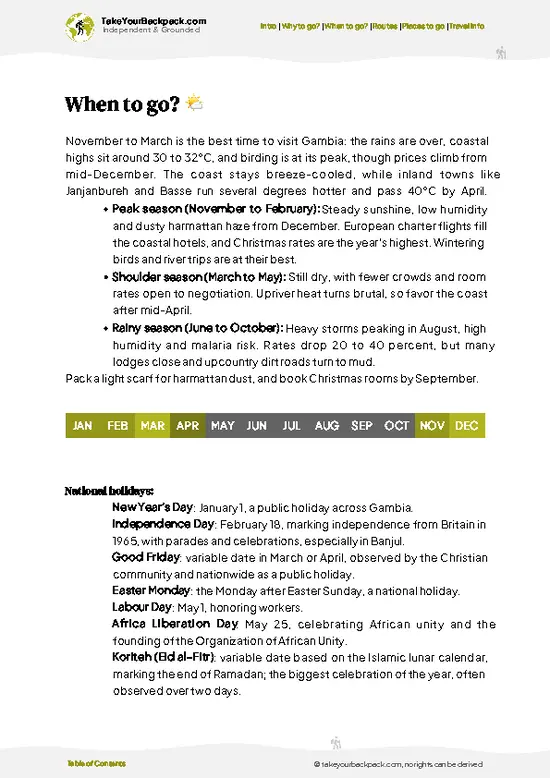
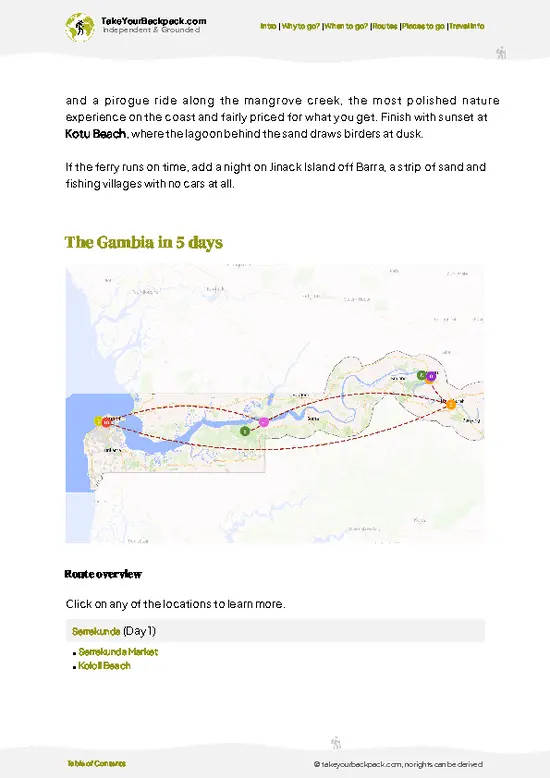
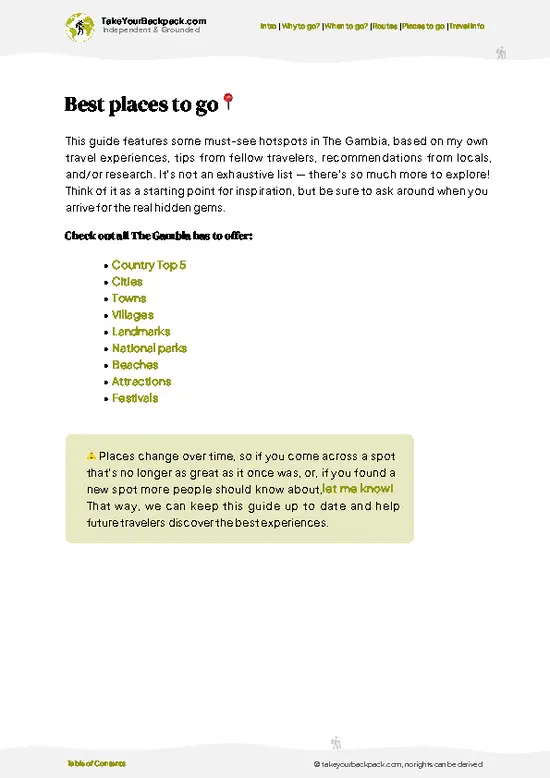
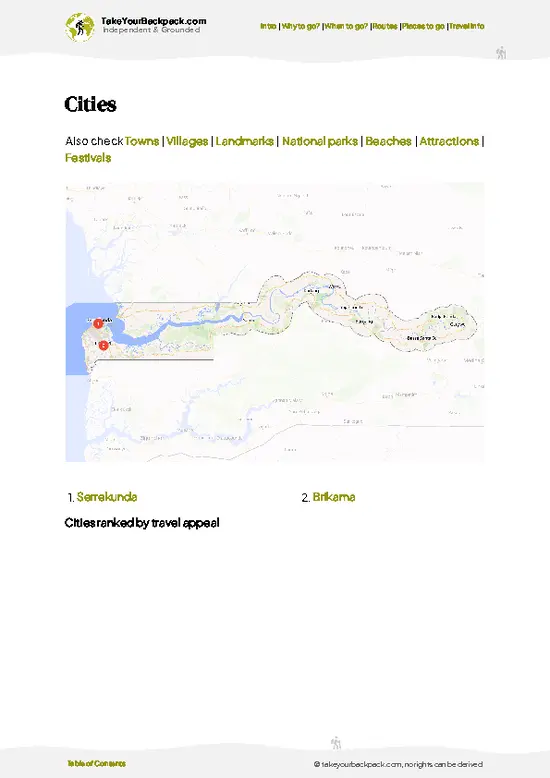
example page 0 from our offline Travel Guide for Gambia
example page 1 from our offline Travel Guide for Gambia
example page 2 from our offline Travel Guide for Gambia
example page 3 from our offline Travel Guide for Gambia
example page 4 from our offline Travel Guide for Gambia
example page 5 from our offline Travel Guide for Gambia
example page 6 from our offline Travel Guide for Gambia
example page 7 from our offline Travel Guide for Gambia
Loading the map 🌍
CLICK TO FILTER
cities
towns
villages
landmarks
national parks
beaches
attractions
festivals
SHOW COUNTRY’S BESTSHOW ALL

✨ Why go?
Ranked #1 national park in The Gambia
What sets this place apart

Makasutu Culture Forest works for backpackers who want a green day away from the beach without arranging a full tour of the interior. Its biggest draw is the mangrove canoe trip on the Mandina Bolong, where a paddler poles a dugout through channels so narrow the branches brush your shoulders. Kingfishers, fish eagles and monitor lizards turn up often, and the water goes silent apart from drips and the odd splash. The second reason is the guided walk through the forest of palms, giant kapoks and baobabs, where local guides explain which leaves cure which ailments and how villagers use the bush. That hands-on knowledge is hard to get on your own on the coast. The third is the evening sessions with drummers and dancers, which stage music and masked performances in the dark under lantern light. … read more 👉
Makasutu Culture Forest works for backpackers who want a green day away from the beach without arranging a full tour of the interior. Its biggest draw is the mangrove canoe trip on the Mandina Bolong, where a paddler poles a dugout through channels so narrow the branches brush your shoulders. Kingfishers, fish eagles and monitor lizards turn up often, and the water goes silent apart from drips and the odd splash. The second reason is the guided walk through the forest of palms, giant kapoks and baobabs, where local guides explain which leaves cure which ailments and how villagers use the bush. That hands-on knowledge is hard to get on your own on the coast. The third is the evening sessions with drummers and dancers, which stage music and masked performances in the dark under lantern light. It is a managed, guided place, so independent roaming is limited, but that is also what keeps it relaxed: you turn up, follow a guide, and finish with something cold to drink. Plan a half day and bring insect repellent.

💡 HighlightsEssential experiences to have while exploring Makasutu Culture Forest

  1. Mandina Bolong mangrove canoe trip: the signature experience. A boatman paddles you through winding tidal creeks lined with mangrove roots, with herons, kingfishers and sometimes monitor lizards along the banks. Allow around an hour.
  2. Guided forest walk: a loop under oil palms, rubber vines and silk-cotton trees led by local guides who point out medicinal plants and explain traditional uses. The ground is soft, shaded and humid.
  3. The giant kapok and baobab trees: some trunks are wide enough that several people can stand in their buttress roots. Their size makes them an easy photo stop and a cool place to rest.
  4. Birdwatching: the mix of forest, palm and creek draws species such as hornbills, bee-eaters, weavers and the occasional fish eagle. Early morning gives the most activity, and a guide helps
… read more 👉
  1. Mandina Bolong mangrove canoe trip: the signature experience. A boatman paddles you through winding tidal creeks lined with mangrove roots, with herons, kingfishers and sometimes monitor lizards along the banks. Allow around an hour.
  2. Guided forest walk: a loop under oil palms, rubber vines and silk-cotton trees led by local guides who point out medicinal plants and explain traditional uses. The ground is soft, shaded and humid.
  3. The giant kapok and baobab trees: some trunks are wide enough that several people can stand in their buttress roots. Their size makes them an easy photo stop and a cool place to rest.
  4. Birdwatching: the mix of forest, palm and creek draws species such as hornbills, bee-eaters, weavers and the occasional fish eagle. Early morning gives the most activity, and a guide helps with spotting.
  5. Monkey and wildlife sightings: green vervet monkeys and red colobus are possible in the canopy, while the creeks hold small fish and crabs. Sightings are never guaranteed, but patience in quiet spots helps.
  6. Traditional drumming and dancing: evening and special-event performances feature djembe rhythms and dancers, with masked figures drawn from local customs. Lantern light and the drum thud inside the forest give it atmosphere.
  7. Palm wine and village crafts stop: a short taste of fresh palm wine, sweet and slightly fizzy, plus small displays of local crafts and traditional cooking. Bring small change if you want to buy.
Start with the Mandina Bolong canoe trip, because the water is calmest, the light softest and the birds most active early in the day, before tour groups arrive and the heat builds.
Spotted a mistake or missing something? Contact us.

Things to do near Makasutu Culture Forest

Ratings based on Tripadvisor reviews. When you book through this link, you support our work at no extra cost to you.

🌤️ When to go?Weather, crowds, and seasonal trade-offs

November to February is the most comfortable window for Makasutu Culture Forest, with dry days and cool mornings.
  • Cool Dry Season (Nov to Feb): Days reach 30 to 34°C (86 to 93°F), nights drop to 16 to 20°C (61 to 68°F) and the sky stays clear. Daylight runs about 11 hours. Tour groups arrive in numbers, and lodge rates are at their highest.
  • Hot Dry Season (Mar to May): Afternoons climb to 35 to 40°C (95 to 104°F) with harmattan haze. Forest paths and the mangrove creek are best at first light. Crowds thin and some lodges discount.
  • Rainy Season (Jun to Oct): Highs of 30 to 33°C (86 to 91°F), high humidity and heavy downpours, with August the wettest. The forest turns thick and green, birdlife is lively, mosquitoes multiply and some tracks turn muddy. Prices drop most, and a few camps close.
  • Birding
… read more 👉
November to February is the most comfortable window for Makasutu Culture Forest, with dry days and cool mornings.
  • Cool Dry Season (Nov to Feb): Days reach 30 to 34°C (86 to 93°F), nights drop to 16 to 20°C (61 to 68°F) and the sky stays clear. Daylight runs about 11 hours. Tour groups arrive in numbers, and lodge rates are at their highest.
  • Hot Dry Season (Mar to May): Afternoons climb to 35 to 40°C (95 to 104°F) with harmattan haze. Forest paths and the mangrove creek are best at first light. Crowds thin and some lodges discount.
  • Rainy Season (Jun to Oct): Highs of 30 to 33°C (86 to 91°F), high humidity and heavy downpours, with August the wettest. The forest turns thick and green, birdlife is lively, mosquitoes multiply and some tracks turn muddy. Prices drop most, and a few camps close.
  • Birding and Boat Trips: Mangrove canoe trips run year round, but low tides can shorten routes in the hot months.
Book a morning slot in any season, since the forest is coolest and the wildlife most active before 10 am.


source: climatestotravel.comJANJanuary: excellent for travelingFEBFebruary: excellent for travelingMARMarch: excellent for travelingAPRApril: excellent for travelingMAYMay: highly recommended for travelingJUNJune: fair for travelingJULJuly: fair for travelingAUGAugust: fair for travelingSEPSeptember: fair for travelingOCTOctober: fair for travelingNOVNovember: excellent for travelingDECDecember: excellent for traveling
gambia-national-park-makasutu-culture-forest
© Google |

✈️ The backpacker research shortcutThe Gambia Travel Guide

An offline-friendly backpacking guide with optimized travel routes, ranked highlights, transport advice, and the best areas to stay.
example page 0 from our offline Travel Guide for Gambia
example page 1 from our offline Travel Guide for Gambia
example page 2 from our offline Travel Guide for Gambia
example page 3 from our offline Travel Guide for Gambia
example page 4 from our offline Travel Guide for Gambia
example page 5 from our offline Travel Guide for Gambia
example page 6 from our offline Travel Guide for Gambia
example page 7 from our offline Travel Guide for Gambia
The digital guide (213 pages) contains:
✅ 50 highlights, ranked by travel appeal
✅ Optimized 2, 3 & 5-day travel routes
✅ Cities, national parks, landmarks, beaches
✅ How to get around
✅ Offline-friendly for travel without Wi-Fi
👉 Click to see all 30+ guide features

📅 Plan smarter in minutes, not weeks
✅ Month by month travel advice
✅ Festivals & national holidays
✅ Budget expectations

🗺️ Go to the right places, skip the overrated ones
✅ Honest pros & cons of destinations
✅ Top hikes, parks & viewpoints
✅ Lesser-known places most travelers miss
✅ Clear “worth it vs skip it” guidance

🛏️ Travel smoothly without rookie mistakes
✅ Best areas to stay
✅ Transport systems explained simply
✅ Common scams & safety advice
✅ SIM cards, money & practical tips

🌍 Understand the country, not just visit it
✅ Culture & traditions
✅ 52 Essential phrases & customs
✅ Festivals worth planning around
✅ Traveler-friendly historical context
✅ Insights that make places more meaningful

📱 Built for real travel conditions
✅ Fully downloadable PDF
✅ Works completely offline
✅ Optimized for phone use
✅ Useful in remote areas & buses
✅ Everything in one place
Stop searching, start planning
Get instant access to your full guide. 30‑day money-back guarantee.
+ Add another guide for just

By proceeding you agree to our terms.
Sent to your inbox immediately after payment • 100% Secure Checkout
Best Backpacking Travel Advisor 2025 tourism awardBest Backpacking
Travel Advisor
2025
What others say about Take Your Backpack Guides:
⭐⭐⭐⭐⭐
Fantastic, amazing amount of information!
⭐⭐⭐⭐⭐
My goodness this is amazing, it's what I've been looking for hats off too you!
⭐⭐⭐⭐⭐
I think this is absolutely BRILLIANT
⭐⭐⭐⭐
Very complete and informative. It's still missing places, but I gotta to commend you
⭐⭐⭐⭐⭐
This is truly amazing, thank you, can't wait to explore it with my kids!
⭐⭐⭐⭐⭐
Awesome resource, thank you!
⭐⭐⭐⭐⭐
This is amazing! Can't wait to explore the ones I haven't seen
⭐⭐⭐⭐
I love this! Well done, great idea.
⭐⭐⭐⭐⭐
Thanks for taking the time to make this gem!
⭐⭐⭐⭐⭐
This might be the best website I've ever seen.
⭐⭐⭐⭐⭐
Congratulations, and thank you so much for your work; it's incredibly valuable.
⭐⭐⭐⭐
In all seriousness I think you did a great job pointing out the important spots
⭐⭐⭐⭐⭐
10/10 very good
⭐⭐⭐⭐⭐
As someone who's only just starting to visit regularly this is awesome, thank you.
⭐⭐⭐⭐
Thank you very much! I'm going to visit my dad, it's going to be very useful!
⭐⭐⭐⭐⭐
This is really cool! We'll be travelling for the first time and this definitely come in handy.
⭐⭐⭐⭐⭐
You are now our minister of culture, congratulations 👨‍💼
⭐⭐⭐⭐⭐
Just wanted to tell you that this is a pearl! Going to follow your recommendations.
⭐⭐⭐⭐⭐
This is so cool. I'll definitely be using the resource for my travels soon.
⭐⭐⭐⭐⭐
This is very impressive! Good work.
⭐⭐⭐⭐⭐
This is an amazing and informative site. Very well done!

🛏️ Where to stay?Best areas to stay in The Gambia

Most backpackers sleep in the Brufut, Sanyang or Bakau area on the coast and visit Makasutu Culture Forest for a day, because lodging inside the reserve is limited to a few upmarket eco-lodges. Those lodges sit among the trees and creeks near Mandina, and they suit a one-night splurge rather than a tight budget.
Bakau, about 40 minutes by road away, has the best hostel-style choice, with simple guesthouses and family-run rooms near the fish market and the botanical garden, plus easy shared taxis to Serrekunda. Kololi and Senegambia Strip, the main tourist area, offer the widest range of mid-priced … read more 👉
Most backpackers sleep in the Brufut, Sanyang or Bakau area on the coast and visit Makasutu Culture Forest for a day, because lodging inside the reserve is limited to a few upmarket eco-lodges. Those lodges sit among the trees and creeks near Mandina, and they suit a one-night splurge rather than a tight budget.
Bakau, about 40 minutes by road away, has the best hostel-style choice, with simple guesthouses and family-run rooms near the fish market and the botanical garden, plus easy shared taxis to Serrekunda. Kololi and Senegambia Strip, the main tourist area, offer the widest range of mid-priced hotels and the most restaurants, but it is louder and busier with touts.
Brufut is quieter, with a beach, a few guesthouses and a short ride to the Tanji bird reserve. Sanyang suits anyone wanting a laid-back surf-and-beach stay with small camps and bungalows.
General rates run about US$15 to 30 for a basic room, US$40 to 90 for a mid-range hotel and US$120 or more for the forest eco-lodges. Book ahead from December to February. Many guesthouses can arrange a driver and a guide to the forest the same day.

👛 Costs (as of 22 October 2026)Money, prices, and spending tips

A day at Makasutu Culture Forest costs about US$54 to 101 per person, with the guided entry being the biggest expense.
CategoryBudget RangeLocal Reality
Entrance and guided tourUS$25 to 40Day packages usually include a guide, forest walk, creek canoe ride and a cultural performance. Rates vary with the tour operator.
Accommodation (high season)US$15 to 30Basic guesthouse on the coast in Bakau or Brufut. Inside the forest, eco-lodges start around US$120.
Accommodation (low season)US$10 to 20Rates fall during the rains, from June to October, and bargaining works.
Local transportUS$6 to 15Shared taxis to Serrekunda cost little, but a private taxi or driver to the forest and back costs more.
Food and suppliesUS$6 to 12Rice and fish dishes at local eateries cost US$2 to 4. Lunch at the forest cafe costs
… read more 👉
A day at Makasutu Culture Forest costs about US$54 to 101 per person, with the guided entry being the biggest expense.
CategoryBudget RangeLocal Reality
Entrance and guided tourUS$25 to 40Day packages usually include a guide, forest walk, creek canoe ride and a cultural performance. Rates vary with the tour operator.
Accommodation (high season)US$15 to 30Basic guesthouse on the coast in Bakau or Brufut. Inside the forest, eco-lodges start around US$120.
Accommodation (low season)US$10 to 20Rates fall during the rains, from June to October, and bargaining works.
Local transportUS$6 to 15Shared taxis to Serrekunda cost little, but a private taxi or driver to the forest and back costs more.
Food and suppliesUS$6 to 12Rice and fish dishes at local eateries cost US$2 to 4. Lunch at the forest cafe costs more.
Water and extrasUS$2 to 4Bottled water, repellent and small tips for guides and musicians.
Total Daily BudgetUS$54 to 101Covers one night in high season, with a guided visit, transport and food.
⚠️ Prices can change and everyone travels differently, so take this as a rough guide. Hope it helps you plan your adventure!

🥾 TrailsBest hikes in Makasutu Culture Forest national park

Makasutu Culture Forest is organized around short guided routes rather than long, signed backcountry trails, so most visitors cover the park on foot and by canoe in a half day. The ground is flat, shaded and often damp, with roots, sandy patches and sticky mud near the creeks.
  • Forest nature walk: a guided loop of roughly 2 to 3 kilometers, taking about 1 to 1.5 hours at an easy pace. Easy difficulty. You pass oil palms, silk-cotton and kapok trees, and guides explain the medicinal plants. Good for birds, and monkeys sometimes appear in the canopy.
  • Mandina Bolong creek and mangrove paddle: not a
… read more 👉
Makasutu Culture Forest is organized around short guided routes rather than long, signed backcountry trails, so most visitors cover the park on foot and by canoe in a half day. The ground is flat, shaded and often damp, with roots, sandy patches and sticky mud near the creeks.
  • Forest nature walk: a guided loop of roughly 2 to 3 kilometers, taking about 1 to 1.5 hours at an easy pace. Easy difficulty. You pass oil palms, silk-cotton and kapok trees, and guides explain the medicinal plants. Good for birds, and monkeys sometimes appear in the canopy.
  • Mandina Bolong creek and mangrove paddle: not a walk but the main route, lasting around 1 hour in a dugout canoe. Very easy, with a boatman doing the work. The creek narrows into tunnels of mangrove roots, and herons and kingfishers hunt along the edges.
  • Village and palm wine trail: a short stroll of under 1 kilometer, about 30 minutes. Easy. It links the forest with a small cultural stop for palm wine tasting and crafts.
  • Evening performance route: a lantern-lit walk of a few hundred meters from the entrance to the staging area, used for drumming and masked dancing events. Easy but uneven underfoot, so a headlamp helps.
Wear closed shoes, long light trousers and plenty of insect repellent, since the mangrove edge draws mosquitoes. Bring water, as the humidity is strong even in the cooler months. Wildlife is best in the early morning, when birds are loud and monkeys move through the trees.
Makasutu Culture Forest is reachable by shared minibus (gelleh-gelleh) toward Brikama followed by a taxi for the last stretch, though many visitors arrive on organized excursions or by private taxi from the coast. Public transport is possible but slow. Entry is by paid ticket, usually in the range of US$15 to 35 depending on package and extras, with canoe and performances sometimes included or charged separately. Crowds peak in late morning when tour groups arrive, so go early or late for quiet paths.
⚠️ Hiking info can sometimes be outdated or inaccurate. Before you hit the trail, check the latest conditions with locals. If you do spot anything that's off, I'd love to hear from you, so I can update it for fellow travelers.

🛡️ SafetyScams, Hazards, and Annoyances

Makasutu Culture Forest is a managed, guided attraction, so the main risks are heat, insects and slippery boardwalks rather than serious danger. Visits follow marked paths with local guides, which removes navigation worries.
Drink water regularly and wear a hat, because humidity makes even short walks tiring from March to May. Wear closed shoes with grip, since the forest floor and the jetty are damp, and carry insect repellent, as mosquitoes are active at dusk and through the rainy season. Take malaria prophylaxis advice from your doctor before arriving.
Wildlife is mild. Monkeys, including green vervets and red colobus, may snatch food, so keep snacks zipped away and never feed them. Monitor lizards and birds are harmless if left alone. Mangrove canoe rides are calm, but wear the life vest … read more 👉
Makasutu Culture Forest is a managed, guided attraction, so the main risks are heat, insects and slippery boardwalks rather than serious danger. Visits follow marked paths with local guides, which removes navigation worries.
Drink water regularly and wear a hat, because humidity makes even short walks tiring from March to May. Wear closed shoes with grip, since the forest floor and the jetty are damp, and carry insect repellent, as mosquitoes are active at dusk and through the rainy season. Take malaria prophylaxis advice from your doctor before arriving.
Wildlife is mild. Monkeys, including green vervets and red colobus, may snatch food, so keep snacks zipped away and never feed them. Monitor lizards and birds are harmless if left alone. Mangrove canoe rides are calm, but wear the life vest provided.
Carry small cash for your driver and guide, and settle prices before the trip. Taxis from the coast can be hot and slow, so leave in the morning and arrange your return in advance.

FAQCommon questions from travelers

Makasutu Culture Forest needs one day for the standard guided visit, which takes about 3 to 5 hours. Add a second day if you want to stay at a lodge in the forest or combine it with the Tanji bird reserve and fishing village, about 30 minutes away by road. Most backpackers make it a full-day trip from Bakau, Kololi or Brufut.
Yes, Makasutu Culture Forest can be reached without a car, though you will need a taxi for the last stretch. Take a shared taxi or minibus (gelle-gelle) from Serrekunda toward Brikama, then hire a taxi for the final leg, which costs roughly US$10 to 20 each way. Many guesthouses can arrange a driver or an organized day tour, with pickup, from about US$30 to 60.
Yes, Makasutu Culture Forest charges an entrance fee, and you pay it as part of a guided visit. Expect roughly US$25 to 40 per person, depending on the package and whether it includes the canoe ride, music and lunch. No separate permit is needed, but you should book through your accommodation or a licensed tour operator, and take cash in case card payment fails.
⚠️ Things can change over time, so always validate details locally before you go.

Other Gambian national parks near Makasutu Culture Forest

Explore more nearby:


💡 Not sure where to go next?
Create a personalized itinerary for The Gambia including Makasutu Culture Forest and the places that fit your trip.

Generate my itinerary

👉 Discover all national parks

Or checkout all The Gambia has to offer (think cities, towns, villages, national parks, hikes, beaches, festivals)
Country photo of The Gambia

We 💚 feedbackFinal thoughts on exploring Makasutu Culture Forest

Makasutu Culture Forest pairs well with a morning at Abuko Nature Reserve or a lazy afternoon on Kotu or Bakau beach, since both sit within an easy ride along the coast. I would do the forest first, then finish on sand with a cold drink. Bring repellent, small change for crafts and a hat, and skip the midday slot if you can.

✍️ Help improve this page!
The information on this page is based on in-depth research, insights shared by experienced travelers, and feedback from the local travel community in The Gambia. While every effort is made to keep the information accurate and current, conditions can change — so if you spot anything incorrect or outdated, please get in touch.


🙋‍♂️ Give feedback

👋 Meet the founderWho’s Behind Take Your Backpack?

Johan, backpacker and founder of TakeYourBackpackHi, I’m Johan (Netherlands 🇳🇱), the creator of TakeYourBackpack. Over the past 3 decades, I’ve backpacked through 90+ countries across six continents, gaining extensive experience with independent travel, long-term trips, and overland routes.

This site is built on a combination of firsthand travel experience and carefully curated insights from other backpackers. Many guides are based on places I’ve personally visited, while others bring together tips, observations, and practical advice shared by trusted travelers I’ve met along the way.

The goal is to provide realistic, experience-driven guidance — not generic itineraries — so you can explore destinations with better context, clearer expectations, and more confidence.