×

The Gambia🇬🇲 | national parksAbuko Nature ReserveCrocodile pond, red colobus, gallery forest, bird hides | things to do and best time to go

Explore Tanbi Wetland National ParkExplore Kiang West National Park

Backpacking in Abuko Nature Reserve
👍 Recommendednational park ranked #2
By Johan Kruseman 🇳🇱 | Updated October 22, 2026

A green monkey drops a half-eaten fruit onto the red-dirt path ahead of you while the air hangs thick, damp and sweet with rotting leaves. Abuko Nature Reserve sits in the Kombo area of the Gambia, southwest of Banjul, on the edge of the Greater Banjul sprawl. It is tiny, a patch of gallery forest with a few kilometers of flat, shaded paths, so nobody gets blisters here, and the trade is that serious hikers will find it short. The reward is density: Nile crocodiles basking at the pond, red colobus overhead, and a birdlist that draws specialists. Hides give you a quiet bench and a clear view of the water. Crowds thin out after the morning tour buses, though touts at the gate can be persistent. Compared with Bijilo Forest Park, Abuko feels wilder, darker and more enclosed, with real forest canopy instead of coastal scrub.

Discover everything you want to know in the 📖 The Gambia Travel Guide.


example page 0 from our offline Travel Guide for Gambia
example page 1 from our offline Travel Guide for Gambia
example page 2 from our offline Travel Guide for Gambia
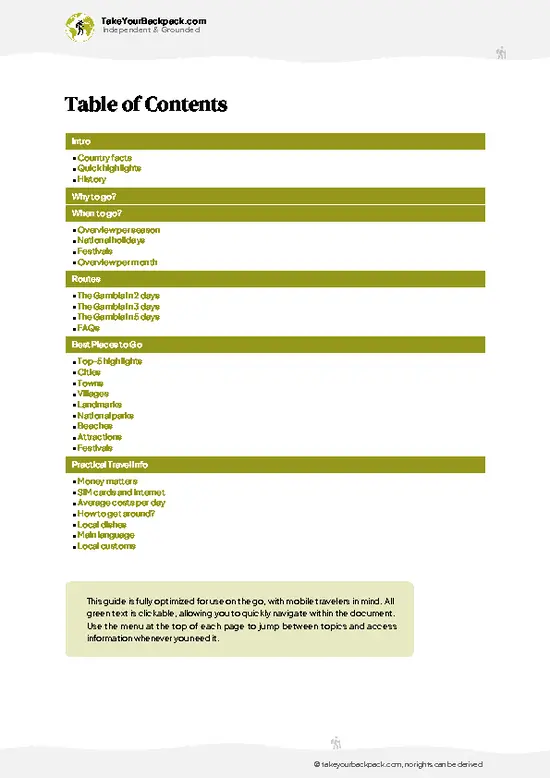
example page 3 from our offline Travel Guide for Gambia
example page 4 from our offline Travel Guide for Gambia
example page 5 from our offline Travel Guide for Gambia
example page 6 from our offline Travel Guide for Gambia
example page 7 from our offline Travel Guide for Gambia
Loading the map 🌍
CLICK TO FILTER
cities
towns
villages
landmarks
national parks
beaches
attractions
festivals
SHOW COUNTRY’S BESTSHOW ALL

✨ Why go?
Ranked #2 national park in The Gambia
The unique appeal for travelers

Abuko Nature Reserve suits backpackers who like to move at their own pace, because the marked paths are simple to follow and you do not need a tour operator to see the main animals. Many visitors still hire a guide at the gate, and I would do so for the first hour, since trained eyes spot the Nile crocodiles at the main pond, a sleeping bushbaby or a well-camouflaged bushbuck that you would walk straight past. Then you can drift off alone and sit in a hide for as long as you like.
The second draw is birding. Over 250 recorded bird species live in this small block of forest, including Ross’s turaco, which is a favorite with photographers, and kingfishers along the water. Because the reserve is compact, you can do a full morning here and still have the afternoon free for the nearby coast. It … read more 👉
Abuko Nature Reserve suits backpackers who like to move at their own pace, because the marked paths are simple to follow and you do not need a tour operator to see the main animals. Many visitors still hire a guide at the gate, and I would do so for the first hour, since trained eyes spot the Nile crocodiles at the main pond, a sleeping bushbaby or a well-camouflaged bushbuck that you would walk straight past. Then you can drift off alone and sit in a hide for as long as you like.
The second draw is birding. Over 250 recorded bird species live in this small block of forest, including Ross’s turaco, which is a favorite with photographers, and kingfishers along the water. Because the reserve is compact, you can do a full morning here and still have the afternoon free for the nearby coast. It also works as a first taste of West African forest without any jungle trekking, which makes it a calm place to start if you are new to the region.

💡 HighlightsWhat this place is best known for

  1. Crocodile Pond: The reserve’s best-known sight, where Nile crocodiles lie motionless on the muddy bank. Approach slowly and you can watch them from a short distance.
  2. Animal Orphanage: A small rescue area with hyenas, a lion enclosure and other animals taken in by the reserve. It gives context on conservation work, though the enclosures are modest.
  3. Green Monkey Troops: Almost guaranteed along the main trail, these monkeys are bold and curious. Keep food hidden, since they will snatch it.
  4. Red Colobus Monkeys: Rarer than the green monkeys and found in the higher canopy, they are a prize for patient watchers. Their chestnut-red coats stand out against green leaves.
  5. Bird Hides: Wooden hides overlook water and forest openings. Sit quietly and you may see Ross’s turaco, hornbills and kingfishers.
  6. Gallery
… read more 👉
  1. Crocodile Pond: The reserve’s best-known sight, where Nile crocodiles lie motionless on the muddy bank. Approach slowly and you can watch them from a short distance.
  2. Animal Orphanage: A small rescue area with hyenas, a lion enclosure and other animals taken in by the reserve. It gives context on conservation work, though the enclosures are modest.
  3. Green Monkey Troops: Almost guaranteed along the main trail, these monkeys are bold and curious. Keep food hidden, since they will snatch it.
  4. Red Colobus Monkeys: Rarer than the green monkeys and found in the higher canopy, they are a prize for patient watchers. Their chestnut-red coats stand out against green leaves.
  5. Bird Hides: Wooden hides overlook water and forest openings. Sit quietly and you may see Ross’s turaco, hornbills and kingfishers.
  6. Gallery Forest Canopy: Tall trees and thick vines create a cool, shaded tunnel along the paths. Humidity is high, and the air smells of damp earth.
  7. Bushbuck and Duikers: Shy forest antelope sometimes appear near dawn or late afternoon. A guide helps you spot them in the undergrowth.
  8. Nile Monitor Lizards: Large lizards often seen near water, either sprawled in sun patches or slipping off the bank when you come near.
For a first visit, start with Crocodile Pond, because it is the clearest wildlife encounter in the reserve and sits near the entrance.
Spotted a mistake or missing something? Contact us.

Things to do near Abuko Nature Reserve

Ratings based on Tripadvisor reviews. When you book through this link, you support our work at no extra cost to you.

🌤️ When to go?Choosing the right time of year

  • Cool Dry Season (November to February): Abuko is at its most comfortable now, with highs of 30 to 34°C (86 to 93°F) and cooler mornings of 17 to 22°C (63 to 72°F). The forest trails are dry, and birds and monkeys are easy to spot. Days run about 11.5 to 12 hours of light.
  • Hot Dry Season (March to May): Highs reach 33 to 38°C (91 to 100°F). Animals gather near the waterholes and the reserve is quiet, but you will want to be inside by early afternoon.
  • Rainy Season (June to October): Expect 28 to 33°C (82 to 91°F), heavy humidity, and storms from July to September. The canopy is lush and migrant birds are scarce, though mosquitoes thrive and paths turn muddy.
  • Crowds and Prices: December to February brings the most visitors and the highest lodging rates on the coast. The rainy months bring noticeable
… read more 👉
  • Cool Dry Season (November to February): Abuko is at its most comfortable now, with highs of 30 to 34°C (86 to 93°F) and cooler mornings of 17 to 22°C (63 to 72°F). The forest trails are dry, and birds and monkeys are easy to spot. Days run about 11.5 to 12 hours of light.
  • Hot Dry Season (March to May): Highs reach 33 to 38°C (91 to 100°F). Animals gather near the waterholes and the reserve is quiet, but you will want to be inside by early afternoon.
  • Rainy Season (June to October): Expect 28 to 33°C (82 to 91°F), heavy humidity, and storms from July to September. The canopy is lush and migrant birds are scarce, though mosquitoes thrive and paths turn muddy.
  • Crowds and Prices: December to February brings the most visitors and the highest lodging rates on the coast. The rainy months bring noticeable discounts.
Arrive when the gates open at 8 a.m. to catch the animals active and the heat low.


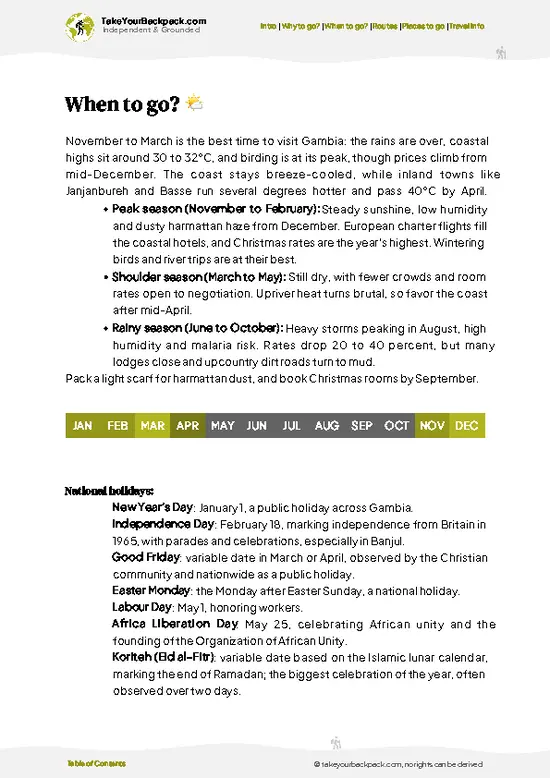
source: climatestotravel.comJANJanuary: excellent for travelingFEBFebruary: excellent for travelingMARMarch: excellent for travelingAPRApril: highly recommended for travelingMAYMay: highly recommended for travelingJUNJune: fair for travelingJULJuly: fair for travelingAUGAugust: fair for travelingSEPSeptember: fair for travelingOCTOctober: fair for travelingNOVNovember: highly recommended for travelingDECDecember: excellent for traveling
gambia-national-park-abuko-nature-reserve v1
© Google |

✈️ The backpacker research shortcutThe Gambia Travel Guide

An offline-friendly backpacking guide with optimized travel routes, ranked highlights, transport advice, and the best areas to stay.
example page 0 from our offline Travel Guide for Gambia
example page 1 from our offline Travel Guide for Gambia
example page 2 from our offline Travel Guide for Gambia
example page 3 from our offline Travel Guide for Gambia
example page 4 from our offline Travel Guide for Gambia
example page 5 from our offline Travel Guide for Gambia
example page 6 from our offline Travel Guide for Gambia
example page 7 from our offline Travel Guide for Gambia
The digital guide (213 pages) contains:
✅ 50 highlights, ranked by travel appeal
✅ Optimized 2, 3 & 5-day travel routes
✅ Cities, national parks, landmarks, beaches
✅ How to get around
✅ Offline-friendly for travel without Wi-Fi
👉 Click to see all 30+ guide features

📅 Plan smarter in minutes, not weeks
✅ Month by month travel advice
✅ Festivals & national holidays
✅ Budget expectations

🗺️ Go to the right places, skip the overrated ones
✅ Honest pros & cons of destinations
✅ Top hikes, parks & viewpoints
✅ Lesser-known places most travelers miss
✅ Clear “worth it vs skip it” guidance

🛏️ Travel smoothly without rookie mistakes
✅ Best areas to stay
✅ Transport systems explained simply
✅ Common scams & safety advice
✅ SIM cards, money & practical tips

🌍 Understand the country, not just visit it
✅ Culture & traditions
✅ 52 Essential phrases & customs
✅ Festivals worth planning around
✅ Traveler-friendly historical context
✅ Insights that make places more meaningful

📱 Built for real travel conditions
✅ Fully downloadable PDF
✅ Works completely offline
✅ Optimized for phone use
✅ Useful in remote areas & buses
✅ Everything in one place
Stop searching, start planning
Get instant access to your full guide. 30‑day money-back guarantee.
+ Add another guide for just

By proceeding you agree to our terms.
Sent to your inbox immediately after payment • 100% Secure Checkout
Best Backpacking Travel Advisor 2025 tourism awardBest Backpacking
Travel Advisor
2025
What others say about Take Your Backpack Guides:
⭐⭐⭐⭐⭐
Fantastic, amazing amount of information!
⭐⭐⭐⭐⭐
My goodness this is amazing, it's what I've been looking for hats off too you!
⭐⭐⭐⭐⭐
I think this is absolutely BRILLIANT
⭐⭐⭐⭐
Very complete and informative. It's still missing places, but I gotta to commend you
⭐⭐⭐⭐⭐
This is truly amazing, thank you, can't wait to explore it with my kids!
⭐⭐⭐⭐⭐
Awesome resource, thank you!
⭐⭐⭐⭐⭐
This is amazing! Can't wait to explore the ones I haven't seen
⭐⭐⭐⭐
I love this! Well done, great idea.
⭐⭐⭐⭐⭐
Thanks for taking the time to make this gem!
⭐⭐⭐⭐⭐
This might be the best website I've ever seen.
⭐⭐⭐⭐⭐
Congratulations, and thank you so much for your work; it's incredibly valuable.
⭐⭐⭐⭐
In all seriousness I think you did a great job pointing out the important spots
⭐⭐⭐⭐⭐
10/10 very good
⭐⭐⭐⭐⭐
As someone who's only just starting to visit regularly this is awesome, thank you.
⭐⭐⭐⭐
Thank you very much! I'm going to visit my dad, it's going to be very useful!
⭐⭐⭐⭐⭐
This is really cool! We'll be travelling for the first time and this definitely come in handy.
⭐⭐⭐⭐⭐
You are now our minister of culture, congratulations 👨‍💼
⭐⭐⭐⭐⭐
Just wanted to tell you that this is a pearl! Going to follow your recommendations.
⭐⭐⭐⭐⭐
This is so cool. I'll definitely be using the resource for my travels soon.
⭐⭐⭐⭐⭐
This is very impressive! Good work.
⭐⭐⭐⭐⭐
This is an amazing and informative site. Very well done!

🛏️ Where to stay?How to pick the right area

There is no accommodation inside Abuko Nature Reserve, so you will sleep in the nearby coastal towns and walk or ride in the same morning. The closest option is Lamin, about 5 km (3 miles) away, where a few simple lodges and the famous Lamin Lodge sit by the mangrove creek. Quieter and cheaper than the beach strip, it suits anyone who wants an early start.
The best all-round choice for most backpackers is Brikama Road and Serrekunda, 20 to 30 minutes by shared taxi or gelly (minibus). Serrekunda has the cheapest rooms, local food stalls and easy onward transport. Expect guesthouse beds and basic … read more 👉
There is no accommodation inside Abuko Nature Reserve, so you will sleep in the nearby coastal towns and walk or ride in the same morning. The closest option is Lamin, about 5 km (3 miles) away, where a few simple lodges and the famous Lamin Lodge sit by the mangrove creek. Quieter and cheaper than the beach strip, it suits anyone who wants an early start.
The best all-round choice for most backpackers is Brikama Road and Serrekunda, 20 to 30 minutes by shared taxi or gelly (minibus). Serrekunda has the cheapest rooms, local food stalls and easy onward transport. Expect guesthouse beds and basic doubles for about US$10 to 25.
Kotu, Bakau and Fajara offer more choice, including hostels, small hotels and bars, with rooms ranging from US$20 to 50 in high season. Bakau has a calmer feel and lies close to the Kachikally crocodile pool. Senegambia, in Kololi, is livelier and pricier but has plenty of restaurants and beach access. From any of these areas, a taxi to the Abuko gate takes 20 to 40 minutes depending on traffic. Book ahead from December to February, when the beachside places fill up.

👛 Costs (as of 22 October 2026)Typical daily expenses

Abuko Nature Reserve costs about US$27 to 73 per day for a backpacker, including entry, a simple room, local transport and food. The figures below are estimates and shift with exchange rates and season; you pay in dalasi.
CategoryBudget RangeLocal Reality
Entrance feeUS$5 to 8Charged per adult at the gate, with lower rates for children and residents. Cash only.
Guide (optional)US$5 to 15Licensed guides wait near the entrance, and prices are negotiated, usually with a tip on top.
Accommodation (high season)US$10 to 30Guesthouses in Serrekunda and Lamin are cheapest. Beach hotels in Kotu and Bakau cost more. Rainy season rates fall.
Local transportUS$2 to 8Shared gelly minibuses and taxis run between the coast and the gate. A private taxi costs more but is quicker.
Food and waterUS$5 to 12Street food,
… read more 👉
Abuko Nature Reserve costs about US$27 to 73 per day for a backpacker, including entry, a simple room, local transport and food. The figures below are estimates and shift with exchange rates and season; you pay in dalasi.
CategoryBudget RangeLocal Reality
Entrance feeUS$5 to 8Charged per adult at the gate, with lower rates for children and residents. Cash only.
Guide (optional)US$5 to 15Licensed guides wait near the entrance, and prices are negotiated, usually with a tip on top.
Accommodation (high season)US$10 to 30Guesthouses in Serrekunda and Lamin are cheapest. Beach hotels in Kotu and Bakau cost more. Rainy season rates fall.
Local transportUS$2 to 8Shared gelly minibuses and taxis run between the coast and the gate. A private taxi costs more but is quicker.
Food and waterUS$5 to 12Street food, chicken and rice plates and bread with omelet are cheap. Restaurant meals near the coast cost double.
Total Daily BudgetUS$27 to 73A frugal day with no guide sits at the low end, while a private taxi and a beach meal push it higher.
⚠️ Prices can change and everyone travels differently, so take this as a rough guide. Hope it helps you plan your adventure!

🥾 TrailsTrail guide for Abuko Nature Reserve national park

Abuko Nature Reserve is a compact reserve with a few kilometers of flat, well-worn footpaths rather than a network of signed trails, so most visitors follow one loop from the entrance past the main water features and back. The ground is packed red earth, with some muddy patches after rain and root-crossed sections under the trees.
  • Main Loop: Roughly 2 to 3 kilometers, taking 1.5 to 2.5 hours with stops. Easy, flat and shaded. It passes the pond, the forest paths and the orphanage area.
  • Hide Detour: Short side paths, around 10 to 20 minutes each way. Easy. They lead to wooden platforms for birdwatching
… read more 👉
Abuko Nature Reserve is a compact reserve with a few kilometers of flat, well-worn footpaths rather than a network of signed trails, so most visitors follow one loop from the entrance past the main water features and back. The ground is packed red earth, with some muddy patches after rain and root-crossed sections under the trees.
  • Main Loop: Roughly 2 to 3 kilometers, taking 1.5 to 2.5 hours with stops. Easy, flat and shaded. It passes the pond, the forest paths and the orphanage area.
  • Hide Detour: Short side paths, around 10 to 20 minutes each way. Easy. They lead to wooden platforms for birdwatching over water.
  • Extended Wildlife Walk: With a guide, a slow 3 to 4 hour visit covering the quieter forest edges. Easy in effort, but humid, so carry water.
The terrain is gentle, the main challenge being heat and humidity, so go early when animals are more active and the forest is cooler. Wildlife includes green monkeys, red colobus, bushbabies, monitor lizards, crocodiles and a long list of forest birds. Guides at the entrance can be hired for a modest fee and add real value for spotting animals.
Abuko Nature Reserve is reached easily from the Greater Banjul and Serrekunda area by shared taxi or minibus, followed by a short walk from the road, or by a quick private taxi. Public transport is frequent, though not rigidly timetabled. Crowds peak mid-morning when tour groups arrive, so early starts are quieter. An entrance fee applies, and cameras may cost extra.
⚠️ Hiking info can sometimes be outdated or inaccurate. Before you hit the trail, check the latest conditions with locals. If you do spot anything that's off, I'd love to hear from you, so I can update it for fellow travelers.

🛡️ SafetySafety Tips and Common Scams in Abuko Nature Reserve

Abuko is a small, well-managed reserve with marked paths and almost no real danger, so a relaxed visit is the norm. The trails are flat and short, and a loop takes about 1.5 to 2 hours. Footing can be slippery after rain, so wear closed shoes with grip. Heat and humidity are the main problem. Carry at least 1 liter of water, use sun protection, and walk early. Mosquitoes are active near the water, so apply repellent and consider long sleeves in the late afternoon.
Wildlife is mostly gentle. Green and Callithrix monkeys, red colobus and baboons live here, and they can grab food from your bag. Keep snacks zipped away and never feed them. Crocodiles live in the pond and the hides keep you at a safe distance, so stay on the paths. Snakes are present but rarely seen. Most visitors are guided by … read more 👉
Abuko is a small, well-managed reserve with marked paths and almost no real danger, so a relaxed visit is the norm. The trails are flat and short, and a loop takes about 1.5 to 2 hours. Footing can be slippery after rain, so wear closed shoes with grip. Heat and humidity are the main problem. Carry at least 1 liter of water, use sun protection, and walk early. Mosquitoes are active near the water, so apply repellent and consider long sleeves in the late afternoon.
Wildlife is mostly gentle. Green and Callithrix monkeys, red colobus and baboons live here, and they can grab food from your bag. Keep snacks zipped away and never feed them. Crocodiles live in the pond and the hides keep you at a safe distance, so stay on the paths. Snakes are present but rarely seen. Most visitors are guided by a local guide, whose spotting skills are worth the small tip. Keep valuables out of sight on the way to and from the gate.

FAQTraveler FAQ

Half a day is enough for Abuko Nature Reserve, since the main loop takes about 1.5 to 2 hours. Add another hour if you want to sit in the bird hides or the monkey area. Many travelers combine it with the nearby Lamin Lodge or Brikama craft market on the same day.
Yes, Abuko Nature Reserve is easy to reach without a car. From Serrekunda, take a shared gelly toward Brikama and get off at Abuko Junction, then walk about 10 to 15 minutes to the gate. A taxi from the Kotu or Senegambia area costs roughly US$10 to 20 each way, and the trip takes 25 to 40 minutes.
Yes, Abuko Nature Reserve charges an entrance fee of roughly US$5 to 8 per adult, paid in cash at the gate. No separate permit is needed for walking the marked trails. Licensed guides, available at the entrance for about US$5 to 15, are optional, and opening hours are usually 8 a.m. to 6 p.m.
⚠️ Things can change over time, so always validate details locally before you go.

Other Gambian national parks near Abuko Nature Reserve

Explore more nearby:


💡 Not sure where to go next?
Create a personalized itinerary for The Gambia including Abuko Nature Reserve and the places that fit your trip.

Generate my itinerary

👉 Discover all national parks

Or checkout all The Gambia has to offer (think cities, towns, villages, national parks, hikes, beaches, festivals)
Country photo of The Gambia

We 💚 feedbackFinal thoughts on exploring Abuko Nature Reserve

Abuko Nature Reserve is best for first-time West Africa visitors, casual birders and anyone who wants wildlife without a long trek. I would arrive right at opening, hire the gate guide for the first stretch, and bring a small bottle of water. Serious hikers should treat it as a half-day add-on, not the main event.

✍️ Help improve this page!
The information on this page is based on in-depth research, insights shared by experienced travelers, and feedback from the local travel community in The Gambia. While every effort is made to keep the information accurate and current, conditions can change — so if you spot anything incorrect or outdated, please get in touch.


🙋‍♂️ Give feedback

👋 Meet the founderWho’s Behind Take Your Backpack?

Johan, backpacker and founder of TakeYourBackpackHi, I’m Johan (Netherlands 🇳🇱), the creator of TakeYourBackpack. Over the past 3 decades, I’ve backpacked through 90+ countries across six continents, gaining extensive experience with independent travel, long-term trips, and overland routes.

This site is built on a combination of firsthand travel experience and carefully curated insights from other backpackers. Many guides are based on places I’ve personally visited, while others bring together tips, observations, and practical advice shared by trusted travelers I’ve met along the way.

The goal is to provide realistic, experience-driven guidance — not generic itineraries — so you can explore destinations with better context, clearer expectations, and more confidence.