×

Gambia🇬🇲 | best national parksExplore the 7 Best national parks in The Gambia

National parks in Gambia are small, flat and riverine, a world apart from the vast savanna reserves of East Africa. Expect mangrove creeks, red laterite tracks, ibis calls and wood smoke. The coast is cheap and easy by shared taxi, while the upriver sites mean long, dusty hauls. For independent travelers and backpackers, crowds are thin and entry fees modest.

By Johan Kruseman 🇳🇱 | Updated October 23, 2026
Explore the best beaches in The Gambia

Why go?Key Factors That Shape the Experience

Gambia is a sliver of land, roughly 30 to 50 kilometers wide, wrapped around the River Gambia, so almost every protected area is shaped by water: tidal mangroves, sandy banks, palm-fringed flats and humid forest remnants. That makes it a birding and primate country, not a big-game one. Expect hippos, monkeys, crocodiles and a bird list that runs past 500 species, but no lions or elephants. Infrastructure is basic. Roads are patchy, signage is minimal, and local guides and boat captains, often paid in cash, are how most parks work. Distances are short, so a park rarely needs more than a day. The air is hot, the light is hazy in the dry months, and the sounds are frog choruses at dusk and weaver colonies at dawn. Go for quiet, small-scale nature rather than spectacle.
Evaluating the Top Choices
The list of best national parks in The Gambia is created based on landscapes, wildlife, adventure opportunities, facilities, and overall experience. If you feel a national park is missing in this list, please let us know.

When to go?Timing Your Visit for the Best Experience

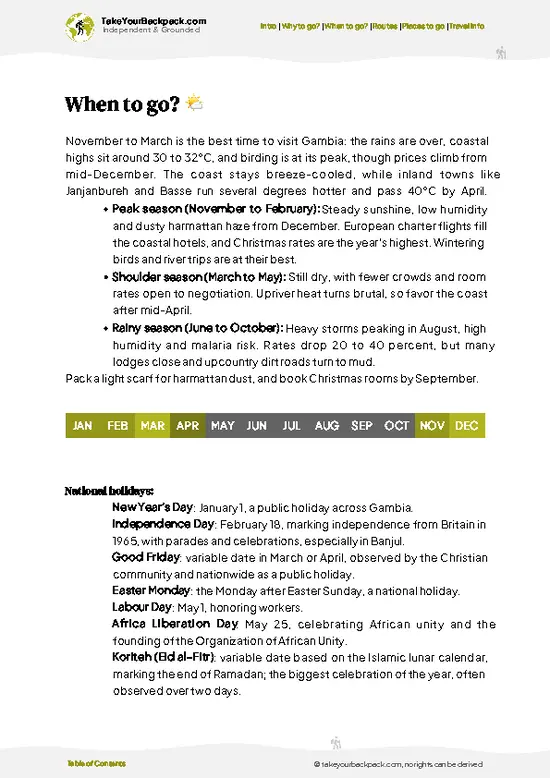
Best months and the dry season: The best months are November to February, when rain is absent, humidity drops and daytime highs sit around 30 to 34°C with cooler dawns near 18 to 22°C. Birds gather at shrinking waterholes and river edges, and the harmattan haze softens the light. Tracks are firm and boats run easily.Shoulder and wet season: March to May turns hot, often 35 to 40°C, especially upriver, with dust in the throat by midday. The rains run roughly June to October, delivering around 800 to 1,000 mm, mostly in July to September. Laterite tracks turn to red mud, mosquitoes surge and some camps and lodges shut or run thin. Prices fall by perhaps 20 to 40 percent, and migrant birds are absent, but resident species are in breeding plumage and the greenery is thick. Peak season lifts coastal … read more 👉
Best months and the dry season: The best months are November to February, when rain is absent, humidity drops and daytime highs sit around 30 to 34°C with cooler dawns near 18 to 22°C. Birds gather at shrinking waterholes and river edges, and the harmattan haze softens the light. Tracks are firm and boats run easily.Shoulder and wet season: March to May turns hot, often 35 to 40°C, especially upriver, with dust in the throat by midday. The rains run roughly June to October, delivering around 800 to 1,000 mm, mostly in July to September. Laterite tracks turn to red mud, mosquitoes surge and some camps and lodges shut or run thin. Prices fall by perhaps 20 to 40 percent, and migrant birds are absent, but resident species are in breeding plumage and the greenery is thick. Peak season lifts coastal bed prices, so book ahead in December and January.

national park hoppingTips for Visiting Multiple Destinations

How many days and how to link regions: A trip combining several parks needs 4 to 7 days. The sensible direction is from the Atlantic coast around Serrekunda and Banjul inland along the river toward Janjanbureh, because the road gets rougher, accommodation thinner and the heat heavier as you go. Coastal stops need only half a day to a full day each. Upriver stops need a night, ideally two. Expect 1 to 2 hours by taxi or minibus between coastal sites, and 4 to 6 hours on the South Bank or North Bank road to the interior, plus ferry waits at Barra and Banjul that can swallow an hour or more.Common planning mistakes: Travelers often cram two parks into one day, then arrive at dusk with no transport. Book a driver or guide for the longer legs, leave early before the heat hits by 10 a.m., and keep one slack day for ferry delays and breakdowns.

The ListMust-Visit national parks in The Gambia

1 Makasutu Culture Forest

Kapok giants, creek canoe, palm wine, drumming nights

Paddle a winding mangrove creek, walk beneath giant kapok trees with a local guide, and finish with fresh palm wine and djembe rhythms.

gambia-national-park-makasutu-culture-forest
© Google |

2 River Gambia National Park

Chimpanzee islands, hippo channels, boat-only access, Janjanbureh

Glide between river islands by boat to watch rehabilitated chimpanzees at feeding time, with hippos snorting in the channels nearby.

3 Tanbi Wetland National Park

Lamin Lodge, tidal creeks, oyster harvesters, mudflat crabs

Board a pirogue at Lamin Lodge and slip through narrow mangrove tunnels where kingfishers perch at eye level and oyster gatherers work the roots.

4 Abuko Nature Reserve

Crocodile pond, red colobus, gallery forest, bird hides

Follow shaded flat paths under dense canopy to a crocodile pond, quiet hides and monkeys that watch from the branches overhead.

gambia-national-park-abuko-nature-reserve
© Google |

5 Kiang West National Park

Mangrove bolongs, roosting owls, baboon tracks, Mandinka villages

Ride a rutted track at dawn to find baboons, bushbuck and daytime owl roosts, then paddle tidal creeks lined with mangrove roots.

6 Tanji Bird Reserve

Lagoon birding, fishing beach, turtle nesting, coastal dunes

Scan dry woodland and lagoon edges with a guide for rollers and terns, then watch painted pirogues unload their catch on the beach.

7 Niumi National Park

Jinack beach, river-mouth sandbars, ferry from Banjul, fishing village

Cross the river by ferry, then walk a wide empty Atlantic beach at low tide and watch waders work the sandbars.

Loading the map 🌍

Expert viewTips and Advice from Travelers

How many parks to visit: I advise two or three parks, no more. Distances are short, but ferries, heat and rough tracks eat time, and the wildlife is subtle, so rushing blurs it. One coastal site and one river or forest site give contrast: the tang of mangrove mud and the clatter of kingfishers against cooler, shadier canopy and the grunts of unseen primates.Choosing by travel style: On a tight budget, pick coastal parks reached by shared taxi, where you can walk with a local guide in the early light. Birders should prioritize river and wetland sites and pay for a boat. Anyone craving solitude should go upriver, where nights are silent but for frogs and distant drums.What it costs: Plan US$25 to 50 a day all in. Entry fees run roughly 100 to 500 Gambian dalasi (about US$1.50 to 8). A licensed … read more 👉
How many parks to visit: I advise two or three parks, no more. Distances are short, but ferries, heat and rough tracks eat time, and the wildlife is subtle, so rushing blurs it. One coastal site and one river or forest site give contrast: the tang of mangrove mud and the clatter of kingfishers against cooler, shadier canopy and the grunts of unseen primates.Choosing by travel style: On a tight budget, pick coastal parks reached by shared taxi, where you can walk with a local guide in the early light. Birders should prioritize river and wetland sites and pay for a boat. Anyone craving solitude should go upriver, where nights are silent but for frogs and distant drums.What it costs: Plan US$25 to 50 a day all in. Entry fees run roughly 100 to 500 Gambian dalasi (about US$1.50 to 8). A licensed guide costs about US$10 to 25 for a half day, and a private boat or pirogue US$20 to 60 depending on length. Shared taxis cost US$1 to 5 per leg, private day hire US$40 to 70. Carry small dalasi notes, as card payment rarely works.Safety and cultural points: Use official guides with ID badges, agree prices before setting out, and ignore touts at park gates. Carry water, sun cover and malaria prophylaxis; evening mosquitoes are relentless. Keep distance from hippos and crocodiles, as boat accidents happen. Dress modestly in villages, ask before photographing people, and greet everyone, since a handshake and “Salaam aleikum” open doors and often earn a better guide and a warmer welcome.

✈️ The backpacker research shortcutThe Gambia Travel Guide

An offline-friendly backpacking guide with optimized travel routes, ranked highlights, transport advice, and the best areas to stay.
example page 0 from our offline Travel Guide for Gambia
example page 1 from our offline Travel Guide for Gambia
example page 2 from our offline Travel Guide for Gambia
example page 3 from our offline Travel Guide for Gambia
example page 4 from our offline Travel Guide for Gambia
example page 5 from our offline Travel Guide for Gambia
example page 6 from our offline Travel Guide for Gambia
example page 7 from our offline Travel Guide for Gambia
The digital guide (213 pages) contains:
✅ 50 highlights, ranked by travel appeal
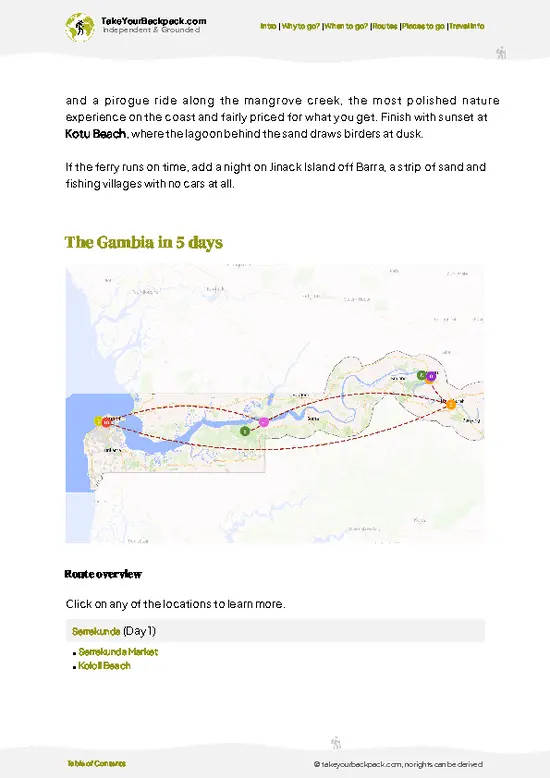
✅ Optimized 2, 3 & 5-day travel routes
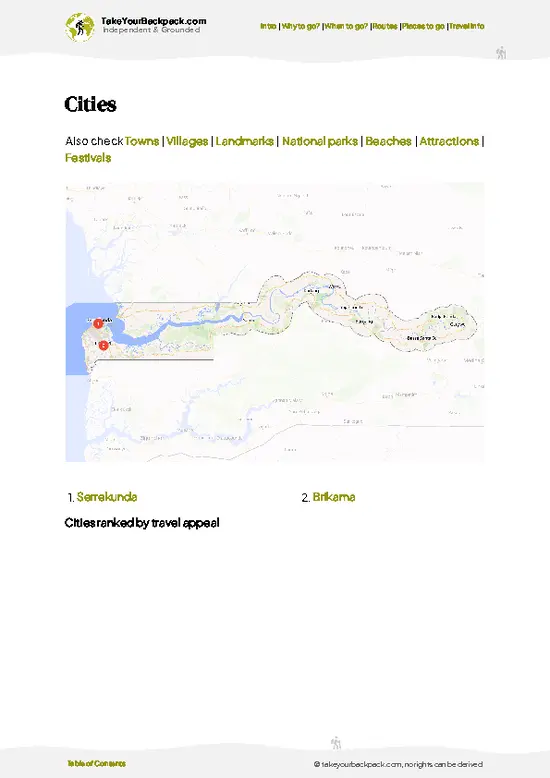
✅ Cities, national parks, landmarks, beaches
✅ How to get around
✅ Offline-friendly for travel without Wi-Fi
👉 Click to see all 30+ guide features

📅 Plan smarter in minutes, not weeks
✅ Month by month travel advice
✅ Festivals & national holidays
✅ Budget expectations

🗺️ Go to the right places, skip the overrated ones
✅ Honest pros & cons of destinations
✅ Top hikes, parks & viewpoints
✅ Lesser-known places most travelers miss
✅ Clear “worth it vs skip it” guidance

🛏️ Travel smoothly without rookie mistakes
✅ Best areas to stay
✅ Transport systems explained simply
✅ Common scams & safety advice
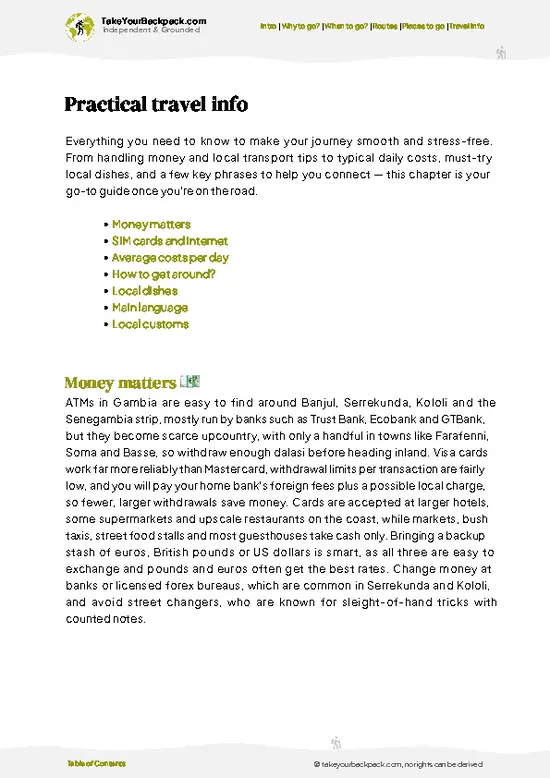
✅ SIM cards, money & practical tips

🌍 Understand the country, not just visit it
✅ Culture & traditions
✅ 52 Essential phrases & customs
✅ Festivals worth planning around
✅ Traveler-friendly historical context
✅ Insights that make places more meaningful

📱 Built for real travel conditions
✅ Fully downloadable PDF
✅ Works completely offline
✅ Optimized for phone use
✅ Useful in remote areas & buses
✅ Everything in one place
Stop searching, start planning
Get instant access to your full guide. 30‑day money-back guarantee.
+ Add another guide for just

By proceeding you agree to our terms.
Sent to your inbox immediately after payment • 100% Secure Checkout
Best Backpacking Travel Advisor 2025 tourism awardBest Backpacking
Travel Advisor
2025
What others say about Take Your Backpack Guides:
⭐⭐⭐⭐⭐
Fantastic, amazing amount of information!
⭐⭐⭐⭐⭐
My goodness this is amazing, it's what I've been looking for hats off too you!
⭐⭐⭐⭐⭐
I think this is absolutely BRILLIANT
⭐⭐⭐⭐
Very complete and informative. It's still missing places, but I gotta to commend you
⭐⭐⭐⭐⭐
This is truly amazing, thank you, can't wait to explore it with my kids!
⭐⭐⭐⭐⭐
Awesome resource, thank you!
⭐⭐⭐⭐⭐
This is amazing! Can't wait to explore the ones I haven't seen
⭐⭐⭐⭐
I love this! Well done, great idea.
⭐⭐⭐⭐⭐
Thanks for taking the time to make this gem!
⭐⭐⭐⭐⭐
This might be the best website I've ever seen.
⭐⭐⭐⭐⭐
Congratulations, and thank you so much for your work; it's incredibly valuable.
⭐⭐⭐⭐
In all seriousness I think you did a great job pointing out the important spots
⭐⭐⭐⭐⭐
10/10 very good
⭐⭐⭐⭐⭐
As someone who's only just starting to visit regularly this is awesome, thank you.
⭐⭐⭐⭐
Thank you very much! I'm going to visit my dad, it's going to be very useful!
⭐⭐⭐⭐⭐
This is really cool! We'll be travelling for the first time and this definitely come in handy.
⭐⭐⭐⭐⭐
You are now our minister of culture, congratulations 👨‍💼
⭐⭐⭐⭐⭐
Just wanted to tell you that this is a pearl! Going to follow your recommendations.
⭐⭐⭐⭐⭐
This is so cool. I'll definitely be using the resource for my travels soon.
⭐⭐⭐⭐⭐
This is very impressive! Good work.
⭐⭐⭐⭐⭐
This is an amazing and informative site. Very well done!

🛏️ Where to stay?Accommodation Highlights

Budget accommodation in The Gambia means small guesthouses, family-run lodges and simple compounds rather than classic dorm hostels, with private rooms typically running US$15 to 35 a night. Kololi and the Senegambia strip have the most choice plus beach access and the liveliest nightlife, though touts are persistent and prices run higher, while Kotu and Fajara are quieter and calmer and Bakau trades polish for a local fishing-town feel close to Kachikally. Banjul itself has few options and goes quiet after dark, so the south-coast villages of Sanyang and Tanji suit you better if you want eco-lodges and empty beaches, at the cost of being far from transport and nightlife.

If you enjoy meeting … read more 👉
Budget accommodation in The Gambia means small guesthouses, family-run lodges and simple compounds rather than classic dorm hostels, with private rooms typically running US$15 to 35 a night. Kololi and the Senegambia strip have the most choice plus beach access and the liveliest nightlife, though touts are persistent and prices run higher, while Kotu and Fajara are quieter and calmer and Bakau trades polish for a local fishing-town feel close to Kachikally. Banjul itself has few options and goes quiet after dark, so the south-coast villages of Sanyang and Tanji suit you better if you want eco-lodges and empty beaches, at the cost of being far from transport and nightlife.

If you enjoy meeting fellow travelers, consider choosing hostels with high ratings for atmosphere. On the other hand, if you prefer having your own space, a hotel might be a better option.

The GambiaSee More of The Gambia

👋 Meet the founderWho’s Behind Take Your Backpack?

Johan, backpacker and founder of TakeYourBackpackHi, I’m Johan (Netherlands 🇳🇱), the creator of TakeYourBackpack. Over the past 3 decades, I’ve backpacked through 90+ countries across six continents, gaining extensive experience with independent travel, long-term trips, and overland routes.

This site is built on a combination of firsthand travel experience and carefully curated insights from other backpackers. Many guides are based on places I’ve personally visited, while others bring together tips, observations, and practical advice shared by trusted travelers I’ve met along the way.

The goal is to provide realistic, experience-driven guidance — not generic itineraries — so you can explore destinations with better context, clearer expectations, and more confidence.