×

The Gambia🇬🇲 | attractionsNational Museum of The GambiaEthnographic cases, kora and drums, slave trade rooms, independence photos | things to do and best time to go

Explore Kachikally Crocodile Pool and MuseumExplore Arch 22

Backpacking in National Museum of The Gambia
👍 Recommendedattraction ranked #6
By Johan Kruseman 🇳🇱 | Updated October 22, 2026

Most people come for the Gambia’s clearest account of its own past: the Roper-era displays on the Gambia River, the slave trade and the road to independence in 1965. What gets overlooked is how calm the place is. Ceiling fans turn over a small, cool hall, and you can read every label without anyone at your shoulder. The museum sits on Independence Drive in Banjul, the Gambia’s capital, a short walk from Arch 22. The ethnographic cases of drums, kora, masks and indigo cloth are the strongest part, and the colonial-era photographs deserve a slow look. The upstairs rooms feel thinner, and some labels are faded or sparse. It is small, so the price is fair rather than a bargain. History-minded travelers and kora lovers will enjoy it most. Anyone wanting interactive exhibits or a full-day attraction will be disappointed.

Discover everything you want to know in the 📖 The Gambia Travel Guide.


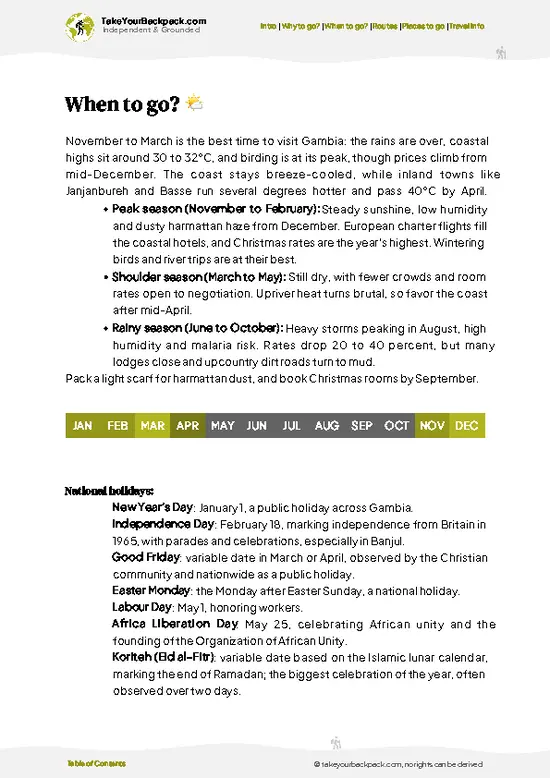
example page 0 from our offline Travel Guide for Gambia
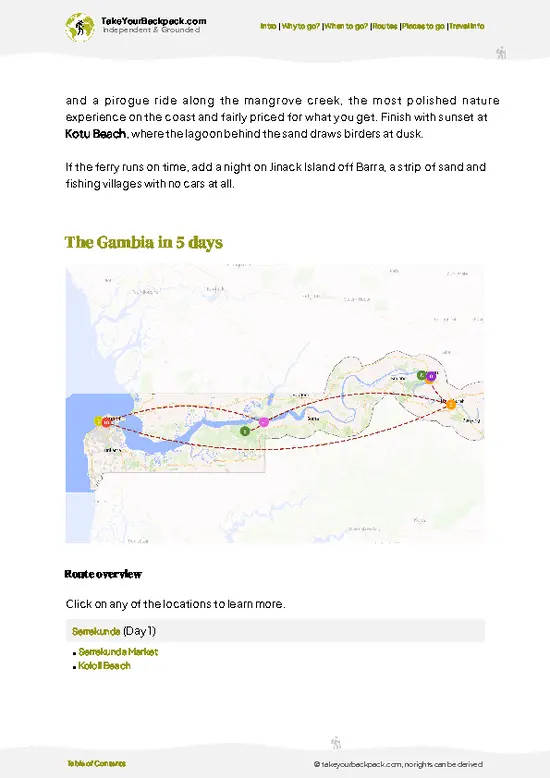
example page 1 from our offline Travel Guide for Gambia
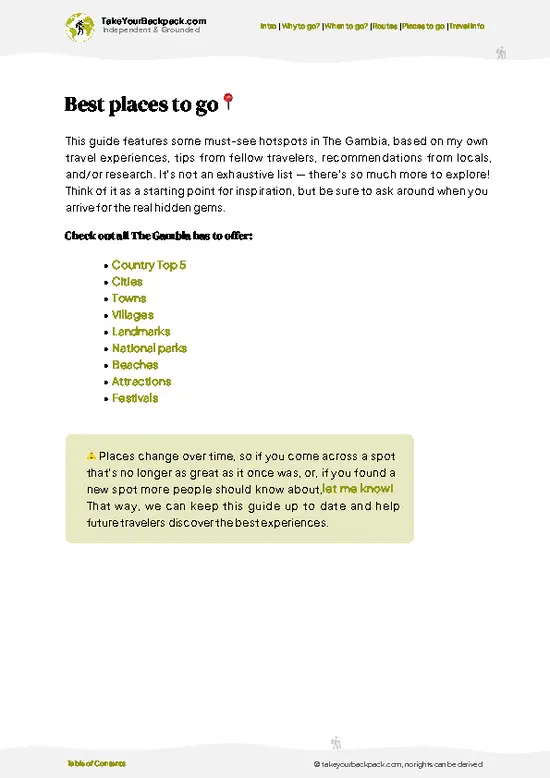
example page 2 from our offline Travel Guide for Gambia
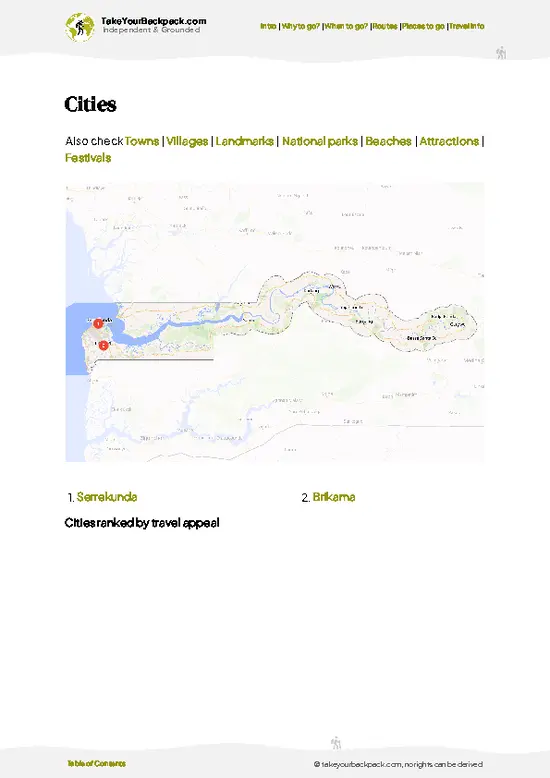
example page 3 from our offline Travel Guide for Gambia
example page 4 from our offline Travel Guide for Gambia
example page 5 from our offline Travel Guide for Gambia
example page 6 from our offline Travel Guide for Gambia
example page 7 from our offline Travel Guide for Gambia
Loading the map 🌍
CLICK TO FILTER
cities
towns
villages
landmarks
national parks
beaches
attractions
festivals
SHOW COUNTRY’S BESTSHOW ALL

✨ Why go?
Ranked #6 attraction in The Gambia
Reasons people choose to visit here

National Museum of The Gambia is the quickest way to make sense of what you will see upriver. The displays on the Mandinka, Fula, Wolof and Jola peoples give names and context to the drums, masks and weaving you meet in villages later. Seeing a kora up close, with its calabash body and 21 strings, makes a live performance at a Kombo hotel or village far more meaningful.

The second reason is the slave trade and independence story. Banjul sits near the river mouth that fed James Island and Juffureh, and the museum frames those sites before you take a boat to them. Photographs of the colonial years and the road to 1965 fill in what the stone ruins cannot.

It also works as a break from Banjul’s heat. An hour here, fans humming and floors cool underfoot, resets a hot day of walking between the ferry terminal, markets and Arch 22.

💡 HighlightsMust-see experiences and standout moments

  1. Ethnographic Gallery: the core of the collection. Cases of masks, cloth, tools and household objects separate the Gambia’s main ethnic groups, so you learn how a Jola rice farmer’s life differed from a Fula herder’s.
  2. Musical Instruments: the kora, balafon, djembe and talking drums are displayed together. The kora’s long neck and calabash resonator are best appreciated at close range.
  3. Slave Trade Exhibits: maps, shackles and written accounts tie the river’s role in the Atlantic trade to places like James Island. It is sobering and short, and it works as preparation for upriver sites.
  4. Independence Photographs: black-and-white images of colonial officials, Banjul streets and the 1965 handover. Look for the early portraits of Dawda Jawara’s generation.
  5. Archaeology Displays: pottery, beads and tools
… read more 👉
  1. Ethnographic Gallery: the core of the collection. Cases of masks, cloth, tools and household objects separate the Gambia’s main ethnic groups, so you learn how a Jola rice farmer’s life differed from a Fula herder’s.
  2. Musical Instruments: the kora, balafon, djembe and talking drums are displayed together. The kora’s long neck and calabash resonator are best appreciated at close range.
  3. Slave Trade Exhibits: maps, shackles and written accounts tie the river’s role in the Atlantic trade to places like James Island. It is sobering and short, and it works as preparation for upriver sites.
  4. Independence Photographs: black-and-white images of colonial officials, Banjul streets and the 1965 handover. Look for the early portraits of Dawda Jawara’s generation.
  5. Archaeology Displays: pottery, beads and tools connected to the Senegambian stone circles, which stand upriver near Wassu. They help you decide whether to make the trip.
  6. Traditional Dress and Textiles: indigo and strip-woven cloth show how pattern and color marked status and occasion.
  7. Souvenir and Craft Corner: a small selection of local pieces near the entrance. It is worth a quick look before the bargaining of the markets.
National Museum of The Gambia takes about an hour to 90 minutes to see properly, and a little longer if you read every label.
Spotted a mistake or missing something? Contact us.

Things to do around National Museum of The Gambia

Ratings based on Tripadvisor reviews. When you book through this link, you support our work at no extra cost to you.

🌤️ When to go?Seasonal considerations and timing

  • Cool Dry Season (November to February): Mornings at the museum on Independence Drive in Banjul are comfortable, with highs of 30 to 33°C (86 to 91°F) and nights near 16 to 20°C (61 to 68°F). Daylight runs about 11 hours. Banjul fills with visitors and flights and rooms cost the most.
  • Hot Dry Season (March to May): Highs reach 32 to 36°C (90 to 97°F) inland, a little less on the coast. Galleries get stuffy by midday, so go at opening. Crowds thin and prices ease.
  • Rainy Season (June to October): Expect 28 to 32°C (82 to 90°F), heavy humidity and downpours that flood Banjul’s low streets, especially in August. Visitors are few and lodging is cheapest.
Arrive when doors open on a weekday morning, since the museum is closed on some public holidays and Fridays can cut hours around midday prayers.

source: climatestotravel.comJANJanuary: highly recommended for travelingFEBFebruary: highly recommended for travelingMARMarch: excellent for travelingAPRApril: excellent for travelingMAYMay: excellent for travelingJUNJune: fair for travelingJULJuly: fair for travelingAUGAugust: fair for travelingSEPSeptember: fair for travelingOCTOctober: fair for travelingNOVNovember: excellent for travelingDECDecember: highly recommended for traveling
gambia-attraction-national-museum-of-the-gambia
© Google |

✈️ The backpacker research shortcutThe Gambia Travel Guide

An offline-friendly backpacking guide with optimized travel routes, ranked highlights, transport advice, and the best areas to stay.
example page 0 from our offline Travel Guide for Gambia
example page 1 from our offline Travel Guide for Gambia
example page 2 from our offline Travel Guide for Gambia
example page 3 from our offline Travel Guide for Gambia
example page 4 from our offline Travel Guide for Gambia
example page 5 from our offline Travel Guide for Gambia
example page 6 from our offline Travel Guide for Gambia
example page 7 from our offline Travel Guide for Gambia
The digital guide (213 pages) contains:
✅ 50 highlights, ranked by travel appeal
✅ Optimized 2, 3 & 5-day travel routes
✅ Cities, national parks, landmarks, beaches
✅ How to get around
✅ Offline-friendly for travel without Wi-Fi
👉 Click to see all 30+ guide features

📅 Plan smarter in minutes, not weeks
✅ Month by month travel advice
✅ Festivals & national holidays
✅ Budget expectations

🗺️ Go to the right places, skip the overrated ones
✅ Honest pros & cons of destinations
✅ Top hikes, parks & viewpoints
✅ Lesser-known places most travelers miss
✅ Clear “worth it vs skip it” guidance

🛏️ Travel smoothly without rookie mistakes
✅ Best areas to stay
✅ Transport systems explained simply
✅ Common scams & safety advice
✅ SIM cards, money & practical tips

🌍 Understand the country, not just visit it
✅ Culture & traditions
✅ 52 Essential phrases & customs
✅ Festivals worth planning around
✅ Traveler-friendly historical context
✅ Insights that make places more meaningful

📱 Built for real travel conditions
✅ Fully downloadable PDF
✅ Works completely offline
✅ Optimized for phone use
✅ Useful in remote areas & buses
✅ Everything in one place
Stop searching, start planning
Get instant access to your full guide. 30‑day money-back guarantee.
+ Add another guide for just

By proceeding you agree to our terms.
Sent to your inbox immediately after payment • 100% Secure Checkout
Best Backpacking Travel Advisor 2025 tourism awardBest Backpacking
Travel Advisor
2025
What others say about Take Your Backpack Guides:
⭐⭐⭐⭐⭐
Fantastic, amazing amount of information!
⭐⭐⭐⭐⭐
My goodness this is amazing, it's what I've been looking for hats off too you!
⭐⭐⭐⭐⭐
I think this is absolutely BRILLIANT
⭐⭐⭐⭐
Very complete and informative. It's still missing places, but I gotta to commend you
⭐⭐⭐⭐⭐
This is truly amazing, thank you, can't wait to explore it with my kids!
⭐⭐⭐⭐⭐
Awesome resource, thank you!
⭐⭐⭐⭐⭐
This is amazing! Can't wait to explore the ones I haven't seen
⭐⭐⭐⭐
I love this! Well done, great idea.
⭐⭐⭐⭐⭐
Thanks for taking the time to make this gem!
⭐⭐⭐⭐⭐
This might be the best website I've ever seen.
⭐⭐⭐⭐⭐
Congratulations, and thank you so much for your work; it's incredibly valuable.
⭐⭐⭐⭐
In all seriousness I think you did a great job pointing out the important spots
⭐⭐⭐⭐⭐
10/10 very good
⭐⭐⭐⭐⭐
As someone who's only just starting to visit regularly this is awesome, thank you.
⭐⭐⭐⭐
Thank you very much! I'm going to visit my dad, it's going to be very useful!
⭐⭐⭐⭐⭐
This is really cool! We'll be travelling for the first time and this definitely come in handy.
⭐⭐⭐⭐⭐
You are now our minister of culture, congratulations 👨‍💼
⭐⭐⭐⭐⭐
Just wanted to tell you that this is a pearl! Going to follow your recommendations.
⭐⭐⭐⭐⭐
This is so cool. I'll definitely be using the resource for my travels soon.
⭐⭐⭐⭐⭐
This is very impressive! Good work.
⭐⭐⭐⭐⭐
This is an amazing and informative site. Very well done!

🛏️ Where to stay?Best areas and accommodation options

Serrekunda and the Senegambia strip in Kololi are the best places for backpackers, and Banjul itself has almost nothing suited to a budget stay. The Senegambia area, about 20 kilometers from the museum, has the densest cluster of hostels and guesthouses, plus restaurants, ATMs and a busy nightlife stretch. It is the easiest place to meet other travelers and to organize tours. Walking after dark is common but take a taxi late at night. Bakau, roughly 12 kilometers away, is calmer, with a fishing beach, a market and a few guesthouses run by local families. It suits solo travelers who want quiet … read more 👉
Serrekunda and the Senegambia strip in Kololi are the best places for backpackers, and Banjul itself has almost nothing suited to a budget stay. The Senegambia area, about 20 kilometers from the museum, has the densest cluster of hostels and guesthouses, plus restaurants, ATMs and a busy nightlife stretch. It is the easiest place to meet other travelers and to organize tours. Walking after dark is common but take a taxi late at night. Bakau, roughly 12 kilometers away, is calmer, with a fishing beach, a market and a few guesthouses run by local families. It suits solo travelers who want quiet mornings and a short shared taxi ride into Banjul. Fajara sits between the two and has leafy streets and a friendlier, residential feel. All three connect to Banjul by yellow shared taxis (gelleh-gelleh minibuses and bush taxis) and then the Banjul ferry terminal area, so you can reach the museum in 30 to 60 minutes depending on traffic. Book ahead from December to February, when beds fill quickly.

👛 Costs (as of 22 October 2026)How expensive it really is

A day at the National Museum of The Gambia costs about US$30 to 45 for a backpacker based on the coast, with the entry fee itself being very small. Most spending goes on getting to Banjul and eating nearby.
CategoryBudget RangeLocal Reality
Museum entryUS$1 to 3A small fee paid in cash at the door; small bills help.
PhotographyUS$0 to 3Some staff ask for a camera fee, so check at the desk.
Transport from Serrekunda or KololiUS$2 to 5 returnShared taxis and minibuses run to Banjul; a private taxi costs far more.
Local transport in BanjulUS$1 to 3Short taxi hops between the museum, Albert Market and the ferry.
Food and drinkUS$3 to 8Rice and fish plates at local eateries in Banjul are cheap.
Accommodation (high season)US$15 to 25Hostel dorm or basic guesthouse room on the coast; cheaper in the rains.
… read more 👉
A day at the National Museum of The Gambia costs about US$30 to 45 for a backpacker based on the coast, with the entry fee itself being very small. Most spending goes on getting to Banjul and eating nearby.
CategoryBudget RangeLocal Reality
Museum entryUS$1 to 3A small fee paid in cash at the door; small bills help.
PhotographyUS$0 to 3Some staff ask for a camera fee, so check at the desk.
Transport from Serrekunda or KololiUS$2 to 5 returnShared taxis and minibuses run to Banjul; a private taxi costs far more.
Local transport in BanjulUS$1 to 3Short taxi hops between the museum, Albert Market and the ferry.
Food and drinkUS$3 to 8Rice and fish plates at local eateries in Banjul are cheap.
Accommodation (high season)US$15 to 25Hostel dorm or basic guesthouse room on the coast; cheaper in the rains.
Total Daily BudgetUS$30 to 45One day including a museum visit and basic meals.
⚠️ Prices can change and everyone travels differently, so take this as a rough guide. Hope it helps you plan your adventure!

FAQCommon questions from travelers

Plan on one to two hours at the National Museum of The Gambia, which is small and easy to see in a single visit. Exhibits cover history, the Wassu stone circles, musical instruments and colonial-era objects. Pair it with Albert Market and the Arch 22 monument for a half-day in Banjul.
The National Museum of The Gambia is worth the entrance fee, which is roughly US$1 to 3. The collection is modest, but it gives helpful context on the Mandinka, Wolof and Fula cultures and the slave trade before you visit sites such as Kunta Kinteh Island. Allow an hour and you get great value for the price.
To reach the National Museum of The Gambia from the Kololi or Serrekunda area, take a shared taxi or minibus to Banjul, which costs about US$1 to 3 and takes 30 to 60 minutes. The museum is on Independence Drive, a short walk from the ferry terminal and Albert Market. A private taxi from the coast costs about US$15 to 25 one way.
⚠️ Things can change over time, so always validate details locally before you go.

Other Gambian attractions near National Museum of The Gambia

Explore more nearby:

  • Albert Market—Covered lanes, wax-print cloth, tailor rows, dried fish and spice| 0 km away
  • Arch 22—35-meter arch, rooftop deck, traffic circle, craft stalls| 1 km away
  • Lamin Lodge—Stilt lodge, mangrove channels, kingfishers, tidal mudflats| 9 km away

💡 Not sure where to go next?
Create a personalized itinerary for The Gambia including National Museum of The Gambia and the places that fit your trip.

Generate my itinerary

👉 Discover all attractions

Or checkout all The Gambia has to offer (think cities, towns, villages, national parks, hikes, beaches, festivals)
Country photo of The Gambia

We 💚 feedbackParting advice and final tips

National Museum of The Gambia suits curious travelers who like to understand a place before they hit the road upriver, and anyone who loves West African music. I would visit early on your first morning in Banjul, then walk to Arch 22 afterward. Skip it if you only want beach time.

✍️ Help improve this page!
The information on this page is based on in-depth research, insights shared by experienced travelers, and feedback from the local travel community in The Gambia. While every effort is made to keep the information accurate and current, conditions can change — so if you spot anything incorrect or outdated, please get in touch.


🙋‍♂️ Give feedback

👋 Meet the founderWho’s Behind Take Your Backpack?

Johan, backpacker and founder of TakeYourBackpackHi, I’m Johan (Netherlands 🇳🇱), the creator of TakeYourBackpack. Over the past 3 decades, I’ve backpacked through 90+ countries across six continents, gaining extensive experience with independent travel, long-term trips, and overland routes.

This site is built on a combination of firsthand travel experience and carefully curated insights from other backpackers. Many guides are based on places I’ve personally visited, while others bring together tips, observations, and practical advice shared by trusted travelers I’ve met along the way.

The goal is to provide realistic, experience-driven guidance — not generic itineraries — so you can explore destinations with better context, clearer expectations, and more confidence.