×

Greenland🇬🇱 | regionsDisko IslandIceberg harbor, basalt cliffs, humpback boat trips, glacier hikes | things to do and best time to go

Explore Kujataa World Heritage SiteExplore Kujataa

Backpacking in Disko Island
🏆 Top pickregion ranked #1
By Johan Kruseman 🇳🇱 | Updated October 22, 2026

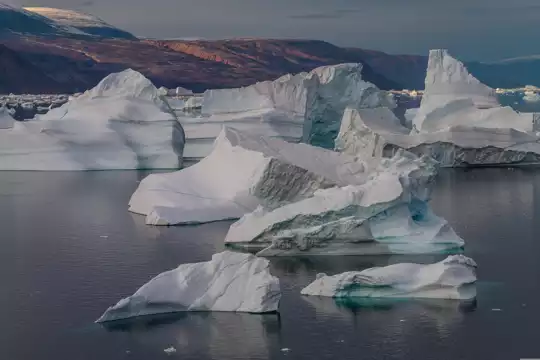
Disko Island gives you Arctic icebergs, basalt cliffs and whale-filled water without the tour-bus crowds of the mainland coast opposite. The island sits in Disko Bay in the north of Greenland, and the only real town, Qeqertarsuaq, hugs its south shore. Walk its few streets and you hear husky howls drifting across the harbor, smell drying fish and diesel, and see colored wooden houses stacked up black rock. Trails leave straight from town into a landscape of tundra, waterfalls and glacier tongues, though bogs, wind and sudden fog make every hike a negotiation. Services are thin, the weather overrules your plans, and the ferry timetable rules everything. In return you get silence, midnight-orange light on bergs in summer, and locals who still hunt and fish for a living. Compared with nearby Ilulissat, Disko Island is quieter and rawer, with fewer boardwalks and far fewer visitors sharing the view.

Discover everything you want to know in the 📖 Greenland Travel Guide.


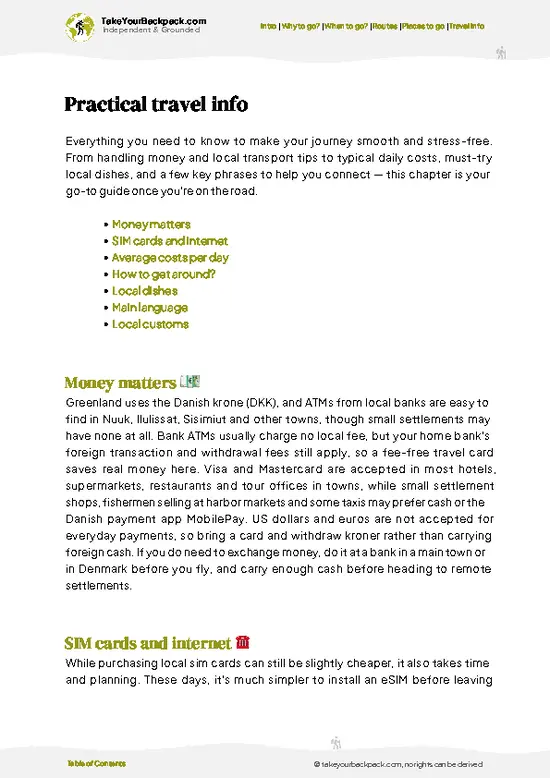
example page 0 from our offline Travel Guide for Greenland
example page 1 from our offline Travel Guide for Greenland
example page 2 from our offline Travel Guide for Greenland
example page 3 from our offline Travel Guide for Greenland
example page 4 from our offline Travel Guide for Greenland
example page 5 from our offline Travel Guide for Greenland
example page 6 from our offline Travel Guide for Greenland
example page 7 from our offline Travel Guide for Greenland
Loading the map 🌍
CLICK TO FILTER
towns
villages
landmarks
national parks
hikes
attractions
festivals
regions
SHOW COUNTRY’S BESTSHOW ALL

✨ Why go?
Ranked #1 region in Greenland
What makes it a must-see region

Disko Island works because everything a backpacker wants sits within walking distance of one small town, so you unpack once and still cover a lot of ground. From Qeqertarsuaq you can step onto a trail to the Lyngmarksbræen glacier in the morning, watch icebergs drift past the harbor at midday, and sit with a coffee in a settlement of fewer than a thousand people. Nature and culture overlap here: the university-run Arctic Station has studied the island’s plants and climate for over a century, while hunters still launch small boats from the same shore. The ferry connection from the mainland is slow and weather-dependent, which sounds like a drawback but filters out casual visitors and forces a slower rhythm. Plan days around tide, wind and fog rather than a checklist. The basalt landscape is … read more 👉
Disko Island works because everything a backpacker wants sits within walking distance of one small town, so you unpack once and still cover a lot of ground. From Qeqertarsuaq you can step onto a trail to the Lyngmarksbræen glacier in the morning, watch icebergs drift past the harbor at midday, and sit with a coffee in a settlement of fewer than a thousand people. Nature and culture overlap here: the university-run Arctic Station has studied the island’s plants and climate for over a century, while hunters still launch small boats from the same shore. The ferry connection from the mainland is slow and weather-dependent, which sounds like a drawback but filters out casual visitors and forces a slower rhythm. Plan days around tide, wind and fog rather than a checklist. The basalt landscape is unlike the granite that dominates most of Greenland, with dark cliffs, orange-stained streams and open valleys that make for varied walking within a short radius.

💡 HighlightsWhat this place is best known for

  1. Qeqertarsuaq Harbor: icebergs drift into this small harbor and ground on the shoreline, and the town’s wooden houses climb the slope behind. Walk the waterfront in the early evening when the ice glows and the huskies call.
  2. Lyngmarksbræen Glacier: a day hike over tundra and moraine from town brings you to the ice edge. Expect streams to cross and wind that rises quickly.
  3. Blæsedalen Valley: a broad, green valley just outside town, with a gentle trail and a small lake. It is the easiest introduction to the island’s interior and good for first-day legs.
  4. Arctic Station: the University of Copenhagen’s research base, founded in 1906, stands at the edge of town. The exterior and setting give a sense of how long scientists have used Disko Island as an outdoor lab.
  5. Qeqertarsuaq Museum: housed in an old
… read more 👉
  1. Qeqertarsuaq Harbor: icebergs drift into this small harbor and ground on the shoreline, and the town’s wooden houses climb the slope behind. Walk the waterfront in the early evening when the ice glows and the huskies call.
  2. Lyngmarksbræen Glacier: a day hike over tundra and moraine from town brings you to the ice edge. Expect streams to cross and wind that rises quickly.
  3. Blæsedalen Valley: a broad, green valley just outside town, with a gentle trail and a small lake. It is the easiest introduction to the island’s interior and good for first-day legs.
  4. Arctic Station: the University of Copenhagen’s research base, founded in 1906, stands at the edge of town. The exterior and setting give a sense of how long scientists have used Disko Island as an outdoor lab.
  5. Qeqertarsuaq Museum: housed in an old blubber house, it covers Inuit culture, Danish colonial history and whaling. Small, quiet and informative on the island’s past.
  6. Qeqertarsuaq Church: a simple wooden church that shows how the community lives day to day. Locals know it as a gathering place more than a sight.
  7. Skansen Hill: a short scramble above town that gives a wide view across the harbor, bay and ice. Few visitors climb it, and it is a favorite local spot for a quiet look at the weather.
  8. Whale watching in Disko Bay: summer boat trips from town look for humpbacks among the icebergs. The scale of a whale against a tabular berg is hard to forget.
  9. Kangerluk: a tiny settlement on the southwest shore, in the island’s largest fjord system, reached by boat. Only a handful of people still live there, and sits in a wild, mountainous setting seldom visited by backpackers.
Disko Island rewards a day that pairs the Lyngmarksbræen glacier hike with an evening stroll along Qeqertarsuaq Harbor, so you end the walk watching the ice light up.
Spotted a mistake or missing something? Contact us.

⌛️ 5 daysA smart one-week plan

Distances on Disko Island are walkable, so the pace is set by weather and the ferry rather than your legs; plan on boots, not taxis, and keep one buffer day.
Day 1: Qeqertarsuaq:
Arrive on the ferry and settle in. Spend the afternoon on the harbor and the museum, since both are close and good for gauging the weather. The slow start gives you time to check conditions and ask locals which trails are dry.
Day 2: Blæsedalen:
Walk the valley as a warm-up. It is flat enough to adjust to the terrain and light, and it lets you test your waterproofs. Return via Arctic Station and the church for a loop that stays near town.
Day 3: Lyngmarksbræen:
This is the big hike, so start with a full day ahead of you. The route crosses streams and moraine, ending at the glacier edge. Come back to the harbor for dinner, … read more 👉
Distances on Disko Island are walkable, so the pace is set by weather and the ferry rather than your legs; plan on boots, not taxis, and keep one buffer day.
Day 1: Qeqertarsuaq:
Arrive on the ferry and settle in. Spend the afternoon on the harbor and the museum, since both are close and good for gauging the weather. The slow start gives you time to check conditions and ask locals which trails are dry.
Day 2: Blæsedalen:
Walk the valley as a warm-up. It is flat enough to adjust to the terrain and light, and it lets you test your waterproofs. Return via Arctic Station and the church for a loop that stays near town.
Day 3: Lyngmarksbræen:
This is the big hike, so start with a full day ahead of you. The route crosses streams and moraine, ending at the glacier edge. Come back to the harbor for dinner, and keep Skansen Hill for a short sunset climb if energy remains.
Day 4: Kangerluk (detour):
Book a boat to the fjord settlement if conditions allow. The trip adds a very different side of Disko Island, with rugged cliffs and few people, and it fits because it uses a day you would otherwise spend repeating town walks. If the sea is rough, swap in whale watching from Qeqertarsuaq.
Day 5: Disko Bay:
Spend the last day on the water with a whale and iceberg trip, then catch the ferry out. Keep the morning flexible in case departures shift.

If you only get one day, make it Day 3. Reaching the glacier edge after hours of open tundra is the moment that explains why people come to Disko Island at all.

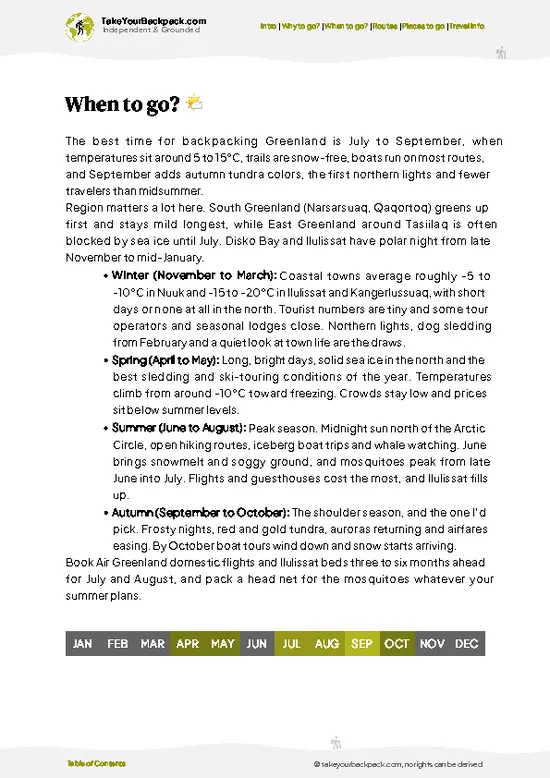
🌤️ When to go?Weather, crowds, and seasonal trade-offs

  • Midnight Sun (late May to late July): The sun stays up around the clock in Qeqertarsuaq, and daytime highs run roughly 5 to 12°C (41 to 54°F). Hiking, kayaking and whale watching are at their best, and the tundra turns green and then purple with flowers. Bring a sleep mask.
  • Icebergs and Autumn (August to September): Days are 4 to 10°C (39 to 50°F), dusk returns, and berry picking on the hillsides begins. Mosquitoes fade, and the first northern lights appear in September. Boat tours still run.
  • Dark Winter (October to February): Temperatures sit between -20 and -5°C (-4 to 23°F). Daylight is short, and the sun disappears for several weeks around the solstice. Aurora viewing is excellent, and so is dog sledding on sea ice. Tours and lodging are limited.
  • Returning Light (March to early May): Days
… read more 👉
  • Midnight Sun (late May to late July): The sun stays up around the clock in Qeqertarsuaq, and daytime highs run roughly 5 to 12°C (41 to 54°F). Hiking, kayaking and whale watching are at their best, and the tundra turns green and then purple with flowers. Bring a sleep mask.
  • Icebergs and Autumn (August to September): Days are 4 to 10°C (39 to 50°F), dusk returns, and berry picking on the hillsides begins. Mosquitoes fade, and the first northern lights appear in September. Boat tours still run.
  • Dark Winter (October to February): Temperatures sit between -20 and -5°C (-4 to 23°F). Daylight is short, and the sun disappears for several weeks around the solstice. Aurora viewing is excellent, and so is dog sledding on sea ice. Tours and lodging are limited.
  • Returning Light (March to early May): Days are -15 to 0°C (5 to 32°F) with bright, lengthening light. Snowshoeing, skiing and sled trips on firm snow are popular, with few other visitors.
Prices peak from June to August, so book ferries and rooms weeks ahead, or travel in early September for lower rates.


source: climatestotravel.comJANJanuary: below average for travelingFEBFebruary: below average for travelingMARMarch: below average for travelingAPRApril: fair for travelingMAYMay: good for travelingJUNJune: highly recommended for travelingJULJuly: excellent for travelingAUGAugust: highly recommended for travelingSEPSeptember: good for travelingOCTOctober: fair for travelingNOVNovember: below average for travelingDECDecember: below average for traveling
greenland-region-disko-island
© Google | Olav Sejeroe

✈️ The backpacker research shortcutGreenland Travel Guide

An offline-friendly backpacking guide with optimized travel routes, ranked highlights, transport advice, and the best areas to stay.
example page 0 from our offline Travel Guide for Greenland
example page 1 from our offline Travel Guide for Greenland
example page 2 from our offline Travel Guide for Greenland
example page 3 from our offline Travel Guide for Greenland
example page 4 from our offline Travel Guide for Greenland
example page 5 from our offline Travel Guide for Greenland
example page 6 from our offline Travel Guide for Greenland
example page 7 from our offline Travel Guide for Greenland
The digital guide (154 pages) contains:
✅ 33 highlights, ranked by travel appeal
✅ Optimized 7, 14 & 21-day travel routes
✅ Cities, national parks, landmarks, beaches
✅ How to get around
✅ Offline-friendly for travel without Wi-Fi
👉 Click to see all 30+ guide features

📅 Plan smarter in minutes, not weeks
✅ Month by month travel advice
✅ Festivals & national holidays
✅ Budget expectations

🗺️ Go to the right places, skip the overrated ones
✅ Honest pros & cons of destinations
✅ Top hikes, parks & viewpoints
✅ Lesser-known places most travelers miss
✅ Clear “worth it vs skip it” guidance

🛏️ Travel smoothly without rookie mistakes
✅ Best areas to stay
✅ Transport systems explained simply
✅ Common scams & safety advice
✅ SIM cards, money & practical tips

🌍 Understand the country, not just visit it
✅ Culture & traditions
✅ 52 Essential phrases & customs
✅ Festivals worth planning around
✅ Traveler-friendly historical context
✅ Insights that make places more meaningful

📱 Built for real travel conditions
✅ Fully downloadable PDF
✅ Works completely offline
✅ Optimized for phone use
✅ Useful in remote areas & buses
✅ Everything in one place
Stop searching, start planning
Get instant access to your full guide. 30‑day money-back guarantee.
+ Add another guide for just

By proceeding you agree to our terms.
Sent to your inbox immediately after payment • 100% Secure Checkout
Best Backpacking Travel Advisor 2025 tourism awardBest Backpacking
Travel Advisor
2025
What others say about Take Your Backpack Guides:
⭐⭐⭐⭐⭐
Fantastic, amazing amount of information!
⭐⭐⭐⭐⭐
My goodness this is amazing, it's what I've been looking for hats off too you!
⭐⭐⭐⭐⭐
I think this is absolutely BRILLIANT
⭐⭐⭐⭐
Very complete and informative. It's still missing places, but I gotta to commend you
⭐⭐⭐⭐⭐
This is truly amazing, thank you, can't wait to explore it with my kids!
⭐⭐⭐⭐⭐
Awesome resource, thank you!
⭐⭐⭐⭐⭐
This is amazing! Can't wait to explore the ones I haven't seen
⭐⭐⭐⭐
I love this! Well done, great idea.
⭐⭐⭐⭐⭐
Thanks for taking the time to make this gem!
⭐⭐⭐⭐⭐
This might be the best website I've ever seen.
⭐⭐⭐⭐⭐
Congratulations, and thank you so much for your work; it's incredibly valuable.
⭐⭐⭐⭐
In all seriousness I think you did a great job pointing out the important spots
⭐⭐⭐⭐⭐
10/10 very good
⭐⭐⭐⭐⭐
As someone who's only just starting to visit regularly this is awesome, thank you.
⭐⭐⭐⭐
Thank you very much! I'm going to visit my dad, it's going to be very useful!
⭐⭐⭐⭐⭐
This is really cool! We'll be travelling for the first time and this definitely come in handy.
⭐⭐⭐⭐⭐
You are now our minister of culture, congratulations 👨‍💼
⭐⭐⭐⭐⭐
Just wanted to tell you that this is a pearl! Going to follow your recommendations.
⭐⭐⭐⭐⭐
This is so cool. I'll definitely be using the resource for my travels soon.
⭐⭐⭐⭐⭐
This is very impressive! Good work.
⭐⭐⭐⭐⭐
This is an amazing and informative site. Very well done!

🛏️ Where to stay?How to pick the right area

Qeqertarsuaq is the only practical base on Disko Island, and it works well for backpackers because nearly everything sits within a 15-minute walk. The town holds the island’s guesthouses, a few small hostels, the museum, a grocery store, and the harbor where boat tours depart. Expect a bed in a shared room from roughly US$50 to 90 a night in summer, more for private rooms, and kitchens in many places let you cook for yourself and save money.

Stay near the harbor if you want quick access to whale-watching departures and the ferry. You will wake to gulls, diesel engines and the clank of fishing … read more 👉
Qeqertarsuaq is the only practical base on Disko Island, and it works well for backpackers because nearly everything sits within a 15-minute walk. The town holds the island’s guesthouses, a few small hostels, the museum, a grocery store, and the harbor where boat tours depart. Expect a bed in a shared room from roughly US$50 to 90 a night in summer, more for private rooms, and kitchens in many places let you cook for yourself and save money.

Stay near the harbor if you want quick access to whale-watching departures and the ferry. You will wake to gulls, diesel engines and the clank of fishing gear, and icebergs drift past your window. The streets close to the church and museum are calmer, with colorful wooden houses and views across Disko Bay.

Social life here is small and friendly. Guests share kitchens, swap hiking advice and often team up to split charter costs, so solo travelers rarely stay lonely. A few small settlements such as Kangerluk are reachable but have very limited lodging, so most people use Qeqertarsuaq as a base and make day trips from it. Book early for July and August, because beds are few and fill fast.

🚌 Getting aroundHow to get around Disko Island

Your own feet carry you furthest on Disko Island, because Qeqertarsuaq is compact and the best trails start at the edge of town. Beyond the settlement the island has no real road network, so everything else comes by boat, helicopter or snowmobile, and weather can cancel any of them. Build slack into your plans.
  • Walking: Free, and the way to reach the black beaches, the basalt shoreline and the Lyngmarksbræen trails. Boots crunch on gravel and spongy tundra, and you finish with icebergs glowing offshore.
  • Ferry from Ilulissat: Disko Line sailings run from late June to mid-September, take about 2 hours and cost roughly US$120 one way. You sit in a warm lounge, watch fulmars skim the swell, and drift past ice the size of apartment blocks.
  • Air Greenland helicopter: In winter, when the heliport is
… read more 👉
Your own feet carry you furthest on Disko Island, because Qeqertarsuaq is compact and the best trails start at the edge of town. Beyond the settlement the island has no real road network, so everything else comes by boat, helicopter or snowmobile, and weather can cancel any of them. Build slack into your plans.
  • Walking: Free, and the way to reach the black beaches, the basalt shoreline and the Lyngmarksbræen trails. Boots crunch on gravel and spongy tundra, and you finish with icebergs glowing offshore.
  • Ferry from Ilulissat: Disko Line sailings run from late June to mid-September, take about 2 hours and cost roughly US$120 one way. You sit in a warm lounge, watch fulmars skim the swell, and drift past ice the size of apartment blocks.
  • Air Greenland helicopter: In winter, when the heliport is open, flights link Qeqertarsuaq with Ilulissat and cost around US$150 to 250, with a flight of roughly 30 to 45 minutes. Rotor noise fills the cabin, and below you the coast unrolls in glaciers, fjords and blue ice.
  • Local boat charters: Fishermen and tour operators run trips to Kronprinsens glacier edges, whale grounds and neighboring settlements for about US$60 to 150 per person in a group. Spray stings your face, the engine thrums, and a humpback fluke may rise beside you.
  • Winter sled or snowmobile: When the sea freezes, local drivers take guests across the ice for about US$80 to 200 per outing. Dogs pant and yelp, runners hiss, and the cold bites your cheeks while pale light spreads across the frozen bay.
Check the weather the evening before any transfer and keep a spare day at both ends of your trip, because fog regularly grounds helicopters and delays boats.

🍲 FoodEating & Drinking in Disko Island

Food on Disko Island comes from the sea and the tundra. Try Greenlandic halibut, fried or smoked, and Arctic char with a buttery, almost sweet flesh. Shrimp from Disko Bay are small, pink and briny, often eaten by the handful from a paper bag. Suaasat, a hearty soup of seal or reindeer with onions and potatoes, warms you after a windy hike. Musk ox and reindeer steaks taste gamey and rich, sometimes with crowberry sauce.

The cheapest bites come from the town’s supermarket and the brættet, the open-air stall where hunters and fishermen sell fresh fish, seal and whale meat straight off the table. Expect the smell of cold salt and blood, and the butcher’s knife thudding on wood. Meals in a café or small restaurant run about US$15 to 35, and alcohol is expensive, so many travelers cook in guesthouse … read more 👉
Food on Disko Island comes from the sea and the tundra. Try Greenlandic halibut, fried or smoked, and Arctic char with a buttery, almost sweet flesh. Shrimp from Disko Bay are small, pink and briny, often eaten by the handful from a paper bag. Suaasat, a hearty soup of seal or reindeer with onions and potatoes, warms you after a windy hike. Musk ox and reindeer steaks taste gamey and rich, sometimes with crowberry sauce.

The cheapest bites come from the town’s supermarket and the brættet, the open-air stall where hunters and fishermen sell fresh fish, seal and whale meat straight off the table. Expect the smell of cold salt and blood, and the butcher’s knife thudding on wood. Meals in a café or small restaurant run about US$15 to 35, and alcohol is expensive, so many travelers cook in guesthouse kitchens.

For drinks, locals sip strong coffee and Greenlandic beer brewed with iceberg water. Try Kaffemik if invited, a home gathering with cake and coffee that is warm and noisy. Greet people, accept offerings politely, and do not photograph catch or hunters without asking. Seal and whale meat are part of daily life, so respond with curiosity instead of judgment.

FAQTraveler FAQ

Two to three days is enough to cover the main sights of Disko Island, though four days gives room for weather delays. Day one suits Qeqertarsuaq’s museum and harbor walk, day two a boat trip for whales and icebergs, and day three a hike toward Lyngmarksbræen or the basalt cliffs. With the helicopter or ferry from Ilulissat running irregularly, leave a buffer day.
Walking covers Qeqertarsuaq and its nearby trails, and the rest needs a boat, helicopter or winter snowmobile. The summer ferry from Ilulissat takes about 2 hours for roughly US$120, and the winter helicopter takes 30 to 45 minutes for about US$150 to 250. Local boat charters reach glaciers and whale grounds for around US$60 to 150 per person in groups.
Disko Island is known for its dramatic basalt cliffs, enormous icebergs from the Ilulissat Icefjord drifting through Disko Bay, and the hot springs and tundra of its interior. Qeqertarsuaq is the only real town, with a population of roughly 800, and it offers whale watching from June to September, dog sledding on winter ice and the midnight sun in summer. The Arctic Station, a University of Copenhagen research base founded in 1906, adds a scientific side to the visit.
⚠️ Things can change over time, so always validate details locally before you go.

Other Greenlandic regions near Disko Island

Explore more nearby:

  • Søndre Strømfjord—inland tundra, musk oxen, gravel tracks| 326 km away
  • Sermersooq—Nuuk fjord boat trips, Qilakitsoq mummies, Tasiilaq sled dogs, Sermilik icebergs| 700 km away
  • Kujataa—Norse ruins, sheep farms, fjord trails, UNESCO farmland| 1023 km away

💡 Not sure where to go next?
Create a personalized itinerary for Greenland including Disko Island and the places that fit your trip.

Generate my itinerary

👉 Discover all regions

Or checkout all Greenland has to offer (think cities, towns, villages, national parks, hikes, beaches, festivals)
Country photo of Greenland

We 💚 feedbackParting advice and final tips

Disko Island is best in late summer, when the midnight sun fades into long golden evenings and the bergs glow over the harbor. Mosquitoes thin out by then too. Bring a head net anyway, plus waterproof boots, and keep a spare day for ferry delays. I would skip rigid plans and let the weather pick your hike.

✍️ Help improve this page!
The information on this page is based on in-depth research, insights shared by experienced travelers, and feedback from the local travel community in Greenland. While every effort is made to keep the information accurate and current, conditions can change — so if you spot anything incorrect or outdated, please get in touch.


🙋‍♂️ Give feedback

👋 Meet the founderWho’s Behind Take Your Backpack?

Johan, backpacker and founder of TakeYourBackpackHi, I’m Johan (Netherlands 🇳🇱), the creator of TakeYourBackpack. Over the past 3 decades, I’ve backpacked through 90+ countries across six continents, gaining extensive experience with independent travel, long-term trips, and overland routes.

This site is built on a combination of firsthand travel experience and carefully curated insights from other backpackers. Many guides are based on places I’ve personally visited, while others bring together tips, observations, and practical advice shared by trusted travelers I’ve met along the way.

The goal is to provide realistic, experience-driven guidance — not generic itineraries — so you can explore destinations with better context, clearer expectations, and more confidence.