×

Greenland🇬🇱 | villagesQeqertarsuaqDisko Island, basalt cliffs, Arctic Station, whaling museum | things to do and best time to go

Explore QasigiannguitExplore Saqqaq

Backpacking in Qeqertarsuaq
👍 Recommendedvillage ranked #5
By Johan Kruseman 🇳🇱 | Updated October 22, 2026

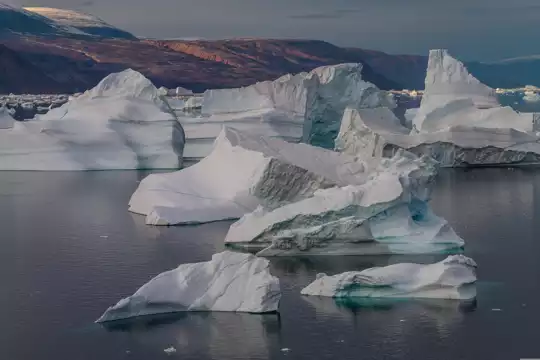
Qeqertarsuaq sits on the south coast of Disko Island, and the town has a basalt landscape where you can walk to a hot spring-fed valley and see icebergs drift past your window. Most first-timers also don’t expect the island itself to be a volcanic plateau with no ferry-free route to anywhere. The settlement lies in western Greenland, on Disko Bay. Streets are gravel and rock, lined with colorful wooden houses, and sled dogs howl from the edges of town at odd hours. Stand on the shore and you hear icebergs crack and hiss as they melt, with a cold salt smell coming off the water. Walks start right from the last house, and evenings are quiet, with a few guesthouse kitchens where hikers swap notes. The trade-off is cost and limited choice. Dark basalt cliffs, black sand and the Red Cliff above the harbor make the walk to the old Arctic Station worth every cold knuckle.

Discover everything you want to know in the 📖 Greenland Travel Guide.


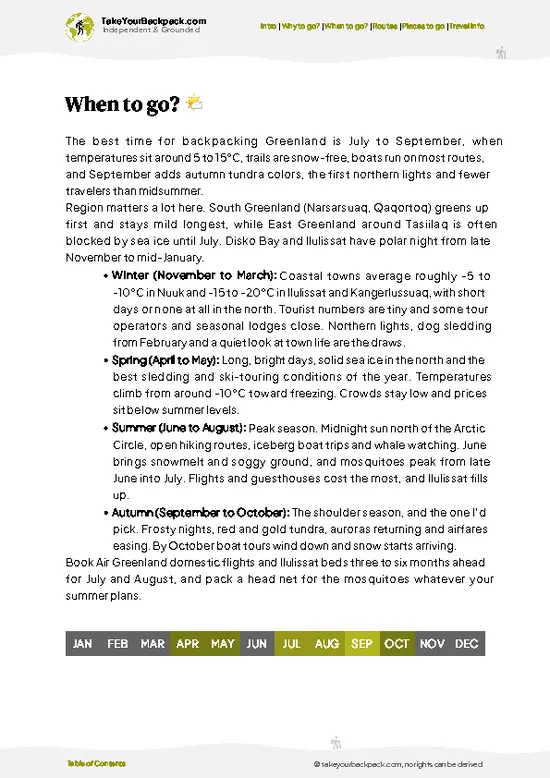
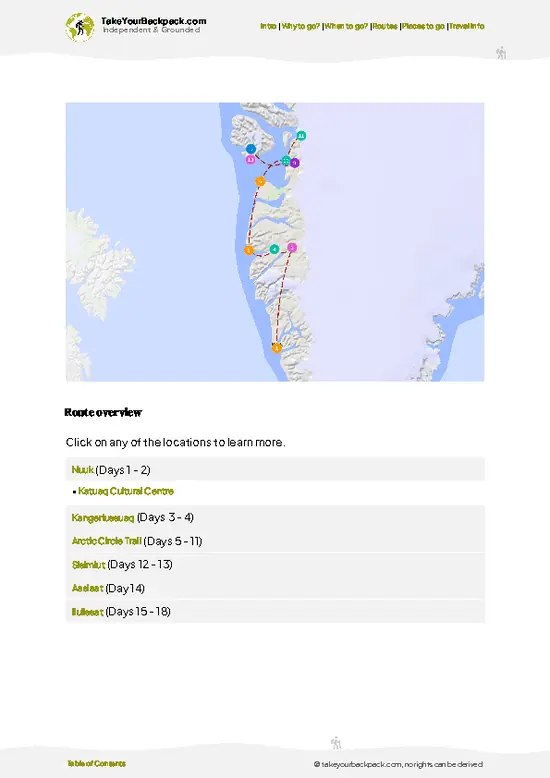
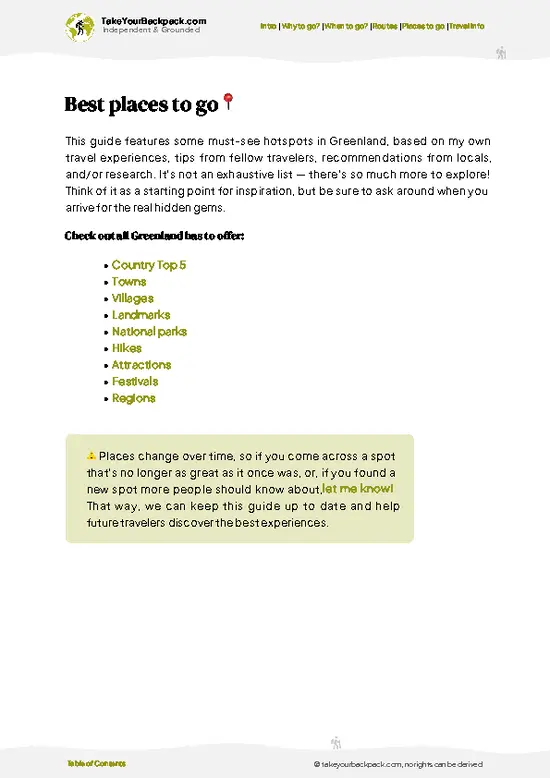
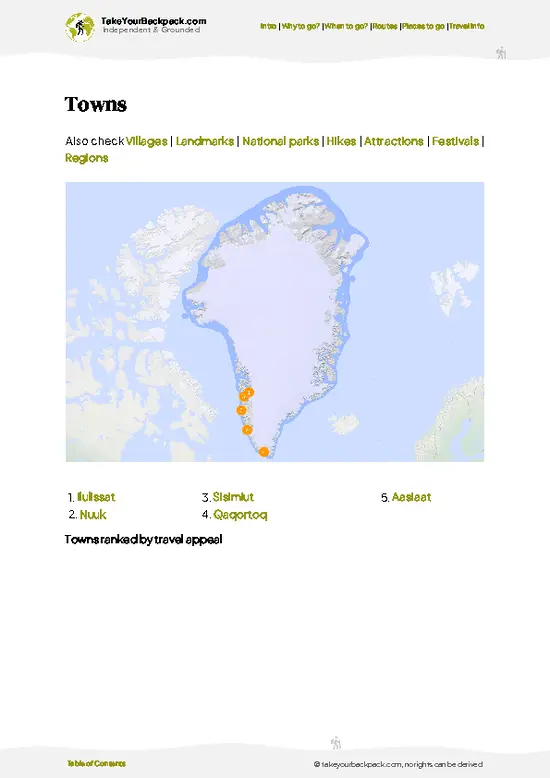
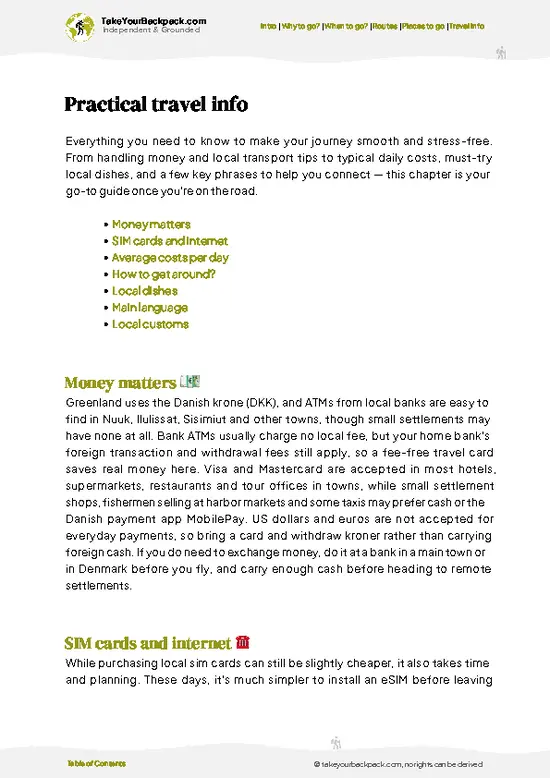
example page 0 from our offline Travel Guide for Greenland
example page 1 from our offline Travel Guide for Greenland
example page 2 from our offline Travel Guide for Greenland
example page 3 from our offline Travel Guide for Greenland
example page 4 from our offline Travel Guide for Greenland
example page 5 from our offline Travel Guide for Greenland
example page 6 from our offline Travel Guide for Greenland
example page 7 from our offline Travel Guide for Greenland
Loading the map 🌍
CLICK TO FILTER
towns
villages
landmarks
national parks
hikes
attractions
festivals
regions
SHOW COUNTRY’S BESTSHOW ALL

✨ Why go?
Ranked #5 village in Greenland
Why visitors keep coming back

Qeqertarsuaq works as a base because the hiking, boat trips and Arctic science all begin within walking distance of the harbor. The reason to come is Disko Island’s volcanic interior: a plateau of basalt, waterfalls and lava formations you can reach from town on foot, with local guides for the longer routes. Add the iceberg-clogged bay, where whale-watching boats leave in summer, and you have two or three days of real variety without a long transfer. Travelers also come for the Arctic Station, a research base run from Copenhagen since the early twentieth century, which gives the town an unusual scientific character. It is a place to linger rather than rush. Hikers, photographers and solo travelers who like quiet do best here, and you will meet others in guesthouses and on boat decks. Those … read more 👉
Qeqertarsuaq works as a base because the hiking, boat trips and Arctic science all begin within walking distance of the harbor. The reason to come is Disko Island’s volcanic interior: a plateau of basalt, waterfalls and lava formations you can reach from town on foot, with local guides for the longer routes. Add the iceberg-clogged bay, where whale-watching boats leave in summer, and you have two or three days of real variety without a long transfer. Travelers also come for the Arctic Station, a research base run from Copenhagen since the early twentieth century, which gives the town an unusual scientific character. It is a place to linger rather than rush. Hikers, photographers and solo travelers who like quiet do best here, and you will meet others in guesthouses and on boat decks. Those who need nightlife, shops or lots of choice will find it too small, and a short stay of two nights is the minimum to justify the effort of getting here.

💡 HighlightsEssential experiences to have while visiting Qeqertarsuaq

  1. Qeqertarsuaq Museum: Housed in the old blue-and-white buildings near the harbor, it covers Inuit and Danish history, whaling and local life. Allow about 45 minutes and US$5 to 8. Visit on a rainy or windy afternoon.
  2. Arctic Station and the Red Cliff shoreline walk: Walk the coast path to the research station, set against rust-colored basalt. The exterior and surroundings are free, and the stroll takes 1 to 2 hours. Go in the evening when the light is soft and icebergs sit in the bay.
  3. Harbor and iceberg viewpoint walk: The small harbor, with fishing boats and drying racks, is the town’s heart. Climb the rocky rise behind it for views over the bay and its drifting ice. It costs nothing and takes 1 to 2 hours. Go at any time, though calm mornings give the best reflections.
For day trips from Qeqertarsuaq, … read more 👉
  1. Qeqertarsuaq Museum: Housed in the old blue-and-white buildings near the harbor, it covers Inuit and Danish history, whaling and local life. Allow about 45 minutes and US$5 to 8. Visit on a rainy or windy afternoon.
  2. Arctic Station and the Red Cliff shoreline walk: Walk the coast path to the research station, set against rust-colored basalt. The exterior and surroundings are free, and the stroll takes 1 to 2 hours. Go in the evening when the light is soft and icebergs sit in the bay.
  3. Harbor and iceberg viewpoint walk: The small harbor, with fishing boats and drying racks, is the town’s heart. Climb the rocky rise behind it for views over the bay and its drifting ice. It costs nothing and takes 1 to 2 hours. Go at any time, though calm mornings give the best reflections.
For day trips from Qeqertarsuaq, consider the Lyngmarksbræen glacier edge, the black-sand beaches along the coast, the lava and waterfall landscapes of the island interior, and boat trips toward the Disko Bay icebergs, all reached by guide or boat. For a first visit, start with the Arctic Station shoreline walk, because it combines the town’s science history, cliffs and ice in one easy outing.
Spotted a mistake or missing something? Contact us.

Things to do near Qeqertarsuaq

Ratings based on Tripadvisor reviews. When you book through this link, you support our work at no extra cost to you.

🌤️ When to go?Weather, crowds, and seasonal trade-offs

  • Midsummer (late June to August): Qeqertarsuaq is at its most open, with highs of 6 to 12°C (43 to 54°F) and the sun dipping barely below the horizon around the solstice. Whale-watching boats run, hiking is easy and mosquitoes peak in July. Prices and beds are at their tightest.
  • Autumn (September to October): Temperatures fall to between -2 and 6°C (28 to 43°F), daylight shrinks fast and the tundra turns rust red. Icebergs are huge, the sky starts to go dark enough for aurora, and boat trips thin out.
  • Winter (November to March): Expect -5 to -20°C (23 to -4°F), with the sun absent or very low around midwinter. Sea ice allows dog sledding, but few services operate.
  • Spring (April to May): Days lengthen quickly, with -12 to 0°C (10 to 32°F), good snow for skiing and sledding, and quiet streets.
Book flights and beds by April for July and August.

source: climatestotravel.comJANJanuary: below average for travelingFEBFebruary: below average for travelingMARMarch: fair for travelingAPRApril: good for travelingMAYMay: good for travelingJUNJune: excellent for travelingJULJuly: excellent for travelingAUGAugust: highly recommended for travelingSEPSeptember: good for travelingOCTOctober: fair for travelingNOVNovember: fair for travelingDECDecember: below average for traveling
greenland-city-qeqertarsuaq
© Google | Olav Sejeroe

✈️ The backpacker research shortcutGreenland Travel Guide

An offline-friendly backpacking guide with optimized travel routes, ranked highlights, transport advice, and the best areas to stay.
example page 0 from our offline Travel Guide for Greenland
example page 1 from our offline Travel Guide for Greenland
example page 2 from our offline Travel Guide for Greenland
example page 3 from our offline Travel Guide for Greenland
example page 4 from our offline Travel Guide for Greenland
example page 5 from our offline Travel Guide for Greenland
example page 6 from our offline Travel Guide for Greenland
example page 7 from our offline Travel Guide for Greenland
The digital guide (154 pages) contains:
✅ 33 highlights, ranked by travel appeal
✅ Optimized 7, 14 & 21-day travel routes
✅ Cities, national parks, landmarks, beaches
✅ How to get around
✅ Offline-friendly for travel without Wi-Fi
👉 Click to see all 30+ guide features

📅 Plan smarter in minutes, not weeks
✅ Month by month travel advice
✅ Festivals & national holidays
✅ Budget expectations

🗺️ Go to the right places, skip the overrated ones
✅ Honest pros & cons of destinations
✅ Top hikes, parks & viewpoints
✅ Lesser-known places most travelers miss
✅ Clear “worth it vs skip it” guidance

🛏️ Travel smoothly without rookie mistakes
✅ Best areas to stay
✅ Transport systems explained simply
✅ Common scams & safety advice
✅ SIM cards, money & practical tips

🌍 Understand the country, not just visit it
✅ Culture & traditions
✅ 52 Essential phrases & customs
✅ Festivals worth planning around
✅ Traveler-friendly historical context
✅ Insights that make places more meaningful

📱 Built for real travel conditions
✅ Fully downloadable PDF
✅ Works completely offline
✅ Optimized for phone use
✅ Useful in remote areas & buses
✅ Everything in one place
Stop searching, start planning
Get instant access to your full guide. 30‑day money-back guarantee.
+ Add another guide for just

By proceeding you agree to our terms.
Sent to your inbox immediately after payment • 100% Secure Checkout
Best Backpacking Travel Advisor 2025 tourism awardBest Backpacking
Travel Advisor
2025
What others say about Take Your Backpack Guides:
⭐⭐⭐⭐⭐
Fantastic, amazing amount of information!
⭐⭐⭐⭐⭐
My goodness this is amazing, it's what I've been looking for hats off too you!
⭐⭐⭐⭐⭐
I think this is absolutely BRILLIANT
⭐⭐⭐⭐
Very complete and informative. It's still missing places, but I gotta to commend you
⭐⭐⭐⭐⭐
This is truly amazing, thank you, can't wait to explore it with my kids!
⭐⭐⭐⭐⭐
Awesome resource, thank you!
⭐⭐⭐⭐⭐
This is amazing! Can't wait to explore the ones I haven't seen
⭐⭐⭐⭐
I love this! Well done, great idea.
⭐⭐⭐⭐⭐
Thanks for taking the time to make this gem!
⭐⭐⭐⭐⭐
This might be the best website I've ever seen.
⭐⭐⭐⭐⭐
Congratulations, and thank you so much for your work; it's incredibly valuable.
⭐⭐⭐⭐
In all seriousness I think you did a great job pointing out the important spots
⭐⭐⭐⭐⭐
10/10 very good
⭐⭐⭐⭐⭐
As someone who's only just starting to visit regularly this is awesome, thank you.
⭐⭐⭐⭐
Thank you very much! I'm going to visit my dad, it's going to be very useful!
⭐⭐⭐⭐⭐
This is really cool! We'll be travelling for the first time and this definitely come in handy.
⭐⭐⭐⭐⭐
You are now our minister of culture, congratulations 👨‍💼
⭐⭐⭐⭐⭐
Just wanted to tell you that this is a pearl! Going to follow your recommendations.
⭐⭐⭐⭐⭐
This is so cool. I'll definitely be using the resource for my travels soon.
⭐⭐⭐⭐⭐
This is very impressive! Good work.
⭐⭐⭐⭐⭐
This is an amazing and informative site. Very well done!

🛏️ Where to stay?Best areas to stay in Greenland

The best bed for most backpackers in Qeqertarsuaq is a room or dorm bunk at Hotel Disko, the main hotel in town, or the cheaper guesthouse-style rooms run by local operators. Beds are limited, so options are few. Dorm-style beds and shared-bathroom rooms run roughly US$70 to 130 a night, and private hotel rooms US$180 to 280. Nothing here is truly cheap, and summer fills up early.

The seaside setting is the reason to stay close to the harbor. From there you can walk to the shops, the museum and the trailheads, and watch icebergs drift past the bay. Some guesthouses offer shared kitchens, which … read more 👉
The best bed for most backpackers in Qeqertarsuaq is a room or dorm bunk at Hotel Disko, the main hotel in town, or the cheaper guesthouse-style rooms run by local operators. Beds are limited, so options are few. Dorm-style beds and shared-bathroom rooms run roughly US$70 to 130 a night, and private hotel rooms US$180 to 280. Nothing here is truly cheap, and summer fills up early.

The seaside setting is the reason to stay close to the harbor. From there you can walk to the shops, the museum and the trailheads, and watch icebergs drift past the bay. Some guesthouses offer shared kitchens, which saves a lot, since restaurant meals are pricey. The Brugsen supermarket stocks pasta, bread and basics for self-catering, so stock up there.

A hostel-style bunk also makes it easy to meet other travelers and split boat trips. Camping is possible outside the settlement on the tundra, though summer mosquitoes are fierce and the weather turns quickly, so bring a sturdy tent and a good net. Check that any wild camping spot is not on private or protected land.

🚌 Day tripsWhere to go beyond the main area

Qeqertarsuaq works well as a base for day trips, because the best outings start right at the harbor or from the edge of town, though anything beyond walking distance depends on a boat or a guide.
Disko Fjord and Kingittoq Basalt Coast:
A boat ride along the south coast takes you past columnar basalt cliffs and icebergs that ground in shallow water off town. Expect 2 to 4 hours on the water and roughly US$90 to 160 per person on a shared tour, with the price falling as the group grows. July and August are the calmest months. First-timers often book the cheapest slot without checking whether the boat has a heated cabin, and then shiver through the cold wind off the ice.

Lyngmarksbræen Glacier Hike:
The glacier sits north of town and the walk across the Disko Island plateau rewards you with open … read more 👉
Qeqertarsuaq works well as a base for day trips, because the best outings start right at the harbor or from the edge of town, though anything beyond walking distance depends on a boat or a guide.
Disko Fjord and Kingittoq Basalt Coast:
A boat ride along the south coast takes you past columnar basalt cliffs and icebergs that ground in shallow water off town. Expect 2 to 4 hours on the water and roughly US$90 to 160 per person on a shared tour, with the price falling as the group grows. July and August are the calmest months. First-timers often book the cheapest slot without checking whether the boat has a heated cabin, and then shiver through the cold wind off the ice.

Lyngmarksbræen Glacier Hike:
The glacier sits north of town and the walk across the Disko Island plateau rewards you with open tundra, musk-ox tracks and a blue ice edge. Allow 6 to 8 hours round trip, most of it on foot from town, so the only costs are food and perhaps a guide at US$100 to 180 if you want to go onto the ice. Late June to early September is the window. Many people set out in thin shoes and get soaked in the wet moss, so wear waterproof boots.

Arctic Station and Red Rock Walk:
The Arctic Station, a research base run by the University of Copenhagen, lies a 30 to 40 minute stroll from the harbor along the shore. Continue on the path and you reach black basalt beaches, a small waterfall and views of Disko Bay icebergs. The walk costs nothing, takes 2 to 3 hours with stops, and is pleasant from June through September. Bring mosquito repellent in July, when the insects swarm.

Whale Watching in Disko Bay:
Humpbacks feed in the bay in summer, and a small boat can reach them within an hour of leaving the harbor. Trips run 3 to 4 hours and cost about US$110 to 170. June to September gives the best odds, but sightings are never guaranteed, so book the first day of your stay and keep a spare one in case weather cancels it.

FAQCommon questions from travelers

Qeqertarsuaq is reached by air or sea from Ilulissat, as there are no roads. In winter, Air Greenland helicopters fly from Ilulissat; from late June to mid-September the heliport closes and Disko Line ferries cross Disko Bay in about 2 hours (roughly US$120). Book early in summer, since seats and bunks fill quickly.
Qeqertarsuaq is worth the trip if you want whales, black basalt cliffs and glacier hikes without the crowds of Ilulissat. Plan 2 to 4 nights to allow for weather delays, and budget at least US$150 to 250 a day including a boat tour. Summer is best for hiking, and winter suits dog sledding.
Qeqertarsuaq is difficult as a day trip from Ilulissat because transport is limited and weather often changes. The flight is short, but schedules rarely allow a same-day return, so stay at least one night. Two nights give time for a boat tour and a hike, and cost about US$150 to 300 extra.
⚠️ Things can change over time, so always validate details locally before you go.

Other Greenlandic villages near Qeqertarsuaq

Explore more nearby:

  • Qasigiannguit—Disko Bay shore, Saqqaq finds, 1700s trading post, halibut harbor| 105 km away
  • Saqqaq—Nuussuaq Peninsula, Saqqaq culture, wooden church, fish landing| 106 km away
  • Kangerlussuaq—Ice sheet access, Point 660, old US airbase, tundra| 275 km away

💡 Not sure where to go next?
Create a personalized itinerary for Greenland including Qeqertarsuaq and the places that fit your trip.

Generate my itinerary

👉 Discover all villages

Or checkout all Greenland has to offer (think cities, towns, villages, national parks, hikes, beaches, festivals)
Country photo of Greenland

We 💚 feedbackKey takeaways before you go

Qeqertarsuaq rewards anyone who looks down at the shoreline. The black basalt beach near the harbor is strewn with small icebergs that grounded overnight, and they change every tide. I would walk it early with a thermos and good boots, and skip the rush to the plateau until you’ve watched the ice come and go.

✍️ Help improve this page!
The information on this page is based on in-depth research, insights shared by experienced travelers, and feedback from the local travel community in Greenland. While every effort is made to keep the information accurate and current, conditions can change — so if you spot anything incorrect or outdated, please get in touch.


🙋‍♂️ Give feedback

👋 Meet the founderWho’s Behind Take Your Backpack?

Johan, backpacker and founder of TakeYourBackpackHi, I’m Johan (Netherlands 🇳🇱), the creator of TakeYourBackpack. Over the past 3 decades, I’ve backpacked through 90+ countries across six continents, gaining extensive experience with independent travel, long-term trips, and overland routes.

This site is built on a combination of firsthand travel experience and carefully curated insights from other backpackers. Many guides are based on places I’ve personally visited, while others bring together tips, observations, and practical advice shared by trusted travelers I’ve met along the way.

The goal is to provide realistic, experience-driven guidance — not generic itineraries — so you can explore destinations with better context, clearer expectations, and more confidence.