v2.webp)



- Jataka murals — the storytelling panels: The caves are basically a picture-book of the Buddha’s previous lives, rendered with surprising emotion and movement. Faces, expressions and tiny background details pull you into full scenes — best seen in caves like 1, 17 and 26. (Personal favorite: sitting in front of a Jataka panel and trying to pick out the little comic or tragic moments the artist left behind.)
- Chaitya Hall of Cave 10: A true architectural moment — a barrel-vaulted prayer hall carved out of the rock with stone “wooden” ribs and a stupa at the end. The scale and the way the light plays inside still feels surprisingly theatrical even after you’ve seen photos.
- Cave 16 — the great vihara and huge Buddha: The largest monastery cave, with a monumental seated Buddha and densely carved
- Jataka murals — the storytelling panels: The caves are basically a picture-book of the Buddha’s previous lives, rendered with surprising emotion and movement. Faces, expressions and tiny background details pull you into full scenes — best seen in caves like 1, 17 and 26. (Personal favorite: sitting in front of a Jataka panel and trying to pick out the little comic or tragic moments the artist left behind.)
- Chaitya Hall of Cave 10: A true architectural moment — a barrel-vaulted prayer hall carved out of the rock with stone “wooden” ribs and a stupa at the end. The scale and the way the light plays inside still feels surprisingly theatrical even after you’ve seen photos.
- Cave 16 — the great vihara and huge Buddha: The largest monastery cave, with a monumental seated Buddha and densely carved attendant figures. It gives you a good sense of monastic life and devotional layout, up close and in uninterrupted scale.
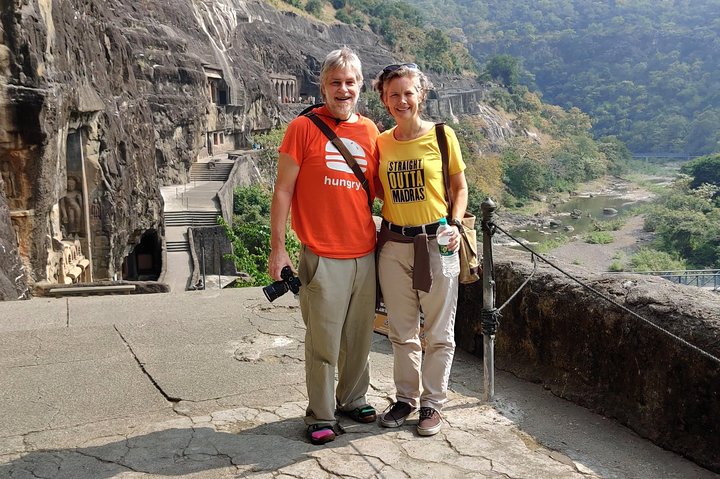
- The cliffside setting and views: The horseshoe gorge and the line of caves chiseled into its face are as much part of the experience as the art. Walk the rim path at morning or late afternoon light for dramatic silhouettes and quieter moments away from the crowds.
- The painting technique and pigments: The colors (reds, greens, deep blues) have survived remarkably well because of the skilled use of mineral and organic pigments and delicate brushwork. Close inspection reveals subtle shading, layered washes and tiny, confident strokes — nothing like a flat museum reproduction.
- Ornate doorways, columns and carved details: Every cave entrance is a mini showpiece — carved pilasters, dancing apsaras, guardian figures and decorative panels. These are where you can see the craftsmen’s patience and taste for detailed patterning.
- History in stone — the evolution of Buddhist art: Visiting Ajanta is like flipping through a slow historical flipbook: early Hinayana austerity evolves into rich Mahayana imagery. The site spans centuries (roughly 2nd century BCE to about the 5th century CE) and explains why Ajanta is UNESCO-listed.
Spotted a mistake or missing something? Contact us.

Most Popular 2-Day Guided Tour of Ajanta & Ellora Caves with Car

Private 2 Days Tour: Ajanta Ellora Caves and Aurangabad City

Aurangabad Ellora Caves sightseeing - Day Tour

Skip-the-Line: All-Inclusive 2-Day Ajanta and Ellora Private Tour

Ajanta & Ellora Combined Tour in a day from Aurangabad
Ajanta Ellora Caves Combo- 2 Day Guided Private Tour

From Aurangabad to Ajanta Ellora Taxi – Best 2-Day Cab Tour

Skip-the-queue private Ajanta & Ellora 2-Day Tour

Ajanta & Ellora Caves and Sightseeing 2 days Tour


 Best Backpacking
.jpg) Hi, I’m Johan (Netherlands 🇳🇱), the creator of TakeYourBackpack. Over the past 3 decades, I’ve backpacked through 90+ countries across six continents, gaining extensive experience with independent travel, long-term trips, and overland routes.
Hi, I’m Johan (Netherlands 🇳🇱), the creator of TakeYourBackpack. Over the past 3 decades, I’ve backpacked through 90+ countries across six continents, gaining extensive experience with independent travel, long-term trips, and overland routes.