×

India🇮🇳 | best landmarksExplore the 10 Best landmarks in India

Landmarks in India are rarely single sights. They are working places: temples where priests still chant at dawn, forts with families picnicking on the ramparts, tombs wedged between traffic and street vendors. That living quality is the draw, and it also sets the pace. Expect noise, queues and touts, and plan around them.

The regions differ sharply. North India (Delhi, Agra, Rajasthan) holds the Mughal and Rajput monuments. It is the easiest to reach by train, but also the most crowded and the most hustled, and foreigner ticket prices at the big names run roughly ₹600 to 1,800 (about US$7 to 21) against ₹30 to 50 for Indians. South India offers huge Dravidian temple complexes where entry is often free or a few rupees, dress rules are strict, and the atmosphere is devotional rather than touristy. Central and eastern India have cave carvings and ancient ruins that see far fewer visitors but need slower, longer transport.

For backpacking or independent travel, the north suits first-timers who want convenience, while the south and center suit anyone prepared to trade comfort for quiet. Skip the sights that are only photo stops; the ones with living worship or deep history repay your time.

By Johan Kruseman 🇳🇱 | Updated October 18, 2026
Explore the best national parks in India

Why go?Why These unique site Stand Out

India works for landmarks because few countries have stacked so many eras of building in one place. Mauryan, Gupta, Chola, Rajput, Mughal and British-colonial patronage each left monuments in different materials, from rock-cut caves to red sandstone and white marble. The result is variety, not repetition. You can spend weeks seeing completely different architectural logic without leaving the country.

The second reason is that religion keeps the landmarks alive. Hindu, Buddhist, Jain, Sikh, Muslim and Christian sites are still used daily, so you see them as they function, with rituals, offerings and festival crowds. This is a real advantage over countries where old monuments are sealed museum pieces. It also means rules apply: shoes off, covered shoulders and knees, restricted areas for non-worshippers, … read more 👉
India works for landmarks because few countries have stacked so many eras of building in one place. Mauryan, Gupta, Chola, Rajput, Mughal and British-colonial patronage each left monuments in different materials, from rock-cut caves to red sandstone and white marble. The result is variety, not repetition. You can spend weeks seeing completely different architectural logic without leaving the country.

The second reason is that religion keeps the landmarks alive. Hindu, Buddhist, Jain, Sikh, Muslim and Christian sites are still used daily, so you see them as they function, with rituals, offerings and festival crowds. This is a real advantage over countries where old monuments are sealed museum pieces. It also means rules apply: shoes off, covered shoulders and knees, restricted areas for non-worshippers, and some inner sanctums closed to non-Hindus.

Geography and climate shape what survives and how you experience it. The dry north and west preserved stone forts and palaces well, while the humid coast and monsoon belts weather carvings faster and add mold and crumbling plaster. Heat is the practical limit. Open courtyards with no shade and midday stone temperatures make many sites unpleasant for hours at a time, so early starts are not optional.

Infrastructure is uneven. The railway network links most major monument cities cheaply, and the big sights have ticket counters, audio guides and official guides. The smaller ones may have none of that, with erratic opening hours and poor signage. Distances are long, and a road journey of 150 kilometers can take five hours.

Before choosing India for landmarks, accept three things. First, the two-tier pricing is real and foreigner fees add up fast. Second, the most famous sites are crowded almost all year, and a second-tier site often delivers a better visit. Third, the pressure from touts, unofficial guides and aggressive souvenir sellers is part of the deal at the headline attractions. It is manageable if you expect it. If you want empty, silent heritage sites, India is the wrong country; if you want depth, scale and living tradition, nowhere else compares.
How the List Was Created
The list of best unique sites in India is created based on history or culture, wow factor, atmosphere, quirks, and memorability. If you feel a unique site is missing in this list, please let us know.

When to go?Best Time to Visit India for landmarks

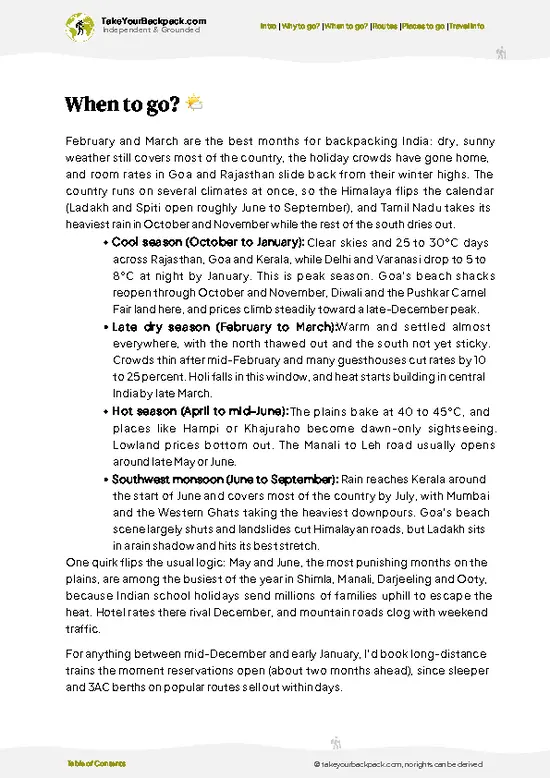
Best months: November to February is the best window for landmarks in India, because daytime temperatures across the north and center sit around 15 to 28°C and there is almost no rain, so long hours outdoors are comfortable. Mornings in Delhi, Agra and Rajasthan can drop to 4 to 8°C in December and January, and fog often delays trains and flights and hides monuments at sunrise. Pack a warm layer and do not schedule tight connections.

Shoulder seasons: October and March are the useful shoulders. October is still humid after the monsoon retreats, with highs of 30 to 35°C in the north, but crowds are lighter and prices lower. March brings 30 to 36°C in the north and is fine if you start before 8 a.m. April and May are not worth it in Rajasthan, the Gangetic plain and central India, where highs … read more 👉
Best months: November to February is the best window for landmarks in India, because daytime temperatures across the north and center sit around 15 to 28°C and there is almost no rain, so long hours outdoors are comfortable. Mornings in Delhi, Agra and Rajasthan can drop to 4 to 8°C in December and January, and fog often delays trains and flights and hides monuments at sunrise. Pack a warm layer and do not schedule tight connections.

Shoulder seasons: October and March are the useful shoulders. October is still humid after the monsoon retreats, with highs of 30 to 35°C in the north, but crowds are lighter and prices lower. March brings 30 to 36°C in the north and is fine if you start before 8 a.m. April and May are not worth it in Rajasthan, the Gangetic plain and central India, where highs of 40 to 47°C turn stone courtyards into hotplates. Hill and mountain areas are the exception in those months.

Monsoon: June to September brings heavy rain, with most regions receiving the bulk of their annual 700 to 1,500 mm in these months. Roads flood, rock-cut cave sites in Maharashtra and Madhya Pradesh can turn slippery, and views are hazy. Skip it for most landmarks. The upside is hotel discounts of 30 to 50 percent and thin crowds, which suits anyone who accepts delays and wet shoes.

Regional differences: South India runs on a different calendar. Tamil Nadu and the southeast coast get their heavy rain from October to December via the northeast monsoon, so the best months there are January to March. Kerala and the west coast are best from December to February. Ladakh and the high Himalaya are open only roughly June to September, when the passes are clear.

Peak periods and closures: Peak season runs from late December to early January, when hotel prices in the main circuit cities can rise 50 to 100 percent and booking ahead is needed. Diwali (October or November) and Holi (March) bring local crowds and closures of shops and some sites. The Taj Mahal in Agra is closed on Fridays, and many state-run monuments close one weekday, so check before building a day around them. Indian school holidays in May and June push domestic crowds into hill areas.

unique site hoppingOptimizing Your Multi-Stop Itinerary

How many days: A trip combining several landmarks in India needs 14 to 21 days, and anything under 10 days means choosing one region only. India is too large and transport too slow to cover it all in a short window, and trying to do so wastes more time on trains than at sights.

Which regions group well: The north forms the easiest cluster: Delhi, Agra and Rajasthan (Jaipur, Jodhpur, Udaipur) are linked by frequent trains and buses. Going Delhi to Agra to Jaipur and then west and south through Rajasthan avoids backtracking. A second cluster is the south, with Chennai, Madurai, Thanjavur and Kochi or Bengaluru, connected by good trains. Central India (Khajuraho, Sanchi, Ajanta and Ellora near Aurangabad) forms a third cluster that needs more patience, since services are thinner. East India, … read more 👉
How many days: A trip combining several landmarks in India needs 14 to 21 days, and anything under 10 days means choosing one region only. India is too large and transport too slow to cover it all in a short window, and trying to do so wastes more time on trains than at sights.

Which regions group well: The north forms the easiest cluster: Delhi, Agra and Rajasthan (Jaipur, Jodhpur, Udaipur) are linked by frequent trains and buses. Going Delhi to Agra to Jaipur and then west and south through Rajasthan avoids backtracking. A second cluster is the south, with Chennai, Madurai, Thanjavur and Kochi or Bengaluru, connected by good trains. Central India (Khajuraho, Sanchi, Ajanta and Ellora near Aurangabad) forms a third cluster that needs more patience, since services are thinner. East India, such as Odisha and Kolkata, pairs with the south better than with the north.

Time per stop: Allow one full day for major monument cities with one big site, two to three days for places with many sites such as Delhi or Jaipur, and half a day to a full day for smaller temple towns. Cave complexes and spread-out temple towns need a full day each, as distances between sites are long and the heat caps your hours.

Getting between regions: Trains are the best value, though the long hauls matter: Delhi to Agra takes about 2 to 3 hours on the fast service, Delhi to Jaipur 4 to 5, Delhi to Mumbai 16 hours on the fastest, and Delhi to Chennai more than 28 hours. For anything over 12 hours, fly. Domestic flights often cost US$40 to 90 when booked a few weeks ahead and save a full day. Book trains through the official IRCTC channels at least a few weeks ahead, since popular ones sell out.

Planning mistakes: The most common error is cramming too many cities into too few days, which leaves you in transit most of the trip. Cap yourself at one major move every two days. A second is visiting only the famous north circuit and leaving, which misses the south and its less hassled temples. A third is ignoring weekly closure days and fog or heat in the wrong season. Another is booking overnight trains back to back, which wears you down. Alternate a night train with a proper bed in a hotel. Build in one empty day per week, because delays are normal in India and a rigid plan breaks quickly.

The ListMust-Visit landmarks in India

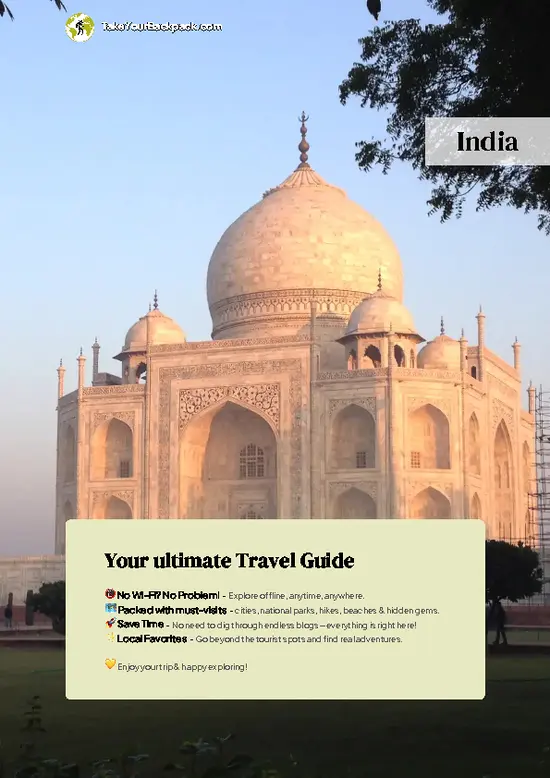
1 Taj Mahal

white marble dome, reflecting pool, symmetrical gardens

Arrive at dawn to see changing light on a mausoleum built for remembrance, where every detail is designed for visual harmony.

India - Taj Mahal

2 Golden Temple

sacred pool, gilded sanctum, community kitchen

Join pilgrims circling a shimmering shrine, pausing for reflection and sharing a meal in the world’s largest free dining hall.

India - the Golden Temple

3 Ajanta Caves

rock-cut monasteries, Buddhist murals, ancient frescoes

Descend into a horseshoe-shaped gorge to see centuries-old cave temples, their walls alive with stories painted in mineral pigments.

4 Ellora Caves

multi-faith temples, basalt cliffs, monolithic carvings

Move between Buddhist, Hindu, and Jain shrines carved into rock, each revealing a different era of religious coexistence and artistry.

5 Meenakshi Temple

gopuram towers, painted ceilings, temple tank

Navigate a labyrinth of halls beneath towering gateways, where rituals and festivals animate the heart of Madurai’s spiritual life.

6 Konark Sun Temple

chariot-shaped sanctuary, stone wheels, solar alignment

Stand before a temple built as a cosmic chariot, its orientation and carvings reflecting centuries of astronomical knowledge.

7 Khajuraho

erotic sculpture, sandstone temples, Chandela dynasty

Survey temple exteriors covered in expressive figures, where sacred and sensual themes intertwine across a UNESCO-listed landscape.

8 Agra Fort

red sandstone ramparts, Mughal palaces, royal courtyards

Walk through a fortified complex where shifting dynasties left behind audience halls, intricate marble inlays, and panoramic views of the Yamuna.

9 Fatehpur Sikri

abandoned capital, red sandstone pavilions, imperial mosque

Wander through a planned city left behind by emperors, where empty courtyards and ornate gateways echo with the ambitions of the Mughal court.

10 Chhatrapati Shivaji Terminus

Victorian Gothic station, domed turrets, railway hub

Arrive at a landmark where colonial-era architecture meets the pulse of Mumbai’s daily commute, with stone carvings and stained glass overhead.

11 Brihadeeswara Temple

towering vimana, granite Nandi, Chola frescoes

Circle a massive temple courtyard, observing the scale of stonework and the legacy of South India’s Chola dynasty in every detail.

12 Charminar

four minarets, central archways, old city crossroads

Stand beneath a 16th-century gateway at the heart of Hyderabad, surrounded by markets and the constant movement of city dwellers.

13 Statue of Unity

colossal sculpture, riverside plaza, viewing gallery

Ascend to observation decks inside the world’s tallest statue, looking out over the Sardar Sarovar Dam and surrounding hills.

14 Rani ki Vav

stepwell corridors, sculpted pillars, subterranean chambers

Descend a series of ornate steps to discover a hidden world of carved figures and cool shade below the plains of Gujarat.

15 Tawang Monastery

mountain monastery, prayer halls, Buddhist murals

Climb to a high-altitude monastery overlooking valleys, where monks maintain centuries-old rituals and colorful festivals mark the calendar.

16 Hoysaleshwara Temple

twin shrines, soapstone reliefs, temple guardians

Examine the layered stories etched into every surface, from mythic battles to daily life, in a temple complex built for close inspection.

17 Ramappa Temple

floating bricks, star-shaped base, Kakatiya reliefs

Observe how light stonework and detailed carvings combine in a temple that survived earthquakes and centuries of changing rule.

18 Chitrakote Falls

horseshoe waterfall, forested plateau, monsoon surge

Watch the Indravati River plunge over a wide cliff, sending mist through the trees and drawing visitors during the rains for dramatic views.

19 Humayun’s Tomb

Persian gardens, domed mausoleum, Mughal symmetry

Stroll through geometric gardens leading to a red-and-white tomb, the prototype for later imperial mausoleums in North India.

Think you know India?

Prove you’re a true local — uncover 9 lesser-known landmarks in India that locals tend to keep to themselves.
Loading the map 🌍

Expert viewInsights from Locals and Experts

How many landmarks to see: Six to eight major landmarks is the right number for a three-week trip, and four or five suits two weeks. India punishes overpacking. Distances are long, trains run late, and a single big site usually eats a half day once you add the queue, security check and the ride in and out. Stack two headline sites on one day and you will see both through a haze of heat and fatigue. Skip the urge to collect a checklist. A week of unhurried wandering around one fort town gives you more than five ticked-off monuments seen from a car window.

The extra landmarks you do add should be free or nearly free. Temples, ghats and old city gates cost little and often reveal more about daily life than ticketed monuments.

Choosing between kinds of landmarks: India has three broad kinds of landmarks, … read more 👉
How many landmarks to see: Six to eight major landmarks is the right number for a three-week trip, and four or five suits two weeks. India punishes overpacking. Distances are long, trains run late, and a single big site usually eats a half day once you add the queue, security check and the ride in and out. Stack two headline sites on one day and you will see both through a haze of heat and fatigue. Skip the urge to collect a checklist. A week of unhurried wandering around one fort town gives you more than five ticked-off monuments seen from a car window.

The extra landmarks you do add should be free or nearly free. Temples, ghats and old city gates cost little and often reveal more about daily life than ticketed monuments.

Choosing between kinds of landmarks: India has three broad kinds of landmarks, and each suits a different traveler. Mughal and Rajput monuments (forts, tombs, palaces) are ticketed, polished and photogenic. They suit first-timers and anyone with limited days, but they draw the biggest crowds and the most touts. Living religious sites (temples, shrines, riverfront steps) are mostly free, crowded in a different way, and best at dawn or dusk when ritual is happening. Choose these if you want atmosphere over architecture. Ancient rock-cut sites and ruined capitals sit far from the main rail lines, take effort to reach, and are nearly empty on weekdays. They suit history-minded travelers with extra time.

If you only have two weeks, take the ticketed monuments for the big names and add one living religious site to balance them. If you are on a long trip, lean toward the remote ruins and temples, because the famous monuments will still be there and are the same on day 3 as on day 30. Palaces converted into museums are the weakest value. Many charge ₹300 to 700 (US$4 to 8) for rooms of faded portraits and glass cases. Skip them unless you have a specific interest.

What it costs per day and per visit: A backpacker can cover India on US$25 to 45 a day including a dorm bed or basic room, trains, street food and one or two paid entries. That range holds in most regions, though Rajasthan palace towns and the major tourist hubs sit at the upper end. Costs jump on days with several ticketed stops, so plan the paid ones across different days rather than bunching them.

Foreigner ticket prices are far above what Indian visitors pay. Expect ₹500 to 700 (US$6 to 8) at most fort and tomb sites, and ₹1,100 to 1,600 (US$13 to 19) at the single most famous marble mausoleum, with extra charges for entering the main chamber. Many Archaeological Survey of India sites take card or QR payment and give a small discount for buying online, so book on the official portal instead of paying at the counter and standing in a second queue. Some sites add a separate video or tripod fee of ₹25 to 100 (under US$1 to 1.20).

Licensed guides cost ₹1,000 to 2,500 (US$12 to 30) for a group of up to four, depending on the site and hours. For the largest forts and temple complexes, a guide earns the fee because the signage is thin and the layouts are confusing. For small sites and ghats, an audio guide at ₹150 to 250 (US$2 to 3) or a downloaded app does the job. Ignore the friendly man at the gate who offers a free tour. It ends at a marble shop or a textile emporium.

Local transport adds up. An auto-rickshaw to a monument costs ₹50 to 200 (US$0.60 to 2.40) if you use a metered ride or an app. Prepaid taxi booths at stations stop the haggling. Day-hire of a car with driver runs ₹2,000 to 4,000 (US$24 to 48) and is worth considering only for scattered rural sites that buses reach slowly.

Costs and mistakes that catch travelers out: The biggest drain is the unplanned detour. Drivers and rickshaw men steer travelers to shops, claiming a site is closed or a road is blocked. If someone says the landmark is shut, check the official hours yourself. Many monuments close one weekday, often Friday for the best-known mausoleum and Monday for several forts and museums, so confirm the day before you arrive. Turning up on a closed day wastes a full day of travel in a country where days are hard to spare.

Another trap is the combined ticket. Some cities sell one pass covering several monuments, valid for a limited window of days. It saves money only if you actually use every site inside that window. Do the sums before buying, and skip it if you plan to visit only two stops.

Queues are a quiet cost. At the big monuments, arriving at opening time saves an hour compared with mid-morning, and the light is softer. Separate lines often exist for foreign visitors, so look for them rather than joining the long general line. Bring only a small bag, since many sites bar large backpacks, food and tripods, and cloakrooms are slow and sometimes unavailable.

Heat is the other budget item. Between April and June, midday temperatures at stone monuments reach 40 to 45°C, and marble and sandstone courtyards burn bare feet. Carry socks for temple floors, 1 to 2 liters of water, and plan indoor stops from noon to 3 p.m.

Safety and cultural considerations: Most landmark visits are safe, and the main risks are petty. Pickpockets work crowds at gates, on steps and during festivals, so carry your phone and wallet in a front pocket or a zipped inner bag. Expect to be approached constantly by guides, photographers and sellers. A polite “no, thank you” said once, followed by continuing to walk, works better than long explanations. Monkeys at some forts and temples snatch bags, food and sunglasses, so keep snacks hidden.

Dress rules matter. Cover shoulders and knees at temples, gurdwaras and mosques, and women should carry a light scarf for head covering where required. Shoes come off at many sites, and a small tip of ₹10 to 20 (US$0.12 to 0.25) at the shoe stand is normal. Some inner sanctums bar non-Hindus, and photography is banned inside many shrines, so ask before raising a camera. Never point your feet at an altar, and walk clockwise around shrines.

Festival days draw crowds that can turn a visit into a crush. Check dates, and avoid the busiest bathing and procession hours unless crowd energy is the point. Women traveling alone should stick to daylight hours at remote ruins, go in pairs where possible, and avoid empty corners of large complexes late in the day.

✈️ The backpacker research shortcutIndia Travel Guide

An offline-friendly backpacking guide with optimized travel routes, ranked highlights, transport advice, and the best areas to stay.
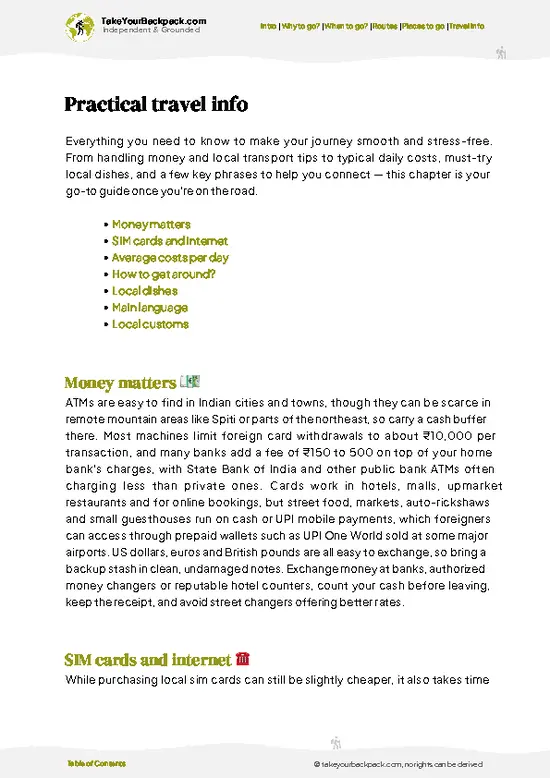
example page 0 from our offline Travel Guide for India
example page 1 from our offline Travel Guide for India
example page 2 from our offline Travel Guide for India
example page 3 from our offline Travel Guide for India
example page 4 from our offline Travel Guide for India
example page 5 from our offline Travel Guide for India
example page 6 from our offline Travel Guide for India
example page 7 from our offline Travel Guide for India
The digital guide (483 pages) contains:
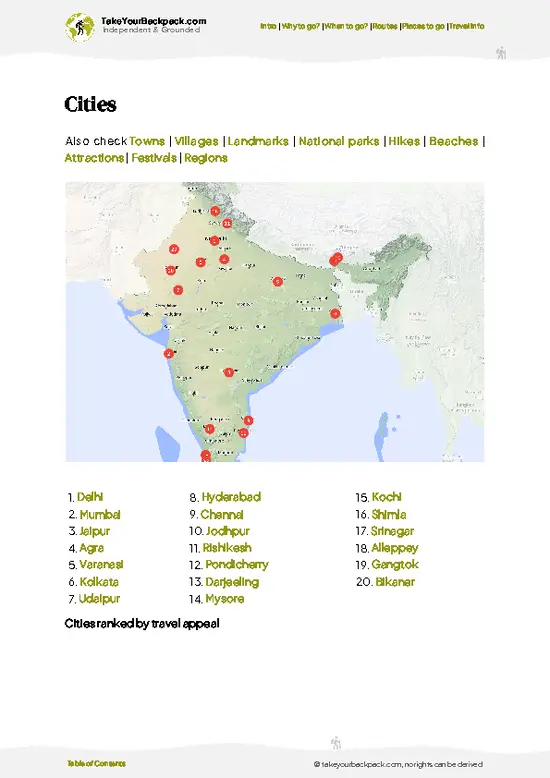
✅ 157 highlights, ranked by travel appeal
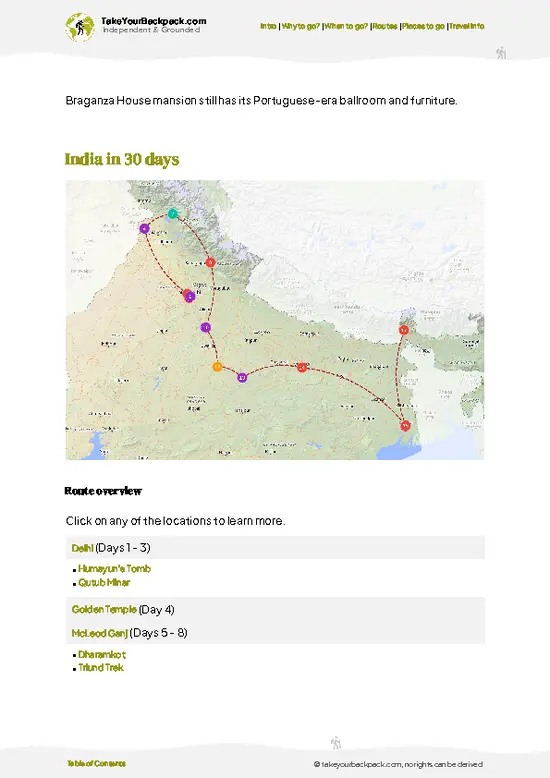
✅ Optimized 14, 21 & 30-day travel routes
✅ Cities, national parks, landmarks, beaches
✅ How to get around
✅ Offline-friendly for travel without Wi-Fi
👉 Click to see all 30+ guide features

📅 Plan smarter in minutes, not weeks
✅ Month by month travel advice
✅ Festivals & national holidays
✅ Budget expectations

🗺️ Go to the right places, skip the overrated ones
✅ Honest pros & cons of destinations
✅ Top hikes, parks & viewpoints
✅ Lesser-known places most travelers miss
✅ Clear “worth it vs skip it” guidance

🛏️ Travel smoothly without rookie mistakes
✅ Best areas to stay
✅ Transport systems explained simply
✅ Common scams & safety advice
✅ SIM cards, money & practical tips

🌍 Understand the country, not just visit it
✅ Culture & traditions
✅ 52 Essential phrases & customs
✅ Festivals worth planning around
✅ Traveler-friendly historical context
✅ Insights that make places more meaningful

📱 Built for real travel conditions
✅ Fully downloadable PDF
✅ Works completely offline
✅ Optimized for phone use
✅ Useful in remote areas & buses
✅ Everything in one place
Stop searching, start planning
Get instant access to your full guide. 30‑day money-back guarantee.
+ Add another guide for just

By proceeding you agree to our terms.
Sent to your inbox immediately after payment • 100% Secure Checkout
Best Backpacking Travel Advisor 2025 tourism awardBest Backpacking
Travel Advisor
2025
What others say about Take Your Backpack Guides:
⭐⭐⭐⭐⭐
Fantastic, amazing amount of information!
⭐⭐⭐⭐⭐
My goodness this is amazing, it's what I've been looking for hats off too you!
⭐⭐⭐⭐⭐
I think this is absolutely BRILLIANT
⭐⭐⭐⭐
Very complete and informative. It's still missing places, but I gotta to commend you
⭐⭐⭐⭐⭐
This is truly amazing, thank you, can't wait to explore it with my kids!
⭐⭐⭐⭐⭐
Awesome resource, thank you!
⭐⭐⭐⭐⭐
This is amazing! Can't wait to explore the ones I haven't seen
⭐⭐⭐⭐
I love this! Well done, great idea.
⭐⭐⭐⭐⭐
Thanks for taking the time to make this gem!
⭐⭐⭐⭐⭐
This might be the best website I've ever seen.
⭐⭐⭐⭐⭐
Congratulations, and thank you so much for your work; it's incredibly valuable.
⭐⭐⭐⭐
In all seriousness I think you did a great job pointing out the important spots
⭐⭐⭐⭐⭐
10/10 very good
⭐⭐⭐⭐⭐
As someone who's only just starting to visit regularly this is awesome, thank you.
⭐⭐⭐⭐
Thank you very much! I'm going to visit my dad, it's going to be very useful!
⭐⭐⭐⭐⭐
This is really cool! We'll be travelling for the first time and this definitely come in handy.
⭐⭐⭐⭐⭐
You are now our minister of culture, congratulations 👨‍💼
⭐⭐⭐⭐⭐
Just wanted to tell you that this is a pearl! Going to follow your recommendations.
⭐⭐⭐⭐⭐
This is so cool. I'll definitely be using the resource for my travels soon.
⭐⭐⭐⭐⭐
This is very impressive! Good work.
⭐⭐⭐⭐⭐
This is an amazing and informative site. Very well done!

🛏️ Where to stay?Top Places to Consider Staying

India has one of Asia’s densest backpacker hostel scenes, with dorm beds typically running ₹400 to 900 (US$5 to 11) and simple private guesthouse rooms from about ₹1,000 to 2,000 (US$12 to 24). In Delhi, Paharganj has the cheapest beds and sits right by New Delhi Railway Station, but it is loud, grimy and full of touts, while Hauz Khas costs a little more and gives you cafés, bars and calmer lanes far from the Old Delhi sights. Elsewhere, Colaba in Mumbai puts you near the Gateway of India at the city’s highest prices, Anjuna and Arambol in Goa bring the parties and a laid-back beach crowd, and Tapovan in Rishikesh and Assi Ghat in Varanasi trade nightlife (alcohol is restricted in both towns) … read more 👉
India has one of Asia’s densest backpacker hostel scenes, with dorm beds typically running ₹400 to 900 (US$5 to 11) and simple private guesthouse rooms from about ₹1,000 to 2,000 (US$12 to 24). In Delhi, Paharganj has the cheapest beds and sits right by New Delhi Railway Station, but it is loud, grimy and full of touts, while Hauz Khas costs a little more and gives you cafés, bars and calmer lanes far from the Old Delhi sights. Elsewhere, Colaba in Mumbai puts you near the Gateway of India at the city’s highest prices, Anjuna and Arambol in Goa bring the parties and a laid-back beach crowd, and Tapovan in Rishikesh and Assi Ghat in Varanasi trade nightlife (alcohol is restricted in both towns) for quiet riverside stays within walking distance of the ghats and yoga schools.

If you enjoy meeting fellow travelers, consider choosing hostels with high ratings for atmosphere. On the other hand, if you prefer having your own space, a hotel might be a better option.

IndiaMore Places Across India

👋 Meet the founderWho’s Behind Take Your Backpack?

Johan, backpacker and founder of TakeYourBackpackHi, I’m Johan (Netherlands 🇳🇱), the creator of TakeYourBackpack. Over the past 3 decades, I’ve backpacked through 90+ countries across six continents, gaining extensive experience with independent travel, long-term trips, and overland routes.

This site is built on a combination of firsthand travel experience and carefully curated insights from other backpackers. Many guides are based on places I’ve personally visited, while others bring together tips, observations, and practical advice shared by trusted travelers I’ve met along the way.

The goal is to provide realistic, experience-driven guidance — not generic itineraries — so you can explore destinations with better context, clearer expectations, and more confidence.