×
Bromo Tengger Semeru National Park

Indonesia🇮🇩 | national parksBromo Tengger Semeru National ParkSea of sand, Bromo crater rim, Semeru summit, sunrise viewpoints | things to do and best time to go

Explore Bali Barat National ParkExplore Bunaken National Park

Backpacking in Bromo Tengger Semeru
🏆 Top picknational park ranked #2
By Johan Kruseman 🇳🇱 | Updated October 15, 2026

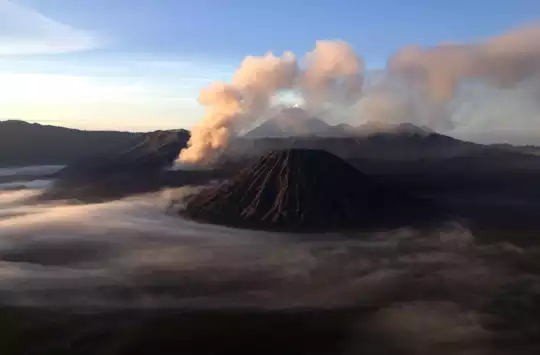
Most online summaries sell Bromo as a one-morning sunrise stop, yet the park’s real backpacker prize is the 2-day loop that adds Semeru, Java’s highest peak at 3,676 m (12,060 ft). The park sits in East Java, roughly between Malang, Probolinggo and Lumajang, so it makes sense alongside Ijen and Yogyakarta. Expect jeep convoys, a dawn crush at Penanjakan viewpoint, and ash-dusted gear. Expect also a flat, otherworldly sand sea, a steaming crater you can walk to the rim of, and Tengger villages with cold mountain air. I once stood on the crater rim at 6 a.m., fingers numb around a glass of sweet ginger tea, sulfur stinging my nose while the caldera floor turned from black to gold. Compared with Gunung Rinjani, Bromo is far more accessible and far more crowded. Compared with Kerinci Seblat, it is tame. Book Semeru climbs well ahead, since permits are limited and closures happen.

Discover everything you want to know in the 📖 Indonesia Travel Guide.


example page 0 from our offline Travel Guide for Indonesia
example page 1 from our offline Travel Guide for Indonesia
example page 2 from our offline Travel Guide for Indonesia
example page 3 from our offline Travel Guide for Indonesia
example page 4 from our offline Travel Guide for Indonesia
example page 5 from our offline Travel Guide for Indonesia
example page 6 from our offline Travel Guide for Indonesia
example page 7 from our offline Travel Guide for Indonesia
Loading the map 🌍
CLICK TO FILTER
cities
towns
villages
landmarks
national parks
hikes
beaches
attractions
festivals
regions
SHOW COUNTRY’S BESTSHOW ALL

✨ Why go?
Ranked #2 national park in Indonesia
What sets this place apart

Backpackers choose Bromo because it rewards independent exploration without a guide. You can reach the crater floor by foot from Cemoro Lawang, crossing the Sea of Sand in about 1 to 1.5 hours, and skip the jeep entirely if you start early. Budget homestays in Cemoro Lawang and Ngadisari run roughly US$8 to 20 a night, so you wake up minutes from the rim. The trail variety is wider than the postcards suggest: a short crater climb, the Savannah and Teletubbies Hills, the Ranu Pani lake route, and the multi-day Semeru ascent for serious hikers. The park suits self-guided travelers for Bromo itself, since paths are obvious and cheap shared transport exists. Tours make sense only for sunrise at Penanjakan, where jeeps are the practical option, and for Semeru, where a registered guide and permit … read more 👉
Backpackers choose Bromo because it rewards independent exploration without a guide. You can reach the crater floor by foot from Cemoro Lawang, crossing the Sea of Sand in about 1 to 1.5 hours, and skip the jeep entirely if you start early. Budget homestays in Cemoro Lawang and Ngadisari run roughly US$8 to 20 a night, so you wake up minutes from the rim. The trail variety is wider than the postcards suggest: a short crater climb, the Savannah and Teletubbies Hills, the Ranu Pani lake route, and the multi-day Semeru ascent for serious hikers. The park suits self-guided travelers for Bromo itself, since paths are obvious and cheap shared transport exists. Tours make sense only for sunrise at Penanjakan, where jeeps are the practical option, and for Semeru, where a registered guide and permit are required. Add the Tengger culture, with Hindu shrines and the Pura Luhur Poten temple on the sand sea, and you get volcano hiking with real cultural texture.

💡 HighlightsKey sights and experiences for travelers

  1. Mount Bromo Crater: An active volcano at 2,329 m (7,641 ft) with a steaming, sulfur-scented crater. You climb about 250 concrete steps from the sand sea to reach the rim and look straight down into the vent.
  2. Penanjakan Viewpoint: At roughly 2,770 m (9,088 ft), this is the classic sunrise lookout. Bromo, Batok and smoking Semeru line up above a layer of cloud. It gets very crowded, so arrive early.
  3. Sea of Sand (Segara Wedi): A flat caldera floor of volcanic sand about 10 km across. Walking it at dawn, with mist hanging low, feels strange and quiet.
  4. Pura Luhur Poten: A Hindu temple on the sand sea at the foot of Bromo, central to the Tengger people’s Yadnya Kasada ceremony, when offerings are thrown into the crater.
  5. Savannah and Teletubbies Hills: Green, ridged slopes on the far side of the sand
… read more 👉
  1. Mount Bromo Crater: An active volcano at 2,329 m (7,641 ft) with a steaming, sulfur-scented crater. You climb about 250 concrete steps from the sand sea to reach the rim and look straight down into the vent.
  2. Penanjakan Viewpoint: At roughly 2,770 m (9,088 ft), this is the classic sunrise lookout. Bromo, Batok and smoking Semeru line up above a layer of cloud. It gets very crowded, so arrive early.
  3. Sea of Sand (Segara Wedi): A flat caldera floor of volcanic sand about 10 km across. Walking it at dawn, with mist hanging low, feels strange and quiet.
  4. Pura Luhur Poten: A Hindu temple on the sand sea at the foot of Bromo, central to the Tengger people’s Yadnya Kasada ceremony, when offerings are thrown into the crater.
  5. Savannah and Teletubbies Hills: Green, ridged slopes on the far side of the sand sea. In the wet season they turn emerald, and in the dry season they fade to gold.
  6. Mount Semeru: Java’s highest summit at 3,676 m (12,060 ft), with regular ash plumes from Jonggring Seloko crater. Climbing requires a permit and is often restricted for safety, so check status first.
  7. Ranu Kumbolo and Ranu Pani: Two crater lakes on the Semeru approach. Ranu Kumbolo, at about 2,400 m, is a famous camp spot, and Ranu Pani is the trailhead village.
I would pick Penanjakan first, though not for the viewpoint crowd itself. The sunrise reveals the whole geography of the caldera at once, which makes every walk afterward easier to understand.
Spotted a mistake or missing something? Contact us.

Things to do near Bromo Tengger Semeru National Park

Ratings based on Tripadvisor reviews. When you book through this link, you support our work at no extra cost to you.

🌤️ When to go?When to go for the best experience

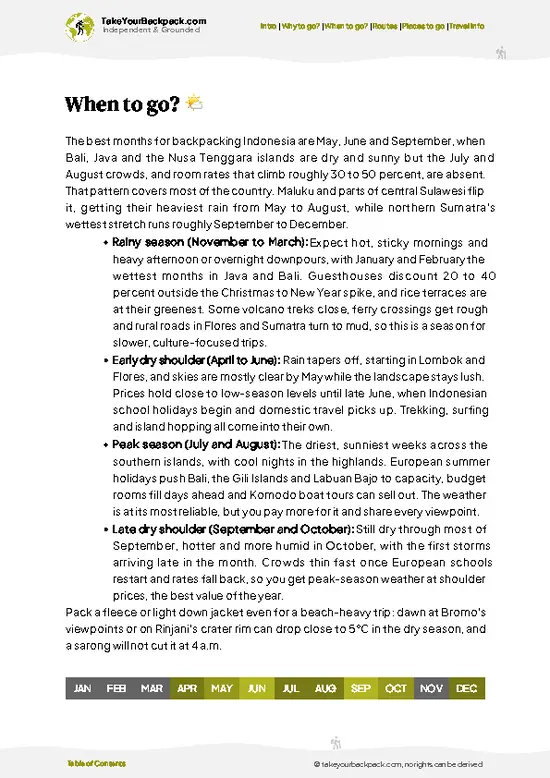
  • Dry Season (May to September): Clearest skies and the best sunrise odds. Days reach 18 to 22°C (64 to 72°F), but dawn temperatures at Cemoro Lawang can drop to 0 to 5°C (32 to 41°F), occasionally with frost. Sunrise is around 5:30 a.m.
  • Wet Season (November to March): Cloud and rain hide views most mornings. Temperatures sit around 10 to 20°C (50 to 68°F). Trails get slick, and Semeru is often closed or restricted. Prices and crowds are lowest.
  • Shoulder Months (April, October): Mixed weather but fewer people, with decent odds of clear mornings.
  • Holidays and Weekends: Indonesian long weekends, Eid and July to August school holidays bring jeep queues at Penanjakan and higher homestay rates, sometimes 30 to 50 percent more.
  • Yadnya Kasada: The Tengger festival around the full moon of the Kasada month
… read more 👉
  • Dry Season (May to September): Clearest skies and the best sunrise odds. Days reach 18 to 22°C (64 to 72°F), but dawn temperatures at Cemoro Lawang can drop to 0 to 5°C (32 to 41°F), occasionally with frost. Sunrise is around 5:30 a.m.
  • Wet Season (November to March): Cloud and rain hide views most mornings. Temperatures sit around 10 to 20°C (50 to 68°F). Trails get slick, and Semeru is often closed or restricted. Prices and crowds are lowest.
  • Shoulder Months (April, October): Mixed weather but fewer people, with decent odds of clear mornings.
  • Holidays and Weekends: Indonesian long weekends, Eid and July to August school holidays bring jeep queues at Penanjakan and higher homestay rates, sometimes 30 to 50 percent more.
  • Yadnya Kasada: The Tengger festival around the full moon of the Kasada month (usually June or July) draws crowds to the crater rim, with lodging booked out.
Aim for a weekday in June or September for clear skies and thinner crowds.


source: climatestotravel.comJANJanuary: fair for travelingFEBFebruary: fair for travelingMARMarch: fair for travelingAPRApril: fair for travelingMAYMay: highly recommended for travelingJUNJune: highly recommended for travelingJULJuly: good for travelingAUGAugust: good for travelingSEPSeptember: highly recommended for travelingOCTOctober: fair for travelingNOVNovember: fair for travelingDECDecember: fair for traveling
Indonesia - Bromo Tengger Semeru National Park

✈️ The backpacker research shortcutIndonesia Travel Guide

An offline-friendly backpacking guide with optimized travel routes, ranked highlights, transport advice, and the best areas to stay.
example page 0 from our offline Travel Guide for Indonesia
example page 1 from our offline Travel Guide for Indonesia
example page 2 from our offline Travel Guide for Indonesia
example page 3 from our offline Travel Guide for Indonesia
example page 4 from our offline Travel Guide for Indonesia
example page 5 from our offline Travel Guide for Indonesia
example page 6 from our offline Travel Guide for Indonesia
example page 7 from our offline Travel Guide for Indonesia
The digital guide (460 pages) contains:
✅ 153 highlights, ranked by travel appeal
✅ Optimized 14, 21 & 30-day travel routes
✅ Cities, national parks, landmarks, beaches
✅ How to get around
✅ Offline-friendly for travel without Wi-Fi
👉 Click to see all 30+ guide features

📅 Plan smarter in minutes, not weeks
✅ Month by month travel advice
✅ Festivals & national holidays
✅ Budget expectations

🗺️ Go to the right places, skip the overrated ones
✅ Honest pros & cons of destinations
✅ Top hikes, parks & viewpoints
✅ Lesser-known places most travelers miss
✅ Clear “worth it vs skip it” guidance

🛏️ Travel smoothly without rookie mistakes
✅ Best areas to stay
✅ Transport systems explained simply
✅ Common scams & safety advice
✅ SIM cards, money & practical tips

🌍 Understand the country, not just visit it
✅ Culture & traditions
✅ 52 Essential phrases & customs
✅ Festivals worth planning around
✅ Traveler-friendly historical context
✅ Insights that make places more meaningful

📱 Built for real travel conditions
✅ Fully downloadable PDF
✅ Works completely offline
✅ Optimized for phone use
✅ Useful in remote areas & buses
✅ Everything in one place
Stop searching, start planning
Get instant access to your full guide. 30‑day money-back guarantee.
+ Add another guide for just

By proceeding you agree to our terms.
Sent to your inbox immediately after payment • 100% Secure Checkout
Best Backpacking Travel Advisor 2025 tourism awardBest Backpacking
Travel Advisor
2025
What others say about Take Your Backpack Guides:
⭐⭐⭐⭐⭐
Fantastic, amazing amount of information!
⭐⭐⭐⭐⭐
My goodness this is amazing, it's what I've been looking for hats off too you!
⭐⭐⭐⭐⭐
I think this is absolutely BRILLIANT
⭐⭐⭐⭐
Very complete and informative. It's still missing places, but I gotta to commend you
⭐⭐⭐⭐⭐
This is truly amazing, thank you, can't wait to explore it with my kids!
⭐⭐⭐⭐⭐
Awesome resource, thank you!
⭐⭐⭐⭐⭐
This is amazing! Can't wait to explore the ones I haven't seen
⭐⭐⭐⭐
I love this! Well done, great idea.
⭐⭐⭐⭐⭐
Thanks for taking the time to make this gem!
⭐⭐⭐⭐⭐
This might be the best website I've ever seen.
⭐⭐⭐⭐⭐
Congratulations, and thank you so much for your work; it's incredibly valuable.
⭐⭐⭐⭐
In all seriousness I think you did a great job pointing out the important spots
⭐⭐⭐⭐⭐
10/10 very good
⭐⭐⭐⭐⭐
As someone who's only just starting to visit regularly this is awesome, thank you.
⭐⭐⭐⭐
Thank you very much! I'm going to visit my dad, it's going to be very useful!
⭐⭐⭐⭐⭐
This is really cool! We'll be travelling for the first time and this definitely come in handy.
⭐⭐⭐⭐⭐
You are now our minister of culture, congratulations 👨‍💼
⭐⭐⭐⭐⭐
Just wanted to tell you that this is a pearl! Going to follow your recommendations.
⭐⭐⭐⭐⭐
This is so cool. I'll definitely be using the resource for my travels soon.
⭐⭐⭐⭐⭐
This is very impressive! Good work.
⭐⭐⭐⭐⭐
This is an amazing and informative site. Very well done!

🛏️ Where to stay?Choosing the right base

The best base is Cemoro Lawang, the village on the caldera rim, where homestays put you minutes from the Bromo trailhead. Inside the park boundaries you will find basic homestays in Cemoro Lawang, Ngadisari and Wonokitri, plus camping at Ranu Kumbolo and Ranu Pani for Semeru hikers. Rooms are simple, with thin walls and cold nights, so ask for hot water and blankets. Expect about US$8 to 20 for a double, with hot showers and breakfast sometimes included. Fewer cheap rooms and higher rates apply at weekends and holidays.
If you want more choice, stay in Probolinggo, which has hotels and a bus terminal … read more 👉
The best base is Cemoro Lawang, the village on the caldera rim, where homestays put you minutes from the Bromo trailhead. Inside the park boundaries you will find basic homestays in Cemoro Lawang, Ngadisari and Wonokitri, plus camping at Ranu Kumbolo and Ranu Pani for Semeru hikers. Rooms are simple, with thin walls and cold nights, so ask for hot water and blankets. Expect about US$8 to 20 for a double, with hot showers and breakfast sometimes included. Fewer cheap rooms and higher rates apply at weekends and holidays.
If you want more choice, stay in Probolinggo, which has hotels and a bus terminal but little atmosphere, or in Malang, a larger city with hostels, cafes and easy transport to Tumpang and the Semeru trailhead. Malang suits backpackers who want nightlife and food. Wonokitri and Tosari, on the Pasuruan side, are a quieter alternative closer to Penanjakan. Whichever you choose, book ahead for Friday and Saturday nights and for the Kasada festival, when rooms across the caldera fill and prices rise sharply.

👛 Costs (as of 15 October 2026)How expensive it really is

A realistic daily budget for Bromo is about US$25 to 50 including entry, a homestay and local food. The numbers below assume independent travel from Probolinggo or Malang.
CategoryBudget RangeLocal Reality
Park entrance (foreigner)IDR 220,000 to 330,000 (US$14 to 21) per dayWeekday rates are lower, weekends and holidays are higher. Pay at the ticket office or online.
AccommodationUS$8 to 20 per nightBasic homestays in Cemoro Lawang or Ngadisari, with hot water often extra.
Sunrise jeepIDR 600,000 to 800,000 (US$38 to 50) per jeepShared across up to 6 people, so about US$7 to 12 each. Prices are fixed by the local jeep association.
Local transportUS$3 to 10Minibus from Probolinggo to Cemoro Lawang takes about 2 hours. Foreigners are often charged more than locals.
FoodUS$4 to 10 per dayWarung meals
… read more 👉
A realistic daily budget for Bromo is about US$25 to 50 including entry, a homestay and local food. The numbers below assume independent travel from Probolinggo or Malang.
CategoryBudget RangeLocal Reality
Park entrance (foreigner)IDR 220,000 to 330,000 (US$14 to 21) per dayWeekday rates are lower, weekends and holidays are higher. Pay at the ticket office or online.
AccommodationUS$8 to 20 per nightBasic homestays in Cemoro Lawang or Ngadisari, with hot water often extra.
Sunrise jeepIDR 600,000 to 800,000 (US$38 to 50) per jeepShared across up to 6 people, so about US$7 to 12 each. Prices are fixed by the local jeep association.
Local transportUS$3 to 10Minibus from Probolinggo to Cemoro Lawang takes about 2 hours. Foreigners are often charged more than locals.
FoodUS$4 to 10 per dayWarung meals cost IDR 25,000 to 50,000. Prices rise in the caldera, and snacks are marked up.
Semeru permit and guideUS$40 to 100 and upRequired for the climb. Costs depend on group size and trip length, and porter fees are extra.
Carry cash in small notes, since ATMs in the caldera are unreliable and some are empty on busy weekends.
⚠️ Prices can change and everyone travels differently, so take this as a rough guide. Hope it helps you plan your adventure!

🥾 TrailsExploring Bromo Tengger Semeru: trails, terrain, and views

The park mixes a flat sand sea, steep volcanic cones, grassland and montane forest. Most hiking is short and easy, though altitude (2,000 to 2,800 m) and cold make early starts feel harder. Ash and dust are common, and a mask or buff helps. Wildlife is modest: you may see Javan langurs, muntjac deer and the occasional Javan hawk-eagle, and the forest around Ranu Pani is quieter than the crater area.
Cemoro Lawang to Bromo Crater
  • Length: about 4 to 5 km one way across the sand sea
  • Duration: 1 to 1.5 hours each way, plus 15 to 20 minutes on the steps
  • Difficulty: Easy to moderate
  • Key features: Pura Luhur
… read more 👉
The park mixes a flat sand sea, steep volcanic cones, grassland and montane forest. Most hiking is short and easy, though altitude (2,000 to 2,800 m) and cold make early starts feel harder. Ash and dust are common, and a mask or buff helps. Wildlife is modest: you may see Javan langurs, muntjac deer and the occasional Javan hawk-eagle, and the forest around Ranu Pani is quieter than the crater area.
Cemoro Lawang to Bromo Crater
  • Length: about 4 to 5 km one way across the sand sea
  • Duration: 1 to 1.5 hours each way, plus 15 to 20 minutes on the steps
  • Difficulty: Easy to moderate
  • Key features: Pura Luhur Poten, Batok cone, crater rim views
  • Terrain: Loose sand, then concrete stairs
Penanjakan Viewpoint
  • Length: about 6 to 7 km from Cemoro Lawang by foot, usually done by jeep
  • Duration: 2 to 2.5 hours on foot, 40 minutes by jeep
  • Difficulty: Moderate, mostly uphill on road
  • Key features: Sunrise panorama of Bromo, Batok and Semeru
  • Terrain: Paved and gravel road
Mount Semeru Summit
  • Length: roughly 22 km round trip from Ranu Pani to Mahameru
  • Duration: 2 to 3 days
  • Difficulty: Hard, with loose ash on the final ascent
  • Key features: Ranu Kumbolo, Kalimati, Mahameru summit
  • Terrain: Forest, savannah and steep scree
Public transport is workable. From Probolinggo bus terminal, minibuses and shared vans run to Cemoro Lawang in about 2 hours, with fares around IDR 35,000 to 50,000 for locals and often more for foreigners. From Malang, shuttles and tour vans reach Tumpang and Ranu Pani. Crowds peak at sunrise and on weekends, but are thin by midday. Foreigners pay a park entrance fee, which is higher on weekends and holidays, and Semeru climbs also require a booked permit.
⚠️ Hiking info can sometimes be outdated or inaccurate. Before you hit the trail, check the latest conditions with locals. If you do spot anything that's off, I'd love to hear from you, so I can update it for fellow travelers.

🛡️ SafetyScams, Hazards, and Annoyances

Bromo is straightforward for most hikers, but the cold and ash catch people out. Pre-dawn temperatures at the rim can fall near 0°C (32°F), so bring a warm layer, gloves and a beanie even in dry season. Wear a mask or buff, because dust and sulfur fumes at the crater can irritate lungs, especially for asthmatics. The sand sea is easy to cross in daylight, but mist can reduce visibility sharply, so stay on the visible track. Bromo’s activity level is monitored by Indonesia’s volcano agency (PVMBG), and rangers close the crater when it is unsafe, so respect posted closures. Semeru is a different matter. The summit is often closed because of eruptions, and you should hike only with a registered guide and current permit. Keep your distance from horses on the sand sea, and carry water, since little is sold beyond the villages.

FAQFrequently asked questions about Bromo Tengger Semeru

Two days and one night is the practical minimum. That gives you one sunrise at Penanjakan or the crater rim and time to walk the sand sea and Savannah. Add 2 to 3 more days if you plan to climb Semeru from Ranu Pani, which usually takes 2 to 3 days with a camp at Ranu Kumbolo.
Yes, you can, with a bit of planning. Minibuses and shared vans run from Probolinggo terminal to Cemoro Lawang in roughly 2 hours for about IDR 35,000 to 50,000, and tour shuttles run from Malang and Surabaya. Once in Cemoro Lawang, the crater is a 1 to 1.5 hour walk across the sand sea, while jeeps are the usual way to reach Penanjakan for sunrise.
Yes, foreigners pay an entrance fee of roughly IDR 220,000 to 330,000 (US$14 to 21) per day, with higher rates on weekends and holidays. Bromo itself needs only the ticket, but Semeru requires a booked permit and a registered guide, usually arranged online or through a Malang agency. Check the status of the Semeru trail before you go, since it often closes after eruptions.
⚠️ Things can change over time, so always validate details locally before you go.

Other Indonesian national parks near Bromo Tengger Semeru

Explore more nearby:


💡 Not sure where to go next?
Create a personalized itinerary for Indonesia including Bromo Tengger Semeru and the places that fit your trip.

Generate my itinerary

👉 Discover all national parks

Or checkout all Indonesia has to offer (think cities, towns, villages, national parks, hikes, beaches, festivals)
Country photo of Indonesia

We 💚 feedbackFinal thoughts on exploring Bromo Tengger Semeru

Bromo is worth it for the moment the caldera appears out of the dark, when you can see three volcanoes at once and smell sulfur on the wind. The drawback is the sunrise crowd. Penanjakan can feel like a stadium, so I would skip the viewpoint on a weekend and walk the sand sea at first light instead, with only a few other hikers around.

✈️ When did I visit Indonesia?
As part of my 1.5 year travel around the world trip, I visited Indonesia twice (and it was worth it): first in September 2015 and a bit later again in January and February 2016.

✍️ Help improve this page!
The information on this page is based on my own backpacking experience in Indonesia, supplemented with up-to-date research and feedback from other travelers. Travel details can change, so if you notice anything outdated or incomplete, feel free to let me know.


🙋‍♂️ Give feedback

👋 Meet the founderWho’s Behind Take Your Backpack?

Johan, backpacker and founder of TakeYourBackpackHi, I’m Johan (Netherlands 🇳🇱), the creator of TakeYourBackpack. Over the past 3 decades, I’ve backpacked through 90+ countries across six continents, gaining extensive experience with independent travel, long-term trips, and overland routes.

This site is built on a combination of firsthand travel experience and carefully curated insights from other backpackers. Many guides are based on places I’ve personally visited, while others bring together tips, observations, and practical advice shared by trusted travelers I’ve met along the way.

The goal is to provide realistic, experience-driven guidance — not generic itineraries — so you can explore destinations with better context, clearer expectations, and more confidence.