×

Indonesia🇮🇩 | best national parksTop-Rated 10 national parks in Indonesia

Indonesia stretches its national parks across more than 17,000 islands, and the experience shifts sharply with every island group. More than 50 parks cover volcano cones, equatorial rainforest, coral reefs and dry savanna, so the first job is choosing a kind, not a name. Volcano parks on Java, Bali and Lombok are the easiest: paved approaches, homestays near the gate and pre-dawn hikes that fill up on weekends. Rainforest parks in Sumatra and Kalimantan demand more effort, with guide-led jungle treks, river boats and long transfers, but they stay quieter and wilder. Marine parks in eastern Indonesia pay off for anyone willing to book boats, and prices there climb fastest.

Costs swing as much as the terrain. Foreign visitors pay far higher entry fees than locals, often IDR 150,000 to 350,000 (about US$10 to 22) a day at the popular parks, and guides are compulsory in many. Backpacking independently works best when you pair one easy park with one remote one. Java and Bali hand you buses, cheap beds and plenty of company, while Papua and Maluku call for patience, flexible dates and a bigger budget. Pick your kind, then push outward.

By Johan Kruseman 🇳🇱 | Updated October 19, 2026
Explore the best hikes in Indonesia

Why go?Understanding Their Importance

Indonesia sits on the Pacific Ring of Fire, straddles the equator and spans the biological boundary known as the Wallace Line, and that combination is why its parks are unlike anywhere else. Asian and Australasian species meet here, so a single country holds tigers and orangutans in the west and tree kangaroos and birds of paradise in the east. Few nations pack active volcanoes, tropical rainforest and coral reefs into one visa stay.

History shaped the system too. Dutch colonial reserves became the seed for many protected areas, and today the national park network is run by the central forestry ministry. Parks are rarely empty wilderness. Villages, farms, temples and fishing communities sit on their edges and sometimes inside them, so a visit usually involves local guides, local boatmen and … read more 👉
Indonesia sits on the Pacific Ring of Fire, straddles the equator and spans the biological boundary known as the Wallace Line, and that combination is why its parks are unlike anywhere else. Asian and Australasian species meet here, so a single country holds tigers and orangutans in the west and tree kangaroos and birds of paradise in the east. Few nations pack active volcanoes, tropical rainforest and coral reefs into one visa stay.

History shaped the system too. Dutch colonial reserves became the seed for many protected areas, and today the national park network is run by the central forestry ministry. Parks are rarely empty wilderness. Villages, farms, temples and fishing communities sit on their edges and sometimes inside them, so a visit usually involves local guides, local boatmen and local homestays. That makes travel richer and more personal, and it also means rules differ from park to park.

Infrastructure is the big variable. Java and Bali offer sealed roads, trains and dense accommodation, so access is simple. Sumatra, Kalimantan, Sulawesi and the eastern islands trade that convenience for isolation: domestic flights, bumpy minibus rides and boats on weather-dependent schedules. Expect to plan around transport rather than the other way round.

Know the practical rules before you commit. Foreigners pay much higher fees than Indonesian citizens, and daily rates have risen at the most popular parks. Many treks and marine areas require a registered guide, a permit or an online booking, sometimes days ahead. Climate matters because Indonesia has no single season: the wet months close some volcano trails, stir up seas and turn jungle tracks to mud. Wildlife is wild, so sightings of orangutans, dragons or rare birds are likely at the right places but never guaranteed.

Volcanoes add another layer. Eruption alerts can shut a trail or an entire park at short notice, so keep a spare day and check official status before setting out. Indonesia rewards the traveler who arrives flexible, carries cash in rupiah for remote gates and treats the parks as working landscapes shared with the people who live beside them. Do that, and the country delivers variety that no neighbor can match.
Behind the Scenes of Selection
The list of best national parks in Indonesia is created based on landscapes, wildlife, adventure opportunities, facilities, and overall experience. If you feel a national park is missing in this list, please let us know.

When to go?Best Time to Visit Indonesia for national parks

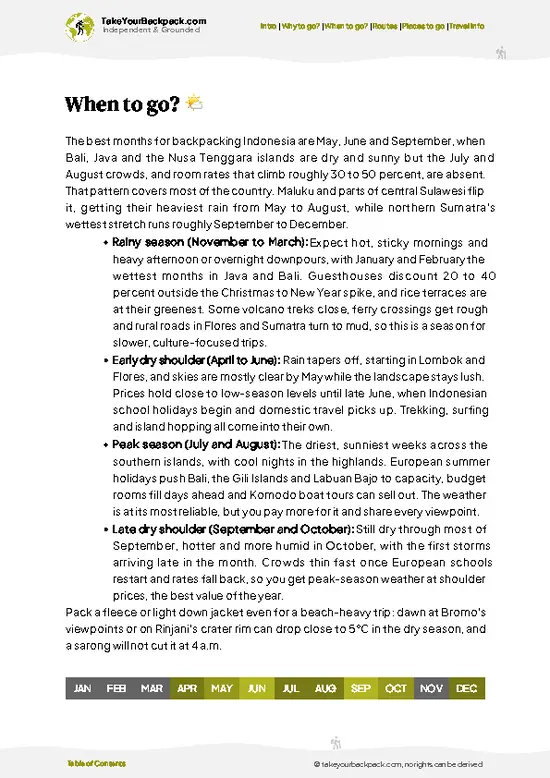
Best months: May to September: The best months for national parks in Indonesia are May to September, when the dry season brings clear skies, firm trails and calm seas across Java, Bali, Lombok, Nusa Tenggara and Sulawesi. Daytime temperatures along the coast sit around 28 to 33°C, and monthly rainfall in these areas often drops below 100 mm, compared with 300 mm or more in the wet months. Volcano summits are the exception to the warmth: above 2,500 meters, pre-dawn temperatures commonly fall to 0 to 8°C, so pack a real jacket.

Regional differences: Indonesia does not run on one calendar. Sumatra and Kalimantan sit on the equator and get rain in every month, with the driest stretch usually June to August and the heaviest downpours November to January. Jungle trekking works year-round there, … read more 👉
Best months: May to September: The best months for national parks in Indonesia are May to September, when the dry season brings clear skies, firm trails and calm seas across Java, Bali, Lombok, Nusa Tenggara and Sulawesi. Daytime temperatures along the coast sit around 28 to 33°C, and monthly rainfall in these areas often drops below 100 mm, compared with 300 mm or more in the wet months. Volcano summits are the exception to the warmth: above 2,500 meters, pre-dawn temperatures commonly fall to 0 to 8°C, so pack a real jacket.

Regional differences: Indonesia does not run on one calendar. Sumatra and Kalimantan sit on the equator and get rain in every month, with the driest stretch usually June to August and the heaviest downpours November to January. Jungle trekking works year-round there, though trails turn slick and leeches multiply after heavy rain. Maluku and parts of Papua run on a reversed pattern, with wetter seas from roughly May to August, so the best window for the far east is often October to April. Check the specific island group before locking dates.

Shoulder seasons: April, early May, October and November make smart shoulder months. Rain arrives in short afternoon bursts instead of all-day soakings, trails are quieter and guesthouse rates can sit 10 to 30 percent below high-season prices. Marine visibility is often excellent in April and October, and mornings stay clear enough for volcano sunrises. Start early, finish by early afternoon and the shoulder months deliver most of the dry-season benefits.

Peak periods and closures: July and August bring the heaviest crowds, driven by European summer holidays and Indonesian school breaks. Book boats, trekking permits and rooms near popular gates weeks ahead, and expect prices for liveaboards and guided treks to run 20 to 40 percent higher. Late December to early January and the Eid al-Fitr holiday (dates shift each year) also fill transport and beds with domestic travelers.

The wet season, roughly November to March on Java, Bali and Nusa Tenggara, shuts some doors. The main high-altitude trekking routes on Lombok normally close from around January to March, and landslides can block roads in Sumatra and Sulawesi. Rough seas also cancel boat departures to remote islands. Eruption alerts can close volcano parks at any time of year, so build a spare day into every plan and check the latest status the evening before.

national park hoppingPlanning Your Route Efficiently

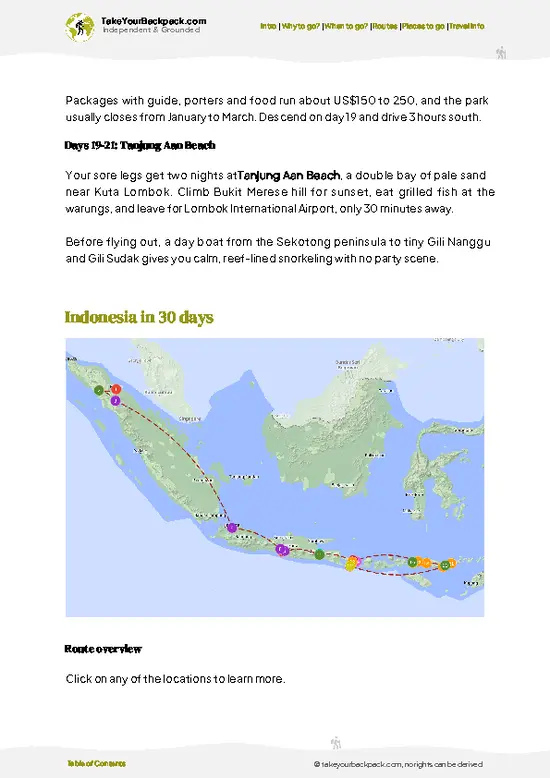
How many days to allow: A trip combining several national parks in Indonesia needs 14 to 21 days, and a month feels comfortable if you add the eastern islands. Distances are huge, so the plan should link regions that share flight routes and a season instead of chasing a long list.

Regions that group well: The strongest cluster is the Java, Bali and Nusa Tenggara chain. It runs west to east in a near-straight line, with overland buses, trains and short ferries between Java and Bali, then flights or boats onward through Lombok and Flores. A traveler can start in Yogyakarta or Surabaya, cross to Bali, then fly from Denpasar to Labuan Bajo (about 1 hour 15 minutes). Travel from west to east, because the dry season holds longest in the east and the final marine stops benefit from late-season calm. … read more 👉
How many days to allow: A trip combining several national parks in Indonesia needs 14 to 21 days, and a month feels comfortable if you add the eastern islands. Distances are huge, so the plan should link regions that share flight routes and a season instead of chasing a long list.

Regions that group well: The strongest cluster is the Java, Bali and Nusa Tenggara chain. It runs west to east in a near-straight line, with overland buses, trains and short ferries between Java and Bali, then flights or boats onward through Lombok and Flores. A traveler can start in Yogyakarta or Surabaya, cross to Bali, then fly from Denpasar to Labuan Bajo (about 1 hour 15 minutes). Travel from west to east, because the dry season holds longest in the east and the final marine stops benefit from late-season calm.

Sumatra and Kalimantan sit in a separate cluster. Flights from Jakarta to Medan take around 2 hours 30 minutes, and Jakarta to Pangkalan Bun or Banjarmasin takes about 1 hour 45 minutes to 2 hours. Pair them with a Java stop as a trunk, then go back through Jakarta between each. Direct links between the two big islands are rare. Sulawesi, Maluku and Papua work best as a second trip or a long-haul extension, each needing 1 to 2 extra transit days.

Time per stop: Allow 2 to 3 days for a Java or Bali volcano stop, including the pre-dawn hike and a rest afternoon. Rainforest parks need 3 to 4 days to cover the transfer, the guided treks and a margin for rain. Marine parks need 3 to 5 days, since boat days cluster around good weather and overnight liveaboards run 2 to 4 nights. Multi-day volcano treks take 2 to 3 days, plus one recovery day for tired legs.

Planning mistakes to avoid: The most common error is cramming too many islands. Trying five parks in ten days means most of the trip is spent in airports and minibuses. Choose three or four stops, then pad them with buffer days.

Another trap is trusting ferry or flight timetables without slack. Small-plane flights in the east often leave early, get delayed by weather or cancel in the wet season, so schedule an extra day before any international departure. Do not book the last flight home on the same day a boat returns.

Travelers also underestimate road time. Sumatra and Sulawesi distances that look short on a map often take 5 to 8 hours on winding roads. Choose flights for long links and keep overland rides for short hops.

Finally, avoid stacking two physically hard stops back to back. Place an easy beach or town day after a summit trek and before a long boat trip, so legs and stomachs recover.

The ListThe Best national parks of Indonesia

1 Komodo National Park

Komodo dragons, Padar viewpoint, Pink Beach, strong currents

Hike with a ranger past wild dragons on Rinca and Komodo, then climb Padar's ridge for the three-bay view and dive the current-swept reefs.

Indonesia - Komodo National Park

2 Bromo Tengger Semeru National Park

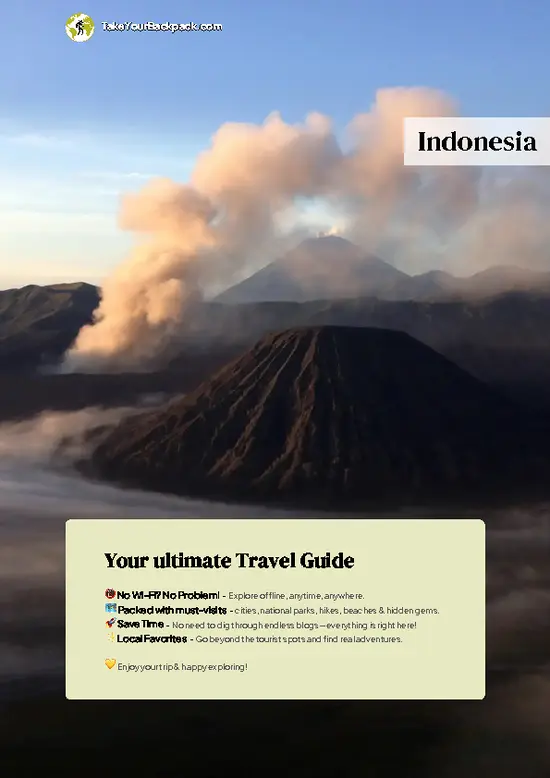
Sea of sand, Bromo crater rim, Semeru summit, sunrise viewpoints

Cross the Tengger caldera sand floor before dawn to reach Bromo's smoking rim, or commit to the multi-day climb of Java's highest peak.

Indonesia - Bromo Tengger Semeru National Park

3 Gunung Leuser National Park

Bukit Lawang orangutans, jungle trekking, Alas River, Leuser ecosystem

Follow guides into dense Sumatran rainforest to see semi-wild orangutans, then float the Bohorok River on inner tubes back to camp.

4 Tanjung Puting National Park

Camp Leakey, klotok houseboats, rehabilitated orangutans, Sekonyer River

Sleep aboard a wooden klotok on the Sekonyer River, stopping at feeding platforms where rehabilitated orangutans descend from the trees.

indonesia-national-park-tanjung-puting-national-park
© Google |

5 Wakatobi National Park

barrier reefs, dive sites, remote islands

Dive or snorkel among intricate coral gardens, then explore quiet islands where traditional sea nomad communities still harvest the reefs.

6 Kelimutu National Park

Tri-colored crater lakes, Moni village, pre-dawn climb, Flores highlands

Climb from Moni before sunrise to watch three crater lakes shift between turquoise, green and black as the light and minerals change.

indonesia-national-park-kelimutu-national-park
© Google |

7 Bali Barat National Park

Menjangan Island reefs, Bali starling, mangrove coast, wall dives

Snorkel the drop-off walls off Menjangan Island, then walk dry monsoon forest trails hoping for the critically endangered Bali starling.

8 Bukit Barisan Selatan National Park

Sumatran rhinos, elephant corridors, Krui coast, lowland rainforest

Trek through lowland forest that shelters rhinos, tigers and elephants, with rough trails and a remote southwestern coastline on the edge.

9 Ujung Kulon National Park

Javan rhino refuge, coastal wilderness, Krakatoa views

Venture through remote peninsulas and offshore islands, searching for the world’s rarest rhino amid wild beaches and volcanic backdrops.

10 Bunaken National Park

Vertical coral walls, Manado Tua volcano, muck-free reefs, shore-entry diving

Step off the beach into steep coral walls that plunge beyond 25 meters, with the cone of Manado Tua visible between dives.

11 Karimunjawa National Park

Island-hopping, blacktip reef sharks, white sand cays, shallow snorkeling

Hire a boat from Java's coast to hop between 22 islands, snorkeling calm shallows and swimming alongside small reef sharks.

12 Way Kambas National Park

elephant sanctuary, grassland marshes, Sumatran tiger range

Observe elephants in protected herds and scan open grasslands for rare wildlife, including the elusive Sumatran tiger and wild buffalo.

13 Baluran National Park

Savanna plains, Mount Baluran backdrop, Bama beach, dry-season wildlife

Drive across open grassland where banteng, deer and macaques gather at waterholes, with Mount Baluran rising behind the dry-season plains.

14 Teluk Cenderawasih National Park

whale shark encounters, Papua coastline, coral atolls

Swim alongside gentle whale sharks in sheltered bays, and explore remote coral atolls scattered along Papua’s northern shore.

15 Sebangau National Park

Blackwater swamp, orangutan research, klotok boats, Kalimantan peat forest

Drift on a narrow wooden boat through dark peatland waterways in Kalimantan, listening for gibbons and watching for wild orangutans in the canopy.

16 Meru Betiri National Park

Sukamade turtle beach, Teluk Hijau, rugged Java south coast, rainforest

Reach a remote southern shore by rough track to watch green and leatherback turtles lay eggs at night, then hike to the Teluk Hijau cove.

17 Siberut National Park

Mentawai culture, dugout canoes, primate endemics, tattooed shamans

Paddle upriver by dugout to stay with Mentawai families in the forest, learning plant medicine and spotting primates found nowhere else.

18 Berbak National Park

Peat swamp, blackwater rivers, Sumatran tigers, boat access

Travel by longboat through tea-colored channels of Sumatra's largest intact peat swamp forest, where tigers and storks live beyond any road.

19 Alas Purwo National Park

G-Land surf break, Sadengan grassland, banteng herds, Goa Istana cave

Walk out to Sadengan meadow at dusk to watch banteng and peacocks graze, then base a surf trip around the left-hand barrels of Plengkung.

Think you know Indonesia?

Prove you’re a true local — uncover 9 lesser-known national parks in Indonesia that locals tend to keep to themselves.
Loading the map 🌍

Expert viewPro Tips for Exploring the Best

How many parks to visit: Three to four national parks is the number I advise for a backpacker spending three to four weeks in Indonesia. That figure matches the country’s logistics. Each stop costs a full day or two in transit, and the parks are spread over thousands of kilometers. Three or four gives you time to hike, wait for wildlife, and rest between hard days, while seven or eight turns the trip into a blur of boarding passes. Even on a short two-week trip, two parks of contrasting types beat four rushed ones.

Choosing between the kinds: Think in three types and pick by travel style. Volcano parks suit first-timers and anyone on a tight schedule. They are the easiest to reach, the cheapest to base in, and the views come on a single early morning or a two-day trek. Rainforest parks suit … read more 👉
How many parks to visit: Three to four national parks is the number I advise for a backpacker spending three to four weeks in Indonesia. That figure matches the country’s logistics. Each stop costs a full day or two in transit, and the parks are spread over thousands of kilometers. Three or four gives you time to hike, wait for wildlife, and rest between hard days, while seven or eight turns the trip into a blur of boarding passes. Even on a short two-week trip, two parks of contrasting types beat four rushed ones.

Choosing between the kinds: Think in three types and pick by travel style. Volcano parks suit first-timers and anyone on a tight schedule. They are the easiest to reach, the cheapest to base in, and the views come on a single early morning or a two-day trek. Rainforest parks suit travelers who love wildlife and do not mind slow, damp days. Sightings take patience, and the best of them are on Sumatra and Kalimantan, where river boats or jungle trails replace roads. Marine parks in the east suit divers, snorkelers and anyone who wants clear water and big seascapes. They are the most expensive type because boats are the only way in.

If this is a first trip, take one volcano park, one rainforest park and one marine park if the time and budget allow. A veteran short on days can drop the volcano type, since the Java and Bali examples are easy to repeat on a later visit. Travelers on very tight budgets should stay with the volcano parks, where local transport and homestays keep costs low.

What it costs: Budget US$30 to 50 a day for basic travel in Java and Bali: a dorm or simple room at US$6 to 15, street food and warung meals at US$5 to 10 a day, and local transport. Add US$10 to 20 a day more on Sumatra, Kalimantan or the eastern islands, where flights and boat charters raise everything. Remember that those figures cover living costs, not park activity.

Park-specific costs are where budgets break. Entry fees for foreigners at the main parks typically run IDR 150,000 to 350,000 a day (about US$10 to 22), with higher rates on weekends and holidays. Guides are compulsory at many trails and paid separately: expect IDR 300,000 to 700,000 (US$19 to 44) for a half or full day on rainforest treks. Multi-day volcano treks sold as packages with porters, food and gear commonly cost IDR 1,800,000 to 3,500,000 (US$110 to 220) for two to three days. Boat days in marine areas range from IDR 600,000 to 1,500,000 (US$38 to 95) for a shared day trip, and shared liveaboards cost IDR 2,500,000 to 5,000,000 (US$155 to 310) for two to three nights. Add charter flights or long transfers on top.

A sensible per-visit budget is US$60 to 120 for an easy volcano park, US$150 to 300 for a rainforest stay with guide and boat, and US$200 to 450 for a marine park outing. Carry rupiah in cash, because remote gates and village guides rarely accept cards, and ATMs vanish quickly beyond the main towns. Book through the park’s official channel or a registered operator, and keep receipts, since fees are checked at gates.

Safety on the trail and on the water: Volcanoes are the first danger. Check the official alert level for the day, respect closure lines, and never climb past a ranger’s barrier for a photo. Sulfur fumes near craters can irritate the lungs, so carry a scarf or mask and do not linger downwind. Summit hikes start in the dark on loose volcanic gravel, so a headlamp, grippy shoes and a warm layer matter more than any fancy gear. Altitude cold is real, and hypothermia has caught under-dressed trekkers in rain.

In rainforest areas, trails flood quickly and river crossings rise after storms. Leeches, insects and heat exhaustion are common, so carry water, electrolyte salts and a spare set of dry clothes. Keep a distance from primates, who can bite and carry disease, and never bring food into the trees where they feed. Hire only licensed guides, who know where animals are and how to read their behavior.

At sea, currents can be strong and sudden. Choose operators who supply life jackets, have working radios and brief you on the plan, and skip boats that look overloaded. Check travel insurance covers trekking above 3,000 meters, diving and evacuation by air, since medical help in remote parks can be hours away.

Cultural care: Many mountains and caves are sacred to local communities, and ceremonies may close a trail for a day. Respect any offering you see on the path, do not step over it, and follow the guide’s instructions about quiet zones or restricted areas. Dress modestly in villages around park gates, with covered shoulders and knees in most areas outside the beach zones. Ask before photographing people, and note that drones usually need a permit and can be banned entirely near wildlife or temples.

Use local homestays, buy from village stalls and tip guides and porters (IDR 50,000 to 150,000, or about US$3 to 9, per person per day is common). That money reaches the people who protect the forest and the reef. Pack out every wrapper, because rubbish collection is thin at the gates and trails, and bring a reusable bottle, since single-use plastic piles up fast.

Be honest with yourself about crowds and costs. Popular volcano summits at sunrise can feel like a queue, and marine day trips in high season can be packed. Go midweek, set out early and book smaller boats, and the same parks show their best side: steaming craters at first light, orangutans swinging above a black river, water so clear that every fish has a shadow.

✈️ The backpacker research shortcutIndonesia Travel Guide

An offline-friendly backpacking guide with optimized travel routes, ranked highlights, transport advice, and the best areas to stay.
example page 0 from our offline Travel Guide for Indonesia
example page 1 from our offline Travel Guide for Indonesia
example page 2 from our offline Travel Guide for Indonesia
example page 3 from our offline Travel Guide for Indonesia
example page 4 from our offline Travel Guide for Indonesia
example page 5 from our offline Travel Guide for Indonesia
example page 6 from our offline Travel Guide for Indonesia
example page 7 from our offline Travel Guide for Indonesia
The digital guide (460 pages) contains:
✅ 153 highlights, ranked by travel appeal
✅ Optimized 14, 21 & 30-day travel routes
✅ Cities, national parks, landmarks, beaches
✅ How to get around
✅ Offline-friendly for travel without Wi-Fi
👉 Click to see all 30+ guide features

📅 Plan smarter in minutes, not weeks
✅ Month by month travel advice
✅ Festivals & national holidays
✅ Budget expectations

🗺️ Go to the right places, skip the overrated ones
✅ Honest pros & cons of destinations
✅ Top hikes, parks & viewpoints
✅ Lesser-known places most travelers miss
✅ Clear “worth it vs skip it” guidance

🛏️ Travel smoothly without rookie mistakes
✅ Best areas to stay
✅ Transport systems explained simply
✅ Common scams & safety advice
✅ SIM cards, money & practical tips

🌍 Understand the country, not just visit it
✅ Culture & traditions
✅ 52 Essential phrases & customs
✅ Festivals worth planning around
✅ Traveler-friendly historical context
✅ Insights that make places more meaningful

📱 Built for real travel conditions
✅ Fully downloadable PDF
✅ Works completely offline
✅ Optimized for phone use
✅ Useful in remote areas & buses
✅ Everything in one place
Stop searching, start planning
Get instant access to your full guide. 30‑day money-back guarantee.
+ Add another guide for just

By proceeding you agree to our terms.
Sent to your inbox immediately after payment • 100% Secure Checkout
Best Backpacking Travel Advisor 2025 tourism awardBest Backpacking
Travel Advisor
2025
What others say about Take Your Backpack Guides:
⭐⭐⭐⭐⭐
Fantastic, amazing amount of information!
⭐⭐⭐⭐⭐
My goodness this is amazing, it's what I've been looking for hats off too you!
⭐⭐⭐⭐⭐
I think this is absolutely BRILLIANT
⭐⭐⭐⭐
Very complete and informative. It's still missing places, but I gotta to commend you
⭐⭐⭐⭐⭐
This is truly amazing, thank you, can't wait to explore it with my kids!
⭐⭐⭐⭐⭐
Awesome resource, thank you!
⭐⭐⭐⭐⭐
This is amazing! Can't wait to explore the ones I haven't seen
⭐⭐⭐⭐
I love this! Well done, great idea.
⭐⭐⭐⭐⭐
Thanks for taking the time to make this gem!
⭐⭐⭐⭐⭐
This might be the best website I've ever seen.
⭐⭐⭐⭐⭐
Congratulations, and thank you so much for your work; it's incredibly valuable.
⭐⭐⭐⭐
In all seriousness I think you did a great job pointing out the important spots
⭐⭐⭐⭐⭐
10/10 very good
⭐⭐⭐⭐⭐
As someone who's only just starting to visit regularly this is awesome, thank you.
⭐⭐⭐⭐
Thank you very much! I'm going to visit my dad, it's going to be very useful!
⭐⭐⭐⭐⭐
This is really cool! We'll be travelling for the first time and this definitely come in handy.
⭐⭐⭐⭐⭐
You are now our minister of culture, congratulations 👨‍💼
⭐⭐⭐⭐⭐
Just wanted to tell you that this is a pearl! Going to follow your recommendations.
⭐⭐⭐⭐⭐
This is so cool. I'll definitely be using the resource for my travels soon.
⭐⭐⭐⭐⭐
This is very impressive! Good work.
⭐⭐⭐⭐⭐
This is an amazing and informative site. Very well done!

🛏️ Where to stay?Top Places to Consider Staying

Indonesia has a deep supply of hostels and family-run guesthouses (homestays), with dorm beds typically running Rp 100,000 to 250,000 (US$6 to 15) and simple private rooms from about Rp 200,000 (US$12). On Bali, Canggu has the most design-forward hostels, surf breaks and late bars but also clogged scooter traffic, Kuta is the cheapest and loudest base and is close to the airport, and Ubud trades nightlife for quiet rice-field lanes, yoga studios and easy access to temples. In Yogyakarta, Sosrowijayan puts you steps from Malioboro and the train station in cheap but noisy alleys, while Prawirotaman is calmer, leafier and better for cafes, and on Lombok and the Gili Islands you will find hostels … read more 👉
Indonesia has a deep supply of hostels and family-run guesthouses (homestays), with dorm beds typically running Rp 100,000 to 250,000 (US$6 to 15) and simple private rooms from about Rp 200,000 (US$12). On Bali, Canggu has the most design-forward hostels, surf breaks and late bars but also clogged scooter traffic, Kuta is the cheapest and loudest base and is close to the airport, and Ubud trades nightlife for quiet rice-field lanes, yoga studios and easy access to temples. In Yogyakarta, Sosrowijayan puts you steps from Malioboro and the train station in cheap but noisy alleys, while Prawirotaman is calmer, leafier and better for cafes, and on Lombok and the Gili Islands you will find hostels clustered along the main beach strips, where Gili Trawangan is the party island and Gili Air the mellow one.

If you enjoy meeting fellow travelers, consider choosing hostels with high ratings for atmosphere. On the other hand, if you prefer having your own space, a hotel might be a better option.

IndonesiaMore Places Across Indonesia

👋 Meet the founderWho’s Behind Take Your Backpack?

Johan, backpacker and founder of TakeYourBackpackHi, I’m Johan (Netherlands 🇳🇱), the creator of TakeYourBackpack. Over the past 3 decades, I’ve backpacked through 90+ countries across six continents, gaining extensive experience with independent travel, long-term trips, and overland routes.

This site is built on a combination of firsthand travel experience and carefully curated insights from other backpackers. Many guides are based on places I’ve personally visited, while others bring together tips, observations, and practical advice shared by trusted travelers I’ve met along the way.

The goal is to provide realistic, experience-driven guidance — not generic itineraries — so you can explore destinations with better context, clearer expectations, and more confidence.