×

Israel🇮🇱 | national parksMasadaDesert plateau, fortress walls, sunrise vistas | things to do and best time to go

Explore Ein GediExplore Mount Meron

Backpacking in Masada
🏆 Top picknational park ranked #1
By Johan Kruseman 🇳🇱 | Updated September 4, 2026

Most guides sell Masada as a pure history stop, but the surprise for backpackers is how much it actually feels like a mini desert-mountain trek, with real elevation gain and exposure that can wipe you out if you treat it like “just a ruin.” Masada sits above the Dead Sea in southern Israel, on the eastern edge of the Judean Desert, not far from Ein Gedi and Einot Tzukim. As a national park, it’s efficient: clear trails (Snake Path and Roman Ramp), big desert views, ibex sightings if you’re lucky, and a cable car if your knees or timing give up. The trade-offs: entrance fees are higher than you expect for a short visit, sunrise crowds can feel like a conveyor belt, and wild camping is basically off the table, so you’re pushed to nearby hostels or kibbutz-style stays. Compared with Ein Gedi’s greener canyons or Timna’s rock playground, Masada is harsher, more controlled, and less “wander anywhere,” but it delivers one concentrated hit of desert drama and history that’s hard to replicate.

Discover everything you want to know in the 📖 Israel Travel Guide.
Safety warning

The current risk level for Israel is high. Check the advice before going.


Get your Israel guide
81 ranked highlights, routes & tips, works offline (299 pages)
Loading the map 🌍
CLICK TO FILTER
cities
towns
villages
landmarks
national parks
hikes
beaches
attractions
festivals
regions
SHOW COUNTRY’S BESTSHOW ALL

✨ Why go?
Ranked #1 national park in Israel
What makes this national park worth exploring

Backpackers flock to Masada for its unique blend of history and adventure. This ancient fortress, perched high above the Dead Sea, offers a chance for independent exploration that many crave. You can hike the Snake Path or take the cable car, but either way, the views are worth the effort.

Budget-conscious travelers will appreciate the camping options nearby, with several hostels offering affordable stays. This keeps your costs low, allowing you to splurge on local food or experiences instead.

The trail variety is another draw. Whether you’re seeking a challenging ascent or a leisurely stroll, Masada has something for everyone. You can wander through the ruins at your own pace, soaking in the stories of the past without the pressure of a guided tour.

For self-guided travelers, this park … read more 👉
Backpackers flock to Masada for its unique blend of history and adventure. This ancient fortress, perched high above the Dead Sea, offers a chance for independent exploration that many crave. You can hike the Snake Path or take the cable car, but either way, the views are worth the effort.

Budget-conscious travelers will appreciate the camping options nearby, with several hostels offering affordable stays. This keeps your costs low, allowing you to splurge on local food or experiences instead.

The trail variety is another draw. Whether you’re seeking a challenging ascent or a leisurely stroll, Masada has something for everyone. You can wander through the ruins at your own pace, soaking in the stories of the past without the pressure of a guided tour.

For self-guided travelers, this park is a dream. You can set your own itinerary, linger at the sites that captivate you, and skip the ones that don’t. Just be mindful of the heat, especially in summer; it can drain your energy quickly. Plan your visit wisely, and you’ll preserve both your budget and your spirit for the moments that truly matter.
Want to include Masada in your Israel route?
Create a personalized Israel itinerary that includes Masada and the places that fit your trip — based on your travel style, budget, and available time. Get your route in seconds.

Generate my trip

💡 HighlightsDon't-miss highlights and experiences

  1. Snake Path (sunrise hike) — The classic steep trail up the eastern slope that earns its name from the switchbacks; hike it at dawn for a glow-over-the-Dead Sea moment and empty paths. Personal favorite — it’s short-ish, sweaty, and worth every step for that sunrise panorama.
  2. Herod’s Northern Palace (terrace palace) — Massive multi-level terraces carved into the cliff where Herod built luxurious rooms and gardens; the stonework and surviving foundations give a real sense of how lavish a desert fortress could be.
  3. Roman siege ramp and siege camps — One of the clearest pieces of ancient military engineering you’ll see: the earthen ramp used to breach the fortress and the surrounding camps where Roman footprints are still obvious in the landscape.
  4. Storerooms and ingenious water system — Hundreds
read more 👉
  1. Snake Path (sunrise hike) — The classic steep trail up the eastern slope that earns its name from the switchbacks; hike it at dawn for a glow-over-the-Dead Sea moment and empty paths. Personal favorite — it’s short-ish, sweaty, and worth every step for that sunrise panorama.
  2. Herod’s Northern Palace (terrace palace) — Massive multi-level terraces carved into the cliff where Herod built luxurious rooms and gardens; the stonework and surviving foundations give a real sense of how lavish a desert fortress could be.
  3. Roman siege ramp and siege camps — One of the clearest pieces of ancient military engineering you’ll see: the earthen ramp used to breach the fortress and the surrounding camps where Roman footprints are still obvious in the landscape.
  4. Storerooms and ingenious water system — Hundreds of rock-cut store rooms and a network of cisterns that collected scarce desert rains; it’s a humbling reminder of how people turned this arid place into a defensible, self-sustaining stronghold.
  5. Western palaces and bathhouse remains — Traces of living quarters, mosaic floors and bath structures that show daily life at the top of the ridge; the contrast between luxury plumbing and the harsh desert is striking.
  6. Panoramic Dead Sea and Judean Desert views — From the summit you get staggering, almost otherworldly vistas: salt flats, the Dead Sea’s mirror surface, and the broad canyon-carved desert. Bring sunglasses and a camera—both will get heavy use.
  7. Wildlife spotting — Nubian ibex, lizards and raptors — Look for sure-footed ibex on the cliffs, sun-basking lizards, and migrating birds of prey riding thermals; it’s not a zoo, but the desert life is surprisingly bold if you watch quietly.
Spotted a mistake or missing something? Contact us.

Things to do near Masada

Ratings based on Tripadvisor reviews. When you book through this link, you support our work at no extra cost to you.

🌤️ When to go?Best time to explore Masada


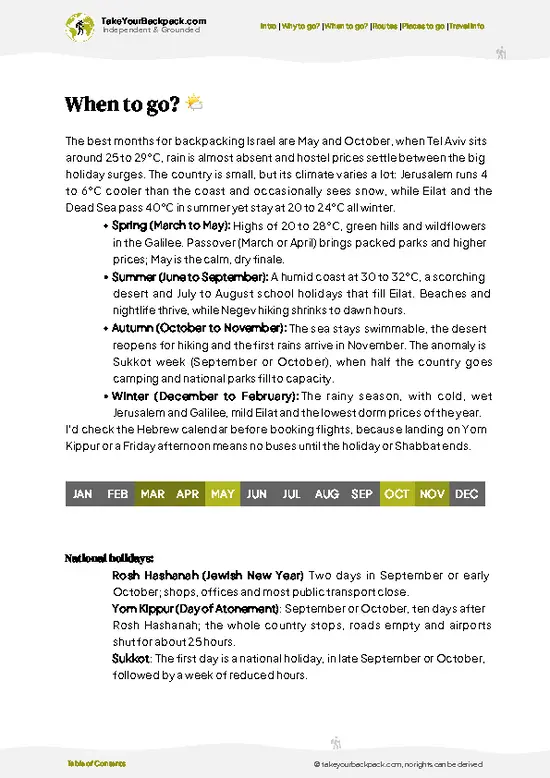
  • Weather: The Dead Sea region where Masada sits is brutally hot in summer, often exceeding 40°C (104°F). Spring and autumn offer milder, more manageable temperatures around 20-30°C (68-86°F), which are far better for hiking and exploring without overheating.

  • Temperature: Winter nights can drop to around 5°C (41°F), so pack layers if you visit then. Daytime temps hover near 20°C (68°F), making it comfortable but sometimes chilly in the shade or early morning.

  • Daylight Hours: Longer days in summer mean more daylight for hikes, but the heat limits your window of activity. In winter, shorter days require an earlier start to avoid losing light on the ascent or descent.

  • Crowds: Peak season is spring and autumn, especially around Israeli holidays and weekends. Arriving early in the morning
read more 👉

  • Weather: The Dead Sea region where Masada sits is brutally hot in summer, often exceeding 40°C (104°F). Spring and autumn offer milder, more manageable temperatures around 20-30°C (68-86°F), which are far better for hiking and exploring without overheating.

  • Temperature: Winter nights can drop to around 5°C (41°F), so pack layers if you visit then. Daytime temps hover near 20°C (68°F), making it comfortable but sometimes chilly in the shade or early morning.

  • Daylight Hours: Longer days in summer mean more daylight for hikes, but the heat limits your window of activity. In winter, shorter days require an earlier start to avoid losing light on the ascent or descent.

  • Crowds: Peak season is spring and autumn, especially around Israeli holidays and weekends. Arriving early in the morning or late afternoon helps dodge the busiest times and the midday sun.

  • Seasonal Activities: Sunrise hikes are popular year-round but best in cooler months to avoid the heat. Summer offers fewer guided tours due to extreme conditions, so self-guided visits require careful planning.

  • Price Fluctuations: Accommodation and tours near Masada spike during peak tourist seasons (spring and autumn). Booking off-peak can save money but expect fewer services and less frequent transport options.


Pro-tip: Aim for late February to early April or late September to early November—temperatures are bearable, crowds thinner, and you’ll have the energy to truly appreciate Masada’s stark landscape without paying a premium.


source: climatestotravel.comJANJanuary: good for travelingFEBFebruary: highly recommended for travelingMARMarch: excellent for travelingAPRApril: excellent for travelingMAYMay: good for travelingJUNJune: fair for travelingJULJuly: below average for travelingAUGAugust: below average for travelingSEPSeptember: good for travelingOCTOctober: excellent for travelingNOVNovember: excellent for travelingDECDecember: good for traveling
when-to-go

✈️ The backpacker research shortcutIsrael Travel Guide

An offline-friendly backpacking guide with optimized travel routes, ranked highlights, transport advice, and the best areas to stay.
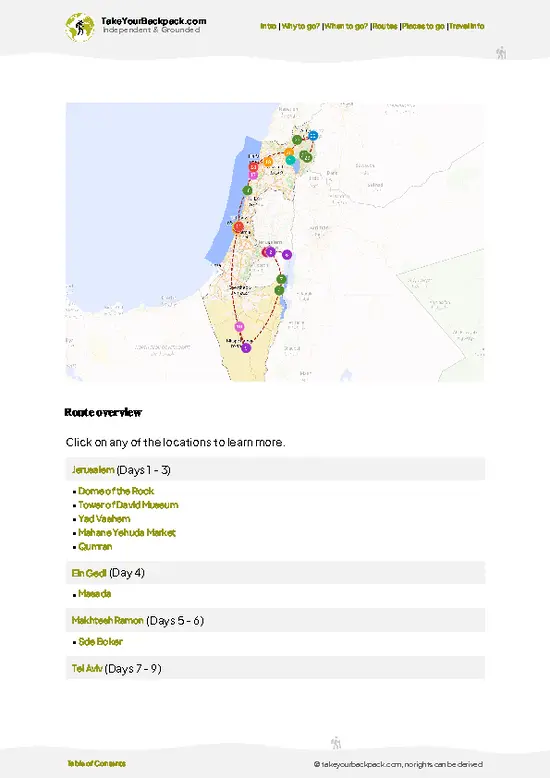
example page 0 from our offline Travel Guide for Israel
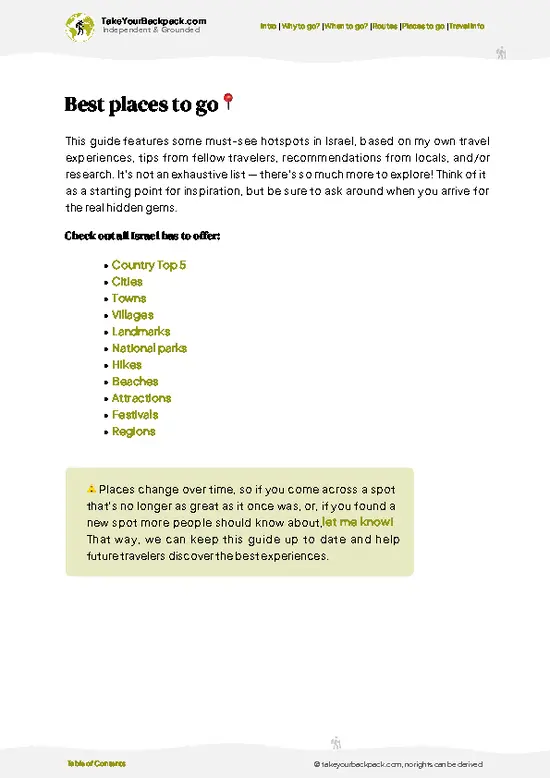
example page 1 from our offline Travel Guide for Israel
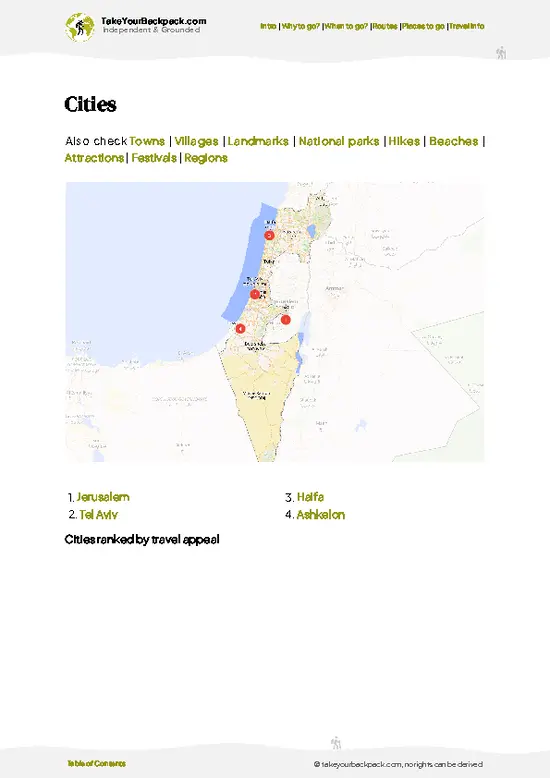
example page 2 from our offline Travel Guide for Israel
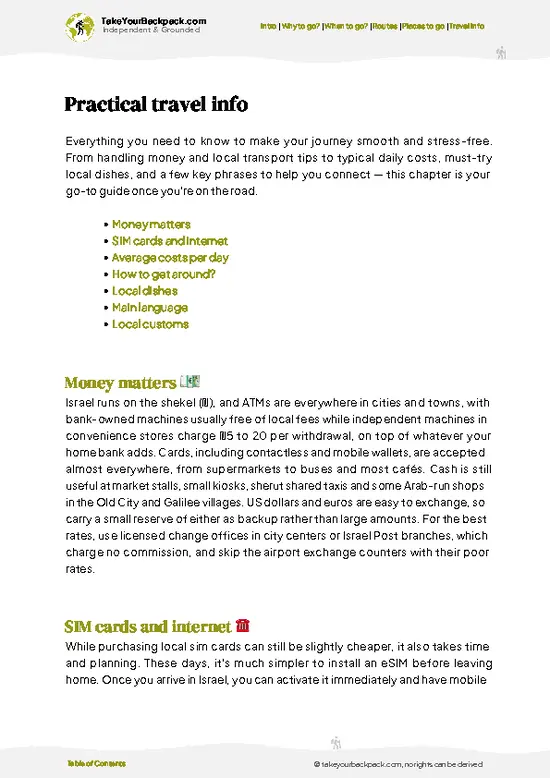
example page 3 from our offline Travel Guide for Israel
example page 4 from our offline Travel Guide for Israel
example page 5 from our offline Travel Guide for Israel
example page 6 from our offline Travel Guide for Israel
example page 7 from our offline Travel Guide for Israel
The digital guide (299 pages) contains:
81 highlights, ranked by travel appeal
Optimized 5, 10 & 15-day travel routes
Cities, national parks, landmarks, beaches
How to get around
Offline-friendly for travel without Wi-Fi
👉 Click to see all 30+ guide features

📅 Plan smarter in minutes, not weeks
Month by month travel advice
Festivals & national holidays
Budget expectations

🗺️ Go to the right places, skip the overrated ones
Honest pros & cons of destinations
Top hikes, parks & viewpoints
Lesser-known places most travelers miss
Clear “worth it vs skip it” guidance

🛏️ Travel smoothly without rookie mistakes
Best areas to stay
Transport systems explained simply
Common scams & safety advice
SIM cards, money & practical tips

🌍 Understand the country, not just visit it
Culture & traditions
52 Essential phrases & customs
Festivals worth planning around
Traveler-friendly historical context
Insights that make places more meaningful

📱 Built for real travel conditions
Fully downloadable PDF
Works completely offline
Optimized for phone use
Useful in remote areas & buses
Everything in one place
Save weeks of stressful planning
Get instant access to your full guide. 30‑day money-back guarantee.
+ Add another guide for just US$7.80

By proceeding you agree to our terms.
Sent to your inbox immediately after payment • 100% Secure Checkout
Best Backpacking Travel Advisor 2025 tourism awardBest Backpacking
Travel Advisor
2025
What others say about Take Your Backpack Guides:
⭐⭐⭐⭐⭐
Fantastic, amazing amount of information!
⭐⭐⭐⭐⭐
My goodness this is amazing, it's what I've been looking for hats off too you!
⭐⭐⭐⭐⭐
I think this is absolutely BRILLIANT
⭐⭐⭐⭐
Very complete and informative. It's still missing places, but I gotta to commend you
⭐⭐⭐⭐⭐
This is truly amazing, thank you, can't wait to explore it with my kids!
⭐⭐⭐⭐⭐
Awesome resource, thank you!
⭐⭐⭐⭐⭐
This is amazing! Can't wait to explore the ones I haven't seen
⭐⭐⭐⭐
I love this! Well done, great idea.
⭐⭐⭐⭐⭐
Thanks for taking the time to make this gem!
⭐⭐⭐⭐⭐
This might be the best website I've ever seen.
⭐⭐⭐⭐⭐
Congratulations, and thank you so much for your work; it's incredibly valuable.
⭐⭐⭐⭐
In all seriousness I think you did a great job pointing out the important spots
⭐⭐⭐⭐⭐
10/10 very good
⭐⭐⭐⭐⭐
As someone who's only just starting to visit regularly this is awesome, thank you.
⭐⭐⭐⭐
Thank you very much! I'm going to visit my dad, it's going to be very useful!
⭐⭐⭐⭐⭐
This is really cool! We'll be travelling for the first time and this definitely come in handy.
⭐⭐⭐⭐⭐
You are now our minister of culture, congratulations 👨‍💼
⭐⭐⭐⭐⭐
Just wanted to tell you that this is a pearl! Going to follow your recommendations.
⭐⭐⭐⭐⭐
This is so cool. I'll definitely be using the resource for my travels soon.
⭐⭐⭐⭐⭐
This is very impressive! Good work.
⭐⭐⭐⭐⭐
This is an amazing and informative site. Very well done!

🛏️ Where to stay?Where staying makes the most sense

When visiting Masada National Park, your accommodation choices can significantly impact your experience. Inside the park, there are no official lodgings. However, the nearby town of Arad is your best bet for budget-friendly options. It’s about a 30-minute drive from the park entrance and offers several hostels and guesthouses. Look for places like the Arad Hostel, which provides a communal vibe and a chance to meet fellow travelers.

If you prefer a more unique experience, consider staying at the Ein Gedi Kibbutz, located about 20 minutes from Masada. This spot offers basic accommodations and … read more 👉
When visiting Masada National Park, your accommodation choices can significantly impact your experience. Inside the park, there are no official lodgings. However, the nearby town of Arad is your best bet for budget-friendly options. It’s about a 30-minute drive from the park entrance and offers several hostels and guesthouses. Look for places like the Arad Hostel, which provides a communal vibe and a chance to meet fellow travelers.

If you prefer a more unique experience, consider staying at the Ein Gedi Kibbutz, located about 20 minutes from Masada. This spot offers basic accommodations and a chance to immerse yourself in local culture. Plus, the nearby botanical gardens and natural springs are worth exploring.

Be mindful of transportation. Public buses run from Arad to Masada, but they can be infrequent, especially on weekends. Renting a car gives you flexibility, allowing you to catch the sunrise at the summit without the hassle of waiting for a ride.

Lastly, keep an eye on the weather. Summers can be scorching, so plan your hikes early in the morning or later in the afternoon to avoid the heat. This way, you’ll conserve your energy for the breathtaking views and rich history that Masada has to offer.

👛 Costs (as of 4 September 2026)Money, prices, and spending tips

Visiting Masada National Park in Israel comes with a few costs that can add up if you’re not prepared.

Entry fees are around $10 to $15 USD for adults. Children and students often get discounts, so check for those rates. If you’re planning to take the cable car up to the summit, that will set you back an additional $15 to $20 USD each way. Hiking up the Snake Path is free, but it’s a steep climb, so consider your energy levels.

Guided tours can range from $50 to $100 USD, depending on the inclusions. Some tours bundle transportation, which can save you money if you’re not renting a car.

Food options inside the park are limited and can be pricey. Expect to pay around $10 to $20 USD for a basic meal. Packing snacks and water can help you avoid those costs.

Parking is available but can … read more 👉
Visiting Masada National Park in Israel comes with a few costs that can add up if you’re not prepared.

Entry fees are around $10 to $15 USD for adults. Children and students often get discounts, so check for those rates. If you’re planning to take the cable car up to the summit, that will set you back an additional $15 to $20 USD each way. Hiking up the Snake Path is free, but it’s a steep climb, so consider your energy levels.

Guided tours can range from $50 to $100 USD, depending on the inclusions. Some tours bundle transportation, which can save you money if you’re not renting a car.

Food options inside the park are limited and can be pricey. Expect to pay around $10 to $20 USD for a basic meal. Packing snacks and water can help you avoid those costs.

Parking is available but can cost around $5 to $10 USD for the day. If you’re using public transport, check the bus schedules, as they can be infrequent.

Plan your visit wisely. The combination of entry fees, transport, and food can quickly add up, so budgeting ahead will help you focus on the experience rather than the expenses.
⚠️ Prices can change and everyone travels differently, so take this as a rough guide. Hope it helps you plan your adventure!

🥾 TrailsHiking Masada national park: highlights and difficulty

Masada National Park is a real gem for hikers, offering a mix of historical significance and stunning views. The main highlight is the dramatic cliff overlooking the Dead Sea, which is a sight that’ll stick with you long after your hike. The terrain varies from well-maintained paths to rocky inclines, so it’s a bit of a workout, but nothing too crazy if you’re moderately fit. Wildlife is sparse but keep an eye out for ibex and various birds, especially in the cooler months.

One of the most popular routes is the Snake Path. Here are the details:
  • Length: 3.8 kilometers (2.4 miles)
  • Estimated Duration:
read more 👉
Masada National Park is a real gem for hikers, offering a mix of historical significance and stunning views. The main highlight is the dramatic cliff overlooking the Dead Sea, which is a sight that’ll stick with you long after your hike. The terrain varies from well-maintained paths to rocky inclines, so it’s a bit of a workout, but nothing too crazy if you’re moderately fit. Wildlife is sparse but keep an eye out for ibex and various birds, especially in the cooler months.

One of the most popular routes is the Snake Path. Here are the details:
  • Length: 3.8 kilometers (2.4 miles)
  • Estimated Duration: 1.5 to 2 hours
  • Difficulty Level: Moderate
  • Key Features: Stunning views of the Dead Sea, ancient ruins at the summit, and a chance to see sunrise if you start early.
  • Terrain: Steep, rocky path with switchbacks; wear good footwear!

Another option is the Roman Ramp, which is a bit easier and more gradual.

Getting to Masada isn’t too tricky; you can catch a bus from Jerusalem or Tel Aviv, but check the schedules since they can be a bit sparse. It can get crowded, especially during weekends and holidays, so if you want a quieter experience, aim for early morning or late afternoon. As for the entrance fee, it’s pretty standard, so be ready to shell out a bit, but it’s worth it for the experience. Just bring plenty of water and sunscreen!
⚠️ Hiking info can sometimes be outdated or inaccurate. Before you hit the trail, check the latest conditions with locals. If you do spot anything that's off, I'd love to hear from you, so I can update it for fellow travelers.

🛡️ SafetyTraveler Safety Guide

Masada National Park is generally straightforward for hikers, but a few realities can enhance your experience. The weather can shift quickly, especially in summer when temperatures soar. Start early to avoid the heat and carry plenty of water—hydration is key.

The terrain is rocky and steep in places, so good footwear is essential. Watch your footing, especially on descents. While the trails are well-marked, a map or GPS can help with navigation, particularly if you venture off the main paths.

Wildlife encounters are rare, but you might spot ibex or various birds. Keep your distance and don’t feed them; it’s better for both you and the animals.

Lastly, be mindful of your pace. The altitude can affect stamina, so take breaks as needed. By preparing for these aspects, you’ll conserve your … read more 👉
Masada National Park is generally straightforward for hikers, but a few realities can enhance your experience. The weather can shift quickly, especially in summer when temperatures soar. Start early to avoid the heat and carry plenty of water—hydration is key.

The terrain is rocky and steep in places, so good footwear is essential. Watch your footing, especially on descents. While the trails are well-marked, a map or GPS can help with navigation, particularly if you venture off the main paths.

Wildlife encounters are rare, but you might spot ibex or various birds. Keep your distance and don’t feed them; it’s better for both you and the animals.

Lastly, be mindful of your pace. The altitude can affect stamina, so take breaks as needed. By preparing for these aspects, you’ll conserve your energy and budget for the moments that truly matter at Masada.

FAQFrequently asked questions about Masada

One day is sufficient to explore Masada thoroughly, including hiking up the Snake Path or taking the cable car and visiting the archaeological site. Allocate about 3-4 hours for the visit to cover the main points of interest. Starting early in the morning is recommended to avoid the midday heat.
Yes, you can visit Masada without a car. Public buses run regularly from Jerusalem and Tel Aviv to the Masada Visitor Center, and from there you can take the cable car or hike up. Organized tours are also available from major cities, providing transport and guided visits.
Yes, there is an entrance fee to Masada. As of recent rates, the fee is around 30 NIS for adults, with discounts for students and seniors. No special permit is needed, but the ticket must be purchased at the entrance or online in advance.
⚠️ Things can change over time, so always validate details locally before you go.

Other Israeli national parks near Masada

Explore more nearby:

  • Ein Gedi—Desert springs, ibex sightings, lush oases| 15 km away
  • Beit Guvrin—Bell caves, ancient dwellings, subterranean networks| 55 km away
  • Eshkol National Park—Desert springs, picnic lawns, palm groves| 82 km away

💡 Not sure where to go next?
Create a personalized itinerary for Israel including Masada and the places that fit your trip.

Generate my itinerary

👉 Discover all national parks

Or checkout all Israel has to offer (think cities, towns, villages, national parks, hikes, beaches, festivals)
Country photo of Israel

We 💚 feedbackWhat to keep in mind

Masada is a must-see for its rich history and breathtaking views of the Dead Sea. Standing atop that ancient fortress, you can almost hear the whispers of the past. But be prepared: the hike up is no joke, especially in the heat. Bring plenty of water and start early to avoid the midday sun. It’s worth the effort, but don’t underestimate the climb; your energy is better spent soaking in the scenery than gasping for breath.

✈️ When did I visit Israel?
In October 2013 I visited Israel and the Westbank.

✍️ Help improve this page!
The information on this page is based on my own backpacking experience in Israel, supplemented with up-to-date research and feedback from other travelers. Travel details can change, so if you notice anything outdated or incomplete, feel free to let me know.


🙋‍♂️ Give feedback

👋 Meet the founderWho’s Behind Take Your Backpack?

Johan, backpacker and founder of TakeYourBackpackHi, I’m Johan (Netherlands 🇳🇱), the creator of TakeYourBackpack. Over the past decade, I’ve backpacked through 80+ countries across six continents, gaining extensive experience with independent travel, long-term trips, and overland routes.

This site is built on a combination of firsthand travel experience and carefully curated insights from other backpackers. Many guides are based on places I’ve personally visited, while others bring together tips, observations, and practical advice shared by trusted travelers I’ve met along the way.

The goal is to provide realistic, experience-driven guidance — not generic itineraries — so you can explore destinations with better context, clearer expectations, and more confidence.

Get full Israel guide •
Instant download • 81 highlights • Full Offline guide