×

Jamaica🇯🇲 | hikesCockpit CountryGuided Maroon routes, limestone cones, sinkholes, Accompong Town | things to do and best time to go

Explore Blue Mountain PeakExplore Holywell Nature Walk

Backpacking in Cockpit Country
By Johan Kruseman 🇳🇱 | Updated October 22, 2026

Cockpit Country has no single marked trail and no summit to tick off; it is a maze of guided community routes through forest. It covers the interior of western Jamaica, where Trelawny, St. James and St. Elizabeth meet. Steep limestone cones, deep sinkholes and almost no road noise make it worth the effort. Phone signal fades fast, so skip going without a guide, which costs hours and can end badly. Book through Accompong or a Trelawny operator the day before and carry small cash, because the villages have no ATMs. Public transport thins out after midday, so start early or you will pay for a private taxi back. When I arrived in Accompong, the road ran out between green cones, a rooster crossed in front of the taxi, and a man with a machete greeted me at the yard edge. Unlike the Blue Mountains, which funnel you toward one summit, Cockpit Country is lateral and unmarked.

Discover everything you want to know in the 📖 Jamaica Travel Guide.
Best time to go: November - April
Duration: 6 hours
Distance: 12 kilometers
Total ascent: 400 meters


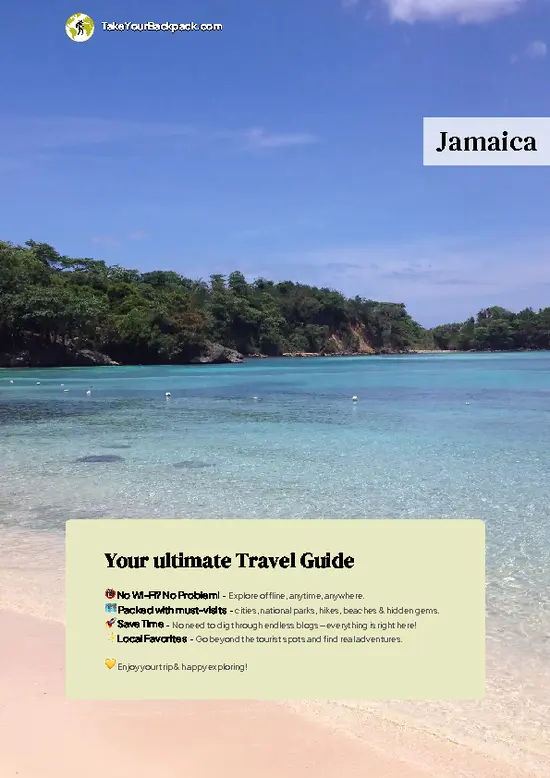
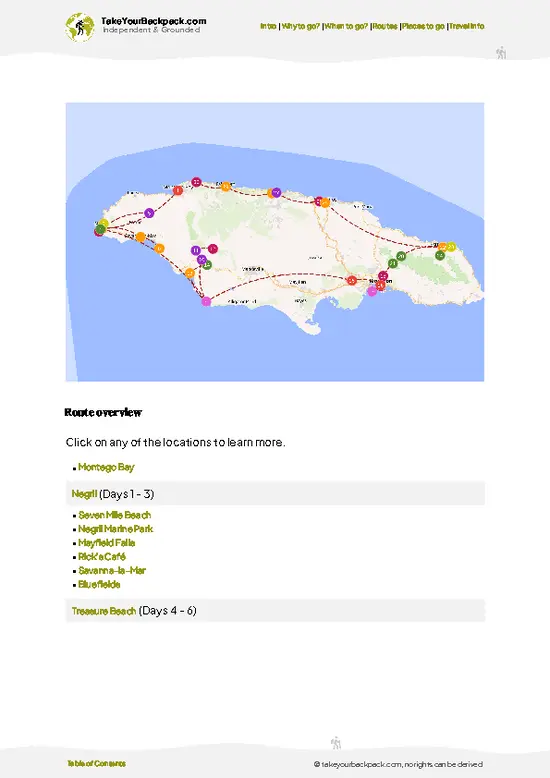
example page 0 from our offline Travel Guide for Jamaica
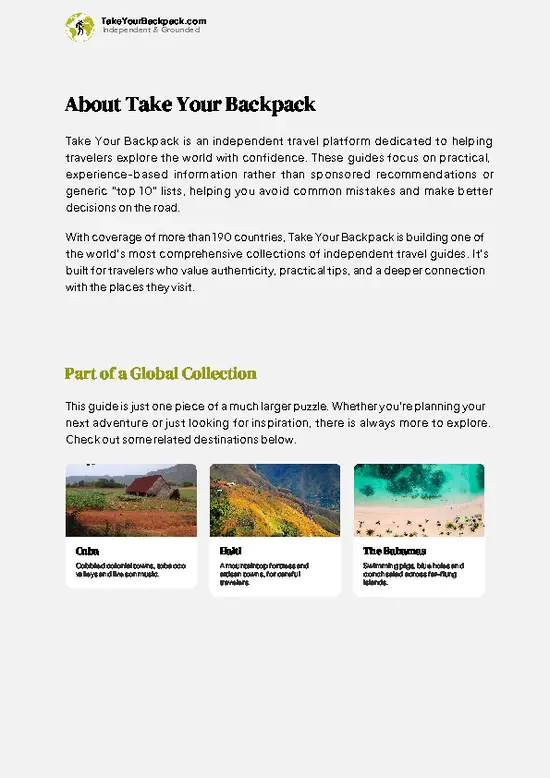
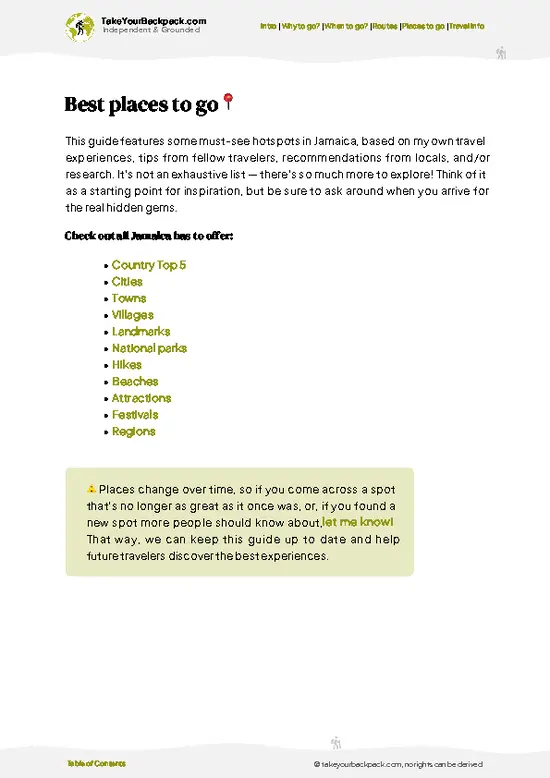
example page 1 from our offline Travel Guide for Jamaica
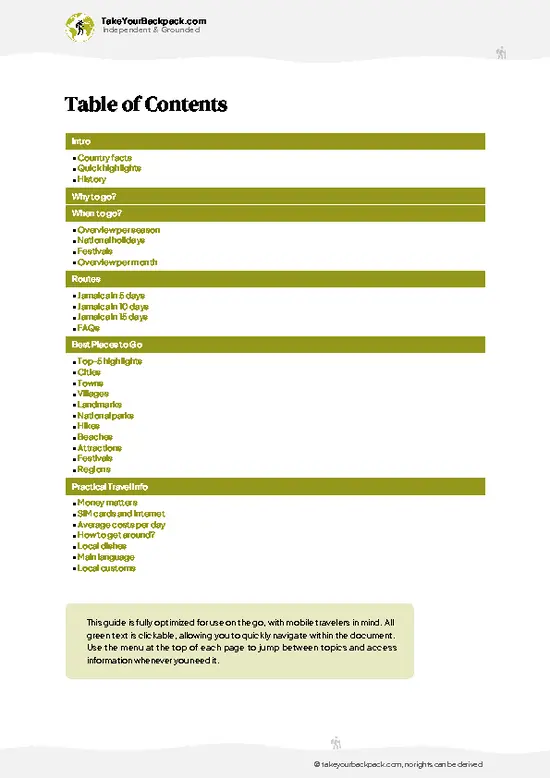
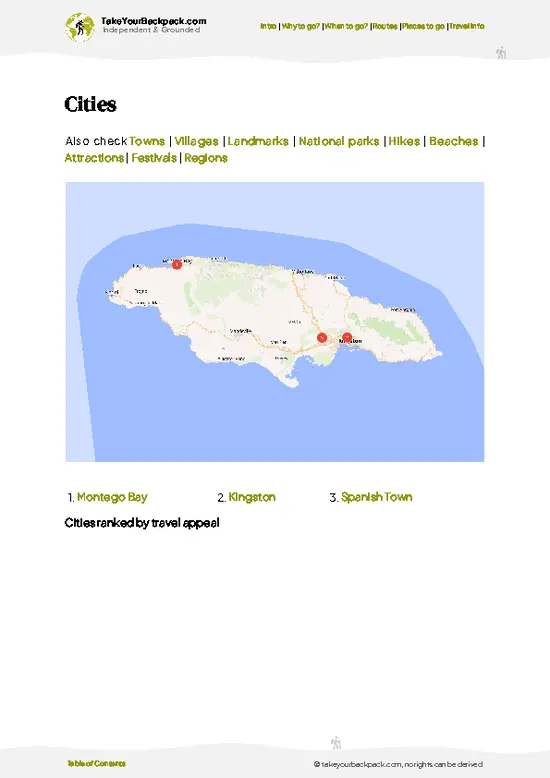
example page 2 from our offline Travel Guide for Jamaica
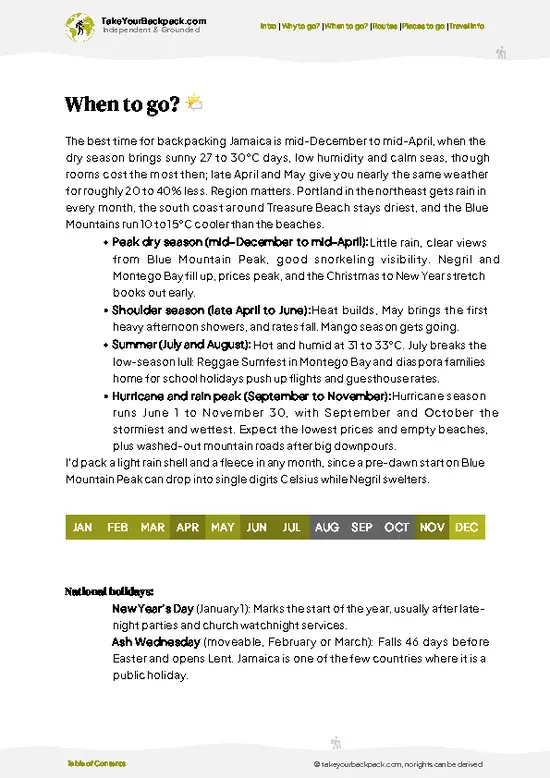
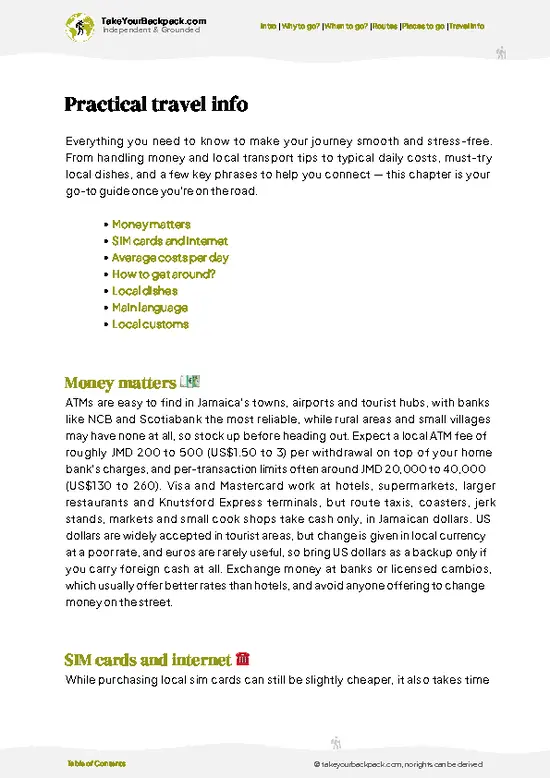
example page 3 from our offline Travel Guide for Jamaica
example page 4 from our offline Travel Guide for Jamaica
example page 5 from our offline Travel Guide for Jamaica
example page 6 from our offline Travel Guide for Jamaica
example page 7 from our offline Travel Guide for Jamaica
Loading the map 🌍
CLICK TO FILTER
cities
towns
villages
landmarks
national parks
hikes
beaches
attractions
festivals
regions
SHOW COUNTRY’S BESTSHOW ALL

✨ Why go?
Ranked #99 hike in Jamaica
What sets this place apart

Cockpit Country gives you something no other Jamaican hike does: a landscape of roughly cone-shaped limestone hills and sinkholes that stopped armies. This is the ground where the Maroons, descendants of escaped enslaved Africans, held out against British troops and won treaties in the 1730s. Walking with a Maroon guide means the history comes with plant names, hunting trails and stories of the escape routes, not a plaque.

The second reason is access. A day hike can begin in Accompong Town or around Albert Town and Windsor without any multi-day logistics, so the walk slots into a loop between Montego Bay and the south coast. Distances are flexible. You can take a two-hour forest walk or a full day, and community guides will shape the route to your legs.

The third is the wildlife. The forest … read more 👉
Cockpit Country gives you something no other Jamaican hike does: a landscape of roughly cone-shaped limestone hills and sinkholes that stopped armies. This is the ground where the Maroons, descendants of escaped enslaved Africans, held out against British troops and won treaties in the 1730s. Walking with a Maroon guide means the history comes with plant names, hunting trails and stories of the escape routes, not a plaque.

The second reason is access. A day hike can begin in Accompong Town or around Albert Town and Windsor without any multi-day logistics, so the walk slots into a loop between Montego Bay and the south coast. Distances are flexible. You can take a two-hour forest walk or a full day, and community guides will shape the route to your legs.

The third is the wildlife. The forest holds the Jamaican giant swallowtail butterfly, the largest in the Americas, plus endemic parrots and the Jamaican boa. Few visitors come here, so you share the trail with birds rather than tour groups.

💡 HighlightsDon't-miss highlights and experiences

  1. Accompong Town: The Maroon settlement on the southern edge of Cockpit Country is the main base for hikers. Its treaty with the British dates to 1739, and the village still runs on its own Maroon council. Walk the lanes, meet your guide and learn how the community lives around the forest.
  2. Peace Cave: A short walk from Accompong, this cave is where Maroon leaders are said to have sealed the peace treaty. It is cool, dark and quiet, with a guide explaining the history. It makes a good reason to stop on any route.
  3. Kindah Square: Accompong’s ceremonial heart holds the old Kindah tree and a drum ground where the January festival honoring Cudjoe, the Maroon leader, gathers crowds. Outside festival days it is still and small, and the guides tell the story in plain language.
  4. Windsor Cave: At Windsor in
… read more 👉
  1. Accompong Town: The Maroon settlement on the southern edge of Cockpit Country is the main base for hikers. Its treaty with the British dates to 1739, and the village still runs on its own Maroon council. Walk the lanes, meet your guide and learn how the community lives around the forest.
  2. Peace Cave: A short walk from Accompong, this cave is where Maroon leaders are said to have sealed the peace treaty. It is cool, dark and quiet, with a guide explaining the history. It makes a good reason to stop on any route.
  3. Kindah Square: Accompong’s ceremonial heart holds the old Kindah tree and a drum ground where the January festival honoring Cudjoe, the Maroon leader, gathers crowds. Outside festival days it is still and small, and the guides tell the story in plain language.
  4. Windsor Cave: At Windsor in Trelawny, about 25 km south of Falmouth, this cave is home to thousands of bats. Local guides lead you in at dusk when the bats stream out. It is the best wildlife spectacle on the northern edge of Cockpit Country.
  5. Forest viewpoints and sinkholes: Guided trails climb the cone ridges to open views over the pitted terrain, with each cockpit a deep green bowl, some hundreds of feet across. Bird watchers should look for the Jamaican parrots and the giant swallowtail butterfly, which flies in the humid understory.
For a first visit, Accompong Town with the Peace Cave gives Cockpit Country its clearest story and the easiest logistics.
Spotted a mistake or missing something? Contact us.

Things to do near Cockpit Country

Ratings based on Tripadvisor reviews. When you book through this link, you support our work at no extra cost to you.

🌤️ When to go?Choosing the right time of year

  • Dry Season (December to April): Cockpit Country is most walkable from December to April, with daytime highs of 27 to 30°C (81 to 86°F), cooler nights near 18 to 21°C (64 to 70°F), and about 11 hours of daylight. Mud is manageable and limestone is less slick.
  • Early Wet Season (May to June): Expect 29 to 32°C (84 to 90°F), afternoon downpours and heavy humidity. Mornings are usually clear, so start early.
  • Late Summer (July to August): Hot and sticky, with highs up to 33°C (91°F). Trails are quieter, and guides have open diaries.
  • Peak Rains and Hurricane Risk (September to November): October is the wettest month, with flooded sinkholes and slippery tracks. Storms are possible until late November, so tours may be canceled.
  • Crowds and Prices: Visitor numbers are small year-round. Community guide rates
… read more 👉
  • Dry Season (December to April): Cockpit Country is most walkable from December to April, with daytime highs of 27 to 30°C (81 to 86°F), cooler nights near 18 to 21°C (64 to 70°F), and about 11 hours of daylight. Mud is manageable and limestone is less slick.
  • Early Wet Season (May to June): Expect 29 to 32°C (84 to 90°F), afternoon downpours and heavy humidity. Mornings are usually clear, so start early.
  • Late Summer (July to August): Hot and sticky, with highs up to 33°C (91°F). Trails are quieter, and guides have open diaries.
  • Peak Rains and Hurricane Risk (September to November): October is the wettest month, with flooded sinkholes and slippery tracks. Storms are possible until late November, so tours may be canceled.
  • Crowds and Prices: Visitor numbers are small year-round. Community guide rates barely change, though lodging in Accompong and nearby towns can fill around the Maroon festival in early January.
Book your guide a few days ahead for January to March and plan to finish hiking by early afternoon.


source: climatestotravel.comJANJanuary: excellent for travelingFEBFebruary: excellent for travelingMARMarch: excellent for travelingAPRApril: highly recommended for travelingMAYMay: fair for travelingJUNJune: fair for travelingJULJuly: fair for travelingAUGAugust: fair for travelingSEPSeptember: fair for travelingOCTOctober: fair for travelingNOVNovember: good for travelingDECDecember: excellent for traveling
jamaica-hike-cockpit-country
© Google | Omar Downie

✈️ The backpacker research shortcutJamaica Travel Guide

An offline-friendly backpacking guide with optimized travel routes, ranked highlights, transport advice, and the best areas to stay.
example page 0 from our offline Travel Guide for Jamaica
example page 1 from our offline Travel Guide for Jamaica
example page 2 from our offline Travel Guide for Jamaica
example page 3 from our offline Travel Guide for Jamaica
example page 4 from our offline Travel Guide for Jamaica
example page 5 from our offline Travel Guide for Jamaica
example page 6 from our offline Travel Guide for Jamaica
example page 7 from our offline Travel Guide for Jamaica
The digital guide (238 pages) contains:
✅ 71 highlights, ranked by travel appeal
✅ Optimized 5, 10 & 15-day travel routes
✅ Cities, national parks, landmarks, beaches
✅ How to get around
✅ Offline-friendly for travel without Wi-Fi
👉 Click to see all 30+ guide features

📅 Plan smarter in minutes, not weeks
✅ Month by month travel advice
✅ Festivals & national holidays
✅ Budget expectations

🗺️ Go to the right places, skip the overrated ones
✅ Honest pros & cons of destinations
✅ Top hikes, parks & viewpoints
✅ Lesser-known places most travelers miss
✅ Clear “worth it vs skip it” guidance

🛏️ Travel smoothly without rookie mistakes
✅ Best areas to stay
✅ Transport systems explained simply
✅ Common scams & safety advice
✅ SIM cards, money & practical tips

🌍 Understand the country, not just visit it
✅ Culture & traditions
✅ 52 Essential phrases & customs
✅ Festivals worth planning around
✅ Traveler-friendly historical context
✅ Insights that make places more meaningful

📱 Built for real travel conditions
✅ Fully downloadable PDF
✅ Works completely offline
✅ Optimized for phone use
✅ Useful in remote areas & buses
✅ Everything in one place
Stop searching, start planning
Get instant access to your full guide. 30‑day money-back guarantee.
+ Add another guide for just

By proceeding you agree to our terms.
Sent to your inbox immediately after payment • 100% Secure Checkout
Best Backpacking Travel Advisor 2025 tourism awardBest Backpacking
Travel Advisor
2025
What others say about Take Your Backpack Guides:
⭐⭐⭐⭐⭐
Fantastic, amazing amount of information!
⭐⭐⭐⭐⭐
My goodness this is amazing, it's what I've been looking for hats off too you!
⭐⭐⭐⭐⭐
I think this is absolutely BRILLIANT
⭐⭐⭐⭐
Very complete and informative. It's still missing places, but I gotta to commend you
⭐⭐⭐⭐⭐
This is truly amazing, thank you, can't wait to explore it with my kids!
⭐⭐⭐⭐⭐
Awesome resource, thank you!
⭐⭐⭐⭐⭐
This is amazing! Can't wait to explore the ones I haven't seen
⭐⭐⭐⭐
I love this! Well done, great idea.
⭐⭐⭐⭐⭐
Thanks for taking the time to make this gem!
⭐⭐⭐⭐⭐
This might be the best website I've ever seen.
⭐⭐⭐⭐⭐
Congratulations, and thank you so much for your work; it's incredibly valuable.
⭐⭐⭐⭐
In all seriousness I think you did a great job pointing out the important spots
⭐⭐⭐⭐⭐
10/10 very good
⭐⭐⭐⭐⭐
As someone who's only just starting to visit regularly this is awesome, thank you.
⭐⭐⭐⭐
Thank you very much! I'm going to visit my dad, it's going to be very useful!
⭐⭐⭐⭐⭐
This is really cool! We'll be travelling for the first time and this definitely come in handy.
⭐⭐⭐⭐⭐
You are now our minister of culture, congratulations 👨‍💼
⭐⭐⭐⭐⭐
Just wanted to tell you that this is a pearl! Going to follow your recommendations.
⭐⭐⭐⭐⭐
This is so cool. I'll definitely be using the resource for my travels soon.
⭐⭐⭐⭐⭐
This is very impressive! Good work.
⭐⭐⭐⭐⭐
This is an amazing and informative site. Very well done!

🛏️ Where to stay?Where staying makes the most sense

If you enjoy meeting fellow travelers, consider choosing hostels with high ratings for atmosphere. On the other hand, if you prefer having your own space, a hotel might be a better option.

🥾 Hike detailsTrail overview: what to expect on the hike

Total Distance: Cockpit Country has no single trail, but a typical guided day route covers about 10 to 14 km. Shorter two-hour walks of 4 to 5 km are common out of Accompong.
Estimated Duration: Plan 4 to 7 hours for a full day hike with stops. Allow extra time for cave visits.
Difficulty: Moderate. The paths are narrow and often muddy, with loose limestone underfoot. Climbs are steep but short.
Starting Point: Most hikes begin in Accompong Town in St. Elizabeth, or on the northern side near Albert Town and Windsor in Trelawny. Public transport is limited. Route taxis and minibuses run from Montego
… read more 👉
Total Distance: Cockpit Country has no single trail, but a typical guided day route covers about 10 to 14 km. Shorter two-hour walks of 4 to 5 km are common out of Accompong.
Estimated Duration: Plan 4 to 7 hours for a full day hike with stops. Allow extra time for cave visits.
Difficulty: Moderate. The paths are narrow and often muddy, with loose limestone underfoot. Climbs are steep but short.
Starting Point: Most hikes begin in Accompong Town in St. Elizabeth, or on the northern side near Albert Town and Windsor in Trelawny. Public transport is limited. Route taxis and minibuses run from Montego Bay and Black River toward the villages, often with a change and fewer services later in the day. Arrange a guide before you travel.
Major Landmarks:
  • Peace Cave: A Maroon treaty site reached by a short forest walk.
  • Kindah Square: The village’s ceremonial center, with drum ground and old tree.
  • Windsor Cave: A bat cave on the north side that suits evening visits.
Terrain and Scenery: Cockpit Country is karst limestone, with sharp cone hills separated by deep bowls called cockpits. Ridges give long views over the green hollows. Expect sharp rock, slick roots and sudden drops, so wear boots with real grip.
Vegetation: Dense tropical forest of tall hardwoods, ferns, bromeliads and vines. Farmers grow yam and other crops in the cleared hollows near villages.
Wildlife: Bird life is the highlight, including Jamaican parrots and many endemic species. The giant swallowtail butterfly, Jamaican boa and bats also live here. Insects are plentiful, so bring repellent.
Practical Notes: Guides are essential, since trails are unmarked and navigation is hard. Carry at least 2 liters of water, snacks and cash for guide fees.
⚠️ Hiking info can sometimes be outdated or inaccurate. Before you hit the trail, check the latest conditions with locals. If you do spot anything that's off, I'd love to hear from you, so I can update it for fellow travelers.

🛡️ SafetyScams, Hazards, and Annoyances

Cockpit Country is straightforward with a local guide, but the terrain is unforgiving without one. The limestone is sharp, pitted and slick after rain, and the cone-shaped hills hide sinkholes and tangled bush where trails vanish. Phone signal is patchy, so navigation by GPS alone is unreliable. Go with a community guide from Accompong or a nearby village, wear boots with real grip and ankle support, and carry at least 2 to 3 liters of water, since streams are scarce in the dry months. Start early to avoid afternoon heat and thunderstorms, which can turn paths to mud and fill caves quickly. Wildlife is mild. You may see the Jamaican boa, which is harmless to people, plus bats in caves and plenty of mosquitoes, so bring repellent. Carry a small first-aid kit, and tell your lodging where you are headed.

FAQFrequently asked questions about Cockpit Country

Cockpit Country hikes range from a 2 to 3 hour guided walk near Accompong to full-day treks of 6 to 8 hours into the interior. Short options include the Peace Cave and the Kindah area, while longer routes follow old Maroon trails through the cockpits. Multi-day crossings are rare and need a village guide and local arrangements.
Cockpit Country is moderate on short guided walks and hard on full-day routes. The limestone is rugged and slick, with steep climbs between cone-shaped hills and humid heat of 27 to 32°C (81 to 90°F). Average fitness is enough for a 2 to 3 hour outing, while the long treks need sturdy boots and good stamina.
Cockpit Country has no formal park permit for most hikes, but a local guide is strongly advised and in practice required on interior routes. In Accompong, community guides typically charge about US$20 to 60 per person depending on route and group size, and the village may add a small entry fee of a few US dollars. Arrange it through your accommodation or the Accompong Maroon Council a day ahead.
⚠️ Things can change over time, so always validate details locally before you go.

Other Jamaican hikes near Cockpit Country

Explore more nearby:


💡 Not sure where to go next?
Create a personalized itinerary for Jamaica including Cockpit Country and the places that fit your trip.

Generate my itinerary

👉 Discover all hikes

Or checkout all Jamaica has to offer (think cities, towns, villages, national parks, hikes, beaches, festivals)
Country photo of Jamaica

We 💚 feedbackFinal thoughts on hiking the Cockpit Country

Cockpit Country pairs best with a coastal stop on either side. I would hike here for a day, then finish on the south coast at Treasure Beach, or begin in Montego Bay and loop through Accompong before heading inland. Skip the night-hike pitch unless you have a guide you trust, and bring boots with real grip.

✈️ When did I visit Jamaica?
As part of my 1.5 year travel around the world trip, I visited Jamaica in May 2016.

✍️ Help improve this page!
The information on this page is based on my own backpacking experience in Jamaica, supplemented with up-to-date research and feedback from other travelers. Travel details can change, so if you notice anything outdated or incomplete, feel free to let me know.


🙋‍♂️ Give feedback

👋 Meet the founderWho’s Behind Take Your Backpack?

Johan, backpacker and founder of TakeYourBackpackHi, I’m Johan (Netherlands 🇳🇱), the creator of TakeYourBackpack. Over the past 3 decades, I’ve backpacked through 90+ countries across six continents, gaining extensive experience with independent travel, long-term trips, and overland routes.

This site is built on a combination of firsthand travel experience and carefully curated insights from other backpackers. Many guides are based on places I’ve personally visited, while others bring together tips, observations, and practical advice shared by trusted travelers I’ve met along the way.

The goal is to provide realistic, experience-driven guidance — not generic itineraries — so you can explore destinations with better context, clearer expectations, and more confidence.