×

Jamaica🇯🇲 | best hikesWhere to Find the Best hikes in Jamaica

Hiking in Jamaica means steep, humid, forested trails led by local guides, not marked long-distance paths. The Blue Mountains around Kingston are the serious option: cold summit mornings, coffee farms, and a pre-dawn start that suits anyone doing a proper climb. The Cockpit Country in the west is rougher, emptier and cheaper, with little signage. The northeast near Port Antonio offers river and waterfall walks that are easy and lightly crowded. Skip the famous north coast falls if you want a hike, since they are mostly paid, packaged crowds. Backpackers on independent budgets do best by pairing one mountain day with community-run treks.

By Johan Kruseman 🇳🇱 | Updated October 23, 2026
Explore the best beaches in Jamaica

Why go?Why Travelers Love These Spots

Jamaica packs unusual variety into a small island. Blue Mountain Peak reaches 2,256 meters, so you can sweat through tropical forest and finish in cool, cloud-wrapped montane woodland within a few hours. Limestone karst terrain in Cockpit Country, a cone-pocked landscape that the Maroons used to resist colonial armies, gives hiking a living historical layer you will not find on a typical tropical island. Much of the high ground sits inside the UNESCO-listed Blue and John Crow Mountains National Park, so the best trails are protected and the access points are fairly well defined.
What Jamaica lacks is infrastructure for self-guided walking. Trails are poorly signed, maps are thin, and mud, roots and sudden rain make navigation harder than the distances suggest. Hiring a local guide is the norm … read more 👉
Jamaica packs unusual variety into a small island. Blue Mountain Peak reaches 2,256 meters, so you can sweat through tropical forest and finish in cool, cloud-wrapped montane woodland within a few hours. Limestone karst terrain in Cockpit Country, a cone-pocked landscape that the Maroons used to resist colonial armies, gives hiking a living historical layer you will not find on a typical tropical island. Much of the high ground sits inside the UNESCO-listed Blue and John Crow Mountains National Park, so the best trails are protected and the access points are fairly well defined.
What Jamaica lacks is infrastructure for self-guided walking. Trails are poorly signed, maps are thin, and mud, roots and sudden rain make navigation harder than the distances suggest. Hiring a local guide is the norm and often required, and the money goes into small communities, which is a good use of it. Public transport reaches trailheads badly. Expect shared taxis, a driver for the final stretch, or a hostel pickup.
Also know that Jamaica is not a long-trek destination. Most hikes take a half day to a full day. If you want multi-day wilderness traverses, go elsewhere. If you want short, culturally rich, guided adventures with beaches nearby, this works well.
Evaluating the Top Choices
The list of best hikes in Jamaica is created based on scenery, challenge, trail quality, landmarks, and overall enjoyment. If you feel a hike is missing in this list, please let us know.

When to go?Optimal Periods for Travel

Best Months for Hiking in Jamaica: December to March is the best window, because it is the driest stretch of the year and the Blue Mountains give their clearest dawn views, with summit temperatures commonly 5 to 12°C at night and Kingston sitting at 24 to 30°C by day.
April and early May are a decent shoulder period: warmer, still mostly dry, and quieter on the trails. October to November is the wettest and worst stretch for mountain hiking. Heavy rain turns trails to slick red mud, rivers rise, and waterfall walks can become unsafe. A second, shorter wet spell hits in May and June.
Hurricane Season and Regional Differences: The Atlantic hurricane season runs June to November, with the highest risk from August to October. Storm systems can close trails and national park access without notice. … read more 👉
Best Months for Hiking in Jamaica: December to March is the best window, because it is the driest stretch of the year and the Blue Mountains give their clearest dawn views, with summit temperatures commonly 5 to 12°C at night and Kingston sitting at 24 to 30°C by day.
April and early May are a decent shoulder period: warmer, still mostly dry, and quieter on the trails. October to November is the wettest and worst stretch for mountain hiking. Heavy rain turns trails to slick red mud, rivers rise, and waterfall walks can become unsafe. A second, shorter wet spell hits in May and June.
Hurricane Season and Regional Differences: The Atlantic hurricane season runs June to November, with the highest risk from August to October. Storm systems can close trails and national park access without notice. The northeast, around Port Antonio, is the wettest part of the island, with rain possible in any month and annual totals well above 3,000 mm in the mountains behind it. Cockpit Country and the west are drier, but July and August are hot, often above 32°C, and limestone trails radiate heat.
Crowds and Prices: Peak season runs mid-December to April. Guesthouse and hotel rates in Kingston and Port Antonio can rise 20 to 40 percent, and Christmas weeks book out. Guide fees for hikes rarely change with the season, so the savings come from sleeping in the low season, not from the trail itself.

hike hoppingPlanning Your Route Efficiently

How Many Days to Combine Jamaica’s Hikes: A trip linking several hikes in Jamaica needs 7 to 10 days, and 5 days is the practical minimum if you cut a region.
Three regions cluster sensibly. Kingston and the Blue Mountains work as one base, with the trailheads 1.5 to 2.5 hours up winding roads. Port Antonio and the northeast sit 2 to 2.5 hours from Kingston and pair easily with it. Cockpit Country belongs with Montego Bay or the interior around Albert Town, roughly 1.5 to 2 hours from the coast. Kingston to Montego Bay takes 3 to 4 hours by highway or the Knutsford Express bus.
The cleanest direction is Montego Bay to Cockpit Country, then across to Kingston and the Blue Mountains, and finishing in Port Antonio, where flights are not needed and the pace slows. Allow 2 to 3 nights in the Blue … read more 👉
How Many Days to Combine Jamaica’s Hikes: A trip linking several hikes in Jamaica needs 7 to 10 days, and 5 days is the practical minimum if you cut a region.
Three regions cluster sensibly. Kingston and the Blue Mountains work as one base, with the trailheads 1.5 to 2.5 hours up winding roads. Port Antonio and the northeast sit 2 to 2.5 hours from Kingston and pair easily with it. Cockpit Country belongs with Montego Bay or the interior around Albert Town, roughly 1.5 to 2 hours from the coast. Kingston to Montego Bay takes 3 to 4 hours by highway or the Knutsford Express bus.
The cleanest direction is Montego Bay to Cockpit Country, then across to Kingston and the Blue Mountains, and finishing in Port Antonio, where flights are not needed and the pace slows. Allow 2 to 3 nights in the Blue Mountains, 1 to 2 for Cockpit Country, and 2 for the northeast.
Planning Mistakes: The commonest error is stacking a pre-dawn summit start (often 2 to 3 a.m.) onto a long transfer day. Keep a rest buffer afterward. Another is trusting route taxis to reach remote trailheads; pre-book a driver or hostel transfer. Travelers also underestimate the winding roads, where 60 km can take two hours. Do not attempt more than one hike a day, and do not schedule hikes on arrival day.

The ListThe Best hikes of Jamaica

1 Blue Mountain Peak

Pre-dawn summit push, 2,256 m, Whitfield Hall start, elfin forest

Climb steeply through moss-draped elfin forest from Whitfield Hall in the dark, aiming to reach the 2,256-meter summit before sunrise lights the ridges.

jamaica-hike-blue-mountain-peak
© Google | Alecia Cain
Loading the map 🌍

Expert viewPro Tips for Exploring the Best

How Many Hikes to Do: Three to four hikes is the right number for most trips. That gives you one serious mountain day, a couple of river or forest walks, and room to recover. Pushing past four means rushing trailheads, paying more transfers, and walking with sore legs on mud that punishes tired feet. Fewer than three wastes the effort of getting to the remote areas.
Which Kind to Prioritize: If you are fit and want the signature challenge, put the Blue Mountain summit first and everything else second. If you prefer culture, choose community-run treks in Cockpit Country or the John Crow Mountains, where guides explain Maroon history and bush medicine. If you are traveling with kids, a beginner, or short on time, pick waterfall and river walks in the northeast and skip the summit. Skip the most … read more 👉
How Many Hikes to Do: Three to four hikes is the right number for most trips. That gives you one serious mountain day, a couple of river or forest walks, and room to recover. Pushing past four means rushing trailheads, paying more transfers, and walking with sore legs on mud that punishes tired feet. Fewer than three wastes the effort of getting to the remote areas.
Which Kind to Prioritize: If you are fit and want the signature challenge, put the Blue Mountain summit first and everything else second. If you prefer culture, choose community-run treks in Cockpit Country or the John Crow Mountains, where guides explain Maroon history and bush medicine. If you are traveling with kids, a beginner, or short on time, pick waterfall and river walks in the northeast and skip the summit. Skip the most heavily packaged north coast waterfall climbs unless you want a wet group activity with photographers and souvenir stalls; they are not a real hike.
What It Costs: Budget about US$50 to 90 a day (roughly J$7,800 to 14,000) including a hostel or guesthouse bed, local food, and shared transport. Add on top: guided summit hikes usually run US$40 to 100 per group or person depending on operator and group size, community guides for forest and cave walks US$20 to 50, and park or site entry fees of about US$5 to 20. Private transfers to remote trailheads cost US$30 to 80 each way, which is where budgets break. Share the cost with other travelers, or book through your hostel. A whole hiking-focused trip of 8 days typically lands at US$450 to 800 excluding flights.
Costs and Mistakes That Catch People Out: Unlicensed guides offering low prices at the roadside often vanish, quote again halfway, or take shortcuts. Book through the national park trust, your accommodation, or a recommended community group, and agree the price in Jamaican dollars or US dollars before you start. Carry small cash, since card machines are rare at trailheads and ATMs are far away.
Pre-dawn departures mean cold. Bring a fleece and rain shell even in a hot Kingston week; summit mornings drop under 10°C and wind makes it feel colder. Wear shoes with real grip, as red clay and wet limestone are slippery, and carry at least 2 liters of water.
Safety and Culture: Never walk remote trails alone. Getting lost is easy, phone signal drops out, and some forest areas include private farmland where wandering off-route causes real problems. Check river levels before any waterfall walk, because flash floods follow heavy rain upstream. Greet people you pass with “good morning” or “afternoon” first; skipping it reads as rude. Ask before photographing people, farms or homes. Leave nothing behind and tip guides, typically 10 to 15 percent, since the fee often covers only part of what the community relies on.

✈️ The backpacker research shortcutJamaica Travel Guide

An offline-friendly backpacking guide with optimized travel routes, ranked highlights, transport advice, and the best areas to stay.
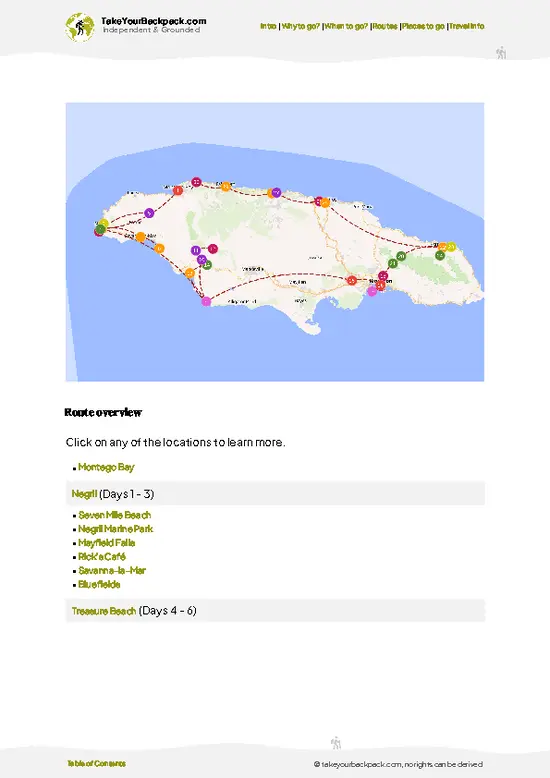
example page 0 from our offline Travel Guide for Jamaica
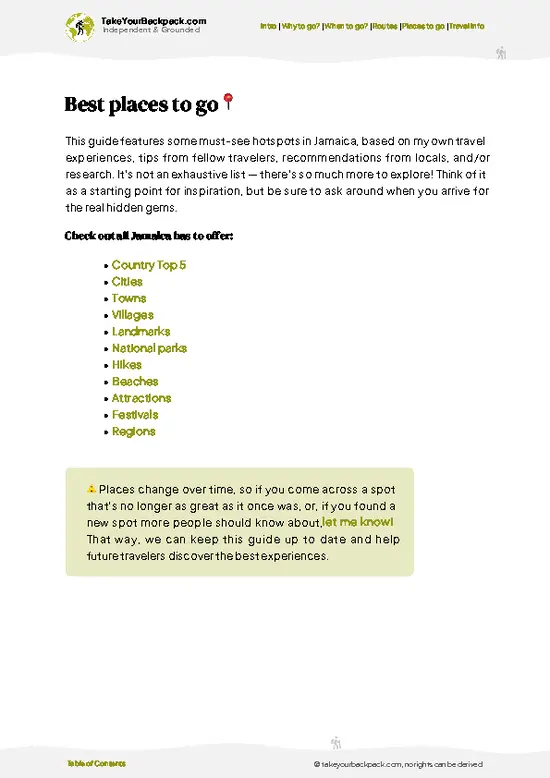
example page 1 from our offline Travel Guide for Jamaica
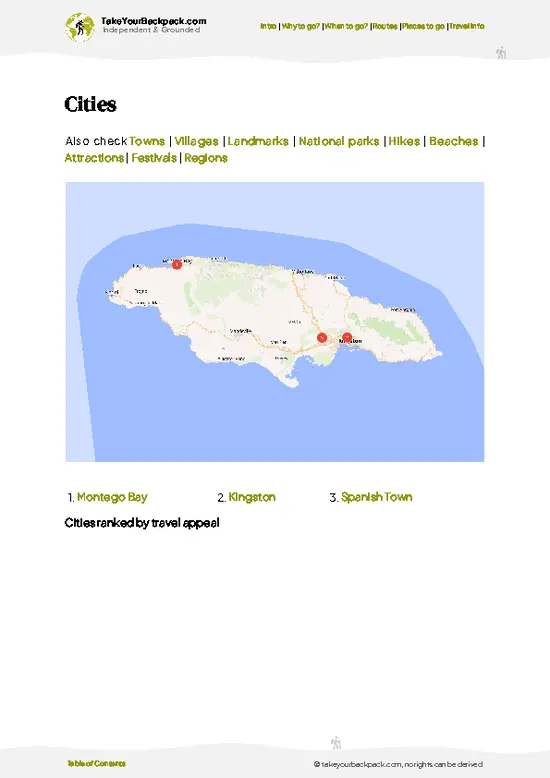
example page 2 from our offline Travel Guide for Jamaica
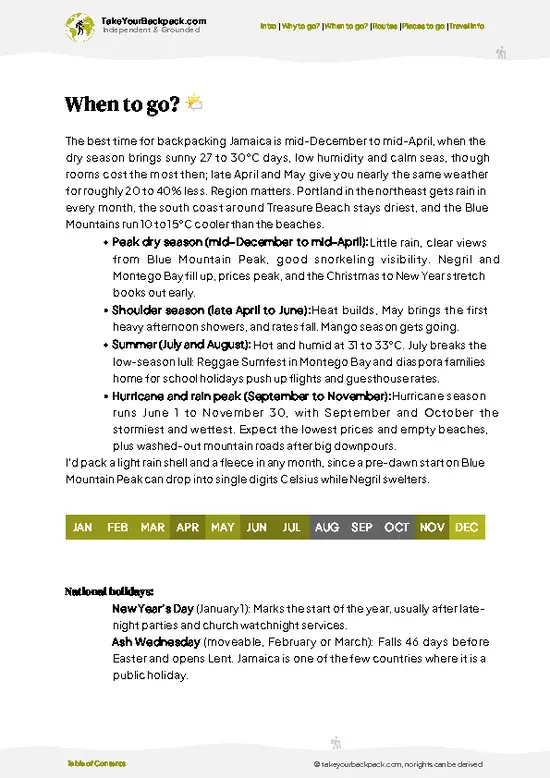
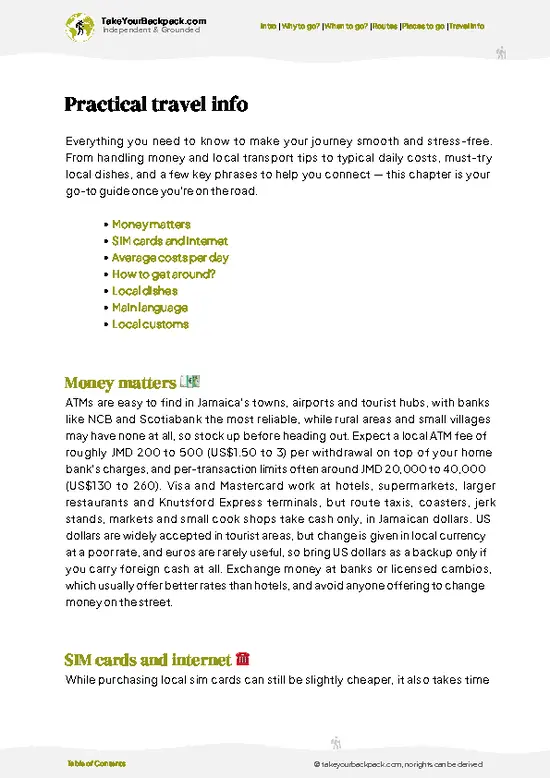
example page 3 from our offline Travel Guide for Jamaica
example page 4 from our offline Travel Guide for Jamaica
example page 5 from our offline Travel Guide for Jamaica
example page 6 from our offline Travel Guide for Jamaica
example page 7 from our offline Travel Guide for Jamaica
The digital guide (238 pages) contains:
✅ 71 highlights, ranked by travel appeal
✅ Optimized 5, 10 & 15-day travel routes
✅ Cities, national parks, landmarks, beaches
✅ How to get around
✅ Offline-friendly for travel without Wi-Fi
👉 Click to see all 30+ guide features

📅 Plan smarter in minutes, not weeks
✅ Month by month travel advice
✅ Festivals & national holidays
✅ Budget expectations

🗺️ Go to the right places, skip the overrated ones
✅ Honest pros & cons of destinations
✅ Top hikes, parks & viewpoints
✅ Lesser-known places most travelers miss
✅ Clear “worth it vs skip it” guidance

🛏️ Travel smoothly without rookie mistakes
✅ Best areas to stay
✅ Transport systems explained simply
✅ Common scams & safety advice
✅ SIM cards, money & practical tips

🌍 Understand the country, not just visit it
✅ Culture & traditions
✅ 52 Essential phrases & customs
✅ Festivals worth planning around
✅ Traveler-friendly historical context
✅ Insights that make places more meaningful

📱 Built for real travel conditions
✅ Fully downloadable PDF
✅ Works completely offline
✅ Optimized for phone use
✅ Useful in remote areas & buses
✅ Everything in one place
Stop searching, start planning
Get instant access to your full guide. 30‑day money-back guarantee.
+ Add another guide for just

By proceeding you agree to our terms.
Sent to your inbox immediately after payment • 100% Secure Checkout
Best Backpacking Travel Advisor 2025 tourism awardBest Backpacking
Travel Advisor
2025
What others say about Take Your Backpack Guides:
⭐⭐⭐⭐⭐
Fantastic, amazing amount of information!
⭐⭐⭐⭐⭐
My goodness this is amazing, it's what I've been looking for hats off too you!
⭐⭐⭐⭐⭐
I think this is absolutely BRILLIANT
⭐⭐⭐⭐
Very complete and informative. It's still missing places, but I gotta to commend you
⭐⭐⭐⭐⭐
This is truly amazing, thank you, can't wait to explore it with my kids!
⭐⭐⭐⭐⭐
Awesome resource, thank you!
⭐⭐⭐⭐⭐
This is amazing! Can't wait to explore the ones I haven't seen
⭐⭐⭐⭐
I love this! Well done, great idea.
⭐⭐⭐⭐⭐
Thanks for taking the time to make this gem!
⭐⭐⭐⭐⭐
This might be the best website I've ever seen.
⭐⭐⭐⭐⭐
Congratulations, and thank you so much for your work; it's incredibly valuable.
⭐⭐⭐⭐
In all seriousness I think you did a great job pointing out the important spots
⭐⭐⭐⭐⭐
10/10 very good
⭐⭐⭐⭐⭐
As someone who's only just starting to visit regularly this is awesome, thank you.
⭐⭐⭐⭐
Thank you very much! I'm going to visit my dad, it's going to be very useful!
⭐⭐⭐⭐⭐
This is really cool! We'll be travelling for the first time and this definitely come in handy.
⭐⭐⭐⭐⭐
You are now our minister of culture, congratulations 👨‍💼
⭐⭐⭐⭐⭐
Just wanted to tell you that this is a pearl! Going to follow your recommendations.
⭐⭐⭐⭐⭐
This is so cool. I'll definitely be using the resource for my travels soon.
⭐⭐⭐⭐⭐
This is very impressive! Good work.
⭐⭐⭐⭐⭐
This is an amazing and informative site. Very well done!

🛏️ Where to stay?Best Places to Stay in Jamaica

Jamaica has a small but solid spread of hostels, guesthouses and cheap cottages, with dorm beds typically around US$20 to 35 a night and simple private rooms from roughly US$40 to 70. Negril has the widest choice: the West End cliffs are quieter, cheaper and better for swimming off rocks, while Seven Mile Beach puts you near the sand and beach bars but costs more and brings constant hustlers. In Kingston, New Kingston keeps you close to restaurants, nightlife and transport and feels safer than downtown after dark, whereas laid-back Treasure Beach and Port Antonio trade nightlife for calm, friendly guesthouse stays near the coast and the rivers.

If you enjoy meeting fellow travelers, consider … read more 👉
Jamaica has a small but solid spread of hostels, guesthouses and cheap cottages, with dorm beds typically around US$20 to 35 a night and simple private rooms from roughly US$40 to 70. Negril has the widest choice: the West End cliffs are quieter, cheaper and better for swimming off rocks, while Seven Mile Beach puts you near the sand and beach bars but costs more and brings constant hustlers. In Kingston, New Kingston keeps you close to restaurants, nightlife and transport and feels safer than downtown after dark, whereas laid-back Treasure Beach and Port Antonio trade nightlife for calm, friendly guesthouse stays near the coast and the rivers.

If you enjoy meeting fellow travelers, consider choosing hostels with high ratings for atmosphere. On the other hand, if you prefer having your own space, a hotel might be a better option.

JamaicaExplore Jamaica

👋 Meet the founderWho’s Behind Take Your Backpack?

Johan, backpacker and founder of TakeYourBackpackHi, I’m Johan (Netherlands 🇳🇱), the creator of TakeYourBackpack. Over the past 3 decades, I’ve backpacked through 90+ countries across six continents, gaining extensive experience with independent travel, long-term trips, and overland routes.

This site is built on a combination of firsthand travel experience and carefully curated insights from other backpackers. Many guides are based on places I’ve personally visited, while others bring together tips, observations, and practical advice shared by trusted travelers I’ve met along the way.

The goal is to provide realistic, experience-driven guidance — not generic itineraries — so you can explore destinations with better context, clearer expectations, and more confidence.