
×

Kiribati🇰🇮 | festivalsKiribati DayMulti-day march past, choir contests, lagoon sailing canoes, craft stalls | things to do and best time to go

Explore Independence Day CelebrationsExplore Kiribati Music Festival

Backpacking in Kiribati Day
By Johan Kruseman 🇳🇱 | Updated October 15, 2026

Once it was mostly speeches, flag-raising and dance contests in front of the maneaba. Today July 12 stretches into several days of marching, singing and canoe racing, and the lagoon edge fills with families in matching island prints. The celebration of independence from Britain is centered in Bairiki, the government district of South Tarawa in Kiribati, with events spread along the single road that runs the length of the atoll. Expect sun on tin roofs, drum-thump rehearsals, coconut smoke and the smell of grilled fish. Hard parts are real. Flights in are infrequent and fill early, so book them first. Beds are few and go quickly, so reserve a guesthouse well ahead. Programs shift without warning, so keep your days loose. ATMs are scarce, so carry Australian dollars in small notes. Cover your shoulders and knees, and bring serious sunscreen. Spend your first morning at the stadium parade, then drift to a village maneaba by afternoon.

Discover everything you want to know in the 📖 Kiribati Travel Guide.


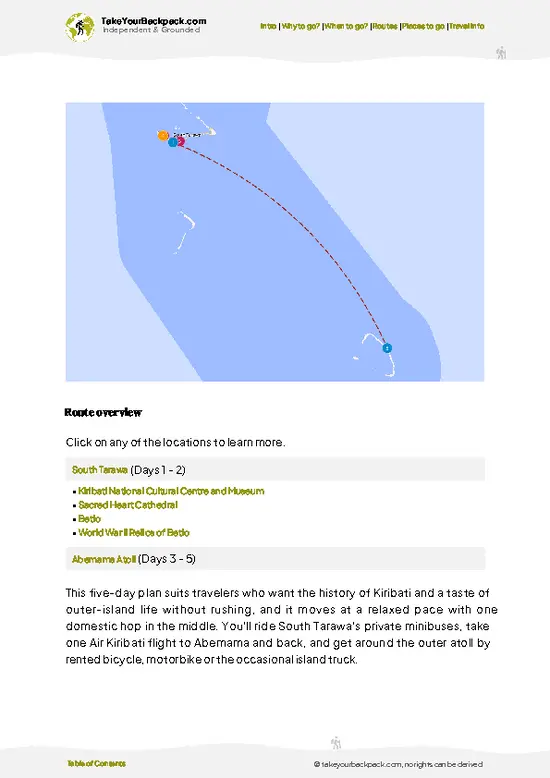
example page 0 from our offline Travel Guide for Kiribati
example page 1 from our offline Travel Guide for Kiribati
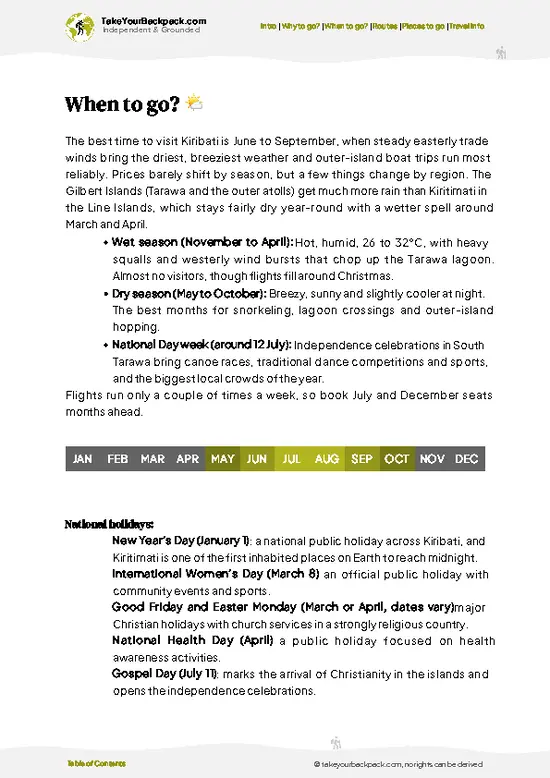
example page 2 from our offline Travel Guide for Kiribati
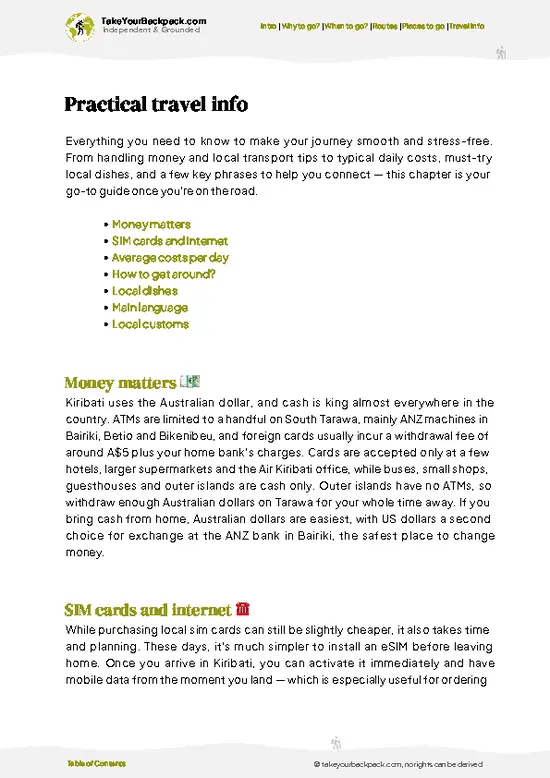
example page 3 from our offline Travel Guide for Kiribati
example page 4 from our offline Travel Guide for Kiribati
example page 5 from our offline Travel Guide for Kiribati
example page 6 from our offline Travel Guide for Kiribati
example page 7 from our offline Travel Guide for Kiribati
Loading the map 🌍
CLICK TO FILTER
towns
villages
landmarks
national parks
beaches
attractions
festivals
regions
SHOW COUNTRY’S BESTSHOW ALL

✨ Why go?
Ranked #99 festival in Kiribati
The unique appeal for travelers

Backpackers plan around Kiribati Day because it is the one moment when the whole country performs for itself rather than for visitors. You are not watching a staged show. You are standing among neighbors from South Tarawa’s villages who have rehearsed their dances for weeks, and a smiling foreigner at the edge of the crowd is usually pulled into the conversation, handed food or made to sit. That temporary community is the draw.

The cultural payoff is concentrated. Choir songs, traditional dance in the maneaba and the sight of sailing canoes on the lagoon all land in a few days, which would take weeks of wandering to piece together on an ordinary visit. Everyday Tarawa is quiet and spread thin, so the timing matters.

It also fits a longer Pacific route. Flights here are sparse, so arriving … read more 👉
Backpackers plan around Kiribati Day because it is the one moment when the whole country performs for itself rather than for visitors. You are not watching a staged show. You are standing among neighbors from South Tarawa’s villages who have rehearsed their dances for weeks, and a smiling foreigner at the edge of the crowd is usually pulled into the conversation, handed food or made to sit. That temporary community is the draw.

The cultural payoff is concentrated. Choir songs, traditional dance in the maneaba and the sight of sailing canoes on the lagoon all land in a few days, which would take weeks of wandering to piece together on an ordinary visit. Everyday Tarawa is quiet and spread thin, so the timing matters.

It also fits a longer Pacific route. Flights here are sparse, so arriving for July 12 gives your stay a reason and a shape, and it pairs well with other Micronesian and Fijian stops. Go with patience and a flexible schedule, and the July 12 national holiday becomes the highlight of the trip.

💡 HighlightsDon't-miss highlights and experiences

  1. The national parade and march past in Bairiki: The formal heart of the celebration, with uniformed groups, school contingents, flags and speeches from officials. It is free to watch, and arriving early gets you shade and a clear view.
  2. Traditional dance performances: Groups from different islands and villages perform seated and standing dances with synchronized arm movements, chanting and clapping. The costumes of woven pandanus and coconut fiber and the intensity of the singing are the standout.
  3. Canoe sailing on Tarawa Lagoon: Local sailing canoes with triangular sails race across the shallow water. The boats are built by hand, and watching them tack against the wind shows how Kiribati people have long moved between islands.
  4. Choir and song competitions: Church and community choirs sing in harmony
… read more 👉
  1. The national parade and march past in Bairiki: The formal heart of the celebration, with uniformed groups, school contingents, flags and speeches from officials. It is free to watch, and arriving early gets you shade and a clear view.
  2. Traditional dance performances: Groups from different islands and villages perform seated and standing dances with synchronized arm movements, chanting and clapping. The costumes of woven pandanus and coconut fiber and the intensity of the singing are the standout.
  3. Canoe sailing on Tarawa Lagoon: Local sailing canoes with triangular sails race across the shallow water. The boats are built by hand, and watching them tack against the wind shows how Kiribati people have long moved between islands.
  4. Choir and song competitions: Church and community choirs sing in harmony that is rich and full, often unaccompanied. Even a short stop in a hall can be memorable, and the crowd reaction is part of the show.
  5. Village feasts and handicraft stalls: Food of fish, breadfruit, coconut and pandanus is shared on mats, and stalls sell woven fans, mats and shell jewelry. Eating with locals is the quickest way into conversation, and buying crafts supports the makers directly.
Allow two to three days to see all of it comfortably, since events are spread along the atoll and run on island time.
Spotted a mistake or missing something? Contact us.

🌤️ When to go?When is the celebration of Kiribati Day?

Kiribati Day is held on July 12 each year, with celebrations running about three to four days around that date, centered on Bairiki, South Tarawa, where the national stadium and the government grounds host the main events.
  • Best day: July 12 itself, when the official ceremony, the parade of schools and island delegations and the dance performances happen. The days before are given to rehearsals, sports and canoe races, which are quieter and easier to watch up close.
  • Weather: Expect 27 to 31°C (81 to 88°F), strong sun, a steady sea breeze and the odd short shower. Bring a wide-brimmed hat, reef-safe sunscreen, a light rain shell and a refillable water bottle. Sunrise is around 6 am and sunset around 6 pm.
  • Booking: Flights into Bonriki are infrequent, so book them and a bed two to three months ahead.
… read more 👉
Kiribati Day is held on July 12 each year, with celebrations running about three to four days around that date, centered on Bairiki, South Tarawa, where the national stadium and the government grounds host the main events.
  • Best day: July 12 itself, when the official ceremony, the parade of schools and island delegations and the dance performances happen. The days before are given to rehearsals, sports and canoe races, which are quieter and easier to watch up close.
  • Weather: Expect 27 to 31°C (81 to 88°F), strong sun, a steady sea breeze and the odd short shower. Bring a wide-brimmed hat, reef-safe sunscreen, a light rain shell and a refillable water bottle. Sunrise is around 6 am and sunset around 6 pm.
  • Booking: Flights into Bonriki are infrequent, so book them and a bed two to three months ahead. Rooms are few and rates can climb 20 to 40 percent.
  • Crowds and roads: The single causeway road between Bonriki and Betio jams near the parade. Arrive in Bairiki early, and leave by minibus before the late afternoon rush.
Arrive two days early so you catch the rehearsals and settle in before the crowds.


source: climatestotravel.comJANJanuary: not recommended for travelingFEBFebruary: not recommended for travelingMARMarch: not recommended for travelingAPRApril: not recommended for travelingMAYMay: not recommended for travelingJUNJune: not recommended for travelingJULJuly: excellent for travelingAUGAugust: not recommended for travelingSEPSeptember: not recommended for travelingOCTOctober: not recommended for travelingNOVNovember: not recommended for travelingDECDecember: not recommended for traveling

✈️ The backpacker research shortcutKiribati Travel Guide

An offline-friendly backpacking guide with optimized travel routes, ranked highlights, transport advice, and the best areas to stay.
example page 0 from our offline Travel Guide for Kiribati
example page 1 from our offline Travel Guide for Kiribati
example page 2 from our offline Travel Guide for Kiribati
example page 3 from our offline Travel Guide for Kiribati
example page 4 from our offline Travel Guide for Kiribati
example page 5 from our offline Travel Guide for Kiribati
example page 6 from our offline Travel Guide for Kiribati
example page 7 from our offline Travel Guide for Kiribati
The digital guide (120 pages) contains:
✅ 25 highlights, ranked by travel appeal
✅ Optimized 2, 3 & 5-day travel routes
✅ Cities, national parks, landmarks, beaches
✅ How to get around
✅ Offline-friendly for travel without Wi-Fi
👉 Click to see all 30+ guide features

📅 Plan smarter in minutes, not weeks
✅ Month by month travel advice
✅ Festivals & national holidays
✅ Budget expectations

🗺️ Go to the right places, skip the overrated ones
✅ Honest pros & cons of destinations
✅ Top hikes, parks & viewpoints
✅ Lesser-known places most travelers miss
✅ Clear “worth it vs skip it” guidance

🛏️ Travel smoothly without rookie mistakes
✅ Best areas to stay
✅ Transport systems explained simply
✅ Common scams & safety advice
✅ SIM cards, money & practical tips

🌍 Understand the country, not just visit it
✅ Culture & traditions
✅ 52 Essential phrases & customs
✅ Festivals worth planning around
✅ Traveler-friendly historical context
✅ Insights that make places more meaningful

📱 Built for real travel conditions
✅ Fully downloadable PDF
✅ Works completely offline
✅ Optimized for phone use
✅ Useful in remote areas & buses
✅ Everything in one place
Stop searching, start planning
Get instant access to your full guide. 30‑day money-back guarantee.
+ Add another guide for just

By proceeding you agree to our terms.
Sent to your inbox immediately after payment • 100% Secure Checkout
Best Backpacking Travel Advisor 2025 tourism awardBest Backpacking
Travel Advisor
2025
What others say about Take Your Backpack Guides:
⭐⭐⭐⭐⭐
Fantastic, amazing amount of information!
⭐⭐⭐⭐⭐
My goodness this is amazing, it's what I've been looking for hats off too you!
⭐⭐⭐⭐⭐
I think this is absolutely BRILLIANT
⭐⭐⭐⭐
Very complete and informative. It's still missing places, but I gotta to commend you
⭐⭐⭐⭐⭐
This is truly amazing, thank you, can't wait to explore it with my kids!
⭐⭐⭐⭐⭐
Awesome resource, thank you!
⭐⭐⭐⭐⭐
This is amazing! Can't wait to explore the ones I haven't seen
⭐⭐⭐⭐
I love this! Well done, great idea.
⭐⭐⭐⭐⭐
Thanks for taking the time to make this gem!
⭐⭐⭐⭐⭐
This might be the best website I've ever seen.
⭐⭐⭐⭐⭐
Congratulations, and thank you so much for your work; it's incredibly valuable.
⭐⭐⭐⭐
In all seriousness I think you did a great job pointing out the important spots
⭐⭐⭐⭐⭐
10/10 very good
⭐⭐⭐⭐⭐
As someone who's only just starting to visit regularly this is awesome, thank you.
⭐⭐⭐⭐
Thank you very much! I'm going to visit my dad, it's going to be very useful!
⭐⭐⭐⭐⭐
This is really cool! We'll be travelling for the first time and this definitely come in handy.
⭐⭐⭐⭐⭐
You are now our minister of culture, congratulations 👨‍💼
⭐⭐⭐⭐⭐
Just wanted to tell you that this is a pearl! Going to follow your recommendations.
⭐⭐⭐⭐⭐
This is so cool. I'll definitely be using the resource for my travels soon.
⭐⭐⭐⭐⭐
This is very impressive! Good work.
⭐⭐⭐⭐⭐
This is an amazing and informative site. Very well done!

🛏️ Where to stay?Best areas to stay in Kiribati

South Tarawa is the only practical base, and the strip between Bairiki and Betio puts you closest to the celebrations. Bairiki and neighboring Nanikai sit right beside the government grounds, so you can walk to the main events. Guesthouses here are small, family run and quiet, and the safest feel comes from staying near other guests and the busy government area rather than on remote stretches of road. Betio, at the western end, is the most crowded and lively part of the atoll, with markets, snack shops and a more local, social street life. It is a short minibus ride from Bairiki, and it gives … read more 👉
South Tarawa is the only practical base, and the strip between Bairiki and Betio puts you closest to the celebrations. Bairiki and neighboring Nanikai sit right beside the government grounds, so you can walk to the main events. Guesthouses here are small, family run and quiet, and the safest feel comes from staying near other guests and the busy government area rather than on remote stretches of road. Betio, at the western end, is the most crowded and lively part of the atoll, with markets, snack shops and a more local, social street life. It is a short minibus ride from Bairiki, and it gives you the best chance of meeting residents and fellow travelers over an evening meal. Bonriki, near the airport, is handy for early flights but quiet, with fewer places to eat. Avoid isolated spots on the lagoon side after dark, and travel on the minibuses until dusk. There is no real hostel scene, so social contact comes from shared guesthouse verandas, community halls and the festival itself. Homestays arranged through a guesthouse or a local contact are a good way to stay with a family, and they spread a small budget further. Book early, as festival week fills the limited rooms quickly.

👛 Costs (as of 15 October 2026)What things cost and how to budget

A realistic budget for Kiribati Day is about A$110 to 190 a day, including a modest guesthouse and festival-day meals. Kiribati uses the Australian dollar (A$), and prices run high because nearly everything is imported.
CategoryBudget RangeLocal Reality
Festival ticketsA$0The parade, dances and sports in Bairiki are free to watch, and only special evening events may ask a small donation.
AccommodationA$70 to 130 per nightGuesthouses in South Tarawa are basic and few. Festival week is the high season, so rates are at the upper end and rooms sell out.
Local transportA$5 to 15Minibuses along the main road cost about A$1 to 2 a ride. Taxis are a few dollars a short trip, and more to the airport.
Food & drinksA$25 to 40Local fish and rice plates at stalls cost A$5 to 10. Imported items and restaurant
… read more 👉
A realistic budget for Kiribati Day is about A$110 to 190 a day, including a modest guesthouse and festival-day meals. Kiribati uses the Australian dollar (A$), and prices run high because nearly everything is imported.
CategoryBudget RangeLocal Reality
Festival ticketsA$0The parade, dances and sports in Bairiki are free to watch, and only special evening events may ask a small donation.
AccommodationA$70 to 130 per nightGuesthouses in South Tarawa are basic and few. Festival week is the high season, so rates are at the upper end and rooms sell out.
Local transportA$5 to 15Minibuses along the main road cost about A$1 to 2 a ride. Taxis are a few dollars a short trip, and more to the airport.
Food & drinksA$25 to 40Local fish and rice plates at stalls cost A$5 to 10. Imported items and restaurant meals are pricey, and coconuts are only about A$1.
Miscellaneous expensesA$10 to 15Water, sunscreen, small gifts for hosts and a handicraft or two. There are few ATMs, so bring cash.
Total Daily BudgetA$110 to 190Based on one night at the high-season rate, with a full day of festival activities.
⚠️ Prices can change and everyone travels differently, so take this as a rough guide. Hope it helps you plan your adventure!

🍲 FoodEating & Drinking in Kiribati Day

Food at Kiribati Day is community cooking, and the best of it comes from island delegation stalls and family tables around the grounds. Fish is the backbone: grilled or fried tuna, reef fish and raw fish in coconut cream, served with rice or breadfruit. Look for palusami, taro leaves baked in coconut cream, and pandanus sweets, plus coconut crab and lobster when someone has caught them. Drinks are simple. Fresh drinking coconuts are cheap and everywhere, and toddy, the sap of the coconut palm, is a local staple, sweet when fresh and mildly fermented later in the day. Bottled water and soft drinks are sold from small stalls, and alcohol is limited.
The most authentic bite is a feast plate shared with the delegation from an outer island such as Abemama or Butaritari, where recipes differ from … read more 👉
Food at Kiribati Day is community cooking, and the best of it comes from island delegation stalls and family tables around the grounds. Fish is the backbone: grilled or fried tuna, reef fish and raw fish in coconut cream, served with rice or breadfruit. Look for palusami, taro leaves baked in coconut cream, and pandanus sweets, plus coconut crab and lobster when someone has caught them. Drinks are simple. Fresh drinking coconuts are cheap and everywhere, and toddy, the sap of the coconut palm, is a local staple, sweet when fresh and mildly fermented later in the day. Bottled water and soft drinks are sold from small stalls, and alcohol is limited.
The most authentic bite is a feast plate shared with the delegation from an outer island such as Abemama or Butaritari, where recipes differ from the main atoll. Food is often served communally, so wait to be invited, take modest portions at first and accept seconds. Lines form fast around midday. Carry cash in small Australian dollar notes, since Kiribati uses the Australian dollar, and cards are rarely accepted at stalls. Portions are generous, and a single plate usually fills you up. Bring your own water bottle and a hat for the wait.

FAQFrequently asked questions about Kiribati Day

Kiribati Day takes place on July 12 each year, with celebrations spread over roughly three to four days around the date. The main events are in Bairiki, South Tarawa, and the national ceremony and parade fall on the day itself. Rehearsals and sports usually start two or three days earlier.
Attending costs very little for the festival itself, since the parade, dances and sports are free to watch. Most of your spending goes on lodging at about A$70 to 130 a night and meals at about A$25 to 40 a day. Expect a daily total of roughly A$110 to 190, or about US$75 to 125.
No tickets are needed for the main celebrations in Bairiki, which are open to the public and free. What you do need in advance is your flight into Bonriki Airport on Tarawa and a guesthouse bed, ideally booked two to three months ahead. Rooms in South Tarawa are limited, and festival week fills them quickly.
⚠️ Things can change over time, so always validate details locally before you go.

Other I-Kiribati festivals near Kiribati Day

Explore more nearby:


💡 Not sure where to go next?
Create a personalized itinerary for Kiribati including Kiribati Day and the places that fit your trip.

Generate my itinerary

👉 Discover all festivals

Or checkout all Kiribati has to offer (think cities, towns, villages, national parks, hikes, beaches, festivals)
Country photo of Kiribati

We 💚 feedbackWhat to keep in mind

Treat Kiribati Day as the anchor of a wider Pacific loop. I would fly in a couple of days early to settle and sort cash, then follow the celebrations with a few quiet days on an outer island or a hop toward Fiji or Nauru. Bring a hat, a sarong and a flexible mindset.

✍️ Help improve this page!
The information on this page is based on in-depth research, insights shared by experienced travelers, and feedback from the local travel community in Kiribati. While every effort is made to keep the information accurate and current, conditions can change — so if you spot anything incorrect or outdated, please get in touch.


🙋‍♂️ Give feedback

👋 Meet the founderWho’s Behind Take Your Backpack?

Johan, backpacker and founder of TakeYourBackpackHi, I’m Johan (Netherlands 🇳🇱), the creator of TakeYourBackpack. Over the past 3 decades, I’ve backpacked through 90+ countries across six continents, gaining extensive experience with independent travel, long-term trips, and overland routes.

This site is built on a combination of firsthand travel experience and carefully curated insights from other backpackers. Many guides are based on places I’ve personally visited, while others bring together tips, observations, and practical advice shared by trusted travelers I’ve met along the way.

The goal is to provide realistic, experience-driven guidance — not generic itineraries — so you can explore destinations with better context, clearer expectations, and more confidence.