
×

Kiribati🇰🇮 | beachesMakin IslandButaritari shallows, wartime relics, bonefish flats, copra at dawn | things to do and best time to go

Explore Bamboo BeachExplore Nukuroa

Backpacking in Makin Island
By Johan Kruseman 🇳🇱 | Updated October 15, 2026

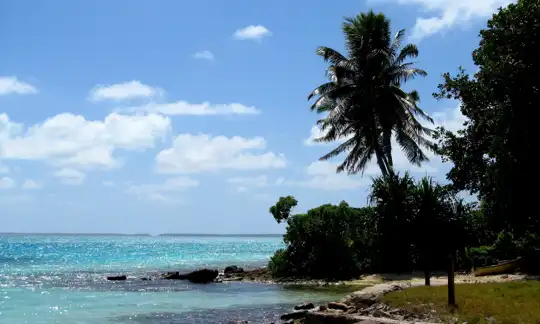
The first thing you notice is the sound: a copra-cutter’s machete thudding in the shade, then the hush of lagoon water barely lapping at coral sand the color of weak tea. Makin Island beach lies in the far north of Kiribati, just northeast of Butaritari atoll, a long way up the Gilbert chain from Tarawa. The water is warm and clear, the sand is clean because almost nobody walks it, and you may have a whole stretch to yourself. The trade-off is that nothing here is built for visitors. Flights are infrequent, the guesthouses are basic, meals are mostly fish, rice, breadfruit and coconut, and the sun is fierce with little shade between palms. Surf is absent and dive infrastructure does not exist, but snorkeling off the reef edges is rewarding. Your first day could be a slow walk along the shore, a swim at high tide, and a plate of grilled fish with a family host.

Discover everything you want to know in the 📖 Kiribati Travel Guide.


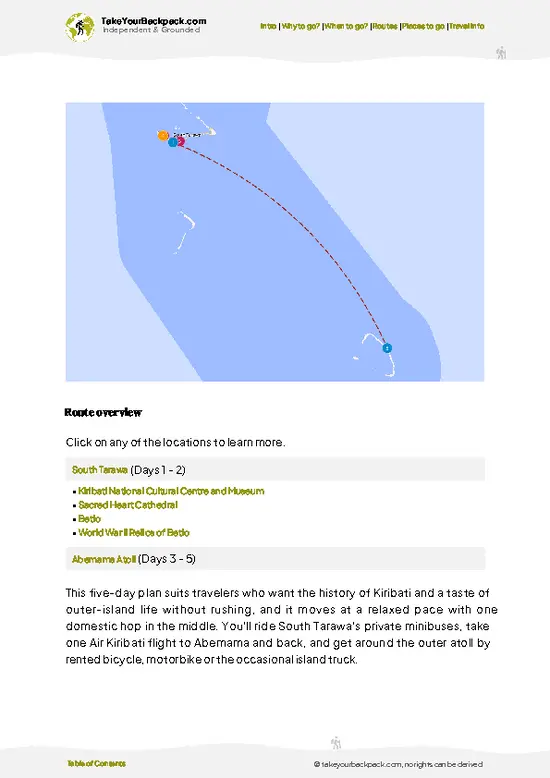
example page 0 from our offline Travel Guide for Kiribati
example page 1 from our offline Travel Guide for Kiribati
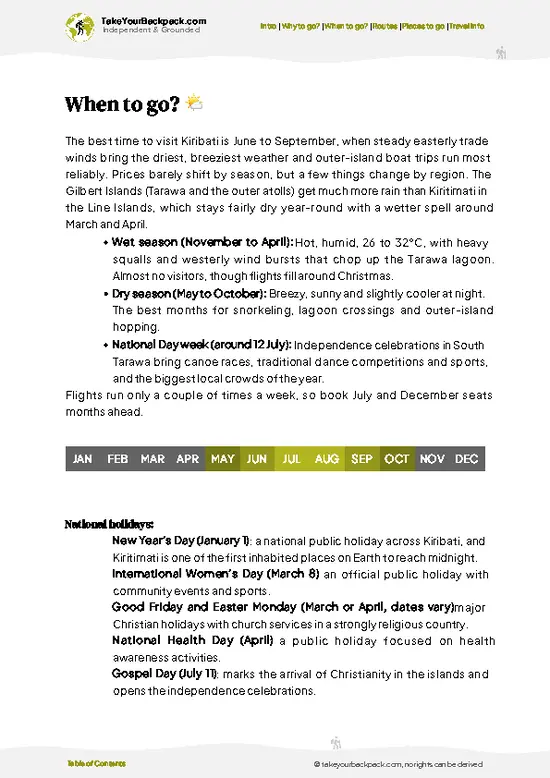
example page 2 from our offline Travel Guide for Kiribati
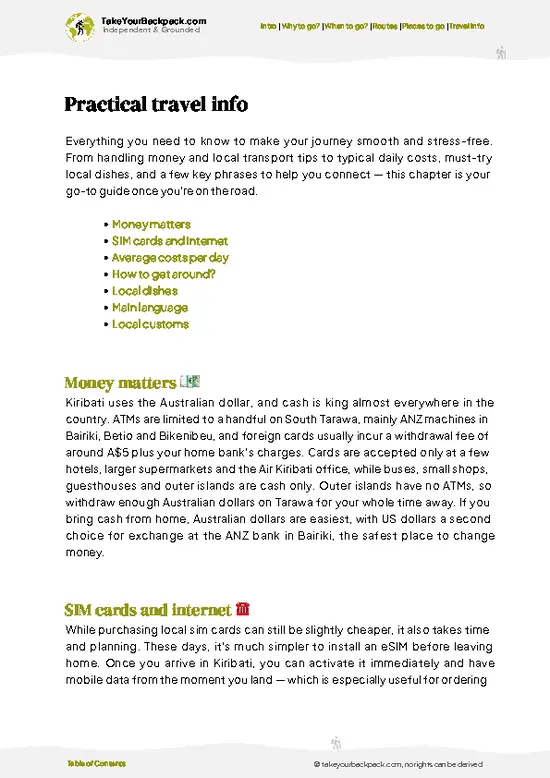
example page 3 from our offline Travel Guide for Kiribati
example page 4 from our offline Travel Guide for Kiribati
example page 5 from our offline Travel Guide for Kiribati
example page 6 from our offline Travel Guide for Kiribati
example page 7 from our offline Travel Guide for Kiribati
Loading the map 🌍
CLICK TO FILTER
towns
villages
landmarks
national parks
beaches
attractions
festivals
regions
SHOW COUNTRY’S BESTSHOW ALL

✨ Why go?
Ranked #99 beach in Kiribati
Why Makin Island should be on your travel list

Backpackers come to Makin for the sense of having arrived somewhere that tourism has barely touched. The attraction is the calm, sheltered shallows, where the beach edge drops quickly into calm turquoise, safe for easy swimming and drifting over coral heads with a mask. Beyond the water, the island is a living village landscape: pandanus roofs, breadfruit trees, fish traps and the daily rhythm of copra and toddy cutting. You eat and sleep close to local families, and conversation comes easily because visitors are rare and curiosity runs both ways.

The second pull is history. In 1942 Carlson’s Raiders landed on neighboring Butaritari in the Makin Raid, and in 1943 a much larger American assault took that atoll from Japanese forces. Rusting guns, concrete remnants and wartime stories are still … read more 👉
Backpackers come to Makin for the sense of having arrived somewhere that tourism has barely touched. The attraction is the calm, sheltered shallows, where the beach edge drops quickly into calm turquoise, safe for easy swimming and drifting over coral heads with a mask. Beyond the water, the island is a living village landscape: pandanus roofs, breadfruit trees, fish traps and the daily rhythm of copra and toddy cutting. You eat and sleep close to local families, and conversation comes easily because visitors are rare and curiosity runs both ways.

The second pull is history. In 1942 Carlson’s Raiders landed on neighboring Butaritari in the Makin Raid, and in 1943 a much larger American assault took that atoll from Japanese forces. Rusting guns, concrete remnants and wartime stories are still part of local life, so the beach walk doubles as a history lesson. If you have already ticked off Tarawa and want the northern Gilberts, this is the stop that justifies the extra effort and the flexible schedule it demands.

💡 HighlightsWhat this place is best known for

  1. Makin Raid and Pacific War relics: Japanese-era wreckage, gun positions and wartime memorials are scattered around Butaritari, and local guides know where the 1942 raid and 1943 battle unfolded. This is what the island is best known for, and seeing it in a village setting is far more affecting than any museum.
  2. Swimming and snorkeling in the shallows: The lagoon side has calm, clear shallows with small coral patches and reef fish. Time your swim for high tide, when the water is deepest and you can float well off the shore.
  3. Village maneaba visit: A maneaba is the traditional open meeting house, with a thatched roof and a wide floor where seating follows clan lines. Ask your host before entering, sit cross-legged, and you may be offered coconut water and a conversation.
  4. Bonefish flats: The shallow
… read more 👉
  1. Makin Raid and Pacific War relics: Japanese-era wreckage, gun positions and wartime memorials are scattered around Butaritari, and local guides know where the 1942 raid and 1943 battle unfolded. This is what the island is best known for, and seeing it in a village setting is far more affecting than any museum.
  2. Swimming and snorkeling in the shallows: The lagoon side has calm, clear shallows with small coral patches and reef fish. Time your swim for high tide, when the water is deepest and you can float well off the shore.
  3. Village maneaba visit: A maneaba is the traditional open meeting house, with a thatched roof and a wide floor where seating follows clan lines. Ask your host before entering, sit cross-legged, and you may be offered coconut water and a conversation.
  4. Bonefish flats: The shallow lagoon flats are good for bonefish, and local fishers will take you out in a small boat. You can wade at low tide and watch them work lines and nets with a precision that is a spectacle in itself.
  5. Toddy and copra at dawn: Early morning is when men climb coconut palms to collect sap for sweet toddy (kamaimai, when boiled down) and when copra is split and spread to dry. Walking the village paths at sunrise lets you watch this daily routine, and the light on the water is soft and gold.
For a first visit, the Makin Raid and Pacific War relics tell you the most about why this remote island matters.
Spotted a mistake or missing something? Contact us.

🌤️ When to go?Best time to visit Makin Island

  • Dry Season (May to October): Northeast trade winds bring the steadier, breezier weather, with highs around 30 to 32°C (86 to 90°F) and nights near 25°C (77°F). Sea crossings from Tarawa tend to be calmer, and lagoon water is clear for swimming.
  • Wet Season (November to April): Makin sits at about 3°N, so it gets heavier squalls than the southern islands, often 25 to 30 days of rain a month at the peak. Humidity is thick, afternoons are sticky, and flights can be delayed or canceled.
  • Daylight: Sunrise and sunset barely move all year, with roughly 12 hours of light, so plan on dark by about 6:15 pm.
  • Crowds and Prices: There are no tourist crowds in any month. Costs stay flat, since lodging is a few guesthouses and village homestays, but seats on the Tarawa flight fill around holidays such as Christmas
… read more 👉
  • Dry Season (May to October): Northeast trade winds bring the steadier, breezier weather, with highs around 30 to 32°C (86 to 90°F) and nights near 25°C (77°F). Sea crossings from Tarawa tend to be calmer, and lagoon water is clear for swimming.
  • Wet Season (November to April): Makin sits at about 3°N, so it gets heavier squalls than the southern islands, often 25 to 30 days of rain a month at the peak. Humidity is thick, afternoons are sticky, and flights can be delayed or canceled.
  • Daylight: Sunrise and sunset barely move all year, with roughly 12 hours of light, so plan on dark by about 6:15 pm.
  • Crowds and Prices: There are no tourist crowds in any month. Costs stay flat, since lodging is a few guesthouses and village homestays, but seats on the Tarawa flight fill around holidays such as Christmas and Independence Day (July 12).
  • Activities: Fishing, lagoon paddling and walks between villages are best in dry months.
Book the flight first, then everything else, because the schedule sets your dates.


source: climatestotravel.comJANJanuary: fair for travelingFEBFebruary: fair for travelingMARMarch: fair for travelingAPRApril: good for travelingMAYMay: excellent for travelingJUNJune: excellent for travelingJULJuly: excellent for travelingAUGAugust: excellent for travelingSEPSeptember: excellent for travelingOCTOctober: excellent for travelingNOVNovember: good for travelingDECDecember: fair for traveling
when-to-go

✈️ The backpacker research shortcutKiribati Travel Guide

An offline-friendly backpacking guide with optimized travel routes, ranked highlights, transport advice, and the best areas to stay.
example page 0 from our offline Travel Guide for Kiribati
example page 1 from our offline Travel Guide for Kiribati
example page 2 from our offline Travel Guide for Kiribati
example page 3 from our offline Travel Guide for Kiribati
example page 4 from our offline Travel Guide for Kiribati
example page 5 from our offline Travel Guide for Kiribati
example page 6 from our offline Travel Guide for Kiribati
example page 7 from our offline Travel Guide for Kiribati
The digital guide (120 pages) contains:
✅ 25 highlights, ranked by travel appeal
✅ Optimized 2, 3 & 5-day travel routes
✅ Cities, national parks, landmarks, beaches
✅ How to get around
✅ Offline-friendly for travel without Wi-Fi
👉 Click to see all 30+ guide features

📅 Plan smarter in minutes, not weeks
✅ Month by month travel advice
✅ Festivals & national holidays
✅ Budget expectations

🗺️ Go to the right places, skip the overrated ones
✅ Honest pros & cons of destinations
✅ Top hikes, parks & viewpoints
✅ Lesser-known places most travelers miss
✅ Clear “worth it vs skip it” guidance

🛏️ Travel smoothly without rookie mistakes
✅ Best areas to stay
✅ Transport systems explained simply
✅ Common scams & safety advice
✅ SIM cards, money & practical tips

🌍 Understand the country, not just visit it
✅ Culture & traditions
✅ 52 Essential phrases & customs
✅ Festivals worth planning around
✅ Traveler-friendly historical context
✅ Insights that make places more meaningful

📱 Built for real travel conditions
✅ Fully downloadable PDF
✅ Works completely offline
✅ Optimized for phone use
✅ Useful in remote areas & buses
✅ Everything in one place
Stop searching, start planning
Get instant access to your full guide. 30‑day money-back guarantee.
+ Add another guide for just

By proceeding you agree to our terms.
Sent to your inbox immediately after payment • 100% Secure Checkout
Best Backpacking Travel Advisor 2025 tourism awardBest Backpacking
Travel Advisor
2025
What others say about Take Your Backpack Guides:
⭐⭐⭐⭐⭐
Fantastic, amazing amount of information!
⭐⭐⭐⭐⭐
My goodness this is amazing, it's what I've been looking for hats off too you!
⭐⭐⭐⭐⭐
I think this is absolutely BRILLIANT
⭐⭐⭐⭐
Very complete and informative. It's still missing places, but I gotta to commend you
⭐⭐⭐⭐⭐
This is truly amazing, thank you, can't wait to explore it with my kids!
⭐⭐⭐⭐⭐
Awesome resource, thank you!
⭐⭐⭐⭐⭐
This is amazing! Can't wait to explore the ones I haven't seen
⭐⭐⭐⭐
I love this! Well done, great idea.
⭐⭐⭐⭐⭐
Thanks for taking the time to make this gem!
⭐⭐⭐⭐⭐
This might be the best website I've ever seen.
⭐⭐⭐⭐⭐
Congratulations, and thank you so much for your work; it's incredibly valuable.
⭐⭐⭐⭐
In all seriousness I think you did a great job pointing out the important spots
⭐⭐⭐⭐⭐
10/10 very good
⭐⭐⭐⭐⭐
As someone who's only just starting to visit regularly this is awesome, thank you.
⭐⭐⭐⭐
Thank you very much! I'm going to visit my dad, it's going to be very useful!
⭐⭐⭐⭐⭐
This is really cool! We'll be travelling for the first time and this definitely come in handy.
⭐⭐⭐⭐⭐
You are now our minister of culture, congratulations 👨‍💼
⭐⭐⭐⭐⭐
Just wanted to tell you that this is a pearl! Going to follow your recommendations.
⭐⭐⭐⭐⭐
This is so cool. I'll definitely be using the resource for my travels soon.
⭐⭐⭐⭐⭐
This is very impressive! Good work.
⭐⭐⭐⭐⭐
This is an amazing and informative site. Very well done!

🛏️ Where to stay?Best areas to stay in Kiribati

Stay in the villages along the lagoon side of Makin, around Butaritari-area settlements, because that is where the few guesthouses and homestays are. Makin Island lies just northeast of Butaritari atoll, and you will sleep in a village, not a resort strip. Expect basic rooms or a thatched-style local house, typically A$30 to 75 (about US$20 to 50) a night, since Kiribati uses the Australian dollar. Meals are often included, mostly fish, rice, coconut and breadfruit.
The main village, Makin Village, has the airstrip, the small shops and the most beds, so it is the practical base for arrivals and … read more 👉
Stay in the villages along the lagoon side of Makin, around Butaritari-area settlements, because that is where the few guesthouses and homestays are. Makin Island lies just northeast of Butaritari atoll, and you will sleep in a village, not a resort strip. Expect basic rooms or a thatched-style local house, typically A$30 to 75 (about US$20 to 50) a night, since Kiribati uses the Australian dollar. Meals are often included, mostly fish, rice, coconut and breadfruit.
The main village, Makin Village, has the airstrip, the small shops and the most beds, so it is the practical base for arrivals and for getting boats or a ride along the causeway road. Solo travelers meet people easily here, because everyone shares the same few paths, and homestay hosts will often introduce you to fishermen or take you out on the lagoon.
Quieter villages farther along the atoll give more privacy and emptier shoreline, but you will depend on a host for transport and food. Dorms and hostel scenes do not exist. Bring cash in small notes, since there are no ATMs, and carry your own drinking water supply or purification tablets.

🛡️ SafetyScams, Hazards, and Annoyances

The lagoon side of Makin is calm, shallow and generally safe, and locals swim there daily. Waves are small inside the lagoon, while the ocean side has stronger surf and currents that can pull hard around channel openings between islets, so keep to the lagoon unless a villager says otherwise. Tides change how deep and how far you can wade, and at low tide the flats are shallow and warm. Sharks live in the surrounding waters, but lagoon swimmers seldom report problems. Wear reef shoes, because coral and sharp shells cut feet easily and cuts get infected fast in the heat.
The equatorial sun is the main hazard. Burn times are short from about 10 am to 3 pm, so cover up and swim early or late. Squalls arrive quickly in the wet months. Theft is rare and the community is close-knit, but ask before … read more 👉
The lagoon side of Makin is calm, shallow and generally safe, and locals swim there daily. Waves are small inside the lagoon, while the ocean side has stronger surf and currents that can pull hard around channel openings between islets, so keep to the lagoon unless a villager says otherwise. Tides change how deep and how far you can wade, and at low tide the flats are shallow and warm. Sharks live in the surrounding waters, but lagoon swimmers seldom report problems. Wear reef shoes, because coral and sharp shells cut feet easily and cuts get infected fast in the heat.
The equatorial sun is the main hazard. Burn times are short from about 10 am to 3 pm, so cover up and swim early or late. Squalls arrive quickly in the wet months. Theft is rare and the community is close-knit, but ask before photographing people and dress modestly in villages, with shoulders and knees covered away from the water.

FAQCommon questions from travelers

Reach it by plane from Tarawa (Bonriki airport) to Makin’s airstrip, just northeast of Butaritari atoll, with Air Kiribati flying on a limited schedule, often a few times a week. The flight takes about 50 minutes and fares run about A$250 to 450 return. Ferries and cargo boats also serve the northern islands, but they take several days and run irregularly. Confirm seats in Tarawa a few days ahead, because schedules shift.
Swimming is good in the calm, clear lagoon, especially at high tide when depth is easier, and snorkeling over coral patches is rewarding on dry-season days with good visibility. Surfing is not developed here, with no rental shops or established breaks, and the ocean side has strong currents. Bring your own mask, snorkel and reef shoes, since nothing is rented. Fishing trips with a local boatman typically cost around A$20 to 60.
Yes, the beaches are free to enter and there are no ticket booths or gates. Land is owned by families and villages, so ask permission before camping or crossing private plots, and a small gift or modest payment is courteous. Expect to pay only for lodging (about A$30 to 75 a night) and for any boat hire. Photography and village visits are welcome if you ask first.
⚠️ Things can change over time, so always validate details locally before you go.

Other I-Kiribati beaches near Makin Island

Explore more nearby:

  • Bamboo Beach—Abaiang lagoon, tidal flats, coral-head snorkeling, outrigger canoes| 174 km away
  • Nukuroa—tidal pools, driftwood, wind-shaped coastline

💡 Not sure where to go next?
Create a personalized itinerary for Kiribati including Makin Island and the places that fit your trip.

Generate my itinerary

👉 Discover all beaches

Or checkout all Kiribati has to offer (think cities, towns, villages, national parks, hikes, beaches, festivals)
Country photo of Kiribati

We 💚 feedbackSumming up the experience

Go in the early morning and again near sunset, when the heat eases, the lagoon turns glassy and villagers are out fishing or cutting toddy. Midday is for shade and a long lunch. I would plan around the tide, because high water is best for swimming and low water for walking the flats. Bring cash, sunscreen and patience with flight schedules.

✍️ Help improve this page!
The information on this page is based on in-depth research, insights shared by experienced travelers, and feedback from the local travel community in Kiribati. While every effort is made to keep the information accurate and current, conditions can change — so if you spot anything incorrect or outdated, please get in touch.


🙋‍♂️ Give feedback

👋 Meet the founderWho’s Behind Take Your Backpack?

Johan, backpacker and founder of TakeYourBackpackHi, I’m Johan (Netherlands 🇳🇱), the creator of TakeYourBackpack. Over the past 3 decades, I’ve backpacked through 90+ countries across six continents, gaining extensive experience with independent travel, long-term trips, and overland routes.

This site is built on a combination of firsthand travel experience and carefully curated insights from other backpackers. Many guides are based on places I’ve personally visited, while others bring together tips, observations, and practical advice shared by trusted travelers I’ve met along the way.

The goal is to provide realistic, experience-driven guidance — not generic itineraries — so you can explore destinations with better context, clearer expectations, and more confidence.