Short version: yes, but it’s different from classic backpacker circuits. Kuwait is safe, people are generally helpful, and English is widely understood in the city, so moving around solo is straightforward. The challenge is that Kuwait isn’t built around budget travelers: there are few hostels, limited public transport, and the social scene is more mall-and-car than street-and-café.
For a budget backpacker, the key is expectations. You won’t find cheap guesthouses on every corner or a big hostel community, but you will find: reliable infrastructure, easy navigation with offline maps, and a low risk of petty crime if you use normal city smarts. Dress modestly, especially outside the city center and in more traditional areas, and avoid public displays of affection; Kuwait is socially conservative and you want to stay low-key.
Independent travel works best if you base yourself in Kuwait City and do day trips. You can walk a lot within certain districts (Salmiya, parts of the city center) and use ride-hailing for longer hops. Food can be kept reasonable by eating at Indian, Filipino, Bangladeshi, and Pakistani worker-oriented restaurants rather than fancy Gulf chains. Tap water is generally not drunk straight; budget a bit for bottled water.
If you’re used to hitchhiking or wild camping, Kuwait is not ideal: camping is possible in the desert in season, but you need to know where you’re going, bring all your own gear and water, and respect local rules and private land. Wild camping near the border areas is a hard no. Overall, Kuwait is easy to backpack logistically, but it’s more of a short, curiosity stop than a long, slow-travel playground.
For most backpackers, 2–3 full days is enough to get a solid feel for Kuwait without blowing your budget.
If you move fast and just want a taste: 1–1.5 days can cover the core: Kuwait City waterfront, a museum or two, the main souq, and a quick look at the towers and skyline. This works well if you’re transiting through on a cheap flight and want to stretch your legs.
For a balanced visit: 2–3 days lets you:
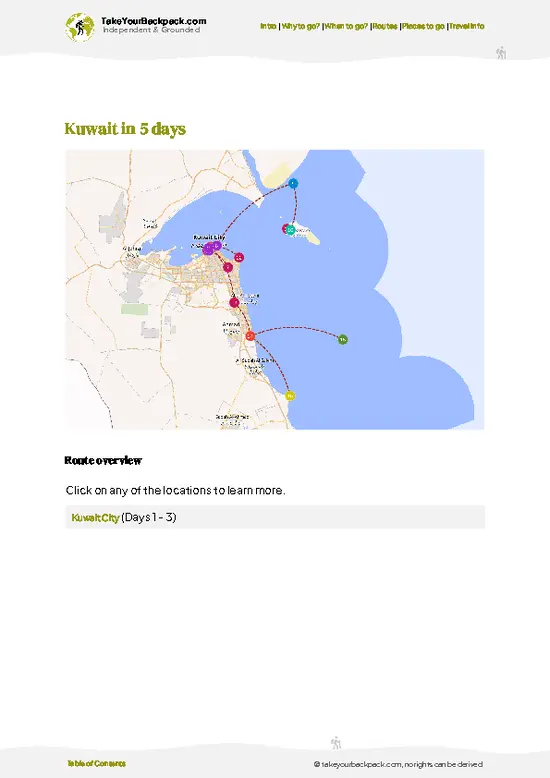
- Spend a full day in Kuwait City: Souq Al-Mubarakiya, the corniche, Kuwait Towers, and a museum.
- Add a half or full day for Failaka Island (if ferries and access are running) or a desert/shoreline outing.
- Have evenings free to wander malls, cafés, and the seaside promenades without rushing.
If you’re deeply into Gulf history, war history, or urban anthropology, 4–5 days can work, but you’ll be padding your time with slow café sessions and repeat walks along the corniche. For a tight regional itinerary, Kuwait is best treated as a short, focused stop rather than a long base.
You can technically get around without a car, but you’ll be leaning heavily on ride-hailing and taxis if you want to keep your sanity.
Inside Kuwait City and close suburbs, you can combine:
- Walking: Works well along the waterfront, in Souq Al-Mubarakiya, and in compact neighborhoods like parts of Salmiya. Sidewalks can be patchy and crossings chaotic, so stay alert.
- Buses: Cheap and reasonably extensive, used heavily by workers. They’re fine for budget travelers who don’t mind slower, less predictable journeys. Routes can be confusing without local knowledge, and schedules aren’t always clear, so treat buses as a money-saver, not a precision tool.
- Ride-hailing/taxis: The practical backbone for car-free travelers. They’re more expensive than buses but still manageable if you share rides or cluster your sightseeing by area. Use them for longer hops, night travel, or when the heat is brutal.
For anything outside the main urban strip—desert areas, remote beaches, or scattered attractions—a car becomes much more useful. Distances are big, shade is rare, and you don’t want to be stranded in 40+°C heat waiting for a bus that may or may not show. If you stay car-free, focus on city-based sights and only do organized trips or ride-hail-based outings beyond that.
For a short, budget-conscious trip, focus on places that show you Kuwait’s character without requiring expensive tours.
1. Kuwait City waterfront and Kuwait Towers
Walk the corniche in the late afternoon or evening when the heat eases. You get sea views, families picnicking, joggers, and a sense of local life. The Kuwait Towers are the country’s visual icon; paying to go up is optional, but at least see them up close.
2. Souq Al-Mubarakiya
This is the heart of old commercial Kuwait. Wander the alleys, spice stalls, and small eateries. It’s one of the few places where you can feel an older rhythm under the modern city. Eat at the simple local restaurants here for good-value meals and people-watching.
3. A solid museum stop
If you care about context, pick at least one:
- The National Museum (when properly open) for history and archaeology.
- The Tareq Rajab Museum (if accessible) for Islamic art and calligraphy.
- A war or remembrance museum for insight into the Iraqi invasion and its impact.
These give Kuwait depth beyond malls and highways.
4. Salmiya and the modern city vibe
Salmiya’s main streets and side alleys show the expat-heavy, everyday side of Kuwait: South Asian eateries, small groceries, and a more lived-in feel than the polished business districts. It’s good for cheap food and a sense of who actually keeps the country running.
5. Failaka Island (if logistics line up)
Failaka is worth it if ferries and access are running smoothly and you’re interested in history. You get a mix of archaeological remains, traces of the Iraqi invasion, and a different pace from the mainland. It’s not ultra-budget once you factor in transport, but it’s one of the few outings that feels distinctly Kuwaiti rather than generically Gulf-urban.
6. Evening mall and café culture
Even if you’re not a mall person, spending an evening in a big mall or busy café area shows you how locals and expats actually socialize in a climate where streets are often too hot. It’s free to wander, and you can nurse a coffee while people-watching.
If you’re short on time or cash, skip anything that eats hours and money without adding much local flavor.
1. Overdoing the malls
One evening in a major mall is enough to understand the scene. After that, every extra mall is just more air-conditioning and global chains. Don’t burn a half-day hopping between them when you could be at the souq or waterfront.
2. Long, generic desert drives without a clear goal
A random desert drive just to say you saw sand is rarely worth the cost of a private tour or car rental. Unless you’re camping with proper gear and local knowledge, or visiting a specific site or event, the desert can feel like a long, expensive commute to emptiness.
3. High-end dining purely for skyline views
If you’re on a backpacker budget, skip pricey restaurants whose main selling point is a view you can mostly enjoy from public areas or cheaper cafés. Kuwait is not short on viewpoints; you don’t need a luxury bill to see the city lights.
4. Multiple museums of the same type
Pick one or two strong museums that match your interests and stop there. Visiting several similar institutions quickly becomes repetitive, especially if you don’t read Arabic and rely on limited English signage.
5. Far-flung attractions that require long taxi rides for a quick photo
Anything that needs a 40–60 minute taxi each way for a 10-minute look is usually not worth it on a tight schedule. Focus on clusters: Kuwait City core, the waterfront strip, and one well-chosen side trip. That way you spend your time walking and exploring instead of sitting in traffic watching your budget leak away.