×

Libya🇱🇾 | national parksHarujBlack basalt plains, cinder cones, crater rims, lava bombs | things to do and best time to go

Explore Al-Ghiran Nature ReserveExplore Al-Kouf National Park

Backpacking in Haruj
👌 Worth visitingnational park ranked #4
By Johan Kruseman 🇳🇱 | Updated October 22, 2026

Black basalt crunches under your boots, and the only shade for miles is the lee of a cinder cone. That is Haruj, a volcanic field in central Libya, southeast of Sabha and north of the Fezzan desert plains. It covers thousands of square kilometers with more than a hundred cones, lava flows and crater lakes of dark rock. There are no marked trails and no visitor center, because this is not a managed park. Skip it if you want signposted loops. Go if you want empty horizons and geology you can touch. Distances are huge and tracks are faint, so experienced travelers hire a local 4x4 driver-guide rather than attempting it alone. Permits and security conditions change, so they arrange everything through a Libyan operator who knows the current situation. Wildlife is sparse, mostly lizards and desert foxes. The ground is littered with volcanic bombs and ropy lava.

Discover everything you want to know in the 📖 Libya Travel Guide.
Safety warning

The current risk level for Libya is high. Check the advice before going.


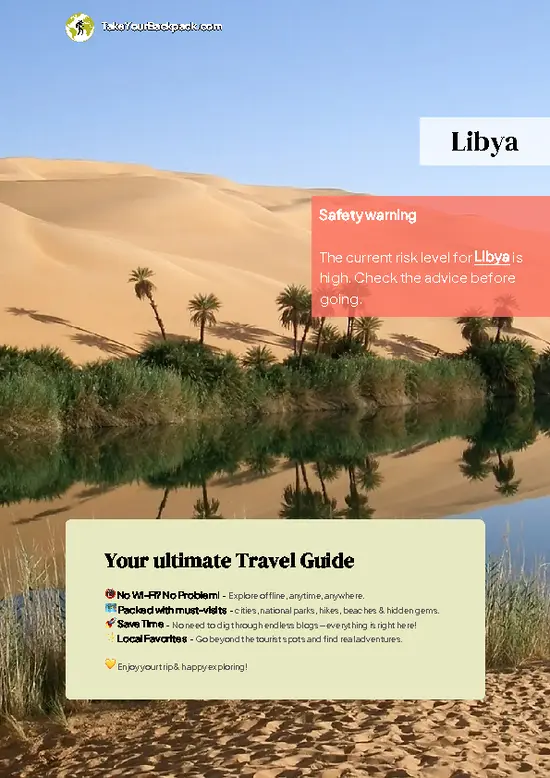
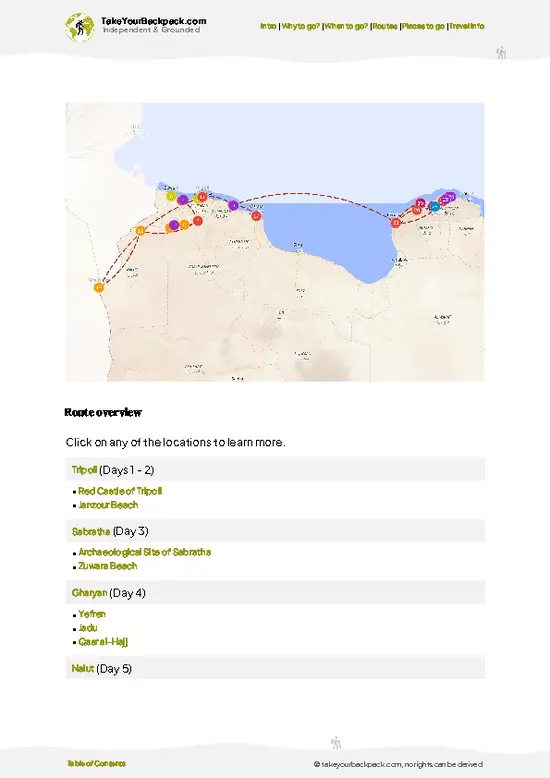
example page 0 from our offline Travel Guide for Libya
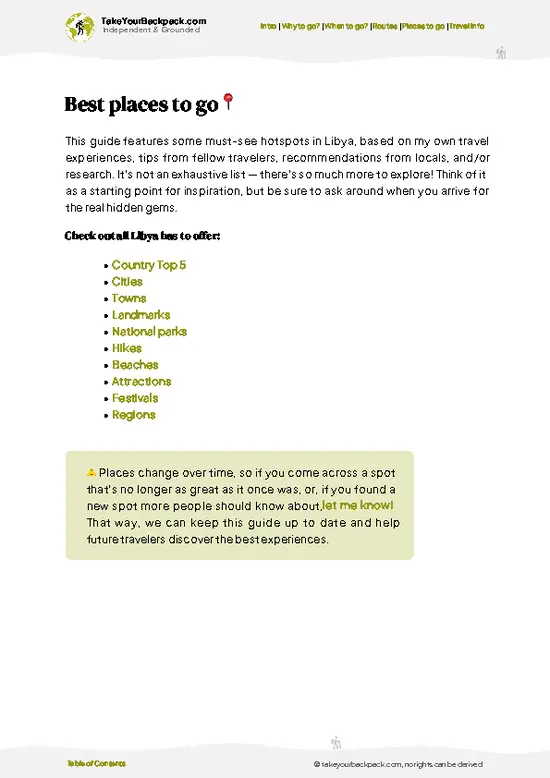
example page 1 from our offline Travel Guide for Libya
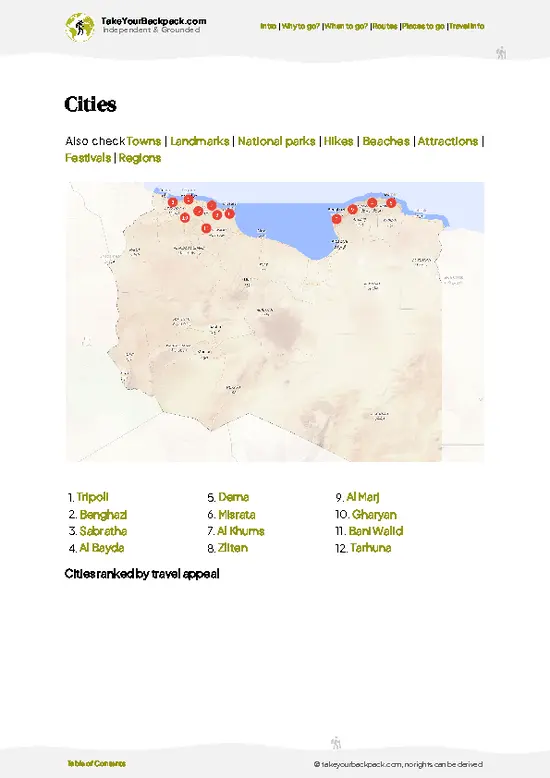
example page 2 from our offline Travel Guide for Libya
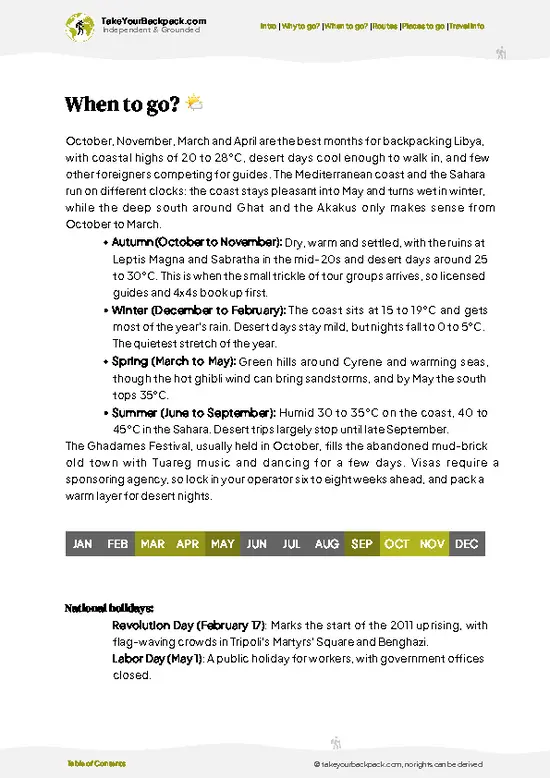
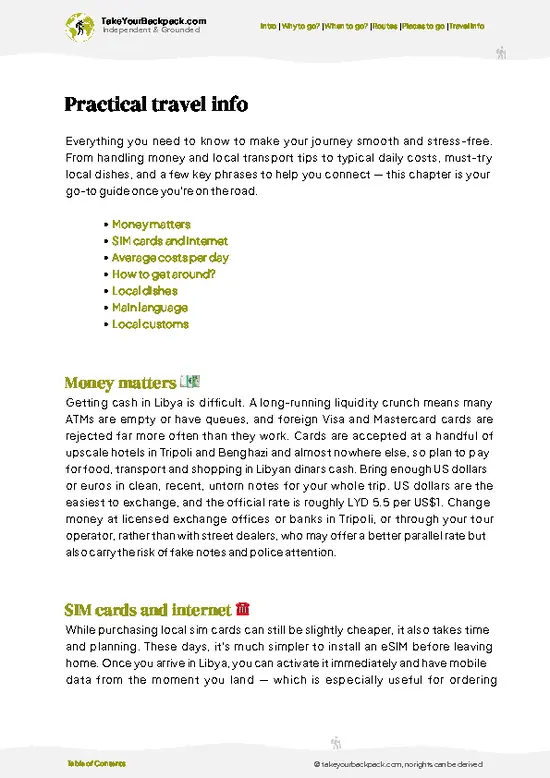
example page 3 from our offline Travel Guide for Libya
example page 4 from our offline Travel Guide for Libya
example page 5 from our offline Travel Guide for Libya
example page 6 from our offline Travel Guide for Libya
example page 7 from our offline Travel Guide for Libya
Loading the map 🌍
CLICK TO FILTER
cities
towns
landmarks
national parks
hikes
beaches
attractions
festivals
regions
SHOW COUNTRY’S BESTSHOW ALL

✨ Why go?
Ranked #4 national park in Libya
What makes this national park worth exploring

Haruj suits people who prefer raw terrain to infrastructure. The field's Haruj al-Aswad, the Black Haruj, is one of the largest volcanic areas in the Sahara, so a few days here feel like walking on another planet. Cones rise from flows of ropy pahoehoe and jagged aa lava, and you can climb many of them in under an hour. Independent exploration means camping in the open, with no fences and no crowds. Nights are cold and the stars are sharp. The area also links to Fezzan's Sabha region, so you can pair it with Saharan oases and rock art. Tours are not optional in practice. Navigation is difficult, fuel and water must be carried, and a driver who knows the tracks is the safest option. If you value solitude and strange geology above comfort, this is a rare place to find both.

💡 HighlightsKey sights and experiences for travelers

  1. Black lava fields: Endless dark basalt plains, ropy and jagged, stretch to the horizon and give the field its name.
  2. Cinder cones: Over a hundred cones can be climbed, with rim views across the flows and crater floors.
  3. Crater rims: Walk the edges of collapsed craters, where red and gray scoria show how the eruptions layered.
  4. Volcanic bombs and lava tubes: Scattered bombs and small tube openings let you see how molten rock cooled.
  5. Desert night sky: With no towns nearby, the Milky Way is clear and camps are silent.
  6. Fezzan edge oases: The surrounding Saharan fringe has palm groves and sand seas that contrast with the black rock.
  7. Rock art near the field: Engravings in the wider Fezzan show how people lived here when the Sahara was wetter.
Haruj rewards starting with a cinder cone climb at first light, … read more 👉
  1. Black lava fields: Endless dark basalt plains, ropy and jagged, stretch to the horizon and give the field its name.
  2. Cinder cones: Over a hundred cones can be climbed, with rim views across the flows and crater floors.
  3. Crater rims: Walk the edges of collapsed craters, where red and gray scoria show how the eruptions layered.
  4. Volcanic bombs and lava tubes: Scattered bombs and small tube openings let you see how molten rock cooled.
  5. Desert night sky: With no towns nearby, the Milky Way is clear and camps are silent.
  6. Fezzan edge oases: The surrounding Saharan fringe has palm groves and sand seas that contrast with the black rock.
  7. Rock art near the field: Engravings in the wider Fezzan show how people lived here when the Sahara was wetter.
Haruj rewards starting with a cinder cone climb at first light, because the cool air makes the loose scoria easier and the long shadows show the flows clearly.
Spotted a mistake or missing something? Contact us.

🌤️ When to go?Best time to explore Haruj

  • Winter (November to February): Daytime highs sit around 20 to 26°C (68 to 79°F), while nights in the volcanic field can drop to 3 to 8°C (37 to 46°F). Days are short, about 10 to 11 hours of light, so plan your walking around that. This is the busiest window for the few expedition operators, and 4x4 and guide rates are at their highest.
  • Spring and Autumn (March to April, October): Highs reach 28 to 35°C (82 to 95°F) and nights are cool at 10 to 18°C (50 to 64°F). Good for camping and crater walks if you start early. Sandstorms (ghibli) can blow in during spring and cut visibility.
  • Summer (May to September): Highs of 38 to 45°C (100 to 113°F) on black basalt make midday travel dangerous. Daylight runs 13 to 14 hours, but almost nobody goes. Prices drop because demand is low, not because conditions
… read more 👉
  • Winter (November to February): Daytime highs sit around 20 to 26°C (68 to 79°F), while nights in the volcanic field can drop to 3 to 8°C (37 to 46°F). Days are short, about 10 to 11 hours of light, so plan your walking around that. This is the busiest window for the few expedition operators, and 4x4 and guide rates are at their highest.
  • Spring and Autumn (March to April, October): Highs reach 28 to 35°C (82 to 95°F) and nights are cool at 10 to 18°C (50 to 64°F). Good for camping and crater walks if you start early. Sandstorms (ghibli) can blow in during spring and cut visibility.
  • Summer (May to September): Highs of 38 to 45°C (100 to 113°F) on black basalt make midday travel dangerous. Daylight runs 13 to 14 hours, but almost nobody goes. Prices drop because demand is low, not because conditions are comfortable.
Book your guide and vehicle for December or January at least two months ahead, and leave a spare day for weather or security-related changes.


source: climatestotravel.comJANJanuary: highly recommended for travelingFEBFebruary: excellent for travelingMARMarch: excellent for travelingAPRApril: highly recommended for travelingMAYMay: fair for travelingJUNJune: below average for travelingJULJuly: below average for travelingAUGAugust: below average for travelingSEPSeptember: fair for travelingOCTOctober: highly recommended for travelingNOVNovember: highly recommended for travelingDECDecember: highly recommended for traveling
when-to-go

✈️ The backpacker research shortcutLibya Travel Guide

An offline-friendly backpacking guide with optimized travel routes, ranked highlights, transport advice, and the best areas to stay.
example page 0 from our offline Travel Guide for Libya
example page 1 from our offline Travel Guide for Libya
example page 2 from our offline Travel Guide for Libya
example page 3 from our offline Travel Guide for Libya
example page 4 from our offline Travel Guide for Libya
example page 5 from our offline Travel Guide for Libya
example page 6 from our offline Travel Guide for Libya
example page 7 from our offline Travel Guide for Libya
The digital guide (205 pages) contains:
✅ 45 highlights, ranked by travel appeal
✅ Optimized 5, 10 & 15-day travel routes
✅ Cities, national parks, landmarks, beaches
✅ How to get around
✅ Offline-friendly for travel without Wi-Fi
👉 Click to see all 30+ guide features

📅 Plan smarter in minutes, not weeks
✅ Month by month travel advice
✅ Festivals & national holidays
✅ Budget expectations

🗺️ Go to the right places, skip the overrated ones
✅ Honest pros & cons of destinations
✅ Top hikes, parks & viewpoints
✅ Lesser-known places most travelers miss
✅ Clear “worth it vs skip it” guidance

🛏️ Travel smoothly without rookie mistakes
✅ Best areas to stay
✅ Transport systems explained simply
✅ Common scams & safety advice
✅ SIM cards, money & practical tips

🌍 Understand the country, not just visit it
✅ Culture & traditions
✅ 52 Essential phrases & customs
✅ Festivals worth planning around
✅ Traveler-friendly historical context
✅ Insights that make places more meaningful

📱 Built for real travel conditions
✅ Fully downloadable PDF
✅ Works completely offline
✅ Optimized for phone use
✅ Useful in remote areas & buses
✅ Everything in one place
Stop searching, start planning
Get instant access to your full guide. 30‑day money-back guarantee.
+ Add another guide for just

By proceeding you agree to our terms.
Sent to your inbox immediately after payment • 100% Secure Checkout
Best Backpacking Travel Advisor 2025 tourism awardBest Backpacking
Travel Advisor
2025
What others say about Take Your Backpack Guides:
⭐⭐⭐⭐⭐
Fantastic, amazing amount of information!
⭐⭐⭐⭐⭐
My goodness this is amazing, it's what I've been looking for hats off too you!
⭐⭐⭐⭐⭐
I think this is absolutely BRILLIANT
⭐⭐⭐⭐
Very complete and informative. It's still missing places, but I gotta to commend you
⭐⭐⭐⭐⭐
This is truly amazing, thank you, can't wait to explore it with my kids!
⭐⭐⭐⭐⭐
Awesome resource, thank you!
⭐⭐⭐⭐⭐
This is amazing! Can't wait to explore the ones I haven't seen
⭐⭐⭐⭐
I love this! Well done, great idea.
⭐⭐⭐⭐⭐
Thanks for taking the time to make this gem!
⭐⭐⭐⭐⭐
This might be the best website I've ever seen.
⭐⭐⭐⭐⭐
Congratulations, and thank you so much for your work; it's incredibly valuable.
⭐⭐⭐⭐
In all seriousness I think you did a great job pointing out the important spots
⭐⭐⭐⭐⭐
10/10 very good
⭐⭐⭐⭐⭐
As someone who's only just starting to visit regularly this is awesome, thank you.
⭐⭐⭐⭐
Thank you very much! I'm going to visit my dad, it's going to be very useful!
⭐⭐⭐⭐⭐
This is really cool! We'll be travelling for the first time and this definitely come in handy.
⭐⭐⭐⭐⭐
You are now our minister of culture, congratulations 👨‍💼
⭐⭐⭐⭐⭐
Just wanted to tell you that this is a pearl! Going to follow your recommendations.
⭐⭐⭐⭐⭐
This is so cool. I'll definitely be using the resource for my travels soon.
⭐⭐⭐⭐⭐
This is very impressive! Good work.
⭐⭐⭐⭐⭐
This is an amazing and informative site. Very well done!

🛏️ Where to stay?Where staying makes the most sense

Nobody stays inside Haruj in any formal sense, because there are no hotels, lodges or marked campgrounds on the volcanic plateau. Backpackers camp wild in the desert beside the cones and lava fields, always as part of a guided 4x4 trip, and you bring tents, sleeping bags rated to near freezing, food and water for the full stay.

The real bases are the towns on the edges. Hun, in the north near Jufra, is the most practical starting point, with a handful of basic guesthouses and simple hotels, plus shops for supplies and fuel. Sokna and Waddan are close neighbors and have small guesthouses and restaurants, … read more 👉
Nobody stays inside Haruj in any formal sense, because there are no hotels, lodges or marked campgrounds on the volcanic plateau. Backpackers camp wild in the desert beside the cones and lava fields, always as part of a guided 4x4 trip, and you bring tents, sleeping bags rated to near freezing, food and water for the full stay.

The real bases are the towns on the edges. Hun, in the north near Jufra, is the most practical starting point, with a handful of basic guesthouses and simple hotels, plus shops for supplies and fuel. Sokna and Waddan are close neighbors and have small guesthouses and restaurants, with rooms usually US$15 to 35 a night. Sabha, in the southwest, is the larger hub with more hotels, ranging from US$25 to 70, and it has the better selection of supermarkets and vehicle repair shops.

Expect rooms to be plain, with limited hot water and occasional power cuts. Most visitors arrange accommodation through the same local operator who supplies the vehicle and guide, which is the most reliable way to get a bed and a safe campsite sorted before heading out.

👛 Costs (as of 22 October 2026)How expensive it really is

A realistic budget for Haruj is around US$150 to 260 per person per day, since independent travel is not practical and a guided 4x4 expedition makes up most of the cost. There is no entrance fee, but your operator will handle any permits and local checkpoints.
CategoryBudget RangeLocal Reality
Entrance fees and permitsUS$0 to 20No ticket booth; permits and paperwork are arranged through your operator
Accommodation (high season)US$10 to 35Wild camping on the plateau is free; guesthouses in Hun, Sokna or Waddan are basic
Guide and 4x4 (shared)US$90 to 160Driver, vehicle and fuel, split among 3 to 4 people; price rises in winter
Local transportUS$5 to 15Shared taxis between Sabha, Hun and nearby towns; settled in cash
Food and suppliesUS$10 to 25Bread, canned fish, pasta and dates from town shops;
… read more 👉
A realistic budget for Haruj is around US$150 to 260 per person per day, since independent travel is not practical and a guided 4x4 expedition makes up most of the cost. There is no entrance fee, but your operator will handle any permits and local checkpoints.
CategoryBudget RangeLocal Reality
Entrance fees and permitsUS$0 to 20No ticket booth; permits and paperwork are arranged through your operator
Accommodation (high season)US$10 to 35Wild camping on the plateau is free; guesthouses in Hun, Sokna or Waddan are basic
Guide and 4x4 (shared)US$90 to 160Driver, vehicle and fuel, split among 3 to 4 people; price rises in winter
Local transportUS$5 to 15Shared taxis between Sabha, Hun and nearby towns; settled in cash
Food and suppliesUS$10 to 25Bread, canned fish, pasta and dates from town shops; restaurant meals in Hun or Sabha cost US$3 to 8
Water and fuel extrasUS$5 to 10Stock up in town before leaving; none is sold on the plateau
Total Daily BudgetUS$150 to 260Cash is needed, as cards are rarely accepted
⚠️ Prices can change and everyone travels differently, so take this as a rough guide. Hope it helps you plan your adventure!

🥾 TrailsPlan your hike in Haruj: routes, terrain, and sights

Haruj has no designated, named trails, so the walks people do are cone climbs and ridge scrambles that begin at the vehicle camp. Plan everything with a local guide.
  • Cone ascents: Most start at the base of a cinder cone and take 30 to 60 minutes up loose scoria. Easy to moderate, but footing slides.
  • Lava flow crossings: Walks over jagged aa lava take one to two hours. Sturdy boots are required because the rock is sharp.
  • Crater rim loops: Circuits of an old crater take about one to two hours and give wide views over the black plain.
  • Wildlife: Expect lizards, beetles and the occasional desert fox. Birds
… read more 👉
Haruj has no designated, named trails, so the walks people do are cone climbs and ridge scrambles that begin at the vehicle camp. Plan everything with a local guide.
  • Cone ascents: Most start at the base of a cinder cone and take 30 to 60 minutes up loose scoria. Easy to moderate, but footing slides.
  • Lava flow crossings: Walks over jagged aa lava take one to two hours. Sturdy boots are required because the rock is sharp.
  • Crater rim loops: Circuits of an old crater take about one to two hours and give wide views over the black plain.
  • Wildlife: Expect lizards, beetles and the occasional desert fox. Birds are rare.
Public transport does not reach Haruj. Travelers usually reach Sabha first and continue in a 4x4 with a driver over rough tracks. The field is almost empty of people, so crowds are never a concern. There is no formal entrance fee, but permits and escorts may be needed depending on conditions, so arrange these through a Libyan operator. Carry all food, water and fuel. Midday heat is intense, and winter nights can drop near freezing.
⚠️ Hiking info can sometimes be outdated or inaccurate. Before you hit the trail, check the latest conditions with locals. If you do spot anything that's off, I'd love to hear from you, so I can update it for fellow travelers.

🛡️ SafetyScams, Hazards, and Annoyances

Haruj is a remote volcanic desert where the main hazards are heat, navigation and the security situation, so travel only with an experienced local guide and a well-prepared 4x4. Check current government travel advice before committing, since conditions in Libya change and many countries advise against travel here.

Summer heat is dangerous, and winter nights can turn properly cold. Walk early, carry far more water than seems sensible, and wear sturdy boots, because the sharp, loose basalt chews through thin soles and slows you down. There are no marked trails, so tracks vanish and a GPS and satellite communicator are worth bringing along with spare fuel and tires. Mobile signal is absent across most of the plateau.

Wildlife is sparse. Scorpions and snakes are the main concern, so shake out … read more 👉
Haruj is a remote volcanic desert where the main hazards are heat, navigation and the security situation, so travel only with an experienced local guide and a well-prepared 4x4. Check current government travel advice before committing, since conditions in Libya change and many countries advise against travel here.

Summer heat is dangerous, and winter nights can turn properly cold. Walk early, carry far more water than seems sensible, and wear sturdy boots, because the sharp, loose basalt chews through thin soles and slows you down. There are no marked trails, so tracks vanish and a GPS and satellite communicator are worth bringing along with spare fuel and tires. Mobile signal is absent across most of the plateau.

Wildlife is sparse. Scorpions and snakes are the main concern, so shake out shoes and boots and check before sitting. Sandstorms can hit without much warning, so stay with the vehicle if one arrives.

FAQTraveler FAQ

Allow 3 to 5 days for Haruj if you are going with a guide and 4x4. That gives you a day to reach the plateau from Hun or Sabha, one or two days among the cones and lava fields, and a day for the return. Add a buffer day in case of sandstorms or checkpoint delays.
Visiting Haruj without a car is not realistic. The plateau has no public transport, no marked trails and no water, and the distances between the edge towns of Hun, Sokna and Waddan and the volcanic fields run to tens of kilometers of soft sand and loose basalt. Shared taxis get you to those towns, but you need a guided 4x4 for the final stretch.
Haruj has no entrance fee and no ticket office. Travelers usually need permits and checkpoint paperwork for travel in the region, which a local operator arranges for roughly US$0 to 20. Your guide and vehicle are the real expense, at around US$90 to 160 per day when shared.
⚠️ Things can change over time, so always validate details locally before you go.

Other Libyan national parks near Haruj

Explore more nearby:


💡 Not sure where to go next?
Create a personalized itinerary for Libya including Haruj and the places that fit your trip.

Generate my itinerary

👉 Discover all national parks

Or checkout all Libya has to offer (think cities, towns, villages, national parks, hikes, beaches, festivals)
Country photo of Libya

We 💚 feedbackIs it worth it?

Haruj is for geology nerds, photographers and veterans of remote desert travel who want silence more than comfort. Go with a trusted local guide and pack a warm sleeping bag, because the nights surprise people. If you need cafes, signs or a quick day trip, skip it.

✍️ Help improve this page!
The information on this page is based on in-depth research, insights shared by experienced travelers, and feedback from the local travel community in Libya. While every effort is made to keep the information accurate and current, conditions can change — so if you spot anything incorrect or outdated, please get in touch.


🙋‍♂️ Give feedback

👋 Meet the founderWho’s Behind Take Your Backpack?

Johan, backpacker and founder of TakeYourBackpackHi, I’m Johan (Netherlands 🇳🇱), the creator of TakeYourBackpack. Over the past 3 decades, I’ve backpacked through 90+ countries across six continents, gaining extensive experience with independent travel, long-term trips, and overland routes.

This site is built on a combination of firsthand travel experience and carefully curated insights from other backpackers. Many guides are based on places I’ve personally visited, while others bring together tips, observations, and practical advice shared by trusted travelers I’ve met along the way.

The goal is to provide realistic, experience-driven guidance — not generic itineraries — so you can explore destinations with better context, clearer expectations, and more confidence.