×

Libya🇱🇾 | landmarksLeptis MagnaSeveran Forum, Hadrianic Baths, seaside theater, Roman harbor | things to do and best time to go

Explore CyreneExplore Archaeological Site of Sabratha

Backpacking in Leptis Magna
UNESCO World Heritage site
🏆 Top pickunique site ranked #1
By Johan Kruseman 🇳🇱 | Updated October 22, 2026

The Severan Basilica at Leptis Magna is built from marble that was shipped in from Greece and Egypt, and the site sits right on a Mediterranean beach, so you can walk from a Roman harbor to open sand in minutes. Leptis Magna lies in the north of Libya, east of Tripoli on the coast near Khoms. It is the best-preserved Roman city in the Mediterranean basin, and it is far emptier than Pompeii or Ephesus, often with only a few other visitors around. The scale is real: colonnaded streets, a theater facing the sea, a huge arena. Access is the hard part, since travel in Libya needs advance planning, a local guide and current security checking. Skip the small museum if you are short on time and spend those hours among the ruins. The Severan Forum, the Hadrianic Baths and the theater deserve the longest stops. Photos are superb with the sea behind the columns. A first day works best if you start at the Arch of Septimius Severus, work down the main street to the forum and basilica, then finish at the theater and harbor.

Discover everything you want to know in the 📖 Libya Travel Guide.
Safety warning

The current risk level for Libya is high. Check the advice before going.


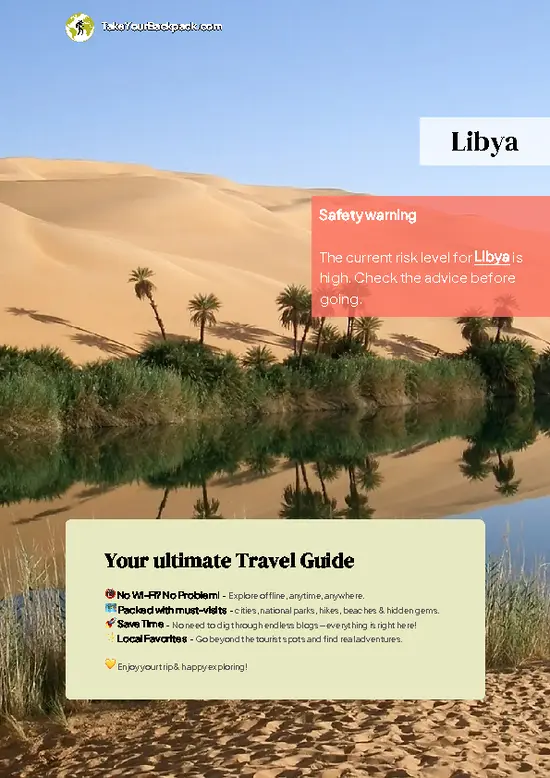
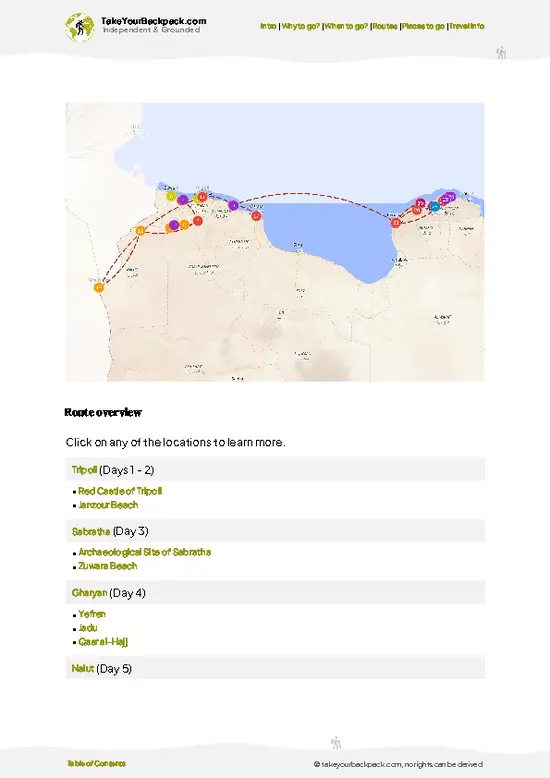
example page 0 from our offline Travel Guide for Libya
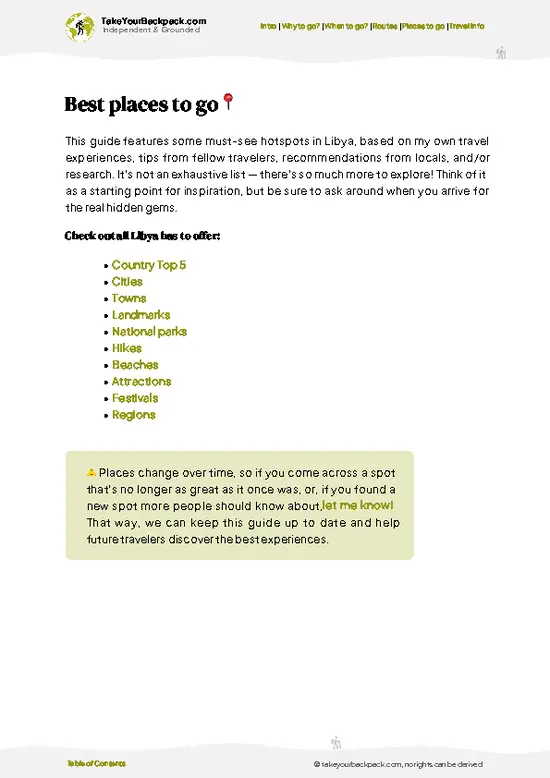
example page 1 from our offline Travel Guide for Libya
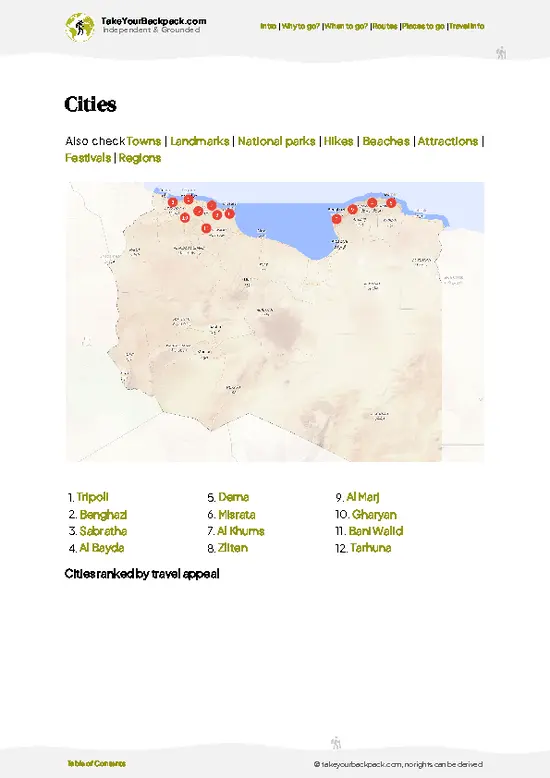
example page 2 from our offline Travel Guide for Libya
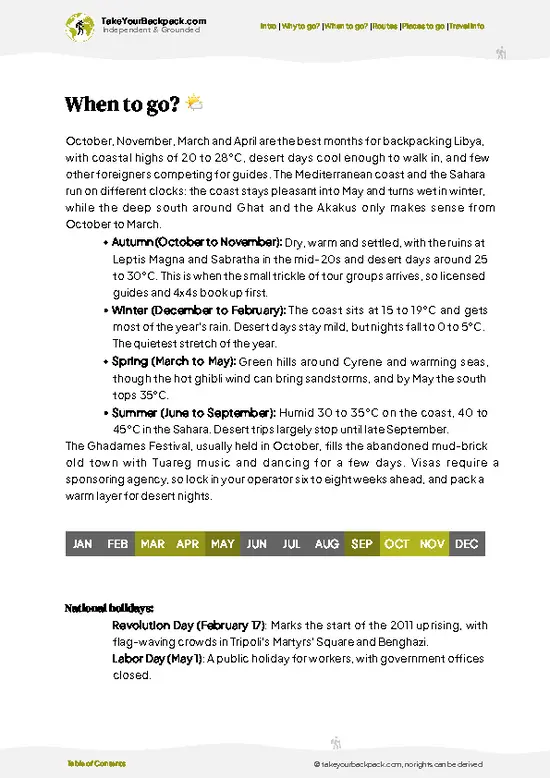
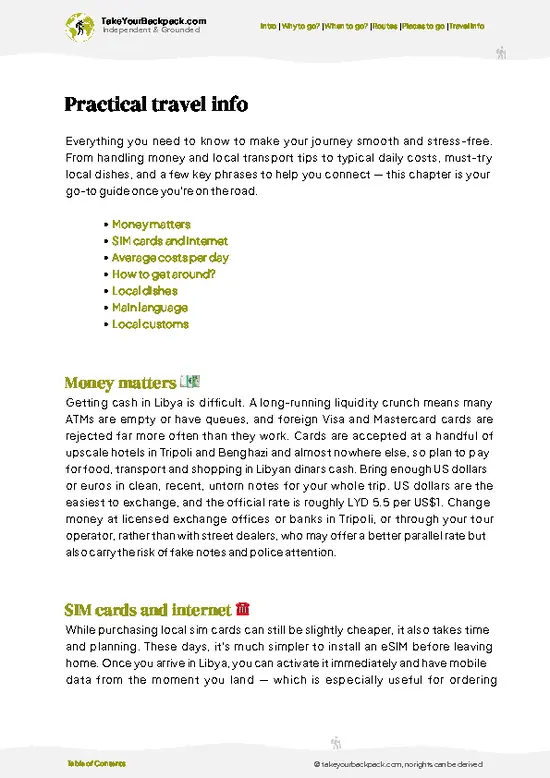
example page 3 from our offline Travel Guide for Libya
example page 4 from our offline Travel Guide for Libya
example page 5 from our offline Travel Guide for Libya
example page 6 from our offline Travel Guide for Libya
example page 7 from our offline Travel Guide for Libya
Loading the map 🌍
CLICK TO FILTER
cities
towns
landmarks
national parks
hikes
beaches
attractions
festivals
regions
SHOW COUNTRY’S BESTSHOW ALL

✨ Why go?
Ranked #1 unique site in Libya
What sets this place apart

Leptis Magna is the reason to put Libya on a route at all. The city was the hometown of the emperor Septimius Severus, who poured imperial money into it, and the result is a scale you rarely get at Roman sites that have been picked clean. Here, the Severan Forum still has carved columns with Medusa heads, and the sea breeze carries through arcades where nobody is selling anything.

The effort is considerable, because independent travel in Libya is limited and arranging a guide and permissions takes patience. That is exactly why the place stays quiet. You can stand in the theater or the harbor with almost nobody in frame, something that is impossible at the big Roman sites in Italy, Turkey or Jordan.

It also fits a wider journey. Pair it with Tripoli’s old medina and museum, or with the other … read more 👉
Leptis Magna is the reason to put Libya on a route at all. The city was the hometown of the emperor Septimius Severus, who poured imperial money into it, and the result is a scale you rarely get at Roman sites that have been picked clean. Here, the Severan Forum still has carved columns with Medusa heads, and the sea breeze carries through arcades where nobody is selling anything.

The effort is considerable, because independent travel in Libya is limited and arranging a guide and permissions takes patience. That is exactly why the place stays quiet. You can stand in the theater or the harbor with almost nobody in frame, something that is impossible at the big Roman sites in Italy, Turkey or Jordan.

It also fits a wider journey. Pair it with Tripoli’s old medina and museum, or with the other ancient coastal cities of Tripolitania such as Sabratha, and you cover the heart of Roman North Africa. For anyone who has seen Rome and Petra and wants a site that still feels half-discovered, the harbor and the basilica alone justify the planning.

💡 HighlightsPlaces and moments you shouldn't skip

  1. Arch of Septimius Severus: A four-sided marble arch that welcomed visitors to the city, carved with scenes of the emperor’s triumphs and family. It is the logical start of any visit.
  2. Severan Forum and Basilica: A vast paved square flanked by arcades whose pillars carry carved Medusa heads. The adjoining basilica has tall columns with detailed reliefs of Hercules and Dionysus.
  3. Old Forum: The earlier civic center, with temples to Roma and Augustus and Liber Pater. It shows the city before the Severan building boom.
  4. Hadrianic Baths: One of the largest bath complexes in the Roman world outside Rome, with marble-floored halls, plunge pools and a latrine with seats still in place.
  5. Theater: Built in the first century AD and facing the sea. Its stage backdrop columns and semicircular seating make it a
… read more 👉
  1. Arch of Septimius Severus: A four-sided marble arch that welcomed visitors to the city, carved with scenes of the emperor’s triumphs and family. It is the logical start of any visit.
  2. Severan Forum and Basilica: A vast paved square flanked by arcades whose pillars carry carved Medusa heads. The adjoining basilica has tall columns with detailed reliefs of Hercules and Dionysus.
  3. Old Forum: The earlier civic center, with temples to Roma and Augustus and Liber Pater. It shows the city before the Severan building boom.
  4. Hadrianic Baths: One of the largest bath complexes in the Roman world outside Rome, with marble-floored halls, plunge pools and a latrine with seats still in place.
  5. Theater: Built in the first century AD and facing the sea. Its stage backdrop columns and semicircular seating make it a photographer’s favorite, especially in late afternoon.
  6. Amphitheater: Carved into an old quarry just east of the main site, close to the shore. The oval arena held spectacles and gladiator fights, and it is nearly always empty.
  7. Circus: A chariot racing track running along the coast, around 450 meters long. It is mostly grassy outlines now, but the scale is impressive.
  8. Harbor and Lighthouse Remains: The Severan harbor with its quays and warehouses, which silted up over the centuries. Walking its long stone edges gives a feel for how goods moved in and out.
Leptis Magna’s theater and the amphitheater combine well in one day, because they sit close together near the sea and make a good late-afternoon finish after the forums and baths.
Spotted a mistake or missing something? Contact us.

🌤️ When to go?Weather, crowds, and seasonal trade-offs

  • Spring (March to May): Daytime highs of 20 to 27°C (68 to 81°F) make the long walk along the Severan Basilica and down to the harbor comfortable. Wildflowers push up between the stones in March and April, and daylight runs about 12 to 14 hours. Crowds stay thin, since few foreign visitors come in any season.
  • Summer (June to September): Highs reach 30 to 35°C (86 to 95°F), with humidity off the Mediterranean and almost no shade among the ruins. Sea breezes help near the harbor, but midday is punishing. Local families fill the nearby Khoms beaches on weekends and prices for rooms edge up.
  • Autumn (October to November): Highs of 22 to 29°C (72 to 84°F) and calmer light for photography. Rain begins to return late in the season.
  • Winter (December to February): Highs of 14 to 19°C (57 to 66°F), lows
… read more 👉
  • Spring (March to May): Daytime highs of 20 to 27°C (68 to 81°F) make the long walk along the Severan Basilica and down to the harbor comfortable. Wildflowers push up between the stones in March and April, and daylight runs about 12 to 14 hours. Crowds stay thin, since few foreign visitors come in any season.
  • Summer (June to September): Highs reach 30 to 35°C (86 to 95°F), with humidity off the Mediterranean and almost no shade among the ruins. Sea breezes help near the harbor, but midday is punishing. Local families fill the nearby Khoms beaches on weekends and prices for rooms edge up.
  • Autumn (October to November): Highs of 22 to 29°C (72 to 84°F) and calmer light for photography. Rain begins to return late in the season.
  • Winter (December to February): Highs of 14 to 19°C (57 to 66°F), lows near 6 to 9°C (43 to 48°F), and the wettest weather of the year. Days are short, about 10 hours, and the ground between the ruins turns muddy.
Arrive at opening time in any season, because the amphitheater and theater are at their best before the heat and the school groups arrive.


source: climatestotravel.comJANJanuary: excellent for travelingFEBFebruary: excellent for travelingMARMarch: excellent for travelingAPRApril: highly recommended for travelingMAYMay: fair for travelingJUNJune: below average for travelingJULJuly: below average for travelingAUGAugust: below average for travelingSEPSeptember: fair for travelingOCTOctober: highly recommended for travelingNOVNovember: excellent for travelingDECDecember: excellent for traveling
libya-unique-site-leptis-magna
© Google |

✈️ The backpacker research shortcutLibya Travel Guide

An offline-friendly backpacking guide with optimized travel routes, ranked highlights, transport advice, and the best areas to stay.
example page 0 from our offline Travel Guide for Libya
example page 1 from our offline Travel Guide for Libya
example page 2 from our offline Travel Guide for Libya
example page 3 from our offline Travel Guide for Libya
example page 4 from our offline Travel Guide for Libya
example page 5 from our offline Travel Guide for Libya
example page 6 from our offline Travel Guide for Libya
example page 7 from our offline Travel Guide for Libya
The digital guide (205 pages) contains:
✅ 45 highlights, ranked by travel appeal
✅ Optimized 5, 10 & 15-day travel routes
✅ Cities, national parks, landmarks, beaches
✅ How to get around
✅ Offline-friendly for travel without Wi-Fi
👉 Click to see all 30+ guide features

📅 Plan smarter in minutes, not weeks
✅ Month by month travel advice
✅ Festivals & national holidays
✅ Budget expectations

🗺️ Go to the right places, skip the overrated ones
✅ Honest pros & cons of destinations
✅ Top hikes, parks & viewpoints
✅ Lesser-known places most travelers miss
✅ Clear “worth it vs skip it” guidance

🛏️ Travel smoothly without rookie mistakes
✅ Best areas to stay
✅ Transport systems explained simply
✅ Common scams & safety advice
✅ SIM cards, money & practical tips

🌍 Understand the country, not just visit it
✅ Culture & traditions
✅ 52 Essential phrases & customs
✅ Festivals worth planning around
✅ Traveler-friendly historical context
✅ Insights that make places more meaningful

📱 Built for real travel conditions
✅ Fully downloadable PDF
✅ Works completely offline
✅ Optimized for phone use
✅ Useful in remote areas & buses
✅ Everything in one place
Stop searching, start planning
Get instant access to your full guide. 30‑day money-back guarantee.
+ Add another guide for just

By proceeding you agree to our terms.
Sent to your inbox immediately after payment • 100% Secure Checkout
Best Backpacking Travel Advisor 2025 tourism awardBest Backpacking
Travel Advisor
2025
What others say about Take Your Backpack Guides:
⭐⭐⭐⭐⭐
Fantastic, amazing amount of information!
⭐⭐⭐⭐⭐
My goodness this is amazing, it's what I've been looking for hats off too you!
⭐⭐⭐⭐⭐
I think this is absolutely BRILLIANT
⭐⭐⭐⭐
Very complete and informative. It's still missing places, but I gotta to commend you
⭐⭐⭐⭐⭐
This is truly amazing, thank you, can't wait to explore it with my kids!
⭐⭐⭐⭐⭐
Awesome resource, thank you!
⭐⭐⭐⭐⭐
This is amazing! Can't wait to explore the ones I haven't seen
⭐⭐⭐⭐
I love this! Well done, great idea.
⭐⭐⭐⭐⭐
Thanks for taking the time to make this gem!
⭐⭐⭐⭐⭐
This might be the best website I've ever seen.
⭐⭐⭐⭐⭐
Congratulations, and thank you so much for your work; it's incredibly valuable.
⭐⭐⭐⭐
In all seriousness I think you did a great job pointing out the important spots
⭐⭐⭐⭐⭐
10/10 very good
⭐⭐⭐⭐⭐
As someone who's only just starting to visit regularly this is awesome, thank you.
⭐⭐⭐⭐
Thank you very much! I'm going to visit my dad, it's going to be very useful!
⭐⭐⭐⭐⭐
This is really cool! We'll be travelling for the first time and this definitely come in handy.
⭐⭐⭐⭐⭐
You are now our minister of culture, congratulations 👨‍💼
⭐⭐⭐⭐⭐
Just wanted to tell you that this is a pearl! Going to follow your recommendations.
⭐⭐⭐⭐⭐
This is so cool. I'll definitely be using the resource for my travels soon.
⭐⭐⭐⭐⭐
This is very impressive! Good work.
⭐⭐⭐⭐⭐
This is an amazing and informative site. Very well done!

🛏️ Where to stay?Best areas and accommodation options

The coastal town of Khoms, about 3 to 5 kilometers west of the ruins, is the most practical area to sleep, with the widest choice of simple rooms, shops, cafes and shared taxis. Its center around the main street and the old market is lively in the evening, with locals out for grilled fish and sweets, and it feels safe for walking after dark. Solo travelers will find it easy to strike up conversations here, though English is limited, so a few Arabic greetings go a long way. Staying here also lets you walk or take a short taxi ride to the site gates in the morning, when the light is soft.

The seafront … read more 👉
The coastal town of Khoms, about 3 to 5 kilometers west of the ruins, is the most practical area to sleep, with the widest choice of simple rooms, shops, cafes and shared taxis. Its center around the main street and the old market is lively in the evening, with locals out for grilled fish and sweets, and it feels safe for walking after dark. Solo travelers will find it easy to strike up conversations here, though English is limited, so a few Arabic greetings go a long way. Staying here also lets you walk or take a short taxi ride to the site gates in the morning, when the light is soft.

The seafront strip between Khoms and the ruins suits those who want sea air and quiet, with a handful of low-key guesthouses and beach apartments. It is calmer but has fewer places to eat, so you will rely on taxis after dark.

Tripoli, roughly 120 kilometers west, is the alternative for longer stays. It has the biggest range of budget rooms, ATMs, and other travelers to swap notes with, and works well if you plan to visit Leptis Magna as a day trip. Budget travelers generally arrange lodging through local contacts or a licensed guide, which is standard practice in Libya, so confirm your base in advance.

👛 Costs (as of 22 October 2026)Travel costs and budget guide for Leptis Magna

Leptis Magna costs about US$38 per day for a backpacker who stays in Khoms, eats local food and uses shared taxis. Libya is largely cash-based and travelers pay in Libyan dinars, so carry small bills.
CategoryBudget RangeLocal Reality
Site entryUS$1 to 3Foreigners pay a small ticket price; the museum is usually a separate fee.
Accommodation (high season)US$15 to 25Simple rooms in Khoms; prices rise in summer and on holiday weekends.
Accommodation (low season)US$10 to 20Winter rooms are easier to bargain for, but heating is basic.
FoodUS$5 to 8Sandwiches, grilled fish, rice and pasta dishes at local cafes.
Local transportUS$2 to 5Shared or private taxis between Khoms and the ruins.
Guide or escortUS$5 to 10A local guide is often arranged for access and context, with the price shared among a group.
… read more 👉
Leptis Magna costs about US$38 per day for a backpacker who stays in Khoms, eats local food and uses shared taxis. Libya is largely cash-based and travelers pay in Libyan dinars, so carry small bills.
CategoryBudget RangeLocal Reality
Site entryUS$1 to 3Foreigners pay a small ticket price; the museum is usually a separate fee.
Accommodation (high season)US$15 to 25Simple rooms in Khoms; prices rise in summer and on holiday weekends.
Accommodation (low season)US$10 to 20Winter rooms are easier to bargain for, but heating is basic.
FoodUS$5 to 8Sandwiches, grilled fish, rice and pasta dishes at local cafes.
Local transportUS$2 to 5Shared or private taxis between Khoms and the ruins.
Guide or escortUS$5 to 10A local guide is often arranged for access and context, with the price shared among a group.
Water and extrasUS$1 to 3Bottled water and snacks, which are essential in the heat.
Total Daily BudgetUS$38Excludes transport to and from Tripoli.
⚠️ Prices can change and everyone travels differently, so take this as a rough guide. Hope it helps you plan your adventure!

FAQTraveler FAQ

Leptis Magna is a Roman city on the Mediterranean coast of Libya, near the town of Khoms and about 120 kilometers east of Tripoli. It reached its peak under Emperor Septimius Severus, who was born here, and it is a UNESCO World Heritage Site. The ruins include a huge basilica, a seaside theater, an amphitheater, and a long colonnaded street leading to the old harbor.
Leptis Magna needs about three to four hours for the main sights, and a full day if you want to include the museum, the hippodrome and the harbor at a relaxed pace. Add the half-day round trip from Tripoli if you are not sleeping nearby. Staying overnight in Khoms lets you see the site in both morning and late afternoon light.
To reach Leptis Magna, travel from Tripoli east along the coastal highway toward Khoms, a drive of roughly 1.5 to 2 hours, and the ruins sit just beyond the town. A private taxi from Tripoli typically costs US$30 to 60 for the round trip, while shared taxis to Khoms are cheaper at around US$3 to 6. From Khoms, a short taxi ride of 5 to 10 minutes takes you to the entrance.
⚠️ Things can change over time, so always validate details locally before you go.

Other Libyan landmarks near Leptis Magna

Explore more nearby:

  • Archaeological Site of Sabratha—Sea-backed Roman theater, Decumanus Maximus, Temple of Isis, Punic mausoleum| 169 km away
  • Qasr al-Hajj—Fortified granary, barrel-vaulted cells, palm-wood beams, plateau views| 210 km away
  • Cyrene—Sanctuary of Apollo, Zeus temple platform, rock-cut necropolis, Jebel Akhdar hills| 707 km away

💡 Not sure where to go next?
Create a personalized itinerary for Libya including Leptis Magna and the places that fit your trip.

Generate my itinerary

👉 Discover all landmarks

Or checkout all Libya has to offer (think cities, towns, villages, national parks, hikes, beaches, festivals)
Country photo of Libya

We 💚 feedbackWhat to keep in mind

Leptis Magna rewards those who look down as well as up. The paving of the main streets still shows grooves and carved markings, and the baths hold mosaics and drainage channels that explain how the city actually functioned. Bring sun protection, a hat and sturdy shoes, since shade is scarce. I would arrive early, take the harbor last, and stay for the light on the theater.

✍️ Help improve this page!
The information on this page is based on in-depth research, insights shared by experienced travelers, and feedback from the local travel community in Libya. While every effort is made to keep the information accurate and current, conditions can change — so if you spot anything incorrect or outdated, please get in touch.


🙋‍♂️ Give feedback

👋 Meet the founderWho’s Behind Take Your Backpack?

Johan, backpacker and founder of TakeYourBackpackHi, I’m Johan (Netherlands 🇳🇱), the creator of TakeYourBackpack. Over the past 3 decades, I’ve backpacked through 90+ countries across six continents, gaining extensive experience with independent travel, long-term trips, and overland routes.

This site is built on a combination of firsthand travel experience and carefully curated insights from other backpackers. Many guides are based on places I’ve personally visited, while others bring together tips, observations, and practical advice shared by trusted travelers I’ve met along the way.

The goal is to provide realistic, experience-driven guidance — not generic itineraries — so you can explore destinations with better context, clearer expectations, and more confidence.