×

Libya🇱🇾 | best landmarksThe Must-See 6 landmarks in Libya

Landmarks in Libya are mostly Roman and Greek ruins, Saharan rock art and mud-brick desert towns, and where you go decides everything. The Mediterranean coast has the largest ruins, easy paved roads and almost no other visitors. The Cyrenaican highlands in the east are greener and quieter still. The Fezzan in the south means long 4WD days and camping. Independent travel here still runs through a licensed local agency, so a backpacker should expect to pay for a guide and driver. Skip the modern Tripoli monuments and head for the ancient sites.

By Johan Kruseman 🇳🇱 | Updated October 19, 2026
Explore the best national parks in Libya

Why go?Understanding Their Importance

Libya holds a rare concentration of classical ruins because Phoenicians, Greeks and Romans all built along its 1,770 km coastline, and then little modern construction covered them. Dry air and sand preserved stonework, mosaics and paintings that would have eroded elsewhere. The interior adds prehistoric rock art and oasis settlements, which are older than anything on the coast.

The weakness is infrastructure and access. Libya has no tourist industry to speak of. There are few hotels outside Tripoli, almost no signage or printed guides at sites, and no cheap public transport between regions. Most governments advise against travel, and security varies by region and changes quickly. Visas depend on a local agency's invitation, so the agency sets your itinerary and its price.

The upside is empty … read more 👉
Libya holds a rare concentration of classical ruins because Phoenicians, Greeks and Romans all built along its 1,770 km coastline, and then little modern construction covered them. Dry air and sand preserved stonework, mosaics and paintings that would have eroded elsewhere. The interior adds prehistoric rock art and oasis settlements, which are older than anything on the coast.

The weakness is infrastructure and access. Libya has no tourist industry to speak of. There are few hotels outside Tripoli, almost no signage or printed guides at sites, and no cheap public transport between regions. Most governments advise against travel, and security varies by region and changes quickly. Visas depend on a local agency's invitation, so the agency sets your itinerary and its price.

The upside is empty sites. Major ruins that would be packed in Italy, Greece or Turkey can be walked in near silence, and nobody crowds your photos. Do not choose Libya for comfort, flexibility or a bargain. It suits travelers who accept a guided, fixed-route trip and want ancient sites with no queues. Cards and apps are unreliable, so plan on cash for nearly everything.
Our Approach to Ranking
The list of best unique sites in Libya is created based on history or culture, wow factor, atmosphere, quirks, and memorability. If you feel a unique site is missing in this list, please let us know.

When to go?Best Time to Visit Libya for landmarks

Best months: October to November and March to April are the best months for Libya's landmarks, because coastal highs sit around 20 to 28°C and the Sahara is bearable, at 25 to 35°C by day.

Summer, from June to September, is not worth it for the south. Fezzan daytime temperatures pass 40 to 45°C, and long drives in a 4WD with no shade are miserable and risky. The coast reaches 30 to 35°C with humidity, which makes open ruins with no cover tiring by late morning.

Winter and shoulder seasons: December to February brings cool, damp weather on the coast and in the Cyrenaican highlands. Highs run 12 to 18°C, and rain is frequent, with Tripoli seeing roughly 300 to 400 mm a year and the Jebel Akhdar more. Mud and wind can spoil photography, but the sites are quiet and the light is good. Saharan … read more 👉
Best months: October to November and March to April are the best months for Libya's landmarks, because coastal highs sit around 20 to 28°C and the Sahara is bearable, at 25 to 35°C by day.

Summer, from June to September, is not worth it for the south. Fezzan daytime temperatures pass 40 to 45°C, and long drives in a 4WD with no shade are miserable and risky. The coast reaches 30 to 35°C with humidity, which makes open ruins with no cover tiring by late morning.

Winter and shoulder seasons: December to February brings cool, damp weather on the coast and in the Cyrenaican highlands. Highs run 12 to 18°C, and rain is frequent, with Tripoli seeing roughly 300 to 400 mm a year and the Jebel Akhdar more. Mud and wind can spoil photography, but the sites are quiet and the light is good. Saharan nights can drop to 0 to 5°C, so desert trips in winter need real sleeping bags, though the days are pleasant at 18 to 25°C.

Spring brings the ghibli, a hot dusty wind that can cloud the sky for a few days in the north. Ramadan shifts each year and shortens opening hours and meal options, so check dates. Libya has no true peak season and no meaningful seasonal price swing, so tour costs stay roughly the same year round.

unique site hoppingSuggested Travel Strategies

Trip length and direction: A trip combining several Libyan landmarks needs 10 to 14 days, and the Sahara leg is what pushes it past a week. The country is huge and the distances are the real constraint, not the number of sites.

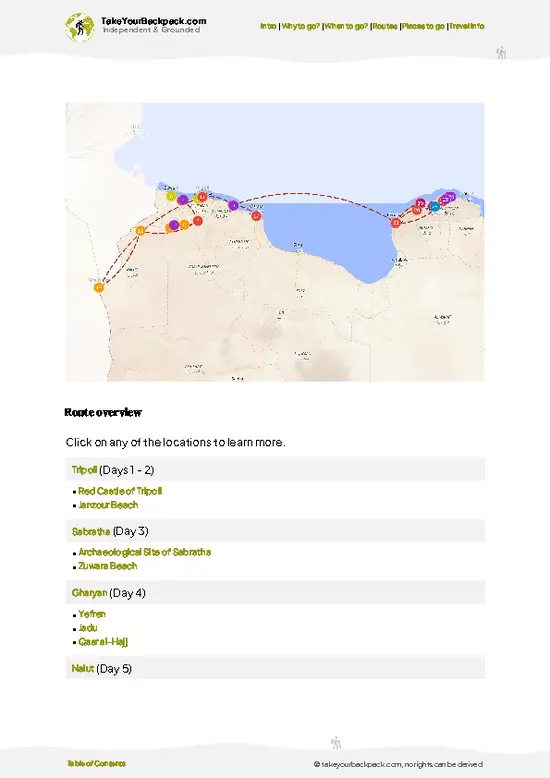
The cleanest grouping is the Tripolitanian coast first. Tripoli works as the hub, with Sabratha about 1 hour west and Leptis Magna about 2 hours east by paved road. Each ancient site needs half a day to a full day, so 3 to 4 days covers the coast. From there, Ghadames is 8 to 9 hours by road from Tripoli, with a day needed on arrival, and the Fezzan around Sebha and the Acacus is a separate expedition, with Sebha roughly 12 hours by road or a short flight. Allow 3 to 5 days there because dune and rock-art tracks go slowly.

Cyrenaica in the east is about 1,000 km from … read more 👉
Trip length and direction: A trip combining several Libyan landmarks needs 10 to 14 days, and the Sahara leg is what pushes it past a week. The country is huge and the distances are the real constraint, not the number of sites.

The cleanest grouping is the Tripolitanian coast first. Tripoli works as the hub, with Sabratha about 1 hour west and Leptis Magna about 2 hours east by paved road. Each ancient site needs half a day to a full day, so 3 to 4 days covers the coast. From there, Ghadames is 8 to 9 hours by road from Tripoli, with a day needed on arrival, and the Fezzan around Sebha and the Acacus is a separate expedition, with Sebha roughly 12 hours by road or a short flight. Allow 3 to 5 days there because dune and rock-art tracks go slowly.

Cyrenaica in the east is about 1,000 km from Tripoli, a 10 to 12 hour drive or a domestic flight to Benghazi. Cyrene then lies 2.5 to 3 hours beyond. Treat it as its own trip unless you have 14 days.

The common mistakes are trying to cover all three regions in a week, trusting a flight schedule that changes without notice, and planning back-to-back long drives. Pick two regions, book flexible internal flights, and keep a spare day for delays at checkpoints and permits.

The ListTop landmarks of Libya

1 Leptis Magna

Roman amphitheater, monumental arches, mosaic floors, coastal setting

Stand beneath soaring arches and wander through sprawling forums where Roman engineering meets the open sea and desert winds.

libya-unique-site-leptis-magna
© Google |

2 Cyrene

Greek columns, hillside ruins, Mediterranean views, ancient necropolis

Walk among limestone temples and weathered statues, tracing the outlines of a city shaped by Greek settlers and Libyan landscapes.

libya-unique-site-cyrene
© Google |

3 Archaeological Site of Sabratha

Theater ruins, Punic foundations, sea-facing temples, pink sandstone

Climb ancient steps and gaze over the Mediterranean from a city where Roman, Phoenician, and Berber influences converge in stone.

libya-unique-site-archaeological-site-of-sabratha
© Google |

4 Waw an Namus

Volcanic crater, black sand, salt lakes, remote oasis

Cross stark desert to reach a volcanic basin where colored lakes and palm groves appear unexpectedly in the Sahara’s emptiness.

5 Qasr al-Hajj

Berber granary, circular towers, mudbrick vaults, desert plateau

Step inside a fortified granary built for survival, with honeycomb chambers and thick walls rising from the arid plateau.

libya-unique-site-qasr-al-hajj
© Google |

6 Haua Fteah

Prehistoric cave, limestone cliffs, archaeological layers, coastal escarpment

Descend into a vast cave shelter that preserves traces of early human life, set high above the Mediterranean’s shifting shoreline.

Loading the map 🌍

Expert viewTips and Advice from Travelers

How many landmarks to plan: Three to four landmarks is the right number for a first trip. Distances are long, a guide and permits are required for each region, and every extra stop adds a day of driving and a day of cost. Packing in seven or eight sites buys exhaustion and gives each ruin about an hour, which is not enough to see anything properly.

Which kind to prioritize: For history-minded travelers, the coastal Roman and Greek ruins are the best value, since they are cheap to reach and need little extra gear. For adventure travelers, the Saharan rock art and oasis towns justify the extra cost because the 4WD, fuel and camping gear cannot be replaced by anything else in the country. Skip modern monuments and the standard museum stops in Tripoli unless there is spare time, because they … read more 👉
How many landmarks to plan: Three to four landmarks is the right number for a first trip. Distances are long, a guide and permits are required for each region, and every extra stop adds a day of driving and a day of cost. Packing in seven or eight sites buys exhaustion and gives each ruin about an hour, which is not enough to see anything properly.

Which kind to prioritize: For history-minded travelers, the coastal Roman and Greek ruins are the best value, since they are cheap to reach and need little extra gear. For adventure travelers, the Saharan rock art and oasis towns justify the extra cost because the 4WD, fuel and camping gear cannot be replaced by anything else in the country. Skip modern monuments and the standard museum stops in Tripoli unless there is spare time, because they are not what you came for.

Real costs: Budget US$120 to 250 a day on a guided trip, covering the guide, a driver, a vehicle and basic lodging. Sahara trips with camping and a 4WD convoy run closer to US$200 to 350 a day. Entry fees at major archaeological sites are small, usually well under US$10 each, but guides, photo permits and informal charges can add a little more. Bring fresh US dollars or euros in cash. Cards and ATMs are unreliable, and the Libyan dinar is traded at a much better rate on the parallel market than at banks, but your agency may advise on the safest way to exchange. Agree in writing what the package covers, because extra days caused by weather or checkpoints can otherwise be billed to you.

What catches travelers out: Delays come from permits and checkpoints, so never book a flight home for the same day you return from a long leg, and leave a one-day buffer. Visas depend on agency invitations that can take weeks, so book three months out. Government travel advisories warn against travel in much of the country, so insurance often does not apply. Check your policy before paying a deposit and choose an agency that updates security by region.

Cultural and safety points: Dress modestly, with covered shoulders and knees. Women should carry a scarf for mosque visits and for rural areas. Alcohol is banned, so do not bring any. Do not photograph military posts, checkpoints or government buildings, and ask before photographing people. Follow the guide on where to stop, because security conditions can change over days, and never wander off alone at remote ruins. During Ramadan, avoid eating or drinking in public during daylight.

✈️ The backpacker research shortcutLibya Travel Guide

An offline-friendly backpacking guide with optimized travel routes, ranked highlights, transport advice, and the best areas to stay.
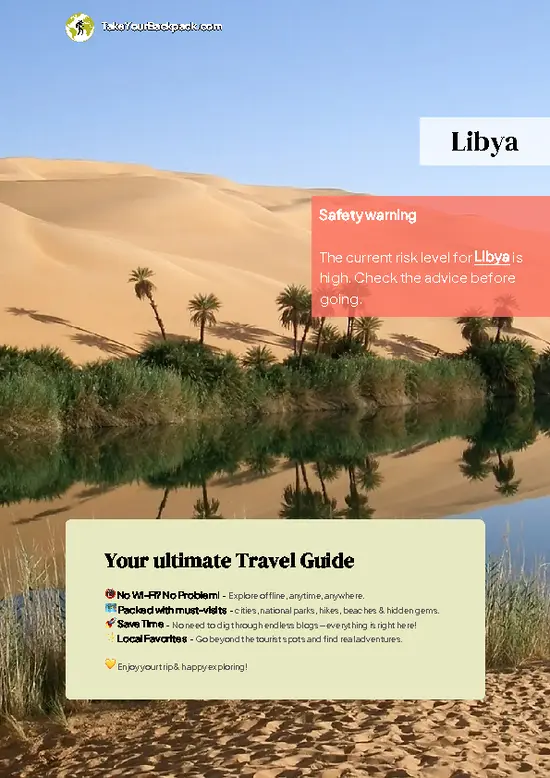
example page 0 from our offline Travel Guide for Libya
example page 1 from our offline Travel Guide for Libya
example page 2 from our offline Travel Guide for Libya
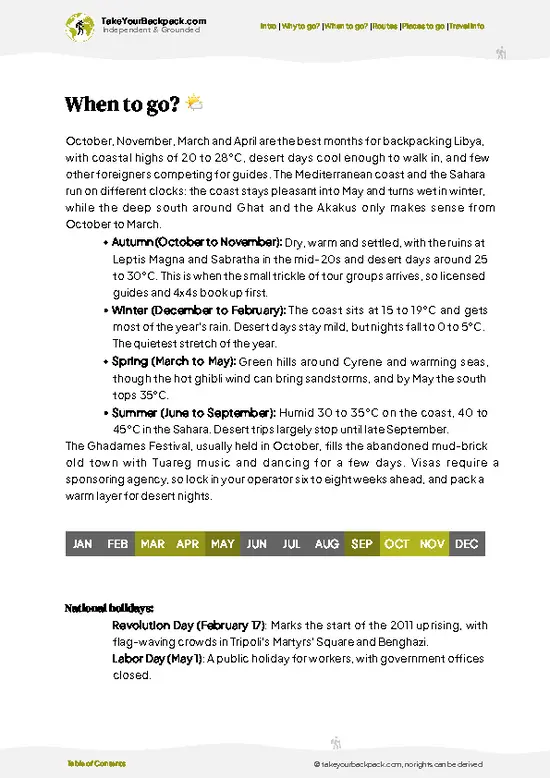
example page 3 from our offline Travel Guide for Libya
example page 4 from our offline Travel Guide for Libya
example page 5 from our offline Travel Guide for Libya
example page 6 from our offline Travel Guide for Libya
example page 7 from our offline Travel Guide for Libya
The digital guide (205 pages) contains:
✅ 45 highlights, ranked by travel appeal
✅ Optimized 5, 10 & 15-day travel routes
✅ Cities, national parks, landmarks, beaches
✅ How to get around
✅ Offline-friendly for travel without Wi-Fi
👉 Click to see all 30+ guide features

📅 Plan smarter in minutes, not weeks
✅ Month by month travel advice
✅ Festivals & national holidays
✅ Budget expectations

🗺️ Go to the right places, skip the overrated ones
✅ Honest pros & cons of destinations
✅ Top hikes, parks & viewpoints
✅ Lesser-known places most travelers miss
✅ Clear “worth it vs skip it” guidance

🛏️ Travel smoothly without rookie mistakes
✅ Best areas to stay
✅ Transport systems explained simply
✅ Common scams & safety advice
✅ SIM cards, money & practical tips

🌍 Understand the country, not just visit it
✅ Culture & traditions
✅ 52 Essential phrases & customs
✅ Festivals worth planning around
✅ Traveler-friendly historical context
✅ Insights that make places more meaningful

📱 Built for real travel conditions
✅ Fully downloadable PDF
✅ Works completely offline
✅ Optimized for phone use
✅ Useful in remote areas & buses
✅ Everything in one place
Stop searching, start planning
Get instant access to your full guide. 30‑day money-back guarantee.
+ Add another guide for just

By proceeding you agree to our terms.
Sent to your inbox immediately after payment • 100% Secure Checkout
Best Backpacking Travel Advisor 2025 tourism awardBest Backpacking
Travel Advisor
2025
What others say about Take Your Backpack Guides:
⭐⭐⭐⭐⭐
Fantastic, amazing amount of information!
⭐⭐⭐⭐⭐
My goodness this is amazing, it's what I've been looking for hats off too you!
⭐⭐⭐⭐⭐
I think this is absolutely BRILLIANT
⭐⭐⭐⭐
Very complete and informative. It's still missing places, but I gotta to commend you
⭐⭐⭐⭐⭐
This is truly amazing, thank you, can't wait to explore it with my kids!
⭐⭐⭐⭐⭐
Awesome resource, thank you!
⭐⭐⭐⭐⭐
This is amazing! Can't wait to explore the ones I haven't seen
⭐⭐⭐⭐
I love this! Well done, great idea.
⭐⭐⭐⭐⭐
Thanks for taking the time to make this gem!
⭐⭐⭐⭐⭐
This might be the best website I've ever seen.
⭐⭐⭐⭐⭐
Congratulations, and thank you so much for your work; it's incredibly valuable.
⭐⭐⭐⭐
In all seriousness I think you did a great job pointing out the important spots
⭐⭐⭐⭐⭐
10/10 very good
⭐⭐⭐⭐⭐
As someone who's only just starting to visit regularly this is awesome, thank you.
⭐⭐⭐⭐
Thank you very much! I'm going to visit my dad, it's going to be very useful!
⭐⭐⭐⭐⭐
This is really cool! We'll be travelling for the first time and this definitely come in handy.
⭐⭐⭐⭐⭐
You are now our minister of culture, congratulations 👨‍💼
⭐⭐⭐⭐⭐
Just wanted to tell you that this is a pearl! Going to follow your recommendations.
⭐⭐⭐⭐⭐
This is so cool. I'll definitely be using the resource for my travels soon.
⭐⭐⭐⭐⭐
This is very impressive! Good work.
⭐⭐⭐⭐⭐
This is an amazing and informative site. Very well done!

🛏️ Where to stay?Top Places to Consider Staying

Libya has no backpacker hostels, so budget accommodation means simple local hotels and a few guesthouses at roughly US$40 to 80 a night, usually booked through the licensed tour operator that sponsors your visa. In Tripoli, the streets around Martyrs’ Square and the Medina put you within walking distance of the old city and the Red Castle, but they get noisy with traffic and offer little after dark. Gargaresh, to the west, has the liveliest strip of cafés, shisha lounges and late-opening restaurants (Libya has no bars), while Ben Ashour and Dahra are calmer residential districts with mid-range hotels and a quieter feel, a short taxi ride from the center.

If you enjoy meeting fellow travelers, … read more 👉
Libya has no backpacker hostels, so budget accommodation means simple local hotels and a few guesthouses at roughly US$40 to 80 a night, usually booked through the licensed tour operator that sponsors your visa. In Tripoli, the streets around Martyrs’ Square and the Medina put you within walking distance of the old city and the Red Castle, but they get noisy with traffic and offer little after dark. Gargaresh, to the west, has the liveliest strip of cafés, shisha lounges and late-opening restaurants (Libya has no bars), while Ben Ashour and Dahra are calmer residential districts with mid-range hotels and a quieter feel, a short taxi ride from the center.

If you enjoy meeting fellow travelers, consider choosing hostels with high ratings for atmosphere. On the other hand, if you prefer having your own space, a hotel might be a better option.

LibyaMore Places Across Libya

👋 Meet the founderWho’s Behind Take Your Backpack?

Johan, backpacker and founder of TakeYourBackpackHi, I’m Johan (Netherlands 🇳🇱), the creator of TakeYourBackpack. Over the past 3 decades, I’ve backpacked through 90+ countries across six continents, gaining extensive experience with independent travel, long-term trips, and overland routes.

This site is built on a combination of firsthand travel experience and carefully curated insights from other backpackers. Many guides are based on places I’ve personally visited, while others bring together tips, observations, and practical advice shared by trusted travelers I’ve met along the way.

The goal is to provide realistic, experience-driven guidance — not generic itineraries — so you can explore destinations with better context, clearer expectations, and more confidence.