×

Libya🇱🇾 | attractionsRed Castle of TripoliCastle ramparts, harbor views, Martyrs’ Square, Ottoman medina | things to do and best time to go

Explore Ghadames Old TownExplore Benghazi National Museum

Backpacking in Red Castle of Tripoli
🏆 Top pickattraction ranked #6
By Johan Kruseman 🇳🇱 | Updated October 22, 2026

The Red Castle of Tripoli, known locally as Assaraya al-Hamra, holds the Jamahiriya Museum, which houses Libya’s best-known collection of Roman statues, mosaics and Saharan artifacts, and it has been closed or restricted for long stretches. The castle stands in Libya’s capital, on the edge of the old medina overlooking the Mediterranean and Green Square (now Martyrs’ Square). Its sheer scale is impressive, with courtyards, ramparts and a maze of halls stretching back to Roman foundations. Crowds are almost nonexistent, which makes wandering feel private, but facilities are thin and signage is poor. Skip any expectation of polished displays. The exterior, courtyards and sea views from the walls deserve your time, as does the neighboring medina. Entry itself is usually cheap or free, so money is not the issue. Access is. Check current opening status locally before you go, because it can change without notice.

Discover everything you want to know in the 📖 Libya Travel Guide.
Safety warning

The current risk level for Libya is high. Check the advice before going.


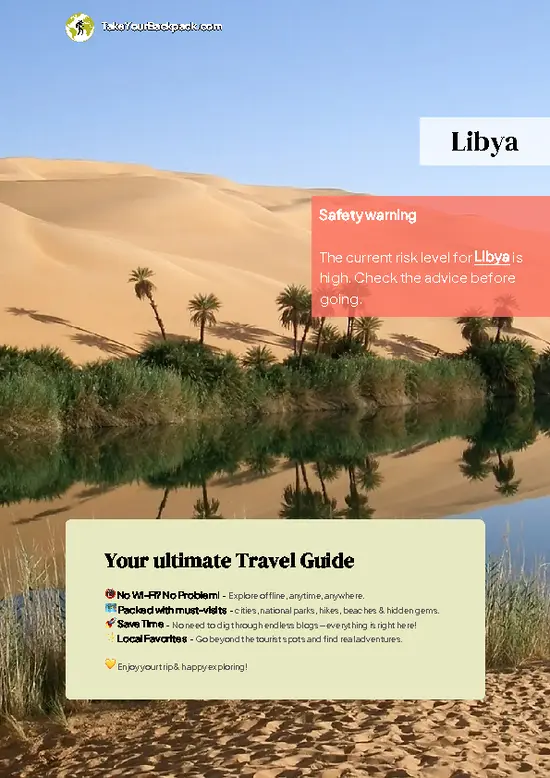
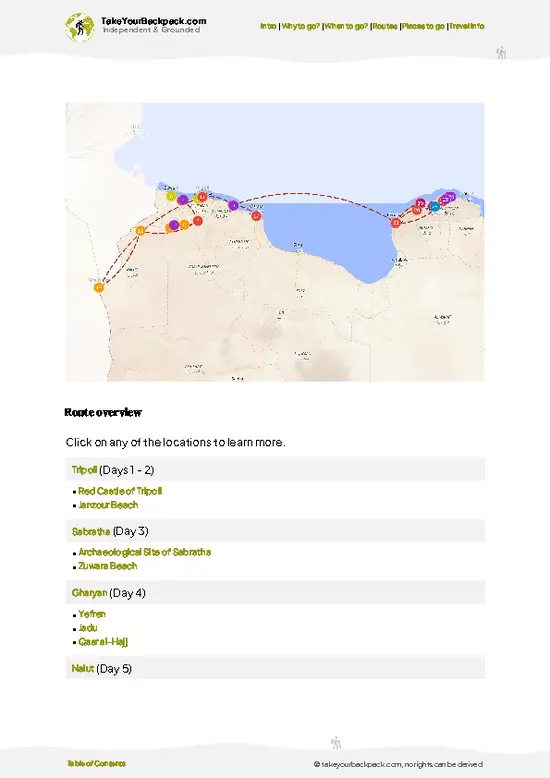
example page 0 from our offline Travel Guide for Libya
example page 1 from our offline Travel Guide for Libya
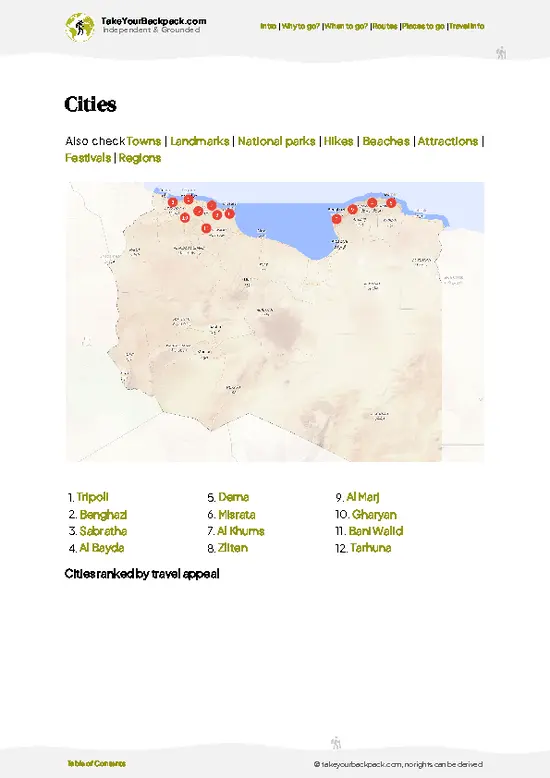
example page 2 from our offline Travel Guide for Libya
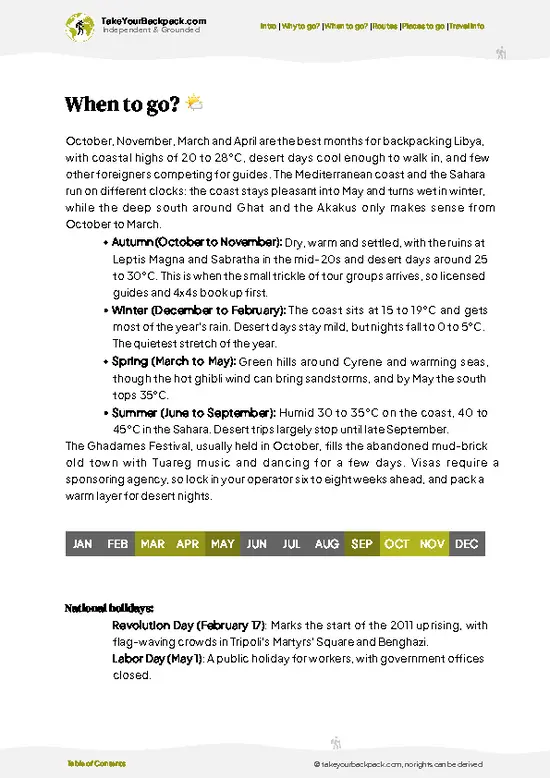
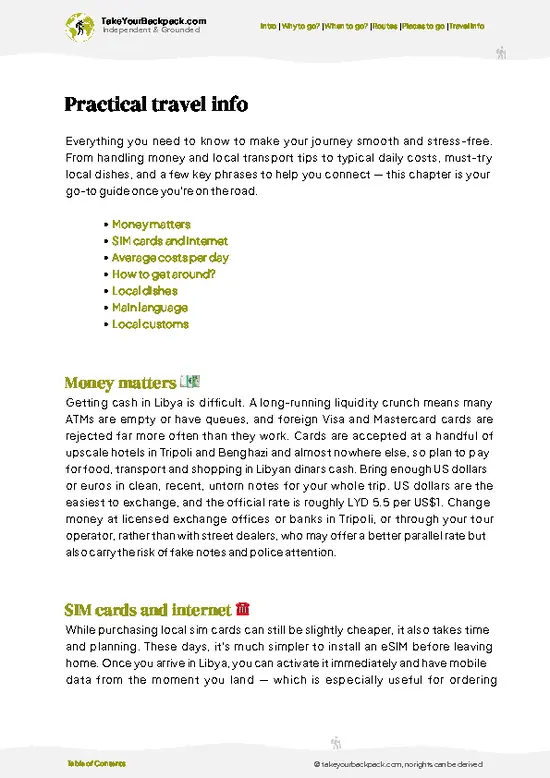
example page 3 from our offline Travel Guide for Libya
example page 4 from our offline Travel Guide for Libya
example page 5 from our offline Travel Guide for Libya
example page 6 from our offline Travel Guide for Libya
example page 7 from our offline Travel Guide for Libya
Loading the map 🌍
CLICK TO FILTER
cities
towns
landmarks
national parks
hikes
beaches
attractions
festivals
regions
SHOW COUNTRY’S BESTSHOW ALL

✨ Why go?
Ranked #6 attraction in Libya
Why Red Castle of Tripoli should be on your travel list

The Red Castle of Tripoli is the single most important historic anchor in Libya’s capital, and few places in North Africa let you stand on one site that has been touched by Romans, Spanish knights, Ottoman governors and Italian colonial rulers. That layered past is the first reason to go. You can read the whole story of Tripoli from the walls, and the city’s old harbor spreads below you.

The second reason is rarity. Libya sees a tiny fraction of the visitors that Tunisia or Egypt receive, so you can explore the castle’s maze of courtyards without elbowing past tour groups. The sea views from the ramparts above the old harbor are among the best in the city.

Finally, it is the natural starting point for a Libya route. From here the medina’s Ottoman-era lanes lie at your feet, and the Roman … read more 👉
The Red Castle of Tripoli is the single most important historic anchor in Libya’s capital, and few places in North Africa let you stand on one site that has been touched by Romans, Spanish knights, Ottoman governors and Italian colonial rulers. That layered past is the first reason to go. You can read the whole story of Tripoli from the walls, and the city’s old harbor spreads below you.

The second reason is rarity. Libya sees a tiny fraction of the visitors that Tunisia or Egypt receive, so you can explore the castle’s maze of courtyards without elbowing past tour groups. The sea views from the ramparts above the old harbor are among the best in the city.

Finally, it is the natural starting point for a Libya route. From here the medina’s Ottoman-era lanes lie at your feet, and the Roman remains of Leptis Magna and Sabratha become far easier to picture once you have seen how the city layered itself.

💡 HighlightsDon't-miss highlights and experiences

  1. Assaraya al-Hamra Fortress Walls: The castle’s thick ramparts and towers are what most people come to see, and walking them shows how the complex grew over centuries.
  2. Jamahiriya Museum Collections: The museum inside holds Libya’s major Roman, Greek and prehistoric finds, including statues and mosaics from Leptis Magna and Sabratha, when it is open.
  3. Inner Courtyards: A series of open yards linked by arcades and stairways, quiet and shaded, ideal for photographs without crowds.
  4. Harbor Viewpoint from the Ramparts: Looking out over the old port and the Mediterranean gives a clear sense of why this spot was fortified.
  5. Martyrs’ Square: The wide public square beside the castle is the capital’s main meeting point, lined with cafes and busy with locals in the evening.
  6. Old Medina Gateway: Steps from the
… read more 👉
  1. Assaraya al-Hamra Fortress Walls: The castle’s thick ramparts and towers are what most people come to see, and walking them shows how the complex grew over centuries.
  2. Jamahiriya Museum Collections: The museum inside holds Libya’s major Roman, Greek and prehistoric finds, including statues and mosaics from Leptis Magna and Sabratha, when it is open.
  3. Inner Courtyards: A series of open yards linked by arcades and stairways, quiet and shaded, ideal for photographs without crowds.
  4. Harbor Viewpoint from the Ramparts: Looking out over the old port and the Mediterranean gives a clear sense of why this spot was fortified.
  5. Martyrs’ Square: The wide public square beside the castle is the capital’s main meeting point, lined with cafes and busy with locals in the evening.
  6. Old Medina Gateway: Steps from the castle, narrow lanes lead into the Ottoman-era old town with workshops, mosques and small markets.
  7. Arch of Marcus Aurelius: A short walk away, this Roman marble arch from the second century is the best-preserved ancient monument in central Tripoli and is free to look at.
The Red Castle of Tripoli’s exterior and the neighboring Martyrs’ Square and Arch of Marcus Aurelius cost nothing, while only the museum interior may carry a small ticket.
Spotted a mistake or missing something? Contact us.

🌤️ When to go?Weather, crowds, and seasonal trade-offs

  • Spring (March to May): Daytime highs of 20 to 27°C (68 to 81°F) make the open courtyards and the walk through the Assaraya al-Hamra museum comfortable. Light is clear for photos of the waterfront, and crowds are thin because few foreign visitors come at all.
  • Summer (June to September): Highs reach 30 to 35°C (86 to 95°F) with heavy humidity off the Mediterranean. Daylight runs about 14 hours, but stone galleries hold heat by midday. Visit early.
  • Autumn (October to November): Temperatures sit at 20 to 28°C (68 to 82°F), and the sea stays warm. This is the most relaxed period for wandering the old city around the castle.
  • Winter (December to February): Highs of 14 to 18°C (57 to 64°F), lows near 8°C (46°F), and most of the country’s rain, so shower days leave the museum floors slick. Daylight shrinks
… read more 👉
  • Spring (March to May): Daytime highs of 20 to 27°C (68 to 81°F) make the open courtyards and the walk through the Assaraya al-Hamra museum comfortable. Light is clear for photos of the waterfront, and crowds are thin because few foreign visitors come at all.
  • Summer (June to September): Highs reach 30 to 35°C (86 to 95°F) with heavy humidity off the Mediterranean. Daylight runs about 14 hours, but stone galleries hold heat by midday. Visit early.
  • Autumn (October to November): Temperatures sit at 20 to 28°C (68 to 82°F), and the sea stays warm. This is the most relaxed period for wandering the old city around the castle.
  • Winter (December to February): Highs of 14 to 18°C (57 to 64°F), lows near 8°C (46°F), and most of the country’s rain, so shower days leave the museum floors slick. Daylight shrinks to about 10 hours.
Aim for opening time on a weekday morning, when the galleries are quiet and cool.


source: climatestotravel.comJANJanuary: good for travelingFEBFebruary: highly recommended for travelingMARMarch: highly recommended for travelingAPRApril: highly recommended for travelingMAYMay: fair for travelingJUNJune: below average for travelingJULJuly: below average for travelingAUGAugust: below average for travelingSEPSeptember: fair for travelingOCTOctober: excellent for travelingNOVNovember: highly recommended for travelingDECDecember: good for traveling
libya-attraction-red-castle-of-tripoli v1
© Google |

✈️ The backpacker research shortcutLibya Travel Guide

An offline-friendly backpacking guide with optimized travel routes, ranked highlights, transport advice, and the best areas to stay.
example page 0 from our offline Travel Guide for Libya
example page 1 from our offline Travel Guide for Libya
example page 2 from our offline Travel Guide for Libya
example page 3 from our offline Travel Guide for Libya
example page 4 from our offline Travel Guide for Libya
example page 5 from our offline Travel Guide for Libya
example page 6 from our offline Travel Guide for Libya
example page 7 from our offline Travel Guide for Libya
The digital guide (205 pages) contains:
✅ 45 highlights, ranked by travel appeal
✅ Optimized 5, 10 & 15-day travel routes
✅ Cities, national parks, landmarks, beaches
✅ How to get around
✅ Offline-friendly for travel without Wi-Fi
👉 Click to see all 30+ guide features

📅 Plan smarter in minutes, not weeks
✅ Month by month travel advice
✅ Festivals & national holidays
✅ Budget expectations

🗺️ Go to the right places, skip the overrated ones
✅ Honest pros & cons of destinations
✅ Top hikes, parks & viewpoints
✅ Lesser-known places most travelers miss
✅ Clear “worth it vs skip it” guidance

🛏️ Travel smoothly without rookie mistakes
✅ Best areas to stay
✅ Transport systems explained simply
✅ Common scams & safety advice
✅ SIM cards, money & practical tips

🌍 Understand the country, not just visit it
✅ Culture & traditions
✅ 52 Essential phrases & customs
✅ Festivals worth planning around
✅ Traveler-friendly historical context
✅ Insights that make places more meaningful

📱 Built for real travel conditions
✅ Fully downloadable PDF
✅ Works completely offline
✅ Optimized for phone use
✅ Useful in remote areas & buses
✅ Everything in one place
Stop searching, start planning
Get instant access to your full guide. 30‑day money-back guarantee.
+ Add another guide for just

By proceeding you agree to our terms.
Sent to your inbox immediately after payment • 100% Secure Checkout
Best Backpacking Travel Advisor 2025 tourism awardBest Backpacking
Travel Advisor
2025
What others say about Take Your Backpack Guides:
⭐⭐⭐⭐⭐
Fantastic, amazing amount of information!
⭐⭐⭐⭐⭐
My goodness this is amazing, it's what I've been looking for hats off too you!
⭐⭐⭐⭐⭐
I think this is absolutely BRILLIANT
⭐⭐⭐⭐
Very complete and informative. It's still missing places, but I gotta to commend you
⭐⭐⭐⭐⭐
This is truly amazing, thank you, can't wait to explore it with my kids!
⭐⭐⭐⭐⭐
Awesome resource, thank you!
⭐⭐⭐⭐⭐
This is amazing! Can't wait to explore the ones I haven't seen
⭐⭐⭐⭐
I love this! Well done, great idea.
⭐⭐⭐⭐⭐
Thanks for taking the time to make this gem!
⭐⭐⭐⭐⭐
This might be the best website I've ever seen.
⭐⭐⭐⭐⭐
Congratulations, and thank you so much for your work; it's incredibly valuable.
⭐⭐⭐⭐
In all seriousness I think you did a great job pointing out the important spots
⭐⭐⭐⭐⭐
10/10 very good
⭐⭐⭐⭐⭐
As someone who's only just starting to visit regularly this is awesome, thank you.
⭐⭐⭐⭐
Thank you very much! I'm going to visit my dad, it's going to be very useful!
⭐⭐⭐⭐⭐
This is really cool! We'll be travelling for the first time and this definitely come in handy.
⭐⭐⭐⭐⭐
You are now our minister of culture, congratulations 👨‍💼
⭐⭐⭐⭐⭐
Just wanted to tell you that this is a pearl! Going to follow your recommendations.
⭐⭐⭐⭐⭐
This is so cool. I'll definitely be using the resource for my travels soon.
⭐⭐⭐⭐⭐
This is very impressive! Good work.
⭐⭐⭐⭐⭐
This is an amazing and informative site. Very well done!

🛏️ Where to stay?Best areas and accommodation options

The streets around Martyrs’ Square and the Old City (Medina) are the most practical place to sleep, since the Red Castle sits right beside them on the waterfront. Libya has no true hostel scene, so budget travelers rely on small, modest hotels and guesthouses in the center. Staying here means you can walk to the castle, the Medina’s souks, the Gurgi Mosque and the Roman Arch of Marcus Aurelius within minutes, and you avoid taxis after dark.

The central district along Omar Mukhtar Street and Al-Shatt Road, running toward the corniche, has a wider choice of mid-range rooms and cafes where you can … read more 👉
The streets around Martyrs’ Square and the Old City (Medina) are the most practical place to sleep, since the Red Castle sits right beside them on the waterfront. Libya has no true hostel scene, so budget travelers rely on small, modest hotels and guesthouses in the center. Staying here means you can walk to the castle, the Medina’s souks, the Gurgi Mosque and the Roman Arch of Marcus Aurelius within minutes, and you avoid taxis after dark.

The central district along Omar Mukhtar Street and Al-Shatt Road, running toward the corniche, has a wider choice of mid-range rooms and cafes where you can meet local students and the occasional foreign worker. It is livelier in the evening than the Medina, which quiets once the shops close.

Social atmosphere is limited, so expect to meet people in tea houses and seafront cafes rather than dorm common rooms. Security conditions in Tripoli can change, so choose lodging through a local contact or host, arrange arrival in daylight, and keep the property within walking distance of the castle rather than in outlying suburbs.

👛 Costs (as of 22 October 2026)Typical daily expenses

Red Castle of Tripoli costs roughly US$27 to 50 per day for a backpacker in high season, with the museum ticket a small part of that. Prices below are estimates, and travelers pay in Libyan dinars, usually in cash.
CategoryBudget RangeLocal Reality
Museum entryUS$1 to 4Foreign visitors pay a small ticket for the Assaraya al-Hamra museum; hours can vary.
Guide (optional)US$5 to 15A local guide can explain the Roman, Ottoman and Spanish layers inside.
Accommodation (high season)US$15 to 25Simple central hotel rooms; low season is often US$10 to 20.
Local transportUS$1 to 4Shared taxis or short private taxi rides from the center; the castle is walkable from Martyrs’ Square.
Food and drinkUS$4 to 8Sandwiches, pasta, fish and sweet tea in Medina cafes.
Total Daily BudgetUS$27 to 50Visa and guide arrangements
… read more 👉
Red Castle of Tripoli costs roughly US$27 to 50 per day for a backpacker in high season, with the museum ticket a small part of that. Prices below are estimates, and travelers pay in Libyan dinars, usually in cash.
CategoryBudget RangeLocal Reality
Museum entryUS$1 to 4Foreign visitors pay a small ticket for the Assaraya al-Hamra museum; hours can vary.
Guide (optional)US$5 to 15A local guide can explain the Roman, Ottoman and Spanish layers inside.
Accommodation (high season)US$15 to 25Simple central hotel rooms; low season is often US$10 to 20.
Local transportUS$1 to 4Shared taxis or short private taxi rides from the center; the castle is walkable from Martyrs’ Square.
Food and drinkUS$4 to 8Sandwiches, pasta, fish and sweet tea in Medina cafes.
Total Daily BudgetUS$27 to 50Visa and guide arrangements are extra and often come to more than the daily spend.


source: en.alwasat.ly
⚠️ Prices can change and everyone travels differently, so take this as a rough guide. Hope it helps you plan your adventure!

FAQTraveler FAQ

Plan on 1.5 to 3 hours inside Red Castle of Tripoli, which is enough for the museum galleries and the courtyards. Add another 2 hours if you want the neighboring Medina souks and Martyrs’ Square. Mornings on weekdays are the calmest.
Red Castle of Tripoli is worth the small ticket, usually US$1 to 4, because it holds Libya’s largest museum, with Roman mosaics and statues from Sabratha and Leptis Magna. Even a half-day visit covers material that would take days to see at the separate ruins. A local guide, around US$5 to 15, helps with the castle’s many building layers.
Red Castle of Tripoli stands on the waterfront next to Martyrs’ Square, about a 15 to 25 minute drive from Mitiga airport depending on traffic. A taxi from the center costs roughly US$2 to 6, and the walk from central hotels is 5 to 15 minutes. Arrange transfers through your host or hotel, and travel in daylight.
⚠️ Things can change over time, so always validate details locally before you go.

Other Libyan attractions near Red Castle of Tripoli

Explore more nearby:


💡 Not sure where to go next?
Create a personalized itinerary for Libya including Red Castle of Tripoli and the places that fit your trip.

Generate my itinerary

👉 Discover all attractions

Or checkout all Libya has to offer (think cities, towns, villages, national parks, hikes, beaches, festivals)
Country photo of Libya

We 💚 feedbackKey takeaways before you go

The Red Castle of Tripoli suits history-hungry travelers who like quiet ruins and can live without polish. If you want guided displays and cafes at every corner, skip it. I would go in the morning with a local guide, bring a camera and spare time for the neighboring medina, and confirm opening status the day before.

✍️ Help improve this page!
The information on this page is based on in-depth research, insights shared by experienced travelers, and feedback from the local travel community in Libya. While every effort is made to keep the information accurate and current, conditions can change — so if you spot anything incorrect or outdated, please get in touch.


🙋‍♂️ Give feedback

👋 Meet the founderWho’s Behind Take Your Backpack?

Johan, backpacker and founder of TakeYourBackpackHi, I’m Johan (Netherlands 🇳🇱), the creator of TakeYourBackpack. Over the past 3 decades, I’ve backpacked through 90+ countries across six continents, gaining extensive experience with independent travel, long-term trips, and overland routes.

This site is built on a combination of firsthand travel experience and carefully curated insights from other backpackers. Many guides are based on places I’ve personally visited, while others bring together tips, observations, and practical advice shared by trusted travelers I’ve met along the way.

The goal is to provide realistic, experience-driven guidance — not generic itineraries — so you can explore destinations with better context, clearer expectations, and more confidence.