×

Luxembourg🇱🇺 | attractionsNational Museum of Military History (Musée National d’Histoire MWorld War II exhibits, dioramas, military vehicles | things to do and best time to go

Explore Grand Ducal PalaceExplore Abbey of Echternach

Backpacking in National Museum of Military History (Musée National d’Histoire M
By Johan Kruseman 🇳🇱 | Updated September 4, 2026

Forget the Instagram myth: the National Museum of Military History isn’t some dusty bunker for war buffs or a quick rainy-day filler. It’s in Diekirch, a small town in northern Luxembourg, and it’s the real deal—raw, immersive, and surprisingly moving. Backpackers, listen up: this place doesn’t sugarcoat history or drown you in endless glass cases. Instead, you get life-sized dioramas, battered gear, and stories that hit harder than any textbook. Yes, it’s off the main tourist drag, so you’ll dodge the selfie-stick mobs that clog Luxembourg City’s palace steps. The downside? It’s not the cheapest museum in the country, and you’ll need to budget for the train ride out. But the payoff is huge: you’ll walk out with a visceral sense of what war meant for real people—Luxembourgers, Americans, Germans—who lived and died on this soil. Compared to the country’s polished castles and postcard-perfect squares, Diekirch’s museum is gritty, honest, and—if you let it—absolutely unforgettable.

Discover everything you want to know in the 📖 Luxembourg Travel Guide.
Loading the map 🌍
CLICK TO FILTER
cities
towns
villages
landmarks
national parks
hikes
attractions
festivals
regions
SHOW COUNTRY’S BESTSHOW ALL

✨ Why go?
Ranked #99 attraction in Luxembourg
Why National Museum of Military History (Musée National d’Histoire M should be on your travel list

The National Museum of Military History in Luxembourg isn’t just another dusty display of old guns and uniforms. Sure, it draws crowds, especially on weekends and holidays, so expect a bit of a queue. But here’s the kicker: this place is a powerhouse for anyone who wants to understand the real grit behind Luxembourg’s role in European conflicts. It’s not just about tanks and planes; it’s about the stories of resilience, strategy, and survival that shaped a tiny country caught in the crossfire of history’s biggest wars.

What sets this museum apart is its raw, unfiltered dive into the human side of military history. You’ll find detailed exhibits on the Battle of the Bulge, a pivotal moment that many gloss over, but here it’s brought to life with artifacts, personal accounts, and immersive displays … read more 👉
The National Museum of Military History in Luxembourg isn’t just another dusty display of old guns and uniforms. Sure, it draws crowds, especially on weekends and holidays, so expect a bit of a queue. But here’s the kicker: this place is a powerhouse for anyone who wants to understand the real grit behind Luxembourg’s role in European conflicts. It’s not just about tanks and planes; it’s about the stories of resilience, strategy, and survival that shaped a tiny country caught in the crossfire of history’s biggest wars.

What sets this museum apart is its raw, unfiltered dive into the human side of military history. You’ll find detailed exhibits on the Battle of the Bulge, a pivotal moment that many gloss over, but here it’s brought to life with artifacts, personal accounts, and immersive displays that hit harder than any textbook. For backpackers trekking through Luxembourg, it’s a major milestone—not just a pit stop but a deep, grounding experience that adds serious context to the landscapes you’re hiking through.

The effort-to-reward ratio is solid. You invest a couple of hours, and you walk away with a layered understanding of Luxembourg’s strategic importance and the sacrifices made on its soil. It’s a cultural and historical anchor that turns a simple country route into a meaningful journey through time.
Want to include National Museum of Military History (Musée National d’Histoire M in your Luxembourg route?
Create a personalized Luxembourg itinerary that includes National Museum of Military History (Musée National d’Histoire M and the places that fit your trip — based on your travel style, budget, and available time. Get your route in seconds.

Generate my trip

💡 HighlightsTop highlights of National Museum of Military History (Musée National d’Histoire M

The Battle of the Bulge Immersion
Forget the sanitized, glass-case approach. This museum drops you right into the mud and chaos of the Ardennes, with full-scale dioramas that don’t sugarcoat anything. You’ll see American and German soldiers frozen in the middle of a firefight, surrounded by the actual debris of war—burned-out tanks, battered jeeps, and the kind of personal gear that makes you realize these were real, terrified people, not just names in a textbook. The sheer density of artifacts from the Battle of the Bulge is staggering. If you think you know WWII, this place will recalibrate your sense of scale and suffering.


Authentic Military Vehicles Collection
This isn’t your average “look but don’t touch” parade of rusting hardware. The museum’s collection of tanks, half-tracks, and … read more 👉
The Battle of the Bulge Immersion
Forget the sanitized, glass-case approach. This museum drops you right into the mud and chaos of the Ardennes, with full-scale dioramas that don’t sugarcoat anything. You’ll see American and German soldiers frozen in the middle of a firefight, surrounded by the actual debris of war—burned-out tanks, battered jeeps, and the kind of personal gear that makes you realize these were real, terrified people, not just names in a textbook. The sheer density of artifacts from the Battle of the Bulge is staggering. If you think you know WWII, this place will recalibrate your sense of scale and suffering.


Authentic Military Vehicles Collection
This isn’t your average “look but don’t touch” parade of rusting hardware. The museum’s collection of tanks, half-tracks, and armored cars is not only enormous for a country this size, but many are restored to working order. You can get nose-to-steel with a Sherman tank, peer inside a German Panther, and see the scars of battle up close. The vehicles aren’t roped off in sterile rows—they’re staged in scenes that feel alive, as if you’ve stumbled onto a battlefield minutes after the fighting stopped.


Personal Stories and Soldier Artifacts
Here’s where the Instagram crowd gets it wrong: the real magic isn’t in the big machines, but in the tiny, heartbreaking details. Letters home, battered helmets, hand-stitched uniforms, and even children’s toys found in the rubble. The museum curates these with a blunt honesty that doesn’t let you look away. You’ll read diary entries that crack open the emotional reality of war, and see faces—actual faces—of Luxembourgers caught between armies. This is where the museum stops being a collection and starts being a gut punch.


Luxembourg’s Civilian Experience
Most military museums skip the home front, but not here. The exhibits on civilian life during occupation are raw and unsentimental. You’ll see ration cards, propaganda leaflets, and the tools of everyday survival. There’s a section on forced labor and resistance that’s as gripping as any Hollywood script, but it’s all real. The museum doesn’t flinch from the ugly parts—collaboration, starvation, the cost of liberation. It’s a rare, unfiltered look at what war does to a country’s soul.


Reconstructed Street Scenes
This is my personal favorite. The museum has rebuilt entire street scenes from wartime Luxembourg, complete with shopfronts, bombed-out buildings, and even the soundscape of distant artillery. Walking through these sets is like time travel with a side of vertigo. You can almost smell the cordite and hear the boots on cobblestones. It’s immersive, a little eerie, and absolutely unforgettable for anyone who wants to feel—not just learn about—history.


Annual Living History Events
If you time your visit right, you’ll catch the museum’s living history weekends. Reenactors in period kit bring the exhibits to life, running drills, cooking over field stoves, and sharing stories that never make it into textbooks. It’s not cosplay—it’s a full-sensory, boots-on-the-ground experience that bridges the gap between past and present. The energy is contagious, and the authenticity is off the charts.
Spotted a mistake or missing something? Contact us.
Things to do near National Museum of Military History (Musée National d’Histoire M

Ratings based on Tripadvisor reviews. When you book through this link, you support our work at no extra cost to you.

🌤️ When to go?Weather, crowds, and seasonal trade-offs


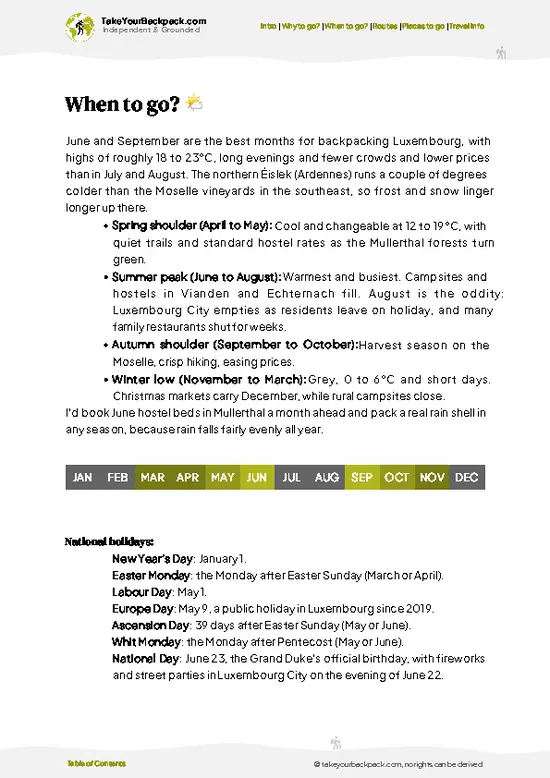
  • Weather: Luxembourg’s climate is mild but unpredictable. From November to February, expect cold, damp days with temperatures hovering around 0°C to 5°C (32°F to 41°F). Spring (March to May) brings a mix of chilly mornings and warming afternoons, perfect for combining indoor museum visits with outdoor strolls.

  • Temperature: Summer (June to August) can be pleasantly warm, ranging from 18°C to 25°C (64°F to 77°F), but the museum’s indoor setting means you won’t be sweating through exhibits regardless of the heat outside.

  • Daylight Hours: Long summer days offer more time for exploring Luxembourg City, but the museum itself is well-lit and inviting year-round. Winter days are short, with daylight shrinking to about 8 hours in December, so plan accordingly if you want to hit other sights too.
read more 👉

  • Weather: Luxembourg’s climate is mild but unpredictable. From November to February, expect cold, damp days with temperatures hovering around 0°C to 5°C (32°F to 41°F). Spring (March to May) brings a mix of chilly mornings and warming afternoons, perfect for combining indoor museum visits with outdoor strolls.

  • Temperature: Summer (June to August) can be pleasantly warm, ranging from 18°C to 25°C (64°F to 77°F), but the museum’s indoor setting means you won’t be sweating through exhibits regardless of the heat outside.

  • Daylight Hours: Long summer days offer more time for exploring Luxembourg City, but the museum itself is well-lit and inviting year-round. Winter days are short, with daylight shrinking to about 8 hours in December, so plan accordingly if you want to hit other sights too.

  • Crowds: Peak tourist season (June to August) brings more visitors, especially on weekends. The museum can feel cramped, so weekdays in shoulder seasons (April-May, September-October) are your best bet for a quieter, more reflective experience.

  • Seasonal Activities: The museum occasionally hosts special exhibitions or events tied to Luxembourg’s military history, often timed around national holidays in May and November. These can add depth but also draw crowds.

  • Price Fluctuations: Entry fees remain stable year-round, but some guided tours or special exhibits may carry extra costs during peak times or special events. Off-season visits often mean fewer add-ons and a more straightforward experience.


Pro-tip: Visit in late spring or early autumn on a weekday morning—cool, comfortable weather with manageable crowds lets you soak in the history without feeling rushed or overwhelmed.


source: climatestotravel.comJANJanuary: fair for travelingFEBFebruary: fair for travelingMARMarch: good for travelingAPRApril: highly recommended for travelingMAYMay: highly recommended for travelingJUNJune: good for travelingJULJuly: good for travelingAUGAugust: good for travelingSEPSeptember: highly recommended for travelingOCTOctober: highly recommended for travelingNOVNovember: good for travelingDECDecember: fair for traveling
when-to-go

✈️ The backpacker research shortcutLuxembourg Travel Guide

An offline-friendly backpacking guide with optimized travel routes, ranked highlights, transport advice, and the best areas to stay.
example page 0 from our offline Travel Guide for Luxembourg
example page 1 from our offline Travel Guide for Luxembourg
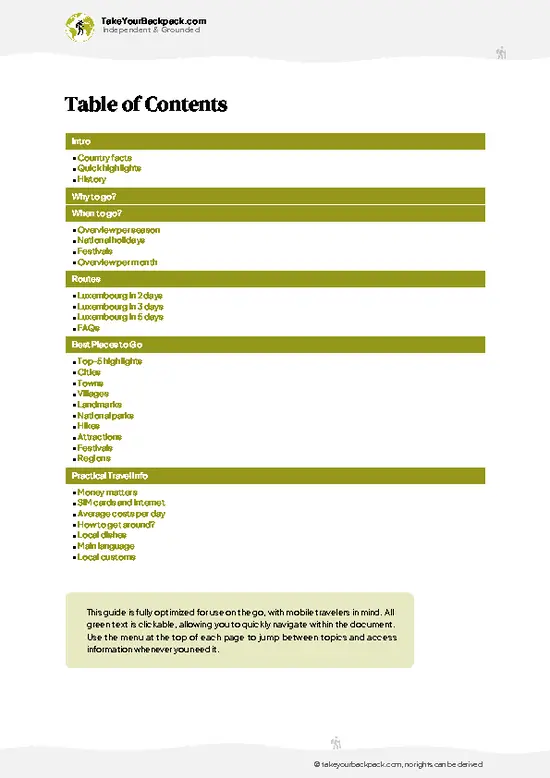
example page 2 from our offline Travel Guide for Luxembourg
example page 3 from our offline Travel Guide for Luxembourg
example page 4 from our offline Travel Guide for Luxembourg
example page 5 from our offline Travel Guide for Luxembourg
example page 6 from our offline Travel Guide for Luxembourg
example page 7 from our offline Travel Guide for Luxembourg
The digital guide (158 pages) contains:
37 highlights, ranked by travel appeal
Optimized 2, 3 & 5-day travel routes
Cities, national parks, landmarks, beaches
How to get around
Offline-friendly for travel without Wi-Fi
👉 Click to see all 30+ guide features

📅 Plan smarter in minutes, not weeks
Month by month travel advice
Festivals & national holidays
Budget expectations

🗺️ Go to the right places, skip the overrated ones
Honest pros & cons of destinations
Top hikes, parks & viewpoints
Lesser-known places most travelers miss
Clear “worth it vs skip it” guidance

🛏️ Travel smoothly without rookie mistakes
Best areas to stay
Transport systems explained simply
Common scams & safety advice
SIM cards, money & practical tips

🌍 Understand the country, not just visit it
Culture & traditions
52 Essential phrases & customs
Festivals worth planning around
Traveler-friendly historical context
Insights that make places more meaningful

📱 Built for real travel conditions
Fully downloadable PDF
Works completely offline
Optimized for phone use
Useful in remote areas & buses
Everything in one place
Save weeks of stressful planning
Get instant access to your full guide. 30‑day money-back guarantee.
+ Add another guide for just US$7.80

By proceeding you agree to our terms.
Sent to your inbox immediately after payment • 100% Secure Checkout
Best Backpacking Travel Advisor 2025 tourism awardBest Backpacking
Travel Advisor
2025
What others say about Take Your Backpack Guides:
⭐⭐⭐⭐⭐
Fantastic, amazing amount of information!
⭐⭐⭐⭐⭐
My goodness this is amazing, it's what I've been looking for hats off too you!
⭐⭐⭐⭐⭐
I think this is absolutely BRILLIANT
⭐⭐⭐⭐
Very complete and informative. It's still missing places, but I gotta to commend you
⭐⭐⭐⭐⭐
This is truly amazing, thank you, can't wait to explore it with my kids!
⭐⭐⭐⭐⭐
Awesome resource, thank you!
⭐⭐⭐⭐⭐
This is amazing! Can't wait to explore the ones I haven't seen
⭐⭐⭐⭐
I love this! Well done, great idea.
⭐⭐⭐⭐⭐
Thanks for taking the time to make this gem!
⭐⭐⭐⭐⭐
This might be the best website I've ever seen.
⭐⭐⭐⭐⭐
Congratulations, and thank you so much for your work; it's incredibly valuable.
⭐⭐⭐⭐
In all seriousness I think you did a great job pointing out the important spots
⭐⭐⭐⭐⭐
10/10 very good
⭐⭐⭐⭐⭐
As someone who's only just starting to visit regularly this is awesome, thank you.
⭐⭐⭐⭐
Thank you very much! I'm going to visit my dad, it's going to be very useful!
⭐⭐⭐⭐⭐
This is really cool! We'll be travelling for the first time and this definitely come in handy.
⭐⭐⭐⭐⭐
You are now our minister of culture, congratulations 👨‍💼
⭐⭐⭐⭐⭐
Just wanted to tell you that this is a pearl! Going to follow your recommendations.
⭐⭐⭐⭐⭐
This is so cool. I'll definitely be using the resource for my travels soon.
⭐⭐⭐⭐⭐
This is very impressive! Good work.
⭐⭐⭐⭐⭐
This is an amazing and informative site. Very well done!

🛏️ Where to stay?Best areas to stay in Luxembourg

The area around the National Museum of Military History in Diekirch isn’t a bustling tourist hub, so don’t expect a nightlife frenzy or endless hostel options. But that’s exactly why it works for backpackers who want to skip the noise and dive into something real. Staying in Diekirch’s town center puts you within walking distance of the museum and offers a safe, laid-back vibe where locals actually live and hang out. It’s social enough—cafés and small bars where you can meet other travelers without the forced hostel-party scene. Plus, prices here are reasonable compared to Luxembourg City, making … read more 👉
The area around the National Museum of Military History in Diekirch isn’t a bustling tourist hub, so don’t expect a nightlife frenzy or endless hostel options. But that’s exactly why it works for backpackers who want to skip the noise and dive into something real. Staying in Diekirch’s town center puts you within walking distance of the museum and offers a safe, laid-back vibe where locals actually live and hang out. It’s social enough—cafés and small bars where you can meet other travelers without the forced hostel-party scene. Plus, prices here are reasonable compared to Luxembourg City, making it a smart base for budget-conscious explorers who want authenticity over hype.

👛 Costs (as of 4 September 2026)How expensive it really is

As of the most recent estimates, the National Museum of Military History in Diekirch, Luxembourg, charges an entrance fee of €5 for adults, €3 for children and teenagers aged 10 to 18, and €3 for students with an ID card. Children under 10 and individuals with special needs receive free admission. Group rates are available for groups of 10 or more, at €3 per person. Optional audio guides are available for €2.50.

source: mnhm.net
⚠️ Prices can change and everyone travels differently, so take this as a rough guide. Hope it helps you plan your adventure!

FAQTraveler FAQ

2 to 3 hours is sufficient to visit the National Museum of Military History. This allows time to explore exhibits covering World War II and Luxembourg's military past in detail. Allocate extra time if you want to read all information panels thoroughly.
Yes, the National Museum of Military History is worth the entrance fee, which is around 5 euros. It offers a comprehensive and well-curated collection of military artifacts, vehicles, and documents that provide valuable insights into Luxembourg's role in wartime history.
You can reach the National Museum of Military History by taking a bus from Luxembourg City center to Diekirch, where the museum is located. It is about 40 kilometers north of the city, and local buses or a rental car are the most practical options for access.
⚠️ Things can change over time, so always validate details locally before you go.

Other Luxembourgish attractions near National Museum of Military History (Musée National d’Histoire M

Explore more nearby:


💡 Not sure where to go next?
Create a personalized itinerary for Luxembourg including National Museum of Military History (Musée National d’Histoire M and the places that fit your trip.

Generate my itinerary

👉 Discover all attractions

Or checkout all Luxembourg has to offer (think cities, towns, villages, national parks, hikes, beaches, festivals)
Country photo of Luxembourg

We 💚 feedbackKey takeaways before you go

The National Museum of Military History in Luxembourg isn’t your typical glossy war museum. It’s raw and detailed, with real artifacts that hit you harder than any Instagram post ever could—especially if you care about understanding the gritty realities behind Europe’s conflicts. But heads up: it’s not a flashy, crowd-pleaser spot, so if you’re expecting big crowds or interactive exhibits, you might find it a bit quiet and old-school. Still, for history buffs craving depth, it’s a solid, no-nonsense stop.

✈️ When did I visit Luxembourg?
I passed Luxembourg in June 2024, a wonderfull country with its hills and a capital with a unique location in a valley.

✍️ Help improve this page!
The information on this page is based on my own backpacking experience in Luxembourg, supplemented with up-to-date research and feedback from other travelers. Travel details can change, so if you notice anything outdated or incomplete, feel free to let me know.


🙋‍♂️ Give feedback

👋 Meet the founderWho’s Behind Take Your Backpack?

Johan, backpacker and founder of TakeYourBackpackHi, I’m Johan (Netherlands 🇳🇱), the creator of TakeYourBackpack. Over the past decade, I’ve backpacked through 80+ countries across six continents, gaining extensive experience with independent travel, long-term trips, and overland routes.

This site is built on a combination of firsthand travel experience and carefully curated insights from other backpackers. Many guides are based on places I’ve personally visited, while others bring together tips, observations, and practical advice shared by trusted travelers I’ve met along the way.

The goal is to provide realistic, experience-driven guidance — not generic itineraries — so you can explore destinations with better context, clearer expectations, and more confidence.

Get full Luxembourg guide •
Instant download • 37 highlights • Full Offline guide