×

Mali🇲🇱 | regionsSikasso Regionlush farmlands, kola nut markets, forested hills, traditional mud compounds | things to do and best time to go

Explore Niger RiverExplore Ségou Region

Backpacking in Sikasso Region
👌 Worth visitingregion ranked #4
By Johan Kruseman 🇳🇱 | Updated June 9, 2026

Here’s the classic Sikasso backpacker dilemma: do you splurge on a private 4x4 to chase waterfalls and remote villages, or brave the bush taxis—sardined in, sweating, but saving enough for an extra week of mangoes and millet beer? That’s the trade-off here, and it’s worth thinking about before you even step off the bus. Sikasso Region sits in Mali’s lush, southern corner, a world away from the dust and din of Bamako or the tourist-thinned Dogon Country. For backpackers, Sikasso is the anti-itinerary: mango orchards, rolling hills, and villages where you’re more likely to be invited for tea than hustled for a tour. It’s cheap, green, and real—though the transport can be slow and the comforts basic. You’ll find more color and rhythm in a single village market here than in all of Segou’s riverfront cafes. If you want Mali without the filter, Sikasso is where you trade convenience for character.

Discover everything you want to know in the 📖 Mali Travel Guide.
Safety warning

The current risk level for Mali is high. Check the advice before going.


Get your Mali guide
76 ranked highlights, routes & tips, works offline (321 pages)
Loading the map 🌍
CLICK TO FILTER
cities
towns
landmarks
national parks
hikes
attractions
festivals
regions
SHOW COUNTRY’S BESTSHOW ALL

✨ Why go?
Ranked #4 region in Mali
What makes this region worth visiting

In the Sikasso Region of Mali, backpackers find a treasure trove of experiences that blend nature and culture seamlessly. The variety of landscapes here is staggering. From rolling hills to lush valleys, you can hike, explore, and soak in the scenery without the hassle of constant relocation.

Transport options are surprisingly flexible. You can hop on a shared taxi-brousse or rent a bike to navigate between villages, giving you the freedom to explore at your own pace. This isn’t just about getting from point A to B; it’s about the journey itself.

The region is rich in cultural experiences too. Engage with local artisans, taste traditional dishes, and participate in vibrant festivals. You can immerse yourself in the daily rhythms of life here, making every moment feel authentic.

By choosing … read more 👉
In the Sikasso Region of Mali, backpackers find a treasure trove of experiences that blend nature and culture seamlessly. The variety of landscapes here is staggering. From rolling hills to lush valleys, you can hike, explore, and soak in the scenery without the hassle of constant relocation.

Transport options are surprisingly flexible. You can hop on a shared taxi-brousse or rent a bike to navigate between villages, giving you the freedom to explore at your own pace. This isn’t just about getting from point A to B; it’s about the journey itself.

The region is rich in cultural experiences too. Engage with local artisans, taste traditional dishes, and participate in vibrant festivals. You can immerse yourself in the daily rhythms of life here, making every moment feel authentic.

By choosing Sikasso, you’re not just ticking off a destination; you’re embracing a slower, more meaningful way to travel. It’s about savoring the journey, not just the destination.
Want to include Sikasso Region in your Mali route?
Create a personalized Mali itinerary that includes Sikasso Region and the places that fit your trip — based on your travel style, budget, and available time. Get your route in seconds.

Generate my trip

💡 HighlightsDon't-miss highlights and experiences

  • Tata of Sikasso — The earthwork fortifications and ramparts that ring old Sikasso are the region’s most tangible piece of history: walk the ramparts, see the old gates, and imagine the 19th-century Kénédougou kingdom that once held this place together. It’s compact, photogenic, and rooted in local memory — not a staged attraction.
  • Sikasso Grand Market (Marché) — A chaotic, colorful daily market where you’ll find textiles, smoked fish, fresh produce, tailors and street food. This is where local life is on full display: bargaining over boubous, watching dyers, and sampling grilled maize or peanut sauce from a stall.
  • Koutiala cotton fields and weaving workshops — Koutiala is Mali’s cotton country. Visiting the surrounding villages and small weaving ateliers gives you a close look at “white
read more 👉
  • Tata of Sikasso — The earthwork fortifications and ramparts that ring old Sikasso are the region’s most tangible piece of history: walk the ramparts, see the old gates, and imagine the 19th-century Kénédougou kingdom that once held this place together. It’s compact, photogenic, and rooted in local memory — not a staged attraction.
  • Sikasso Grand Market (Marché) — A chaotic, colorful daily market where you’ll find textiles, smoked fish, fresh produce, tailors and street food. This is where local life is on full display: bargaining over boubous, watching dyers, and sampling grilled maize or peanut sauce from a stall.
  • Koutiala cotton fields and weaving workshops — Koutiala is Mali’s cotton country. Visiting the surrounding villages and small weaving ateliers gives you a close look at “white gold” in the field and how raw cotton turns into locally woven cloth and household textiles — an agricultural + craft combo you won’t get in Bamako.
  • Senoufo and Miniature-Carved Villages around Yorosso (hidden gem) — Yorosso and nearby villages are home to Senoufo-speaking communities whose carved masks, granary caps and ritual houses are still made and used locally. It’s a quieter, more authentic place to see sculpture, painted compounds and seasonal rites than the better-trodden sites farther west.
  • Cashew orchards and small-scale processors — The south of Sikasso Region has exploded with cashew cultivation. Visiting a cashew orchard and a tiny processing unit (often family-run) shows a modern rural economy in action: harvest, drying, and local sorting — plus you’ll be offered kernels hot off the fire.
  • Bougouni town market and mango lanes — Bougouni’s market is a regional hub and a good base for tasting the region’s fruit bounty in season (mangoes, mangos and more mangoes), meeting farmers and watching commodity trade that keeps the south of Mali moving.
  • Yanfolila’s forested hills and small waterfalls (hidden gem) — The Yanfolila area dips into greener, hillier country on the Guinean frontier. There are modest waterfalls, forest tracks and village trails that make for cool hikes and swimming holes — none of the infrastructure of big parks, just nature locals escape to on weekends.
  • Traditional music nights — Wassoulou and local ensembles — Sikasso Region is a living musical landscape: local bars, community squares and village celebrations feature Wassoulou-influenced singers, ngoni and percussion ensembles. Catching a late-night set is one of the best ways to feel the place.
  • Kolondiéba river valleys and rice-field landscapes (hidden gem) — The southern river valleys around Kolondiéba have lowland rice paddies, riverside villages and simple boat crossings. It’s a mellow agricultural landscape — great for a cycle ride between hamlets and for seeing how local food is grown and processed.
  • Village craft circuits — pottery, blacksmithing and woodcarving — Around Sikasso city and the smaller towns there are clusters of artisan villages where potters, ironsmiths and carvers still produce everyday tools and ritual objects. These workshops are hands-on, open to visitors, and show techniques passed down through generations rather than museum pieces.
Spotted a mistake or missing something? Contact us.
⌛️ 5 daysWhat you can realistically do in a week

Day 1: Sikasso
The journey begins in Sikasso, the region’s bustling hub. This city is your gateway, where the transport network converges. Buses and shared taxis are plentiful, but they can be unpredictable. Arrive early to secure your spot and avoid the midday heat. Spend the day exploring the local markets, where the vibrant colors and aromas will draw you in. The pace here is relaxed, allowing you to acclimate and soak in the local culture.

Day 2: Koutiala
From Sikasso, head to Koutiala, about a two-hour ride. This town is known for its cotton production, and the landscape shifts to vast fields. The bus ride is a chance to witness rural Mali, a stark contrast to Sikasso’s urban energy. Once in Koutiala, visit the local cooperative to see how cotton is processed. The experience is eye-opening … read more 👉
Day 1: Sikasso
The journey begins in Sikasso, the region’s bustling hub. This city is your gateway, where the transport network converges. Buses and shared taxis are plentiful, but they can be unpredictable. Arrive early to secure your spot and avoid the midday heat. Spend the day exploring the local markets, where the vibrant colors and aromas will draw you in. The pace here is relaxed, allowing you to acclimate and soak in the local culture.

Day 2: Koutiala
From Sikasso, head to Koutiala, about a two-hour ride. This town is known for its cotton production, and the landscape shifts to vast fields. The bus ride is a chance to witness rural Mali, a stark contrast to Sikasso’s urban energy. Once in Koutiala, visit the local cooperative to see how cotton is processed. The experience is eye-opening and connects you to the region’s economy.

Day 3: Bougouni
Next, make your way to Bougouni, roughly an hour from Koutiala. The transport here is less frequent, so plan accordingly. Bougouni is a quieter stop, perfect for a breather. Explore the nearby waterfalls, a refreshing escape from the heat. This is where you can truly appreciate the natural beauty of Mali.

Day 4: Off-Path Reward - The Village of Koutiala
Take a detour to a nearby village, where you can engage with locals and experience traditional Malian life. This off-path reward offers a glimpse into the heart of the culture, far from the tourist trail. It’s a chance to share stories and perhaps even join in a local dance.

Day 5: Return to Sikasso
Wrap up your journey back in Sikasso. This final day is about reflection and savoring the experiences you’ve gathered. Visit a local eatery for a taste of authentic Malian cuisine. The flavors here will linger long after your trip ends.

The must-do day? Day 2 in Koutiala. It encapsulates the essence of the Sikasso Region, blending culture, economy, and stunning landscapes into one unforgettable experience.
Turn your Sikasso Region visit into an Mali adventure
Build a complete Mali route with Sikasso Region, hidden gems, must-see destinations, and realistic travel times included.

Generate my trip

🌤️ When to go?Seasonal considerations and timing


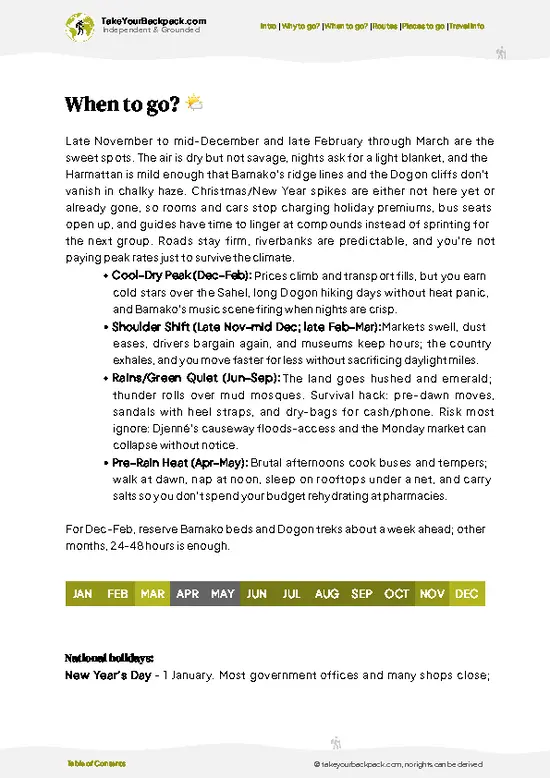
  • Topic: Weather — The Sikasso Region basks in a tropical savanna climate. The rainy season runs from May to October, turning the landscape lush but making dirt roads a mudslide nightmare. Dry season, November to April, is your golden window for hassle-free trekking and village visits.

  • Topic: Temperature — Expect highs around 30-35°C (86-95°F) during the dry season, cooling off at night to a comfortable 18-22°C (64-72°F). The rainy months bring slightly cooler days but sticky humidity that can sap your energy fast.

  • Topic: Daylight Hours — Near the equator, daylight stays steady year-round, roughly 12 hours. Sunrise around 6:30 AM, sunset near 6:30 PM, giving you a reliable rhythm to plan your hikes and market visits.

  • Topic: Crowds — Sikasso isn’t exactly overrun, but the dry season
read more 👉

  • Topic: Weather — The Sikasso Region basks in a tropical savanna climate. The rainy season runs from May to October, turning the landscape lush but making dirt roads a mudslide nightmare. Dry season, November to April, is your golden window for hassle-free trekking and village visits.

  • Topic: Temperature — Expect highs around 30-35°C (86-95°F) during the dry season, cooling off at night to a comfortable 18-22°C (64-72°F). The rainy months bring slightly cooler days but sticky humidity that can sap your energy fast.

  • Topic: Daylight Hours — Near the equator, daylight stays steady year-round, roughly 12 hours. Sunrise around 6:30 AM, sunset near 6:30 PM, giving you a reliable rhythm to plan your hikes and market visits.

  • Topic: Crowds — Sikasso isn’t exactly overrun, but the dry season draws more travelers and local festivals. If you want to dodge the few tourists and enjoy a quieter vibe, aim for shoulder months like November or April.

  • Topic: Seasonal Activities — The dry season hosts traditional ceremonies and open-air markets in full swing. The rainy season is quieter but perfect for birdwatching and seeing the countryside in full bloom if you don’t mind the mud.

  • Topic: Price Fluctuations — Prices for lodging and guides spike during the dry season’s peak (December to February). Booking early or traveling in shoulder months can save you a tidy sum without sacrificing comfort.


Pro-tip: Arrive just as the rains end in November—roads clear, crowds thin, and the land is still green. It’s the sweet spot for savvy backpackers who want the best of both worlds.


source: climatestotravel.comJANJanuary: highly recommended for travelingFEBFebruary: highly recommended for travelingMARMarch: highly recommended for travelingAPRApril: highly recommended for travelingMAYMay: fair for travelingJUNJune: fair for travelingJULJuly: fair for travelingAUGAugust: fair for travelingSEPSeptember: fair for travelingOCTOctober: fair for travelingNOVNovember: excellent for travelingDECDecember: highly recommended for traveling
when-to-go

✈️ The backpacker research shortcutMali Travel Guide

An offline-friendly backpacking guide with optimized travel routes, ranked highlights, transport advice, and the best areas to stay.
example page 0 from our offline Travel Guide for Mali
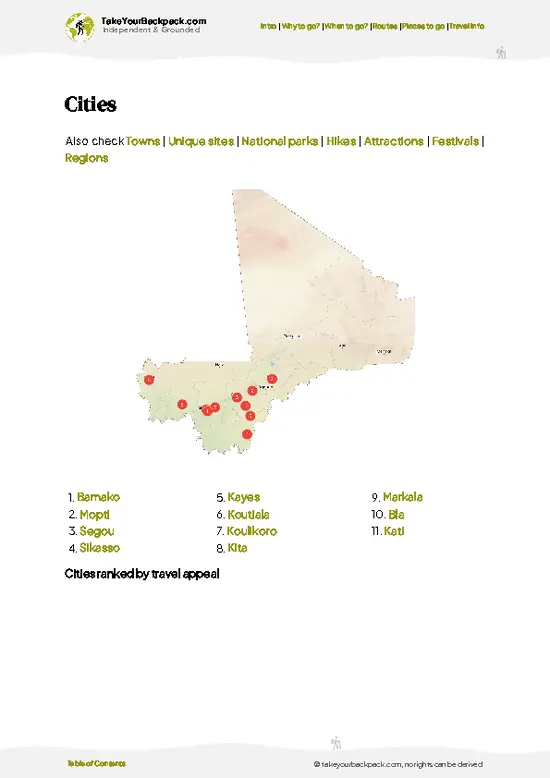
example page 1 from our offline Travel Guide for Mali
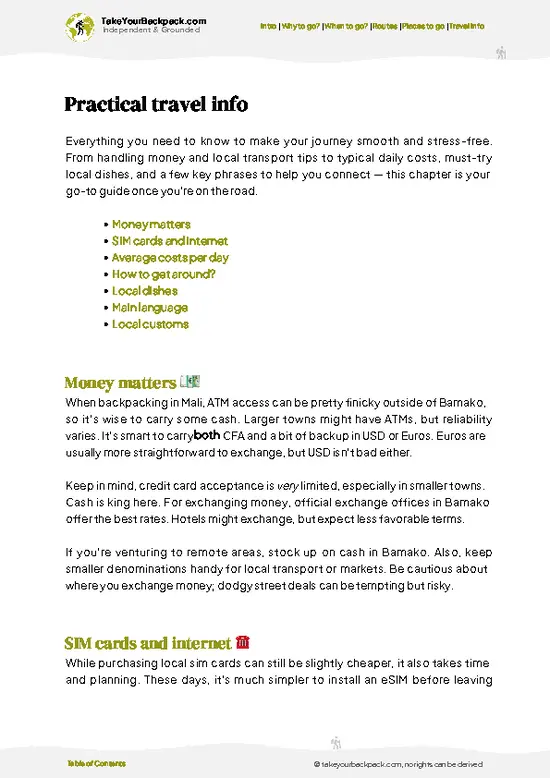
example page 2 from our offline Travel Guide for Mali
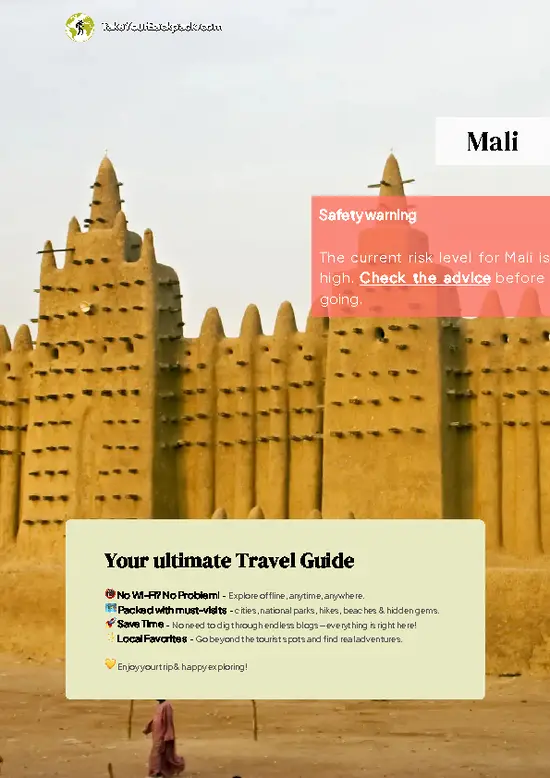
example page 3 from our offline Travel Guide for Mali
example page 4 from our offline Travel Guide for Mali
example page 5 from our offline Travel Guide for Mali
example page 6 from our offline Travel Guide for Mali
example page 7 from our offline Travel Guide for Mali
The digital guide (321 pages) contains:
76 highlights, ranked by travel appeal
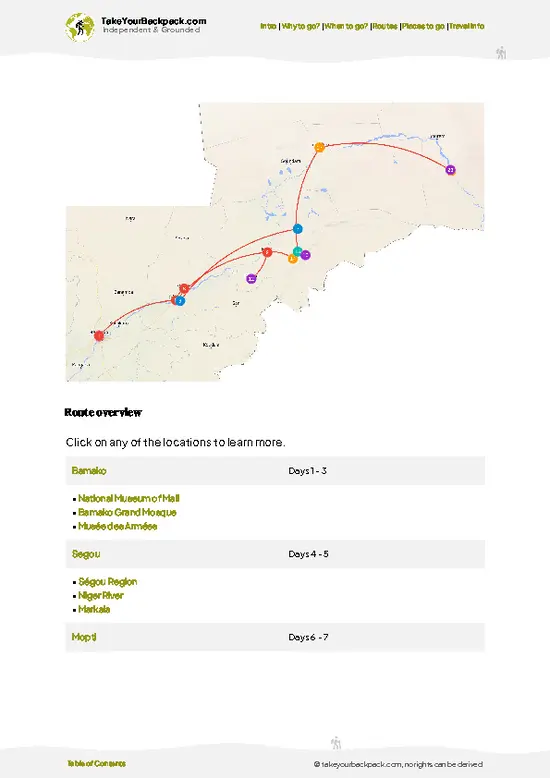
Optimized 5, 10 & 15-day travel routes
Cities, national parks, landmarks, beaches
How to get around
Offline-friendly for travel without Wi-Fi
👉 Click to see all 30+ guide features

📅 Plan smarter in minutes, not weeks
Month by month travel advice
Festivals & national holidays
Budget expectations

🗺️ Go to the right places, skip the overrated ones
Honest pros & cons of destinations
Top hikes, parks & viewpoints
Lesser-known places most travelers miss
Clear “worth it vs skip it” guidance

🛏️ Travel smoothly without rookie mistakes
Best areas to stay
Transport systems explained simply
Common scams & safety advice
SIM cards, money & practical tips

🌍 Understand the country, not just visit it
Culture & traditions
52 Essential phrases & customs
Festivals worth planning around
Traveler-friendly historical context
Insights that make places more meaningful

📱 Built for real travel conditions
Fully downloadable PDF
Works completely offline
Optimized for phone use
Useful in remote areas & buses
Everything in one place
Save weeks of stressful planning
Get instant access to your full guide. 30‑day money-back guarantee.


By proceeding you agree to our terms.
Sent to your inbox immediately after payment • 100% Secure Checkout
Best Backpacking Travel Advisor 2025 tourism awardBest Backpacking
Travel Advisor
2025
What others say about Take Your Backpack Guides:
⭐⭐⭐⭐⭐
Fantastic, amazing amount of information!
⭐⭐⭐⭐⭐
My goodness this is amazing, it's what I've been looking for hats off too you!
⭐⭐⭐⭐⭐
I think this is absolutely BRILLIANT
⭐⭐⭐⭐
Very complete and informative. It's still missing places, but I gotta to commend you
⭐⭐⭐⭐⭐
This is truly amazing, thank you, can't wait to explore it with my kids!
⭐⭐⭐⭐⭐
Awesome resource, thank you!
⭐⭐⭐⭐⭐
This is amazing! Can't wait to explore the ones I haven't seen
⭐⭐⭐⭐
I love this! Well done, great idea.
⭐⭐⭐⭐⭐
Thanks for taking the time to make this gem!
⭐⭐⭐⭐⭐
This might be the best website I've ever seen.
⭐⭐⭐⭐⭐
Congratulations, and thank you so much for your work; it's incredibly valuable.
⭐⭐⭐⭐
In all seriousness I think you did a great job pointing out the important spots
⭐⭐⭐⭐⭐
10/10 very good
⭐⭐⭐⭐⭐
As someone who's only just starting to visit regularly this is awesome, thank you.
⭐⭐⭐⭐
Thank you very much! I'm going to visit my dad, it's going to be very useful!
⭐⭐⭐⭐⭐
This is really cool! We'll be travelling for the first time and this definitely come in handy.
⭐⭐⭐⭐⭐
You are now our minister of culture, congratulations 👨‍💼
⭐⭐⭐⭐⭐
Just wanted to tell you that this is a pearl! Going to follow your recommendations.
⭐⭐⭐⭐⭐
This is so cool. I'll definitely be using the resource for my travels soon.
⭐⭐⭐⭐⭐
This is very impressive! Good work.
⭐⭐⭐⭐⭐
This is an amazing and informative site. Very well done!

🛏️ Where to stay?How to pick the right area

In the Sikasso Region of Mali, you’ll find a few standout spots that cater to backpackers looking for safety, social vibes, and budget-friendly options.

Start with Sikasso, the regional capital. It’s a bustling hub where you can mingle with locals and fellow travelers. The market scene is alive with colors and sounds, perfect for snagging some street food or local crafts. The energy here is contagious, and you’ll find plenty of cafes to kick back and swap stories with other backpackers.

Next up is Koutiala, known for its friendly atmosphere. This town is a bit quieter but offers a genuine glimpse … read more 👉
In the Sikasso Region of Mali, you’ll find a few standout spots that cater to backpackers looking for safety, social vibes, and budget-friendly options.

Start with Sikasso, the regional capital. It’s a bustling hub where you can mingle with locals and fellow travelers. The market scene is alive with colors and sounds, perfect for snagging some street food or local crafts. The energy here is contagious, and you’ll find plenty of cafes to kick back and swap stories with other backpackers.

Next up is Koutiala, known for its friendly atmosphere. This town is a bit quieter but offers a genuine glimpse into Malian life. The local music scene is vibrant, and you might catch a live performance in the evenings. It’s a great place to connect with locals who are eager to share their culture.

Don’t overlook Yanfolila, a small village that’s a bit off the beaten path. It’s a perfect spot for those who want to escape the hustle. The scenery is stunning, and you can easily explore nearby waterfalls or hike in the surrounding hills.

Each of these places offers a unique flavor of Mali, ensuring you soak up the culture while keeping your budget intact. Choose wisely, and you’ll walk away with stories that last a lifetime.

🚌 Getting aroundHow to get from A to B

The Sikasso Region of Mali pulses with a rhythm that’s anything but predictable. Here, transport is a dance between chaos and intuition. Schedules? They’re more like suggestions, often bending to the whims of the day. You’ll find yourself navigating a vibrant tapestry of bustling markets, where the air is thick with the scent of spices and the sounds of bartering. The locals move with a fluidity that suggests they know the unspoken rules of the road. Whether you’re hopping on a shared taxi or waiting for a bush taxi to fill up, patience is your best ally. Embrace the flow, and you’ll find that the journey is as enriching as the destination.


  • Shared Taxis: These are your go-to for quick hops between towns. Expect to pay around 1,500 to 3,000 CFA, depending on distance. They usually run from
read more 👉
The Sikasso Region of Mali pulses with a rhythm that’s anything but predictable. Here, transport is a dance between chaos and intuition. Schedules? They’re more like suggestions, often bending to the whims of the day. You’ll find yourself navigating a vibrant tapestry of bustling markets, where the air is thick with the scent of spices and the sounds of bartering. The locals move with a fluidity that suggests they know the unspoken rules of the road. Whether you’re hopping on a shared taxi or waiting for a bush taxi to fill up, patience is your best ally. Embrace the flow, and you’ll find that the journey is as enriching as the destination.


  • Shared Taxis: These are your go-to for quick hops between towns. Expect to pay around 1,500 to 3,000 CFA, depending on distance. They usually run from early morning until late afternoon, but don’t be surprised if they leave when full, which can be a bit of a waiting game. Comfort varies, but you’ll often find a lively atmosphere inside.


  • Bush Taxis: For longer distances, bush taxis are essential. Prices range from 2,500 to 5,000 CFA, and they can take you to places like Sikasso or Bougouni. They typically leave when full, which can mean a wait, but the ride is often an adventure in itself, with locals sharing stories and snacks. Expect a few hours of travel, and don’t forget to bring water!


  • Motorbike Taxis (Zemidjans): If you’re feeling adventurous, hop on a zemidjan for short trips within towns. Prices are negotiable, usually around 500 to 1,000 CFA. They’re fast and can weave through traffic, but comfort is minimal. Just hold on tight and enjoy the breeze!


  • Buses: Larger buses connect major cities and are a budget-friendly option. Fares can be as low as 1,000 CFA, but they’re slower and less frequent. They often leave in the morning, so plan ahead. The trade-off here is comfort for cost, as you might be sharing space with cargo.


For efficient travel, always ask locals about the best times to catch transport. They know the ins and outs better than any schedule. If you can, travel early in the day to avoid the heat and snag the best seats. Embrace the unpredictability, and you’ll find the journey becomes part of the adventure.

🍲 FoodWhat to Eat & Drink

In the Sikasso Region, food is a celebration of flavors and community. Dive into fufu, a starchy staple made from cassava or yam, often served with a rich sauce that bursts with spices. Don’t miss jollof rice, a vibrant one-pot dish that’s a party on your plate, with tomatoes, onions, and a hint of chili. Pair it with grilled fish or chicken, marinated in local spices that dance on your palate.

Street food is where the magic happens. Stroll through bustling markets and let the aroma of baked goods and fried snacks guide you. Try bofrot, a sweet doughnut-like treat, or akara, savory bean cakes that are crispy on the outside and fluffy inside. Grab a bottle of bissap, a refreshing hibiscus drink that’s both tart and sweet, perfect for cooling down after a day of exploration.

Dining here is … read more 👉
In the Sikasso Region, food is a celebration of flavors and community. Dive into fufu, a starchy staple made from cassava or yam, often served with a rich sauce that bursts with spices. Don’t miss jollof rice, a vibrant one-pot dish that’s a party on your plate, with tomatoes, onions, and a hint of chili. Pair it with grilled fish or chicken, marinated in local spices that dance on your palate.

Street food is where the magic happens. Stroll through bustling markets and let the aroma of baked goods and fried snacks guide you. Try bofrot, a sweet doughnut-like treat, or akara, savory bean cakes that are crispy on the outside and fluffy inside. Grab a bottle of bissap, a refreshing hibiscus drink that’s both tart and sweet, perfect for cooling down after a day of exploration.

Dining here is communal. Expect to share dishes, so don’t be shy about passing the fufu. It’s customary to eat with your hands, using the bread or fufu to scoop up sauces. Just remember to wash your hands before digging in; it’s a sign of respect. Embrace the local vibe, and you’ll feel like a true insider, savoring every bite of this rich culinary tapestry.

Other Malian regions near Sikasso Region

Explore more nearby:

  • Ségou Region—colonial-era buildings, pottery workshops, wide boulevards, annual music festival| 305 km away
  • Cliff of Bandiagara (Land of the Dogons)—sandstone escarpment, Dogon villages, ancient granaries, masked dances| 581 km away
  • Niger River—bustling river ports, seasonal floodplains, fishing communities, pirogue journeys| 635 km away

💡 Not sure where to go next?
Create a personalized itinerary for Mali including Sikasso Region and the places that fit your trip.

Generate my itinerary

👉 Discover all regions

Or checkout all Mali has to offer (think cities, towns, villages, national parks, hikes, beaches, festivals)
Country photo of Mali

We 💚 feedbackKey takeaways before you go

Sikasso has a pulse that’s hard to ignore. The vibrant markets are a sensory overload—spices, textiles, and laughter blend into a beautiful chaos. Don’t miss the early morning at the local café; that’s when the real conversations happen. A heads-up: the roads can be rough, so don’t rush your journey. Embrace the delays; they often lead to the best stories. Trust me, the warmth of the people here will make every bump worth it.

✍️ Help improve this page!
The information on this page is based on in-depth research, insights shared by experienced travelers, and feedback from the local travel community in Mali. While every effort is made to keep the information accurate and current, conditions can change — so if you spot anything incorrect or outdated, please get in touch.


🙋‍♂️ Give feedback

👋 Meet the founderWho’s Behind Take Your Backpack?

Johan, backpacker and founder of TakeYourBackpackHi, I’m Johan (Netherlands 🇳🇱), the creator of TakeYourBackpack. Over the past decade, I’ve backpacked through 80+ countries across six continents, gaining extensive experience with independent travel, long-term trips, and overland routes.

This site is built on a combination of firsthand travel experience and carefully curated insights from other backpackers. Many guides are based on places I’ve personally visited, while others bring together tips, observations, and practical advice shared by trusted travelers I’ve met along the way.

The goal is to provide realistic, experience-driven guidance — not generic itineraries — so you can explore destinations with better context, clearer expectations, and more confidence.

Get full Mali guide •
Instant download • 76 highlights • Full Offline guide